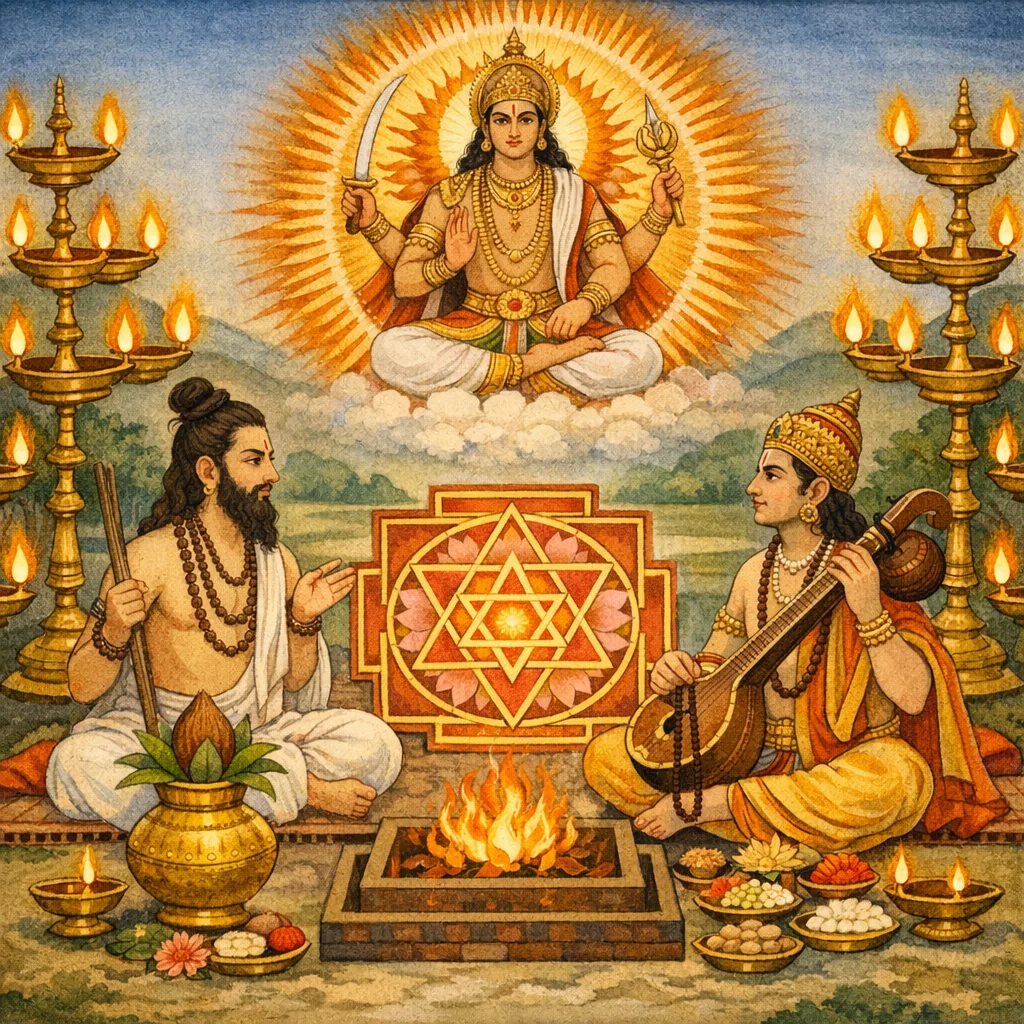
Mantra-Māhātmya and Sādhana of Kārtavīryārjuna (Nyāsa, Yantra, Homa, and Dīpa-Vrata)
Nārada notes that kings rise and fall by karma and asks why Kārtavīryārjuna is uniquely served by the world. Sanatkumāra replies that he is an incarnation of the Sudarśana-cakra who worshipped Dattātreya and gained supreme tejas; mere remembrance grants victory and recovery of losses. The chapter then discloses formerly hidden tantra procedures: detailed nyāsa/kavaca placements, mantra testing, and viniyoga (ṛṣi Dattātreya, Anuṣṭubh metre, devatā Kārtavīryārjuna, bīja/śakti Dhruva), with body-mapping and meditation iconography. It lays out practice rules—japa counts, homa proportions and offerings, hexagram/triangle diagram elements, worship of eight śaktis, and a full yantra design with kumbha-abhiṣeka benefits and protective village use. Next come result-specific homa materials (uccāṭana, vaśya, śānti, stambhana, prosperity, anti-theft) and oblation-count regulations, followed by a catalog of mantra families and metres with cautions on Gāyatrī phrasing and night recitation. It culminates in an extensive dīpa-vrata detailing auspicious months/tithis/nakṣatras/yogas, lamp-vessel measures, wick counts, setup, saṅkalpa-mantra, omens, conduct restrictions, guru authorization, and completion by feeding brāhmaṇas and giving dakṣiṇā, ending with the colophon.
Shlokas
Verse 1
नारद उवाच । कार्तवीर्यतप्रभृतयो नृपा बहुविधा भुवि । जायंतेऽथ प्रलीयंते स्वस्वकर्मानुसारतः ॥ १ ॥
Narada said: On the earth, many kinds of kings—beginning with Kartavīrya and others—are born and then pass away, each in accordance with his own karma.
Verse 2
तत्कथं राजवर्योऽसौ लोकेसेव्यत्वमागतः । समुल्लंघ्य नृपानन्यानेतन्मे नुद संशयम् ॥ २ ॥
How, then, did that foremost of kings become worthy of being served by the world—surpassing all other rulers? Dispel this doubt of mine.
Verse 3
सनत्कुमार उवाच । श्रृणु नारद वक्ष्यामि संदेहविनिवृत्तये । यथा सेव्यत्वमापन्नः कार्तवीर्यार्जुनो भुवि ॥ ३ ॥
Sanatkumāra said: Listen, O Nārada; to remove your doubt I shall explain how Kārtavīrya Arjuna came to be revered and served upon the earth.
Verse 4
यः सुदर्शनचक्रस्यावतारः पृथिवीतले । दत्तात्रेयं समाराध्य लब्धवांस्तेज उत्तमम् ॥ ४ ॥
He, the incarnation of the Sudarśana Cakra upon the earth, having duly worshipped Dattātreya, attained the highest tejas, the supreme spiritual radiance.
Verse 5
तस्य क्षितीश्वरेंद्रस्य स्मरणादेव नारद । शत्रूञ्जयति संग्रामे नष्टं प्राप्नोति सत्वरम् ॥ ५ ॥
O Nārada, by mere remembrance of that sovereign lord of the earth, one conquers enemies in battle and swiftly recovers what has been lost.
Verse 6
तेनास्य मंत्रपूजादि सर्वतंत्रेषु गोपितम् । तुभ्यं प्रकाशयिष्येऽहं सर्वसिद्धिप्रदायकम् ॥ ६ ॥
Therefore, the procedures of mantra-recitation, worship, and related rites concerning this have been kept concealed in all Tantras; but to you I shall reveal them, for they bestow every accomplishment (siddhi).
Verse 7
वह्नितारयुता रौद्री लक्ष्मीरग्नींदुशांतियुक् । वेधाधरेन्दुशांत्याढ्यो निद्रयाशाग्नि बिंदुयुक् ॥ ७ ॥
Raudrī is joined with Fire and Tārā; Lakṣmī is endowed with the pacifying influence of Fire and Moon. Vedhā is enriched with the pacifying influence of the sustaining Moon; and Nidrā is joined with Āśā, Fire, and the Bindu (nasal point).
Verse 8
पाशो मायांकुशं पद्मावर्मास्त्रे कार्तवीपदम् । रेफोवा द्यासनोऽनन्तो वह्निजौ कर्णसंस्थितौ ॥ ८ ॥
In this nyāsa/kavaca arrangement, place the pāśa (noose) and the māyā-aṅkuśa (goad of Māyā), the padma (lotus), the varma (armour) and the astra (mantric missile), and the word «kārtavī»; the letter «ra» (repha) or the syllable «vā», «dyāsana», «ananta», and the two syllables of Agni are to be stationed at the ears.
Verse 9
मेषः सदीर्घः पवनो मनुरुक्तो हृदंतिमः । ऊनर्विशतिवर्णोऽयं तारादिर्नखवर्णकः ॥ ९ ॥
«Meṣa» (Aries) is described as “with a long measure”; it is “pavana” (wind-like) and is said to be “uttered by Manu”, ending with “hṛd”. This series is of fewer than twenty letters/syllables; it begins with “tārā” and is marked by the “nakha” class of letters (terminal-sign group).
Verse 10
दत्तात्रेयो मुनिश्चास्यच्छन्दोऽनुष्टुबुदाहृतम् । कार्तवीर्यार्जुनो देवो बीजशक्तिर्ध्रुवश्च हृत् ॥ १० ॥
For this mantra/vidyā, the seer (ṛṣi) is the sage Dattātreya, and its metre is declared to be Anuṣṭubh. The presiding deity is Kārtavīryārjuna; the bīja (seed) and the śakti (power) are Dhruva; and the hṛt (heart) is the locus for nyāsa and meditation.
Verse 11
शेषाढ्यबीजयुग्मेन हृदयं विन्यसेदधः । शांतियुक्तचतुर्थेन कामाद्येन शिरोंऽगकम् ॥ ११ ॥
With the pair of seed-syllables (bīja) endowed with the power of Śeṣa, one should place them below as hṛdaya-nyāsa (the heart placement). And with the fourth seed-syllable joined with “śānti”, from the series beginning with “kāma…”, one should place it upon the head as aṅga-nyāsa (the limb placement).
Verse 12
इन्द्वाढ्यं वामकर्णाद्यमाययोर्वीशयुक्तया । शिखामंकुशपद्माभ्यां सवाग्भ्यां वर्म विन्यसेत् ॥ १२ ॥
He should arrange the varma/kavaca (protective armour) by placing the syllables beginning at the left ear—endowed with the indu (lunar) element—and, with the Māyā-syllables joined to the number twenty (vīśa), he should perform nyāsa upon the śikhā (topknot), the aṅkuśa (goad), and the padma (lotus), together with the syllables of vāk (sacred speech).
Verse 13
वर्मास्त्राभ्यामस्त्रमुक्तं शेषार्णैर्व्यापकं पुनः । हृदये जठरे नाभौ जठरे गुह्यदेशतः ॥ १३ ॥
Having thus discharged the Astra (weapon-mantra) together with the Varma (armour-mantra), one should again perform the all-pervading protective nyāsa with the remaining syllables—placing them in the heart, in the belly, at the navel, again in the belly, and in the secret region below.
Verse 14
दक्षपादे वामपादे सक्थ्नि जानुनि जंघयोः । विन्यसेद्बीजदशकं प्रणवद्वयमध्यगम् ॥ १४ ॥
On the right foot and the left foot, on the thigh, on the knee, and on the shanks, one should perform nyāsa of the ten seed-syllables, set between two utterances of the praṇava (Oṁ).
Verse 15
ताराद्यानथ शेषार्णान्मस्तके च ललाटके । भ्रुवोः श्रुत्योस्तथैवाक्ष्णोर्नसि वक्त्रे गलेंऽसके ॥ १५ ॥
Then, beginning with the syllable “tārā” and thereafter the remaining syllables, one should place them upon the head and the forehead; likewise upon the eyebrows, the ears, the eyes, the nose, the face, and upon the throat and the shoulder-region.
Verse 16
सर्वमन्त्रेण सर्वांगे कृत्वा व्यापकमादृतः । सर्वेष्टसिद्धये ध्यायेत्कार्तवीर्यं जनेश्वरम् ॥ १६ ॥
Having reverently pervaded the entire body with the “universal mantra”, one should meditate on Kārtavīrya, the lord among men, for the attainment of all desired accomplishments.
Verse 17
उद्यद्रर्कसहस्राभं सर्वभूपतिवन्दितम् । दोर्भिः पञ्चाशता दक्षैर्बाणान्वामैर्धनूंषि च ॥ १७ ॥
Blazing like a thousand rising suns and revered by all kings, he bore fifty skilled arms—holding arrows in the right hands and bows in the left.
Verse 18
दधतं स्वर्णमालाढ्यं रक्तवस्त्रसमावृतम् । चक्रावतारं श्रीविष्णोर्ध्यायेदर्जुनभूपतिम् ॥ १८ ॥
One should meditate upon King Arjuna as the very embodiment of Śrī Viṣṇu’s Cakra‑avatāra—adorned with a splendid golden garland and clad in red garments.
Verse 19
लक्षमेकं जपेन्मन्त्रं दशांशं जुहुयात्तिलैः । सतण्डुलैः पायसेन विष्णुपीठे यजत्तुतम् ॥ १९ ॥
One should recite the mantra one lakh times; then offer a tenth part as oblations into the sacred fire with sesame, together with rice‑grains and pāyasa (rice‑pudding), and duly perform worship at Viṣṇu’s holy seat, the Viṣṇu‑pīṭha.
Verse 20
षट्कोणेषु षडंगानि ततो दिक्षु विविक्षु च । चौरमदविभञ्जनं मारीमदविभंजनम् ॥ २० ॥
Within the six triangles (of the hexagram), place the six auxiliaries (ṣaḍaṅga); then, in the cardinal and intermediate directions, inscribe the formulae that shatter the pride of thieves and that shatter the pride of Māri (pestilence/disease).
Verse 21
अरिमदविभंजनं दैत्यमदविभंजनम् । दुष्टनाशं दुःखनाशं दुरितापद्विनाशकम् ॥ २१ ॥
He who shatters the pride of enemies and breaks the arrogance of the daityas; the destroyer of the wicked, the remover of sorrow, and the annihilator of misfortunes and calamities.
Verse 22
दिक्ष्वष्टशक्तयः पूज्याः प्राच्यादिष्वसितप्रभाः । क्षेमंकरी वश्यकरी श्रीकरी च यशस्करी ॥ २२ ॥
In the quarters, the eight Śaktis should be worshipped—dark‑radiant in the eastern and other quarters—namely: Kṣemaṅkarī (she who grants welfare), Vaśyakarī (she who brings others under influence), Śrīkarī (she who bestows prosperity), and Yaśaskarī (she who grants fame).
Verse 23
आयुः करी तथा प्रज्ञाकरी विद्याकरी पुनः । धनकर्यष्टमी पश्चाल्लोकेशा अस्त्रसंयुताः ॥ २३ ॥
It bestows long life; it bestows intelligence as well, and again it bestows learning. Thereafter, the Aṣṭamī observance brings wealth; and the Lokapālas, lords of the worlds, are endowed with their weapons.
Verse 24
एवं संसाधितो मंत्रः प्रयोगार्हः प्रजायते । कार्तवीर्यार्जुनस्याथ पूजायंत्रमिहोच्यते ॥ २४ ॥
Thus, when the mantra has been properly accomplished through disciplined practice, it becomes fit for practical application. Now, the worship-diagram (pūjā-yantra) of Kārtavīryārjuna is described here.
Verse 25
स्वबीजानंगध्रुववाक्कर्णिकं दिग्दलं लिखेत् । तारादिवर्मांतदलं शेषवर्णदलांतरम् ॥ २५ ॥
One should inscribe the central pericarp (karṇikā) with one’s own seed-syllable (bīja), together with the aṅga-mantras, the fixed (dhruva) formula, and the vāk (speech) mantra; then draw the petals corresponding to the directions. On the petals, write the series beginning with Tārā and ending with Varma; and in the spaces between the petals, write the remaining syllables.
Verse 26
ऊष्मान्त्यस्वरकिंजल्कं शेषार्णैः परिवेष्टितम् । कोणालंकृतभूतार्णभूगृहं यन्त्रमीशितुः ॥ २६ ॥
The Lord’s yantra is to have, at its center, the “pollen” formed from the vowels ending in the ūṣman letters, and it is to be encircled by the remaining syllables; its corners are to be ornamented with the bhūta-syllables, and it is to be set within a bhūgṛha (earth-square enclosure).
Verse 27
शुद्धभूमावष्टगन्धैर्लिखित्वा यन्त्रमादरात् । तत्र कुंभं प्रतिष्ठाप्य तत्रावाह्यार्चयेन्नृपम् ॥ २७ ॥
On purified ground, one should carefully draw the yantra using the eight fragrant substances (aṣṭa-gandha). Then, placing a consecrated water-pot (kumbha) upon it, one should invoke the deity there and worship Him with due rites.
Verse 28
स्पृष्ट्वा कुंभं जपेन्मन्त्रं सहस्रं विजितेंद्रियः । अभिषिं चेत्तदंभोभिः प्रियं सर्वेष्टसिद्धये ॥ २८ ॥
Having touched the kumbha (water-pot), the self-controlled practitioner should recite the mantra a thousand times; then, with that very water, he should perform abhiṣeka (ritual sprinkling/bathing) for the beloved Deity, for the accomplishment of all desired aims.
Verse 29
पुत्रान्यशो रोगनाशमायुः स्वजनरंजनम् । वाक्सिद्धिं सुदृशः कुम्भाभिषिक्तो लभते नरः ॥ २९ ॥
A man who undergoes the kumbha-abhiṣeka (consecration with a sanctified water-pot) obtains sons, fame, the destruction of disease, long life, the affection of his own people, mastery of speech (vāk-siddhi), and a pleasing appearance.
Verse 30
शत्रूपद्रव आपन्ने ग्रामे वा पुटभेदने । संस्थापंयेदिदं यन्त्रं शत्रुभीतिनिवृत्तये ॥ ३० ॥
When a village is afflicted by enemy harassment—or when a protective enclosure (puṭa) is breached—one should install this yantra in order to remove the fear of enemies.
Verse 31
सर्षपारिष्टलशुनकार्पासैर्मार्यते रिपुः । धत्तूरैः स्तभ्यते निम्बैर्द्वेष्यते वश्यतेंऽबुजैः ॥ ३१ ॥
By means of mustard (sarsapa), ariṣṭa, garlic, and cotton the enemy is struck down; with dhattūra he is immobilized; with neem he is made hateful; and with lotuses he is brought under control.
Verse 32
उच्चाटने विभीतस्य समिद्भिः खदिरस्य च । कटुतैलमहिष्याज्यैर्होमद्रव्यांजनं स्मृतम् ॥ ३२ ॥
For the rite of uccāṭana (driving away/dispelling), the kindling-sticks (samidh) of vibhītaka and also of khadira are prescribed; along with pungent oil and buffalo-ghee—these are remembered as the oblation-materials for the homa.
Verse 33
यवैर्हुते श्रियः प्राप्तिस्तिलैराज्यैरघक्षयः । तिलतंडुलसिद्धार्थजालैर्वश्यो नृपो भवेत् ॥ ३३ ॥
When oblations are offered with barley, the prosperity of Śrī (Lakṣmī) is attained; with sesame and ghee, sins are destroyed. By arranging sesame, rice, and white mustard (siddhārtha) in a ritual array, even a king may be brought under one’s influence.
Verse 34
अपामार्गार्कदूर्वाणां होमो लक्ष्मीप्रदोऽघनुत् । स्त्रीवश्यकृत्प्रियंगूणां मुराणां भूतशांतिदः ॥ ३४ ॥
A homa with apāmārga, arka, and dūrvā is said to bestow Lakṣmī’s prosperity and to destroy sin. A homa with priyangu is said to bring women under one’s influence; a homa with murā is said to pacify bhūtas (restless spirits).
Verse 35
अश्वत्थोदुंबरप्लक्षवटबिल्वसमुद्भवाः । समिधो लभते हुत्वा पुत्रानायुर्द्धनं सुखम् ॥ ३५ ॥
By offering into the sacred fire as fuel-sticks (samidh) those taken from the aśvattha, udumbara, plakṣa, vaṭa, and bilva trees, one gains sons, long life, wealth, and happiness.
Verse 36
निर्मोकहेमसिद्धार्थलवणैश्चौरनाशनम् । रोचनागोमयैस्तंभो भूप्राप्तिः शालिभिर्हुतैः ॥ ३६ ॥
By a rite employing a snake’s cast-off skin (nirmoka), gold, white mustard (siddhārtha), and salt, thieves are destroyed (that is, theft is warded off). With rocanā (yellow orpiment) and cow-dung there is the stambhana effect—immobilization. By offering rice-grains into the fire, one gains land.
Verse 37
होमसंख्या तु सर्वत्र सहस्रादयुतावधि । प्रकल्पनीया मन्त्रज्ञैः कार्य्यगौरवलाघवात् ॥ ३७ ॥
In every case, the number of oblations in a homa should be fixed—from one thousand up to ten thousand—by those expert in mantra, according to whether the intended rite is weighty (major) or light (minor).
Verse 38
कार्तवीर्य्यस्य मन्त्राणामुच्यते लक्षणं बुधाः । कार्तवीर्यार्जुनं ङेंतं सर्वमंत्रेषु योजयेत् ॥ ३८ ॥
O wise ones, the defining marks of Kārtavīrya’s mantras are now declared. In every mantra one should insert the marker-bīja “ṅeṃtaṃ” together with the name “Kārtavīryārjuna”.
Verse 39
स्वबीजाद्यो दशार्णोऽसौ अन्ये नवशिवाक्षराः । आद्यबीजद्वयेनासौ द्वितीयो मन्त्र ईरितः ॥ ३९ ॥
That mantra, beginning with its own seed-syllable, is a ten-syllabled formula (daśārṇa); the others are the nine-syllabled Śiva-letters. When prefixed with the first two seed-syllables, it is declared to be the second mantra.
Verse 40
स्वकामाभ्यां तृतीयोऽसौ स्वभ्रूभ्यां तु चतुर्थकः । स्वपाशाभ्यां पञ्चमोऽसौ षष्टः स्वेन च मायया ॥ ४० ॥
The third arises from His own desires; the fourth, from His own eyebrows. The fifth is from His own nooses (pāśa), and the sixth from His own māyā.
Verse 41
स्वांकुशाभ्यां सप्तमः स्यात्स्वरमाभ्यामथाष्टमः । स्ववाग्भवाभ्यां नवमो वर्मास्त्राभ्यामथांतिमः ॥ ४१ ॥
The seventh (nyāsa) is to be done with the pair of mantras “svā” and “aṅkuśa”; then the eighth with the pair “svara” and “mā”. The ninth is with the pair “vāg” and “bhava”; and the final one with the pair “varma” and “astra”.
Verse 42
द्वितीयादिनवांतेषु बीजयोः स्याद्व्यतिक्रमः । मंत्रे तु दशमे वर्णा नववर्मास्त्रमध्यगाः ॥ ४२ ॥
From the second through the ninth positions, the two bīja-syllables are to be placed in mutual interchange. But in the mantra’s tenth position, the letters are arranged so that the nine protective coverings (nava-varman) stand with the “astra” syllable set in the middle.
Verse 43
एतेषु मंत्रवर्येषु स्वानुकूलं मनुं भजेत् । एषामाद्ये विराट्छदोऽन्येषु त्रिष्टुबुदाहृतम् ॥ ४३ ॥
Among these most excellent mantras, one should adopt and worship the mantra that is favorable and suited to oneself. Of them, the first is said to be in the Virāṭ metre, while the others are declared to be in the Triṣṭubh metre.
Verse 44
दश मंत्रा इमे प्रोक्ता यदा स्युः प्रणवादिकाः । तदादिमः शिवार्णः स्यादन्ये तु द्वादशाक्षराः ॥ ४४ ॥
When these ten mantras are taught as beginning with the praṇava (Oṁ), then the first among them is the Śiva-syllable; the others, however, are of twelve syllables.
Verse 45
त्रिष्टुपूछन्दस्तथाद्ये स्यादन्येषु जगती मता । एवं विंशतिमंत्राणां यजनं पूर्ववन्मतम ॥ ४५ ॥
In the first mantra, the metre should be Triṣṭubh; in the remaining ones, Jagatī is prescribed. Thus, the ritual offering for these twenty mantras is to be performed in the same manner as previously stated.
Verse 46
दीर्घाढ्यमूलबीजेन कुर्यादेषां षडंगकम् । तारो हृत्कार्तवीर्यार्जुनाय वर्मास्त्रठद्वयम् ॥ ४६ ॥
With the ‘long’ root-seed syllable, one should perform the ṣaḍaṅga, the sixfold ancillary application, for these. Then, using the tāra—the praṇava (Oṁ)—one should, for Kārtavīrya Arjuna, apply in the heart the paired set: the armor (varma) and weapon (astra) mantras.
Verse 47
चतुर्दशार्णो मंत्रोऽयमस्येज्या पूर्ववन्मता । भूनेत्रसमनेत्राक्षिवर्णेरस्यांगपंचकम् ॥ ४७ ॥
This is a fourteen-syllabled mantra; its mode of worship is considered the same as previously described. Its five ancillary limbs (aṅga) are to be arranged with the syllables/letters characterized as “bhū”, “netra”, “sama”, “netra”, and “akṣi”.
Verse 48
तारो हृद्भगवान् ङेंतः कार्तवीर्यार्जुनस्तथा । वर्मास्त्राग्निप्रियामंत्रः प्रोक्तो ह्यष्टादशार्णकः ॥ ४८ ॥
“Tāra,” “Hṛd-bhagavān,” “Ṅeṃta,” and “Kārtavīryārjuna”—thus is proclaimed the “Varmāstra–Agni-priyā” mantra, consisting of eighteen syllables.
Verse 49
त्रिवेदसप्तयुग्माक्षिवर्णैः पंचांगकं मनोः । नमो भगवते श्रीति कार्तवीर्यार्जुनाय च ॥ ४९ ॥
Using the syllables denoted by the three Vedas and the seven pairs of “eyes” (specific letter-groups), one should form Manu’s five-limbed (pañcāṅga) mantra—“Namo Bhagavate Śrī”—and apply it also to Kārtavīryārjuna.
Verse 50
सर्वदुष्टांतकायेति तपोबलपराक्रमः । परिपालितसप्तांते द्वीपाय सर्वरापदम् ॥ ५० ॥
Mighty through the power of austerity, he was renowned as “the destroyer of all the wicked.” Having protected the world through the full cycle of the seven ages, he became the refuge for the entire dvīpa and for all beings.
Verse 51
जन्यचूडा मणांते ये महाशक्तिमते ततः । सहस्रदहनप्रांते वर्मास्त्रांतो महामनुः ॥ ५१ ॥
Then, for the greatly powerful one, there are formulae beginning with “Janyacūḍā” and ending with “Maṇānta”; and near the close of the section called “Sahasradahana” is the great mantra that concludes with “Varmāstra.”
Verse 52
त्रिषष्टिवर्णवान्प्रोक्तः स्मरमात्सर्वविघ्नहृत् । राजन्यक्रवर्ती च वीरः शूरस्तृतीयकः ॥ ५२ ॥
He is described as possessing sixty-three syllabic units; merely by being remembered, he removes all obstacles. He is also a cakravartin among the royal order—a heroic, valorous one, the third in sequence.
Verse 53
माहिष्मतीपतिः पश्चाञ्चतुर्थः समुदीरितः । रेवांबुपरितृप्तश्च काणो हस्तप्रबाधितः ॥ ५३ ॥
Thereafter, the lord of Māhiṣmatī is proclaimed as the fourth. He was satisfied by the waters of the Revā (Narmadā), and he was one-eyed, his hand being impaired.
Verse 54
दशास्येति च षड्भिः स्यात्पदैर्ङेतैः षडंगकम् । सिंच्यमानं युवतिभिः क्रीडंतं नर्मदाजले ॥ ५४ ॥
The expression beginning with “daśāsya-” is to be understood as a six-membered (ṣaḍaṅga) unit, made up of six well-known words. It portrays (the deity) sporting in the waters of the Narmadā, while young women playfully sprinkle him with water.
Verse 55
हस्तैर्जलौधं रुंधंतं ध्यायेन्मत्तं नृपोत्तमम् । एवं ध्यात्वायुतं मंत्रं पजेदन्यत्तु पूर्ववत् ॥ ५५ ॥
One should meditate on the excellent king, intoxicated with divine fervour, who with his hands holds back a rushing flood of water. Having thus meditated, one should repeat the mantra ten thousand times; the remaining procedure should be performed as stated earlier.
Verse 56
पूर्वं तु प्रजपेल्लक्षं पूजायोगश्च पूर्ववत् । कार्तवीर्यार्जुनो नाम राजा बाहुसहस्रवान् ॥ ५६ ॥
First, one should perform a lakh (one hundred thousand) repetitions (japa) of the mantra, and the method of worship should be as previously described. In this connection there was a king named Kārtavīrya Arjuna, possessed of a thousand arms.
Verse 57
तस्य संस्मरणादेव हृतं नष्टं च संवदेत् । लभ्यते मंत्रवर्योऽयं द्वात्रिंशद्वर्णसंयुतः ॥ ५७ ॥
By the mere recollection of it, what has been stolen or lost is spoken of—revealed and indicated. This excellent mantra is obtained, consisting of thirty-two syllables.
Verse 58
पादैः सर्वेण पंचांगं ध्यानपूजादि पूर्ववत् । कार्तवीर्याय शब्दांते विद्महे पदमुञ्चरेत् ॥ ५८ ॥
With all the pādas of the mantra, one should perform the fivefold observance—meditation, worship (pūjā), and the rest—exactly as taught before. At the close of the formula for Kārtavīrya, one should utter “vidmahe” and then recite the next pāda.
Verse 59
महावीर्याय वर्णांते धीमहीति पदं वदेत् । तन्नोऽर्जुनः प्रवर्णांते चोदयात्पदमीरयेत् ॥ ५९ ॥
At the end of the phrase “mahāvīryāya,” one should utter “dhīmahi.” Then, at the end of “tan no ’rjunaḥ,” one should recite “codayāt.”
Verse 60
गायत्र्येषार्जुन स्योक्ता प्रयोगादौ जपेत्तु ताम् । अनुष्टुभं मनुं रात्रौ जपतां चौरसंचयाः ॥ ६० ॥
O Arjuna, this Gāyatrī has been declared; it should be japa-recited at the beginning of a rite. But for those who recite the Anuṣṭubh mantra at night, there arises an accumulation of sin akin to theft.
Verse 61
पलायंते गृहाद्दूरं तर्पणाद्ध्रवनादपि । अथो दीपविधिं वक्ष्ये कार्तवीर्यप्रियंकरम् ॥ ६१ ॥
They flee far from the house, driven off even by the rites of tarpana (libations) and offerings. Now, therefore, I shall explain the procedure of the sacred lamp, pleasing and beneficial to Kārtavīrya.
Verse 62
वैशाखे श्रावणे मार्गे कार्तिकाश्विनपौषतः । माघफाल्गुनयोर्मासोर्दीपारंभं समाचरेत् ॥ ६२ ॥
One should duly begin the rite of offering lamps (dīpārambha) in the months of Vaiśākha, Śrāvaṇa, Mārgaśīrṣa, Kārtika, Āśvina, Pauṣa, Māgha, and Phālguna.
Verse 63
तिथौ रिक्ताविहीनायां वारे शनिकुजौ विना । हस्तोत्तराश्विरौद्रेयपुष्यवैष्णववायुभे ॥ ६३ ॥
One should choose a tithi (lunar day) that is not ‘Riktā’ (void and inauspicious). Likewise, one should choose a weekday excluding Saturday and Tuesday; and one should prefer the nakṣatras Hasta, Uttarāśvinī, Raudra, Puṣya, Vaiṣṇava, and Vāyu-bha.
Verse 64
द्विदैवते च रोहिण्यां दीपारंभो हितावहः । चरमे च व्यतीपाते धृतौ वृद्धौ सुकर्मणि ॥ ६४ ॥
Commencing the lighting (or installation) of a lamp is beneficial when the asterisms Dvidaivata and Rohiṇī prevail; likewise it is auspicious in the concluding phase of Vyatīpāta, and during the yogas Dhṛti, Vṛddhi, and Sukarman.
Verse 65
प्रीतौ हर्षं च सौभाग्ये शोभनायुष्मतोरपि । करणे विष्टिरहिते ग्रहणेऽर्द्धोदयादिषु ॥ ६५ ॥
In matters of prīti (affection), there is harṣa (joy); and for prosperity and good fortune, the kāraṇas Saubhāgya, Śobhana, and Āyuṣmān are also commended. For undertaking rites, one should choose a karaṇa free from Viṣṭi (Bhadrā), and likewise observe the rules regarding eclipses and special occasions such as Arddhodaya and the like.
Verse 66
योगेषु रात्रौ पूर्वाह्णे दीपारंभः कृतः शुभः । कार्तिके शुक्लसप्तम्यां निशीथेऽतीव शोभनः ॥ ६६ ॥
During auspicious yogas, commencing the lamp-offering at night or in the forenoon is highly auspicious. In the month of Kārttika, beginning it at midnight on the bright fortnight’s seventh lunar day (Śukla-saptamī) is especially splendid and meritorious.
Verse 67
यदि तत्र रवेर्वारः श्रवणं भं च दुर्लभम् । अत्यावश्यककार्येषु मासादीनां न शोधनम् ॥ ६७ ॥
If, on that occasion, Sunday (Ravi-vāra) and the Śravaṇa nakṣatra are difficult to obtain, then for works that are absolutely necessary there is no need to perform corrective scrutiny (śodhana) of the month and other calendrical factors.
Verse 68
आद्ये ह्युपोष्य नियतो ब्रह्मचारी सपीतकैः । प्रातः स्नात्वा शुद्धभूमौ लिप्तायां गोमयोदकैः ॥ ६८ ॥
On the first day, observing a disciplined fast, the practitioner—living as a brahmacārī and clad in yellow—should bathe at dawn and then prepare a purified spot of ground, smeared with a mixture of cow-dung and water.
Verse 69
प्राणानायम्य संकल्प्य न्यासान्पूर्वोदितांश्चरेत् । षट्कोणं रचयेद्भूमौ रक्तचंदनतंडुलैः ॥ ६९ ॥
Having regulated the breath through prāṇāyāma and formed the saṅkalpa (ritual resolve), one should perform the nyāsas as previously taught; then, upon the ground, one should draw the ṣaṭkoṇa (six-angled figure) with rice grains colored by red sandalwood.
Verse 70
अतः स्मरं समालिख्य षट्कोणेषु समालिखेत् । नवार्णैर्वेष्टयेत्तञ्च त्रिकोणं तद्बहिः पुनः ॥ ७० ॥
Thereupon one should first draw Smara (Kāma) and inscribe it within the ṣaṭkoṇa. Then one should encircle it with the nine-syllabled navārṇa-mantra, and again draw a triangle outside it.
Verse 71
एवं विलिखिते यन्त्रे निदध्याद्दीपभाजनम् । स्वर्णजं रजतोत्थं वा ताम्रजं तदभावतः ॥ ७१ ॥
When the yantra has thus been inscribed, one should place upon it a lamp-vessel—made of gold, or of silver; or, if those are unavailable, made of copper.
Verse 72
कांस्यपात्रं मृण्मयं च कनिष्ठं लोहजं मृतौ । शांतये मुद्गचूर्णोत्थं संधौ गोधूमचूर्णजम् ॥ ७२ ॥
A bronze vessel is best; a clay vessel is inferior; and in times of death-related impurity an iron vessel is prescribed. For śānti rites of pacification, offerings prepared from mung-bean flour should be used; and at the saṃdhi twilight junctions, offerings made from wheat flour are prescribed.
Verse 73
आज्ये पलसहस्रे तु पात्रं शतपलं स्मृतम् । आज्येऽयुतपले पात्रं पलपंचशता स्मृतम् ॥ ७३ ॥
For ghee (ājya) in the measure of one thousand palas, the prescribed vessel (pātra) is said to be one hundred palas. For ghee in the measure of ten thousand palas, the prescribed vessel is said to be five hundred palas.
Verse 74
पंचसप्ततिसंख्ये तु पात्रं षष्टिपलं स्मृतम् । त्रिसाहस्री घृतपले शर्करापलभाजनम् ॥ ७४ ॥
For the count of seventy-five, the vessel (pātra) is said to be sixty palas. And for ghee measuring three thousand palas, the container is reckoned by the pala-measure of sugar—i.e., the standard sugar-measure vessel is prescribed.
Verse 75
द्विसाहख्त्र्यां द्विशतमितं च भाजनमिष्यते । शतेऽक्षिचरसंश्यातमेवमन्यत्र कल्पयेत् ॥ ७५ ॥
For two thousand (units), a vessel of two hundred (units) is prescribed. For one hundred (units), it is reckoned as ‘akṣi-cara’; and in other cases too one should compute in the same manner.
Verse 76
नित्यदीपे वह्निपलं पात्रमाज्यं पलं स्मृतम् । एवं पात्रं प्रतिष्ठाप्य वर्तीः सूत्रोत्थिताः क्षिपेत् ॥ ७६ ॥
For the perpetual lamp (nitya-dīpa), the vessel should be one pala, and the ghee too is prescribed as one pala. Having thus set the vessel in its proper place, one should place within it the wicks (varti) made from thread.
Verse 77
एका तिस्रोऽथवा पंचसप्ताद्या विषमा अपि । तिथिमानादासहस्रं तंतुसंख्या विनिर्मिता ॥ ७७ ॥
Whether it be one, or three, or again an odd number beginning with five or seven—according to the measure of a tithi (lunar day), the count of threads (tantu-saṅkhyā) is determined as a thousand, and so on.
Verse 78
गोघृतं प्रक्षिपेत्तत्र शुद्धवस्त्रविशोधितम् । सहस्रपलसंख्यादिदशांशं कार्यगौरवात् ॥ ७८ ॥
There he should add cow’s ghee, purified by straining through a clean cloth—one-tenth in proportion to the measure, such as a thousand palas and the like, according to the heaviness and importance of the rite.
Verse 79
सुवर्णादिकृतां रम्यां शलाकां षोडशांगुलाम् । तदर्द्धां वा तदर्द्धां वा सूक्ष्माग्रां स्थूलमूलिकाम् ॥ ७९ ॥
One should use a pleasing śalākā (probe) made of gold or the like, sixteen finger-breadths in length—or else half of that (or half again)—with a fine, pointed tip and a thicker base.
Verse 80
विमुंचेद्दक्षिणे पात्रमध्ये चाग्रे कृताग्रिकाम् । पात्रदक्षिणदिग्देशे मुक्त्वां गुलचतुष्टयम् ॥ ८० ॥
One should place the tufted offering on the southern side—within the vessel, and also at its front. Then, having set the four lumps on the vessel’s southern side, the rite proceeds in due order.
Verse 81
अधोग्रां दक्षिणाधारां निखनेच्छुरिकां शुभाम् । दीपं प्रज्वालयेत्तत्र गणेशस्मृतिपूर्वकम् ॥ ८१ ॥
He should bury the auspicious knife with its point downward and its handle toward the south; and there, after first remembering Gaṇeśa, he should light a lamp.
Verse 82
दीपात्पूर्वत्र दिग्भागे सर्वतोभद्रमंडले । तंडुलाष्टदले वापि विधिवत्स्थापयेद्धूटम् ॥ ८२ ॥
To the east of the lamp, in the eastern quarter, within a sarvatobhadra ritual diagram—or else upon an eight-petalled design made of rice-grains—one should duly place the dhūṭa, as prescribed.
Verse 83
तत्रावाह्य नृपाधीशं पूजयेत्पूर्ववत्सुधीः । जलाक्षतान्समादाय दीपं संकल्पयेत्ततः ॥ ८३ ॥
There, having invoked the Lord of kings, the wise should worship Him as before. Then, taking rice-grains moistened with water (akṣata), one should make the sacred resolve (saṅkalpa) for the lamp.
Verse 84
दीपसंकल्पमंत्रोऽयं कथ्यते द्वीषुभूमितः । प्रणवः पाशमाये च शिखा कार्ताक्षराणि च ॥ ८४ ॥
This is declared to be the saṅkalpa-mantra for the ritual lamp, set out according to the ground-arrangement in the two directions: it includes the Praṇava (Oṁ), the syllables “pāśa” and “māyā,” as well as “śikhā” and the “kārta” letters.
Verse 85
वीर्यार्जुनाय माहिष्मतीनाथाय सहस्र च । बाहवे इति वर्णांते सहस्रपदमुच्चरेत् ॥ ८५ ॥
For Vīryārjuna, the lord of Māhiṣmatī, one should also utter the word “sahasra” (a thousand); and at the end of the syllables, one should recite the thousand-word formula ending with “bāhave”.
Verse 86
क्रतुदीक्षितहस्ताय दत्तात्रेयप्रियाय च । आत्रेयायानुसूयांते गर्भरत्नाय तत्परम् ॥ ८६ ॥
To him whose hands are consecrated for sacrificial rites, who is beloved of Dattātreya; to Ātreya—O Anusūyā—and to that jewel of the womb (the unborn child), may this be offered with full devotion (bhakti).
Verse 87
नमो ग्रीवामकर्णेंदुस्थितौ पाश इमं ततः । दीपं गृहाण अमुकं रक्ष रक्ष पदं पुनः ॥ ८७ ॥
Salutations! O Pāśa, the noose abiding at the neck—whose ear is adorned with the moon—thereafter accept this lamp from such-and-such a one; protect, protect again this place/this step.
Verse 88
दुष्टान्नाशययुग्मं स्यात्तथा पातय घातय । शत्रून् जहिद्वयं माया तारः स्वं बीजमात्मभूः ॥ ८८ ॥
The pair of words “Destroy the wicked” is of mantra-form; likewise “cause (them) to fall” and “strike down.” The twofold formula “slay the enemies” is taught; and “Māyā,” “Tāra,” “Sva,” and “Ātmabhū” are also seed-syllables (bīja-mantras).
Verse 89
वह्नीप्रिया अनेनाथ दीपवर्येण पश्चिमा । भिमुखेनामुकं रक्ष अमुकांते वरप्रद ॥ ८९ ॥
O beloved of Fire, by means of this excellent lamp—facing the western direction—protect such-and-such a person; O bestower of boons, grant fulfillment to such-and-such.
Verse 90
मायाकाशद्वयं वामनेत्रचंद्रयुतं शिवा । वेदादिकामचामुंडाः स्वाहा तु पूसबिंदुकौ ॥ ९० ॥
“Śivā” is joined with the twofold “māyā–ākāśa” and is associated with the Moon in the left eye. The powers named “Veda,” “Ādi,” “Kāma,” and “Cāmuṇḍā” are to be contemplated in their respective placements; and “Svāhā” is to be placed with the two bindus belonging to Pūṣan.
Verse 91
प्रणवोऽग्निप्रिया मंत्रो नेत्रबाणाधराक्षरः । दत्तात्रेयो मुनिर्मालामंत्रस्य परिकीर्तितः ॥ ९१ ॥
For the mālā-mantra (garland-mantra), the praṇava (Oṁ) is declared to be the mantra; Agni-priyā is its presiding power; the syllables are Netra, Bāṇa, and Ādhara; and the sage Dattātreya is proclaimed as its seer.
Verse 92
छन्दोऽमितं कार्तवीर्युर्जुनो देवोऽखिलाप्तिकृत् । चामुंडया षडंगानि चरेत्षड्दीर्घयुक्तया ॥ ९२ ॥
The Chandas (Vedic metres) are immeasurable; Kartavīrya Arjuna is a divine one who accomplishes all attainments. Along with Cāmuṇḍā, one should practice the six limbs (ṣaḍaṅga), endowed with six long, extended measures.
Verse 93
ध्यात्वा देवं ततो मंत्रं पठित्वांते क्षिपेज्जजलम् । गोविंदाढ्यो हली सेंदुश्चामुंडाबीजमीरितम् ॥ ९३ ॥
Having meditated upon the Deity, one should then recite the mantra; and at its conclusion one should sprinkle (or cast) water. It is said that the (mantra) is adorned with the name “Govinda,” includes “Halī,” is joined with “Indu,” and contains the seed-syllable (bīja) of Cāmuṇḍā.
Verse 94
ततो नवाक्षरं मंत्रं सहस्रं तत्पुरो जपेत् । तारोऽनंतो बिंदुयुक्तो मायास्वं वामनेत्रयुक् ॥ ९४ ॥
Then, in the proper sequence, one should repeat a thousand times the nine-syllabled mantra—formed from the Praṇava (Om), joined with “ananta,” together with the bindu, combined with “māyā,” and endowed with the “left-eye” mark.
Verse 95
कूर्माग्नी शांतिबिंद्वाढ्यौ वह्नि जायांकुशं ध्रुवम् । ऋषिः पूर्वोदितोनुष्टुप्छंदोऽन्यत्पूर्ववत्पुनः ॥ ९५ ॥
For the mantras “Kūrma-agni,” “Śānti-bindu-vāḍhya,” “Vahni,” “Jāyā-aṅkuśa,” and “Dhruva,” the seer (ṛṣi) is the same as stated earlier; the metre is Anuṣṭubh; and the remaining ritual assignments are again as previously described.
Verse 96
सहस्रं मंत्रराजं च जपित्वा कवचं पठेत् । एवं दीपप्रदानस्य कर्ताप्नोत्यखिलेऽप्सितम् ॥ ९६ ॥
Having recited the Mantra-rāja a thousand times, one should then chant the protective hymn (kavaca). Thus, the performer of the lamp-offering attains all desired results.
Verse 97
दीपप्रबोधकाले तु वर्जयेदशुभां गिरम् । विप्रस्य दर्शनं तत्र शुभदं परिकीर्तितम् ॥ ९७ ॥
At the time of lighting the lamp, one should avoid inauspicious speech. The sight of a brāhmaṇa at that moment is declared to be auspicious and bestowing good fortune.
Verse 98
शूद्राणां प्रध्यमं प्रोक्तं म्लेच्छस्य वधबन्धनम् । आख्वोत्वोर्दर्शनं दुष्टं गवाश्वस्य सुखावहम् ॥ ९८ ॥
It is taught that for Śūdras the foremost punishment is beating; for a mleccha it is execution or imprisonment. The sight of a camel and a horse is inauspicious, while the sight of cows and horses is said to bring well-being.
Verse 99
दीपज्वाला समा सिद्ध्यै वक्रा निशविधायिनी । शब्दा भयदा कर्तुरुज्ज्वला सुखदा मता ॥ ९९ ॥
A lamp-flame that is even and steady leads to success. A flame that bends or wavers portends misfortune. A crackling, noisy flame brings fear to the performer, but a bright and radiant flame is held to bestow happiness.
Verse 100
कृष्णा शत्रुभयोत्पत्त्ये वमंती पशुनाशिनी । कृते दीपे यदा पात्रं भग्नं दृश्यते दैवतः ॥ १०० ॥
A dark, inauspicious sign indicates fear arising from enemies; vomiting is a portent of loss of cattle. Likewise, when, after a lamp has been lit, its vessel is seen broken by fate, it too is regarded as an omen.
Verse 101
पक्षादर्वाक्तदा गच्छेद्यजमानो यमालयम् । वर्त्यतरं यदा कुर्यात्कार्यं सिद्ध्येद्विलंबतः ॥ १०१ ॥
If a rite is undertaken before the proper fortnight, the sacrificer (yajamāna) is said to go to Yama’s abode. But if he performs it at a later, more fitting time, the intended undertaking is accomplished—though with delay.
Verse 102
नेत्रहीनो भवेत्कर्ता तस्मिन्दीपांतरे कृते । अशुचिस्पर्शने व्याधिर्दीपनाशे तु चौरभीः ॥ १०२ ॥
If another lamp is lit from that ritual lamp, the performer is said to be deprived of sight. If an impure person touches it, illness results; and if the lamp is extinguished or destroyed, it portends danger from thieves.
Verse 103
श्वमार्जाराखुसंस्पर्शे भवेद्भूपतितो भयम् । पात्रारंभे वसुपलैः कृतो दीपोऽखिलेष्टदः ॥ १०३ ॥
If a dog, cat, or rat touches the ritual arrangement, it is said to bring fear of the king’s displeasure (or loss of royal favor). Yet a lamp prepared at the very beginning of the rite with cow’s ghee grants the fulfillment of all desired aims.
Verse 104
तस्माद्दीपः प्रयत्नेन रक्षणीयोंऽतरायतः । आसमाप्तेः प्रकुर्वीत ब्रह्मचर्यं च भूशयः ॥ १०४ ॥
Therefore the lamp should be diligently protected from all obstacles. Until the observance is completed, one should also practise brahmacarya—sleeping upon the ground.
Verse 105
स्त्रीशूद्रपतितादीनां संभाषामपि वर्जयेत् । जपेत्सहस्रं प्रत्येकं मंत्रराजं नवाक्षरम् ॥ १०५ ॥
One should avoid even conversation with women, Śūdras, the fallen, and the like; and for each observance one should recite a thousand repetitions of the nine-syllabled royal Mantra, the King of mantras.
Verse 106
स्तोत्रपाठं प्रतिदिनं निशीथिन्यां विशेषतः । एकपादेन दीपाग्रे स्थित्वा यो मंत्रनायकम् ॥ १०६ ॥
He who recites a hymn each day—especially at midnight—and, standing before the lamp upon one foot, worships the Lord, the sovereign of mantras.
Verse 107
सहस्रं प्रजपेद्वात्रौ सोऽभीष्टं क्षिप्रमाप्नुयात् । समाप्य शोभनदिने संभोज्य द्विजसत्तमान् ॥ १०७ ॥
Let him recite it a thousand times at night; he will swiftly obtain the desired fruit. When the observance is completed, on an auspicious day he should feed the most excellent of the twice-born—learned brāhmaṇas.
Verse 108
कुंभोदकेन कर्तारमभिषिंचन्मनुं जपेत् । कर्ता तु दक्षिणां दद्यात्पुष्कलां तोषहेतवे ॥ १०८ ॥
Sprinkling the officiant with water from the ritual kumbha, one should recite the sacred mantra. Then the patron of the rite should bestow a generous dakṣiṇā (priestly fee), for satisfaction and the rite’s completion.
Verse 109
गुरौ तुष्टे ददातीष्टं कृतवीर्यसुतो नृपः । गुर्वाज्ञया स्वयं कुर्याद्यदि वा कारयेद्गुरुः ॥ १०९ ॥
When the Guru is pleased, the king—the son of Kṛtavīrya—grants what is desired. By the Guru’s command, he should do the act himself, or the Guru may have it done through him.
Verse 110
दत्त्वा धनादिकं तस्मै दीपदानाय नारद । गुर्वाज्ञामन्तरा कुर्याद्यो दीपं स्वेष्टसिद्धये ॥ ११० ॥
O Nārada, after giving him wealth and other requisites for the offering of a lamp, whoever lights a lamp to fulfill his own desired ends—without the Guru’s permission—acts improperly.
Verse 111
सिद्धिर्न जायते तस्य हानिरेव पदे पदे । उत्तमं गोघृतं प्रोक्तं मध्यमं महषीभवम् ॥ १११ ॥
For such a person, success does not arise; at every step there is only loss. Therefore cow’s ghee is declared the best, while ghee derived from buffalo is said to be of middling quality.
Verse 112
तिलतैलं तु तादृक् स्यात्कनीयोऽजादिजं घृतम् । आस्यरोगे सुगंधेन दद्यात्तैलेन दीपकम् ॥ ११२ ॥
Sesame oil may likewise be used in the same way; for a milder measure, one may use ghee prepared from goat’s milk. In diseases of the mouth, a medicated oil made fragrant with aromatics should be administered as a therapeutic oil-lamp application.
Verse 113
सिद्ध्वार्थसंभवेनाथ द्विषतां नाशनाय च । सहस्रेण पलैर्दीपे विहिते च न दृश्यते ॥ ११३ ॥
O Lord, even when a lamp is duly prepared with a thousand palas of oil or ghee, its light is not seen—though meant to bring success of purpose and the destruction of hostile forces.
Verse 114
कार्यसिद्धस्तदा कुर्यात्र्रिवारं दीपजं विधिम् । तदा सुदुर्लभमपि कार्य्यं सिद्ध्व्येन्न संशयः ॥ ११४ ॥
Then, once one’s undertaking has met with success, one should perform the lamp-born rite three times. Thereupon, even a very difficult objective will be accomplished—without doubt.
Verse 115
दीपप्रियः कार्तवीर्यो मार्तंडो नतिवल्लभः । स्तुतिप्रोयो महाविष्णुर्गणेश स्तपर्णप्रियः ॥ ११५ ॥
He is the lover of lamps, the offering of light; Kārtavīrya; Mārtaṇḍa, the Sun; the beloved of those who bow in reverence; the one who delights in hymns of praise; Mahāviṣṇu; Gaṇeśa; and the one who is fond of sacred leaf-offerings.
Verse 116
दुर्गार्चनप्रिया नूनमभिषेकप्रियः शिवः । तस्मात्तेषां प्रतोषाय विदध्यात्तत्तदादरात् ॥ ११६ ॥
Surely, Durgā delights in worship, and Śiva delights in abhiṣeka, the ritual bathing. Therefore, to please them, one should perform each of those acts with reverent care.
Verse 117
इति श्रीबृहन्नारदीयपुराणे पूर्वभागे बृहदुपाख्याने तृतीयपादे कार्तवीर्यमाहात्म्यमन्त्रदीपकथनं नाम षट्सप्ततितमोऽध्यायः ॥ ७६ ॥
Thus, in the venerable Bṛhannāradīya Purāṇa—within the Pūrva-bhāga, in the Great Narrative (Bṛhad-upākhyāna), in the Third Pada—ends the seventy-sixth chapter, entitled “The Account that Illuminates the Mantra and Greatness of Kārtavīrya.”
Frequently Asked Questions
Sanatkumāra explicitly links his efficacy to (1) his divine identity as Sudarśana’s earthly manifestation and (2) empowerment through Dattātreya worship; therefore, smaraṇa (remembrance) itself is framed as a siddhi-producing act—granting victory over enemies and restoration of what is lost—while the longer sādhana (nyāsa/yantra/homa/dīpa-vrata) operationalizes that protection in ritual form.
The chapter lays out a standard tantric workflow: viniyoga (ṛṣi–chandas–devatā plus bīja/śakti/hṛdaya), ṣaḍaṅga and aṅga-nyāsa, kavaca/varma and astra deployment, dhyāna of the deity’s form, yantra inscription and kumbha installation with abhiṣeka, japa with homa (including intent-specific materials), and finally a regulated dīpa-vrata governed by calendrics, omens, purity, and guru authorization.
The dīpa-vrata is presented as a sustained, rule-bound extension of the mantra’s protective field: it uses prior nyāsa and yantra logic, adds strict timing (months/tithis/nakṣatras/yogas), prescribes vessel and wick measures, and interprets flame behavior as diagnostic omens—culminating in completion rites (feeding brāhmaṇas, dakṣiṇā) to seal the observance’s phala.