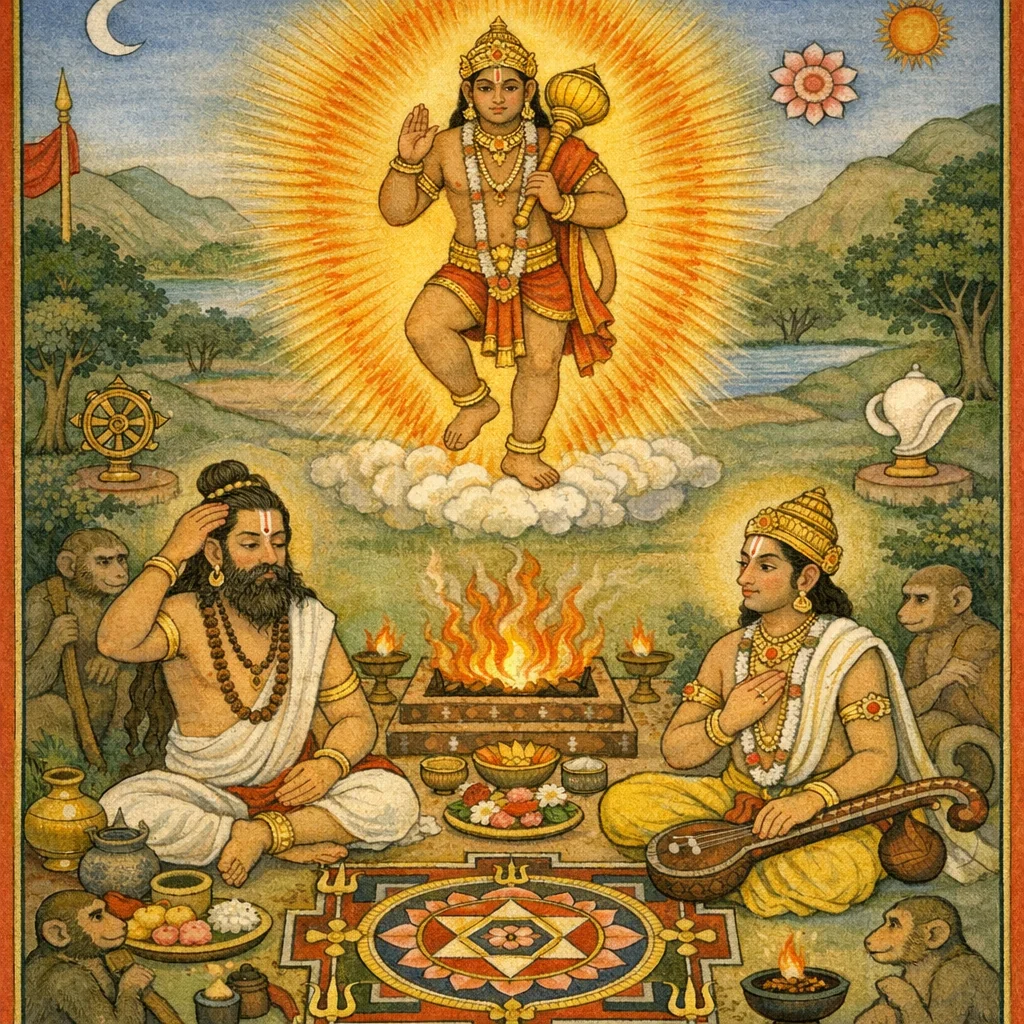
Hanumān-mantra-kathana: Mantra-bheda, Nyāsa, Yantra, and Prayoga
Sanatkumāra teaches Nārada (within the Sanakādi transmission frame) a graded body of Hanumān mantras and their ritual grammar: bīja formations, a chief twelve-syllabled “Mantra-rāja” ending in hṛdaya, and further 8-, 10-, 12-, and 18-syllabled forms with stated ṛṣi/chandas/devatā and bīja–śakti assignments. He details ṣaḍaṅga and aṅga-nyāsa on head, eyes, throat, arms, heart, navel, and feet; prescribes dhyāna of Āñjaneya as sun-radiant and world-shaking; and sets worship on a Vaiṣṇava pīṭha with limb-offerings on filaments/leaves plus offerings to attendant vānara and lokapāla. The chapter lists prayogas for removing fear of kings/enemies, healing fever, poison, and epilepsy-like afflictions, protective ash-and-water rites, travel and dream protection, and victory in battle. It specifies several yantras (concentric rings, a trident/vajra bhūpura, hexagon/lotus layouts, a banner-yantra) with materials, inks, prāṇa-pratiṣṭhā, wearing rules, and timings (aṣṭamī, caturdaśī, Tuesday/Sunday). It concludes by promising siddhi, prosperity, and eventual liberation through disciplined japa, homa, and bhakti to Hanumān, Rāma’s messenger.
Shlokas
Verse 1
सनत्कुमार उवाच । अथोच्यंते हनुमतो मंत्राः सर्वेष्टदायकाः । यान्समाराध्य विप्रेंद्र तत्तुल्याचरणा नराः ॥ १ ॥
Sanatkumāra said: Now are declared the mantras of Hanumān, which grant every desired aim. O best of brāhmaṇas, by duly worshipping and propitiating these, men become endowed with conduct comparable to his.
Verse 2
मनुः स्वरेंदुसंयुक्तं गगनं च भगान्विताः । हसफाग्निनिशाधीशाःद्वितीयं बीजमीरितम् ॥ २ ॥
“‘Manu’ joined with ‘svara’ and ‘indu’, and ‘gagana’ together with ‘bhaga’; and ‘ha-sa-pha’, along with ‘agni’ and the ‘lord of the night’—this is declared to be the second seed-mantra (bīja).”}]}
Verse 3
स्वफाग्नयो भगेंद्वाढ्यास्तृतीयं बीजमीरितम् । वियद्भृग्वग्निमन्विंदुयुक्तं स्याञ्च चतुर्थकम् ॥ ३ ॥
‘Sva’, ‘phā’, and ‘agni’, together with ‘bhaga’ and the lunar element (indu)—this is declared to be the third bīja. The fourth is said to be ‘viyat’, followed by ‘bhṛgu’ and ‘agni’, and joined with the bindu (nasal dot).
Verse 4
पंचमं भगचंद्राढ्यावियद्भृगुस्वकाग्नयः । मन्विंद्वाढ्यौ हसौ षष्टं ङेंतः स्याद्धनुमांस्ततः ॥ ४ ॥
The fifth set is: bha-ga, ca-ndra, āḍhya, viyat, bhṛgu, sva, and agni. The sixth is: manvin, dvāḍhya, and hasu. After that, the one ending in “ṅem” is said to be Hanumān.
Verse 5
हृदयांतो महामंत्रराजोऽयं द्वादशाक्षरः । रामचन्द्रो मुनिश्चास्य जगतीछंद ईरितम् ॥ ५ ॥
This “King of Great Mantras” ends with the word “hṛdaya” and is a twelve-syllabled mantra. Its seer (ṛṣi) is Rāmacandra, and its metre (chandas) is declared to be Jagatī.
Verse 6
देवता हनुमान्बीजं षष्टं शक्तिर्द्वतीयकम् । षड्बीजैश्च षडंगानि शिरोभाले दृशोर्मुखे ॥ ६ ॥
The presiding deity is Hanumān; the sixth is the bīja, and the second is the śakti. With the six bījas, one should assign the six aṅgas—upon the head, the forehead, the two eyes, and the mouth.
Verse 7
गलबाहुद्वये चैव हृदि कुक्षौ च नाभितः । ध्वजे जानुद्वये पादद्वये वर्णान्क्रमान्न्यसेत् ॥ ७ ॥
On the throat and on both arms, on the heart, the abdomen and the navel; on the genital region, on both knees, and on both feet—one should place the syllables/letters in their proper sequence (nyāsa).
Verse 8
षड्बीजानि पदद्वंद्वं मूर्ध्नि भाले मुखे हृदि । नाभावूर्वोर्जंघयोश्च पादयोर्विन्यसेत्क्रमात् ॥ ८ ॥
One should place the six seed-mantras, in pairs and in due sequence—upon the crown of the head, the forehead, the face, and the heart; then upon the navel, the thighs, the shanks, and finally upon the feet.
Verse 9
अंजनीगर्भसंभूतं ततो ध्यायेत्कपीश्वरम् । उद्यत्कोट्यर्कसंकाशं जगत्प्रक्षोभकारकम् ॥ ९ ॥
Then one should meditate on Kapīśvara (Hanumān), born from Añjanā’s womb—radiant like ten million rising suns, and able to shake the worlds.
Verse 10
श्रीरामांघ्रिध्याननिष्टं सुग्रीवप्रमुखार्चितम् । वित्रासयंतं नादेन राक्षसान्मारुतिं भजेत् ॥ १० ॥
One should worship Māruti (Hanumān)—steadfast in meditation on the feet of Śrī Rāma, revered by Sugrīva and others, and who terrifies the rākṣasas by his mighty roar.
Verse 11
ध्यात्वैवं प्रजपेद्भानुसहस्रं विजितैंद्रियः । दशांशं जुहुयाद्बीहीन्पयोदध्याज्यमिश्रितान् ॥ ११ ॥
Having thus meditated, and with the senses restrained, one should recite the Bhānusahasra (the ‘Thousand [Names/Hymn] of the Sun’). Then, as a tenth part (of the japa count), one should offer into the fire grains of rice mixed with milk, curd, and ghee.
Verse 12
पूर्वोक्ते वैष्णवे पीठे मूर्त्तिं संकल्प्य मूलतः । आवाह्य तत्र संपूज्य पाद्यादिभिरुपायनैः ॥ १२ ॥
On the Vaiṣṇava pedestal described earlier, one should first, from the very beginning, establish the deity’s form through sacred intention; then, having invoked Him there, one should worship Him fully with offerings such as water for washing the feet (pādya) and other customary gifts.
Verse 13
केशरेष्वंगपूजा स्यात्पत्रेषु च ततोऽर्चयेत् । रामभक्तो महातेजाः कपिराजो महाबलः ॥ १३ ॥
One should perform worship of the Deity’s limbs upon the flower’s filaments, and then offer worship upon the leaves. He is a devotee of Rāma—of great splendor—the king of monkeys, and of mighty strength.
Verse 14
द्रोणाद्रिहारको मेरुपीठकार्चनकारकः । दक्षिणाशाभास्करश्च सर्वविघ्नविनाशकः ॥ १४ ॥
He is the remover of the Droṇādri mountain; the one who causes worship at the Meru-seat with gold; the Sun that shines in the southern quarter; and the destroyer of all obstacles.
Verse 15
इत्थं सम्पूज्य नामानि दलाग्रेषु ततोऽर्चयेत् । सुग्रीवमंगद नीलं जांबवंतं नलं तथा ॥ १५ ॥
Thus, after duly honoring the sacred names upon the tips of the leaves, one should then perform worship, invoking Sugrīva, Aṅgada, Nīla, Jāmbavān, and also Nala.
Verse 16
सुषेणं द्विविदं मैंदं लोकपालस्ततोऽर्चयेत् । वज्राद्यानपि संपूज्य सिद्धश्चैवं मनुर्भवेत् ॥ १६ ॥
Thereafter, the practitioner should worship the Lokapālas, and also Suṣeṇa, Dvivida, and Mainda. Having duly worshipped Vajra and the others as well, in this manner the practitioner becomes accomplished (siddha) and attains the status of a Manu.
Verse 17
मंत्रं नवशतं रात्रौ जपेद्दशदिनावधि । यो नरस्तस्य नश्यंति राजशत्रूत्थभीतयः ॥ १७ ॥
That man who recites the mantra nine hundred times at night for a period of ten days—his fears arising from kings and enemies are destroyed.
Verse 18
मातुलिंगाम्रकदलीफलैर्हुत्वा सहस्रकम् । द्वाविंशतिब्रह्मचारि विप्रान्संभोजयेच्छुचीन् ॥ १८ ॥
Having offered a thousand oblations with the fruits of citron, mango, and banana, one should then feed twenty-two pure brāhmaṇas who are brahmacārins.
Verse 19
एवंकृते भूतविषग्रहरोगाद्युपद्रवाः । नश्यंति तत्क्षणादेव विद्वेषिग्रहदानवाः ॥ १९ ॥
When this is performed in this manner, afflictions such as spirit-hauntings, poison, planetary seizures, diseases, and other disturbances are destroyed instantly; even hostile grahas and demonic forces perish.
Verse 20
अष्टोत्तरशतेनांबु मंत्रितं विषनाशनम् । भूतापस्मारकृत्योत्थज्वरे तन्मंत्रमंत्रितैः ॥ २० ॥
Water, consecrated by reciting the mantra one hundred and eight times, becomes a destroyer of poison; and in fevers arising from spirit-affliction, epilepsy, or malevolent rites (kṛtyā), that same mantra—again used to consecrate—serves as the remedy.
Verse 21
भस्मभिः सलिलैर्वापि ताडयेज्ज्वरिणं क्रुधा । त्रिदिनाज्ज्वरमुक्तोऽसौ सुखं च लभते नरः ॥ २१ ॥
With ash, or else with water, one should strike the fever-afflicted person in anger; within three days that man becomes free from fever and attains comfort as well.
Verse 22
औषधं वा जलं वापि भुक्त्वा तन्मंत्रमंत्रितम् । सर्वान्रोगान्पराभूय सुखी भवति तत्क्षणात् ॥ २२ ॥
Having consumed medicine or even water that has been empowered by that mantra, one overcomes all diseases and becomes happy at that very moment.
Verse 23
तज्जप्तभस्मलिप्तांगो भुक्त्वा तन्मंत्रितं पयः । योद्धुं गच्छेच्च यो मंत्री शस्त्रसंघैंर्न बाध्यते ॥ २३ ॥
An officiant who smears his body with ash empowered by that japa, and then drinks milk consecrated with that same mantra—if he goes forth to battle—is not overcome by volleys of weapons.
Verse 24
शस्क्षतं व्रणस्फोटो लूतास्फोटोऽपि भस्मना । त्रिर्जप्तेन च संस्पृष्टाः शुष्यंत्येव न संशयः ॥ २४ ॥
A cut, a blistering wound, and even a spider-bite swelling—when touched with ash over which the mantra has been recited three times—dry up indeed; of this there is no doubt.
Verse 25
जपेदर्कास्तमारभ्य यावदर्कोदयो भवेत् । मन्त्रं सप्तदिनं यावञ्चादाय भस्मकीलकौ ॥ २५ ॥
Beginning at sunset and continuing until sunrise, one should recite the mantra. For seven days, one should also keep with oneself the ashes and the kīlaka (ritual peg) as part of the rite.
Verse 26
निखनेदभिमन्त्र्याशुशत्रूणां द्वार्यलक्षितः । विद्वेषं मिथ आपन्नाः पलायंतेऽरयोऽचिरात् ॥ २६ ॥
Having quickly consecrated it with the mantra, one should bury it at the enemy’s doorway without being noticed; then the foes, falling into mutual hatred, soon flee away.
Verse 27
भस्मांबु चंदनं मंत्री मंत्रेणानेन मंत्रितम् । भक्ष्यादियोजितं यस्मै ददाति स तु दासवत् ॥ २७ ॥
If a mantra-practitioner consecrates ash, water, and sandal paste with this mantra and gives them—together with edible offerings and the like—to someone, then he acts only like a servant, not as a true knower of mantra.
Verse 28
क्रूराश्च जंतवोऽप्येवं भवंति वशवर्तिनः । गृहीत्वेशनदिस्कंस्थं करंजतरुमूलकम् ॥ २८ ॥
In this very manner, even fierce creatures become compliant and come under one’s control, when one takes the karañja tree’s root that has been placed (or fixed) upon the īśana-disc arrangement.
Verse 29
कृत्वा तेनांगुष्टमात्रां प्रतिमां च हनूमतः । कृत्वा प्राणप्रतिष्टां च सिंदूराद्यैः प्रपूज्य च ॥ २९ ॥
With that (substance), one should fashion a thumb-sized image of Hanumān; then, having performed the prāṇa-pratiṣṭhā (invocation of life-presence), one should duly worship it with vermilion and other offerings.
Verse 30
गृहस्याभिमुखी द्वारे निखनेन्मंत्रमुञ्चरन् । ग्रहाभिचाररोगाग्निविषचौरनृपोद्भवाः ॥ ३० ॥
Facing the doorway of the house, one should bury it while reciting the mantra. Thereby arise protections against planetary afflictions, black-magic attacks, disease, fire, poison, thieves, and troubles originating from the king (state authority).
Verse 31
न जायंते गृहे तस्मिन् कदाचिदप्युपद्रवाः । तद्गृहं धनपुत्राद्यैरेधते प्रत्यहं चिरम् ॥ ३१ ॥
In that house, troubles never arise at any time. That household steadily flourishes day after day for a long time—abounding in wealth, sons, and other blessings.
Verse 32
निशि यत्र वने भस्म मृत्स्नया वापि यत्नतः । शत्रोः प्रतिकृतिं कृत्वा हृदि नाम समालिखेत् ॥ ३२ ॥
At night, in a forest, with careful effort using ash or clay, one should make an effigy of the enemy and write the (enemy’s) name upon its chest.
Verse 33
कृत्वा प्राणप्रतिष्टांतं भिंद्याच्छस्त्रैर्मनुं जपन् । मंत्रांते प्रोञ्चरेच्छत्रोर्नाम छिंधि च भिंधि च ॥ ३३ ॥
Having completed the rite concluding with the ‘installation of life’ (prāṇa-pratiṣṭhā), one should strike and split it with weapons while repeating the mantra. At the end of the mantra, one should utter the enemy’s name aloud, adding: “Cut!” and “Split!”
Verse 34
मारयेति च तस्यांते दंतैरोष्टं निपूड्य च । पाण्योस्तले प्रपीड्याथ त्यक्त्वा तं स्वगृहं व्रजेत् ॥ ३४ ॥
And at the end, saying “I will kill (you),” he should bite down on his lip with his teeth and then press the palms of his hands together; thereafter, leaving that place, he should go back to his own house.
Verse 35
कुर्वन्सप्तदिनं चैवं हन्याच्छत्रुं न संशयः । राजिकालवणैर्मुक्तचिकुरः पितृकानने ॥ ३५ ॥
Performing it in this very manner for seven days, one destroys one’s enemy—there is no doubt. With the hair loosened and (smeared/anointed) with mustard and salt, (one should do this rite) in the grove sacred to the Pitṛs (ancestors).
Verse 36
धत्तूरफलपुष्पैश्च नखरोमविषैरपि । द्विक कौशिकगृध्राणां पक्षैः श्लेष्मांतकाक्षजैः ॥ ३६ ॥
And also with the fruits and flowers of dhattūra, and with poisonous substances derived from nails and hair; with the wings of the dvika, the owl, and the vulture; and with the eye-born secretion of the drug called “śleṣmāntaka” (the destroyer of phlegm).
Verse 37
समिद्धिस्त्रिशतं यामयदिङ्मुखो जुहुयान्निशि । एवं सप्तदिनं कुर्वन्मारयेदुद्धतं रिपुन् ॥ ३७ ॥
Facing the southern direction, one should perform oblations at night with three hundred fuel-sticks. Practised in this manner for seven days, it is said to bring about the destruction of an arrogant enemy.
Verse 38
वित्रासस्त्रिदिनं रात्रौ श्मशाने षट्शतं जपेत् । ततो वेताल उत्थाय वदेद्भावि शुभाशुभम् ॥ ३८ ॥
At night, in a cremation ground, one should recite the mantra called Vitrāsa six hundred times for three nights. Then the Vetāla will rise and speak of what is to come—both auspicious and inauspicious.
Verse 39
किंकरीभूय वर्त्तेत कुरुते साधकोदितम् । भास्मांबुमंत्रितं रात्रौ सहस्रावृत्तिकं पुनः ॥ ३९ ॥
Becoming, as it were, a servant of the mantra and the rite, the practitioner should conduct himself accordingly and do what is prescribed for the sādhaka. Again, at night he should consecrate ash and water with the mantra, repeating it a thousand times.
Verse 40
दिनत्रयं च तत्पश्चात्प्रक्षिपेत्प्रतिमासु च । यासु कासु च स्थूलासु लघुष्वपि विशेषतः ॥ ४० ॥
And after three days, one should place it into the images (icons) as well—whether into any large icons or, especially, even into small ones.
Verse 41
मंत्रप्रभावाञ्चलनं भवत्येव न संशयः । अष्टम्यां वा चतुर्दश्यां कुजे वा रविवासरे ॥ ४१ ॥
There is no doubt that the potency of a mantra is stirred and brought into effective operation—especially when performed on the eighth lunar day, the fourteenth lunar day, on Tuesday, or on Sunday.
Verse 42
हनुमत्प्रतिमां पट्टे माषैः स्नेहपरिप्लुतैः । कुर्याद्रम्यां विशुद्धात्मा सर्वलक्षणलक्षिताम् ॥ ४२ ॥
With a purified mind, one should fashion a beautiful image of Hanumān upon a cloth, using māṣa (black gram) moistened with ghee/oil, making it complete with all auspicious iconographic marks.
Verse 43
तैलदीपं वामभागे घृतदीपं तु दक्षिणे । संस्थाप्यावाहयेत्पश्चान्मूलमंत्रेण मंत्रवित् ॥ ४३ ॥
Placing an oil lamp on the left and a ghee (ghṛta) lamp on the right, the knower of mantras should then perform the invocation (āvāhana) by means of the root mantra (mūla-mantra).
Verse 44
प्राणप्रतिष्टां कृत्वा च पाद्यादीनि समर्पयेत् । रक्तचंदनपुष्पैश्च सिंदूराद्यैः समर्चयेत् ॥ ४४ ॥
After performing prāṇa-pratiṣṭhā (establishing the life-presence in the Deity), one should offer the ritual services beginning with pādya (water for washing the feet) and the rest; and one should worship with red sandalwood, flowers, and sindūra (vermilion) and similar offerings.
Verse 45
धूपं दीपं प्रदायाथ नैवेद्यं च समर्पयेत् । अपूपमोदनं शाकमोदकान्वटकादिकम् ॥ ४५ ॥
After offering incense (dhūpa) and a lamp (dīpa), one should present the naivedya (food-offering)—such as apūpa (cakes), modana (cooked rice), śāka (vegetable dishes), modaka (sweet dumplings), and vaṭaka and the like (fritters).
Verse 46
साज्यं च तत्समर्प्याथ मूलमंत्रेण मंत्रवित् । अखंडितान्यहिलतादलानि सप्तविंशतिम् ॥ ४६ ॥
Then the knower of mantras should offer that together with ghee (ghṛta), using the root mantra; and he should offer twenty-seven unbroken leaves of the ahilatā plant.
Verse 47
त्रिधा कृत्वा सपूगानि मूलेनैव समर्पयेत् । एवं संपूज्य मंत्रज्ञो जपेद्दशशंत मनुम् ॥ ४७ ॥
Having divided the areca-nuts (pūga) into three portions, one should offer them at the very root (of the sacred plant) with that same root mantra. Thus, after duly completing the worship, the knower of mantras should recite the sacred formula in japa one thousand times.
Verse 48
कर्पूरारार्तिकं कृत्वा स्तुत्वा च बहुधा सुधीः । निजेप्सितं निवेद्याथ विधिवद्विसृजेत्ततः ॥ ४८ ॥
Having performed the camphor ārati and offered many praises, the wise devotee should then present his cherished request; thereafter he should duly conclude the rite according to the prescribed procedure.
Verse 49
नैवेद्यान्नेन संभोज्य ब्राह्मणान्सप्तसंख्यया । निवेदितानि पर्णानि तेभ्यो दद्याद्विभज्य च ॥ ४९ ॥
Having fed seven Brāhmaṇas with the food offered as naivedya, one should also, after proper division, distribute to them the leaves that were used in the offering.
Verse 50
दक्षिणां च यथा शक्ति दत्त्वा तान् विसृजेत्सुधीः । तत इष्टगणैः सार्द्धं स्वयं भुंजीत वाग्यतः ॥ ५० ॥
Having given dakṣiṇā according to one’s capacity, the wise man should respectfully dismiss them; thereafter, with his chosen companions, he should partake of the meal himself, restraining his speech.
Verse 51
तद्दिने भूमिशय्यां च ब्रह्मचर्य्यं समाचरेत् । एवं यः कुरुते मर्त्यः सोऽचिरादेव निश्चितम् ॥ ५१ ॥
On that day one should sleep upon the ground and observe brahmacarya (celibate restraint). The mortal who practices thus surely attains the intended result very soon—this is assured.
Verse 52
प्राप्नुयात्सकलान्कामान्कपीशस्य प्रसादतः । हनुमत्प्रतिमां भूमौ विलिखेत्तत्पुरो मनुम् ॥ ५२ ॥
By the grace of Kapīśa (Hanumān), one attains all desired aims. One should draw the image of Hanumān upon the ground and, before it, inscribe the mantra.
Verse 53
साध्यनाम द्वितीयांतं विमोचय विमोचय । तत्पूर्वं मार्जयेद्वामपाणिनाथ पुनर्लिखेत् । एवमष्टोत्तरशतं लिखित्वा मार्जयेत्पुनः ॥ ५३ ॥
Write the name of the intended person (the sādhya) in the accusative case, followed by the words “vimocaya, vimocaya” (“release, release”). Then, with the left hand, wipe it away and write it again. Thus, having written it one hundred and eight times, wipe it once more.
Verse 54
एवं कृते महाकारागृहाच्छीघ्रं विमुच्यते । एवमन्यानि कर्माणि कुर्य्यांत्पल्लवमुल्लिखन् ॥ ५४ ॥
When this is done in this manner, one is quickly released from the great prison-house of bondage. In the same way, one should perform the other rites as well, while inscribing or drawing the sprout (pallava).
Verse 55
सर्षपैर्वश्यकृद्धोमो विद्वेषे हयमारजैः । कुंकुमैरिध्मकाष्ठैर्वा मरीचैर्जीरकैरपि ॥ ५५ ॥
An oblation (homa) performed with mustard seeds (sarsapa) brings about the rite of attraction (vaśya). For arousing enmity (vidveṣa), it is performed with hayamāraja. Likewise, it may be performed with kunkuma (saffron), with proper fuel-woods, and also with black pepper (marīca) and cumin (jīraka).
Verse 56
ज्वरे दूर्वागुडूचीभिर्दध्ना क्षीरेण वा घृतैः । शूले करंजवातारिसमिद्भिस्तैललोलितैः ॥ ५६ ॥
In cases of fever (jvara), one should use dūrvā grass and guḍūcī, together with curd, or milk, or ghee. In cases of colic pain (śūla), one should use kindling-sticks (samidh) of karañja and vātāri, well-smeared and stirred in oil.
Verse 57
तैलाक्ताभिश्च निर्गुंडीसमिद्भिर्वा प्रयत्नतः । सौभाग्ये चंदनैश्चेंद्रलोचनैर्वा लवंगकैः ॥ ५७ ॥
With effort, one may perform the rite using kindling-sticks (samidh) of nirguṇḍī smeared with oil; and for the attainment of good fortune (saubhāgya), one may use sandalwood, indralocana, or cloves.
Verse 58
सुगंधपुष्पैर्वस्त्राप्त्यै तत्तद्धान्यैस्तदाप्तये । रिपुपादरजोभिश्च राजीलवणमिश्रितैः ॥ ५८ ॥
With fragrant flowers one gains garments; with the particular grains, one attains their corresponding fruits; and by using the dust from an enemy’s feet mixed with rājī (black mustard) and salt, one brings about the intended effect upon that foe.
Verse 59
होमयेत्सप्तरात्रं च रिपुर्याति यमालयम् । धान्यैः संप्राप्यते धान्यमन्नैरन्नसमुच्छ्रयः ॥ ५९ ॥
If one performs the fire-offering (homa) for seven nights, an enemy goes to Yama’s abode. By offering grains one obtains grains; by offering food one gains an abundance of food.
Verse 60
तिलाज्यक्षीरमधुभिर्महिषीगोसमृद्धये । किं बहूक्तैर्विषे व्याधौ शांतौ मोहे च मारणे ॥ ६० ॥
With sesame, ghee, milk, and honey one promotes prosperity in buffaloes and cows. What need is there to say much more? These same applications are used against poison, in disease, for pacification rites, for delusion, and even for rites of destruction.
Verse 61
विवादे स्तंभने द्यूते भूतभीतौ च संकटे । वश्ये युद्धे क्षते दिव्ये बंधमोक्षे महावने ॥ ६१ ॥
In disputes, in rites of immobilization (stambhana), in gambling, in fear caused by spirits, and in calamity; for subjugation, in battle, when wounded, in ordeals (divya), for release from bondage, and in a great forest—this mantra/prayoga is to be employed.
Verse 62
साधितोऽयं नृणां दद्यान्मंत्रः श्रेयः सुनिश्चितम् । वक्ष्येऽथ हनुमद्यंत्रं सर्वसिद्धिप्रदायकम् ॥ ६२ ॥
When this mantra has been duly accomplished through proper practice, one should bestow it upon people; it is assuredly a source of spiritual welfare. Now I shall describe the Hanumān-yantra, which grants every kind of attainment.
Verse 63
लांगूलाकारसंयुक्तं वलयत्रितयं लिखेत् । साध्यनाम लिखेन्मध्ये पाशिबीज प्रवेष्टितम् ॥ ६३ ॥
One should draw three concentric rings, furnished with a tail-like extension; in the center write the name of the intended aim (or person), enclosing it with the seed-syllable (bīja) of the noose, pāśī.
Verse 64
उपर्यष्टच्छदं कृत्वा पत्रेषु कवचं लिखेत् । तद्बहिर्दंहमालिख्य तद्बहिश्चतुरस्रकम् ॥ ६४ ॥
Having made an upper covering of eight layers, one should write the protective ‘kavaca’ upon the leaves; outside it draw a ring, and outside that again, a square.
Verse 65
चतुरसस्रस्य रेखाग्रे त्रिशूलानि समालिखेत् । सौं बीजं भूपुरस्याष्टवज्रेषु विलिखेत्ततः ॥ ६५ ॥
At the tips of the square’s boundary lines one should draw tridents. Then one should inscribe the seed-syllable “sauṃ” upon the eight vajra-like projections of the bhūpura, the yantra’s outer enclosure.
Verse 66
कोणेष्वकुंशमालिख्य मालामंत्रेण वेष्टयेत् । तत्सर्वं वेष्टयेद्यंत्रवलयत्रितयेन च ॥ ६६ ॥
Having drawn in the corners the sign of the ankuśa (goad) without a hook, one should wrap it with the Garland-Mantra (Mālā-mantra); and then further encircle the whole with the yantra’s three concentric rings.
Verse 67
शिलायां फलके वस्त्रे ताम्रपत्रेऽथ कुड्यके । ताडपत्रेऽथ भूर्जे वा रोचनानाभिकुंकुभैः ॥ ६७ ॥
It may be inscribed on stone, on a wooden board, on cloth, on a copper plate, or on a wall; likewise on palm-leaf or on birch-bark (bhūrja), using rocanā, musk, and saffron as pigments or ink.
Verse 68
यंत्रमेतत्समालिख्य निराहारो जितेंद्रियः । कपेः प्राणान्प्रतिष्टाप्य पूजयेत्तद्यथाविधि ॥ ६८ ॥
Having carefully drawn this sacred yantra, fasting and with the senses restrained, one should establish the prāṇa (vital presence) of Kapi and then worship it according to the prescribed rite.
Verse 69
अशेषदुःखशान्त्यर्थः यंत्रं संधारयेद् बुधः । मारीज्वराभिचारादिसर्वोपद्रवनाशनम् ॥ ६९ ॥
For the pacification of all sorrow, the wise should keep or wear this yantra; it destroys every affliction—such as epidemic fever (mārī-jvara), sorcery (abhicāra), and other calamities.
Verse 70
योषितामपि बालानां धृतं जनमनोहरम् । भूतकृत्यापिशाचानां दर्शनादेव नाशनम् ॥ ७० ॥
Even women and children may wear it; it delights the minds of people. By its very sight, bhūtas, kṛtyās, and piśācas—harmful spirits and occult afflictions—are destroyed.
Verse 71
मालामंत्रमथो वक्ष्ये तारो वाग्विष्णुगेहिनी । दीर्घत्रयान्विता माया प्रागुक्तं कूटपञ्चकम् ॥ ७१ ॥
Now I shall explain the mālā-mantra, the rosary-mantra: it is made of the ‘tāra’ syllable, then ‘vāk’, then the formula ‘viṣṇu-gehini’; next comes ‘māyā’ endowed with three long vowels—together forming the fivefold coded cluster (kūṭa-pañcaka) previously described.
Verse 72
ध्रुवो हृद्धनुमान्ङेंतोऽथ प्रकटपराक्रमः । आक्रांतदिग्मंडलांते यशोवितानसंवदेत् ॥ ७२ ॥
Then Dhruva—steadfast at heart, bow in hand, and manifest in valor—having overrun the limits of the quarters, causes the canopy of his fame to resound everywhere.
Verse 73
धवलीकृतवर्णांते जगत्त्रितयवज्र च । देहज्वलदग्निसूर्य कोट्यंते च समप्रभ ॥ ७३ ॥
At the final culmination, where all hues are made white, and where the threefold universe seems shattered as by a vajra’s stroke—there that radiance shines with equal splendor: like the blazing fire within the body, like the sun, even like the light of countless suns together.
Verse 74
तनूरुहपदांते तु रुद्रावतार संवदेत् । लंकापुरी ततः पश्चाद्दहनोदधिलंघन ॥ ७४ ॥
At Tanūruhapadānta, one should recount the discourse concerning Rudra’s incarnation. Thereafter, one should speak of Laṅkā-city, and then of the burning of Laṅkā and the crossing of the ocean.
Verse 75
दशग्रीवशिरः पश्चात्कृतांतकपदं वदेत् । सीतांते श्वसनपदं वाय्वंते सुतमीरयेत् ॥ ७५ ॥
After uttering “Daśagrīva-śiraḥ”, one should then pronounce the word “Kṛtāntaka”. At the end of “Sītā”, one should utter the term “Śvasana”; and at the end of “Vāyu”, one should pronounce “Suta”.
Verse 76
अंजनागर्भसंभूतः श्रीरामलक्ष्मणान्वितः । नंदंति कर वर्णांते सैन्यप्राकार ईरयेत् ॥ ७६ ॥
Born from Añjanā’s womb and accompanied by Śrī Rāma and Lakṣmaṇa—one should utter this as a protective rampart for the army; it brings delight at the end of one’s undertaking.
Verse 77
सुग्रीवसख्यकादूर्णाद्रणवालिनिवर्हण । कारणद्रोणशब्दांते पर्वतोत्पाटनेति च ॥ ७७ ॥
Because he formed friendship with Sugrīva; because he extended or crossed like a thread; because he removed Vāli in battle; because he was the cause of great outcomes; because of the sound “droṇa”; and because he uprooted a mountain—thus (these are the reasons for his various appellations).
Verse 78
अशोकवनवीथ्यंते दारुणाक्षकुमारक । छेदनांते वनरक्षाकरांते तु समूह च ॥ ७८ ॥
O Dāruṇākṣa-kumāraka, at the end of the avenue in the Aśoka-grove there is a clearing; and at the far end of the wood-cutters’ ground there is also a gathering-place of the forest-guards.
Verse 79
विभञ्जनांते ब्रह्मास्त्रब्रह्मशक्ति ग्रसेति च । लक्ष्मणांते शक्तिभेदनिवारणपदं वदेत् ॥ ७९ ॥
At the end of the mantra called Vibhañjanā, one should utter: “May the Brahmāstra and the Brahma-śakti be swallowed up.” And at the end of the mantra called Lakṣmaṇā, one should pronounce the counter-formula that prevents the splitting or piercing power of the śakti-weapon.
Verse 80
विशल्योषधिशब्दांते समानयन संपठेत् । बालोदित ततो भानुमंडलग्रसनेति च ॥ ८० ॥
After appending the words “viśalyā” and “oṣadhi” (the healing herb), one should recite the formula beginning with “samānayana.” Then, at sunrise, one should also recite the formula called “the devouring of the solar orb.”
Verse 81
मेघनादहोमपदाद्विध्वंसनपदं वदेत् । इंद्रजिदूधकारांते णसीतासक्षकेति च ॥ ८१ ॥
From the mantra-segment called “Meghanāda-homa,” one should utter the “vidhvaṃsana” (destructive/expelling) segment; and at the end of the “Indrajit” segment, after the ūdhakāra-ending, one should also recite: “ṇa-sītā-sakṣaketi.”
Verse 82
राक्षसीसंघशब्दांते विदारणपदं वदेत् । कुंभकर्णादिसंकीर्त्यवधांते च परायण ॥ ८२ ॥
At the end of the expression “the host of rākṣasīs,” one should utter the word “vidāraṇa” (“rending/tearing apart”). And after mentioning Kumbhakarṇa and the others, at the conclusion of the slaying, one should recite the concluding portion as the final recitation (parāyaṇa).
Verse 83
श्रीरामभक्तिवर्णांते तत्परेति समुद्र च । व्योमद्रुमलंघनेति महासामर्थ्य संवदेत् ॥ ८३ ॥
At the close of describing devotion to Śrī Rāma, one should proclaim: “He is wholly devoted to Rāma”; and one should also speak of his crossing of the ocean and his leaping over trees that rise to the very sky, thereby declaring his great and extraordinary power.
Verse 84
महातेजःपुंजशब्दाद्विराजमानवोञ्चरेत् । स्वामिवचनसंपादितार्जुनांते च संयुग ॥ ८४ ॥
One should practice uñchavṛtti (living by gleaning), shining forth through the very sound of a great mass of spiritual radiance; and, having fulfilled the command of one’s master, one should enter the struggle to the very end—like Arjuna, who acted at his Lord’s word.
Verse 85
सहायांते कुमारेति ब्रह्मचारिन्पदंवदेत् । गंभीरशब्दोदयांते दक्षिणापथ संवदेत् । मार्त्ताण्डमेरु शब्दांते वदेत्पर्वतपीटिका ॥ ८५ ॥
When a word ends with “sahāyā”, one should utter “kumāra”; when it ends with “brahmacārin”, one should say “pada”. At the end of the utterance of “gaṃbhīra”, one should say “dakṣiṇāpatha”; and at the end of the words “Mārttāṇḍa” and “Meru”, one should utter “parvata-pīṭikā”.
Verse 86
अर्चनांते तु सकलमंत्रांते मपदं वदेत् । आचार्यमम शब्दांते सर्वग्रहविनाशन ॥ ८६ ॥
At the conclusion of worship (arcanā), and at the end of every complete mantra, one should utter the syllable “ma”. And at the end of the word “ācārya”, one should add “mama”—this is said to destroy all harmful planetary influences (grahas).
Verse 87
सर्वज्वरोञ्चाटनांते सर्वविषविनाशन । सर्वापत्तिनिवारण सर्वदुष्टनिबर्हण ॥ ८७ ॥
O (mantra/deity), you are the final remedy that drives away all fevers; you destroy every poison; you avert every calamity; and you utterly quell all wicked forces.
Verse 88
सर्वव्याध्यादि सम्प्रोच्य भयांते च निवारण ॥ ८८ ॥
Having duly set forth the means for all diseases and the like, he also, at the very end, proclaims the remedy that dispels fear.
Verse 89
सर्वशत्रुच्छेदनेति ततो मम परस्य च ॥ ८९ ॥
Therefore, (this mantra/name) is called “the cutter of all enemies,” and it is effective both for me and for another as well.
Verse 90
ततस्त्रिभुवनांते तु पुंस्त्रीनपुंसकात्मकम् । सर्वजीवपदांते तु जातं वशययुग्मकम् ॥ ९० ॥
Then, at the end of the expression denoting the three worlds, the form becomes masculine, feminine, and neuter; and at the end of the word denoting all living beings, the paired sounds ‘vaśaya’ arise.
Verse 91
ममाज्ञाकारकं पश्चात्संपादय युगं पुनः । ततो नानानामधेयान्सर्वान् राज्ञः स संपठेत् ॥ ९१ ॥
Afterwards, in accordance with my command, he should again establish the proper division of the yugas; then he should correctly recite all the various name-appellations of the kings.
Verse 92
परिवारान्ममेत्यंते सेवकान् कुरु युग्मकम् । सर्वशस्त्रवीत्यंते षाणि विध्वंसय द्वयम् ॥ ९२ ॥
At the end, separate (them) from my retinue and make a pair of attendants; and at the end of the circuit of all weapons, destroy the two—thus the six are duly dealt with.
Verse 93
लज्जादीर्घत्रयोपेता होत्रयं चैहि युग्मकम् । विलोमं पंचकूटानि सर्वशत्रून्हनद्वयम् ॥ ९३ ॥
Combine the syllables beginning with “lajjā” with three long vowels; then take the triad “hotrayaṃ” and the pair “caihi.” Next, apply reverse order (viloma), form the five clusters (pañcakūṭāni), and add the double “hana,” said to destroy all enemies.
Verse 94
परबलानि परांते सैन्यानि क्षोभयद्वयम् ॥ ९४ ॥
At the enemy’s flank, that pair stirred up and cast the opposing forces into confusion.
Verse 95
मम सर्वं कार्यजातं साधयेति द्वयं ततः ॥ ९५ ॥
Then one should employ the pair of expressions: “Accomplish all my undertakings.”
Verse 96
सर्वदुष्टदुर्जनांते मुखानि कीलयद्वयम् । धेत्रयं वर्मत्रितयं फट्त्रयं हांत्रयं ततः ॥ ९६ ॥
As a concluding application to subdue all wicked and malicious persons, ‘nail shut’ their mouths with the twofold kīlaka; then apply the threefold “dhe,” the threefold protective “varma,” the threefold “phaṭ,” and thereafter the threefold “hāṃ.”
Verse 97
वह्निप्रियांतो मंत्रोऽयं मालासंज्ञोऽखिलेष्टदः ॥ ९७ ॥
This mantra, ending with the phrase “vahnipriyā,” is known as the “Mālā” (garland) mantra, and it bestows all desired aims.
Verse 98
वस्वष्टबाणवर्णोऽयं मंत्रः सर्वेष्टसाधकः ॥ ९८ ॥
This eight-syllabled mantra is the accomplisher of all desired aims.
Verse 99
महाभये महोत्पाते स्मृतोऽयं दुःखनाशनः । द्वादशार्णस्य षट्कूटं त्यक्त्वा बीजं तथादिमम् ॥ ९९ ॥
In great fear and in grave portents, the remembrance of this mantra destroys suffering. One should omit the sixfold division (ṣaṭkūṭa) of the twelve-syllabled formula, and likewise omit the primordial seed-syllable.
Verse 100
पंचकूटात्मको मंत्रः सर्वकामप्रदायकः । रामचंद्रो मुनिश्चास्य गायत्री छंद ईरितम् ॥ १०० ॥
This mantra is constituted of five ‘peaks’ (pañcakūṭa) and is said to bestow all desired aims. Its seer (ṛṣi) is Rāmacandra, and its metre is declared to be Gāyatrī.
Verse 101
हनुमान्देवता प्रोक्तो विनियोगोऽखिलाप्तये । पंचबीजैः समस्तेन षडंगानि समाचरेत् ॥ १०१ ॥
Hanumān is declared to be the presiding deity (devatā) of this mantra. Its application (viniyoga) is for attaining all results. With the complete set of the five seed-syllables, one should duly perform the six-limbed (ṣaḍaṅga) rites.
Verse 102
रामदूतो लक्ष्मणांते प्राणदाताञ्जनीसुतः । सीताशोकविनाशोऽयं लंकाप्रासादभंजनः ॥ १०२ ॥
He is Rāma’s messenger; at the brink of Lakṣmaṇa’s death he restored life; he is Añjanī’s son. He destroys Sītā’s sorrow and shatters the palaces of Laṅkā.
Verse 103
हनुमदाद्याः पंचैते बीजाद्या ङेयुताः पुनः । षडंगमनवो ह्येते ध्यानपूजादि पूर्ववत् ॥ १०३ ॥
These five mantras beginning with “Hanumat” are again to be known as joined with the seed-syllables (bīja) and the like. Indeed, these are the six-limbed (ṣaḍaṅga) mantras; meditation, worship, and the rest are to be performed as previously described.
Verse 104
प्रणवो वाग्भवं पद्मा माया दीर्घत्रयान्विता । पंचकूटानि मंत्रोऽयं रुद्रार्णः सर्वसिद्धिदः ॥ १०४ ॥
The Praṇava (Oṁ), the Vāgbhava bīja, Padmā bīja, and Māyā bīja—each furnished with the three long vowels—constitute the five “peaks” (kūṭas). This mantra, made of Rudra-syllables, bestows all attainments (siddhis).
Verse 105
ध्यानपूजादिकं सर्वमस्यापि पूर्ववन्मतम् । अयमाराधितो मंत्रः सर्वाभीष्टप्रदायकः ॥ १०५ ॥
For this mantra too, all procedures—such as meditation and worship—are to be understood as the same as described earlier. When properly propitiated, this mantra bestows all desired aims.
Verse 106
नमो भगवते पश्चादनंतश्चंद्रशेखरां । जनेयाय महांते तु बलायांतेऽग्निवल्लभा ॥ १०६ ॥
Salutations to the Blessed Lord—endless, the Moon-crested One (Candraśekhara)—known as the Progenitor; the Great End, the very strength at the end, and the beloved of Agni, the sacred Fire.
Verse 107
अष्टादशार्णो मंत्रोऽयं सुनिरीश्वरसंज्ञकः । छंदोऽनुष्टुप्देवता तु हनुमान्पवनात्मजः ॥ १०७ ॥
This is an eighteen-syllabled mantra, known by the name “Sunirīśvara.” Its metre is Anuṣṭubh, and its presiding deity is Hanumān, the son of Pavana, the Wind-god.
Verse 108
हं बीजं वह्निवनिता शक्तिः प्रोक्ता मनीषिभिः । आंजनेयाय हृदयं शिरश्च रुद्रमूर्तये ॥ १०८ ॥
The wise declare the syllable “haṃ” to be the seed (bīja), and teach “Vahnivanitā” as its power (śakti). In nyāsa, the heart is assigned to Āñjaneya (Hanumān), and the head to the deity in the form of Rudra.
Verse 109
शिखायां वायुपुत्रायाग्निगर्भाय वर्मणि । रामदूताय नेत्रं स्याद्बह्यास्त्रायास्त्रमीरितम् ॥ १०९ ॥
Upon the topknot (śikhā) one should place, by nyāsa, the power of Vāyu’s son; upon the protective armour (varman), that of the Fire-born one. For the eyes (netra) it is said to be Rāma’s messenger. Thus the external missile (bahyāstra) is declared, and its weapon-mantra is enjoined.
Verse 110
तप्तचामीकरनिभं भीघ्नसंविहिताञ्जलिम् । चलत्कुंडलदीप्तास्यं पद्मक्षं मारुतिं स्मरेत् ॥ ११० ॥
One should meditate on Māruti (Hanumān): radiant like heated gold, with hands joined in reverent añjali, his face shining with swinging earrings, lotus-eyed—the remover of obstacles.
Verse 111
ध्यात्वैवमयुतं जप्त्वा दशांशं जुहुयात्तिलैः । वैष्णवे पूजयेत्पीठे प्रागुद्दिष्टेन वर्त्मना ॥ १११ ॥
Having thus meditated, one should repeat the mantra ten thousand times; then offer a tenth part of that count into the fire with sesame seeds. Thereafter, upon a Vaiṣṇava seat/altar, one should worship the Lord according to the procedure previously prescribed.
Verse 112
अष्टोत्तरशतं नित्यं नक्तभोजी जितेंद्रियः । जपित्वा क्षुद्ररोगेभ्यो मुच्यते नात्र संशयः ॥ ११२ ॥
He who is self-controlled, eats only at night, and daily repeats it one hundred and eight times, becomes freed from minor ailments—of this there is no doubt.
Verse 113
महारोगनिवृत्त्यै तु सहस्रं प्रत्यहं जपेत् । राक्षसौघं विनिघ्नंतं कपिं ध्यात्वाधनाशनम् ॥ ११३ ॥
For the removal of grievous disease, one should recite it a thousand times each day, meditating on the Monkey-hero (Hanumān) who destroys the hordes of rākṣasas and dispels the loss of wealth.
Verse 114
अयुतं प्रजपेन्नित्यमचिराज्ज यति द्विषम् । सुग्रीवेण समं रामं संदधानं कपिं स्मरन् ॥ ११४ ॥
Reciting it daily ten thousand times, one swiftly conquers an enemy—meditating on that monkey (Hanumān) who brought about the alliance of Rāma with Sugrīva.
Verse 115
प्रजपेदयुतं यस्तु संधिं कुर्याद्द्विपद्वयोः । ध्यात्वा लंकां दहंतं तमयुतं प्रजपेन्मनुम् ॥ ११५ ॥
Whoever performs the sandhi (euphonic junction) of the two pādas should recite the mantra ten thousand times; meditating on Him who burns Laṅkā, one should again repeat that mantra ten thousand times.
Verse 116
अचिरादेव शत्रूणां ग्रामान्संप्रदहेत्सुधीः । ध्यात्वा प्रयाणसमये हनुमन्तं जपेन्मनुम् ॥ ११६ ॥
The wise person would very quickly set the enemies’ villages ablaze; and at the time of setting out, having meditated on Hanumān, one should repeat the mantra.
Verse 117
यो याति सोऽचिरात्स्वेष्टं साधयित्वा गृहे व्रजेत् । हनुमंतं सदा गेहे योऽर्चयेज्जपतत्परः ॥ ११७ ॥
Whoever sets out on a journey, having swiftly accomplished the desired aim, returns home. Such is the fruit for one who always worships Hanumān in the house and remains devoted to japa, the sacred repetition.
Verse 118
आरोग्यं च श्रियं कांतिं लभते निरुपद्रवम् । कानने व्याघ्रचौरेभ्यो रक्षेन्मनुरयं स्मृतः ॥ ११८ ॥
By this mantra one attains health, prosperity, and radiant splendour, free from affliction. In the forest it protects from tigers and thieves—such is this mantra, remembered in sacred tradition.
Verse 119
प्रस्वापकाले शय्यायां स्मरेन्मंत्रमनन्यधीः । तस्य दुःस्वप्नचौरादिभयं नैव भवेत्क्वचित् ॥ ११९ ॥
At the time of falling asleep, lying upon the bed, one should remember the mantra with undivided mind; for such a person, fear of bad dreams, thieves, and the like never arises at any time.
Verse 120
वियत्सेंदुर्हनुमते ततो रुद्रात्मकाय च । वर्मास्त्रांतो महामंत्रो द्वादशार्णोऽष्टसिद्धिकृत् ॥ १२० ॥
Next comes the great twelve-syllabled mantra, ending with the protective formulae of “armour” and “weapon”: first addressed to Hanumān, whose splendour is like vermilion in the sky, and then to the deity of Rudra-nature. This mantra is said to bestow the eight siddhis.
Verse 121
रामचन्द्रो मुनिश्चास्य जगती छन्द ईरितम् । हनुमान्देवतां बीजमाद्यं शक्तिर्हुमीरिता ॥ १२१ ॥
For this mantra, the seer (ṛṣi) is said to be Rāmacandra; the metre is Jagatī; the presiding deity is Hanumān. The primordial seed-syllable is declared, and the śakti is stated as “Hum”.
Verse 122
षड्दीर्घभाजा बीजेन षडंगानि समाचरेत् । महाशैलं समुत्पाट्य धावंतं रावणं प्रति ॥ १२२ ॥
Using the seed-syllable that bears six long vowels, one should perform the sixfold auxiliary rites (ṣaḍaṅga). Uprooting a great mountain, he ran forth toward Rāvaṇa.
Verse 123
लाक्षारक्तारुणं रौद्रं कालांतकयमोपमम् । ज्वलदग्निसमं जैत्रं सूर्यकोटिसमप्रभम् ॥ १२३ ॥
Reddish like lac and blood, fierce in aspect, comparable to Yama—the ender at the final dissolution; like blazing fire, victorious, and radiant with the splendor of ten million suns.
Verse 124
अंगदाद्यैर्महावीरैर्वेष्टितं रुद्ररूपिणम् । तिष्ठ तिष्ठ रणे दुष्ट सृजंतं घोरनिः स्वनम् ॥ १२४ ॥
Surrounded by great heroes such as Aṅgada, he appeared in a Rudra-like form. “Stand! Stand in battle, you wicked one!”—he roared, unleashing a terrifying, thunderous cry.
Verse 125
शैवरूपिणमभ्यर्च्य ध्यात्वा लक्ष जपेन्मनुम् । दशांशं जुहुयाद्वीहीन्पयोदध्याज्यमिश्रितान् ॥ १२५ ॥
After worshipping the deity in a Śaiva form and meditating upon Him, one should repeat the mantra one hundred thousand times; and then offer into the fire, as a tenth part (of that count), rice-grains mixed with milk, curd, and ghee.
Verse 126
पूर्वोक्ते वैष्णवे पीठे विमलादिसमन्विते । मूर्तिं संकल्प्य मूलेन पूजा कार्या हनूमतः ॥ १२६ ॥
On the previously described Vaiṣṇava altar—adorned with attendants such as Vimalā and others—one should ritually conceive and install the image; then, using the root-mantra, the worship of Hanūmān should be performed.
Verse 127
ध्यानैकमात्रोऽपि नृणां सिद्धिरेव न संशयः । अथास्य साधनं वक्ष्ये लोकानां हितकाम्यया ॥ १२७ ॥
Even mere meditation alone brings attainment for people—there is no doubt. Now, for the welfare of the world, I shall explain the means for accomplishing it.
Verse 128
हनुमत्साधनं पुण्यं महापातकनाशनम् । एतद्गुह्यतमं लोके शीघ्रसिद्धिकरं परम् ॥ १२८ ॥
The sādhana centered on Hanumān is holy merit and destroys even the greatest sins. It is the most secret teaching in the world—supreme—and swiftly bestows accomplishment (siddhi).
Verse 129
मंत्री यस्य प्रसादेन त्रैलोक्यविजयी भवेत् । प्रातः स्नात्वा नदीतीरे उपविश्य कुशासने ॥ १२९ ॥
That mantra by whose grace one becomes victorious over the three worlds—at dawn, having bathed, one should sit on a kuśa-grass seat upon the bank of a river.
Verse 130
प्राणायामषडंगे च मूलेन सकलं चरेत् । पुष्पांजल्यष्टकं दत्वा ध्यात्वा रामं ससीतकम् ॥ १३० ॥
Then one should perform the complete rite with the six-limbed prāṇāyāma, employing the root-mantra. Having offered eight anjali handfuls of flowers, one should meditate on Śrī Rāma together with Sītā.
Verse 131
ताम्रपात्रे ततः पद्ममष्टपत्रं सकेशरम् । कुचंदनेन घृष्टेन संलिखेत्तच्छलाकया ॥ १३१ ॥
Then, upon a copper plate, one should inscribe an eight-petalled lotus complete with its central pericarp, using a stylus coated with ground white sandalwood.
Verse 132
कर्मिकायां लिखेन्मंत्रं तत्रावाह्य कपीश्वरम् । मूर्तिं मूलेन संकल्प्य ध्यात्वा पाद्यादिकं चरेत् ॥ १३२ ॥
One should write the mantra upon the karmikā (ritual surface) and there invoke Kapīśvara. Having mentally established the deity’s form through the root-mantra and meditated upon it, one should proceed with the offerings beginning with pādya (water for washing the feet) and the rest of the worship.
Verse 133
गंधपुष्पादिकं सर्वं निवेद्य मूलमंत्रतः । केसरेषु षडंगानि दलेषु च ततोऽर्चयेत् ॥ १३३ ॥
Having offered all items such as sandal paste and flowers while reciting the mūla-mantra, one should then worship by placing the six auxiliaries (ṣaḍaṅga) upon the filaments (kesara) and thereafter upon the petals (dala).
Verse 134
सुग्रीवं लक्ष्मणं चैव ह्यंगदं नलनीलकौ । जांबवंतं च कुमुदं केसरीशं दलेऽर्चयेत् ॥ १३४ ॥
On a (sacred) leaf, one should worship Sugrīva and Lakṣmaṇa, and also Aṅgada, Nala and Nīla, as well as Jāmbavān, Kumuda, and the lord of the monkeys, Hanumān.
Verse 135
दिक्पालांश्चापि वज्रादीन्पूजयेत्तदनंतरम् । एवं सिद्धे मनौ मंत्री साधयेत्स्वेष्टमात्मनि ॥ १३५ ॥
After that, one should also worship the guardians of the directions (Dikpāla), along with the vajra and the other divine emblems. When the mantra has thus been perfected, the mantra-practitioner should accomplish the desired aim within oneself.
Verse 136
नदीतीरे कानने वा पर्वते विजनेऽथवा । साधयेत्साधक श्रेष्टो भूमिग्रहणपूर्वकम् ॥ १३६ ॥
On a riverbank, in a forest, on a mountain, or in any solitary place, the best of practitioners should carry out the sādhana—first having duly taken and prepared the ground as the ritual site.
Verse 137
जिताहारो जितश्वासो जितवाक्च जितेंद्रियः । दिग्बन्ध नादिकं कृत्वा न्यासध्यानादिपूर्वकम् ॥ १३७ ॥
Having mastered diet, breath, speech, and the senses, one should first perform the directional sealing (digbandha) and the nāḍikā rite, and then proceed with preliminaries such as nyāsa and meditation.
Verse 138
लक्षं जपेन्मंत्रराजं पूजयित्वा तु पूर्ववत् । लक्षांति दिवसं प्राप्य कुर्य्याञ्च पूजनं महत् ॥ १३८ ॥
Having worshipped in the same manner as before, one should recite the Mantra-King one hundred thousand times; and when the day of completing the lakh arrives, one should perform a grand, special worship.
Verse 139
एकाग्रमनसा सम्यग्ध्यात्वा पवननंदनम् । दिवारात्रौ जपं कुर्याद्यावत्संदर्शनं भवेत् ॥ १३९ ॥
With a one-pointed mind, having properly meditated on Pavanānandana (Hanumān), one should perform japa day and night until direct darśana arises.
Verse 140
सुदृढं साधकं मत्वा निशीथे पवनात्मजः । सुप्रसन्नस्ततो भूत्वा प्रयाति साधकाग्रतः ॥ १४० ॥
At midnight, the son of the Wind, deeming the practitioner steadfast, becomes exceedingly pleased; then, graciously, he comes forth and stands before the practitioner.
Verse 141
यथेप्सितं वरं दत्वा साधकाय कपीश्वरः । वरं लब्ध्वा साधकंद्रो विहरेदात्मनः सुखैः ॥ १४१ ॥
Kapīśvara, the Lord of the monkeys, granted the practitioner the boon he desired; and the foremost of practitioners, having obtained that boon, dwelt in the joys of his own inner bliss.
Verse 142
एतद्धि साधनं पुण्यं लोकानां हितकाम्यया । प्रकाशितं रहस्यं वै देवानामपि दुर्लभम् ॥ १४२ ॥
Indeed, this is a holy and efficacious sādhana, revealed out of a wish for the welfare of the worlds—a secret truly rare even among the devas.
Verse 143
अन्यानपिप्रयोगांश्च साधयेदात्मनो हितान् । वियदिंदुयुतं पश्चान्ङेंतं पवननंदनम् ॥ १४३ ॥
One should also accomplish other beneficial prayogas for one’s own welfare. Thereafter, one should worship Pavanānandana—Hanumān—accompanied by the moon in the sky.
Verse 144
वह्निप्रियांतो मंत्रोऽयं दशार्णः सर्वकामदः । मुन्यादिकं च पूर्वोक्तं षडंगान्यपि पूर्ववत् ॥ १४४ ॥
This is a ten-syllabled (daśārṇa) mantra ending with the words “vahnipriyā,” bestowing all desired aims. The ṛṣi and other preliminaries were stated earlier; the six ancillary limbs (ṣaḍaṅgas) are to be applied here as before.
Verse 145
ध्यायेद्रणे हनूमंतं सूर्यकोटिसमप्रभम् । धावंतं रावणं जेतुं दृष्ट्वा सत्वरमुत्थितम् ॥ १४५ ॥
In battle, one should meditate on Hanumān, radiant like ten million suns; seeing the foe, he swiftly rose and rushed forth to conquer Rāvaṇa.
Verse 146
लक्ष्मणं च महावीरं पतितं रणभूतले । गुरुं च क्रोधमुत्पाद्य ग्रहोतुं गुरुपर्वतम् ॥ १४६ ॥
And Lakṣmaṇa, that great hero, lay fallen on the battlefield. Then, stirring up fierce anger, (Hanumān) set out to seize the mighty mountain of medicinal herbs.
Verse 147
हाहाकारैः सदर्पैश्च कंपयंतं जगत्त्रयम् । आब्रह्मांडं समाख्याप्य कृत्वा भीमं कलेवरम् ॥ १४७ ॥
With dreadful cries and proud displays of might, he shook the three worlds; and, making his presence known up to the very Brahmāṇḍa, he assumed a terrifying bodily form.
Verse 148
लक्षं जपेद्दशांशेन जुहुयात्पूर्ववत्सुधीः । पूर्ववत्पूजनं प्रोक्तं मंत्र स्यास्य विधानतः ॥ १४८ ॥
The wise practitioner should repeat the mantra one hundred thousand times; then, as a tenth part of that count, he should offer oblations into the fire as before. Likewise, the worship is prescribed as before—this is the proper procedure for this mantra.
Verse 149
एवं सिद्धे मनौ मंत्री साधयेदात्मनो हितम् । अस्यापि मंत्रवर्यस्य रहस्यं साधनं तु वै ॥ १४९ ॥
When the mantra has thus been perfected, the practitioner should then accomplish what is beneficial for himself. Indeed, even for this excellent mantra there is a secret method of practice.
Verse 150
सुगोप्यं सर्वतंत्रेषु न देयं यस्य कस्यचित् । ब्राह्मे मुहूर्ते चोत्थाय कृतनित्यक्रियः शुचिः ॥ १५० ॥
This teaching is to be kept well-guarded among all the tantras and should not be given to just anyone. Rising in the Brahma-muhūrta, one should be pure, having completed the daily obligatory rites.
Verse 151
गत्वा नदीं तः स्नात्वा तीर्थमावाह्य चाष्टधा । मूलमंत्रं ततो जप्त्वा सिंचेदादित्यसंख्यया ॥ १५१ ॥
Having gone to the river, one should then bathe; invoking the sacred tīrtha by the eightfold method, one should thereafter repeat the principal (root) mantra, and then perform the sprinkling/ablution the number of times corresponding to the Ādityas (the solar deities).
Verse 152
एवं स्नानादिकं कृत्वा गंगातीरेऽथवा पुनः । पर्वते वा वने वापि भूमिग्रहणपूर्वकम् ॥ १५२ ॥
Thus, after performing bathing and the other preliminary purificatory acts, one should proceed—either on the bank of the Gaṅgā, or again on a mountain or in a forest—beginning with the proper taking and selection of the ground (establishing a suitable place and seat).
Verse 153
आद्यवर्णैः पूरकं स्यात्पञ्चवर्गैश्च कुम्भकम् । रेचकं च पुनर्याद्यैरेवं प्राणान्नियन्य च ॥ १५३ ॥
Inhalation (pūraka) is to be done with the initial letters; retention (kumbhaka) with the five groups of letters; and exhalation (recaka) again with the initial letters—thus the vital breaths (prāṇas) are regulated and restrained.
Verse 154
विधाय भूतशुद्ध्यादि पीठन्यासावधि पुनः । ध्यात्वा पूर्वोक्तविधिना संपूज्य च कपीश्वरम् ॥ १५४ ॥
Having again performed the rite beginning with bhūtaśuddhi (purification of the elements) up to pīṭha-nyāsa (installation of the sacred seat), and then meditating according to the procedure taught earlier, one should duly bring the worship of Kapīśvara to completion.
Verse 155
तदग्रे प्रजपेन्नित्यं साधकोऽयुतमादरात् । सप्तमे दिवसे प्राप्ते कुर्याञ्च पूजनं महत् ॥ १५५ ॥
Thereafter the sādhaka should, with reverence, perform japa daily—ten thousand repetitions. When the seventh day arrives, he should then undertake a grand act of worship.
Verse 156
एकाग्रमनसा मन्त्री दिवारात्रं जपेन्मनुम् । महाभयं प्रदत्वा त्रिभागशेषासु निश्चितम् ॥ १५६ ॥
With a one-pointed mind, the mantra-practitioner should repeat the sacred mantra day and night. After offering the prescribed “great fear” (mahābhaya) as a penalty or expiation, the remainder is to be fixed according to the determined threefold division.
Verse 157
यामिनीषु समायाति नियतं पवनात्मजः । यथेप्सितं वरं दद्यात्साधकाय कपीश्वरः ॥ १५७ ॥
During the nights, Pavanātmaja—the son of the Wind-god—surely comes; and Kapīśvara, Lord of the monkeys, grants the sādhaka the boon he desires.
Verse 158
विद्यां वापि धनं वापि राज्यं वा शत्रुनिग्रहम् । तत्क्षणादेव चाप्नोति सत्यं सत्यं न संशयः ॥ १५८ ॥
At that very instant one attains either learning, or wealth, or sovereignty, or the subjugation of enemies. This is truth—truth indeed; there is no doubt.
Verse 159
इह लोकेऽखिलान्कामान्भुक्त्वांते मुक्तिमाप्नुयात् । सद्याचितं वायुयुग्मं हनूमंतेति चोद्धरेत् ॥ १५९ ॥
In this world, having enjoyed all desired aims, one finally attains liberation (mukti). One should also utter the promptly effective mantra: “Hanūmān”—the paired name of Vāyu.
Verse 160
फलांते फक्रियानेत्रयुक्ता च कामिका ततः । धग्गंते धगितेत्युक्त्वा आयुरास्व पदं ततः ॥ १६० ॥
At the end of the “phala” portion, one should next employ the syllabic sequence “pha-kri-yā-ne-tra”, joined with the mantra-part called Kāmikā. Then, at the end of “dhagga”, having uttered “dhagite”, one should thereafter proceed to the word “āyur āsva”.
Verse 161
लोहितो गरुडो हेतिबाणनेत्राक्षरो मनुः । मुन्यादिकं तु पूर्वोक्तं प्लीहरोगहरो हरिः ॥ १६१ ॥
“Lohita, Garuḍa, the mantra called Hetibāṇa-netrākṣara, and Manu”—these are the mantra-designations. The group beginning with “the sages (munis)” has been stated earlier. Hari is the remover of diseases of the spleen.
Verse 162
देवता च समुद्दिष्टा प्लीहयुक्तोदरे पुनः । नागवल्लीदलं स्थाप्यमुपर्याच्छादयेत्ततः ॥ १६२ ॥
The presiding deity has also been indicated. Again, in a case of abdominal swelling associated with the spleen, one should place a betel leaf (nāgavallī) and then cover it over from above.
Verse 163
वस्त्रं चैवाष्टगुणितं ततः साधकसत्तमः । शकलं वंशजं तस्योपरि मुंचेत्कपिं स्मरेत् ॥ १६३ ॥
Then the best of practitioners should take a cloth folded eightfold; upon it he should place a piece of bamboo, and he should meditate upon Kapi, the sacred Monkey (Āñjaneya, Hanumān).
Verse 164
आरण्यसाणकोत्पन्ने वह्नौ यष्टिं प्रतापयेत् । बदरीभूरुहोत्थां तां मंत्रेणानेन सप्तधा ॥ १६४ ॥
In a fire produced by rubbing forest-wood (araṇi), one should heat a staff made from the shoot of the badarī (jujube) tree, reciting this mantra seven times.
Verse 165
तया संताडयेद्वंशशकलं जठरस्थितम् । सप्तकृत्वः प्लीहरोगो नाशमायाति निश्चितम् ॥ १६५ ॥
With that remedy, one should strike the piece of bamboo placed upon the belly; when done seven times, the disease of the spleen certainly comes to destruction.
Verse 166
तारो नमो भगवते आंजनेयाय चोञ्चरेत् । अमुकस्य श्रृंखलां त्रोटयद्वितयमीरयेत् ॥ १६६ ॥
One should first utter the sacred syllable ‘tāra’ (Oṃ), then recite: “Obeisance to the Blessed Āñjaneya (Hanumān).” After that, one should pronounce the pair of words: “Break the fetters of so-and-so,” naming the person concerned.
Verse 167
बंधमोक्षं कुरुयुगं स्वाहांतोऽयं मनुर्मतः । ईश्वरोऽस्य मुनिश्छन्दोऽनुष्टुप्च देवता पुनः ॥ १६७ ॥
The mantra is held to be: “bandhamokṣaṁ kuruyugaṁ”, ending with “svāhā”. Its seer (ṛṣi) is Īśvara; its metre is Anuṣṭubh; and its presiding deity is again Īśvara.
Verse 168
श्रृंखलामोचरः श्रीमान्हनूमान्पवनात्मजः । हं बीजं ठद्वयं शक्तिर्बंधमोक्षे नियोगता ॥ १६८ ॥
The illustrious Hanumān, son of the Wind-god, is the “releaser from chains.” The seed-syllable is “haṃ”; the śakti is the twofold “ṭha”; and he is appointed for both bondage and liberation.
Verse 169
षड्दीर्घवह्रियुक्तेन बीजेनांगानि कल्पयेत् । वामे शैलं वैरिभिदं विशुद्धं टंकमन्यतः ॥ १६९ ॥
With the seed-mantra joined to the six long vowels and the syllable of fire, one should arrange the ritual “limbs” (aṅga-nyāsa). On the left, place the “mountain” and the “enemy-splitter”; on the other side, the pure “ṭaṅka” (chisel/hammer).
Verse 170
दधानं स्वर्णवर्णं च ध्यायेत्कुंडलिनं हरिम् । एवं ध्यात्वा जपेल्लक्षदशांशं चूतपल्लवैः ॥ १७० ॥
One should meditate on Hari as adorned with coiled earrings and of golden hue. Having thus contemplated Him, one should perform japa equal to one-tenth of a lakh, using tender mango leaves.
Verse 171
जुहुयात्पूर्ववत्प्रोक्तं यजनं वास्य सूरिभिः । महाकारागृहे प्राप्तो ह्ययुतं प्रजपेन्नरः ॥ १७१ ॥
He should perform the oblations (homa) exactly as previously prescribed, as taught by the learned. And if a man has come to be confined in a great prison, then he should recite the mantra ten thousand times.
Verse 172
शीघ्रं कारागृहान्मुक्तः सुखी भवति निश्चितम् । यंत्रं चास्य प्रवक्ष्यामि बन्धमोक्षकरं शुभम् ॥ १७२ ॥
Released quickly from the prison-house, he surely becomes happy. And I shall now declare his auspicious yantra—one that brings about release from bondage.
Verse 173
अष्टच्छदांतः षट्कोणं साध्यनामसमन्वितम् । षट्कोणेषु ध्रुवं ङेंतमांजनेयपदं लिखेत् ॥ १७३ ॥
Within an eight-petalled lotus enclosure, draw a hexagon and inscribe within it the name of the intended attainment (sādhya). In the six corners of the hexagon, write the fixed (dhruva) syllable and the word “Ṅeṃ”, together with the epithet “Āñjaneya”.
Verse 174
अष्टच्छदेषु विलिखेत्प्रणवो वातुवात्विति । गोरोचनाकुंकुमेन लिखित्वा यंत्रमुत्तमम् ॥ १७४ ॥
Upon the eight petals, inscribe the syllable Oṁ together with the mantra “vātu-vātu.” Written with gorocanā (yellow pigment) and saffron, it becomes an excellent yantra.
Verse 175
धृत्वा मूर्ध्नि जपेन्मंत्रमयुतं बन्धमुक्तये । यन्त्रमेतल्लिखित्वा तु मृत्तिकोपरि मार्जयेत् ॥ १७५ ॥
Placing it upon the head, one should repeat the mantra ten thousand times for release from bondage. Having written this yantra, one should then rub or apply it upon clay or earth.
Verse 176
दक्षहस्तेन मन्त्रज्ञः प्रत्यहं मंडला वधि । एवं कृते महाकारागृहान्मंत्री विमुच्यते ॥ १७६ ॥
With the right hand, the knower of mantras should perform the rite each day until the prescribed maṇḍala period is completed. When this is done, even one bound like a prisoner in a great jail is set free.
Verse 177
गगनं ज्वलनः साक्षी मर्कटेति द्वयं ततः । तोयं शशेषे मकरे परिमुंचति मुंचति ॥ १७७ ॥
“Sky,” “fire,” “witness,” and “monkey”—these are then presented as a pair (two forms/terms). Likewise, in the case of “water,” when the word is retained with the sibilant “śa” and with “makara,” it appears as “parimuñcati” and “muñcati”.
Verse 178
ततः श्रृंखलिकां चेति वेदनेत्राक्षरो मनुः । इमं मंत्रं दक्षकरे लिखित्वा वामहस्ततः ॥ १७८ ॥
Then the mantra—beginning with the syllables known as the “Veda’s eye”—is to be employed with the utterance “śr̥ṅkhalikā.” Having written this mantra upon the right palm, one should proceed from the left hand according to the prescribed rite.
Verse 179
दूरिकृत्य जपेन्मंत्रमष्टोत्तरशतं बुधः । त्रिसप्ताहात्प्रबद्धोऽसौ मुच्यते नात्र संशयः ॥ १७९ ॥
Setting aside all distractions and withdrawing to a fitting distance, the wise should recite the mantra one hundred and eight times. Within three weeks, even one bound by affliction is released—of this there is no doubt.
Verse 180
मुन्याद्यर्चादिकं सर्वमस्य पूर्ववदाचरेत् । लक्षं जपो दशांशेन शुभैर्द्रव्यैश्च होमयेत् ॥ १८० ॥
As before, he should perform all rites beginning with the worship of the sages and related observances. He should complete one lakh (100,000) mantra-repetitions, and then offer a homa equal to one-tenth of that number, using auspicious ritual substances.
Verse 181
पुच्छाकारे सुवस्त्रे च लेखन्या क्षुरकोत्थया । गन्धाष्टकैर्लिखेद्वूपं कपिराजस्य सुन्दरम् ॥ १८१ ॥
On a fine cloth shaped like a tail, using a pen made from the kṣura plant, one should draw—employing the eight fragrant substances—the beautiful form of Kapirāja, Lord of the monkeys.
Verse 182
तन्मध्येऽष्टदशार्णं तु शत्रुनामान्वितं लिखेत् । तेन मन्त्राभिजप्तेन शिरोबद्ध्वेन भूमिपः ॥ १८२ ॥
In its center one should write the eighteen-syllabled mantra, inserting the enemy’s name. When it has been empowered by repeated recitation and then bound upon the head, the king gains protection and victory.
Verse 183
जयत्यरिगणं सर्वं दर्शनादेव निश्चितम् । चन्द्रसूर्यो परागादौ पूर्वोक्तं लेखयेद्ध्वजे ॥ १८३ ॥
By the mere sight of that banner, victory over the entire host of enemies is assured beyond doubt. Therefore, as stated earlier, one should inscribe the Moon and the Sun upon the foremost part of the standard.
Verse 184
ध्वजमादाय मन्त्रज्ञः संस्पर्शान्मोक्षणावधि । मातृकां जापयेत्पश्चाद्दशांशेन च होमयेत् ॥ १८४ ॥
Taking up the ritual banner, the knower of mantras should carry the rite onward from the consecrating touch until the time of its release. Thereafter he should perform japa of the Mātṛkā (syllabic-goddess) mantra, and offer a fire-oblation (homa) equal to one-tenth of the japa count.
Verse 185
तिलैः सर्षपसंमिश्रैः संस्कृते हव्यवाहने । गजे ध्वजं समारोप्य गच्छेद्युद्ध्वाय भूपतिः ॥ १८५ ॥
When the sacred fire has been duly prepared and sesame mixed with mustard has been offered into Agni, the king should raise the banner upon an elephant and then proceed to battle.
Verse 186
गजस्थं तं ध्वजं दृष्ट्वा पलायन्तेऽरयो ध्रुवम् । महारक्षाकरं यन्त्रं वक्ष्ये सम्यग्धनूमतः ॥ १८६ ॥
Seeing that banner mounted upon an elephant, the enemies surely flee. Now I shall explain, in proper manner, the great protective yantra, as taught by Dhanūmata.
Verse 187
लिखेद्वसुदलं पद्मं साध्याख्यायुतकर्णिकम् । दलेऽष्टकोणमालिख्य मालामन्त्रेण वेष्टयेत् ॥ १८७ ॥
One should draw a lotus with eight petals, and in its pericarp write the name of the intended sādhya, the desired objective. Upon each petal one should draw an octagon, and then encircle it with the Mālā-mantra, the Garland-Mantra.
Verse 188
तद्बहिर्माययावेष्ट्य प्राणस्थापनमाचरेत् । लिखितं स्वर्णलेखन्या भूर्जपत्रे सुशोभने ॥ १८८ ॥
Then, having enclosed it outwardly with a protective covering, one should perform the rite of infusing life (prāṇa-pratiṣṭhā). It should be written with a golden stylus upon a beautiful sheet of birch-bark.
Verse 189
काश्मीररोचनाभ्यां तु त्रिलोहेन च वेष्टितम् । सम्पातसाधितं यंत्रं भुजे वा मूर्ध्नि धारयेत् ॥ १८९ ॥
One should wear a yantra, prepared with saffron and rocanā pigment and wrapped with a triple-metal binding; having been empowered through the rite of sampāta, it should be worn either on the arm or upon the head.
Verse 190
रणे दुरोदरे वादे व्यवहारे जयं लभेत् । ग्रहैर्विघ्नैर्विषैः शस्त्रैश्चौरैर्नैवाभिभूयते ॥ १९० ॥
In battle, in perilous ventures, in debate, and in legal disputes, one attains victory; and one is not overcome by planets, obstacles, poisons, weapons, or thieves.
Verse 191
सर्वान्रो गानपाकृत्य चिरं जीवेच्छतं समाः । षड्दीर्घयुक्तं गगन वह्न्याख्यं तारसंपुटम् ॥ १९१ ॥
By the prescribed chant, all diseases are removed, and one should live long—indeed for a hundred years. For this, the ‘tāra-saṃpuṭa’ is taught, called “gagana” and “vahni,” and furnished with six long vowels.
Verse 192
अष्टार्णोऽयं महामंत्रो मालामंत्रोऽथ कथ्यते । प्रणवो वज्रकायेति वज्रतुंडेति संपठेत् ॥ १९२ ॥
This is an eight-syllabled great mantra, also taught as the rosary-mantra. One should recite it beginning with the Praṇava (Oṁ): “Oṁ Vajrakāya,” and “Oṁ Vajratuṇḍa.”
Verse 193
कपिलांते पिंगलेति उर्द्ध्वकेशमहापदम् । बलरक्तमुखांते तु तडिज्जिह्व महा ततः ॥ १९३ ॥
At the end comes the form called Kapilā; then Piṅgalā; then the great station (mahā-pada) named Ūrdhva-keśa. And at the close—its mouth of reddish hue—there is the great form called Taḍij-jihvā, “Lightning-tongued.”
Verse 194
रौद्रदंष्ट्रोत्कटं पश्चात्कहद्वंद्वं करालिति । महदृढप्रहारेण लंकेश्वरवधात्ततः ॥ १९४ ॥
Thereafter one should recite “Raudra-daṁṣṭra-otkaṭa”, then “Kaha-dvandva”, and “Karāla”. By a great and steadfast stroke, thereupon occurs the slaying of the Lord of Laṅkā.
Verse 195
वायुर्महासेतुपदं बंधांते च महा पुनः । शैलप्रवाह गगनेचर एह्येहि संवदेत् ॥ १९५ ॥
“One should utter: ‘O Vāyu, established at the great bridge-like station; O Mighty One who brings bindings to an end; O mover like a mountain-torrent; O sky-wanderer—come, come!’—thus should one address and invoke (the deity).”
Verse 196
भगवन्महाबलांते पराक्रमपदं वदेत् । भैरवाज्ञापयैह्येहि महारौद्रपदं ततः ॥ १९६ ॥
At the end of the mantra “O Blessed Lord, O Greatly Powerful One,” one should utter the “parākrama” (valor) formula. Then, invoking Bhairava’s command, one should say “aihi ehi” (“come, come”); after that, one should utter the “mahāraudra” formula.
Verse 197
दीर्घपुच्छेन वर्णांते वदेद्वेष्टय वैरिणम् । जंभयद्वयमाभाष्य वर्मास्त्रांतो मनुर्मतः ॥ १९७ ॥
Placing the long-tailed letter at the end, one should utter “veṣṭaya” to bind and enwrap the enemy. Having pronounced the pair of “jaṃbhaya” formulas, tradition holds that the mantra concludes with the protective “varmāstra”, the armor-weapon.
Verse 198
मालाह्वयो द्विजश्रेष्ट शरनेत्रधराक्षरः । मालामंत्राष्टार्णयोश्च मुन्याद्यर्चा तु पूर्ववत् ॥ १९८ ॥
O best of Brahmins, the arrangement called “Mālā” is formed from the syllables marked by the indications of the “arrow” and the “eye”; and for the eight-syllabled Mālā-mantra as well, the worship beginning with the sages is to be performed exactly as stated before.
Verse 199
जप्तो युद्धे जयं दद्याद्व्याधौ व्याधिविनाशनः । एवं यो भजते मंत्री वायुपुत्रं कपीश्वरम् ॥ १९९ ॥
When this (mantra) is recited, it grants victory in battle; in illness, it becomes the destroyer of disease. Thus the practitioner, with devotion, worships Vāyu’s son, the Lord of the Vānara hosts—Hanumān.
Verse 200
सर्वान्स लभते कामान्दे वैरपि सुदुर्लभान् । धनं धान्यं सुतान्पौत्रान्सौभाग्यमतुलं यशः ॥ २०० ॥
He attains all desired objects—even those exceedingly hard to obtain, even for the gods: wealth, grain, sons and grandsons, incomparable good fortune, and fame.
Frequently Asked Questions
The chapter is delivered by Sanatkumāra as the principal teacher, within the broader Sanakādi-to-Nārada Purāṇic dialogue structure characteristic of the Nārada Purāṇa.
The text specifies, for key formulas, the mantra’s ṛṣi (seer), chandas (metre), devatā (presiding deity), and assigns bīja and śakti; it also instructs ṣaḍaṅga applications via nyāsa using the stated seed sets.
Nyāsa (aṅga placement), dhyāna, pīṭha-based pūjā with limb-worship, homa at one-tenth of japa, naivedya and brāhmaṇa-bhojana, and multiple yantra constructions with prāṇa-pratiṣṭhā and wearing/installation rules.
Yes, it lists aggressive abhicāra-style procedures alongside protective and healing rites. In scholarly and devotional study, these are typically contextualized as part of historical prayoga taxonomies, while practice is traditionally restricted by adhikāra (qualification), guru-upadeśa, and dhārmic constraints.