Yuga-Dharma Framework, Kali-Yuga Diagnosis, and the Hari-Nāma Remedy (Transition to Vedānta Inquiry)
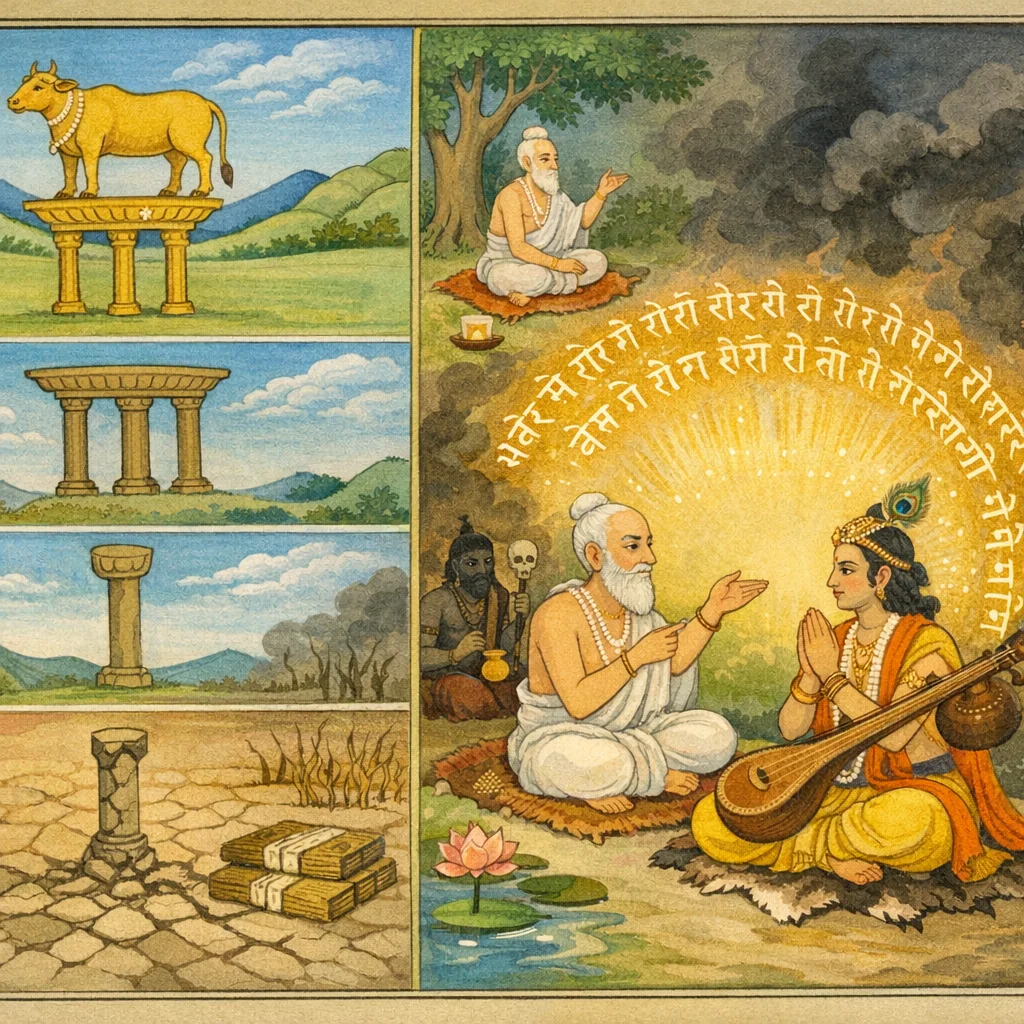
Nārada asks Sanaka for the defining marks, duration, and working conditions of the yugas. Sanaka explains the caturyuga scheme with its saṃdhyā and saṃdhyāṃśa, and recounts dharma’s steady decline from Kṛta to Kali, noting Hari’s yuga-associated hues and the division of the Veda in Dvāpara. The chapter then paints a detailed picture of Kali-yuga: decay of vows and rites, hypocrisy within social orders, political oppression, confusion of roles, famine and drought, and the rise of heretical impostors. Yet Sanaka declares that Kali cannot harm those devoted to Hari, and teaches the chief disciplines for each yuga—culminating in Kali’s stress on dāna and especially nāma-saṅkīrtana. Several litanies of Hari’s names (and also Śiva’s) are given as protection and liberation. The discourse closes by turning from yuga-dharma to mokṣa-dharma: Nārada seeks an illustrative account of Brahman; Sanaka directs him to Sanandana, beginning a Vedāntic sequence on release.
Shlokas
Verse 1
नारद उवाच । आख्यातं भवता सर्वं मुने तत्त्वार्थ कोविद । इदानीं श्रोतुमिच्छामि युगानां स्थितिलक्षणम् ॥ १ ॥
Nārada said: “O sage, knower of the true purport of reality, you have explained everything. Now I wish to hear the defining characteristics and the established course—its duration and condition—of the Yugas.”
Verse 2
सनक उवाच । साधु साधु महाप्राज्ञ मुने लोकोपकारक । युगधर्मान्प्रबक्ष्यामि सर्वलोकोपकारकान् ॥ २ ॥
Sanaka said: “Well said, well said, O greatly wise sage, benefactor of the world. Now I shall expound the duties of the ages (yuga-dharmas) that bring welfare to all worlds.”
Verse 3
धर्मो विवृद्धिमायाति काले कस्मिंस्चिदुत्तम । तथा विनासमायाति धर्म्म एव महीतले ॥ ३ ॥
O noble one, at certain times Dharma grows and flourishes; and likewise, upon the earth itself, Dharma also declines and comes to ruin.
Verse 4
कृतं त्रेता द्वापरं च कलिश्चेति चतुर्युगम् । दिव्यैर्द्वादशभिर्ज्ञेयं वत्सरैस्तत्र सत्तम ॥ ४ ॥
Kṛta, Tretā, Dvāpara, and Kali—these four together constitute a caturyuga. O best of the virtuous, know that its measure is twelve divine years.
Verse 5
संध्यासन्ध्यांशयुक्तानि युगानि सदृशानि वै । कालतो वेदितव्यानि इत्युक्तं तत्त्वादर्शिभिः ॥ ५ ॥
The Yugas are indeed comparable in structure, being furnished with their twilight (saṃdhyā) and twilight-portions (saṃdhyāṃśa). They are to be understood according to their measure of time—so have the seers of truth declared.
Verse 6
आद्ये कृतयुगं प्राहुस्ततस्त्रेताविधानकम् । ततश्च द्वापरं प्राहुः कलिमंत्यं विदुः क्रमात् ॥ ६ ॥
They declare that first comes the Kṛta (Satya) Yuga; after that the Tretā Yuga, established in its own order; then they speak of the Dvāpara; and finally, in due sequence, they know Kali as the last.
Verse 7
देवदानवगंधर्वा यक्षराक्षसपन्नगाः । नासन्कृतयुगे विप्र सर्वे देवसमाः स्मृताः ॥ ७ ॥
In the Kṛta Yuga, O brāhmaṇa, there were no distinctions such as gods, Dānavas, Gandharvas, Yakṣas, Rākṣasas, or nāgas; all were remembered as equal to the gods.
Verse 8
सर्वे हृष्टाश्च धर्मिष्टा न तत्र क्रयविक्रयौ । वेदानां च विभागश्च न युगे कृतसंज्ञके ॥ ८ ॥
In the age called Kṛta, all were joyful and firmly established in Dharma; there was no buying or selling there, and even the division of the Vedas did not exist.
Verse 9
ब्राह्मणाः क्षत्रिया वैश्याः शूद्राः स्वाचारतत्पराः । सदा नारायणपरास्तपोध्यानपरायणाः ॥ ९ ॥
Brahmins, Kshatriyas, Vaishyas, and Shudras—devoted to their own proper conduct—are always devoted to Nārāyaṇa, intent on austerity, and dedicated to meditation.
Verse 10
कामादिदोषनिर्मुक्ताः शमादिगुणतत्पराः । धर्मसाधनचित्ताश्च गतासूया अदांभिकाः ॥ १० ॥
Freed from faults such as desire, devoted to virtues beginning with tranquility, intent upon the means of Dharma, devoid of envy, and without hypocrisy—such people are fit for the higher path.
Verse 11
सत्यवाक्यरताः सर्वे चतुराश्रमधर्मिणः । वेदाध्ययनसंपन्नाः सर्वशास्त्रविचक्षणाः ॥ ११ ॥
All were devoted to truthful speech, established in the duties of the four āśramas, accomplished in Vedic study, and discerning in every branch of sacred learning.
Verse 12
चतुराश्रमयुक्तेन कर्मणा कालयोनिना । अकामफलसंयोगाः प्रयांति परमां गतिम् ॥ १२ ॥
By action grounded in the four āśramas and shaped by the order of time, those not bound to desire-born results attain the supreme state.
Verse 13
नारायणः कृतयुगे शुक्लवर्णः सुनिर्मलः । त्रेताधर्मान्प्रवक्ष्यामि श्रृणुष्व सुसमाहितः ॥ १३ ॥
In the Kṛta Yuga, Nārāyaṇa is white in hue, perfectly pure. Now I shall explain the dharmas of the Tretā Yuga—listen with a well-collected mind.
Verse 14
धर्मः पांडुरतां याति त्रेतायां मुनिसत्तम । हरिस्तु रक्तातां याति किंचित्क्लेशान्विता जनाः ॥ १४ ॥
O best of sages, in the Tretā Yuga Dharma turns pale, losing its full vigor, while Hari takes on a reddish hue; and people become touched by a measure of hardship.
Verse 15
क्रियायोगरताः सर्वे यज्ञकर्मसु निष्टिताः । सत्यव्रता ध्यानपराः सदाध्यानपरायणाः ॥ १५ ॥
All were devoted to kriyā-yoga, firmly established in sacrificial rites (yajña). They were vowed to truth, intent on meditation (dhyāna), and ever wholly dedicated to meditation.
Verse 16
द्विपादो वर्तते धर्मो द्वापरे च मुनीश्वर । हरिः पीतत्वमायाति वेदश्चापि विभज्यते ॥ १६ ॥
O best of sages, in the Dvāpara age Dharma stands upon two legs; Hari assumes a yellow hue, and the Veda too becomes divided.
Verse 17
असत्यनिरताश्चापि केचित्तत्र द्विजोत्तमाः । ब्राह्मणाद्याश्च वर्णाः स्युः केचिद्रागादिदुर्गुणाः ॥ १७ ॥
O best of the twice-born, there too some are devoted to untruth; and among the social orders beginning with the brāhmaṇas, some are marked by faults such as attachment (rāga) and other vices.
Verse 18
केचित्स्वर्गापवर्गार्थं विप्रयज्ञान्प्रकुर्वते । केचिद्धनादिकामाश्च केचित्कल्मषचेतसः ॥ १८ ॥
Some perform the sacrifices prescribed for brāhmaṇas seeking heaven or final liberation (apavarga); some do so desiring wealth and other gains; and some, with minds tainted by sin, perform them from impure motives.
Verse 19
धर्माधर्मौ समौ स्यातां द्वापरे विप्रसत्तम । अधर्मस्य प्रभावेण क्षीयंते च प्रजास्तथा ॥ १९ ॥
O best of brāhmaṇas, in the Dvāpara age dharma and adharma become evenly matched; and under the influence of adharma, the creatures and people likewise decline and waste away.
Verse 20
अल्पायुषो भविष्यंति केचिञ्चापि मुनीश्वर । केचित्पुण्यरतान् दृष्ट्वा असूयां विप्र कुर्वते ॥ २० ॥
O best of sages, some people will be short-lived; and some, O brāhmaṇa, on seeing those devoted to meritorious deeds, will fall into jealousy and fault-finding.
Verse 21
कलिस्थितिं प्रवक्ष्यामि तच्छृणुष्व समाहितः । धर्मः कलियुगे प्राप्ते पादेनैकेन वर्तते ॥ २१ ॥
I shall describe the condition of the Kali age—listen with a collected mind. When the Kali-yuga arrives, Dharma stands on only a single foot, a mere quarter of its full strength.
Verse 22
तामसं युगमासाद्य हरिः कृष्णत्वमेति च । यः कश्चिदपि धर्मात्मा यज्ञाचारान्करोति च ॥ २२ ॥
When the tāmasa age (Kali) arrives, Hari indeed assumes the form of Kṛṣṇa; and whoever is righteous at heart, continuing the prescribed disciplines of yajña, remains established in dharma.
Verse 23
यः कश्चिदपि पुण्यात्मा क्रियायोगरतो भवेत् । नरं धर्मरतं दृष्ट्वा सर्वेऽसूयां प्रकुर्वते ॥ २३ ॥
Even if someone is virtuous and devoted to disciplined practice in kriyā-yoga, on seeing a man steadfast in dharma, people still tend to indulge in envy and fault-finding.
Verse 24
व्रताचाराः प्रणश्यंति ज्ञानयज्ञादयस्तथा । उपद्रवा भविष्यंति ह्यधर्मस्य प्रवतनात् ॥ २४ ॥
With adharma spreading, observances of vows and right conduct will perish; likewise, sacrifices rooted in knowledge (jñāna-yajña) and other sacred rites will decline, and calamities will arise.
Verse 25
असूयानिरताः सर्वे दंभाचारपरायणाः । प्रजाश्चाल्पायुषः सर्वा भविष्यंति कलौ युगे ॥ २५ ॥
In the Kali-yuga, all people will be absorbed in envy and devoted to hypocritical conduct; and all beings will become short-lived.
Verse 26
नारद उवाच । युगधर्माः समाख्यातास्त्वया संक्षेपतो मुने । कलिं विस्तरतो ब्रूहि त्वं हि धर्मविदां वरः ॥ २६ ॥
Narada said: “O sage, you have briefly declared the dharmas of the yugas. Now speak of Kali-yuga in full detail, for you are the foremost among the knowers of Dharma.”
Verse 27
ब्राह्मणाः क्षत्रिया वैश्याः शूद्राश्चमुनिसत्तम । किमाहाराः किमाचाराः भविष्यंति कलौ युगे ॥ २७ ॥
O best of sages, what food will brāhmaṇas, kṣatriyas, vaiśyas, and śūdras partake of, and what conduct will they follow in the age of Kali?
Verse 28
सनक उवाच । श्रृणुष्व मुनिशार्दूल सर्वलोकोपकारक । कलिधर्मान्प्रवक्ष्यामि विस्तरेण यथातथम् ॥ २८ ॥
Sanaka said: “Listen, O tiger among sages, benefactor of all the worlds. I shall expound the dharmas of the Kali age in due detail—fully and exactly, as they truly are.”
Verse 29
सर्वे धर्मा विनश्यंति कृष्णे कृष्णत्वमागते । तस्मात्कलिर्महाघोरः सर्वपातकसंकरः ॥ २९ ॥
When Kṛṣṇa returns to His own divine state (departing from this world), all forms of dharma decline and perish. Therefore Kali becomes exceedingly dreadful—a confounding mixture that breeds every kind of sin.
Verse 30
ब्राह्मणाः क्षत्रिया वैश्याः शूद्रा धर्मपराङ्मुखाः । घोरे कलियुगे प्राप्ते द्विजा वेदपराङ्मुखाः ॥ ३० ॥
When the dreadful Kali-yuga arrives, brāhmaṇas, kṣatriyas, vaiśyas, and śūdras all turn away from dharma; and the twice-born (dvijas) turn away from the Veda.
Verse 31
व्याजधर्मरताः सर्वे असूयानिरतास्तथा । वृथाहंकारदुष्टाश्च सत्यहीनाश्च पंडिताः ॥ ३१ ॥
All become devoted to pretended religiosity, absorbed in fault-finding; corrupted by vain pride, and—though called “learned”—devoid of truthfulness.
Verse 32
अहमेवाधिक इति सर्वेऽपि विवदंति च । अधर्मलोलुपाः सर्वे तथा वैतंहिका नराः ॥ ३२ ॥
All of them argue, saying, “I alone am superior.” They are all greedy for unrighteousness; such men are also deceitful and hypocritical.
Verse 33
अतः स्वल्पायुषः सर्वे भविष्यंति कलौ युगे । अल्पायुष्ट्वान्मनुष्याणां न विद्याग्रहणं द्विज ॥ ३३ ॥
Therefore, in the age of Kali all people will become short-lived. Because human beings have little lifespan, O twice-born one, there will be no proper acquisition of sacred learning.
Verse 34
विद्याग्रहणशून्यत्वादधर्मो वर्तते पुनः । युत्क्रमेण प्रजाः सर्वा म्रियंते पापतत्पराः ॥ ३४ ॥
Because people are devoid of receiving and cultivating true knowledge, unrighteousness rises again; and in due sequence, all beings perish—intent on sin.
Verse 35
ब्राह्मणाद्यास्तथा वर्णाः संकीर्यंते परस्परम् । कामक्रोधपरा मूढा वृथासंतापपीडिताः ॥ ३५ ॥
Thus the social orders beginning with the brāhmaṇas become mixed with one another. Driven by desire and anger, people grow deluded and are tormented by needless misery.
Verse 36
शूद्रतुल्या भविष्यंति सर्वे वर्णा कलौ युगे । उत्तमा नीचतां यांति नीचाश्चोत्तमतां तथा ॥ ३६ ॥
In the Kali age, all the varṇas will become like Śūdras; the noble will sink into lowliness, and the lowly will likewise rise to high station.
Verse 37
राजनो द्रव्यनिरतास्तथा ह्यन्यायवर्त्तिनः । पीडयंति प्रजाश्चैव करैरत्यर्थयोजितैः ॥ ३७ ॥
Kings, engrossed in wealth and treading the path of injustice, will oppress their subjects by imposing taxes that are excessively burdensome.
Verse 38
शववाहाभविष्यंति शूद्राणां च द्विजातयः । धर्मस्त्रीष्वपि गच्छंति पतयो जारधर्मिणः ॥ ३८ ॥
In times to come, the twice-born (dvija) will become bearers of corpses for the Śūdras; and even righteousness will pass to women, while husbands will live by the conduct of adulterers.
Verse 39
द्विषंति पितरं पुत्रा भर्तारं च स्त्रियोऽखिलाः । परिस्त्रीनिरतः सर्वे परद्रव्यपरायणाः ॥ ३९ ॥
Sons will hate their fathers, and all wives will despise their husbands. Everyone will be addicted to other men’s wives and devoted to other people’s wealth.
Verse 40
मत्स्यामिषेण जीवंति दुहंतश्चाप्यजीविकाम् । घोरे कलियुगे विप्र सर्वे पापरता जनाः ॥ ४० ॥
O brāhmaṇa, in the dreadful Kali-yuga people will make their living by fish and meat, and even by milking as a livelihood; all will become devoted to sin.
Verse 41
सतामसूयानिरतां उपहासं प्रकुर्वते । सरित्तीरेषु कुद्दालैर्वापयिष्यंति चौषधीः ॥ ४१ ॥
They will delight in envy of the virtuous and mock them; and on the banks of rivers they will dig with spades and plant medicinal herbs.
Verse 42
पृथ्वी निष्फलतां याति बीजं पुष्पं विनश्यति । वेश्यालावंयशीलेषु स्पृहा कुर्वंति योषितः ॥ ४२ ॥
The earth will become unproductive; seeds and blossoms will perish. Women will come to long for the beauty and ways of courtesans.
Verse 43
धर्मविक्रयिणो विप्राः स्त्रियश्च भगविक्रयाः । वेदविक्रयकाश्चान्ये शूद्राचाररता द्विजाः ॥ ४३ ॥
Brāhmaṇas will become sellers of dharma; women will become sellers of the body; others will become sellers of the Veda; and the twice-born will delight in the conduct of śūdras.
Verse 44
साधूनां विधवानां च वित्तान्यपहरंति च । न व्रतानि चरिष्यन्ति ब्राह्मणा द्रव्यलोलुपाः ॥ ४४ ॥
They will even seize the wealth of the virtuous and of widows; and brāhmaṇas, greedy for riches, will no longer observe the sacred vows (vratas).
Verse 45
धर्माचारं परित्यज्य वृथावादैर्विषज्जिताः । द्विजाः कुर्वंति दंभार्थं पितृश्राद्धादिकाः क्रियाः ॥ ४५ ॥
Abandoning righteous conduct and tainted by meaningless talk, some twice-born men will perform rites such as the ancestral śrāddha only for the sake of show and hypocrisy.
Verse 46
अपात्रेष्वेव दानानि प्रयच्छंति नराधमाः । दुग्धलोभनिमित्तेन गोषु प्रीतिं च कुर्वते ॥ ४६ ॥
The basest of men bestow gifts only upon the unworthy, and they show affection toward cows merely out of greed for milk.
Verse 47
न कुर्वंति तथा विप्राः स्नानशौचादिकाः क्रियाः । अपात्रेष्वेव दानानि प्रयच्छंति नराधमाः ॥ ४७ ॥
Such brāhmaṇas do not perform the prescribed acts like bathing and ritual purity; and those lowest among men give gifts only to unworthy recipients.
Verse 48
साधुनिंदापराश्चैव विप्रनिंदापरास्तथा । न कस्यापि मनो विप्र विष्णुभक्तिपरं भवेत् ॥ ४८ ॥
O Brāhmaṇa, those devoted to criticizing the virtuous, and likewise those intent on criticizing brāhmaṇas—no one’s mind, in their case, becomes inclined toward devotion (bhakti) to Lord Viṣṇu.
Verse 49
यज्विनश्च द्विजानैव धनार्थराजकिंकराः । ताडयंति द्विजान्दुष्टाः कृष्णे कृष्णत्वमागते ॥ ४९ ॥
When Kṛṣṇa has come in His own dark-hued form, wicked servants of kings—greedy for wealth—strike even the twice-born brāhmaṇas and the sacrificers.
Verse 50
दानहीना नराः सर्वे घोरे कलियुगे मुने । प्रतिग्रहं प्रकुर्वंति पतितानामपि द्विजाः ॥ ५० ॥
O sage, in the dreadful Kali Yuga all people are devoid of charity; even the twice-born accept gifts indiscriminately, even from the fallen.
Verse 51
कलेः प्रथमपादेऽपि विंनिंदंति हरिं नराः । युगान्ते च हरेर्नाम नैवकश्चिद्वदिष्यति ॥ ५१ ॥
Even in the very first quarter of Kali-yuga, people revile Hari; and at the end of the age, no one at all will even utter the name of Hari.
Verse 52
शूद्रस्त्रीसंगनिरता विधवासंगलोलुपाः । शूद्रान्नभोगनिरता भविष्यंति कलौ द्विजाः ॥ ५२ ॥
In the age of Kali, the twice-born will become given to the company of Śūdra women, eager for association with widows, and devoted to enjoying food obtained from Śūdras.
Verse 53
विहाय वेदसन्मार्गं कुपथाचारसंगताः । पाषंडाश्चभविशष्यंतिचतुराश्रमनिंदकाः ॥ ५३ ॥
Abandoning the true path of the Vedas and associating with corrupt practices on a wrong road, they will become heretics and will revile the fourfold system of āśramas (the stages of life).
Verse 54
न चद्विजा तिशुश्रूषां कुर्वंति चरणोद्भवाः । द्विजातिधर्मान्गृह्णन्ति पाखण्डलिङ्गिनोऽधमाः ॥ ५४ ॥
And those born from the feet do not render service to the twice-born; while the lowest of men—bearing the marks of heretical sects—appropriate the duties and practices meant for the twice-born.
Verse 55
काषायपरिवीताश्च जटिला भस्मधूलिताः । शूद्राधर्मान्प्रवक्ष्यंती कूटयुक्तपरायणाः ॥ ५५ ॥
Clad in ochre garments, wearing matted locks, and smeared with ash and dust, they will proclaim doctrines of dharma meant for śūdras—being devoted to deceit and contrivance.
Verse 56
द्विजाःस्वाचारमुत्स्सृज्यचपरपाकान्नभोजिनः । भविष्यंतिदुरात्मानः शूद्राः प्रव्रजितास्तथा ॥ ५६ ॥
Abandoning their own prescribed conduct, the twice-born will eat food cooked by others and become wicked-minded. Likewise, even the śūdras will take up the life of renunciation.
Verse 57
उत्कोचजीविनस्तत्र भविष्यंति कलौ मुने । धर्मटीनास्तु पाषंडा कापाला भिक्षवोऽधमाः ॥ ५७ ॥
O sage, in the age of Kali there will arise those who make their living by bribes. And there will be heretical impostors who wear the guise of Dharma—kapāla-bearing mendicants and base monks.
Verse 58
धर्मविध्वंसशीलानां द्विजानां द्विजसत्तम । शूद्रा धर्मान्प्रवक्ष्यंतिह्यधिरुह्योत्तमासनम् ॥ ५८ ॥
O best of the twice-born, when the twice-born become bent on the ruin of Dharma, the śūdras will mount the highest seat and begin expounding Dharma.
Verse 59
एते चान्येच बहवो नग्नरक्तपटादिकाः । पाषंडाः प्रचारिष्यंति प्रायो वेदविदूषकाः ॥ ५९ ॥
These and many others—marked by nakedness, red garments, and the like—will spread as heretical factions, and for the most part they will defile and corrupt the Veda.
Verse 60
गीतवादित्रकुशलाः क्षुद्रधर्मसमाश्रयाः । भविष्यंतिकलौ प्रायो धर्मविध्वंसका नराः ॥ ६० ॥
In the age of Kali, most people will be skilled in song and in playing instruments, yet they will take refuge in petty, superficial forms of religion—and thus become destroyers of true Dharma.
Verse 61
अल्पद्रव्या वृथालिंगा वृथाहंकारदूषिताः । हर्तारं परवित्तानां भवितारो नराधमाः ॥ ६१ ॥
Those of scant means, who wear outward marks in vain and are stained by hollow pride—such lowest of men become thieves, stealing the wealth of others.
Verse 62
प्रतिग्रहपरा नित्यं जगदुन्मार्गशीलिनः । आत्मस्तुतिपराः सर्वे परनिंदापरास्तथा ॥ ६२ ॥
They are ever intent on accepting gifts, habitually leading the world onto a wrong path; all are devoted to self-praise and likewise devoted to censuring others.
Verse 63
विश्वस्तघातिनः क्रूरा दयाधर्मविवर्जिताः । भविष्यंति नरा विप्र कलौ चाधर्मबांधवाः ॥ ६३ ॥
O brāhmaṇa, in the age of Kali people will become treacherous—betraying those who trust them—cruel, and devoid of compassion and dharma; indeed, in Kali they will be companions and kinsmen of unrighteousness.
Verse 64
परमायुश्च भविता तदा वर्षाणि षोडश । घोरे कलियुगे विप्र पंचवर्षा प्रसूयते ॥ ६४ ॥
Then the maximum lifespan will be only sixteen years. O brāhmaṇa, in the dreadful Kali-yuga, a girl will give birth at the age of five.
Verse 65
सप्तवर्षाष्टवर्षाश्च युवानोऽतः परे जरा । स्वकर्मत्यागिनः सर्वे कृतघ्नाभिन्नवृत्तयः ॥ ६५ ॥
Some are seven or eight years old; others are youths, and beyond that are the aged. All abandon their own proper duties; they are ungrateful, and their conduct is divided and inconsistent.
Verse 66
याचकाश्चद्विजा नित्यं भविष्यंति कलौ युगे । परावमाननिरताः प्रहृष्टाः परवेश्मनि ॥ ६६ ॥
In the age of Kali, even the twice-born will continually become beggars—ever intent on insulting others, and delighting in the houses of strangers.
Verse 67
तत्रैव निंदानिरता वृथाविश्रंभिणो जनाः । निदां कुर्वंति सततं पितृमातृसुतेषु च ॥ ६७ ॥
There itself, people become absorbed in fault-finding and place trust in others without discernment; they constantly engage in slander—even against their own father, mother, and children.
Verse 68
वदंति वाचा धर्मांश्च चेतसा पापलोलुपाः । धनविद्यावयोमत्ताः सर्वदुःखपरायणाः ॥ ६८ ॥
They speak of dharma with their mouths, yet in their minds they hanker after sin. Intoxicated with wealth, learning, and youth, they become devoted only to every kind of sorrow.
Verse 69
व्याधितस्करदुर्भिक्षैः पीडिता अतिमांयिनः । प्रपुष्यंति वृथैवामी न विचार्य च दुष्कृतम् ॥ ६९ ॥
Afflicted by disease, thieves, and famine, the excessively deluded still struggle on in vain—without reflecting on their own misdeeds.
Verse 70
धर्ममार्गप्रणेतारं तिरस्कुर्वंति पापिनः । धर्मकार्ये रतं चैव वृथाविश्रंभिणो जनाः ॥ ७० ॥
Sinners disparage the one who lays down the path of dharma; and people who place their trust in vain also mock the person who is devoted to righteous action.
Verse 71
भविष्यंति कलौ प्राप्ते राजानो म्लेच्छजातयः । शूद्रा भैक्ष्यरताश्चैव तेषां शुश्रूषणे द्विजाः ॥ ७१ ॥
When the age of Kali arrives, kings will arise from mleccha (foreign and impious) lineages; Śūdras will be devoted to begging, while the twice-born (dvijas) will be engaged in serving them.
Verse 72
न शिष्यो न गुरुः कश्चिन्न पुत्रो न पिता तथा । न भार्या न पतिश्चैव भवितारोऽत्र संकरे ॥ ७२ ॥
In this confusion and intermixture, there will be no true disciple and no true teacher; likewise no real son and no real father. Neither wife nor husband will truly remain as such amid this disorder.
Verse 73
कलौ गते भविष्यंति धनाढ्या अपि याचकाः । रस विक्रयिणश्चापि भविष्यंति द्विजातयः ॥ ७३ ॥
As the age of Kali advances, even the wealthy will become beggars; and the twice-born too will become sellers of tastes and pleasures—worldly enjoyments.
Verse 74
धर्मकंचुकसंवीता मुनिवेषधरा द्विजाः । अपण्यविक्रयरता अगम्यागामिनस्तथा ॥ ७४ ॥
Brahmins, wrapped in the cloak of “dharma” and wearing the guise of sages, will delight in trading what should not be traded, and will go to women who ought not be approached.
Verse 75
वेदनिंदापराश्चैव धर्मशास्त्रविनिंदुकाः । शूद्रवृत्त्यैव जीवंति नरकार्हा द्विजा मुने ॥ ७५ ॥
And those dvijas who are intent on reviling the Vedas and who disparage the Dharmaśāstras—living only by occupations deemed proper to śūdras—O sage, are fit for hell.
Verse 76
अनावृष्टभयं प्राप्ता गगनासक्तदृष्टयः । भविष्यंति कलौ मर्त्यासर्वे क्षुद्भयकातराः ॥ ७६ ॥
In the Kali age, mortals will be seized by fear of drought; their gaze will remain fixed upon the sky, and all will be distressed and shaken by the fear of hunger.
Verse 77
कंदपर्णफलाहारास्तापंसा इव मानवाः । आत्मानं तारयिष्यंति अनावृष्ट्यातिदुखिताः ॥ ७७ ॥
Tormented by extreme suffering due to drought, people will sustain and save themselves by living on roots, leaves, and fruits—like ascetics engaged in austerity.
Verse 78
कामार्ता ह्रस्वदेहाश्च लुब्धा श्चाधर्मतत्पराः । कलौ सर्वे भविष्यंति स्वल्पभाग्या बहुप्रजाः ॥ ७८ ॥
In the age of Kali, all people will become tormented by desire, short in stature, greedy, and devoted to unrighteousness; they will be of little fortune, yet have many children.
Verse 79
स्त्रियः स्वपोषणपरा वेश्या लावण्यशीलिकाः । पतिवाक्यमनादृत्य सदान्यगृहतत्पराः ॥ ७९ ॥
Women, intent on their own maintenance—courtesans and those who are charming and coquettish—will disregard a husband’s words and will ever be devoted to another man’s household.
Verse 80
दुःशीला दुष्टशीलेषु करिष्यिंति सदा स्पृहाम् । असद्वृत्ता भविष्यंति पुरुषेषु कुलांगनाः ॥ ८० ॥
Women of bad conduct will always long for men of wicked character; and even women of good family will become of improper conduct among men.
Verse 81
चौरादिभयभीताश्च काष्टयंत्राणि कुर्वते । दुर्भिक्षकरपीडाभिरतीवोपद्रुता जनाः ॥ ८१ ॥
Terrified by thieves and other perils, people fashion wooden contrivances for protection. Stricken by famine and crushed by oppressive taxes, the populace is sorely distressed.
Verse 82
गोधूमान्नयवान्नाढ्ये देशे यास्यंति दुःखिताः । निधाय हृद्यकर्मणि प्रेरयंति वचः शुभम् ॥ ८२ ॥
The distressed go to a land abundant in wheat and barley fare. Fixing their minds on what gladdens and benefits the heart, they speak auspicious, heartening words.
Verse 83
स्वकार्यसिद्धिपर्यंतं बंधुतां कुर्वते जनाः । भिक्षवश्चाव मित्रादिस्नेहसंबंधयंत्रिताः ॥ ८३ ॥
People keep kinship only until their own ends are achieved. Even mendicants may become bound, ensnared by affection and ties of relationship such as friendship.
Verse 84
अन्नोपाधिनिमित्तेन शिष्यान्गृह्णंति भिक्षवः ॥ ८४ ॥
Using food as a pretext, mendicants take on disciples.
Verse 85
उभाभ्यामथ पाणिभ्यां शिरःकंडूयनं स्त्रियः । कुर्वंत्यो गुरुभर्तॄणामाज्ञामुल्लंघयंति च ॥ ८५ ॥
Moreover, women who scratch their heads with both hands also transgress the commands of their elders and their husbands.
Verse 86
पाषंडालापनिरताः पाषंडजनसंगिनः । यदा द्विजा भविष्यंति तदा वृद्धिं कलिर्व्रजेत् ॥ ८६ ॥
When the twice-born become absorbed in speaking with heretics (pāṣaṇḍas) and keep company with heretical people, then the Age of Kali advances and grows in strength.
Verse 87
यदा प्रजा न यक्ष्यंति न होष्यंति द्विजातयः । तदैव तु कलेर्वृद्धिरनुमेया विचक्षणैः ॥ ८७ ॥
When people no longer perform sacrifices (yajña), and the twice-born no longer maintain the sacred fires, then the wise should understand that the power of Kali has certainly increased.
Verse 88
अधर्मवृद्धिर्भविता बासमृत्युरपि द्विजा । सर्वधर्मेषु नष्टेषु याति निःश्रीकतां जगत् ॥ ८८ ॥
O twice-born ones, unrighteousness (adharma) will increase, and even untimely death will occur; when all forms of dharma are destroyed, the world falls into a state devoid of prosperity and auspiciousness.
Verse 89
एवं कलेः स्वरूपं ते कथितं विप्रसत्तम । हरिभक्तिपरानेष न कलिर्बाधते क्वचित् ॥ ८९ ॥
Thus, O best of brāhmaṇas, the nature of Kali has been explained to you. But Kali never troubles those who are wholly devoted to bhakti for Hari (Viṣṇu).
Verse 90
ततः परं कृतयुगे त्रेतायुगे त्रेतायां ध्यानमेव च । द्वापरे यज्ञमेवाहुर्दानमेकं कलौ युगे ॥ ९० ॥
Thereafter they declare that in the Kṛta Yuga the foremost practice is meditation (dhyāna); in the Tretā Yuga as well, meditation indeed. In the Dvāpara Yuga, they say sacrifice (yajña) is the chief means; while in the Kali Yuga, giving (dāna) alone is the principal dharma.
Verse 91
यत्कृते दशभिर्वर्षैस्त्रेतायां शरदा च यत् । द्वापरे यञ्च मासेन ह्यहोरात्रेण तत्कलौ ॥ ९१ ॥
The spiritual fruit attained in the Kṛta-yuga by ten years of practice, in the Tretā-yuga by one autumn season, and in the Dvāpara-yuga by one month— that very same fruit is attained in the Kali-yuga in a single day and night.
Verse 92
ध्यायन्कृते जयन्यज्ञैस्त्रेतायां द्वापरेऽर्चयन् । यदाप्नोति तदाप्नोति कलौ संकीर्त्य केशवम् ॥ ९२ ॥
Whatever attainment one gains in the Kṛta-yuga by meditation, in the Tretā-yuga by victory-sacrifices (yajñas), and in the Dvāpara-yuga by worship, that very same attainment is gained in the Kali-yuga simply by congregationally chanting Keśava’s name.
Verse 93
अहोरात्रं हरेर्नाम कीर्तयंति च ये नराः । कुर्वंति हरिपूजां वा न कलिर्बाधते च तान् ॥ ९३ ॥
Those who, day and night, sing the Name of Hari—or who perform worship of Hari—are not afflicted by the influence of Kali.
Verse 94
नमो नारायणायेति कीर्तयंति च ये नराः । निष्कामा वा सकामा वा न कलिर्बाधते च तान् ॥ ९४ ॥
Those who chant, “Obeisance to Nārāyaṇa,” whether desireless or desire-motivated—Kali, the age of quarrel, does not afflict them.
Verse 95
हरिनामपरा ये तु घोरे कलियुगे द्विज । त एव कृतकृत्याश्च न कलिर्बाधते हि तान् ॥ ९५ ॥
O twice-born one, in this dreadful age of Kali, those who are wholly devoted to the Name of Hari—only they are truly fulfilled; Kali does not afflict them.
Verse 96
हरिपूजापरा ये च हरिनामपरायणाः । त एव शिवतुल्याश्च नात्र कार्या विचारणा ॥ ९६ ॥
Those devoted to the worship of Hari and wholly dedicated to chanting Hari’s Name—those very persons are equal to Śiva; on this there is no need for further deliberation.
Verse 97
समस्तजगदाधारं परमार्थस्वरुपिणम् । घोरे कलियुगे प्राप्ते विष्णुं ध्यायन्न सीदति ॥ ९७ ॥
When the dreadful Kali Yuga has arrived, one who meditates on Viṣṇu—support of the entire universe and whose very nature is the Supreme Reality—does not fall into misery.
Verse 98
अहो अति सुभाग्यास्ते सकृद्वै केशवार्चकाः । घोरें कलियुगे प्राप्ते सर्वधर्मविवर्जिते ॥ ९८ ॥
Ah! Supremely fortunate indeed are those who worship Keśava even once—especially now that the dreadful Kali Age has arrived, an age in which all dharmic conduct is cast aside.
Verse 99
न्यूनातिरिक्तदोषाणां कलौ वेदोक्तकर्मणाम् । हरिस्मरणमेवात्र संपूर्णत्वविधायकम् ॥ ९९ ॥
In the Kali age, Vedic rites as enjoined in the scriptures are often marred by the faults of deficiency and excess; here, the remembrance of Hari alone is what makes them complete and fully effective.
Verse 100
हरे केशव गोविंद वासुदेव जगन्मय । इतीरयंति ये नित्यं नहि तान्बाधते कलिः ॥ १०० ॥
Those who constantly utter, “Hare, Keśava, Govinda, Vāsudeva, O all-pervading Lord of the universe,” are not afflicted by Kali.
Verse 101
शिव शंकर रुद्रेश नीलकंठ त्रिलोचन । इति जल्पंति ये वापि कलिस्तान्नापि बाधते ॥ १ ॥
Those who repeatedly utter, “Śiva, Śaṅkara, Rudreśa, Nīlakaṇṭha, Trilocana”—such persons are not afflicted at all by Kali and his influences.
Verse 102
महादेव विरूपाक्ष गंगाधर मृडाव्यय । इत्थं वदंति ये विप्र ते कृतार्था न संशयः ॥ २ ॥
O Brahmin, those who thus speak and praise, “Mahādeva, Virūpākṣa, Gaṅgādhara, Mṛḍa, Avyaya”—they are truly fulfilled in life; of this there is no doubt.
Verse 103
जनार्दन जगन्नात पीतांबरधराच्युत । इति वाप्युञ्चरंतीह न च तेषां कलेर्भयम् ॥ ३ ॥
Here, those who even utter the Lord’s names—“Janārdana, Jagannātha, Acyuta, the wearer of the yellow garment”—for them there is no fear of the Kali age.
Verse 104
संसारे सुलभाः पुंसां पुत्रदारधनादयः । घोरे कलियुगे विप्र हरिभक्तस्तु दुर्लभा ॥ ४ ॥
In worldly life, sons, wife, wealth, and the like are easily obtained by men; but in this dreadful Kali age, O brāhmaṇa, a true devotee of Hari is indeed rare.
Verse 105
कर्मश्रद्धाविहीना ये पाषंडा वेदनिंदकाः । अधर्मनिरता नैव नरकार्हा हरिस्मृतेः ॥ ५ ॥
Those heretics who are devoid of faith in sacred duties, who revile the Vedas, and who are devoted to unrighteousness—by the remembrance of Hari, they are not fit for hell (they are freed from that fate).
Verse 106
वेदमार्गबहिष्टानां जनानां पापकर्मणाम् । मनः शुद्धिविहीनानां हरिनाम्नैव निष्कृतिः ॥ ६ ॥
For those who stand outside the Vedic path, who commit sinful deeds and lack purity of mind, expiation is accomplished solely through the holy Name of Hari.
Verse 107
दैवाधीनं जगत्सर्वमिदं स्थावरजंगमम् । यथाप्रेरितमेतेन तथैव कुरुतें द्विज ॥ ७ ॥
This entire universe—both the immovable and the movable—rests upon divine ordinance. O twice-born one, beings act exactly as They impel them.
Verse 108
शक्तितः सर्वकर्माणि वेदोक्तानि विधाय च । समर्पयेन्महाविष्णौ नारायणपरायणः ॥ ८ ॥
Having performed, to the best of one’s ability, all actions enjoined by the Vedas, one wholly devoted to Nārāyaṇa should offer them all to Mahāviṣṇu.
Verse 109
समर्पितानि कर्माणि महविष्णौ परात्मनि । संपूर्णतां प्रयांत्येव हरिस्मरणमात्रतः ॥ ९ ॥
Actions offered to Mahāviṣṇu, the Supreme Self, attain complete fulfillment—indeed, merely through the remembrance of Hari.
Verse 110
हरिभक्तिरतानां च पापबंधो न जायते । अतोऽतिदुर्लभा लोके हरिभक्तिर्दुरात्मनाम् ॥ १० ॥
For those absorbed in bhakti to Hari, the bondage of sin does not arise. Therefore, in this world, devotion to Hari is exceedingly rare among the wicked-minded.
Verse 111
अहो हरिपरा ये तु कलौ घोरे भयंकरे । ते सुभाग्या महात्मानः सत्संगर हिता अपि ॥ ११ ॥
Ah! Those devoted to Hari, even in the dreadful and fearsome Kali age—such souls are truly fortunate, great-hearted indeed, and they too are blessed by satsaṅga, the company of the virtuous.
Verse 112
हरिस्मरणनिष्टानां शिवनामरतात्मनाम् । सत्यं समस्तकर्माणि यांति संपूर्णतां द्विज ॥ १२ ॥
O brāhmaṇa, truly, for those steadfast in remembrance of Hari, and whose whole being delights in the Name of Śiva, all their undertakings indeed reach complete fulfilment.
Verse 113
अहो भाग्यमहो भाग्यं हरिनाम रतात्मनाम् । त्रिदर्शेरपि ते पूज्याः किमन्यैर्बहुभाषितैः ॥ १३ ॥
Oh, what fortune—what extraordinary fortune—belongs to those whose hearts delight in the holy Name of Hari. Even the gods revere them; what need is there to say much more?
Verse 114
तस्मात्समस्तलोकानां हितमेव मयोच्यते । हरिनामपरान्मर्त्यान्न कलिर्बाधर्तक्वचित् ॥ १४ ॥
Therefore I declare what is truly beneficial for all worlds: mortals devoted to the Name of Hari are never afflicted by Kali at any time.
Verse 115
हरेर्नामैव नामैव नामैव मम जीवनम् । कलौ नास्त्येव नास्त्येव गतिरन्यथा ॥ १५ ॥
The Name of Hari alone—only the Name, only the Name—is my very life. In the Kali age there is truly no other way, no other way—no alternative path to liberation.
Verse 116
सूत उवाच । एवं स नारदो विप्राः सनकेन प्रबोधितः । परां निर्वृत्तिमापन्नः पुनरेतदुवाच ह ॥ १६ ॥
Sūta said: Thus, O brāhmaṇas, Nārada—having been instructed by Sanaka—attained the supreme state of detachment and peace, and then spoke these words again.
Verse 117
नारद उवाच । भगवन्सर्वशास्त्रज्ञ स्वयातिकरुणात्मना । प्रकाशितं जगज्ज्योतिः परं ब्रह्म सनातनम् ॥ १७ ॥
Nārada said: O Blessed One, knower of all the śāstras—by your own supremely compassionate nature you have revealed the Light of the universe: the eternal Supreme Brahman.
Verse 118
एतदेव परं पुण्यमेतदेव परं तपः । यः स्मरेत्पुंडरीकाक्षं सर्वपापविनाशनम् ॥ १८ ॥
This alone is the highest merit; this alone is the highest austerity: to remember Puṇḍarīkākṣa (Viṣṇu, the lotus-eyed Lord), the destroyer of all sins.
Verse 119
ब्रह्मन्नानाजगञ्चैतदेकचित्संप्रकाशितम् । त्वयोक्तं तत्प्रतीयेऽहं कथं दृष्टांतमंतरा ॥ १९ ॥
O Brahman, you have said that this manifold universe is illumined by the one Consciousness alone. I accept your statement—yet how is it to be understood without an illustrative example?
Verse 120
तस्माद्येन यथा ब्रह्म प्रतीतं बोधितेन तु । तदाख्याहि यथा चित्तं सीदत्स्थितिमवाप्नुयात् ॥ २० ॥
Therefore, tell me how Brahman is realized as it has been understood by the enlightened teacher, so that my mind—now sinking—may regain steadiness and peace.
Verse 121
एतच्छ्रुत्वा वचो विप्रा नारदस्य महात्मनः । सनकः प्रत्युवाचेदं स्मरन्नारायणं परम् ॥ २१ ॥
Hearing these words of the great-souled Nārada, the brāhmaṇa sages—Sanaka, remembering the Supreme Nārāyaṇa—replied as follows.
Verse 122
सनक उवाच । ब्रह्मन्नहं ध्यानपरो भवेयं सनंदनं पृच्छ यथाभिलाषम् । वेदांतशास्त्रे कुशलस्तवायं निवर्तयेद्वा परमार्यवंद्यः ॥ २२ ॥
Sanaka said: “O Brahman, I shall remain intent on meditation. Ask Sanandana whatever you wish; he is skilled in the śāstra of Vedānta, and—revered by the noblest—he will dispel your doubt and set you at peace.”
Verse 123
इतीरितं समाकर्ण्य सनकस्य स नारदः । सनंदनं मोक्षधर्मान्प्रष्टुं समुपचक्रमे ॥ २३ ॥
Having heard what Sanaka had thus declared, the sage Nārada then began to question Sanandana about the principles of liberation (mokṣa-dharma).
Frequently Asked Questions
It provides a technical time-architecture for yugas, indicating that each yuga is not only a duration but also has transitional “twilight” segments (saṃdhyā and saṃdhyāṃśa). This supports a śāstric reading where dharma’s condition changes gradually at boundaries, not merely abruptly, and it anchors ethical-historical claims in a cosmological measure.
The chapter repeatedly elevates remembrance and chanting of Hari’s names—especially congregational nāma-saṅkīrtana of Keśava—as the decisive protection from Kali and as a direct means to the same attainments achieved by longer disciplines in earlier yugas. It also states that Hari-smaraṇa completes Vedic rites that are otherwise marred by deficiency or excess in Kali.
After cataloging yuga conditions and Kali’s decline, it turns to the inner logic of liberation: Nārada asks how the one Consciousness (Brahman) illumines the manifold world and requests an illustrative explanation. Sanaka then directs him to Sanandana, explicitly transitioning the discourse from social-ritual dharma to Vedāntic realization.