The Greatness of Viṣṇu (Uttaṅka’s Hymn, Hari’s Manifestation, and the Boon of Bhakti)
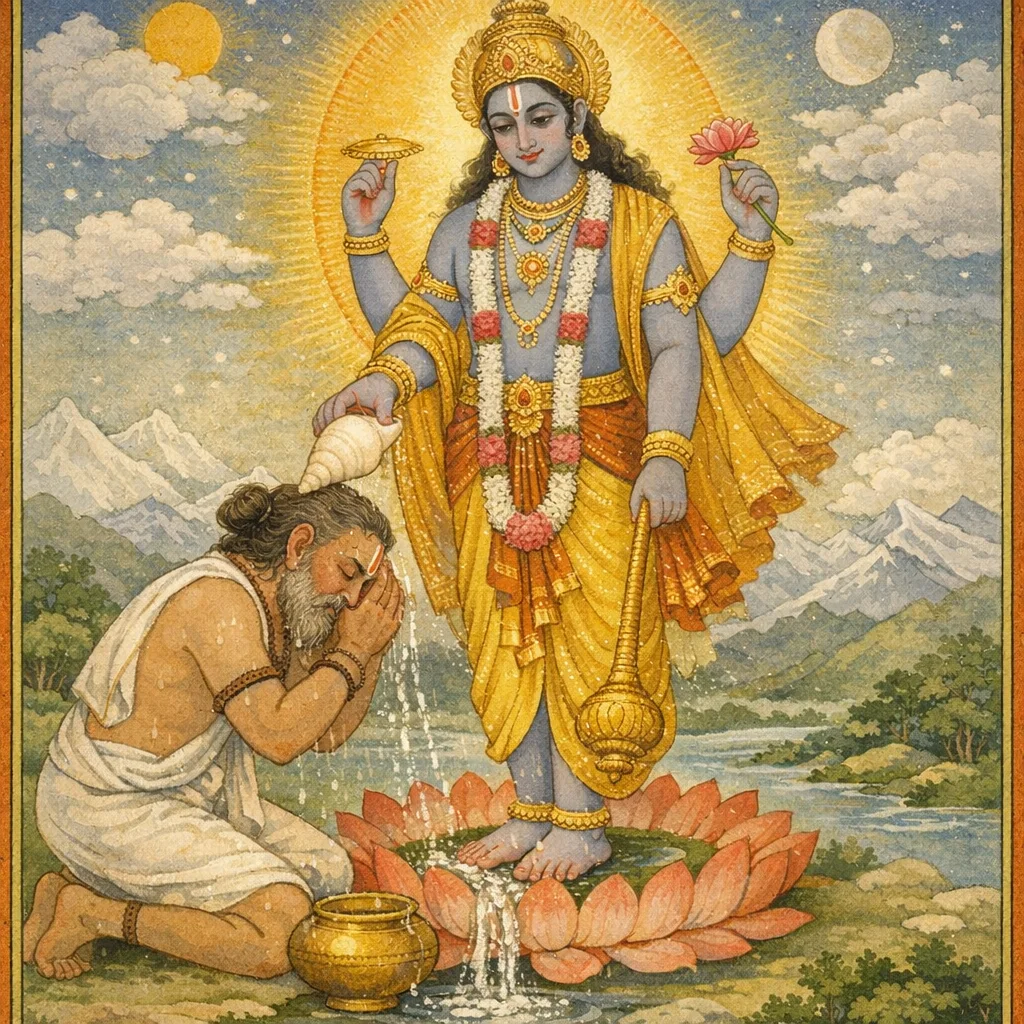
Nārada asks Sanaka about the hymn that pleased Janārdana (Viṣṇu) and the boon Uttaṅka received. Sanaka tells how Uttaṅka, devoted to Hari and inspired by the holiness of the Lord’s foot-water, recited a long stotra praising Viṣṇu as the primordial cause, the inner Self, and the truth beyond māyā and the guṇas, yet also as the immanent support of the cosmos. Moved by his surrender, Lakṣmī’s Lord appears in a vivid theophany; Uttaṅka prostrates, weeps, and bathes the Lord’s feet. Offered a boon, he asks only for unwavering bhakti through all births. Viṣṇu grants it, imparts rare divine knowledge by touching him with the conch, and instructs him to worship by kriyā-yoga and go to Nara-Nārāyaṇa’s abode for liberation. The phalaśruti concludes that reciting or hearing this chapter removes sins, fulfills aims, and leads to mokṣa.
Shlokas
Verse 1
नारद उवाच । किं तत्स्तोत्रं महाभाग कथं तुष्टो जनार्दनः । उत्तङ्कः पुण्यपुरुषः कीदृशं लब्धवान्वरम् 1. ॥ १ ॥
Nārada said: “O greatly fortunate one, what was that hymn of praise? How was Janārdana (Viṣṇu) pleased? And what kind of boon did the virtuous Uttaṅka obtain?”
Verse 2
सनक उवाच । उत्तङ्कस्तु तदा विप्रो हरिध्यानपरायणः । पादोदकस्य माहात्म्यं दृष्ट्वा तुष्टाव भक्तितः ॥ २ ॥
Sanaka said: Then the brāhmaṇa Uttanka, wholly devoted to meditation on Hari, having beheld the greatness of the pādodaka—the water that has washed the Lord’s feet—praised it with devotion.
Verse 3
उत्तङ्क उवाच । नतोऽस्मि नारायणमादिदेवं जगन्निवासं जगदेकबन्धुम् । चक्राब्जशार्ङ्गासिधरं महान्तं स्मृतार्तिनिघ्नं शरणं प्रपद्ये ॥ ३ ॥
Uttaṅka said: I bow to Nārāyaṇa, the primordial Lord—the abode of the universe, the sole kinsman of all the worlds—great, bearing the discus, lotus, Śārṅga bow, and sword. He who destroys the distress of those who remember Him, to Him I take refuge.
Verse 4
यन्नाभिजाब्जप्रभवो विधाता सृजत्यमुं लोकसमुच्चयं च । यत्क्रोधतो हन्ति जगच्च रुद्र स्तमादिदेवं प्रणतोऽस्मि विष्णुम् ॥ ४ ॥
I bow to that primal God, Vishnu—by whom the Creator, Brahmā, born from the lotus arising from His navel, brings forth this entire aggregate of worlds; and from whose wrath Rudra destroys the universe.
Verse 5
पद्मापतिं पद्मदलायताक्षं विचित्रवीर्यं निखिलैकहेतुम् । वेदान्तवेद्यं पुरुषं पुराणं तेजोनिधिं विष्णुमहं प्रपन्नः ॥ ५ ॥
I take refuge in Vishnu—the Lord of Padmā (Lakshmi), lotus-petaled-eyed, of wondrous power, the single cause of all; the primeval Puruṣa known through Vedānta, the ancient one, the treasury of divine radiance.
Verse 6
आत्माक्षरः सर्वगतोऽच्युताख्यो ज्ञानात्मको ज्ञानविदां शरण्यः । ज्ञानैकवेद्यो भगवाननादिः प्रसीदतां व्यष्टिसमष्टिरूपः ॥ ६ ॥
May that Lord—called Acyuta—who is the imperishable Self, all-pervading, whose very nature is pure knowledge, the refuge of the knowers; knowable only through true knowledge, beginningless, and manifest as both the individual and the cosmic totality—be gracious to us.
Verse 7
अनन्तवीर्यो गुणजातिहीनो गुणात्मको ज्ञानविदां वरिष्ठः । नित्यः प्रपन्नार्तिहरः परात्मा दयाम्बुधिर्मे वरदस्तु भूयात् ॥ ७ ॥
May that Supreme Self—of infinite might, beyond all limiting categories of qualities and birth, yet the very essence of all virtues; the foremost among the knowers of true knowledge; eternal; the remover of the distress of those who surrender—an ocean of compassion—be ever my bestower of boons.
Verse 8
यः स्थूलसूक्ष्मादिविशेषभेदैर्जगद्यथावत्स्वकृतं प्रविष्टः । त्वमेव तत्सर्वमनन्तसारं त्वत्तः परं नास्ति यतः परात्मन् ॥ ८ ॥
You are the One who, having created this universe, has entered into it exactly as it is—distinguished as gross and subtle and by other particular differences. You alone are all of this, of infinite essence; beyond You there is nothing, O Supreme Self.
Verse 9
अगोचरं यत्तव शुद्धरूपं मायाविहीनं गुणजातिहीनम् । निरञ्जनं निर्मलमप्रमेयं पश्यन्ति सन्तः परमार्थसंज्ञम् ॥ ९ ॥
The wise behold that pure form of Yours which is beyond the reach of the senses—free from Māyā, devoid of the classifications of qualities and kinds, stainless, spotless, and immeasurable—known as the Supreme Reality.
Verse 10
एकेन हेम्नैव विभूषणानि यातानि भेदत्वमुपाधिभेदात् । तथैव सर्वेश्वर एक एव प्रदृश्यते भिन्न इवाखिलात्मा ॥ १० ॥
Just as ornaments made of a single gold appear different because of differences in their forms and adjuncts, so too the Supreme Lord is truly one alone, yet the All-Self is seen as though diverse.
Verse 11
यन्मायया मोहितचेतसस्तं पश्यन्ति नात्मानमपि प्रसिद्धम् । त एव मायारहितास्तदेव पश्यन्ति सर्वात्मकमात्मरूपम् ॥ ११ ॥
Those whose minds are deluded by Māyā perceive That, yet they do not perceive even the well-known Self. But those very ones—free from Māyā—behold that same Reality as the Self-form that is the essence of all.
Verse 12
विभुं ज्योतिरनौपम्यं विष्णुसंज्ञं नमाम्यहम् । समस्तमेतदुद्भूतं यतो यत्र प्रतिष्ठितम् ॥ १२ ॥
I bow to that all-pervading, incomparable Light known as Viṣṇu—from whom this entire universe has arisen, and in whom (and by whom) it stands established.
Verse 13
यतश्चैतन्यमायातं यद्रू पं तस्य वै नमः । अप्रमेयमनाधारमाधाराधेयरूपकम् ॥ १३ ॥
Salutations indeed to That from which consciousness has arisen, and whose very form it is—immeasurable, without any external support, and yet appearing as both the support and the supported.
Verse 14
परमानन्दचिन्मात्रं वासुदेवं नतोऽस्म्यहम् । हृद्गुहानिलयं देवं योगिभिः परिसेवितम् ॥ १४ ॥
I bow to Vāsudeva—pure consciousness and supreme bliss—who dwells in the cave of the heart, the Divine One revered and constantly attended upon by yogins.
Verse 15
योगानामादिभूतं तं नमामि प्रणवस्थितम् । नादात्मकं नादबीजं प्रणवात्मकमव्ययम् ॥ १५ ॥
I bow to that primordial source of all yogas, established as the Praṇava (Oṁ)—of the nature of Nāda (mystic sound), the seed of Nāda, and itself the imperishable essence of the Praṇava.
Verse 16
सद्भावं सच्चिदानन्दं तं वन्दे तिग्मचक्रिणम् । अजरं साक्षिणं त्वस्य ह्यवाङ्मनसगोचरम् ॥ १६ ॥
I bow to that sharp-disc-bearing Lord—whose true nature is pure Being, Consciousness, and Bliss; who is unborn and unaging, the inner Witness of all, and who is indeed beyond the reach of speech and mind.
Verse 17
निरञ्जनमनन्ताख्यं विष्णुरूपं नतोऽस्म्यहम् । इन्द्रि याणि मनो बुद्धिः सत्त्वं तेजो बलं धृतिः ॥ १७ ॥
I bow to the stainless One, known as Ananta, whose very form is Vishnu. The senses, the mind, the intellect, sattva (purity), radiance, strength, and steadfastness—all arise from Him and abide in Him.
Verse 18
वासुदेवात्मकान्याहुः क्षेत्रं क्षेत्रज्ञमेव च । विद्याविद्यात्मकं प्राहुः परात्परतरं तथा ॥ १८ ॥
They declare that both the “field” (kṣetra) and the “knower of the field” (kṣetrajña) are of the very nature of Vāsudeva. They also say that knowledge and ignorance, too, are constituted of Him; and that He is the Supreme—higher even than the highest.
Verse 19
अनादिनिधनं शान्तं सर्वधातारमच्युतम् । ये प्रपन्ना महात्मानस्तेषां मक्तिर्हि शाश्वती ॥ १९ ॥
Those great souls who take refuge in the Unborn and Unending One—peaceful, the universal Sustainer, the Infallible Acyuta—for them liberation (mukti) is indeed eternal.
Verse 20
वरं वरेण्यं वरदं पुराणं । सनातनं सर्वगतं समस्तम् । नतोऽस्मि भूयोऽपि नतोऽस्मि भूयो । नतोऽस्मि भूयोऽपि नतोऽस्मि भूयः ॥ २० ॥
I bow again and again to that Purāṇa—supremely excellent, most worthy of choice, bestowing boons; eternal, all-pervading, and complete in every way. Again and again I bow; again and again I bow.
Verse 21
यत्पादतोयं भवरोगवैद्यो । यत्पादपांसुर्विमलत्वसिद्ध्यै । यन्नाम दुष्कर्मनिवारणाय । तमप्रमेयं पुरुषं भजामि ॥ २१ ॥
I worship that immeasurable Supreme Person: His foot-water is the physician for the disease of worldly existence (saṃsāra), His foot-dust brings the attainment of purity, and His very Name wards off sinful deeds.
Verse 22
सद्रू पं तमसद्रू पं सदसद्रू पमव्ययम् । तत्तद्विलक्षणं श्रेष्ठं श्रेष्ठाच्छ्रेष्ठतरं भजे ॥ २२ ॥
I worship that Imperishable Supreme Reality—having the form of being, and also the form beyond being; having the form of existence-and-nonexistence; distinct from all such descriptions; the Highest, and even higher than the highest.
Verse 23
निरञ्जनं निराकारं पूर्णमाकाशमध्यगम् । परं च विद्याविद्याभ्यां हृदम्बुजनिवासिनम् ॥ २३ ॥
He is stainless and formless, complete, pervading the inner sky of consciousness; the Supreme who is beyond both knowledge and ignorance, dwelling in the lotus of the heart.
Verse 24
स्वप्रकाशमनिर्देश्यं महतां च महत्तरम् । अणोरणीयांसमजं सर्वोपाधिविवर्जितम् ॥ २४ ॥
Self-luminous and beyond description, greater than even the greatest; subtler than the subtlest, unborn, and free from all limiting adjuncts—such is That Supreme Reality.
Verse 25
यन्नित्यं परमानन्दं परं ब्रह्म सनातनम् । विष्णुसंज्ञं जगद्धाम तमस्मि शरणं गतः ॥ २५ ॥
I have taken refuge in Him who is eternal, the supreme bliss, the highest and everlasting Brahman—known by the name “Vishnu,” the very abode and support of the universe.
Verse 26
यं भजन्ति क्रियानिष्ठा यं पश्यन्ति च योगिनः । पूज्यात्पूज्यतरं शान्तं गतोऽस्मि शरणं प्रभुम् ॥ २६ ॥
I have taken refuge in that Lord whom those devoted to ritual action worship, and whom the yogins behold—peaceful, and more worthy of worship than all that is worshipped.
Verse 27
यं न पश्यन्ति विद्वांसो य एतद्व्याप्य तिष्ठति । सर्वस्मादधिकं नित्यं नतोऽस्मि विभुमव्ययम् ॥ २७ ॥
I bow to the all-pervading, imperishable Lord—whom even the learned do not perceive, yet who stands pervading this entire universe, eternally higher than all.
Verse 28
अन्तःकरणसंयोगाज्जीव इत्युच्यते च यः । अविद्याकार्यरहितः परमात्मेति गीयते ॥ २८ ॥
That very Self, through association with the inner instrument (antaḥkaraṇa), is spoken of as the jīva; yet, free from the effects of ignorance (avidyā), it is praised as the Paramātman, the Supreme Self.
Verse 29
सर्वात्मकं सर्वहेतुं सर्वकर्मफलप्रदम् । वरं वरेण्यमजनं प्रणतोऽस्मि परात्परम् ॥ २९ ॥
I bow to the Supreme beyond the beyond—who is the Self of all, the cause of all, the giver of the fruits of every action; the best and most worthy of worship, unborn.
Verse 30
सर्वज्ञं सर्वगं शान्तं सर्वान्तर्यामिणं हरिम् । ज्ञानात्मकं ज्ञाननिधिं ज्ञानसंस्थं विभुं भजे ॥ ३० ॥
I worship Hari—omniscient, all-pervading, tranquil, the inner ruler (antaryāmin) dwelling within all; whose very essence is knowledge, the treasury of knowledge, established in knowledge, the all-powerful Lord.
Verse 31
नमाम्यहं वेदनिधिं मुरारिं । वेदान्तविज्ञानसुनिश्चितार्थम् । सूर्येन्दुवत् प्रोज्ज्वलनेत्रमिन्द्रं । खगस्वरूपं वपतिस्वरूपम् ॥ ३१ ॥
I bow to Murāri, the treasure-house of the Vedas, whose meaning is firmly ascertained through realized knowledge of Vedānta; to the sovereign Lord whose eyes blaze like the sun and the moon; who assumes the form of a bird, and who is Himself the Lord of beings.
Verse 32
सर्वेश्वरं सर्वगतं महान्तं वेदात्मकं । वेदविदां वरिष्ठम् । तं वाङ्मनोऽचिन्त्यमनन्तशक्तिं । ज्ञानैकवेद्यं पुरुषं भजामि ॥ ३२ ॥
I worship that Supreme Purusha—the Lord of all, all-pervading and the Great—whose very nature is the Veda, the foremost among the knowers of the Veda; inconceivable to speech and mind, of infinite power, and knowable only through true knowledge.
Verse 33
इन्द्रा ग्निकालासुरपाशिवायुसोमेशमार्त्तण्डपुरन्दराद्यैः । यः पाति लोकान् परिपूर्णभावस्तमप्रमेयं शरणं प्रपद्ये ॥ ३३ ॥
I take refuge in that immeasurable Supreme Being—whose nature is perfect fullness—who protects the worlds through Indra, Agni, Kāla, the Asuras, Pāśi (Varuṇa), Vāyu, Soma, Īśa, Mārtaṇḍa (the Sun), Purandara, and others.
Verse 34
सहस्रशीर्षं च सहस्रपादं सहस्राबाहुं च सहस्रनेत्रम् । समस्तयज्ञैः परिजुष्टमाद्यं नतोस्मि तुष्टिप्रदमुग्रवीर्यम् ॥ ३४ ॥
I bow to the Primeval One—of a thousand heads, a thousand feet, a thousand arms, and a thousand eyes—who is fully propitiated by all sacrifices, who grants contentment, and whose power is formidable.
Verse 35
कालात्मकं कालविभागहेतुं गुणत्रयातीतमहं गुणज्ञम् । गुणप्रियं कामदमस्तसङ्गमतीन्द्रि यं विश्वभुजं वितृष्णम् ॥ ३५ ॥
I meditate upon Him who is the very essence of Time, the cause behind the divisions of time; who transcends the three guṇas yet fully knows the guṇas; who delights in virtue and grants rightful desires; who is free from all attachment, beyond the senses; who sustains and enjoys the universe, and is utterly without craving.
Verse 36
निरीहमग्र्यं मनसाप्यगम्यं मनोमयं चान्नमयं निरूढम् । विज्ञानभेदप्रतिपन्नकल्पं न वाङ्मयं प्राणमयं भजामि ॥ ३६ ॥
I worship that Supreme, actionless Reality—unreachable even by the mind—established beyond the mental sheath (manomaya) and the food-made sheath (annamaya); conceived through distinctions of higher knowledge (vijñāna); and not confined to speech nor to the vital-breath sheath (prāṇamaya).
Verse 37
न यस्य रूपं न बलप्रभावे न यस्य कर्माणि न यत्प्रमाणम् । जानन्ति देवाः कमलोद्भवाद्याः स्तोष्याम्यहं तं कथमात्मरूपम् ॥ ३७ ॥
He has no form, no measurable strength or manifest power; His deeds are beyond grasp, and there is no standard by which He may be proven. Even the gods—beginning with Brahmā, the lotus-born—do not truly know Him. How then can I praise that One whose very nature is the Self?
Verse 38
संसारसिन्धौ पतितं कदर्यं मोहाकुलं कामशतेन बद्धम् । अकीर्तिभाजं पिशुनं कृतघ्नं सदाशुचिं पापरतं प्रमन्युम् । दयाम्बुधे पाहि भयाकुलं मां पुनः पुनस्त्वां शरणं प्रपद्ये ॥ ३८ ॥
Fallen into the ocean of saṃsāra, wretched and base, bewildered by delusion, bound by a hundred desires; bearing ill-fame, malicious, ungrateful, ever impure, devoted to sin, and swollen with pride—O ocean of compassion, protect me who am seized by fear. Again and again I take refuge in You.
Verse 39
इति प्रसादितस्तेन दयालुः कमलापतिः । प्रत्यक्षतामगात्तस्य भगवांस्तेजसां निधिः ॥ ३९ ॥
Thus, being propitiated by him, the compassionate Lord of Lakṣmī became directly manifest before him—the Bhagavān, the very treasury of divine splendor.
Verse 40
अतसीपुष्पसङ्काशं फुल्लपङ्कजलोचनम् । किरीटिनं कुण्डलिनं हारकेयूरभूषितम् ॥ ४० ॥
He shone like the blue flax-flower, with eyes like fully blossomed lotuses; crowned, wearing earrings, and adorned with a necklace and armlets.
Verse 41
श्रीवत्सकौस्तुभधरं हेमयज्ञोपवीतिनम् । नासाविन्यस्तमुक्ताभवर्धमानतनुच्छविम् ॥ ४१ ॥
I meditate upon the Lord who bears the Śrīvatsa mark and the Kaustubha jewel, who wears a golden sacred thread; His bodily radiance seems to increase through the pearl-ornament set upon His nose.
Verse 42
पीताम्बरधरं देवं वनमालाविभूषितम् । तुलसीकोमलदलैरर्चिताङिघ्रं महाद्युतिम् ॥ ४२ ॥
I meditate upon the divine Lord, clad in yellow garments and adorned with a forest garland; His feet are worshipped with tender tulasī leaves, and He shines with great splendor.
Verse 43
किङ्किणीनूपुराद्यैश्च शोभितं गरुडध्वजम् । दृष्ट्वा ननाम विप्रेन्द्रो दण्डवत्क्षितिमण्डले ॥ ४३ ॥
Seeing the Lord—whose banner bears Garuḍa and who was adorned with tinkling ornaments such as anklets and bells—the foremost of brāhmaṇas bowed down, prostrating like a staff upon the earth.
Verse 44
अभ्यषिञ्चद्धरेः पादावुत्तङ्को हर्षवारिभिः । मुरारे रक्ष रक्षेति व्याहरन्नान्यधीस्तदा ॥ ४४ ॥
Then Uttaṅka bathed Hari’s feet with tears of joy, repeatedly uttering, “O Murāri, protect me—protect me,” and at that time he thought of nothing else.
Verse 45
तमुत्थाप्य महाविष्णुरालिलिङ्ग दयापरः । वरं वृणीष्व वत्सेति प्रोवाच मुनिपुङ्गवम् ॥ ४५ ॥
Lifting him up, Mahāviṣṇu—overflowing with compassion—embraced that foremost of sages and said, “Dear one, choose a boon.”
Verse 46
असाध्यं नास्ति किञ्चित्ते प्रसन्ने मयि सत्तम । इतीरितं समाकर्ण्य ह्युत्तङ्कश्चक्रपाणिना । पुनः प्रणम्य तं प्राह देवदेवं जनार्दनम् ॥ ४६ ॥
“When I am pleased with you, O best of beings, nothing at all is impossible.” Hearing these words from the discus-bearing Lord, Uttaṅka bowed again and then addressed Janārdana, the God of gods.
Verse 47
किं मां मोहयसीश त्वं किमन्यैर्देव मे वरैः । त्वयि भक्तिर्दृढा मेऽस्तु जन्मजन्मान्तरेष्वपि ॥ ४७ ॥
O Lord, why do You bewilder me? O God, what use are other boons to me? Let my devotion (bhakti) to You be steadfast, even through birth after birth.
Verse 48
कीटेषु पक्षिषु मृगेषु सरीसृपेषु रक्षःपिशाचमनुजेष्वपि यत्र तत्र । जातस्य मे भवतु केशव ते प्रसादात्त्वय्येव भक्तिरचलाव्यभिचारिणी च ॥ ४८ ॥
Whether I am born among insects, birds, beasts, reptiles, or even among rākṣasas, piśācas, or human beings—wherever and in whatever form—by Your grace, O Keśava, may I have devotion to You alone: unwavering and never straying.
Verse 49
एवमस्त्विति लोकेशः शङ्खप्रान्तेन संस्पृशन् । दिव्यज्ञानं ददौ तस्मै योगिनामपि दुर्लभम् ॥ ४९ ॥
“So be it,” said the Lord of the worlds; and, touching him with the tip of His conch, He bestowed divine knowledge—knowledge difficult to attain even for accomplished yogins.
Verse 50
पुनः स्तुवन्तं विप्रेन्द्रं देवदेवो जनार्दनः । इदमाह स्मितमुखो हस्तं तच्छिरसि न्यसन् ॥ ५० ॥
As the foremost of Brahmins continued praising Him, Janārdana—the God of gods—spoke these words with a gentle smile, placing His hand upon that sage’s head.
Verse 51
श्री भगवानुवाच । आराधय क्रियायोगैर्मां सदा द्विजसत्तम । नरनारायणस्थानं व्रज मोक्षं गमिष्यसि ॥ ५१ ॥
The Blessed Lord said: “O best of the twice-born, worship Me always through the disciplines of Kriyā-yoga. Go to the sacred abode of Nara-Nārāyaṇa; you shall attain liberation (mokṣa).”}]}}】}
Verse 52
त्वया कृतमिदं स्तोत्रं यः पठेत्सततं नरः । सर्वान्कामानवाप्यान्ते मोक्षभागी भवेत्ततः ॥ ५२ ॥
Whoever continually recites this hymn composed by you attains all desired aims; and in the end, thereafter, becomes a recipient of liberation (mokṣa).
Verse 53
इत्युक्त्वा माधवो विप्रं तत्रैवान्तर्दधे मुने । नरनारायणस्थानमुत्तङ्कोऽपि ततो ययौ ॥ ५३ ॥
Having spoken thus, Mādhava vanished from that very place, O sage. Thereafter, Uttaṅka too departed for the holy abode of Nara and Nārāyaṇa.
Verse 54
तस्माद्भक्तिः सदा कार्या देवदेवस्य चक्रिणः । हरिभक्तिः परा प्रोक्ता सर्वकामफलप्रदा ॥ ५४ ॥
Therefore, devotion should always be practiced toward the Lord of lords, the wielder of the discus. Devotion to Hari is declared to be supreme, granting the fruits of all righteous desires.
Verse 55
उत्तङ्को भक्तिभावेन क्रियायोगपरो मुने । पूजयन्माधवं नित्यं नरनारायणाश्रमे ॥ ५५ ॥
O sage, Uttaṅka—filled with devotional feeling and devoted to the discipline of karma-yoga—worshipped Mādhava daily in the hermitage of Nara and Nārāyaṇa.
Verse 56
ज्ञानविज्ञानसम्पन्नः सञ्च्छिन्नद्वैतसंशयः । अवाप दुरवापं वै तद्विष्णोः परमं पदम् ॥ ५६ ॥
Endowed with both spiritual knowledge and realized insight, and having cut off all doubts born of duality, he indeed attained that hard-to-attain supreme abode of Lord Viṣṇu.
Verse 57
पूजितो नमितो वापि संस्मृतो वापि मोक्षदः । नारायणो जगन्नाथो भक्तानां मानवर्द्धनः ॥ ५७ ॥
Whether worshipped, bowed to, or even merely remembered, Nārāyaṇa—the Lord of the universe—bestows liberation and increases the spiritual excellence of His devotees.
Verse 58
तस्मान्नारायणं देवमनन्तमपराजितम् । इहामुत्र सुखप्रेप्सुः पूजयेद्भक्तिसंयुतः ॥ ५८ ॥
Therefore, one who seeks happiness here and hereafter should worship Lord Nārāyaṇa—the divine, infinite, and unconquered—endowed with devotion.
Verse 59
यः पठेदिदमाख्यानं शृणुयाद्वा समाहितः । सोऽपि सर्वाघनिर्मुक्तः प्रयाति भवनं हरेः ॥ ५९ ॥
Whoever, with a focused mind, recites this sacred account—or even listens to it—becomes freed from all sins and attains the abode of Hari.
Verse 60
इति श्रीबृहन्नारदीयपुराणे पूर्वभागे प्रथमपादे विष्णुमाहात्म्यंनामाष्टत्रिंशोऽध्यायः ॥ ३८ ॥
Thus ends the thirty-eighth chapter, called “The Greatness of Viṣṇu,” in the First Pāda of the Pūrva-bhāga of the Śrī Bṛhannāradīya Purāṇa.
Frequently Asked Questions
Instead of worldly siddhis, Uttaṅka asks for unwavering bhakti in every birth and in any yoni. The chapter presents this as the highest boon because it naturally leads to jñāna and mokṣa; Viṣṇu then confirms this hierarchy by granting divine knowledge and directing him to kriyā-yoga and the Nara-Nārāyaṇa abode.
The stotra identifies Viṣṇu as the sole cause and substratum of the universe, beyond guṇas and sensory reach, yet immanent as the All-Self. It uses Vedāntic markers (māyā, non-duality, kṣetra–kṣetrajña, witness-consciousness) to show that devotion culminates in realization of the Supreme Reality.
Viṣṇu instructs Uttaṅka to worship Him always through kriyā-yoga and to go to the sacred abode of Nara-Nārāyaṇa, where liberation is attained—linking disciplined practice, sacred geography, and mokṣa-dharma.