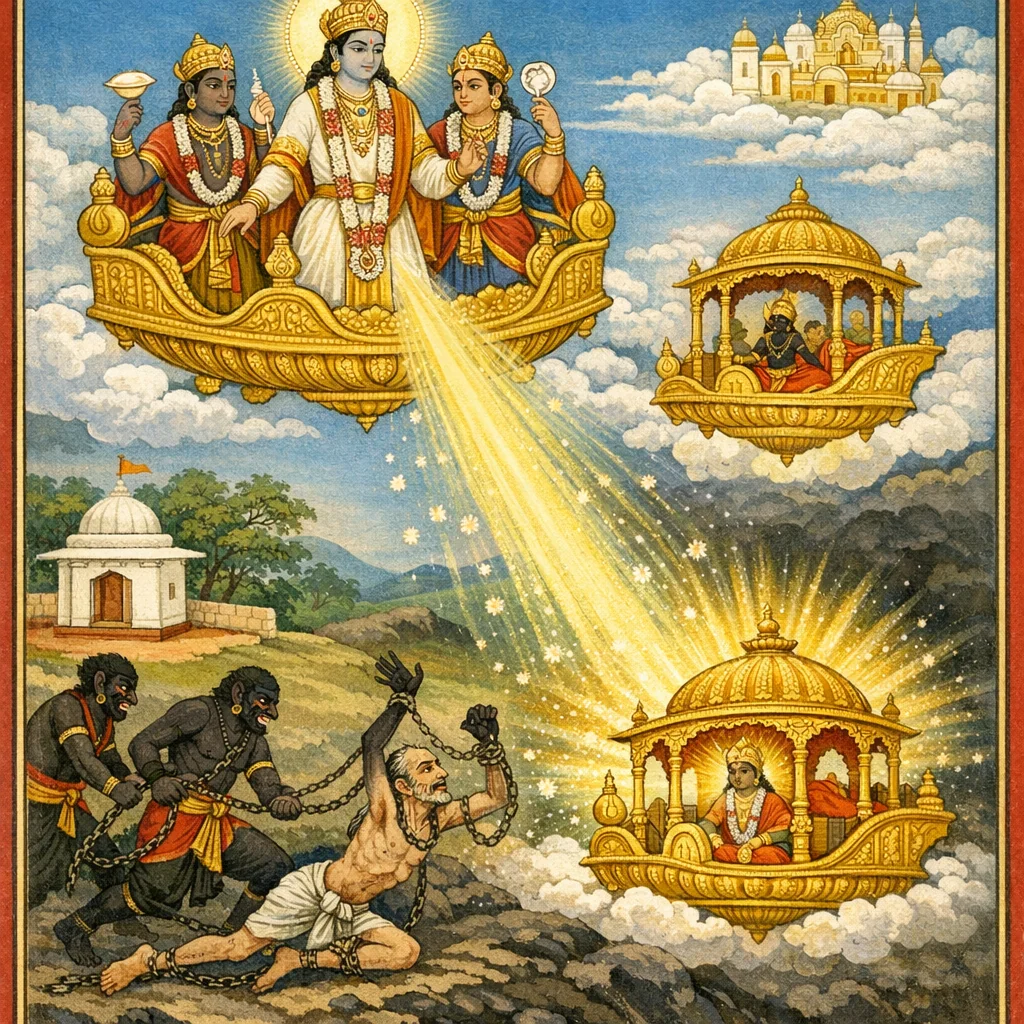
Yajñamālī–Sumālī Upākhyāna: Merit-Transfer through Temple Plastering (Lepa) and the Redemption of a Sinner
Sanaka tells Nārada of two brāhmaṇa brothers, sons of Vedamālā, whose lives diverge. Yajñamālī divides the inheritance justly, gives in charity, maintains his father’s public works, and serves in Viṣṇu’s temple; Sumālī squanders wealth in vice—music, liquor, courtesans, adultery—then turns to theft and forbidden foods, ending in abandonment and persecution. When both die at the same time, Viṣṇu’s attendants honor Yajñamālī and carry him by vimāna toward Viṣṇuloka. On the way he sees Sumālī dragged by Yama’s servants as a hungry, thirsty preta. Moved by compassion and the duty of friendship (saptapadī), he asks how one burdened with sin may be freed. Viṣṇu’s messengers reveal Yajñamālī’s prior-birth merit: in Hari’s temple he cleared mud and prepared a place for plastering (lepa), and the merit of that lepa-act can be bestowed. Yajñamālī transfers it to Sumālī; Yama’s servants flee, a celestial chariot arrives, and both reach Viṣṇuloka. Yajñamālī attains final liberation; Sumālī later returns to earth, becomes a virtuous brāhmaṇa devoted to Hari, bathes in the Gaṅgā, beholds Viśveśvara, and attains the supreme abode. The chapter concludes that bhakti—worship of Viṣṇu, company of Hari-bhaktas, and Hari-nāma—dissolves even great sins.
Shlokas
Verse 1
सनक उवाच । वेदमालेः सुतौ प्रोक्तौ यावुभौ मुनिसत्तम । यज्ञमाली सुमाली च तयोः कर्माधुनोच्यत ॥ १ ॥
Sanaka said: “O best of sages, the two sons of Vedamālā have been mentioned—Yajñamālī and Sumālī. Now their deeds are being described.”
Verse 2
तयोराद्यो यज्ञमाली विभेद पितृसंचितम् । धनं द्विधा कनिष्टस्य भागमेकं ददौ तदा ॥ २ ॥
Of the two, the elder—Yajñamālī—then divided the wealth amassed by their father into two parts, and at that time gave one share to the younger brother.
Verse 3
सुमाली च धनं सर्वं व्यसनाभिरकतः सदा । अपादाना दिभिश्चैव नाशयामास भो द्विज ॥ ३ ॥
And Sumālī too—ever addicted to vices—squandered all his wealth, O twice-born one, through theft and other such misdeeds.
Verse 4
गीतवाद्यरतो नित्यं मद्यपानरतोऽभवत् । वेश्याविभ्रमलुब्धोऽसौ परदारतोऽभवत् ॥ ४ ॥
He became ever absorbed in song and instrumental music, and he fell into addiction to liquor. Ensnared by the allure and coquettish arts of courtesans, that man also turned his desire toward other men’s wives.
Verse 5
सर्वस्मिन्नाशमायाते हिरण्ये पितृसंचिते । अपहृत्य परं द्रव्यं वारस्त्रीनिरतोऽभवत् ॥ ५ ॥
When all the gold amassed by his father had been lost, he seized another’s wealth and became devoted to courtesans.
Verse 6
दृष्ट्वा सुमालिनः शूलं यज्ञमाली महामतिः । बभूव दुःखितोऽत्यर्थं भ्रातरं चदमब्रवीत् ॥ ६ ॥
Seeing Sumālin’s spear, the great-minded Yajñamālī became exceedingly sorrowful and then spoke these words to his brother.
Verse 7
अलममत्यंतकष्टेन वृत्तेनास्मत्कुलेऽनुज । त्वमेक एव दुष्टात्मा महापापरतोऽभवः ॥ ७ ॥
Enough, O younger brother, of this extremely painful and disgraceful conduct in our family. You alone have become wicked-minded and devoted to great sin.
Verse 8
एवं निवारयंतं तं बहुशो ज्येष्टसोदरम् । हनिष्यामीति निश्चित्य खङ्गहस्तः कचेऽग्रहीत् ॥ ८ ॥
Thus, though his elder brother repeatedly tried to restrain him, he resolved, “I will kill him,” and—sword in hand—seized him by the hair.
Verse 9
ततो महारवो जज्ञे नगरे भृशदारुणः । बबंधुर्नागराश्चैनं कुपितास्ते सुमालिनम् ॥ ९ ॥
Then a great and exceedingly dreadful uproar arose in the city; and the enraged townspeople seized and bound Sumālin.
Verse 10
यज्ञमाली ह्यमेयात्मा पौरान्संप्रार्थ्य दुःखितः । बंधनान्मोचयामास भ्रातृस्नेहविमोहितः ॥ १० ॥
Yajñamālī—though of immeasurable spirit—became sorrowful; and, having earnestly entreated the townspeople, he released them from their bonds, being deluded by affection for his brother.
Verse 11
यज्ञमाली पुनस्चापि बिभिदे स्वधनं द्विधा । आददे स्वयमर्द्धं च ददावर्द्धं यवीयसे ॥ ११ ॥
Then Yajñamālī again divided his own wealth into two parts: he kept one half for himself and gave the other half to his younger brother.
Verse 12
सुमाली त्वतिमूढात्मा तद्धनं चापि नारद । मूर्खैः पारंवडचंडालैर्बुभुजे च सहोद्धतः ॥ १२ ॥
O Nārada, Sumālī—utterly deluded in mind—also squandered that wealth, enjoying it in the company of foolish, base-born outcastes, behaving with arrogant recklessness.
Verse 13
असतामुपभो गाय दुर्जनानां विभूतयः । पिचुमंदः फलाढ्योऽपि काकैरेवोपभुज्यते ॥ १३ ॥
Even if the picumanda tree is rich with fruit, it is eaten only by crows; likewise, the prosperities of wicked people are enjoyed by the base and unworthy.
Verse 14
भ्रात्रा दत्तं धनं तञ्च सुमाली नाशयन्मुने । मद्यपानप्रमत्तश्च गोमांसा दीन्यभक्षयत् ॥ १४ ॥
O sage, Sumālī squandered even the wealth given by his brother; and, intoxicated by liquor, he went so far as to eat cow-flesh and other forbidden meats.
Verse 15
त्यक्तो बंधुजनैः सर्वैश्चांडालस्त्रीसमन्वितः । राज्ञापि बाधितो विप्रप्रपेदे निर्जनं वनम् ॥ १५ ॥
Abandoned by all his relatives, accompanied by a Caṇḍāla woman, and even harassed by the king, the brāhmaṇa departed for a lonely forest.
Verse 16
यज्ञमाली सुधीर्विप्र सदा धर्मरतोऽभवेत् । अवारितं ददावन्नं सत्सङ्गगतकल्मषः ॥ १६ ॥
A wise brāhmaṇa, adorned with the garland of sacrifice, should ever remain devoted to dharma; he should give food without obstruction to those who seek it, for by the company of the virtuous his sins are washed away.
Verse 17
पित्रा कृतानि सर्वाणि तडागादीनि सत्तम । अपालयत्प्रयत्नेन सदा धर्मपरायणः ॥ १७ ॥
O best of the virtuous, he diligently maintained and protected all the reservoirs, ponds, and other works that had been constructed by his father, remaining ever devoted to dharma.
Verse 18
विश्राणितं धनं सर्वं यज्ञमालेर्महात्मनः । सत्पात्रदाननिष्टस्य धर्ममार्गप्रवर्तिनः ॥ १८ ॥
The great-souled Yajñamāli distributed all his wealth in charity—steadfast in giving to worthy recipients and devoted to setting the path of Dharma in motion.
Verse 19
अहो सदुपभोगाय सज्जनानां विभूतयः । कल्पवृक्षफलं सर्वममरैरेव भुज्यते ॥ १९ ॥
Alas! The prosperity meant for the noble to enjoy in righteousness—like the whole fruit of the wish-fulfilling Kalpavṛkṣa—is in truth consumed only by the immortals, the gods.
Verse 20
धनं विश्राण्य धर्मार्थं यज्ञमाली महामतिः । नित्यं विष्णुगृहे सम्यक्परिचर्य्यापरोऽभवत् ॥ २० ॥
Having given away his wealth for the sake of dharma, the great-minded Yajñamālī became ever devoted to proper service in the temple of Viṣṇu.
Verse 21
कालेन गच्छता तौ तु वृद्धभावमुपागतौ । यज्ञमाली सुमाली च ह्येककाले मृतावुभौ ॥ २१ ॥
As time passed, the two reached old age; and Yajñamālī and Sumālī indeed both died at the very same time.
Verse 22
हरिपूजारतस्यास्य यज्ञमालिमहात्मनः । हरिः संप्रेषयामास विमानं पार्षदा वृतम् ॥ २२ ॥
For the great-souled Yajñamālī, devoted to the worship of Hari, Hari Himself dispatched a celestial vimāna, surrounded by His attendants.
Verse 23
दिव्यं विमानमारुह्य यज्ञमाली महामतिः । पूज्यमानः सुरगणैः स्तूयमानो मुनीश्वरैः ॥ २३ ॥
Ascending the celestial vimāna, the great-minded Yajñamālī—honoured by hosts of gods and praised by the foremost sages—went forth in glory.
Verse 24
गंधर्वैर्गीयमानश्च सेवितश्चाप्सरोगणैः । कामधेन्वा पुष्यमाणश्चित्राभरणभूषितः ॥ २४ ॥
He is sung by the Gandharvas, attended by hosts of Apsarases, nourished by Kāmadhenū—the wish-fulfilling cow—and adorned with splendid, variegated ornaments.
Verse 25
कोमलैस्तुलसीमाल्यैर्भूषितस्तेजसां निधिः । गच्छन्विष्णुपदं दिव्यंमनुजं पथि दृष्टवान् ॥ २५ ॥
Adorned with soft garlands of Tulasī—he, a veritable treasury of spiritual splendor—while proceeding toward the divine Viṣṇupada, the abode of Viṣṇu, he saw a human being on the path.
Verse 26
ताह्यमानं यमभटैः क्षुत्तृड्भ्यां परिपीडितम् । प्रेतभूतं विवस्त्रं च दुःखितं पाशवेष्टितम् । इतस्ततः प्राधावन्तं विलपंतमनाथवत् ॥ २६ ॥
Dragged along by Yama’s attendants, crushed by hunger and thirst—becoming a wandering preta, naked and miserable, bound in nooses—he runs here and there, wailing like one without any protector.
Verse 27
क्रोशन्तं च सुदंतं च दृष्ट्वा मनसि विव्यथे ॥ २७ ॥
Seeing him crying out, and also seeing Sudanta, he was deeply distressed in his heart.
Verse 28
यज्ञमालीदयायुक्तो विष्णुदूतान्समीपगान् । कोऽयं भटैर्बाध्यमानं इत्यपृच्छत्कृतांजलिः ॥ २८ ॥
Yajñamālī, moved by compassion, approached the messengers of Viṣṇu and—joining his palms—asked: “Who is this person being harassed by these guards?”
Verse 29
अथ ते हरिदूतास्तं यज्ञमालिमहौजसम् । असौ सुमाली भ्राता ते पापात्मेति समब्रुवन् ॥ २९ ॥
Then the messengers of Hari addressed the mighty Yajñamālī and said, “This is Sumālī—your brother—whose very nature is sinful.”
Verse 30
यज्ञमाली समाकर्ण्य व्याख्यातं विष्णुकिंकरैः । मनसा दुःखमापन्नः पुनः पप्रच्छ नारद ॥ ३० ॥
Having heard what was explained by the servants of Vishnu, Yajñamālī became distressed in his mind; then Nārada questioned them again.
Verse 31
कथमस्य भवेन्मोक्षः सांचितैः पापसंचयैः । तदुपायंबदध्वं मे यूयं हि ममबांधवाः ॥ ३१ ॥
“How can he attain liberation when heaps of accumulated sins have been stored up? Tell me the means for that, for you are indeed my kinsmen and well-wishers.”
Verse 32
सख्यं साप्तपदीनं स्यादित्याहुर्धर्मकोविदाः । सतां साप्तपदी मैत्री सत्सतां त्रिपदी तथा ॥ ३२ ॥
Those skilled in dharma say that true friendship is established through the ‘seven-step’ bond (saptapadī). Among the virtuous, friendship is confirmed by seven steps; and among the truly noble, even three steps are enough.
Verse 33
सत्सतामपि ये संतस्तेषां मैत्रघी पदे पदे ॥ ३३ ॥
Even among the virtuous, those who are truly saintly show friendliness and goodwill at every step.
Verse 34
तस्मान्मे बांधवा यूयं मां नेतुं समुपागताः । यतोऽयं मम भ्रातापि मुच्यते तदिहोच्यताम् ॥ ३४ ॥
Therefore, O my kinsmen, you have come here to lead me away. Tell me here what must be done, by which even this my brother may be released.
Verse 35
यज्ञमालिवचः श्रुत्वा विष्णुदूता दयालवः । पुनः स्मितामुखाः प्रोचुर्यज्ञमालिहरिप्रियम् ॥ ३५ ॥
Hearing Yajñamāli’s words, the compassionate messengers of Viṣṇu again spoke with smiling faces, addressing Yajñamāli, who was dear to Hari.
Verse 36
विष्णुदूता ऊचुः । यज्ञमालिन्महाभाग नारायणपरायण । उपायं तव वक्ष्यामः सुमालिप्रेममुक्तिदम् ॥ ३६ ॥
The messengers of Viṣṇu said: “O most fortunate Yajñamālin, wholly devoted to Nārāyaṇa, we shall tell you a means that bestows upon Sumāli loving bhakti and liberation.”
Verse 37
कृतं यत्सुमहत्कर्म त्वया प्राक्तनजन्मनि । प्रवक्ष्यामः समासेन तच्छ्रणुष्व समाहितः ॥ ३७ ॥
That exceedingly great deed which you performed in a former birth we shall now relate in brief; listen with a mind collected and attentive.
Verse 38
पुरा त्वं वैश्यजातीयो नाम्ना विश्वंघभरः स्मृतः । त्वया कृतानि पापानि अहंत्यगणितानि वै ॥ ३८ ॥
Formerly you were born among the Vaiśyas, remembered by the name Viśvaṃghabhara; and the sins you committed were indeed innumerable and grievous.
Verse 39
सुकर्मवासनाहीनो मातापित्रोर्विरोधकृत् । एकदा बंधुभिस्त्यक्तः शोकसंतापपीडितः ॥ ३९ ॥
Devoid of any inclination toward virtuous deeds, and acting in opposition to his own mother and father, he was once abandoned by his relatives and became tormented by grief and burning anguish.
Verse 40
क्षुधाग्निनापि संतप्तः प्राप्तवान्हरिमंदिरम् । तदा वृष्टिरभूत्तत्र तत्स्थानं पंकिलं ह्यभूत ॥ ४० ॥
Scorched even by the fire of hunger, he reached the temple of Hari. Just then rain fell there, and that place indeed became muddy.
Verse 41
दीरीकृतस्त्वया पंकस्तत्स्थाने स्थातुमिच्छया । उपलेपनतां प्राप्तं तत्स्थानं विष्णुमंदिरे ॥ ४१ ॥
Because you wished to stand in that very spot, you pushed aside the mire; and in Viṣṇu’s temple that place became fit to be smeared and plastered—purified and made suitable for worship.
Verse 42
त्वयोषितं तु तद्गात्रौ तस्मिन्देवालये द्विज । दंशितश्चैव सर्पेण प्राप्तं पञ्चत्वमेव च ॥ ४२ ॥
But when you sat upon his body there in that temple, O twice-born one, he was also bitten by a serpent and indeed met his end, becoming one with the five elements.
Verse 43
तेन पुण्यप्रभावेन उपलेपकृतेन च । विप्रजन्म त्वया प्राप्तं हरि भक्तिस्तथाचला ॥ ४२ ॥
By the power of that merit—and by the act of anointing and plastering the sacred place as well—you have attained birth as a brāhmaṇa, and your devotion (bhakti) to Hari has likewise become unwavering.
Verse 44
कल्पकोटिशतं साग्रं संप्राप्य हरिसन्निधिम् । वसाद्य ज्ञानमासाद्य परं मोक्षं गमिष्यसि ॥ ४३ ॥
After reaching the holy presence of Hari for a little more than a hundred crore kalpas, dwelling there and attaining true jñāna, you shall go to the supreme liberation, mokṣa.
Verse 45
अनुजं पातकिश्रेष्टं त्वं समुद्धर्त्तमिच्छसि । उपायं तव वक्ष्यामस्तं निबोध महामते ॥ ४४ ॥
You wish to rescue your younger brother—the foremost among sinners. I shall tell you the means for that; understand it well, O great-minded one.
Verse 46
गोचर्ममात्रभूमेस्तु उपलेपनजं फलम् । दत्त्वोद्धर महाभाग भ्रातरं कृपयान्वितः ॥ ४५ ॥
The merit born of plastering and purifying even a patch of ground no larger than a cowhide—bestow that merit, O noble one, and with compassion lift up your brother.
Verse 47
एवमुक्तो विष्णुदूतैर्यज्ञमाली महापतिः । तत्फलं प्रददौ तस्मै भ्रात्रे पापविमुक्तये ॥ ४६ ॥
Thus addressed by the messengers of Viṣṇu, Yajñamālī, the great lord, bestowed that fruit of merit upon his brother, for his release from sin.
Verse 48
सुमाली भ्रातृदत्तेन पुण्येन गतकल्मषः । बभूव यमदूतास्तु तं त्यक्त्वा प्रपलायिताः ॥ ४७ ॥
By the merit bestowed by his brother, Sumālī was freed from all taint of sin; and Yama’s messengers, abandoning him, fled away.
Verse 49
विमानं चागतं सद्यः सर्वभोगसमन्वितम् । तदा सुमाली स्वर्यानमारुह्य मुमुदे मुने ॥ ४८ ॥
At once a celestial vimāna arrived, endowed with every kind of delight. Then Sumālī mounted that heavenly conveyance and rejoiced, O sage.
Verse 50
तावुभौ भ्रातरौ विप्र सुरवृंदनमस्कृतौ । अवापतुर्भृशं प्रीतिं समालिंग्य परस्परम् ॥ ४९ ॥
O brāhmaṇa, those two brothers—revered even by hosts of the devas—attained great joy as they embraced one another.
Verse 51
यज्ञमाली सुमाली च स्तूयमानौ महर्षिभिः । गीयमानौ च गंधर्वैर्विष्णुलोकं प्रजग्मतुः ॥ ५० ॥
Yajñamālī and Sumālī—praised by the great sages and sung by the Gandharvas—departed and attained Viṣṇu’s realm, Viṣṇuloka.
Verse 52
अवाप्य हरिसालोक्यं सुमाली मुनिसत्तम । यज्ञमाली चोषतुस्तौ कल्पमेकं मुदान्वितौ ॥ ५१ ॥
O best of sages, Sumālī and Yajñamālī, having attained sālokya—residence in the same world as Hari (Viṣṇu)—dwelt there joyfully for the span of one kalpa.
Verse 53
भुक्त्वा भोगान्बहूँस्तत्र यज्ञमाली महामतिः । तत्रैव ज्ञानसंपन्नः परं मोक्षमुपागतः ॥ ५२ ॥
Having enjoyed many delights there, the great-minded Yajñamālī—endowed with true knowledge in that very state—attained the supreme liberation, mokṣa.
Verse 54
सुमाली तु महाभागो विष्णुलोके मुदान्वितः । स्थित्वा भूमिं पुनः प्राप्य विप्रत्वं समुपागतः ॥ ५३ ॥
Sumālī, that greatly blessed one, rejoiced in Viṣṇu’s realm. Having dwelt there, he returned again to the earth and attained the state of a brāhmaṇa.
Verse 55
अतिशुद्धे कुले जातो गुणवान्वेदपारगः । सर्वसंपत्समोपेतो हरिभक्तिपरायणः ॥ ५४ ॥
Born in a most pure lineage, virtuous and fully accomplished in the Vedas, endowed with every prosperity, he is wholly devoted to bhakti for Hari (Viṣṇu).
Verse 56
व्याहरन्हरिनामानि प्रपेदे जाह्नवीतटम् । तत्र स्नातश्च गंगायां दृष्ट्वा विश्वेश्वरं प्रभुम् ॥ ५५ ॥
Uttering the names of Hari, he reached the bank of the Jāhnavī (Gaṅgā). There, after bathing in the Gaṅgā, he beheld Lord Viśveśvara, the supreme Master.
Verse 57
अवाप परमं स्थानं योगिनामपि दुर्लभम् । उपलेपनमाहात्म्यं कथितं ते मुनीश्वर ॥ ५६ ॥
He attained the supreme abode—rare even for accomplished yogins. Thus, O lord among sages, the greatness of the sacred act of plastering and purifying has been told to you.
Verse 58
तस्मात्सर्वप्रयत्नेन संपूज्यो जगतांपतिः । अकामादपि ये विष्णोः सकृत्पूजां प्रकुर्वते ॥ ५७ ॥
Therefore, with every effort, the Lord of the worlds should be duly worshiped. Even those who, without personal desire, perform but a single act of worship of Viṣṇu gain great spiritual benefit.
Verse 59
न तेषां भवबंधस्तु कदाचिदपि जायते । हरिभक्तिरतान्यस्तु हरिबुद्ध्या समर्चयेत् ॥ ५८ ॥
For them, the bondage of saṃsāra never arises at any time. But one devoted to Hari-bhakti should worship all that is worthy, with the understanding that all is Hari.
Verse 60
तस्य तुष्यंति विप्रेंद्र ब्रह्मविष्णुमहेश्वराः । हरिभक्तिपराणां तु संगिनां संगमात्रतः ॥ ५९ ॥
O best of brāhmaṇas, Brahmā, Viṣṇu, and Maheśvara are pleased with him; indeed, by mere association with companions devoted to Hari, their satisfaction is won.
Verse 61
मुच्यते सर्वपापेभ्यो महापातकवानपि । हरिपूजापराणां च हरिनामरतात्मनाम् ॥ ६० ॥
Even one burdened with the great sins (mahāpātakas) is freed from all sins—this is so for those devoted to Hari’s worship and for those whose very self is absorbed in Hari’s Name.
Verse 62
शुश्रूषानिरता यांति पापिनोऽपि परां गतिम् ॥ ६१ ॥
Even sinners, when devoted to humble service and attentive listening, attain the supreme state.
Frequently Asked Questions
Because it is framed as direct seva to Hari’s sacred space: a seemingly minor act that makes worship possible becomes a high-density karmic merit. The narrative teaches that devotional service embedded in ritual cleanliness and temple maintenance can mature into bhakti, elevate birth and destiny, and even become transferable for another’s release.
The chapter’s mechanism is puṇya-dāna (bestowal of merit): Yajñamālī grants the fruit of his lepa-merit to Sumālī. This drives away Yama’s attendants, restores Sumālī to divine conveyance, and places him in Viṣṇu’s realm, after which he continues toward purification and higher attainment through renewed devotion.
It supplies the ethical justification for intervention: friendship/kinship is validated through shared steps, implying moral responsibility. Yajñamālī’s compassion is presented not as sentimental weakness but as dharmic solidarity that motivates seeking an authorized means of rescue.
No. Yajñamālī proceeds from Viṣṇuloka to supreme liberation after vast cosmic time and true knowledge, while Sumālī first enjoys Viṣṇuloka, then returns to earth as a purified brāhmaṇa devoted to Hari, and later reaches the supreme abode—showing graded liberation tied to purification and bhakti.