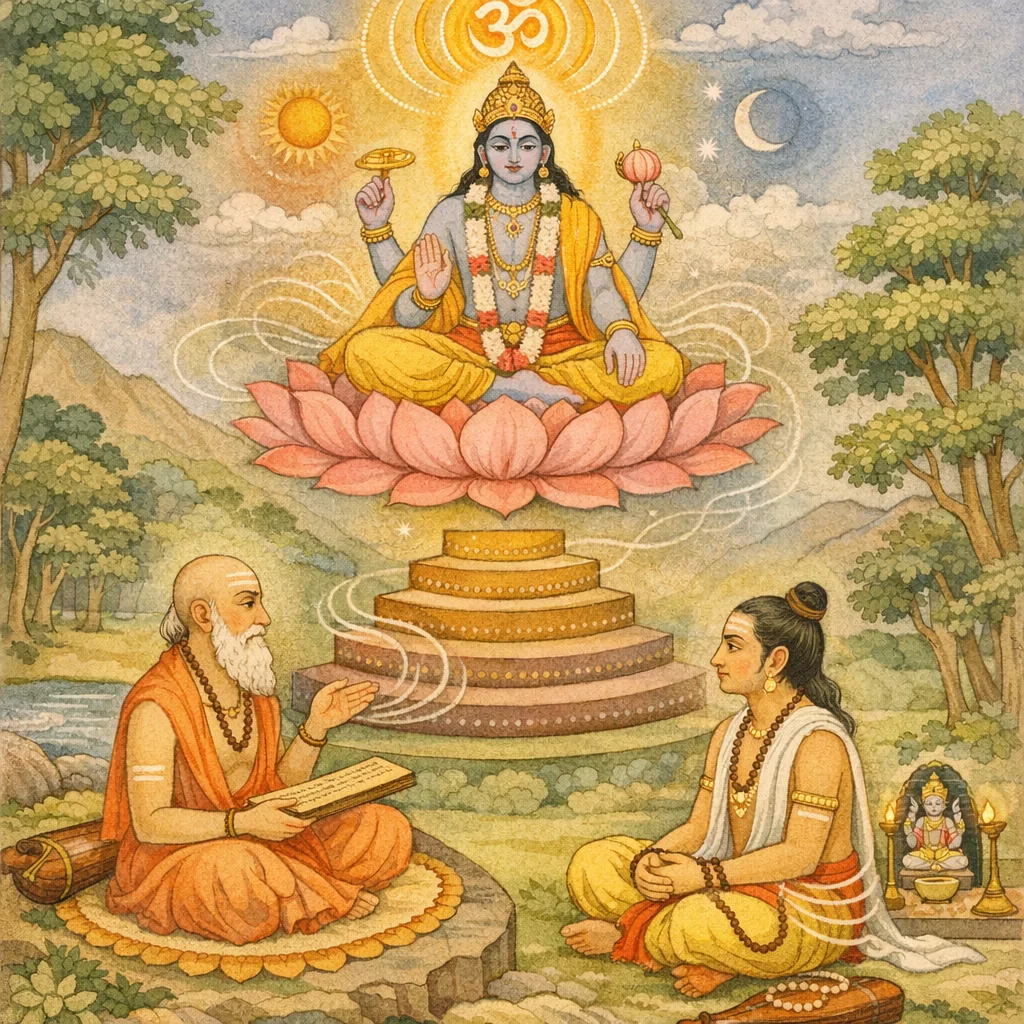
Mokṣopāya: Bhakti-rooted Jñāna and the Aṣṭāṅga Yoga of Viṣṇu-Meditation
Nārada asks Sanaka how the noose of saṃsāra can be cut when beings ceaselessly create and undergo karma. Sanaka praises Nārada’s purity and proclaims Viṣṇu/Nārāyaṇa as creator–sustainer–dissolver and bestower of mokṣa, taught both devotionally (worship, refuge, divine forms) and metaphysically as the non-dual, self-luminous Brahman. Nārada then inquires about the rise of yogic siddhi. Sanaka teaches that liberation is through jñāna, yet jñāna is rooted in bhakti; devotion arises from merit gained by dāna, yajña, tīrtha-pilgrimage, and related acts. Yoga is twofold—karma and jñāna—and jñāna-yoga requires the foundation of right action, stressing Keśava’s pratimā-worship and ahiṃsā-based ethics. As sins are exhausted, discernment of the eternal and the impermanent brings detachment and the longing for release. Sanaka further explains higher/lower self, kṣetra–kṣetrajña, māyā, and Śabda-Brahman (mahāvākyas) as triggers of liberating insight. Finally he details the eight limbs—yama, niyama, āsana, prāṇāyāma (nāḍīs and fourfold breath), pratyāhāra, dhāraṇā, dhyāna, samādhi—culminating in meditation on Viṣṇu’s form and contemplation of Praṇava/Oṁ.
Shlokas
Verse 1
नारद उवाच । भगवन्सर्वमाख्यातं यत्पृष्टं विदुषा त्वया । संसारपाशबद्धानां दुःखानि सुबहूनि च ॥ १ ॥
Narada said: O Blessed Lord, you, the wise one, have fully explained all that was asked—along with the many sufferings of those bound by the noose of saṃsāra.
Verse 2
अस्य संसारपाशस्य च्छेदकः कतमः स्मृतः । येनोपायेन मोक्षः स्यात्तन्मे ब्रूहि तपोधन ॥ २ ॥
This noose of saṃsāra—what means is remembered in tradition as its cutter? By what method may mokṣa be attained? Tell me that, O treasure of austerity.
Verse 3
प्राणिभिः कर्मजालानि क्रियंते प्रत्यहं भृशम् । भुज्यंते च मुनिश्रेष्ठ तेषां नाशः कथं भवेत् ॥ ३ ॥
Living beings, day after day, ceaselessly weave a dense web of karma, and they also taste its fruits—joy or sorrow. O best of sages, how can that store of karmas ever come to an end?
Verse 4
कर्मणा देहमाप्नोति देही कामेन बध्यते । कामाल्लोभाभिभूतः स्याल्लोभात्क्रोधपरायणाः ॥ ४ ॥
By karma the embodied being attains a body; by desire he becomes bound. From desire he is overcome by greed, and from greed he becomes devoted to anger.
Verse 5
क्रोधाञ्च धर्मनाशः स्याद्धर्मनाशान्मतिभ्रमः । प्रनष्टबुद्धिर्मनुजः पुनः पापं करोति च ॥ ५ ॥
From anger, dharma is destroyed; from the destruction of dharma arises confusion of judgment. When a person’s intellect is lost, he again commits sin.
Verse 6
तस्माद्देहं पापमूलं पापकर्मरतं तथा । यथा देहभ्रमत्यक्त्वा मोक्षभाक्स्यात्तथा वद ॥ ६ ॥
Therefore, tell me how one may abandon the delusion of identifying with the body—this body, a root of sin and inclined toward sinful acts—and thus become a partaker of liberation; explain that to me.
Verse 7
सनक उवाच । साधु साधु महाप्राज्ञ मतिस्ते विमलोर्जिता । यस्मात्संसारदुःखान्नो मोक्षोपायमभीप्ससि ॥ ७ ॥
Sanaka said: “Excellent, excellent, O greatly wise one! Your intellect is pure and well-established, since you desire from us the means to liberation from the suffering of worldly existence.”
Verse 8
यस्याज्ञया जगत्सर्वं ब्रह्म्ना सृजति सुव्रत । हरिश्च पालको रुद्रो नाशकः स हि मोक्षदः ॥ ८ ॥
O you of excellent vows: by His command Brahmā creates this entire universe; Hari (Viṣṇu) sustains it, and Rudra dissolves it—He indeed is the giver of moksha, liberation.
Verse 9
अहमादिविशेषांता जातायस्य प्रभावतगः । तं विद्यान्मोक्षदं विष्णुं नारायणमनामयम् ॥ ९ ॥
From His power all differentiated existence—beginning with the sense of “I” and ending in the subtlest distinctions—has arisen. Know Him as Viṣṇu, Nārāyaṇa, the bestower of moksha, free from all affliction.
Verse 10
यस्याभिन्नमिदं सर्वं यच्चेंगद्यञ्च नेंगति । तमुग्रमजरं देवं ध्यात्वा दुःखात्प्रमुच्यते ॥ १० ॥
For Him this entire universe is non-separate—both what moves and what does not move. By meditating on that fierce, ageless Divine, one is released from sorrow.
Verse 11
अविकारमजं शुद्धं स्वप्रकाशं निरंजनम् । ज्ञानरुपं सदानंदं प्राहुर्वैमोक्षसाधनम् ॥ ११ ॥
They declare as the true means to liberation that Reality which is changeless, unborn, pure, self-luminous, stainless—whose very nature is consciousness and eternal bliss.
Verse 12
यस्यावताररुपाणि ब्रह्माद्या देवतागणाः । समर्चयंति तं विद्याच्छाश्वतस्थानदं हरिम् ॥ १२ ॥
Know Hari (Viṣṇu) to be the bestower of the eternal abode—He whose incarnate forms (avatāras) are duly worshipped even by Brahmā and the hosts of gods.
Verse 13
जितप्राणा जिताहाराः सदा ध्यानपरायणाः । हृदि पश्यंति यं सत्यं तं जामीहि सुखावहम् ॥ १३ ॥
Those who have mastered the vital breath, conquered their diet, and are ever devoted to meditation behold in the heart that Truth—know that Reality as the giver of bliss.
Verse 14
निर्गुणोऽपि गुणाधारो लोकानुग्रहरुपधृक् । आकाशमध्यगः पूर्णस्तं प्राहुर्मोक्षदं नृणाम् ॥ १४ ॥
Though beyond the (material) guṇas, He is the support of all guṇas; assuming a form out of compassion for the worlds, all-pervading and complete—Him they declare to be the giver of liberation to human beings.
Verse 15
अध्यक्षः सर्वकार्याणां देहिनो हृदये स्थितः । अनूपमोऽखिलाधारस्तां देवं शरणं व्रजेत् ॥ १५ ॥
The Supreme Overseer of all actions dwells in the heart of the embodied being. Unequalled and the support of all, that Divine Lord—one should take refuge in Him.
Verse 16
सर्वं संगृह्य कल्पांते शेते यस्तु जले स्वयम् । तं प्राहुर्मोक्षदं विष्णुं मुनयस्तत्त्वदर्शिनः ॥ १६ ॥
At the end of the aeon, having withdrawn everything into Himself, He lies by Himself upon the waters; the seers who behold the truth declare Him to be Vishnu, the giver of liberation.
Verse 17
वेदार्थविद्भिः कर्मज्ञैरिज्यते विविधैर्मखैः । स एव कर्मफलदो मोक्षदोऽकामकर्मणाम् ॥ १७ ॥
He is worshipped through many kinds of sacrificial rites by those who know the meaning of the Vedas and are skilled in ritual action; He alone bestows the fruits of deeds, and He grants liberation to those who perform action without desire.
Verse 18
हव्यकव्यादिदानेषु देवतापितृरूपधृक् । भुंक्ते य ईश्वरोऽव्यक्तस्तं प्राहुर्मोक्षदं प्रभुम् ॥ १८ ॥
He who, in offerings such as havya and kavya, assumes the forms of the devas and the ancestors and partakes of those gifts—That unmanifest Lord is proclaimed the sovereign Master who bestows liberation.
Verse 19
ध्यातः प्रणमितो वापि पूजितो वापि भक्तितः । ददाति शाश्वतं स्थानं तं दयालुं समर्चयेत् ॥ १९ ॥
Whether He is meditated upon, bowed to, or worshipped with devotion, He grants the eternal abode; therefore one should duly adore that compassionate Lord.
Verse 20
आधारः सर्वभूतानांमेको यः पुरुषः परः । जरामरणनिर्मुक्तो मोक्षदः सोऽव्ययो हरिः ॥ २० ॥
Hari is the supreme Person—one without a second—who is the support of all beings; free from old age and death, imperishable, and the bestower of liberation.
Verse 21
संपूज्य यस्य पादाब्जं देहिनोऽपि मुनीश्वर । अमृतत्वं भजंत्याशु तं विदुः पुरुषोत्तमम् ॥ २१ ॥
O lord of sages, even embodied beings, by duly worshipping His lotus-feet, swiftly attain immortality; Him they know as the Supreme Person, Puruṣottama.
Verse 22
आनन्दमजरं ब्रह्म परं ज्योतिः सनातनम् । परात्परतरं यञ्च तद्विष्णोः परमं पदम् ॥ २२ ॥
That which is Brahman—blissful and unborn; the supreme, eternal Light; and that which is higher than the highest—this indeed is the supreme abode (parama-pada) of Viṣṇu.
Verse 23
अद्वयं निगुणं नित्यमद्वितीयमनौपमम् । परिपूर्णं ज्ञानमयं विदुर्मोक्षप्रताधकम् ॥ २३ ॥
The wise know That Reality as non-dual, beyond the guṇas, eternal, without a second and incomparable—complete, made of pure consciousness-knowledge, and the bestower of mokṣa, liberation.
Verse 24
एवंभूतं परं वस्तु योगमार्गविधानतः । य उपास्ते सदा योगी स याति परमं पदम् ॥ २४ ॥
That Supreme Reality, of such a nature, when constantly worshipped and meditated upon by the yogin according to the disciplines laid down on the path of Yoga—such a yogin attains the highest state.
Verse 25
परसर्वसंगपरित्यागी शमादिगुणसंयुतः । कामर्द्यैवर्जितोयोगी लभते परमं पदम् ॥ २५ ॥
The yogin who abandons every attachment, is endowed with virtues beginning with śama (tranquility), and is free from desire and lethargy, attains the Supreme State.
Verse 26
नारद उवाच । कर्मणा केन योगस्य सिद्धिर्भवति योगिनाम् । तदुपायं यथातत्त्वं ब्रूहि मे वदतां वर ॥ २६ ॥
Narada said: “By what kind of action (karma) does the siddhi, the attainment of Yoga, arise for yogins? O best among speakers, tell me truly—according to reality—the means for that.”
Verse 27
सनक उवाच । ज्ञानलभ्यं परं मोक्षं प्राहुस्तत्त्वार्थचिंतकाः । यज्ज्ञानं भक्तिमूलं च भक्तिः कर्मवतां तथा ॥ २७ ॥
Sanaka said: “The contemplators of truth declare that the supreme liberation is attained through knowledge. Yet that very knowledge has bhakti as its root; and likewise, for those engaged in action (karma), bhakti is the means as well.”
Verse 28
दानानि यज्ञा विविधास्तीर्थयात्रादयः कृताः । येन जन्मसहस्त्रेषु तस्य भक्तिर्भवेद्धरौ ॥ २८ ॥
Charity, many kinds of yajña, pilgrimages to the sacred tīrthas, and similar holy acts—these have been performed by that person through thousands of births; by such merit, devotion (bhakti) to Hari (Viṣṇu) arises.
Verse 29
अक्षयः परमो धर्मो भक्तिलेशेन जायते । श्रद्धया परया चैव सर्वं पापं प्रणश्यति ॥ २९ ॥
The supreme, imperishable Dharma arises even from the slightest trace of bhakti; and through the highest śraddhā, all sin is utterly destroyed.
Verse 30
सर्वपापेषु नष्टेषु बुद्धिर्भवति निर्मला । सैव बुद्धिः समाख्याता ज्ञानशब्देन सूरिभिः ॥ ३० ॥
When all sins have been destroyed, the buddhi becomes pure; and that very purified intellect is what the wise call “jñāna”—knowledge.
Verse 31
ज्ञानं च मोक्षदं प्राहुस्तज्ज्ञानं योगिनां भवेत् । योगस्तु द्विविधः प्रोक्तः कर्मज्ञानप्रभेदतः ॥ ३१ ॥
They declare that jñāna bestows mokṣa, liberation; and that such knowledge is to be possessed by yogins. Moreover, yoga is taught as twofold, distinguished as the path of karma (action) and the path of jñāna (knowledge).
Verse 32
क्रियायोगं विना नॄणां ज्ञानयोगो न सिध्यति । क्रियायोगरतस्तस्माच्छ्रद्धया हरिमर्चयेत् ॥ ३२ ॥
For human beings, jñāna-yoga does not succeed without kriyā-yoga, the discipline of right action. Therefore, one devoted to such practice should, with śraddhā, worship Hari (Viṣṇu).
Verse 33
द्विजभूम्यग्निसूर्याम्बुधातुहृञ्चित्रसंज्ञिताः । प्रतिमाः केशवस्यैता पूज्य एतासु भक्तितः ॥ ३३ ॥
The sacred images (pratimās) of Keśava are known by the names Dvija, Bhūmi, Agni, Sūrya, Ambu, Dhātu, Hṛt, and Citra. In these forms He is to be worshipped with bhakti, devoted reverence.
Verse 34
कर्मणा मनसा वाचा परिपीडापराङ्मुखः । तस्मात्सर्वगतं विष्णुं पूजयेद्भक्तिसंयुतः ॥ ३४ ॥
Turning away from harming others by deed, by mind, and by speech, one should therefore worship all-pervading Viṣṇu with faith and bhakti.
Verse 35
अहिंसा सत्यमक्रोधो ब्रह्मचर्यापरिग्रहौ । अनीर्ष्या च दया चैव योगयोरूभयोः समाः ॥ ३५ ॥
Non-violence (ahiṃsā), truthfulness, freedom from anger, brahmacarya (celibate purity), non-possessiveness, absence of envy, and compassion—these are equally essential in both paths of Yoga.
Verse 36
चराचरात्मकं विश्वं विष्णुरेव सनातनः । इति निश्चित्य मनसा योगद्वितयमभ्यसेत् ॥ ३६ ॥
Having firmly ascertained in the mind that the entire universe—of both the moving and the unmoving—is none other than the eternal Viṣṇu, one should practice the twofold discipline of yoga.
Verse 37
आत्मवत्सर्वभूतानि ये मन्यंते मनीषिणः । ते जानंति परं भावं देवदेवस्य चक्रिणः ॥ ३७ ॥
Those wise ones who regard all beings as their own Self truly know the supreme nature of the Deva of devas, the discus-wielding Lord (Viṣṇu).
Verse 38
यदि क्रोधादिदुष्टात्मा पूजाध्यानपरो भवेत् । न तस्य तुष्यते विष्णुर्यतो धर्मपतिः स्मृतः ॥ ३८ ॥
Even if one is devoted to worship and meditation, if the inner nature is tainted by anger and the like, Viṣṇu is not pleased with him, for Viṣṇu is remembered as the Lord of Dharma.
Verse 39
यदि कामादिदुष्टात्मा देव पूजापरो भवेत् । दंभाचारः स विज्ञेयः सर्वपातकिभिः समः ॥ ३९ ॥
If one whose inner self is corrupted by desire and other vices becomes devoted to the worship of the Deity, he should be known as a hypocrite; his conduct is equal to that of all sinners.
Verse 40
तपः पूजाध्यानपरोयस्त्वसूयारतो भवेत् । तत्तपः सा च पूजा च तद्ध्यानं हि निरर्थकम् ॥ ४० ॥
But if one devoted to austerity, worship, and meditation becomes given to malice and fault-finding, then that austerity, that worship, and that meditation are indeed rendered meaningless.
Verse 41
तस्मात्सर्वात्मकं विष्णुं शमादिगुणतत्परः । मुक्तयर्थमर्चयेत्सम्यक् क्रियायोगपरो नरः ॥ ४१ ॥
Therefore, one devoted to virtues beginning with śama (tranquility) should properly worship Viṣṇu—who is the Self of all—for the sake of liberation, being dedicated to disciplined practice (kriyā-yoga).
Verse 42
कर्मणा मनसा वाचा सर्वलोकहिते रतः । समर्चयति देवेशं क्रियायोगः स उच्यते ॥ ४२ ॥
When one—through deed, mind, and speech—remains devoted to the welfare of all beings and duly worships the Lord of the gods, that is called Kriyā-yoga, the yoga of sacred action.
Verse 43
नारायणं जगद्योनिं सर्वांतयर्यामिणं हरिम् । स्तोत्राद्यैः स्तौति यो विष्णुं कर्मयोगी स उच्यते ॥ ४३ ॥
He who praises Viṣṇu—Nārāyaṇa, the womb-source of the universe, Hari dwelling as the Inner Controller (antaryāmin) in all beings—through hymns and like acts of worship is called a karma-yogin.
Verse 44
उपवासादिभिश्चैव पुराणश्रवणादिभिः । पुष्पाद्यैश्चार्चनं विष्णोः क्रियायोग उदाहृतः ॥ ४४ ॥
Fasting and related observances, hearing the Purāṇas and similar practices, and worship of Viṣṇu with flowers and other offerings—this is declared to be Kriyā-yoga, the discipline of devotional action.
Verse 45
एवं भक्तिमतां विष्णौ क्रियायोगरतात्मनाम् । सर्वपापानि नश्यंति पूर्वजन्मार्जितानि वै ॥ ४५ ॥
Thus, for those devoted to Viṣṇu, whose minds are absorbed in Kriyā-yoga, all sins—indeed even those amassed in previous births—are destroyed.
Verse 46
पापक्षयाच्छुद्वमतिर्वांछति ज्ञानमुत्तमम् । ज्ञानं हि मोक्षदं ज्ञेयं तदुपायं वदामि ते ॥ ४६ ॥
When sins are exhausted, the mind is purified and longs for the highest knowledge. Know that knowledge bestows liberation (mokṣa); I shall tell you the means to attain it.
Verse 47
चराचरात्मके लोके नित्यं चानित्यमेव च । सम्यग् विचारयेद्धीमान्सद्भिः शास्त्रार्थकोविदैः ॥ ४७ ॥
In this world, made of both the moving and the unmoving, the wise should rightly contemplate what is eternal and what is truly impermanent, together with the good who are skilled in the true meaning of the scriptures.
Verse 48
अनित्यास्तु पदार्था वै नित्यमेको हरिः स्मृतः । अनित्यानि परित्यज्य नित्यमेव समाश्रयेत् ॥ ४८ ॥
Truly, all things are impermanent; Hari alone is remembered as eternal. Therefore, abandoning what is transient, one should take refuge in the Eternal alone.
Verse 49
इहामुत्र च भोगेषु विरक्तश्च तथा भवेत् । अविरक्तो भवेद्यस्तु स संसारे प्रवर्तते ॥ ४९ ॥
Here and hereafter, one should become detached from enjoyments. But whoever remains without detachment continues to act and revolve within saṃsāra.
Verse 50
अनित्येषु पदार्थेषु यस्तु रागी भवेन्नरः । तस्य संसारविच्छित्तिः कदाचिन्नैव जायते ॥ ५० ॥
If a person becomes attached with craving to impermanent things, then for him the severance of saṃsāra never arises—at any time.
Verse 51
शमादिगुणसंपन्नो मुमुक्षुर्ज्ञानमभ्यसेत् । शमादिगुणहीनस्य ज्ञानं नैव च सिध्यति ॥ ५१ ॥
A seeker of liberation (mumukṣu) endowed with the virtues beginning with śama should practice spiritual knowledge; for one who lacks those virtues, knowledge is never truly accomplished.
Verse 52
रागद्वेषविहीनो यः शमादिगुणसंयुतः । हरिध्यानपरो नित्यं मुमुक्षुरभिधीयते ॥ ५२ ॥
One who is free from attachment and aversion, endowed with virtues beginning with śama, and always devoted to meditation on Hari—such a person is called a mumukṣu, a seeker of liberation.
Verse 53
चतुर्भिः साधनैरेभिर्विशुद्धमतिरुच्यते । सर्वगं भावयेद्विष्णुं सर्वभूतदयापरः ॥ ५३ ॥
By these four disciplines, one is said to attain a purified understanding. With compassion toward all beings, one should contemplate Vishnu, the all-pervading Lord.
Verse 54
क्षराक्षरात्मकं विश्वं व्याप्य नारायणः स्थितः । इति जानाति यो विप्रतज्ज्ञानं योगजं विदुः ॥ ५४ ॥
O brāhmaṇa, one who knows that Nārāyaṇa pervades and abides within the entire universe—comprised of both the perishable (kṣara) and the imperishable (akṣara)—is said by the wise to possess knowledge born of Yoga.
Verse 55
योगोपायमतो वक्ष्ये संसारविनिवर्त्तकम् । योगो ज्ञानं विशुद्धं स्यात्तज्ज्ञानं मोक्षदं विदुः ॥ ५५ ॥
Therefore I shall describe the means of Yoga that turns one back from saṃsāra. Yoga is pure knowledge; and that knowledge, the wise know, bestows liberation (mokṣa).
Verse 56
आत्मानं द्विविधं प्राहुः परापरविभेदतः । द्वे ब्रह्मणी वेदितव्ये इति चाथर्वर्णी श्रुतिः ॥ ५६ ॥
They declare the Self (Ātman) to be of two kinds, distinguished as the higher and the lower. Likewise, the Atharvanic Śruti teaches that two Brahmans are to be known.
Verse 57
परस्तु निर्गुणः प्रोक्तो ह्यहंकारयुतोऽपरः । तयोरभेदविज्ञानं योग इत्यभिधीयते ॥ ५७ ॥
The higher is said to be without attributes (nirguṇa), while the lower is associated with ego (ahaṃkāra). The knowledge of their non-difference is what is called Yoga.
Verse 58
पंचभूतात्मके देहे यः साक्षी हृदये स्थितः । अपरः प्रोच्यते सद्भिः परमात्मा परः स्मृतः ॥ ५८ ॥
Within the body made of the five elements, the Witness abiding in the heart is called by the wise “apara” (the lower); the Supreme Paramātman is remembered as “para” (the higher).
Verse 59
शरीरं क्षेव्रमित्याहुस्तत्स्थः क्षेत्रज्ञ उच्यते । अव्यक्तः परमः शुद्धः परिपूर्ण उदाहृतः ॥ ५९ ॥
They declare the body to be the “kṣetra” (field), and the One dwelling within it is called the “kṣetrajña” (knower of the field). He is spoken of as unmanifest, supreme, pure, and complete in Himself.
Verse 60
यदा त्वभेदविज्ञानं जीवात्मपरमात्मनोः । भवेत्तदा मुनिश्रेष्ठ पाशच्छेदोऽपरात्मनः ॥ ६० ॥
But when the knowledge of non-difference between the jīva and the Supreme Paramātman arises, then, O best of sages, the bonds of the embodied self are cut asunder.
Verse 61
एकः शुद्धोऽक्षरो नित्यः परमात्मा जगन्मयः । नृणां विज्ञानभेदेन भेदवानिव लक्ष्यते ॥ ६१ ॥
The Supreme Paramātman is one—pure, imperishable, eternal, and pervading the whole universe; yet, due to differences in human understanding, He is perceived as though divided into many.
Verse 62
एकमेवाद्वितीयं यत्परं ब्रह्म सनातनम् । गीयमानं च वेदांतैस्तस्मान्नास्ति परं द्विज ॥ ६२ ॥
That supreme, eternal Brahman is truly one without a second, and is sung of in the Vedānta; therefore, O twice-born one, there is nothing higher than That.
Verse 63
न तस्य कर्म कार्यं वा रुपं वर्णमथापि वा । कर्त्तृत्वं वापि भोक्तृत्वं निर्गुणस्य परात्मनः ॥ ६३ ॥
For the Nirguṇa Supreme Self there is no action, nor any work to be brought forth; there is no form, nor even color. For the attributeless Parātman there is neither doership nor enjoyership.
Verse 64
निदानं सर्वहेतूनां तेजो यत्तेजसां परम् । किमप्यन्यद्यतो नास्ति तज्ज्ञेयं मुक्तिहेतवे ॥ ६४ ॥
That which is the source of all causes, the supreme Light beyond all lights—than which nothing else exists—should be known, for it is the cause of liberation.
Verse 65
शब्दब्रह्ममयं यत्तन्महावाक्यादिकं द्विज । तद्विचारोद्भवं ज्ञानं परं मोक्षस्य साधनम् ॥ ६५ ॥
O twice-born one, that which consists of Śabda-Brahman—namely the Mahāvākyas and related Vedic utterances—when reflected upon gives rise to the highest knowledge; and that supreme knowledge is the means to liberation.
Verse 66
सम्यग्ज्ञानविहीनानां दृश्यते विविधं जगतग् । परमज्ञानिनामेतत्परब्रह्मात्मकं द्विज ॥ ६६ ॥
To those who lack right knowledge, the world appears as manifold and diverse. But to the supreme knowers, O twice-born one, this very world is of the nature of the Supreme Brahman.
Verse 67
एक एव परानन्दो निर्गुणः परतः परः । भाति विज्ञानभेदेन बहुरुपधरोऽव्ययः ॥ ६७ ॥
The Supreme Bliss is one alone—without qualities, beyond the beyond; yet, through distinctions of cognition, the imperishable One appears as the bearer of many forms.
Verse 68
मायिनो मायया भेदं पश्यन्ति परमात्मनि । तस्मान्मायां त्यजेद्योगान्मुमुक्षुर्द्विजसत्तम् ॥ ६८ ॥
Those deluded by Māyā behold difference within the Supreme Self. Therefore, O best of the twice-born, the seeker of liberation should renounce Māyā through Yoga.
Verse 69
नासद्रूपान सद्रूपा माया नैवोभयात्मिका । अनिर्वाच्या ततो ज्ञेया भेदबुद्धिप्रदार्यिनी ॥ ६९ ॥
Māyā is neither of the unreal nor of the real, nor of both. Therefore it is to be known as indescribable—yet it is what cleaves and generates the intellect of difference, the sense of separation.
Verse 70
मायैव ज्ञानशब्देन बुद्ध्यते मुनिसत्तम । तस्मादज्ञानविच्छेदो भवेद्रौजितमायिनाम् ॥ ७० ॥
O best of sages, it is Māyā itself that is understood by the term “knowledge”; therefore, for those whose Māyā has been dispelled, the severance of ignorance arises.
Verse 71
सनातनं परं ब्रह्म ज्ञानशब्देन कथ्यते । ज्ञानिनां परमात्मा वै हृदि भाति निरन्तरम् ॥ ७१ ॥
The eternal Supreme Brahman is spoken of by the word “knowledge” (jñāna). Indeed, for the knowers, the Supreme Self shines ceaselessly within the heart.
Verse 72
अज्ञानं नाशयेद्योगी योगेन मुनिसत्तम । अष्टांगैः सिद्ध्यते योगस्तानि वक्ष्यामि तत्त्वतः ॥ ७२ ॥
O best of sages, the yogin should destroy ignorance through Yoga. Yoga is perfected by eight limbs; I shall explain those limbs in accordance with the truth.
Verse 73
यमाश्च नियमाश्चैव आसनानि च सत्तम । प्राणायामः प्रत्याहारो धारणा ध्यानमेव च ॥ ७३ ॥
O best among the virtuous: the yamas and the niyamas, and also the postures; pranayama, withdrawal of the senses, concentration, and meditation as well—these are to be undertaken.
Verse 74
समाधिश्च मुनिश्रेष्ट योगाङ्गानि यथाक्रमम् । एषां संक्षेपतो वक्ष्ये लक्षणानि मुनीश्वर ॥ ७४ ॥
O best of sages, and samādhi as well—together with the limbs of Yoga in their proper order. I shall state, in brief, the defining characteristics of these, O lord among munis.
Verse 75
अहिंसा सत्यमस्तेयं ब्रह्मचर्यापरिग्रहौ । अक्रोधस्चानसूया च प्रोक्ताः संक्षेपतो यमाः ॥ ७५ ॥
Non-violence, truthfulness, non-stealing, celibacy, non-possessiveness, freedom from anger, and absence of envy—these are declared, in brief, to be the yamas (ethical restraints).
Verse 76
सर्वेषामेव भूतानामक्लेशजननं हि यत् । अहिंसा कथिता सद्भिर्योगसिद्धिप्रदायिनी ॥ ७६ ॥
That which brings freedom from affliction to all beings is called non-violence (ahiṃsā); the noble declare it to be the bestower of success in Yoga.
Verse 77
यथार्थकथनं यञ्च धर्माधर्मविवेकतः । सत्यं प्राहुर्मुनिश्रेष्ट अस्तेयं श्रृणु साम्प्रतम् ॥ ७७ ॥
O best of sages, they declare ‘truthfulness’ to be speaking what is as it really is, guided by discernment between dharma and adharma. Now listen to the teaching on non-stealing (asteya).
Verse 78
चौर्येण वा बलेनापि परस्वहरणं हि यत् । स्तेयमित्युच्यते सद्भिरस्तेयं तद्विपर्ययम् ॥ ७८ ॥
Whether by stealth or even by force, taking away another’s property is what the righteous call “steya” (theft). Its opposite is “asteya” (non-stealing).
Verse 79
सर्वत्र मैथुनत्यागो ब्रह्मचर्यं प्रकीर्त्तितम् । ब्रह्मचर्यपरित्यागाज्ज्ञानवानपि पातकी ॥ ७९ ॥
Brahmacarya is proclaimed as the renunciation of sexual intercourse in every circumstance. By abandoning brahmacarya, even one endowed with knowledge becomes a sinner.
Verse 80
सर्वसंगपरित्यागी मैथुनेयस्तु वर्त्तते । स चंडालसमो ज्ञेयः सर्ववर्णबहिष्कृतः ॥ ८० ॥
Even if one has renounced all worldly associations, if he still lives as a maithuneya—one devoted to sexual indulgence—he should be known as equal to a caṇḍāla, excluded by all the varṇas.
Verse 81
यस्तु योगरतो विप्र विषयेषु स्पृहान्वितः । तत्संभाषणमात्रेण ब्रह्महत्या भवेन्नृणाम् ॥ ८१ ॥
O brāhmaṇa, one who is devoted to yoga yet filled with craving for sense-objects—by merely conversing with such a person, men incur the sin of brahmahatyā, the gravest transgression.
Verse 82
सर्वसंगपरित्यागी पुनः संगी भवेद्यदि । तत्संगसंगिनां संगान्महापातकदोषभाक् ॥ ८२ ॥
If one who has renounced all attachments becomes attached again, then by associating with those who associate with such attachment, one incurs the taint of a mahāpātaka, a great sin.
Verse 83
अनादानं हि द्रव्याणामापद्यपि मुनीश्वर । अपरिग्रह इत्युक्तो योगसंसिद्धिकारकः ॥ ८३ ॥
O lord among sages, the refusal to accept possessions—even in times of distress—is called aparigraha (non-possessiveness); it is said to be a cause of success and perfection in Yoga.
Verse 84
आत्मनस्तु समुत्कर्षादतिनिष्ठुरभाषणम् । क्रोधमाहुर्धर्मविदो ह्यक्रोधस्तद्विपर्ययः ॥ ८४ ॥
Harsh speech that arises from self-exaltation (thinking oneself superior) is called krodha (anger) by the knowers of dharma; and its opposite is akrodha (non-anger).
Verse 85
धनाद्यैरधिकं दृष्ट्वा भृशं मनसि तापनम् । असूया कीर्तिता सद्भिस्तत्त्यागो ह्यनसूयता ॥ ८५ ॥
When one sees another surpassing oneself in wealth and the like, and the mind burns intensely, the good call that state asūyā (envy). The abandonment of that is indeed anasūyatā (freedom from envy).
Verse 86
एवं संक्षेपतः प्रोक्ता यमा विबुधसत्तम । नियमानपि वक्ष्यामितुभ्यं ताञ्छृणु नारद ॥ ८६ ॥
Thus, in brief, the yamas have been explained, O best among the wise. Now I shall also describe the niyamas to you—listen to them, O Nārada.
Verse 87
तपःस्वाध्यायसंतोषाः शौचं च हरिपूजनम् । संध्योपासनमुख्याश्च नियमाः परिकीर्त्तिताः ॥ ८७ ॥
Austerity (tapas), self-study (svādhyāya), contentment (santoṣa), purity (śauca), the worship of Hari, and—foremost among them—the observance of the Sandhyā rites: these are declared to be the niyamas (religious observances).
Verse 88
चांद्रायणादिभिर्यत्र शरीरस्य विशोषणम् । तपो निगदितं सद्भिर्योगसाधनमुत्तमम् ॥ ८८ ॥
That discipline in which the body is restrained and made lean through observances such as the Cāndrāyaṇa is declared by the virtuous to be “tapas”—the highest means for accomplishing Yoga.
Verse 89
प्रणवस्योपनिषदां द्वादशार्णस्य च द्विज । अष्टाक्षरस्य मंत्रस्य महावाक्यचयस्य च ॥ ८९ ॥
O twice-born one, this teaching concerns the Upaniṣadic doctrine of the Praṇava (Oṁ), the twelve-syllabled mantra, the eight-syllabled mantra, and also the collection of the great Vedic mahāvākyas.
Verse 90
जपः स्वाध्याय उदितो योगसाधनमुत्तमम् । स्वाध्यायं यस्त्यजेन्मूढस्तस्य योगो न सिध्यति ॥ ९० ॥
Japa and svādhyāya are proclaimed as the supreme means for accomplishing Yoga. The deluded one who abandons svādhyāya—his Yoga does not attain success.
Verse 91
योगं विनापि स्वाध्यायात्पापनाशो भवेन्नृणाम् । स्वाध्यायैस्तोष्यमाणाश्च प्रसीदंति हि देवताः ॥ ९१ ॥
Even without formal yoga, the sins of human beings are destroyed through svādhyāya. And the deities, being pleased by such recitation and study, indeed become gracious.
Verse 92
जपस्तु त्रिविधः प्रोक्तो वाचिकोपांशुमानसः । त्रिविधेऽपि च विप्रेन्द्र पूर्वात्पूर्वात्परो वरः ॥ ९२ ॥
Japa is declared to be of three kinds: spoken aloud (vācika), murmured/whispered (upāṁśu), and mental (mānasa). And among these three, O best of Brahmins, each succeeding form is superior to the preceding one.
Verse 93
मंत्रस्योच्चारणं सम्यक्स्फुटाक्षरपदं यथा । जपस्तु वाचिकः प्रोक्तः सर्वयज्ञफलप्रदः ॥ ९३ ॥
When a mantra is pronounced rightly, with its syllables and words clearly enunciated, that recitation is called vocal japa (vācika); it is said to bestow the fruits of all yajñas (sacrifices).
Verse 94
मंत्रस्योच्चारणे किंचित्पदात्पदविवेचनम् । स तूपांशुर्जपः प्रोक्तः पूर्वस्माद्द्विगुणोऽधिकः ॥ ९४ ॥
When a mantra is uttered with slight, word-by-word articulation, that is declared to be whispered recitation, upāṁśu-japa; it is said to yield more than twice the merit of the former mode.
Verse 95
विधाय ह्यक्षरश्रेण्यां तत्तदर्थविचारणम् । स जपोमानसः प्रोक्तो योगसिद्धिप्रदायकः ॥ ९५ ॥
When one arranges the mantra’s succession of syllables and reflects upon the meaning of each, that is declared to be mental japa (mānasa-japa); it is said to bestow yogic attainments (siddhis).
Verse 96
जपेन देवता नित्यं स्तुवतः संप्रसीदति । तस्मात्स्वाध्यायसंपन्नो लभेत्सर्वान्मनोरथान् ॥ ९६ ॥
By japa, the deity becomes ever fully pleased with the one who continually offers praise. Therefore, one endowed with svādhyāya—self-study and sacred recitation—attains all desired aims.
Verse 97
यदृच्छालाभसंतुष्टिः संतोष इति गीयते । संतोषहीनः पुरुषो न लभेच्छर्म कुत्रचित् ॥ ९७ ॥
Contentment (santoṣa) is sung as the satisfaction with whatever comes unasked. A person devoid of contentment finds peace nowhere.
Verse 98
न जातुकामः कामानामुपभोगेन शाम्यति । इतोऽधिकं कदा लप्स्य इति कामस्तु वर्द्धते ॥ ९८ ॥
Desire is never truly quenched by enjoying sense-objects; rather it grows, thinking, “When will I obtain something more than this?”
Verse 99
तस्मात्कामं परित्यज्य देहसंशोषकारणम् । यदृच्छालाभसंतुष्टो भवेद्धर्मपरायणः ॥ ९९ ॥
Therefore, abandoning desire—the cause of the body’s wasting—one should be content with whatever comes unsought, and become wholly devoted to dharma.
Verse 100
बाह्याभ्यन्तरभेदेन शौचं तु द्विविधं स्मृतम् । मृज्जलाभ्यां बहिः शुद्धिर्भावशुद्धिस्तथान्तरम् ॥ १०० ॥
Purity (śauca) is remembered as twofold: external and internal. External cleanliness is gained by cleansing earth and water, while inner purity is the purification of one’s bhāva—one’s disposition and intent.
Verse 101
अन्तःशुद्धिविहीनैस्तु येऽध्वरा विविधाः कृताः । न फलंति मुनीश्रेष्ट भस्मनि न्यस्तहव्यवत् ॥ १ ॥
But the various sacrifices (adhvara) performed by those who lack inner purity bear no fruit, O best of sages—like an oblation placed upon ashes.
Verse 102
भावशुद्धिविहीनानां समस्तं कर्मनिष्फलम् । तस्माद्रागादिकं सर्वं परित्यज्य सुखी भवेत् ॥ २ ॥
For those devoid of purity of intention (bhāva), every action becomes fruitless. Therefore, abandoning all attachment (rāga) and the like, one should become peaceful and happy.
Verse 103
मृदाभारसहस्त्रैस्तु कुम्भकोटिजलैस्तथा । कृतशौचोऽपि दुष्टात्मा चंडालसदृशः स्मृतः ॥ ३ ॥
Even if one performs purification with thousands of loads of earth and with water from tens of millions of pots, a person of wicked nature—though outwardly cleansed—is remembered as like a caṇḍāla (an outcaste).
Verse 104
अंतःशुद्धिविहीनस्तु देवपूजापरो यदि । तमेव दैवतं हंति नरकं च प्रपद्यते ॥ ४ ॥
If one is devoid of inner purity yet remains devoted to ritual worship of the Deity, he truly offends that very Deity—his worship becomes an aparādha—and he falls into hell.
Verse 105
अंतःशुद्धिविहीनश्च बहिःशुद्धिं करोति यः । अलंकृतः सुराभाण्ड इव शांतिं न गच्छति ॥ ५ ॥
One who lacks inner purity yet performs only outward purification does not attain peace—like a liquor-vessel that may be decorated, but within remains what it is.
Verse 106
मनश्शुद्धिविहीना ये तीर्थयात्रां प्रकुर्वते । न तान्पुंनति तीर्थानि सुराभांडमिवापगा ॥ ६ ॥
Those who undertake pilgrimages to tīrthas while lacking purity of mind are not purified by the sacred places—just as a river cannot purify a vessel filled with liquor.
Verse 107
वाचा धर्मान्प्रवलदति मनसा पापमिच्छति । जानीयात्तं मुनिश्रेष्ट महापातकिनां वरम् ॥ ७ ॥
With his mouth he utters words of dharma, yet in his mind he longs for sin. Know him, O best of sages, as foremost among the great sinners.
Verse 108
विशुद्धमानसा ये तु धर्ममात्रमनुत्तमम् । कुर्वंति तत्फलं विद्यादक्षयं सुखदायकम् ॥ ८ ॥
But those whose minds are purified, who perform only the unsurpassed duty of Dharma—know that its fruit is imperishable and a giver of happiness.
Verse 109
कर्मणा मनसा वाचा स्तुतिश्रवण पूजनैः । हरिभक्तिर्दृढा यस्य हरिपूजेति गीयते ॥ ९ ॥
One whose devotion to Hari is firm—through deeds, mind, and speech, and through acts such as hearing His praises and worship—this is proclaimed as true worship of Hari.
Verse 110
यमाश्च नियमाश्चैव संक्षेपेण प्रबोधिताः । एभिर्विशुद्धमनसां मोक्षं हस्तगतं विदुः ॥ १० ॥
Thus the yamas and the niyamas have been taught in brief. By these, those whose minds are purified know liberation to be as good as already in their grasp.
Verse 111
यमैश्च नियमैश्चैव स्थिरबुद्धिर्जितेन्द्रियः । अभ्यसेदासनंसम्यग्योगसाधनमुत्तमम् ॥ ११ ॥
Steady in understanding and having mastered the senses, one should indeed practice āsana correctly, together with yama and niyama—this is the highest means of yoga-discipline.
Verse 112
पद्मकं स्वस्तिकं पीठं सैंहं कौक्कुटकौंजरे । कौर्मंवज्रासनं चैव वाराहं मृगचैलिकम् ॥ १२ ॥
Padmaka, Svastika, Pīṭha, Siṃha, Kaukkuṭa and Auñjara, as well as Kaurma, Vajrāsana, Vārāha, and Mṛgacailika—these are the postures (āsanas) spoken of for yogic practice.
Verse 113
क्रौञ्चं च नालिकं चैव सर्वतोभद्रमेव च । वार्षभं नागमात्स्ये च वैयान्घं चार्द्धचंद्रकम् ॥ १३ ॥
(These are) the Kraunca, the Nālika, and also the Sarvatobhadra; the Vārṣabha, the Nāga and Mātsya; the Vaiyāṅgha, and the Ardhacandraka as well.
Verse 114
दंडवातासनं शैलं स्वभ्रं मौद्गरमेव च । माकरं त्रैपथं काष्ठं स्थाणुं वैकर्णिकं तथा ॥ १४ ॥
(These are further technical names:) Daṇḍavāta-āsana, Śaila, Svabhra, Maudgara; likewise Mākara, Traipatha, Kāṣṭha, Sthāṇu, and also Vaikarṇika.
Verse 115
भौमं वीरासनं चैव योगसाधनकारणम् । त्रिंशत्संख्यान्यासनानि मुनीन्द्रैः कथितानि वै ॥ १५ ॥
Bhauma-āsana and Vīrāsana too are means for accomplishing yogic practice. Indeed, thirty āsanas in number have been taught by the foremost sages.
Verse 116
एषामेकतमं बद्धा गुरुभक्तिपरायणः । उपासको जयेत्प्राणान्द्वन्द्वातीतो विमत्सरः ॥ १६ ॥
Having firmly embraced any one of these (disciplines), a worshipper devoted to reverence for the guru should conquer the vital impulses, transcending all dualities and remaining free from envy.
Verse 117
प्राङ्मुखोदङ्मुखो वापि तथा प्रत्यङ्मुखोऽपि वा । अभ्यासेन जयेत्प्राणान्निःशब्दे जनवर्जिते ॥ १७ ॥
Facing east, north, or even west, one should, through steady practice, master the vital breaths (prāṇas) in a silent place that is free from people.
Verse 118
प्राणो वायुः शरीरस्थ आयामस्तस्य निग्रहः । प्राणायाम इति प्रोक्तो द्विविधः स प्रकीर्त्तितः ॥ १८ ॥
Prāṇa is the vital air abiding within the body; its measured regulation and restraint is called prāṇāyāma. It is declared to be of two kinds.
Verse 119
अगर्भश्च सगर्भश्च द्वितीयस्तु तयोर्वरः । जयध्यानं विनागर्भः सगर्भस्तत्समन्वितः ॥ १९ ॥
Meditation (dhyāna) is of two kinds: without support (nirgarbha) and with support (sagarbha). Of these, the second—meditation with support—is superior. ‘Jaya-dhyāna’ is the supportless kind; the supported kind is that which is joined with it, resting on a concrete support such as form, mantra, or divine attribute.
Verse 120
रेचकः पूरकश्चैव कुंभकः शून्यकस्तथा । एवं चतुर्विधः प्रोक्तः प्राणायामो मनीषिभिः ॥ २० ॥
Exhalation (recaka), inhalation (pūraka), retention (kuṃbhaka), and the empty pause (śūnyaka)—thus the wise declare prāṇāyāma to be fourfold.
Verse 121
जंतूनां दक्षिणा नाडी पिंगला परिकीर्तिता । सूर्यदैवतका चैव पितृयोनिरिति श्रुता ॥ २१ ॥
In living beings, the right-side subtle channel is known as Piṅgalā; it is presided over by the Sun, and it is heard to be the pathway connected with the Pitṛs (ancestral realm).
Verse 122
देवयोनिरिति ख्याता इडा नाडी त्वदक्षिणा । तत्राधिदैवत चंद्रं जानीहि मुनिसत्तमं ॥ २२ ॥
Know, O best of sages, that the iḍā nāḍī—renowned as the ‘source of the gods’—lies to your right; and understand that its presiding deity is the Moon.
Verse 123
एतयोरुभयोर्मध्ये सुषुम्णा नाडिका स्मृता । अतिसूक्ष्मा गुह्यतमा ज्ञेया सा ब्रह्मदैवता ॥ २३ ॥
Between those two nāḍīs, the channel called Suṣumṇā is spoken of. It is exceedingly subtle and most secret; it should be understood as presided over by the deity Brahmā.
Verse 124
वामेन रेचयेद्वायुं रेचनाद्रेचकः स्मृतः । पूरयेद्दक्षिणेनैव पूरणात्पूरकः स्मृतः ॥ २४ ॥
One should exhale the breath through the left nostril; because it is an act of expulsion, it is called Recaka. One should then inhale through the right nostril; because it is an act of filling, it is called Pūraka.
Verse 125
स्वदेहपूरितं वायं निगृह्य न विमृंचति । संपूर्णकुंभवत्तिष्टेत्कुम्भकः स हि विश्रुतः ॥ २५ ॥
Having restrained the breath that has filled one’s own body, one does not release it; remaining steady like a completely filled water-pot—this is indeed the well-known practice called kumbhaka.
Verse 126
न गृह्णाति न त्यजति वायुमंतर्बहिः स्थितम् । विद्धि तच्छून्यकं नाम प्राणायामं यथास्थितम् ॥ २६ ॥
When one neither draws in nor releases the breath that abides within and without, know that steady state to be the prāṇāyāma called “Śūnyaka.”
Verse 127
शनैःशनैर्विजेतव्यः प्राणो मत्तगजेन्द्रवत् । अन्यथा खलु जायन्ते महारोगा भयंकराः ॥ २७ ॥
The life-breath must be mastered gradually—like subduing a rutting lord of elephants. Otherwise, indeed, dreadful great diseases arise.
Verse 128
क्रमेण योजयेद्वायुं योगी विगतकल्मषः । स सर्वपापनिर्मुक्तो ब्रह्मणः पदमाप्नुयात् ॥ २८ ॥
A yogin, free from all taint, should regulate the vital breath (prāṇa) step by step. Released from every sin, he may attain the supreme state of Brahman.
Verse 129
विषयेषु प्रसक्तानि चेन्द्रियाणि मुनीश्वरः । समामाहृत्य निगृह्णाति प्रत्याहारस्तु स स्मृतः ॥ २९ ॥
O lord of sages, when the senses, drawn toward their objects, are gathered back and firmly restrained, that is remembered as pratyāhāra—the withdrawal of the senses.
Verse 130
जितेन्द्रिया महात्मानो ध्यानशून्या अपि द्विज । प्रयान्ति परमं ब्रह्म पुनरावृत्तिदुर्लभम् ॥ ३० ॥
O twice-born one, great-souled beings who have conquered the senses—even without formal meditation—attain the Supreme Brahman, a state from which return to rebirth is exceedingly difficult.
Verse 131
अनिर्जितेंद्रियग्रामं यस्तु ध्यानपरो भवेत् । मूढात्मानं च तं विद्याद्ध्यानं चास्य न सिध्यति ॥ ३१ ॥
But one who is devoted to meditation while the host of his senses remains unconquered—know him to be deluded in mind; his meditation does not attain success.
Verse 132
यद्यत्पश्यति तत्सर्वं पश्येदात्मवदात्मनि । प्रत्याहृतानीन्द्रियाणि धारयेत्सा तु धारणा ॥ ३२ ॥
Whatever one perceives, one should behold it all within the Self, as of the very nature of the Self. With the senses withdrawn, one should hold the mind steady—this indeed is dhāraṇā (concentration).
Verse 133
योगाज्जितेंद्रियग्रामस्तानि हृत्वा दृढं हृदि । आत्मानं परमं ध्यायेत्सर्वधातारमच्युतम् ॥ ३३ ॥
Having, through Yoga, conquered the host of senses, one should withdraw them and firmly establish them in the heart; then one should meditate upon the Supreme Self—Acyuta, the unfailing Lord, the universal sustainer of all.
Verse 134
सर्वविश्वात्मकं विष्णुं सर्वलोकैककारणम् । विकसत्पद्यपत्राक्षं चारुकुण्डलभूषितम् ॥ ३४ ॥
I worship Viṣṇu, whose very Self is the entire universe, the single cause of all worlds—whose eyes are like fully blossomed lotus petals, and who is adorned with beautiful earrings.
Verse 135
दीर्घबाहुमुदाराङ्गं सर्वालङ्कारभृषितम् । पीताम्बरधरं देवं हेमयज्ञोपवीतिनम् ॥ ३५ ॥
He is long-armed and noble-limbed, adorned with every ornament; the radiant Deva clad in yellow garments (pītāmbara), wearing a golden sacred thread (yajñopavīta).
Verse 136
बिभ्रतं तुलसीमालां कौस्तुभेन विराजितम् । श्रीवत्सवक्षसं देवं सुरासुरनमस्कृतम् ॥ ३६ ॥
I beheld the Lord who wore a garland of tulasī, who shone with the Kaustubha jewel, whose chest bore the mark of Śrīvatsa, and who is revered with salutations by both the gods and the asuras.
Verse 137
अष्टारे हृत्सरोजे तु द्वादशांगुलविस्तृते । ध्यायेदात्मानमव्यक्तं परात्परतरं विभुम् ॥ ३७ ॥
In the heart-lotus, which has eight spokes and extends twelve finger-breadths, one should meditate on the Self—the Unmanifest (Avyakta), the all-pervading Lord who is higher than even the highest.
Verse 138
ध्यानं सद्भिनिर्गदितं प्रत्ययस्यैकतानता । ध्यानं कृत्वा मुहुर्त्तं वा परं मोक्षं लभेन्नरः ॥ ३८ ॥
Meditation, as declared by the wise, is the one-pointed continuity of a single thought. By practicing such meditation even for one muhūrta (about forty-eight minutes), a person attains the supreme liberation.
Verse 139
ध्यानात्पापानि नश्यन्ति ध्यानान्मोक्षं च विंदति । ध्यानात्प्रसीदति हरिद्धर्यानात्सर्वार्थसाधनम् ॥ ३९ ॥
Through meditation, sins are destroyed; through meditation one attains liberation as well. By meditation Hari becomes pleased; and by steadfast meditation all aims are accomplished.
Verse 140
यद्यद्रूपं महाविष्णोस्तत्तद्ध्यायेत्समाहितम् । तेन ध्यानेन तुष्टात्मा हरिर्मोक्षं ददाति वै ॥ ४० ॥
Whatever form of Mahāviṣṇu one contemplates, one should meditate on that very form with a collected mind. Pleased by such meditation, Hari—whose heart is satisfied—indeed bestows liberation.
Verse 141
अचञ्चलं मनः कुर्याद्ध्येये वस्तुनि सत्तम । ध्यानं ध्येयं ध्यातृभावं यथा नश्यति निर्भरम् ॥ ४१ ॥
O best of the virtuous, one should make the mind unwavering in the object fit for meditation, so that—completely—the triad of meditation, the object of meditation, and the sense of being the meditator dissolves away.
Verse 142
ततोऽमृतत्वं भवति ज्ञानामृतनिषेवणात् । भवेन्निरन्तरं ध्यानादभेदप्रतिपादनम् ॥ ४२ ॥
Thereafter, immortality arises from the steady partaking of the nectar of knowledge. And through uninterrupted meditation, the realization and establishment of non-difference (oneness) comes to be.
Verse 143
सुषुत्पिवत्परानन्दयुक्तश्चोपरतेन्द्रियः । निर्वातदीपवत्संस्थः समाधिरभिधीयते ॥ ४३ ॥
When one is as if in deep sleep—yet united with supreme bliss—when the senses cease their outward activity and the mind stands steady like a lamp in a windless place, that state is called samādhi.
Verse 144
योगी समाध्यवस्थायां न श्रृणोति न पश्यति । न जिघ्रति न स्पृशति न किंचद्वक्ति सत्तम ॥ ४४ ॥
O best of the virtuous, when the yogin is established in the state of samādhi, he neither hears nor sees; he neither smells nor touches, and he speaks nothing at all.
Verse 145
आत्मा तु निर्मलः शुद्धः सञ्चिदानन्दविग्रहः । सर्वोपाधिविनिर्मुक्तो योगिनां भात्यचञ्चलः ॥ ४५ ॥
But the Self (Ātman) is stainless and pure—of the very form of Existence, Consciousness, and Bliss (sat-cit-ānanda). Free from all limiting adjuncts (upādhis), it shines steadily, unmoving, to the yogins.
Verse 146
निर्गुणोऽपि परो देवो ह्यज्ञानाद्गुणवानिव । विभात्यज्ञाननाशे तु यथापूर्वं व्यवस्थितम् ॥ ४६ ॥
Though the Supreme Lord is indeed beyond all qualities (nirguṇa), because of ignorance He appears as if endowed with qualities; but when ignorance is destroyed, He shines forth as He truly is—abiding in His original state.
Verse 147
परं ज्योतिरमेयात्मा मायावानिव मायिनाम् । तन्नाशे निर्मलं ब्रह्म प्रकाशयति पंडितं ॥ ४७ ॥
The Supreme Light, whose Self is immeasurable, appears—like one possessed of māyā—to those who are deluded by māyā. When that (māyā) is destroyed, the stainless Brahman illumines the wise one.
Verse 148
एकमेवाद्वितीयं च परं ज्योतिर्निरंजनम् । सर्वेषामेव भूतानामंतर्यामितया स्थितम् ॥ ४८ ॥
He is One alone, without a second—the supreme, stainless Light—abiding within all beings as the Antaryāmin, the Inner Ruler.
Verse 149
अणोरणीयान्महतो महीयान्सनातनात्माखिलविश्वहेतुः । पश्यंति यज्ज्ञानविदां वरिष्टाः परात्परस्मात्परमं पवित्रम् ॥ ४९ ॥
Smaller than the smallest and greater than the greatest, the Eternal Self—the cause of the whole universe—is beheld by the foremost knowers as the supremely pure Reality, higher than the highest.
Verse 150
अकारादिक्षकारांतवर्णभेदव्यवस्थितः । पुराणपुरुषोऽनादिः शब्दब्रह्मेति गीयते ॥ ५० ॥
The beginningless Purāṇa-Puruṣa, established as the differentiated array of letters from ‘a’ to ‘kṣa’, is praised as Śabda-Brahman—the Absolute in the form of sacred sound.
Verse 151
विशुद्दमक्षरं नित्यं पूर्णमाकाशमध्यगम् । आनन्दं निर्मलशांतं परं ब्रह्मेति गीयते ॥ ५१ ॥
That Supreme Brahman is sung as perfectly pure, imperishable, eternal, complete and all-pervading—abiding in the vast expanse of space—bliss itself, stainless and utterly tranquil.
Verse 152
योगिनो हृदि पश्यन्ति परात्मानं सनातनम् । अविकारमजं शुद्धं परं ब्रह्मेति गीयते ॥ ५२ ॥
Yogins behold within the heart the eternal Supreme Self—unchanging, unborn, and pure—who is celebrated as the highest Brahman.
Verse 153
ध्यानमन्यत्प्रवक्ष्यामि श्रृणुष्व मुनि सत्तम । संसारतापतप्तानां सुधावृष्टिसमं नृणाम् ॥ ५३ ॥
Now I shall expound another method of meditation—listen, O best of sages. For men scorched by the heat of saṃsāra, it is like a rain of nectar.
Verse 154
नारायणं परानन्दं स्मरेत्प्रणवसंस्थितम् । नादरुपमनौपम्यमर्द्धमात्रोपरिस्थितम् ॥ ५४ ॥
One should meditate on Nārāyaṇa, the Supreme Bliss, who abides within the sacred Praṇava “Oṃ”—whose very form is the subtle sound (nāda), incomparable, and established above the half-mora (ardha-mātrā).
Verse 155
अकारं ब्रह्मणो रुपमुकारं विष्णुरुपवत् । मकारं रुद्ररुपं स्यादर्ध्दमात्रं परात्मकम् ॥ ५५ ॥
The syllable “A” is the form of Brahmā; the syllable “U” is of the nature of Viṣṇu; the syllable “M” is the form of Rudra; and the half-mora—the subtle resonance—is the Supreme Self.
Verse 156
मात्रास्तिस्त्रः समाख्याता ब्रह्मविष्णु शिवाधिपाः । तेषां समुच्चयं विप्र परब्रह्मप्रबोधकम् ॥ ५६ ॥
Three mātrā are declared—presided over by Brahmā, Viṣṇu, and Śiva. O brāhmaṇa, their combined integration is what awakens realization of the Supreme Brahman (Parabrahman).
Verse 157
वाच्यं तु परमं ब्रह्म वाचकः प्रणवः स्मृतः । वाच्यवाचकसंबन्धो ह्युपचारात्तयोर्द्विजा ॥ ५७ ॥
The Supreme Brahman is what is denoted (vācya), and the Praṇava (Oṃ) is remembered as its denoter (vācaka). O twice-born ones, the relation between the denoted and the denoter is spoken of only by convention (figurative attribution).
Verse 158
जपन्तः प्रणवं नित्यं मुच्यन्ते सर्वपातकैः । तदभ्यासेन संयुक्ताः परं मोक्षं लभन्ति च ॥ ५८ ॥
Those who constantly repeat the Pranava (Oṁ) are freed from all sins; and, united with the steady practice of that japa, they attain the supreme liberation as well.
Verse 159
जपंश्च प्रणवं मन्त्रं ब्रह्मविष्णुशिवात्मकम् । कोटिसूर्यसमं तेजो ध्यायेदात्मनि निर्मलम् ॥ ५९ ॥
He should also repeat the Praṇava (Oṃ), the mantra whose essence is Brahmā, Viṣṇu, and Śiva, and meditate within himself on that stainless radiance, equal to ten million suns.
Verse 160
शालग्रामशिलारुपं प्रतिमारुपमेव वा । यद्यत्पापहरं वस्तु तत्तद्वा चिन्तयेद्धृदि ॥ ६० ॥
Whether in the form of a Śālagrāma stone or in the form of an idol, whatever object is a remover of sin—one should contemplate that very thing within the heart.
Verse 161
यदेतद्दैष्णवं ज्ञानं कथितं ते मुनीश्वर । एतद्विदित्वा योगीन्द्रो लभते मोक्षमुत्तमम् ॥ ६१ ॥
O lord of sages, this Vaiṣṇava knowledge that you have taught—by truly understanding this, even the foremost of yogins attains the highest liberation.
Verse 162
यस्त्वेतच्छॄणुयाद्वापि पठेद्वापि समाहितः । स सर्वपापनिर्मुक्तो हरिसालोक्यमान्पुयात् ॥ ६२ ॥
Whoever, with a focused mind, listens to this teaching or recites it—even so—becomes freed from all sins and attains residence in the same realm as Hari (Viṣṇu), namely Harisālokya.
Frequently Asked Questions
Sanaka states that liberation is attained through knowledge, but that knowledge is ‘rooted in devotion’; bhakti purifies sin and clarifies the intellect, and that purified intellect is what the wise call jñāna. Thus, devotion functions as the ethical and affective catalyst that makes Vedāntic insight stable and liberating.
Kriyā-yoga is defined as disciplined devotional action performed through body, speech, and mind for the welfare of all beings—praise, worship, fasting/observances, and listening to Purāṇas—done with inner purification and without hypocrisy or malice.
Beyond technique, Yoga is defined as the knowledge of non-difference between the ‘lower’ self (witness in the heart associated with ego in empirical life) and the ‘higher’ Paramātman. When this non-difference is realized, the bonds of the embodied being are cut.
Yama, niyama, āsana, prāṇāyāma, pratyāhāra, dhāraṇā, dhyāna, and samādhi—presented in order, with expanded definitions of yamas/niyamas, a catalog of āsanas, and technical prāṇāyāma details including nāḍīs and the fourfold breath process.
Oṁ is taught as the denoter (vācaka) of the Supreme Brahman (vācya): ‘A’ corresponds to Brahmā, ‘U’ to Viṣṇu, ‘M’ to Rudra, and the subtle half-mora (ardha-mātrā) to the Supreme Self. Japa and meditation on Praṇava are said to destroy sin and lead to liberation.