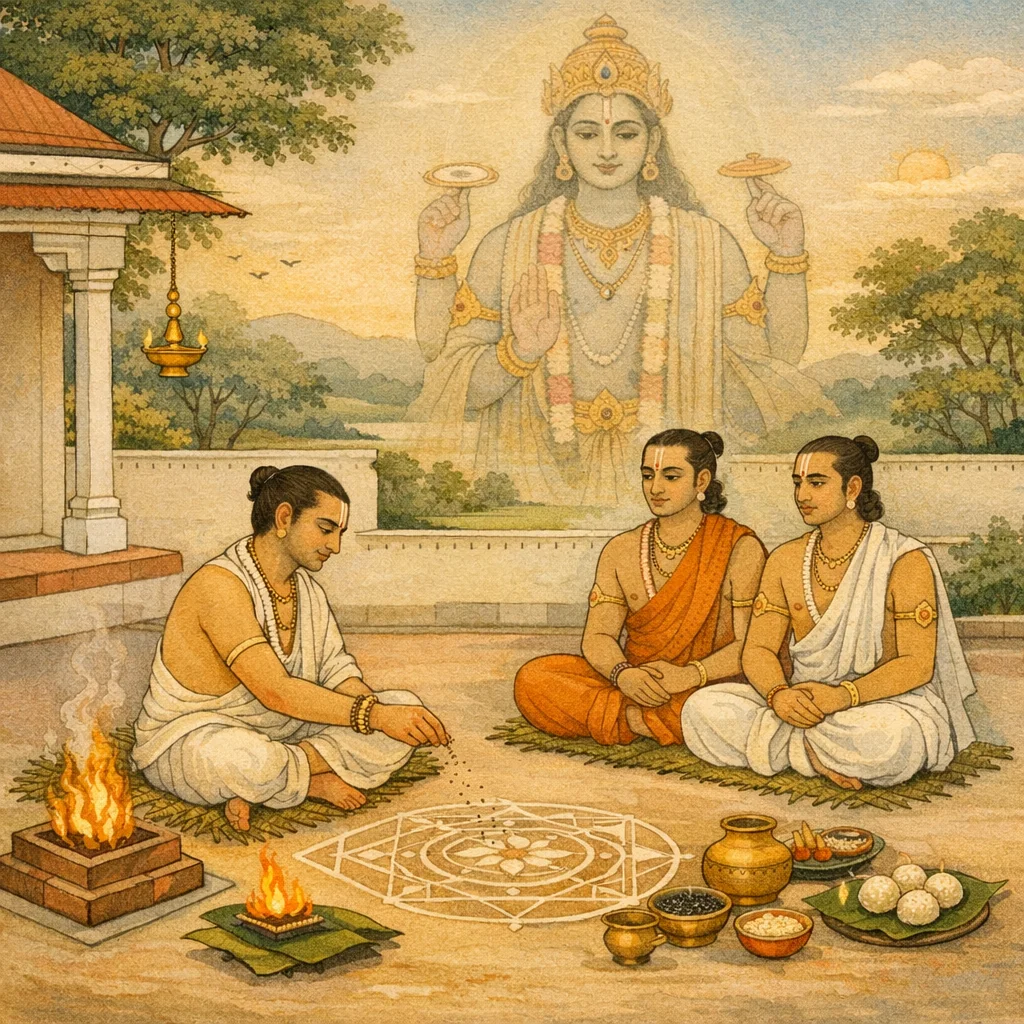
Śrāddha-prayoga: Niyama, Brāhmaṇa-parīkṣā, Kutapa-kāla, Tithi-nyāya, and Vaiṣṇava-phala
Sanaka instructs Nārada in the “supreme procedure” of Śrāddha. It opens with the prior day’s restraints (single meal, celibacy, sleeping on the ground, avoiding travel/anger/sex) and warns of grave sin for invited participants who break continence. It then defines the ideal brāhmaṇa officiant/recipient—śrotriya, a Viṣṇu-bhakta, learned in Smṛti and Vedānta, compassionate—and lists disqualifications (deformities, impure livelihoods, unethical conduct, selling Veda/mantras, etc.). Next it fixes the proper time: Kutapa in the afternoon (aparāhṇa), with detailed tithi rules for kṣayāha, viddhā overlap, kṣaya/vṛddhi selection, and parā-tithi. The ritual sequence follows: inviting Viśvedevas and Pitṛs, maṇḍala forms, pādya/ācamanīya, sesame scattering, arghya vessels, mantra cues, worship, havis and fire offerings (including palm-homa when fire is absent), feeding protocol and silence, recitations (Gāyatrī count, Puruṣa Sūkta, Tri-madhu/Tri-suparṇa, Pāvamāna), piṇḍa, svasti-vācana, akṣayya-udaka, dakṣiṇā, and dismissal mantras. It ends with emergency substitutes and a strong Vaiṣṇava conclusion: all beings and offerings are pervaded by Viṣṇu; proper Śrāddha dissolves sin and sustains the flourishing of one’s lineage.
Shlokas
Verse 1
सनक उवाच । श्रृणुष्व मुनिशार्दूल श्राद्धस्य विधिमुत्तमम् । यच्छ्रुत्वा सर्वपापेभ्यो मुच्यते नात्र संशयः ॥ १ ॥
Sanaka said: “O tiger among sages, listen to the supreme procedure of Śrāddha; by hearing it one is freed from all sins—of this there is no doubt.”
Verse 2
क्षयाहपूर्वदिवसे स्नात्वा चैकाशनो भवेत् । अधः शायी ब्रह्मचारी निशि विप्रान्निमंत्रयेत् ॥ २ ॥
On the day before the kṣayāha, having bathed, one should eat only once; one should sleep upon the ground, observe brahmacarya, and at night invite the brāhmaṇas to be honored with food in the rite.
Verse 3
दन्तधावनतांबूले तैलाभ्यंगं तथैव च । रत्योषधिपरान्नानि श्राद्धकर्त्ताविवर्जयेत् ॥ ३ ॥
One who performs Śrāddha should refrain from brushing the teeth and chewing tāmbūla (betel), and likewise from oil-massage; he should also abstain from sexual pleasure, medicinal preparations, and rich, indulgent foods.
Verse 4
अध्वानं कलहं क्रोधं व्यवायं च धुरं तथा । श्राद्धकर्त्ता च भोक्ता च दिवास्वापं च वर्जयेत् ॥ ४ ॥
One should avoid travelling, quarrelling, anger, sexual intercourse, and bearing burdens; and both the performer of the śrāddha and the one who partakes of it should also refrain from sleeping in the daytime.
Verse 5
श्राद्धे निमंत्रितो यस्तु व्यवायं कुरुते यदि । ब्रह्महत्यामवाप्नोति नरकं चापि गच्छति ॥ ५ ॥
If a person invited for a Śrāddha engages in sexual intercourse, he incurs sin equal to brahmahatyā (killing a brāhmaṇa) and also goes to hell.
Verse 6
श्राद्धे नियोजयेद्विप्रं श्रोत्रिय विष्णुतत्परम् । यथास्वाचारनिरतं प्रशांतं सत्कुलोद्भवम् ॥ ६ ॥
In the śrāddha rite, one should appoint a brāhmaṇa who is a learned śrotriya, devoted to Viṣṇu, steadfast in proper conduct according to his tradition, serene in disposition, and born in a reputable family.
Verse 7
रागद्वेषविहीनं च पुराणार्थविशारदम् । त्रिमधुत्रिसुपर्णज्ञं सर्वभूतदयापरम् ॥ ७ ॥
Free from attachment and aversion, well-versed in the true purport of the Purāṇas, knowing the doctrines of the “three Madhus” and the “three Suparṇas,” and devoted to compassion toward all beings.
Verse 8
देवपूजारतं चैव स्मृतितत्त्वविशारदम् । वेदांततत्त्वसंपन्नं सर्वलोकहिते रतम् ॥ ८ ॥
He is devoted to the worship of the gods, deeply versed in the principles of the Smṛtis, accomplished in the truths of Vedānta, and ever engaged in the welfare of all worlds.
Verse 9
कृतज्ञं गुणसंपन्नं गुरुशुश्रूषणे रतम् । परोपदेशनिरतं सच्छास्त्रकथनैस्तथा ॥ ९ ॥
One should be grateful, endowed with virtues, devoted to serving the guru, committed to instructing others, and likewise engaged in expounding true and noble scriptures.
Verse 10
एते नियोजितव्या वै श्राद्धे विप्रा मुनीश्वर । श्राद्धे वर्ज्याप्रवक्ष्यामि श्रृणु तान्मुसमाहितः ॥ १० ॥
“These Brahmin priests are indeed to be appointed for the Śrāddha, O lord among sages. Now I shall describe those who must be avoided in a Śrāddha—listen with full attention.”
Verse 11
न्पूनांगश्चाधिकांगश्च कदर्यो रोगितस्तथा । कुष्टी च कुनखी चैव लंबकर्णः क्षतव्रतः ॥ ११ ॥
One who is missing a limb or has an extra limb; one who is miserly; likewise one who is diseased; a leper; one with deformed nails; one with long, pendulous ears; and one whose religious observance (vrata) has been broken—(such persons are regarded as unfit here).
Verse 12
नक्षत्रपाठजीवी च तथा च शवदाहकः । कुवादी परिर्वत्ता च तथा देवलकः खलः ॥ १२ ॥
One who lives by reciting nakṣatra-readings, one who burns corpses, a perverse disputant, a turncoat ever changing sides, and likewise the devalaka who serves the gods for hire—such a man is wicked.
Verse 13
निंदकोऽमर्षणो धूर्तस्तथैव ग्रामयाजकः । असच्छास्त्राभिनिरतः परान्ननिगतस्तथा ॥ १३ ॥
A slanderer, one who cannot endure, a deceitful man; likewise a village priest who officiates for hire; one devoted to false treatises, and one who lives dependent on others’ food—such persons are blameworthy and unfit in matters of dharma.
Verse 14
वृषलीसूति पोष्टा च वृषलीपतिरेव च । कुंडश्च गोलकश्चैव ह्ययाज्यानां च याजकः ॥ १४ ॥
Also disqualified are: the son born of a Śūdra woman (vṛṣalī), one who maintains such improper unions, the husband of a Śūdra woman; likewise the kuṇḍa and the golaka; and the priest who performs yajña for those who are not fit to be sacrificed for.
Verse 15
दंभाचारो वृथामुंडी ह्यन्यस्त्रीधनतत्परः । विष्णुभक्तिविहीनश्च शिवभक्तिपराड्मुखः ॥ १५ ॥
He acts in hypocrisy; he shaves his head in vain as mere display; he is intent on others’ women and wealth; he is devoid of bhakti to Viṣṇu, and has turned away from bhakti to Śiva.
Verse 16
वेदविक्रयिणश्चैव व्रतविक्रयिणस्तथा । स्मृतिविक्रयिणश्चैव मंत्रविक्रयिणस्तथा ॥ १६ ॥
Likewise, those who sell the Veda, those who sell vratas (sacred vows), those who sell the Smṛtis, and those who sell mantras—sacred formulas—are also condemned.
Verse 17
गायकाः काव्यकर्त्तारो भिषक्छास्त्रोपजीविनः । वेदनिंदापरश्चैव ग्रामापण्यप्रदाहकः ॥ १७ ॥
Singers, makers of poetry, those who live by the medical sciences, those devoted to reviling the Veda, and the one who sets fire to a village market—these are counted among the condemned kinds.
Verse 18
तथातिकामुकश्चैव रसविक्रयकारकः । कूटयुक्तिरतश्चैव श्राद्धे वर्ज्याः प्रयत्नतः ॥ १८ ॥
Likewise, the excessively lustful, the trader in intoxicating drink, and the one who delights in deceitful contrivances—such people should be carefully avoided in the śrāddha rite.
Verse 19
निंमत्रयीत पूर्वेद्युस्तस्मिन्नेव दिनेऽथवा । निमंत्रितो भवेद्विप्रो ब्रह्मचारी जितेंद्रियः ॥ १९ ॥
One should extend the invitation either on the previous day or on that very day. The invited brāhmaṇa should be a brahmacārī, self-controlled and master of his senses.
Verse 20
श्राद्धे क्षणस्तु कर्त्तव्यः प्रसादश्चेति सत्तम । निमंत्रयेद्द्विजं प्राज्ञं दर्भपाणिर्जितेंद्रियः ॥ २० ॥
O best of the virtuous, during the śrāddha one should observe the proper ritual moment and maintain a serene, gracious disposition. With senses restrained and holding darbha grass in hand, one should invite a learned brāhmaṇa.
Verse 21
ततः प्रातः समुत्थाय प्रातः कृत्यं समाप्य च । श्राद्धं समाचरेद्विद्वान्काले कुतपसंज्ञिते ॥ २१ ॥
Then, rising early in the morning and completing the prescribed morning duties, the learned person should perform the śrāddha rite at the time known as Kutapa.
Verse 22
दिवसस्याष्टमे काले यदा मंदायते रविः । स कालः कुतपस्तत्र पितॄणां दत्तमक्षयम् ॥ २२ ॥
In the eighth division of the day, when the Sun’s heat and force begin to soften, that time is called Kutapa; offerings given then to the Pitṛs (ancestors) become imperishable in result.
Verse 23
अपराह्णः पितॄणां तु दत्तः कालः स्वयंभुवा । तत्काल एव दातव्यं कव्यं तस्माद्द्विजोत्तमैः ॥ २३ ॥
The afternoon (aparāhṇa) has been appointed by Svayambhū (Brahmā) as the proper time for the Pitṛs. Therefore, the offering meant for the ancestors (kavya) should be given precisely at that time by the best of the twice-born.
Verse 24
यत्काव्यं दीयते द्वव्यैरकाले मुनिसत्तम । राक्षसं तद्धि विज्ञेयं पितॄणां नोपतिष्टति ॥ २४ ॥
O best of sages, any śrāddha-offering (kāvya) that is given to two persons at an improper time should be understood as ‘Rākṣasa’; it does not reach the Pitṛs (ancestors).
Verse 25
काव्यं प्रत्तं तु सायाह्ने राक्षसं तद्भवेदपि । दाता नरकमाप्नोति भोक्ता च नरकं व्रजेत् ॥ २५ ॥
If a śrāddha-offering (kāvya) is given in the evening, it becomes ‘rākṣasa’ in nature. The giver attains hell, and the eater too goes to hell.
Verse 26
क्षयाहस्य तिथैर्विप्र यदि दंडमितिर्भवेत् । विद्धापराह्णि कायां तु श्राद्धं कार्यं विजानता ॥ २६ ॥
O brāhmaṇa, if on a day of ‘tithi-loss’ (kṣayāha) the tithis yield only a daṇḍa-measure of time, then the one who understands the rule should perform the śrāddha in the afternoon, during the ‘viddhā’ (overlapped) portion.
Verse 27
क्षयाहस्य तिथिर्या तु ह्यपराह्णद्वये यदि । पूर्वा क्षये तु कर्त्तव्या वृद्वौ कार्या तथोत्तरा ॥ २७ ॥
If, on a day of tithi-loss (kṣaya), the relevant lunar day spans both afternoon periods, then in the case of loss the observance should be performed for the earlier tithi; but in the case of tithi-increase (vṛddhi), it should be performed for the later tithi.
Verse 28
मुहूर्त्त द्वितये पूर्वदिने स्यादपरेऽहनि । तिथिः सायाह्नगा यत्र परा काव्यस्य विश्रुता ॥ २८ ॥
When, on the previous day, the relevant tithi begins within the second muhūrta, and on the following day that tithi extends into the late afternoon—evening, that tithi is renowned in the tradition as the “parā” (superior) one for the rite.
Verse 29
किंचित्पूर्वदिने प्राहुर्मुहूर्त्तद्वितये सति । नैतन्मतं हि सर्वेषां काव्यदाने मुनीश्वर ॥ २९ ॥
Some say it should be done a little earlier—on the previous day, when the second muhūrta has arrived. But, O lord among sages, this view is not accepted by all with regard to the gifting of a kāvya (literary work).
Verse 30
निमंत्रितेषु विप्रेषु मिलितेषु द्विजोत्तम । प्रायश्चित्तविशुद्धात्मा तेभ्योऽनुज्ञां समाहरेत् ॥ ३० ॥
When the invited brāhmaṇas have assembled, O best of the twice-born, the performer—his inner being purified by the expiatory rite (prāyaścitta)—should obtain their permission to conclude the observance.
Verse 31
श्राद्धार्थं समनुज्ञातो विप्रान्भूयो निमंत्रयेत् । उभौ च विश्वेदेवार्थं पित्रर्थं त्रीन्यथाविधि ॥ ३१ ॥
Having obtained permission for the Śrāddha rite, one should again invite the brāhmaṇas—two for the Viśvedevas and three, according to rule, for the Pitṛs (ancestors).
Verse 32
देवतार्थं च पित्रर्थमेकैकं वा निमंत्रयेत् । श्राद्धार्थं समनुज्ञातः कारयेन्मंडलद्वयम् ॥ ३२ ॥
For the sake of the Devas and for the sake of the Pitṛs (ancestors), one should invite them—either together or each separately. Having obtained consent for the Śrāddha rite, he should have two ritual maṇḍalas prepared.
Verse 33
चतुरस्त्रं ब्राह्मणस्य त्रिकोणं क्षत्रियस्य वै । वैश्यस्य वर्तुलं ज्ञेयं शूद्रस्याभ्याभ्युक्षणं भवेत् ॥ ३३ ॥
The Brāhmaṇa’s ritual diagram is to be four-sided; the Kṣatriya’s, a triangle. The Vaiśya’s should be known as a circle; while for the Śūdra, the rite is performed by sprinkling purificatory water.
Verse 34
ब्राह्मणानामभावे तु भ्रातरं पुत्रमेव च । आत्मानं वा नियुंजीत न विप्रं वेदवर्जितम् ॥ ३४ ॥
But if qualified Brāhmaṇas are not available, one may appoint one’s brother, or even one’s own son, or else oneself; however, one should not appoint a so‑called Brāhmaṇa who is devoid of the Veda.
Verse 35
प्रक्षाल्य विप्रपादांश्च ह्याचांनानुपवेश्य च । यथावदर्चनं कुर्यात्स्मरन्नारायणं प्रभुम् ॥ ३५ ॥
Having washed the feet of the Brāhmaṇas and then seating them after offering ācamana (sipping-water), one should perform the worship properly—while remembering Nārāyaṇa, the Supreme Lord.
Verse 36
ब्राह्मणानां तु मध्ये च द्वारदेशे तथैव च । अपहता इत्यृचा वै कर्त्ता तु विकिरेत्तिलान् ॥ ३६ ॥
In the midst of the Brāhmaṇas, and likewise at the doorway, the performer should scatter sesame seeds while reciting the Ṛgvedic verse beginning with “apahatā…”.
Verse 37
यवैर्दर्भघैश्च विश्वेषां देवानामिदमासनम् । दत्त्वेति भूयो दद्यच्च दैवे क्षणप्रतीक्षणम् ॥ ३७ ॥
With barley grains and bundles of darbha grass, one should offer this seat to all the gods, saying, “This seat is given.” Then, in the divine offering, one should continue to give again and again, moment after moment.
Verse 38
अक्षय्यासनयोः षष्टी द्वितीयावाहने स्मृता । अन्नदाने चतुर्थी स्याच्छेषाः संपुद्धयः स्मृताः ॥ ३८ ॥
For the imperishable gift (akṣayya) and the gift of a seat (āsana), the sixth lunar day (Ṣaṣṭhī) is prescribed; for a second conveyance (dvitīya-vāhana), the second lunar day (Dvitīyā) is remembered. For the gift of food (anna-dāna), the fourth lunar day (Caturthī) is recommended; the remaining cases are to be understood as “saṃpuddhayaḥ”—complete purifications and auspicious fulfillments—as taught.
Verse 39
आसाद्य पात्रद्वितयं दर्भशाखासमन्वितम् । तत्पात्रे सेचयेत्तोयं शन्नोदेवीत्यृचा ततः ॥ ३९ ॥
Having brought forward two vessels furnished with sprigs of darbha grass, one should then pour water into that vessel while reciting the Ṛg-vedic verse beginning “śaṃ no devī….”
Verse 40
यवोसीति ति यवान् क्षित्प्वा गंधपुष्पे च वाग्यतः । आवाहयेत्ततो देवान्विश्वे देवास्स इत्यृचा ॥ ४० ॥
Reciting “yavosi,” one should scatter barley grains, and then—restraining speech—offer fragrant substances and flowers. Thereafter, one should invoke the deities with the Ṛg-vedic verse beginning “viśve devāsaḥ.”
Verse 41
या दिव्या इति मंत्रेण दद्यादर्घ्यं समाहितः । गंधैश्च पत्रपुष्पैश्च धूपैर्दीपैर्यजेत्ततः ॥ ४१ ॥
With a collected mind, one should offer arghya (a respectful water-offering) using the mantra beginning “yā divyā.” Thereafter, one should worship with fragrances, leaves and flowers, incense, and lamps.
Verse 42
देवैश्च समनुज्ञातो यजेत्पितृगणांस्तथा । तिलसंयुक्तदर्भैश्च दद्यात्तेषां सदासनम् ॥ ४२ ॥
Having obtained the assent of the devas, one should then duly worship the hosts of the Pitṛs; and with darbha-grass mixed with sesame, one should provide them a proper seat.
Verse 43
पात्राण्यासादयेत्त्रीणि ह्यर्घाथ पूर्ववद्द्विजः । शन्नोदेव्या जलं क्षिप्त्वा तिलोसीति तिलाक्षिपेत् ॥ ४३ ॥
For offering arghya, the twice-born should set out three vessels as before. Reciting “śaṃ no devyā…”, he should pour in water; then, uttering “tilo ’si”, he should cast sesame seeds into it.
Verse 44
उशन्त इत्यृचावाह्य पितॄन्विप्रः समाहितः । या दिव्या इति मंत्रेण दद्यादर्घ्यं च पूर्ववत् ॥ ४४ ॥
Having invoked the Pitṛs with the Ṛk beginning “uśanta…”, the concentrated brāhmaṇa should then, with the mantra “yā divyā…”, offer the arghya in the same manner as previously prescribed.
Verse 45
गंधैश्च पत्रपुष्पैश्च धूपैर्दीपैश्च सत्तम । वासोर्भिभूषणैश्वैव यथाविभवमर्चयेत् ॥ ४५ ॥
O best of the virtuous, one should worship according to one’s means—offering fragrances, leaves and flowers, incense and lamps, as well as garments and ornaments.
Verse 46
ततोऽन्नाग्रं समादाय घृतयुक्तं विचक्षणः । अग्नौ करिष्य इत्युक्त्वा तेभ्योऽनुज्ञां समाहरेत् ॥ ४६ ॥
Then the wise man, taking the foremost portion of the food mixed with ghee, should say, “I shall offer this into the fire,” and having said so, he should obtain their permission.
Verse 47
करवै करवाणीति चापृष्टा ब्राह्मणा मुने । कुरुष्व क्रियतां वेति कुर्विति ब्रूयुरेव च ॥ ४७ ॥
O sage, when asked, “Should I do it?” or “May I have it done?”, the brāhmaṇas would indeed reply: “Do it,” “Let it be done,” or simply, “Do.”
Verse 48
उपासनाग्निमाधाय स्वगृह्योक्तविधानतः । सामाय च पितृमते स्वधा नम इतीरयेत् ॥ ४८ ॥
Having kindled the upāsanā fire according to the procedure taught in one’s own Gṛhya-sūtra, in the rite meant for the Pitṛs one should utter: “svadhā, namaḥ.”
Verse 49
अग्नये कव्यवाहनाय स्वधा नम इतीह वा । स्वाहांतेनापि वा प्राज्ञो जुहुयात्पितृयज्ञवत् ॥ ४९ ॥
Here the wise should offer oblations as in the pitṛyajña, saying, “svadhā, namaḥ to Agni, the kavyavāhana, bearer of offerings to the Pitṛs,” or else he may offer with the concluding formula “svāhā.”
Verse 50
आभ्यामेवाहुतिभ्यां तु पितॄणां तृप्तिरक्षया । अग्न्यभावे तु विप्रस्य पाणौ होमो विधीयते ॥ ५० ॥
Indeed, by these two oblations alone the Pitṛs attain inexhaustible satisfaction. And when fire is unavailable, for a brāhmaṇa the homa is prescribed to be offered into the palm of the hand.
Verse 51
यथाचारं प्रकुर्वीत पाणावग्नौ च वा द्विज । नह्यग्निर्दूरगः कार्यः पार्वणे समुपस्थिते ॥ ५१ ॥
O twice-born one, perform the rite according to proper tradition—either with fire in the palm of the hand or with the sacred fire. When the parvaṇa rite has arrived, the fire should not be kept far away nor fetched from a distance.
Verse 52
संधायाग्निं ततः कार्यं कृत्वा तं विसृजेत्कृती । यद्याग्निर्दूरगो विप्र पार्वणे समुपस्थिते ॥ ५२ ॥
Having kindled the sacred fire, the wise should perform the prescribed rite and then, with reverence, dismiss the fire. O brāhmaṇa, if at the time of the Parvaṇa rite the fire is far away and not readily available, this very procedure is to be followed.
Verse 53
भ्रातृभिः कारयेच्छ्राद्धं साग्निकैर्विधिवद्द्विजैः । क्षयाहे चैव संप्रात्पे स्वस्याग्निर्दूरगो यदि ॥ ५३ ॥
If, when the kṣaya-aha—the day for performing Śrāddha for the ancestors—has arrived, one’s own sacred fire is far away, one should have the Śrāddha performed through one’s brothers, by duly qualified twice-born brāhmaṇas who maintain the fire (sāgnika), in accordance with proper procedure.
Verse 54
तथैव भ्रातरस्तत्र लौकिकाग्नावपि स्थिताः । उपासनान्गौ दूरस्थे समीपेभ्रातरि स्थइते ॥ ५४ ॥
In the same manner, the brothers there remained stationed even by the ordinary household fire. The auxiliary observances of worship (upāsanā) were arranged—some at a distance, while the brother who was near remained in place.
Verse 55
यद्यग्नौ जुहुयाद्वापि पाणौ वा स हि पातकी । उपासनाग्ना दूरस्थे केचिदिच्छंति वै द्विजाः ॥ ५५ ॥
Even if one were to offer oblations into the fire—or even into one’s own hand—such a person is indeed a sinner. When the sacred fire meant for daily worship (upāsanā-agni) is kept far away, some twice-born men still desire to proceed with rites in that improper manner.
Verse 56
तच्छेष विप्रपात्रेषु विकिरेत्संस्मरन्हरिम् । भक्ष्यैर्भोज्यैश्च लेह्यैश्च स्वाद्यैर्विप्रान्प्रपूजयत् ॥ ५६ ॥
Remembering Hari, one should distribute the remaining offerings into the vessels of the brāhmaṇas, and honor the brāhmaṇas as well with foods to be chewed, eaten, licked, and sipped.
Verse 57
अन्नत्यागं ततः कुर्य्यादुभयत्र समाहितः । आगच्छंतु महाभागाविश्वेदेवा महाबलाः ॥ ५७ ॥
Then, with a collected mind and attentiveness in both respects, he should perform the rite of setting aside and offering food, invoking: “May the greatly fortunate and mighty Viśvedevās come here.”
Verse 58
ये यत्र विहिताः श्राद्धे सावधानां भवंतु ते । इति संप्रार्थयेद्देवान्ये देवास ऋचा नु वै ॥ ५८ ॥
At a Śrāddha, one should reverently pray: “May the deities prescribed for each place and rite be present here with full attention.” Thus indeed one should supplicate the gods with a sacred ṛc, a Vedic verse.
Verse 59
तथासंप्रार्थयद्विप्रान्ये च हेति ऋचा पितॄन् । अमूर्तानां मूर्तानां च पितॄणां दीप्ततेजसाम् ॥ ५९ ॥
Thus he duly supplicated the brāhmaṇa sages, and also invoked the Pitṛs with the Ṛg-vedic formula “heti”—the radiant ancestors, both formless and embodied.
Verse 60
नमस्यामि सदा तेषां ध्यानिनां योगचजक्षुषाम् । एवं पितॄन्नमस्कृत्य नारायण परायणः ॥ ६० ॥
I ever bow to those meditators who possess the yogic eye. Thus, having paid homage to the Pitṛs, one who is wholly devoted to Nārāyaṇa proceeds with single-minded refuge in Him.
Verse 61
दत्तं हविश्च तत्कर्ण विष्णवे विनिवेदयेत् । ततस्ते ब्राह्मणाः सर्वे भुञ्जीरन्वाग्यता द्विजाः ॥ ६१ ॥
After giving the havis (oblation), one should formally offer that sacred portion to Lord Viṣṇu. Thereafter, all those brāhmaṇas—self-restrained and disciplined in speech—should partake of the meal.
Verse 62
हसतो वदते कोऽपि राक्षघसं तद्भवेद्धविः । यथाचार प्रदेयं च मधुमांसादिकं तथा ॥ ६२ ॥
If someone speaks while laughing, that becomes havis—an offering fit for the Rākṣasas. Therefore one should present offerings according to the established ācāra (proper conduct); likewise, where prescribed, honey, meat, and the like are to be given.
Verse 63
पाकादिं च प्रशंसेरन् वाग्यता धृतभाजनाः । यदि पात्रं त्यजेत्कोऽपि ब्राह्मणः श्राद्धयोजितः ॥ ६३ ॥
Holding their vessels and restraining speech, they should praise the cooked offerings and the like. If any Brāhmaṇa appointed for the Śrāddha were to abandon (leave behind) the vessel, then…
Verse 64
श्राद्धहंता स विज्ञेयो नरकायोपपद्यते । भुंजानेषु च विप्रेषु ह्यन्योन्यं संस्पुशेद्यदि ॥ ६४ ॥
He should be known as a destroyer of the Śrāddha, and he falls into hell. And if, while the Brāhmaṇas are eating, they touch one another, that too is a fault that spoils the rite.
Verse 65
तदन्नमत्यजन्भुक्त्वा गायत्र्यष्टशतं जपेत् । भुज्यमानेषु विप्रेषु कर्त्ता श्रद्धापरायणः ॥ ६५ ॥
Having eaten without rejecting that very food, the performer should recite the Gāyatrī mantra in japa eight hundred times, devoted to śraddhā, while the Brāhmaṇas are being fed.
Verse 66
स्मरेन्नारायणं देवमनंतमपराजितम् । रक्षोघ्नान्वैष्णवांश्चैव पैतृकांश्चविशेषतः ॥ ६६ ॥
One should remember Lord Nārāyaṇa—the Divine, the Infinite (Ananta), the Unconquered (Aparājita)—especially when performing the rākṣasa-destroying protective rites, the Vaiṣṇava observances, and the ancestral (paitṛka) rites.
Verse 67
जपेच्च पौरुषं सूक्तं नाचिकेतत्रयं तथा । त्रिमधु त्रिसुपर्णं च पावमानं यजूंषि च ॥ ६७ ॥
One should also recite the Pauruṣa Sūkta; likewise the three Nāciketa formulae, the Tri-madhu and Tri-suparṇa passages, and the Pāvamāna hymns together with the Yajus-mantras.
Verse 68
सामान्यपितथोक्तानि वदेत्पुण्यप्रदां स्तथा । इतिहासपुराणानि धर्मशास्त्राणि चैव हि ॥ ६८ ॥
One should teach those general instructions declared by the forefathers, for they bestow merit; and one should likewise expound the Itihāsas and Purāṇas, and indeed the Dharmaśāstras as well.
Verse 69
भुंजीरन्ब्रह्मणा यावत्तावदेताञ्जपेद्द्विज । ब्राह्मणेषु च भुक्तेषु विकिरं विक्षिपेत्तथा ॥ ६९ ॥
O twice-born one, for as long as the Brāhmaṇas are eating, one should recite these mantras. And when the Brāhmaṇas have finished their meal, one should likewise scatter the ritual offering (vikira) as prescribed.
Verse 70
शेषमन्नं वदेच्चैव मधुसूक्तं च वै जपेत् । स्वयं च पादौ प्रक्ाल्य सम्यगाचम्य नारद ॥ ७० ॥
One should also utter the formula over the remaining food and recite the Madhu-sūkta. Then, O Nārada, washing one’s feet oneself, one should perform ācamana properly.
Verse 71
आचांतेषु च विप्रेषु पिंडं निर्वापयेत्ततः । स्वस्तिवा चनकं कुर्यादक्षय्योदकमेव च ॥ ७१ ॥
When the Brāhmaṇas have performed ācamana, one should then offer the piṇḍa. Thereafter, one should have the auspicious benediction recited (svasti-vācana) and also perform the rite of the inexhaustible water-offering (akṣayya-udaka).
Verse 72
दत्त्वा समाहितः कुर्यात्तथा विप्राभिवादनम् । अचालयित्वा पात्रं तु स्वस्ति कुर्वंति ये द्विजाः ॥ ७२ ॥
After giving the gift, one should remain composed and then offer reverent salutations to the brāhmaṇas. Without moving the offering-vessel, the twice-born recite words of blessing, “svasti.”
Verse 73
वत्सरं पितरस्तेषां भवंत्युच्छिष्टभोजिनः । दातारो नोऽभिवर्द्धंतामित्याद्यैः स्मृतिभाषितैः ॥ ७३ ॥
For a full year, the Pitṛs (ancestral spirits) of those people subsist on the leftovers (impure), as declared in the Smṛti sayings that begin, “May our donors prosper.”
Verse 74
आशीर्वचो लभेत्तेभ्यो नमस्कारं चरेत्ततः । दद्याच्च दक्षिणां शक्त्या तांबूलं गंधसंयुतम् ॥ ७४ ॥
One should receive blessings from them and then offer respectful salutations. Thereafter, according to one’s capacity, one should give dakṣiṇā (an honorarium) and offer tāmbūla (betel) together with fragrant substances.
Verse 75
न्युब्जपात्रमथानीय स्वधाकारमुदीरयेत् । वाजेवाजे इति ऋचा पितॄन्देवान्विसर्जयेत् ॥ ७५ ॥
Then, bringing the vessel placed upside down, one should utter the Svadhā-formula; and with the Ṛgvedic verse beginning “vāje-vāje,” one should duly dismiss the Pitṛs and the Devas.
Verse 76
भोक्ता च श्राद्धकृत्तस्यां रजन्यां मैथुनं त्यजेत् । तथा स्वाध्यायमध्वानं प्रयत्नेन परित्यजेत् ॥ ७६ ॥
On that night, both the one who partakes of the śrāddha meal and the performer of the śrāddha should abstain from sexual intercourse; likewise, they should carefully refrain from svādhyāya (Vedic self-recitation) and from travel.
Verse 77
अध्वगश्चातुरश्चैव विहीनश्च धनैस्तथा । आमश्राद्धं प्रकुर्वीत हेम्ना वास्पृश्यभार्यकः ॥ ७७ ॥
A traveller, a capable man, and even one who lacks wealth should perform an emergency śrāddha; and if need be, he may do so with gold, or at least by touching his wife as a substitute rite.
Verse 78
द्रव्याभावे द्विजाभावे ह्यन्नमात्रं च पाचयेत् । पैतृकेन तु सूक्तेन होमं कुर्याद्विचक्षणः ॥ ७८ ॥
When ritual materials are lacking, and even when a qualified brāhmaṇa is unavailable, one should at least cook simple food; and the discerning should perform the homa with the ancestral (paitṛka) Vedic hymn.
Verse 79
अत्यंत हव्यशून्यश्चैत्स्वशक्त्या तु तृणं गवाम् । स्नात्वा च विधिवद्विप्र कुर्याद्वा तिलतपर्णम् ॥ ७९ ॥
If one is utterly without anything fit for oblation (havya), then according to one’s ability—after bathing as prescribed, O brāhmaṇa—one may instead offer grass for cows, or perform tarpaṇa with sesame and water.
Verse 80
अथवा रोदनं कुर्यादत्युच्चैर्विजने वने । दरिद्रोऽहं महापापी वदन्निति विचक्षणः ॥ ८० ॥
Or else, the discerning person should weep very loudly in a lonely forest, repeatedly declaring, “I am poor; I am a great sinner.”
Verse 81
परेद्युः श्राद्धकृन्मर्त्यो यो न तर्पयते पितॄन् । तत्कुलं नाशमायाति ब्रह्महत्यां च विंदति ॥ ८१ ॥
A mortal who performs the śrāddha on the previous day but does not offer tarpaṇa to the Pitṛs—his family line comes to ruin, and he incurs sin equivalent to brahmahatyā (slaying a brāhmaṇa).
Verse 82
श्राद्धं कुर्वंति ये मर्त्याः श्रद्धावंतो मुनीश्वर । न तेषां संततिच्छेदः संपन्नास्ते भवंति च ॥ ८२ ॥
O lord among sages, those mortals who perform Śrāddha with faith suffer no break in their lineage; they also become prosperous.
Verse 83
पितॄन्यंजति यें श्राद्धे तैस्तु विष्णुः प्रपूजितः । तस्मिंस्तुष्टे जगन्नाथे सर्वास्तुष्यंति देवताः ॥ ८३ ॥
Those who satisfy the Pitṛs through the śrāddha rite thereby worship Viṣṇu in the most eminent way. When Jagannātha, the Lord of the world, is pleased, all the deities become pleased.
Verse 84
पितरो देवताश्चैव गंधर्वाप्सरसस्तथा । यक्षाश्च सिद्धा मनुजा हरिरेव सनातनः ॥ ८४ ॥
The Pitṛs, the gods, the Gandharvas and Apsarases, the Yakṣas, the Siddhas, and human beings—indeed all of them are none other than Hari, the Eternal.
Verse 85
येनेदमखिलं जातं जगत्स्थावरजंगमम् । तस्माद्दाता च भोक्ता च सर्वं विष्णुः सनातनः ॥ ८५ ॥
From whom this entire universe—of the immovable and the moving—has arisen, therefore that Eternal Viṣṇu alone is everything: the giver and the enjoyer (recipient) of all.
Verse 86
यदस्ति विप्र यन्नास्ति दृश्यं चादृश्यमेव च । सर्वं विष्णुमयं ज्ञेयं तस्मादन्यन्न विद्यते ॥ ८६ ॥
O brāhmaṇa, whatever exists and whatever does not exist—what is seen and what is unseen—know all of it to be pervaded by Viṣṇu; therefore, nothing whatsoever exists apart from Him.
Verse 87
आधारभूतो विश्वस्य सर्वभूतात्मकोऽव्ययः । अनौपम्यस्वभावश्च भगवान्हव्यकव्यभुक् ॥ ८७ ॥
He is the very foundation of the universe, the imperishable Inner Self of all beings; incomparable in nature is the Blessed Lord, who partakes of the offerings cast into the sacred fire and of the ancestral oblations.
Verse 88
परब्रह्माभिधेयो य एक एव जनार्दनः । कर्त्ता कारयिता चैव सर्वं विष्णुः सनातनः ॥ ८८ ॥
He who is spoken of as the Supreme Brahman is the one and only Janārdana. He alone—the eternal Viṣṇu—is both the doer and the one who causes action; all that exists is Viṣṇu.
Verse 89
इत्येवं ते मुनिश्रेष्ठ श्राद्धास्य विधिरुत्तमः । कथितः कुर्वतामेवं पापं सद्यो विलीयते ॥ ८९ ॥
Thus, O best of sages, the supreme procedure of this Śrāddha has been declared to you. For those who perform it in this manner, sin melts away at once.
Verse 90
य इदं पठते भक्त्या श्राद्धकाले द्विजोत्तमः । पितरस्तस्य तुष्यंति संततिश्चैव वर्द्धते ॥ ९० ॥
O best of the twice-born, whoever recites this with devotion at the time of Śrāddha—his ancestors are satisfied, and his lineage too surely flourishes.
Frequently Asked Questions
The chapter states that Svayambhū (Brahmā) appoints aparāhṇa for Pitṛs; Kutapa is defined as the eighth division of the day when the sun’s intensity softens, and offerings made then become ‘imperishable’ (akṣayya) in result for the ancestors.
A śrāddha offering made at an improper time—especially in the evening or incorrectly timed to tithi—becomes ‘Rākṣasa’ (spoiled/inauspicious) and is said not to reach the Pitṛs, bringing negative consequences to both giver and eater.
It prioritizes a learned śrotriya devoted to Viṣṇu, steady in proper conduct, serene, from a reputable family, free from attachment/aversion, Purāṇa-aware, Smṛti-versed, Vedānta-accomplished, compassionate, grateful, and engaged in teaching and welfare.
It allows alternatives such as offering as homa into the palm (for a brāhmaṇa) when fire is unavailable, cooking simple food when materials/priests are lacking, offering sesame and water or grass for cows, and treating such acts as emergency śrāddha done according to one’s capacity.