The Pañcarātra Vow (Haripañcaka Vrata): Observance from Śukla Ekādaśī to Pūrṇimā
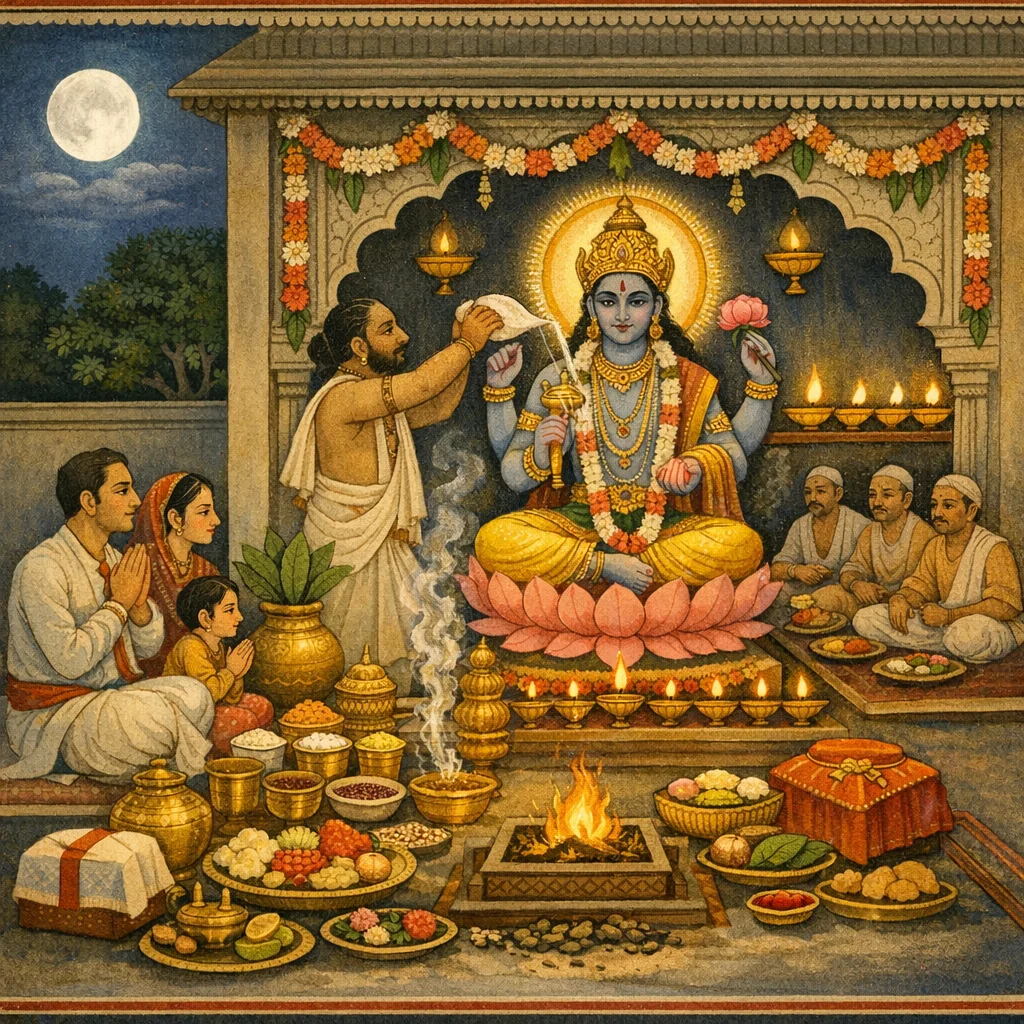
Sanaka instructs Nārada on the rare Haripañcaka (Pañcarātra) vow: a five-night observance to Viṣṇu that grants dharma, artha, kāma, and mokṣa. Beginning in Mārgaśīrṣa (bright fortnight), one prepares with purity (tooth-cleaning, bathing), deva-pūjā, and the pañca-mahāyajñas; keeps a regulated diet (once daily), then fasts on Śukla Ekādaśī, rises early, worships Hari at home, and performs pañcāmṛta abhiṣeka. The votary offers upacāras (gandha, puṣpa, dhūpa, dīpa, naivedya, tāmbūla), circumambulates, and recites knowledge-centered salutations to Vāsudeva/Janārdana. With a formal saṅkalpa, five nights of foodlessness are dedicated; jāgaraṇa (night vigil) is kept on Ekādaśī and extended through Dvādaśī–Caturdaśī, with similar worship on Pūrṇimā. Special Pūrṇimā rites include milk abhiṣeka, tila-homa, and sesame charity. On the sixth day, after āśrama duties, pañcagavya is taken; brāhmaṇas are fed and gifts are given (pāyasa with honey and ghee, fruits, a fragrant-water kalaśa, and a cloth-covered pot with five gems), and udyāpana is performed after a year-long cycle. The chapter ends by proclaiming mokṣa and vast merit, even liberation through devoted hearing.
Shlokas
Verse 1
सनक उवाच । अन्यद्व्रतं प्रवक्ष्यामि श्रृणु नारद तत्त्वतः । दुर्लभं सर्वलोकेषु विख्यातं हरिपञ्चकम् ॥ १ ॥
Sanaka said: I shall now expound another sacred vow—listen, O Nārada, to its true principle. It is rare in all the worlds and renowned as the Haripañcaka.
Verse 2
नारीणां च नराणां च सर्वदुःखनिवारणम् । धर्मकामार्थमोक्षाणां निदानं मुनिसत्तम ॥ २ ॥
O best of sages, it removes all sorrow for women and men alike, and is the very source from which dharma, kāma, artha, and mokṣa arise.
Verse 3
सर्वाभीष्टप्रदं चैव सर्वव्रतफलप्रदम् । मार्गशीर्षे सिते पक्षे दशम्यां नियतेन्द्रियः ॥ ३ ॥
It bestows all desired aims and grants the fruits of every vow. In the month of Mārgaśīrṣa, in the bright fortnight, on the tenth lunar day, one should observe it with the senses restrained.
Verse 4
कुर्यात्स्नानादिकं कर्म दन्तधावनपूर्वकम । कृत्वा देवार्चनं सम्यक्तथा पञ्च महाध्वरान् ॥ ४ ॥
One should perform the duties beginning with bathing—preceded by cleaning the teeth; and, having duly worshiped the Devas, one should also carry out the five great sacrifices (pañca-mahāyajñas).
Verse 5
एकाशी च भवेत्तस्मिन् दिने नियममास्थिताः । ततः प्रातः समुत्थाय ह्येकादश्यां मुनीश्वरः ॥ ५ ॥
On that day one should abide in restraint and discipline, taking food only once. Then, rising early on the morning of Ekādaśī, the lordly sage (munīśvara) should proceed with the prescribed observance.
Verse 6
स्नानं कृत्वा यथाचारं हरिं चैवार्चयेद्गृहे । स्नापयेद्देवदेवेशं पञ्चामृतविधानतः ॥ ६ ॥
Having bathed according to proper practice, one should worship Hari at home; and one should bathe the Lord of the gods with pañcāmṛta, in the prescribed manner.
Verse 7
अर्चयेत्परया भक्त्या गन्धपुष्पादिभिः क्रमात् । धूपैर्दीपैश्च नैवैद्यैस्ताम्बूलैश्च प्रदक्षिणैः ॥ ७ ॥
One should worship (the Lord) with supreme devotion, in due order, offering fragrances and flowers and the like—along with incense, lamps, naivedya (food-offerings), tāmbūla (betel), and by performing pradakṣiṇā (circumambulations).
Verse 8
संपूज्य देवदेवेशमिमं मन्त्रमुदीरयेत् । नमस्ते ज्ञानरूपाय ज्ञानदाय नमोऽस्तुते ॥ ८ ॥
Having duly worshipped the Lord of gods, one should recite this mantra: “Salutations to You who are the very form of knowledge; salutations to You, the giver of knowledge—may my obeisance be unto You.”
Verse 9
नमस्ते सर्वरूपाय सर्वसिद्धिप्रदायिने । एवं प्रणम्य देवेशं वासुदेवं जनार्दनम् ॥ ९ ॥
Salutations to You who are of every form, the bestower of all attainments. Having thus bowed down to the Lord of gods—Vāsudeva, Janārdana—(he/they) offered reverence.
Verse 10
वक्ष्यमाणेन मन्त्रेण ह्युपवासं समर्पयेत् । पञ्चरात्रं निराहारो ह्यद्यप्रभृति केशव ॥ १० ॥
With the mantra that will be spoken next, one should solemnly dedicate the vow of fasting: “From this day onward, O Keśava, for five nights I shall remain without food.”
Verse 11
त्वदाज्ञया जगत्स्वामिन्ममाभीष्टप्रदो भव । एवं समाप्य देवस्य उपवासं जितेन्द्रियः ॥ ११ ॥
O Lord of the universe, by Your command, become the giver of the boon I seek. Thus, having completed the Lord’s fast, and with the senses subdued, the devotee concludes the observance.
Verse 12
रात्रौ जागरणं कुर्यादेकादश्यामथो द्विज । द्वादश्यां च त्रयोदश्यां चतुर्दश्यां जितेन्द्रियः ॥ १२ ॥
O twice-born one, on the night of Ekādaśī one should keep a vigil; and on Dvādaśī, Trayodaśī, and Caturdaśī as well, remaining self-controlled and master of the senses.
Verse 13
पौर्णमास्यां च कर्त्तव्यमेवं विष्ण्वर्चनं मुने । एकादश्यां पौर्णमास्यां कर्त्तव्यं जागरं तथा ॥ १३ ॥
O sage, in this very manner the worship of Viṣṇu should also be performed on the full-moon day. And on Ekādaśī and on the full-moon day as well, a night-long vigil (jāgaraṇa) should likewise be observed.
Verse 14
पञ्चामृतादिपूजा तु सामान्या दिनपञ्चसु । क्षीरेण स्नापयेद्विष्णुं पौर्णमास्यां तु शक्तितः । तिलहोमश्च कर्त्तव्यस्तिलदानं तथैव च ॥ १४ ॥
The worship that begins with the offering of pañcāmṛta is the standard rite on the five sacred days. But on the full-moon day, according to one’s capacity, one should bathe Lord Viṣṇu with milk; and one should also perform a tila-homa (sesame oblation) and likewise give sesame in charity.
Verse 15
ततः षष्टे दिने प्राप्ते निर्वत्यं स्वाश्रमक्रियाम् । संप्राश्य पञ्चगव्यं च पूजयेद्विधिवद्धरिम् ॥ १५ ॥
Then, when the sixth day arrives, having duly completed the duties of one’s own āśrama (stage of life), one should partake of pañcagavya and thereafter worship Hari (Viṣṇu) according to the proper rite.
Verse 16
ब्राह्मणान्भोजयेत्पश्चाद्विभवे सत्यवारितम् । ततः स्वबन्धुभिः सार्द्धं स्वयं भुञ्जीत वाग्यतः ॥ १६ ॥
Afterwards, if one has the means and is true to one’s word, one should first feed the Brāhmaṇas; then, together with one’s own kinsmen, one should eat oneself, restraining speech.
Verse 17
एवं पौषादिमासेषु कार्त्तिकान्तेषु नारद । शुक्लपक्षे व्रतं कुर्यात्पूर्वोक्तविधिना नरः ॥ १७ ॥
Thus, O Nārada, in the months beginning with Pauṣa and ending with Kārttika, a person should observe the vow in the bright fortnight (śukla-pakṣa), following the procedure stated earlier.
Verse 18
एवं संवत्सरं कार्यं व्रतं पापप्रणाशनम् । पुनः प्राप्ते मार्गशीर्षे कुर्यादुद्यापनं व्रती ॥ १८ ॥
Thus, this sin-destroying vow should be observed for a full year; and when the month of Mārgaśīrṣa returns again, the votary should perform its concluding rite (udyāpana).
Verse 19
एकादश्यां निराहारो भवेत्पूर्वमिव द्विज । द्वादश्यां पञ्चगव्यं च प्राशयेत्सुसमाहितः ॥ १९ ॥
O twice-born one, on Ekādaśī he should remain without food, as prescribed earlier. On Dvādaśī, being well-composed, he should partake of pañcagavya as well.
Verse 20
गन्धपुष्पादिभिः सम्यग्देवदेवं जनार्दनम् । अभ्यर्च्योपायनं दद्याद्ब्राह्यणाय जितेन्द्रियः ॥ २० ॥
With perfumes, flowers, and the like, one should duly worship Janārdana, the God of gods; and, having conquered the senses, one should then offer a respectful gift (upāyana) to a brāhmaṇa.
Verse 21
पायसं मधुसंमिश्रं घृतयुक्तं फलान्वितम् । सुगन्धजलसंयुक्तं पूर्णकुम्भं सदक्षिणम् ॥ २१ ॥
Rice-pudding (pāyasa) mixed with honey, enriched with ghee and accompanied by fruits; and a full water-pot (pūrṇa-kumbha) filled with fragrant water—together with the proper honorarium (dakṣiṇā)—are to be offered.
Verse 22
वस्त्रेणाच्छादितं कुम्भं पञ्चरत्नसमन्वितम् । दद्यादध्यात्मविदुषे ब्राह्मणाय मुनीश्वर ॥ २२ ॥
O lord among sages, one should gift to a brāhmaṇa learned in spiritual wisdom (adhyātma) a water-pot covered with cloth and furnished with the five gems.
Verse 23
सर्वात्मन् सर्वभूतेश सर्वव्यापिन्सनातन । परमान्नप्रदानेन सुप्रीतो भव माधव ॥ २३ ॥
O Supreme Self, Lord of all beings, all-pervading and eternal Mādhava—be exceedingly pleased by this offering of the finest food.
Verse 24
अनेन पायसं दत्त्वा ब्राह्मणान्भोजयेत्ततः । शक्तितो बन्धुभिः सार्द्धं स्वयं भुञ्जीत वाग्यतः ॥ २४ ॥
By this observance, one should offer pāyasa (milk-rice) and then feed the brāhmaṇas. Thereafter, according to one’s means, one should eat oneself together with one’s relatives, maintaining restraint in speech.
Verse 25
व्रतमेतत्तु यः कुर्याद्धरिपञ्चकसंज्ञितम् । न तस्य पुनरावृत्तिर्ब्रह्यलोकात्कदाचन ॥ २५ ॥
Whoever undertakes this vow known as the Haripañcaka—there is never again any return (rebirth) for him from Brahmaloka at any time.
Verse 26
व्रतमेतत्प्रकर्त्तव्यमिच्छद्भिर्मोक्षमुत्तम् । समस्तपापकान्तारदावानलसमं द्विज ॥ २६ ॥
O brāhmaṇa, those who desire the supreme liberation should undertake this vow; it is like a raging forest-fire that burns through the entire wilderness of sins.
Verse 27
गवां कोटिसहस्त्राणि दत्त्वा यत्फलमाप्नुयात् । तत्फलं लभ्यते पुम्भिरेतस्मादुपवासतः ॥ २७ ॥
Whatever merit a person would obtain by gifting tens of thousands of crores of cows— that very merit is gained by a man through this fast (upavāsa).
Verse 28
यस्त्वेतच्छृणुयाद्भक्त्या नारायणपरायणः । स मुच्यते महाघोरैः तापकानां च कोटिभिः ॥ २८ ॥
But whoever hears this with devotion, being wholly devoted to Nārāyaṇa, is released from even the most dreadful torments—indeed, from crores of such afflictions.
Verse 29
इति श्रीबृहन्नांरदीयपुराणं पूर्वभागे प्रथमपादे व्रताख्याने मार्गशीर्षशुल्कैकादशीमासभ्य पौर्णिमापर्यन्तं पञ्चरात्रिव्रतं नामैकविंशोऽध्यायः ॥ २१ ॥
Thus ends the twenty-first chapter, called “The Pañcarātra Vow,” in the First Pada of the Pūrva-bhāga of the revered Bṛhan-Nāradīya Purāṇa, within the section on vows—describing the observance from the bright-fortnight Ekādaśī of the month of Mārgaśīrṣa up to the full-moon day.
Frequently Asked Questions
It is presented as a high-yield vrata-kalpa that integrates discipline (fasting and vigil), standardized Viṣṇu pūjā (pañcāmṛta abhiṣeka and upacāras), and dharmic social exchange (feeding brāhmaṇas, dāna, dakṣiṇā), culminating in mokṣa-dharma promises—non-return from Brahmaloka and the burning of sins like a forest fire.
Purity and restraint, Viṣṇu worship at home, pañcāmṛta bathing of the deity (standard across the days), offerings (flowers, incense, lamp, naivedya, tāmbūla), pradakṣiṇā, mantra-based salutations, and night-long vigil—plus special Pūrṇimā additions like milk abhiṣeka, tila-homa, and tila-dāna.
After observing the vow for a full year, the votary repeats the fasting and worship cycle when Mārgaśīrṣa returns, then completes udyāpana with brāhmaṇa-feeding and offerings such as pāyasa mixed with honey and ghee with fruits, a fragrant-water kalaśa with dakṣiṇā, and a cloth-covered water-pot endowed with five gems to a spiritually learned brāhmaṇa.
It explicitly claims the vow as a source of dharma, kāma, artha, and mokṣa, framing devotional worship and ascetic restraint as a single integrated pathway that yields worldly well-being while orienting the practitioner toward liberation.