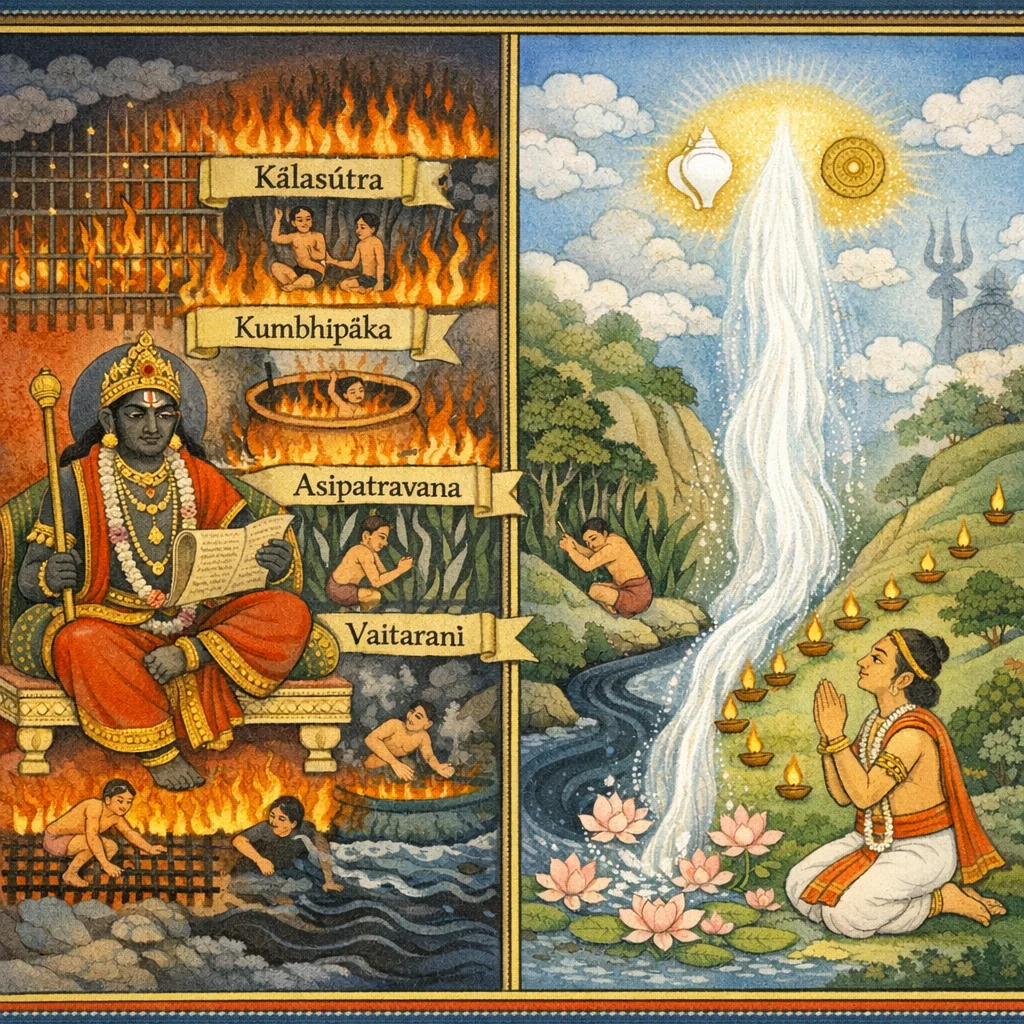
Pāpa-bheda, Naraka-yātanā, Mahāpātaka-vicāra, Atonement Limits, Daśa-vidhā Bhakti, and Gaṅgā as Final Remedy
Framed by Sanaka’s narration, Dharmarāja (Yama) instructs King Bhagīratha on kinds of sin and their matching hell-torments. It first lists named narakas and severe yātanās—burning, cutting, freezing, filth-based punishments, and iron implements—then turns to dharmic classification: the four mahāpātakas (brahma-hatyā, surā-pāna, steya—especially gold theft, and guru-talpa-gamana), with sinful association as a fifth, and other “equivalent” offences sharing their weight. The chapter distinguishes sins with possible prāyaścitta from those declared aprāyaścitta, and traces long karmic sequences of hell-stay and degraded rebirths for envy, theft, adultery, perjury, obstructing gifts, excessive taxation, temple pollution, and more. It then pivots to remedy: expiation near Viṣṇu, the saving power of the Gaṅgā, and a tenfold typology of bhakti across tāmasic, rājasic, and sāttvic grades, concluding with the non-duality of Hari and Śiva and Bhagīratha’s mission to bring Gaṅgā for ancestral deliverance.
Shlokas
Verse 1
धर्मराज उवाच । पाप भेदान्प्रवक्ष्यामि यथा स्थूलाश्च यातनाः । श्रृणुष्व धैर्यमास्थाय रौद्रा ये नरका यतः ॥ १ ॥
Dharmarāja said: “I shall describe the different kinds of sin, and likewise the severe torments. Listen, steadying yourself with courage, to those dreadful hells (narakas) from which these sufferings arise.”
Verse 2
पापिनो ये दुरात्मानो नरकाग्निषु सन्ततम् । पच्यन्ते येषु तान्वक्ष्ये भयंकरफलप्रदान् ॥ २ ॥
Those sinners, evil-minded, are continually cooked in the fires of hell; I shall describe those fires, which bestow terrifying fruits (results).
Verse 3
तपनोवालुकाकुम्भौमहारौरवरौरवौ । कुम्भघीपाको निरुच्छ्वासः कालसूत्रः प्रमर्दनः ॥ ३ ॥
Tapana, Vālukā, and Kumbha; (also) Raurava and Mahāraurava; Kumbhaghīpāka, Nirucchvāsa, Kālasūtra, and Pramardana—these (too) are named as hell-realms.
Verse 4
असिपत्रवनं घोरं लालाभक्षोहिमोत्कटः । मूषावस्था वसाकूपस्तथा वैतरणी नदी ॥ ४ ॥
There is the dreadful Asipatravana (forest of sword-like leaves), the torment called Lālābhakṣa, the intensely freezing realm (Himotkaṭa), the condition of being reduced to a mouse (Mūṣāvasthā), the pit of fat (Vasākūpa), and also the river Vaitaraṇī.
Verse 5
भक्ष्यन्ते मूत्रपानं च पुरीषह्लद एव च । तप्तशूलं तप्तशिला शाल्मलीद्रुम एव च ॥ ५ ॥
They are made to eat (filth) and to drink urine; they are also plunged into a mire of excrement. They are tormented by red-hot spears, red-hot stones, and even by the śālmalī (silk-cotton) tree (with its painful thorns).
Verse 6
तथा शोणितकूपश्च घोरः शोणितभोजनः । स्वमांसभोजनं चैव वह्निज्वालानिवेशनम् ॥ ६ ॥
Likewise, there is the dreadful hell called Śoṇitakūpa (“the pit of blood”), and (another) called Śoṇitabhojana (“feeding on blood”); also (the hell) Svamāṃsabhojana (“eating one’s own flesh”), and Vahnijvālāniveśana (“dwelling amid flames of fire”).
Verse 7
शिलावृष्टिः शस्त्रवृष्टिर्वह्निवृष्टिस्तथैव च । क्षारोदकं चोष्णतोयं तप्तायः पिण्डभक्षणम् ॥ ७ ॥
There is a rain of stones, a rain of weapons, and likewise a rain of fire; (there is) alkaline water and scalding hot water, and the eating of lumps of red-hot iron.
Verse 8
अथ शिरःशोषणं च मरुत्प्रपतनं तथा । तथा पाशाणवर्णं च कृमिभोजनमेव च ॥ ८ ॥
Then there occur dryness of the head, collapse due to the wind, a stone-like discoloration, and even being eaten by worms.
Verse 9
क्षारो दपानं भ्रमणं तथा क्रकचदारणम् । पुरीषलेपनं चैव पुरीषस्य च भोजनम् ॥ ९ ॥
Caustic alkali, the drinking of intoxicants, aimless roaming, being cut with a saw, being smeared with excrement, and even eating excrement.
Verse 10
रेतः पानं महाघोरं सर्वसन्धिषुदाडनम् । धूमपानं पाशबन्धं नानाशूलानुलेपनम् ॥ १० ॥
They are made to drink semen—an exceedingly dreadful torment; their every joint is burned; they are forced to drink smoke; they are bound with nooses; and they are smeared with many kinds of sharp spikes.
Verse 11
अङ्गारशयनं चैव तथा मुसलमर्द्दनम् । बहूनि काष्ठयन्त्राणि कषणं छेदनं तथा ॥ ११ ॥
There is lying upon beds of burning coals, and likewise being crushed by pestles; there are many wooden contrivances (of torture), as well as scraping and cutting.
Verse 12
पतनोत्पतनं चैव गदादण्डादिपीहनम् । गजदन्तप्रहरणं नानासर्पैश्च दंशनम् ॥ १२ ॥
There are repeated falls and being hurled upward again; crushing by clubs, staves, and the like; blows struck with elephants’ tusks; and bites inflicted by many kinds of serpents.
Verse 13
शीताम्बुसेचनं चैव नासायां च मुखे तथा । घोरक्षाराम्बुपानं च तथा लवणभक्षणम् ॥ १३ ॥
Also to be avoided are dousing oneself with cold water, and likewise pouring water into the nose and the mouth; drinking harsh alkaline water, and also the eating of salt.
Verse 14
स्त्रायुच्छेदं स्नायुबन्धमस्थिच्छेदं तथैव च । क्षाराम्बुपूर्णरन्ध्राणां प्रवेशं मांसभोजनम् ॥ १४ ॥
Cutting the sinews, severing ligament-bonds, and likewise breaking bones; entering into openings filled with alkaline water; and eating meat—these are counted among acts that bring ritual taint and are to be avoided in purity-based observances.
Verse 15
पित्तपानं महाघोरं तथैवःश्लेष्मभोजनम् । वृक्षाग्रात्पातनंचैव जलान्तर्मज्जनं तथा ॥ १५ ॥
Drinking bile—most dreadful indeed—likewise eating phlegm; being hurled from the top of a tree; and being forced to sink beneath the water—these too are described as terrible sufferings.
Verse 16
पाषाणधारणं चैव शयनं कण्टकोपरि । पिपीलिकादंशनं च वृश्चिकैश्चापि पीडनम् ॥ १६ ॥
Carrying heavy stones, lying upon thorns, being bitten by ants, and also being tormented by scorpions—such are the hardships one inflicts upon oneself.
Verse 17
व्याघ्रपीडा शिवापीडा तथा महिषमीडनम् । कर्द्दमे शयनं चैव दुर्गन्धपरिपूरणम् ॥ १७ ॥
There is torment from tigers, affliction from jackals, and also trampling by buffaloes; there is lying down in mud, and being completely filled with foul stench.
Verse 18
बहुशश्चार्धशयनं महातिक्तनिषेवणम् । अत्युष्णतैलपानं च महाकटुनिषेवणम् ॥ १८ ॥
Frequent half-sleep, excessive indulgence in very bitter foods, drinking oil that is overly hot, and excessive use of very pungent foods.
Verse 19
कषायोदकपानं च तत्पपाषाणतक्षणम् । अत्युष्णशीतस्नानं च तथा दशनशीर्णनम् ॥ १९ ॥
Drinking astringent decoction-water, chiselling stones for that purpose, bathing in excessively hot or cold water, and wearing down the teeth.
Verse 20
तप्तायः शयनं चैव ह्ययोभारस्य बन्धनम् । एवमाद्यामहाभाग यातनाः कोटिकोटिशः ॥ २० ॥
Lying upon a bed of red-hot iron, and being bound under the weight of iron burdens—such and countless other torments, O great-souled one, occur in crores.
Verse 21
अपि वर्षसहस्त्रेण नाहं निगदितुं क्षमः । एतेषु यस्य यत्प्राप्तं पापिनः क्षितिरक्षक ॥ २१ ॥
Even in a thousand years I would not be capable of fully describing it. O protector of the earth, among these sinners, each one receives whatever particular result has fallen to his share.
Verse 22
तत्सर्वं संप्रवक्ष्यामि तन्मे निगदतः श्रृणु । ब्रह्महा च सुरापी च स्तेयी च गुरुतल्पगः ॥ २२ ॥
I shall now explain all of that in full—listen to me as I speak: the slayer of a brāhmaṇa, the drinker of intoxicants, the thief, and the violator of the guru’s bed.
Verse 23
महापातकिनस्त्वेते तत्संसर्गी च पञ्चमः । पंतिभेदीवृथापाकी नित्यं ब्रह्मणदूषकः ॥ २३ ॥
These indeed are the great sinners (mahāpātakins); and as a fifth is counted the one who keeps company with them. Also included are the breaker of the communal dining line, the one who cooks food in vain (without due purpose or rite), and the one who constantly maligns a brāhmaṇa.
Verse 24
आदेशी वेदविक्रेता पञ्चैते ब्रह्मधातकाः । ब्रह्मणं यः समाहूय दास्यामीति धनादिकम् । एश्चान्नास्तीति यो ब्रुयात्तमाहुर्ब्रह्यघातिनम् ॥ २४ ॥
One who, as a religious functionary, issues authoritative commands for gain, and one who sells the Veda—such are counted among the five called “slayers of Brahman,” destroyers of brāhmaṇical sanctity. Likewise, one who summons a brāhmaṇa saying, “I will give you wealth and the like,” and then declares, “There is nothing,” is said to be guilty of brahma-ghāta.
Verse 25
स्नानार्थं पूजनार्थँ वा गच्छतो ब्राह्मणस्य यः । समायात्यंतरायत्वं तमाहुर्ब्रह्मधातिनम् ॥ २५ ॥
Whoever comes forward and becomes an obstruction to a brāhmaṇa who is going for sacred bathing or for worship—such a person is declared a “slayer of Brahman,” a violator of holy order.
Verse 26
पस्निन्दासु निरतश्चात्मोत्कर्षरतश्व यः । असत्यनिरतश्वचैव ब्रह्महा परिकीर्तितः ॥ २६ ॥
One who is absorbed in slandering others, who delights in self-exaltation, and who remains devoted to falsehood—such a person is declared a brahmahā, a “slayer of a brāhmaṇa,” in the moral and spiritual sense.
Verse 27
अधर्मस्यानुमन्ता च ब्रह्महा परिकीर्तितः । अन्योद्वेगरतश्चैव अन्येषां दोषसूवकः ॥ २७ ॥
He who consents to adharma, approving unrighteousness, is also declared a brahmahā. Likewise, one who delights in unsettling others, and one who proclaims the faults of others like an informer, is counted among such sinners.
Verse 28
दम्भाचाररतश्वैव ब्रह्महेत्यभिधीयते । नित्यं प्रतिग्रहरतस्तथा प्राणिवधे रतः ॥ २८ ॥
One devoted to hypocritical conduct is indeed called a “slayer of a brāhmaṇa” (brahmahā). Likewise, one ever intent on accepting gifts, and one who delights in killing living beings, is spoken of as belonging to that same grievous class.
Verse 29
अधर्मस्यानुममन्ता च ब्रह्महा परिकीर्तितः । ब्रह्महत्या समं पापमेव बहुविधं नृप ॥ २९ ॥
O king, one who gives assent to unrighteousness (adharma) is declared a slayer of a brāhmaṇa; he incurs manifold sins, equal to the sin of brāhmaṇa-slaying.
Verse 30
सुरापानसमं पापं प्रवक्ष्यामि समासतः । गणान्नभोजनं चैव गणिकानां निषेवणम् ॥ ३० ॥
I shall state briefly the sins held equal to drinking intoxicants: eating food from impure groups, and consorting with courtesans.
Verse 31
पतितान्नादनं चैव सुरापानसमं स्मृतम् । उपासमापरित्यागो देवलानां च भोजनम् ॥ ३१ ॥
Eating food given by a fallen person is remembered as equal to drinking liquor. Likewise, abandoning one’s daily worship, and eating food offered to the deities before it is properly received as prasāda, are also condemned.
Verse 32
सुरापयोषित्संयोगः सुरापानसमः स्मृतः । यः शूद्रेण समाहतो भोजनं कुरुते द्विजः ॥ ३२ ॥
Union with a woman connected with liquor is remembered as tantamount to drinking liquor. Likewise, a twice-born man (dvija) who eats food struck or defiled by a Śūdra is also regarded as equal to a drinker of liquor.
Verse 33
सुरापी स हि विज्ञेयः सर्वधर्मबहिष्कृतः । यः शूद्रेणाभ्यनुज्ञातः प्रेष्यकर्म करोति च ॥ ३३ ॥
He should indeed be known as a drinker of surā, cast out from all dharmic observances—he who, with a Śūdra’s permission, performs servile work as a menial.
Verse 34
सुरापान समं पापं लभते स नराधमः । एवं बहुविधं पापं सुरापानसमं स्मृतम् ॥ ३४ ॥
That vilest of men incurs sin equal to the drinking of surā. Thus, the tradition declares many kinds of sin to be on par with surā-drinking.
Verse 35
हेमस्तेयसमं पापं प्रवक्ष्यामि निशामय । कन्दमूलफलानां च कस्तूरी पटवाससाम् ॥ ३५ ॥
Listen: I shall describe the sin equal to stealing gold—namely, the theft of roots, tubers, and fruits, as well as kastūrī (musk), betel leaves, and garments.
Verse 36
सदा स्तेयं च रत्नानां स्वर्णस्तेयसमं स्मृतम् । ताम्रायस्त्र्रपुकांस्यानामाज्यस्य मधुनस्तथा ॥ ३६ ॥
Stealing jewels is always regarded as equivalent to stealing gold; likewise, the theft of copper, iron, tin, kāṃsya (bell-metal), ghee, and honey is counted in the same class.
Verse 37
स्तेयं सुगन्धद्रव्याण्णां स्वर्णस्तेयसमं स्मृतम् । क्रमुकस्यापिहरणमम्भसां चन्दनस्य च ॥ ३७ ॥
The stealing of fragrant substances is declared to be equivalent to stealing gold; likewise, taking away areca nuts (kramuka), water, and sandalwood is counted among serious thefts.
Verse 38
पर्णरसापहरणं स्वर्णस्तेयसमं स्मृतम् । पितृयज्ञपरित्यागो धर्मकार्यविलोपनम् ॥ ३८ ॥
The stealing of leaf juice is declared equal to the theft of gold. Likewise, abandoning the ancestral offering (Pitr-yajna) amounts to the destruction of religious duty.
Verse 39
यतीर्नां निन्दतं चैव स्वर्णस्तेयसमं स्मृतम् । भक्ष्याणां चापहरणं धान्यानां हरणं तथा ॥ ३९ ॥
Slandering ascetics (Yatis) is declared to be equal to the theft of gold. Likewise, taking away edible provisions and stealing grain are counted as grave thefts.
Verse 40
रुद्राक्षहरणं चैव स्वर्णस्तेयसमं स्मृतम् । भागीनीगमनं चैव पुत्रस्त्रीगमनं तथा ॥ ४० ॥
Stealing Rudraksha beads is declared to be equal to the theft of gold. Likewise, sexual intercourse with one's sister and with one's daughter-in-law is condemned in the same category.
Verse 41
रजस्वलादिगमनं गुरुतल्पसमं स्मृतम् । हीनजात्याभिगमनं मद्यपस्त्रीनिषेवणम् ॥ ४१ ॥
Intercourse with a menstruating woman is declared equal to the sin of violating the teacher's bed. Likewise, approaching a woman of degraded caste or one who drinks liquor.
Verse 42
परस्त्रीगमनं चैव गुरुतल्पसमं स्मृतम् । भ्रातृस्त्रीगमनं चैव वयस्यस्त्रीनिषेवणम् ॥ ४२ ॥
Going to another man's wife is declared to be equal in gravity to violating the teacher's bed; likewise, approaching one's brother's wife and consorting with the wife of one's friend.
Verse 43
विश्वस्तागमनं चैव गुरुतल्पसमं स्मृतम् । अकाले कर्मकरणं पुत्रीगमनमेव च ॥ ४३ ॥
Intercourse with a trusted (protected) woman is declared to be equal to the sin of violating the teacher’s bed. So too are performing sexual acts at improper times, and intercourse with one’s own daughter.
Verse 44
धर्मलोपः शास्त्रनिन्दा गुरुतल्पसमं स्मृतम् । इत्येवमादयो राजन्महापातकसंज्ञिताः ॥ ४४ ॥
The abandonment of dharma and the disparagement of the sacred scriptures are declared to be equal to the sin of violating the guru’s bed. Thus, O King, these and similar acts are known as the “great sins” (mahāpātakas).
Verse 45
एतेष्वेकतमेनापि सङ्गकृत्तत्समो भवेत् । यथाकथंचित्पापानामेतेषां परमर्षिभिः ॥ ४५ ॥
Even by forming association with just one among these, a person becomes equal to that (sinner). Thus, in some way or other, these supreme sages have declared a means for the removal of sins.
Verse 46
शान्तैस्तु निष्कृतिर्दृष्टा प्रायश्चितादिकल्पनैः । प्रायश्चित्तविहीनानि पापानि श्रृणु भूपते ॥ ४६ ॥
Expiation (niṣkṛti) is indeed taught through pacificatory rites (śānti) and the prescribed forms of atonement (prāyaścitta). Now, O king, listen to those sins for which no atonement is laid down.
Verse 47
समस्तपापतुल्यानि महानरकदानि च । ब्रह्महत्यादिपापानां कथंचिन्निष्कृतिर्भवेत् ॥ ४७ ॥
These (sins) are equal to all sins and are givers of the great hells; even for sins such as brahma-hatyā (the killing of a brāhmaṇa), some means of expiation may, in some way, be possible.
Verse 48
ब्रह्मणं द्वेष्टि यस्तस्य निष्कृतिर्नास्ति कुत्रचित् । विश्वस्तघातिनं चैव कृतन्घानां नरेश्वर ॥ ४८ ॥
O king, for one who hates Brahmins there is no expiation anywhere; likewise for one who betrays a trusting person, and for those who slay their benefactors.
Verse 49
शूद्रस्त्रीसङ्गिनां चैव निष्कृतिर्नास्ति कुत्रचित् । शूद्रान्नपुष्टदेहानां वेदनिन्दारतात्मनाम् ॥ ४९ ॥
For those who keep company with Śūdra women, there is no expiation anywhere. Likewise, for those whose bodies are nourished by Śūdra food and whose minds delight in reviling the Veda, no atonement is found.
Verse 50
सत्कथानिन्दकानांच नेहामुत्रचनिष्कृतिः ॥ ५० ॥
For those who disparage sacred and virtuous discourse, there is no atonement—neither in this world nor in the next.
Verse 51
बौद्धालयं विशेद्यस्तु महापद्यपि वैद्विजः । नतस्यनिष्कृतिर्दृष्टाप्रायश्चितशतैरपि ॥ ५१ ॥
Even if a twice-born man enters a Buddhist shrine in a time of great calamity, no expiation is prescribed for him—even by hundreds of acts of penance.
Verse 52
बौद्धाः पाषंण्डिनः प्रोक्ता यतो वेदविनिन्दकाः । तस्माद्विजस्तान्नेक्षेत यतो धर्मबहिष्कृताः ॥ ५२ ॥
The Buddhists are declared to be pāṣaṇḍins (heretics), because they revile the Vedas. Therefore a twice-born person should not even look upon them, since they are excluded from dharma.
Verse 53
ज्ञानतोऽज्ञानतो वापि द्विजो बोद्धालयं विशेत् । ज्ञात्वा चेन्निष्कृतिर्नास्ति शास्त्राणामिति निश्वयः ॥ ५३ ॥
Whether knowingly or unknowingly, if a twice-born (dvija) enters the abode of the enlightened, then upon understanding it becomes certain: the śāstras declare that for such a transgression there is no prāyaścitta, no expiation.
Verse 54
एतेषां पापबाहुल्यान्नरकं कोटिकल्पकम् । प्रायश्चित्तविहीनानि प्रोक्तान्यन्यानि च प्रभो ॥ ५४ ॥
O Lord, because these deeds are laden with abundant sin, they lead to hell for ten million kalpas; and other acts too have been declared to be without any prāyaścitta, without expiation.
Verse 55
पापानि तेषां नरकान्गदतो मे निशामय ॥ ५५ ॥
Listen to me as I describe the sins of those people and the hells to which they go.
Verse 56
महापातकिनस्तेषु प्रत्येकं युगवासिनः । तदन्ते पृथिवीमेत्य सप्तजन्मसु गर्दभाः ॥ ५६ ॥
Among them, the great sinners remain there—each for the span of a yuga; when that time ends, they return to the earth and are born as donkeys for seven lives.
Verse 57
ततः श्वानो विद्धदेहा भवेयुर्दशजन्मसु । आशताब्दं विट्कृमयः सर्पा द्वादशजन्मसु ॥ ५७ ॥
Thereafter they are born as dogs with afflicted bodies for ten births. For a hundred years they become worms in excrement, and then they are born as serpents for twelve births.
Verse 58
ततः सहस्त्रजन्मानि मृगाद्याः पशवो नृप । शताब्दं स्थावराश्चैव ततो गोधाशरीरिणः ॥ ५८ ॥
Thereafter, O king, one is born a thousand times among animals such as deer and the like; then for a hundred years one remains among the immobile beings (plants). After that, one obtains a body like that of a godhā (lizard).
Verse 59
ततस्तु सत्पजन्मानि चण्डालाः पापकारिणः । ततः षोडश जन्मानि शूद्राद्या हीनजातयः ॥ ५९ ॥
Thereafter, for seven births, the sinner becomes a caṇḍāla, one who commits evil deeds. After that, for sixteen births, one is born among the lower castes—beginning with the śūdra and other degraded births.
Verse 60
ततस्तु जन्मद्वितये दरिद्राव्याधिपीडिताः । प्रतिग्रहपरा नित्यं ततो निरयगाः पुनः ॥ ६० ॥
Then, in the next two births, they are afflicted by poverty and disease; ever intent on living by accepting gifts, they again go to hell thereafter.
Verse 61
असूयाविष्टमनसो रौरवे नरके स्मृतम् । तत्र कल्पद्वयं स्थित्वा चाण्डालाः शतजन्मसु ॥ ६१ ॥
Those whose minds are possessed by envy are said to fall into the hell called Raurava. Having remained there for two kalpas, they are then born as caṇḍālas for a hundred lifetimes.
Verse 62
मा ददस्वेति यो ब्रूयाद्गवान्गिब्राह्मणेषु च । शुनां योनिशतं गत्वा चाण्डालेषूपजायते ॥ ६२ ॥
Whoever says, “Do not give,” thus obstructing the gifting of cows and other offerings to Brāhmaṇas—after passing through a hundred wombs of dogs—is then born among Caṇḍālas.
Verse 63
ततो विष्ठाकृतमिश्चैव ततो व्याघ्रस्त्रिजन्मसु । तदंते नरकं याति युगानामेकविंशतिम् ॥ ६३ ॥
Then he becomes a creature that feeds on dung; thereafter, for three births, he is born as a tiger. At the end of that, he goes to hell for twenty-one yugas.
Verse 64
परनिन्दापरा ये च ये च निष्ठुरभाषिणः । दानानां विघ्नकर्त्तारस्तेषां पापफलं श्रृणु ॥ ६४ ॥
Hear the sinful consequence of those who delight in slandering others, who speak harshly, and who become obstacles to acts of charity.
Verse 65
मुशलोलूखलाभ्यां तु चूर्ण्यन्ते तस्करा भृशम् । तदन्ते तप्तपाषाणग्रहणं वत्सरत्रयम् ॥ ६५ ॥
But thieves are violently crushed to powder with pestles and mortars; and after that, for three years, they are made to seize scorching-hot stones.
Verse 66
ततश्च कालसूत्रेण भिद्यन्ते सप्त वत्सरान् । शोचन्तः स्वानिकर्माणि परद्रव्यापहारकाः ॥ ६६ ॥
Then, by the torment called Kālasūtra, the thieves who steal another’s property are cut and pierced for seven years, lamenting their own deeds.
Verse 67
कर्मणा तत्र पच्यन्ते नरकान्गिषु सन्ततम् ॥ ६७ ॥
There, because of their own actions, they are continually scorched in the fires of the hell-realms.
Verse 68
परस्वसूचकानां च नरकं श्रृणु दारुणम् । यावद्युगसहस्त्रं तु तप्तायः पिण्डभक्षणम् ॥ ६८ ॥
Hear now of the dreadful hell destined for those who inform against others’ wealth: for a thousand yugas they are made to eat lumps of red-hot iron.
Verse 69
संपीड्यते च रसना संदंशैर्भृशदारुणैः । निरुच्छ्वासं महाघोरे कल्पार्द्धं निवसन्ति ते ॥ ६९ ॥
Their tongue is crushed with extremely dreadful pincers; breathless, they dwell in that most terrifying place for half a kalpa.
Verse 70
परस्त्रीलोलुपानां च नरकं कथयामि ते । तप्तताम्रस्त्रियस्तेन सुरुपाभरणैर्युताः ॥ ७० ॥
Now I shall tell you of the hell reserved for those who lust after another man’s wife: there, women made of red-hot copper, adorned with beautiful ornaments and an alluring form, become the instruments of torment.
Verse 71
यादृशीस्तादृशीस्ताश्च रमन्ते प्रसभं बहु । विद्ववन्तं भयेनासां गृह्णन्ति प्रसभं च तम् ॥ ७१ ॥
Women of such-and-such a disposition consort freely and shamelessly; and out of fear of them, they forcibly seize even a learned man.
Verse 72
कथयन्तश्च तत्कर्म नयन्ते नरकान्क्रमात् । अन्यं भजन्ते भूपाल पतिं त्यक्त्वा च याः स्त्रियः ॥ ७२ ॥
And those who speak approvingly of such conduct lead (themselves and others) step by step into hells. O king, those women too who abandon their husband and consort with another (also incur such downfall).
Verse 73
तत्पायःपुरुशास्तास्तु तत्पायःशयनेबलात् । पातयित्वा रमन्ते च बहुकालं बलान्विताः ॥ ७३ ॥
But those men, ruled by that same compulsion, are overpowered by force upon that very bed; and, having cast others down, they sport for a long time, strengthened by their own might.
Verse 74
ततस्तैर्योषितो मुक्ता हुताशनसमोज्ज्वलम् । यः स्तम्भं समाश्लिष्य तिष्ठन्त्यब्दसहस्त्रकम् ॥ ७४ ॥
Then those women were released by them; and for a thousand years they stood, clinging to a pillar blazing with the radiance of fire.
Verse 75
ततः क्षारोदकस्नानं क्षारोदकनिषेवणम् । तदन्ते नरकान् सर्वान् भुञ्जतेऽब्दशतं शतम् ॥ ७५ ॥
Thereafter comes bathing in alkaline, briny water and the forced drinking of that same alkaline water; and after that one must endure all the hells, suffering for a hundred hundreds of years (ten thousand years).
Verse 76
यो हन्ति ब्राह्मणं गां च क्षत्रियं च नृपोत्तमम् । स चापि यातनाः सर्वा भुंक्ते कल्पेषु पञ्चसु ॥ ७६ ॥
He who kills a Brahmin, a cow, and a Kshatriya who is an excellent king—he too must undergo all punishments, experiencing them through five kalpas.
Verse 77
यः श्रृणोति महन्निन्दां सादरं तत्फलं श्रृणु । तेषां कर्णेषु दाप्यन्ते तप्तायः कीलसंचयाः ॥ ७७ ॥
Whoever listens attentively to grievous slander—hear its fruit: into the ears of such people are driven clusters of red-hot iron nails.
Verse 78
ततश्च तेषु छिद्रेषु तैलमत्युष्णमुल्बणम् । पूर्यते च ततश्चापिं कुम्भीपाकं प्रपद्यते ॥ ७८ ॥
Then, into those perforations, exceedingly hot and fierce oil is poured; and thereafter the sinner is made to undergo the torment known as Kumbhīpāka.
Verse 79
नास्तिकानां प्रवक्ष्यामि विमुखानां हरे हरौ । अब्दानां कोटिपर्यन्तं लवणं भुञ्जते हि ते ॥ ७९ ॥
Now I shall describe the fate of the atheistic—those who have turned away from Hari: for as long as ten million years, they indeed are made to subsist on salt.
Verse 80
ततश्च कल्पपर्यन्तं रौरवे तप्तसैकते । भज्यंते पापकर्मणोऽन्येप्येवं नराधिप ॥ ८० ॥
Thereafter, until the end of the aeon (kalpa), in the Raurava hell with its burning sands, sinners are broken and tormented in this very manner as well, O king.
Verse 81
ब्राह्मणान्ये निरीक्षन्ते कोपदृष्ट्या नराधमाः । तप्तसूचीसहस्त्रेण चक्षुस्तेषां प्रसूर्यते ॥ ८१ ॥
Those vile men who glare at Brahmanas with angry eyes have their eyesight pierced—as if by a thousand red‑hot needles.
Verse 82
ततः क्षाराम्बुधाराभिः सेच्यन्ते नृपसत्तम । ततश्च क्रकर्चेर्घोरैर्भिद्यन्ते पापकर्म्मणः ॥ ८२ ॥
Then, O best of kings, they are drenched with streams of caustic, alkaline water; and then the evil-doers are split apart by dreadful saw-like instruments.
Verse 83
विश्वासघातिनां चैव मर्यादाभेदिनां तथा । परान्नलोल्लुपानां च नरकं श्रृणु दारुणम् ॥ ८३ ॥
For those who betray trust, who transgress established boundaries and codes of conduct, and who greedily covet the food of others—hear now of the dreadful hell destined for them.
Verse 84
स्वमांसभोजिनो नित्यं भक्षमाणाः श्वभिस्तु ते । नरकेषु समस्तेषु प्रत्येकं ह्यब्दवासिनः ॥ ८४ ॥
Those who eat their own flesh are continually devoured by dogs; in every one of the hells, they must dwell for a year each.
Verse 85
प्रतिग्रहरता ये च ये वै नक्षत्रपाठकाः । ये च देवलकान्नानां भोजिनस्ताञ्श्रृणुष्व मे ॥ ८५ ॥
Hear from me about those addicted to accepting gifts, those who make their living by reciting the science of the stars, and those who eat the food of temple-servants (devalakas).
Verse 86
राजन्नाकल्पपर्यन्तं यातनास्वासु दुःखिताः । पच्यन्ते सततं पापाविष्टा भोगरताः सदा ॥ ८६ ॥
O King, tormented in those punishments and afflicted with suffering, they are continually “cooked” until the end of the aeon—ever possessed by sin, always devoted to sense-enjoyments.
Verse 87
ततस्तैलेन पूर्यन्ते कालसूत्रप्रपीडिताः । ततः क्षारोदकस्नानं मूत्रविष्टानिषेवणम् ॥ ८७ ॥
Then, tormented in the hell called Kālasūtra, they are drenched with oil. After that, they are made to bathe in caustic brine-like water and are forced to consume urine and feces.
Verse 88
तदन्ते भुवमासाद्य भवन्ति म्लेच्छजातयः । अन्योद्वेगरता ये तु यान्ति वैतरणीं नदीम् ॥ ८८ ॥
When that period of suffering ends, returning to the earth they are born among mleccha (outsider) communities. But those who delight in causing fear and distress to others go to the Vaitaraṇī River.
Verse 89
त्यक्तपञ्चमहायज्ञा लालाभक्षं व्रजन्ति हि । उपासनापरित्यागी रौरवं नरकं व्रजेत् ॥ ८९ ॥
Those who abandon the five great daily sacrifices indeed fall into the state of feeding on spittle. One who renounces worship (upāsanā) goes to the Raurava hell.
Verse 90
विप्रग्रामकरादानं कुर्वतां श्रृणु भूपते । यातनास्वासु पच्यन्ते यावदाचन्द्रतारकम् ॥ ९० ॥
O King, hear this: those who impose taxes upon Brahmins and villages are cooked in torments for as long as the moon and stars endure.
Verse 91
ग्रामेषु भूपालवरो यः कुर्यादधिकं करम् । स सहस्त्रकुलो भुङ्क्तेनरकं कल्पपञ्चसु ॥ ९१ ॥
That foremost of kings who levies excessive taxes upon villages—he, along with a thousand generations of his lineage, suffers hell for five kalpas.
Verse 92
विप्रग्रामकरादानं योऽनुमन्तातु पापकृत् । स एव कृतवान् राजन्ब्रह्महत्यासहस्त्रकम् ॥ ९२ ॥
O King, the sinful person who merely gives consent to the collection of taxes from a community of Brahmanas is as though he himself has committed a thousand acts of brahmahatyā (the killing of a Brahmana).
Verse 93
कालसूत्रे महाघोरे स वसेद्दिचतुर्युगम् । अयोनौ च वियोनौ च पशुयोनौ च यो नरः ॥ ९३ ॥
That man who falls into birth without a womb, into a deformed or defective birth, or into an animal womb shall dwell in the exceedingly dreadful hell called Kālasūtra for the span of two sets of four yugas.
Verse 94
त्यजेद्रेतो महापापी सरेतोभोजनं लभेत् । वसाकूपं ततः प्राप्य स्थित्वा दिव्याब्दसत्पकम् ॥ ९४ ॥
A great sinner who wastes or casts away his semen is made to eat food mixed with semen; thereafter, reaching the “Pit of Fat” (Vasā-kūpa), he remains there for seventy divine years.
Verse 95
रेतोभोजी भवेन्मर्त्यः सर्वलोकेषु निन्दितः । उपवासदिने राजन्दन्तधावनकृन्नरः ॥ ९५ ॥
A mortal who consumes semen becomes censured in all worlds. And, O King, a man who cleans his teeth on a day of upavāsa (sacred fasting), thus violating the vrata’s discipline, is likewise blameworthy.
Verse 96
स घोरं नरकं यातिव्याघ्रपक्षं चतुर्युगम् । यः स्वकर्मपरित्यागी पाषण्डीत्युच्यते बुधैः ॥ ९६ ॥
He goes to the dreadful hell called Vyāghrapakṣa for four yugas—he who abandons his own prescribed duties is called a pāṣaṇḍin (heretic, renegade) by the wise.
Verse 97
तत्संगकृतमोघः स्यात्तावुभावतिपापिनौ । कल्पकोटिसहस्त्रेषु प्रान्पुतो नरकान्क्रमात् ॥ ९७ ॥
Keeping company with such persons makes the fruit of one’s life futile; those two become exceedingly sinful, and for thousands of crores of kalpas they are driven, step by step, into the hells—life after life.
Verse 98
देवद्रव्यापहर्त्तारो गुरुद्रव्यापहारकाः । ब्रह्महत्याव्रतसमं दुष्कृतं भुञ्जते नृप ॥ ९८ ॥
O King, those who steal wealth belonging to the gods, and those who steal the wealth of their guru, reap evil karma equal to the great sin and expiatory burden of the Brahmahatyā-vrata.
Verse 99
अनाथधनहर्त्तारो ह्यनाथं ये द्विषन्ति च । कल्पकोटिसहस्त्राणि नरके ते वसन्ति च ॥ ९९ ॥
Those who steal the wealth of the helpless, and those who hate the helpless, dwell in hell for thousands of crores of kalpas.
Verse 100
स्त्रीशूद्राणां समीपे तु ये वेदाध्ययने रताः । तेषां पापफलं वक्ष्ये श्रृणुष्व सुसमाहितः ॥ १०० ॥
But those who are devoted to studying or reciting the Veda in the presence of women and Śūdras—listen with a well-composed mind, and I shall declare the sinful consequence for them.
Verse 101
अधःशीर्षोर्ध्वपादाश्च कीलिताः स्तम्भकद्वये । ध्रूम्रपानरता नित्यं तिष्ठन्त्याब्रह्मवत्सरम् ॥ १०१ ॥
With their heads hanging down and their feet raised upward, they are nailed to a pair of pillars; ever addicted to smoke, they remain thus until the end of Brahmā’s year.
Verse 102
जले देवालये वापि यस्त्यजेद्देहजं मलम् । भ्रूणहत्यासमं पापं संप्रान्पोत्यतिदारुणम् ॥ १०२ ॥
Whoever discards bodily filth into water—or even within a temple—incurs an exceedingly dreadful sin, equal to the sin of killing an embryo.
Verse 103
दन्तास्थिकेशनखरान्ये त्यज्यन्त्यमरालये । जले वा भुक्तशेषं च तेषां पापफलं श्रृणु ॥ १०३ ॥
Hear the sinful consequence incurred by those who discard teeth, bones, hair, and nails in a temple, or who throw remnants of eaten food into water.
Verse 104
प्रासप्रोता हलैर्भिन्ना आर्त्तरावविराविणः । अत्युष्णतैलपाकेऽतितप्यन्ते भृशदारुणे ॥ १०४ ॥
Pierced through by spears and split apart by ploughs, crying out with anguished screams, they are intensely tormented—boiled in extremely hot oil—in a most dreadful (hellish) cooking.
Verse 105
कुर्वन्ति दुःखसंतप्तास्ततोऽन्येषु व्रजन्ति च । ब्रह्मसंहरते यस्तु गन्धकाष्टं तथैव च ॥ १०५ ॥
Afflicted and scorched by suffering, they keep performing (such acts) and then move on to other (courses of action). But one who brings about the dissolution of the (sense of) ‘Brahman’ (i.e., the egoic conceit of being Brahman) also (destroys) the ‘sulphur-wood’ likewise (i.e., the fuel that keeps the fire of bondage burning).
Verse 106
स याति नरकं घोरं यावदाचन्द्रतारकम् । ब्रह्मस्वहरणं राजन्निहामुत्र च दुःखदम् ॥ १०६ ॥
O King, he goes to a dreadful hell for as long as the moon and stars endure. The theft of a brāhmaṇa’s property brings suffering both here (in this world) and hereafter (in the next).
Verse 107
इहसंपद्विनाशायपरत्रनरकाय च । कूटसाक्ष्यंवदेद्यस्तु तस्य पापफलंश्रृणु ॥ १०७ ॥
Whoever gives false testimony brings about the ruin of prosperity in this world and leads himself to hell in the next. Hear now the sinful consequence of such perjury.
Verse 108
स याति यातनाः सर्वा यावदिन्द्राश्चतुर्दश । इहपुत्राश्च विनश्यन्ति परत्र च ॥ १०८ ॥
He endures every kind of torment for as long as fourteen Indras endure; and his sons perish—both in this world and in the hereafter.
Verse 109
रौरवं नरकं भुङक्ते ततोऽन्यानपि च क्रमात् । ये चातिकामिनो मर्त्या ये च मिथ्याप्रवादिनः ॥ १०९ ॥
Those mortals who are excessively lustful, and those who speak falsehoods, suffer the hell called Raurava; thereafter, in due sequence, they undergo other hells as well.
Verse 110
तेषां सुखे जलौकास्तु पूर्य्यन्ते पन्नगोपमाः । एवं षष्टिसहस्त्राब्दे ततः क्षाराम्बुसेचनम् ॥ ११० ॥
As they seemed to be at ease, leeches—resembling serpents—became fully engorged (with their blood). Thus it continued for sixty thousand years; then followed the sprinkling of alkaline water.
Verse 111
ये वृथामांसनिरतास्ते यान्ति क्षारकर्दमम् । ततो गजैर्निपात्यन्ते मरुत्प्रपतनं यथा ॥ १११ ॥
Those who indulge in eating meat without any rightful cause fall into the caustic mire. From there they are hurled down by elephants, as if cast into a wind-swept precipice.
Verse 112
तदन्ते भवमासाद्य हीनाङ्गाः प्रभवन्ति च । यस्त्वृतौ नाभिगच्छेत स्वस्त्रिंय मनुजेश्वर ॥ ११२ ॥
Thereafter, when conception occurs, children with deficient limbs may be born. O lord of men, he who does not approach his own wife during her proper season (ṛtu) incurs such a consequence.
Verse 113
स याति रौरवं घोरं ब्रह्महकत्यां च विन्दति । अन्याचाररतं दृष्ट्वा यः शक्तो न निवारयेत् ॥ ११३ ॥
He who sees a person engaged in wrongful conduct and, though able, does not restrain him, goes to the dreadful Raurava hell and also incurs the sin of brahma-hatyā (slaying a brāhmaṇa).
Verse 114
तत्पापं समवान्पोति नरकं तावुभावपि । पापिनां पापगणनां कृत्वान्येभ्यो दिशन्ति विन्दति ॥ ११४ ॥
He fully reaps that sin and also enters hell. One who calculates the sins of sinners and assigns their punishments to others likewise obtains his own due consequence.
Verse 115
अस्तित्वे तुल्यपापास्ते मिथ्यात्वे द्विगुणा नृप । अपापे पातकं यस्तु समरोप्य विनिन्दति ॥ ११५ ॥
O King, if the alleged fault truly exists, the sin of speaking it is equal to that fault; but if it is false, the sin becomes double. And whoever imputes sin where there is no sin and censures the innocent commits a grave offence.
Verse 116
स याति नरकं घोरं यावञ्चर्द्रार्क तारकम् । पापिनां निन्द्यमानानां पापार्द्धं क्षयमेति च ॥ ११६ ॥
He goes to a dreadful hell for as long as the moon, the sun, and the stars endure; and for sinners who are censured by the righteous, half of their sin is destroyed.
Verse 117
यस्तु व्रतानि संगृह्य असमाप्य परित्यज्येत् । सोऽसिपत्रेऽनुभूयार्तिं हीनाङगोजायते भुवि ॥ ११७ ॥
But whoever undertakes sacred vows (vrata) and abandons them before completing them suffers torment in the Asipatra hell and is later born on earth with a defective body, with limbs missing or impaired.
Verse 118
अन्यैः संगृह्यमाणानांव्रतानां विघ्नकृन्नरः । अतीव दुःखदंरौद्रं स याति श्लेष्मभोजनम् ॥ ११८ ॥
A man who obstructs the vows (vratas) undertaken by others goes to a fiercely dreadful realm of extreme suffering, where he is made to feed on phlegm.
Verse 119
न्याये च धर्मशिक्षायां पक्षपातं करोति यः । न तस्य निष्कृतिर्भूयः प्रायश्चित्तायुतैरपि ॥ ११९ ॥
Whoever shows partiality in the administration of justice and in the teaching of dharma—there is no further expiation for him, even by tens of thousands of acts of penance.
Verse 120
अभोज्यभोजी संप्राप्यं विङ्भोज्यं तु समायुतम् । ततश्चण्डालयोनौ तु गोमांसाशी सदा भवेत् ॥ १२० ॥
One who eats what is forbidden to be eaten comes to the condition of eating filth. Thereafter, he is born in the womb of a caṇḍāla, and becomes one who always eats cow-flesh.
Verse 121
अवमान्य द्विजान्वाग्भिर्ब्रह्महत्यां च विन्दति । सर्वाश्चयातना भुक्त्वा चाण्डालो दशजन्मसु ॥ १२१ ॥
One who insults the twice-born (dvijas) with harsh speech incurs sin equal to brahma-hatyā (slaying a brāhmaṇa). After suffering all punishments, he is born as a caṇḍāla for ten lifetimes.
Verse 122
विप्राय दीयमाने तु यस्तु विघ्नं समाचरेत् । ब्रह्महत्यासमं तेन कर्त्तव्यं व्रतमेव च ॥ १२२ ॥
But if, when a gift is being given to a brāhmaṇa, someone deliberately creates an obstruction, then for that person it becomes equal to the sin of brahma-hatyā (killing a brāhmaṇa); therefore, a vow of expiation must indeed be undertaken by him.
Verse 123
अपहृत्य पस्स्यार्थं यः परेभ्यः प्रयच्छति । अपहर्त्ता तु निरयी यस्यार्थस्तस्य तत्फलम् ॥ १२३ ॥
Whoever takes another’s property and then gives it away to others—such a giver is truly a thief. The thief falls into hell, while the fruit (of that wealth) rightly belongs to the one from whom it was taken.
Verse 124
प्रतिश्रुत्याप्रदानेन लालाभक्षं व्रजेन्नरः । यतिनिन्दापरो राजन् शिलानमात्रे प्रयाति हि ॥ १२४ ॥
By making a promise and then not giving, a man is reduced to feeding on saliva. But one devoted to reviling ascetics, O King, is indeed cast down to the state of a mere stone.
Verse 125
आरामच्छेदिनो यान्ति युगानामेकविंशतिम् । श्वभोजनं ततः सर्वा भुञ्जते यातनाः क्रमात् ॥ १२५ ॥
Those who destroy gardens (public groves/pleasure-grounds) go (to hell) for twenty-one yugas. Thereafter, they are made to eat dog-food; then, in due order, they undergo all the other torments.
Verse 126
देवतागृहभेत्तारस्तडागानां च भूपते । पुष्पारामभिदश्चैव यां गतिं यान्ति तच्छॄणु ॥ १२६ ॥
O king, hear what fate is attained by those who break into temples of the gods, who destroy reservoirs and ponds, and who ruin flower-gardens.
Verse 127
यातनास्वासु सर्वासु पच्यन्ते वै पृथक् पृथक् । ततश्च विष्टाकृमयः कल्पानामेकविंशतिम् ॥ १२७ ॥
In all those torturous states, they are indeed cooked—each one separately. Thereafter, they become worms in excrement for twenty-one kalpas.
Verse 128
ततश्चाण्डालयोनौ तु शतजन्मानि भूपते । ग्रामविध्वंसकानां तु दाहकानां च लुम्पताम् ॥ १२८ ॥
Thereafter, O King, the destroyers of villages—those who set them ablaze and those who plunder—are born for a hundred lifetimes in the womb of the cāṇḍālas (outcastes).
Verse 129
महत्पापं तदादेष्टुं न क्षमोऽहं निजायुषा । उच्छिष्टभोजिनो ये च मित्रद्रोहपराश्च ये ॥ १२९ ॥
O King, I am not able, even within my own lifespan, to fully describe that great sin—the sin of those who eat impure remnants and of those devoted to betraying their friends.
Verse 130
एतेषां यातनास्तीव्रा भवन्त्याचन्द्रतारकम् । उच्छिन्नपितॄदेवेज्या वेंदमार्गबहिःस्थिताः ॥ १३० ॥
For such people, the torments are severe and endure as long as the moon and stars remain. Having cut off the worship due to the ancestors and the gods, they stand outside the path of the Veda.
Verse 131
पापानां यातानानां च धर्माणां चापि भूपते । एवं बहुविधा भूप यातनाः पापकारिणाम् ॥ १३१ ॥
O King, thus have the punishments (yātanās) of sins—and also the principles of dharma—been described. In this way, O ruler, the tormenting consequences for those who commit sin are of many kinds.
Verse 132
तेषां तासां च संख्यानं कर्त्तुं नालमहं प्रभो । पापानां यातनानां च धर्माणां चापि भूपते ॥ १३२ ॥
O Lord—O King—I am not capable of fully enumerating the number of those varieties of sins, the torments (yātanās) that arise from them, and even the forms of dharma.
Verse 133
संख्यां निगदितुं लोके कः क्षमो विष्णुना विना । एतेषां सर्वपापानां धर्मशास्त्रविधानतः ॥ १३३ ॥
Who in this world can fully state the number of all these sins, as set forth by the ordinances of the Dharma-śāstras—except Lord Viṣṇu?
Verse 134
प्रायश्चित्तेषु चीर्णेषु पापराशिः प्रणश्यति । प्रायश्चित्तानि कार्याणि समीपे कमलापतेः ॥ १३४ ॥
When prāyaścitta—acts of expiation—are properly performed, the accumulated mass of sins is destroyed. Therefore, expiatory rites should be undertaken in the presence, near Kamalāpati, the Lord of Lakṣmī (Viṣṇu).
Verse 135
न्यूनातिरिक्तकृत्यानां संपूर्तिकरणाय च । गङ्गा चतुलसी चैव सत्सङ्गो हरिकीर्त्तनम् ॥ १३५ ॥
To make one’s religious duties complete—whether performed deficiently or in excess—the aids are the Gaṅgā, Tulasi, association with the virtuous (satsaṅga), and the singing of Hari’s Names and glories (kīrtana).
Verse 136
अनसूया ह्यहिंसा च सर्वेप्येते हि पापहाः । विष्ण्वर्पितानि कर्माणि सफलानि भवन्ति हि ॥ १३६ ॥
Freedom from envy and ahiṃsā—non-violence—indeed all these virtues destroy sin. And actions offered to Viṣṇu truly become fruitful.
Verse 137
अनर्प्पितानि कर्माणि भस्मविन्यस्तद्रव्यवत् । नित्यं नैमित्तिकं काम्यं यच्चान्यन्मोक्षमाधनम् ॥ १३७ ॥
Actions not offered to the Lord are like valuables laid in ashes—rendered fruitless. Whether daily duties, occasional rites, desire-motivated rituals, or any other practices taken up as means to mokṣa, they become meaningful only when dedicated as an offering.
Verse 138
विष्णौ समार्पितं सर्वं सात्त्विकं सफलं भवेत् । हरिभक्तिः परा नृणां सर्वं पापप्राणाशिनी ॥ १३८ ॥
Whatever is offered to Viṣṇu becomes sāttvika and bears true fruit. For human beings, devotion to Hari is the highest path, and it destroys the very life-breath of all sins.
Verse 139
सा भक्तिदशधा ज्ञेया पापारण्यदवोपमा । तामसै राजसैश्चैव सात्त्विकैश्च नृपोत्तम ॥ १३९ ॥
That devotion (bhakti) should be understood as tenfold, comparable to a forest-fire that burns up the wilderness of sin—and it is of the tāmasic, rājasic, and also the sāttvic kinds, O best of kings.
Verse 140
यच्चान्यस्य विनाशार्थं भजनं श्रीपतेर्नृप । सा तामस्यधमा भक्तिः खलभावधरा यतः ॥ १४० ॥
O king, worship of Śrīpati (Lord Viṣṇu) undertaken for the destruction of another is the lowest, tāmasic form of devotion, for it is sustained by a wicked disposition.
Verse 141
योऽर्चयेत्कैतवधिया स्वैरिणी स्वपतिं यथा । नारायणं जगन्नाथं तामसी मध्यमा तु सा ॥ १४१ ॥
One who worships Nārāyaṇa—the Lord of the universe—with a deceitful motive, like an unchaste woman approaching her own husband, that worship is tāmasī, of the middling kind.
Verse 142
देवापूजापरान्दृष्ट्वा मात्सर्याद्योऽर्चयेद्धीरम् । सा भक्तिः पृथिवीपाल तामसी चोत्तमा स्मृता ॥ १४२ ॥
Seeing others devoted to the worship of the Lord, one who, out of envy, worships the steadfast (devotee)—that devotion, O protector of the earth, is remembered as tāmasī, born of tamas.
Verse 143
धनधान्यादिकं यस्तु प्रार्थयन्नर्चयेद्वरिम् । श्रद्धया परया युक्तः सा राजस्यधमा स्मृता ॥ १४३ ॥
But one who worships Hari while praying for wealth, grain, and the like—even though endowed with supreme faith—such worship is remembered as the lowest form of the rājasa (passionate) type.
Verse 144
यः सर्वलोकविख्यातकीर्तिमुद्दिश्य माधवम् । अर्चयेत्परया भक्त्या सा मध्या राजसी मता ॥ १४४ ॥
One who worships Mādhava with supreme devotion, but with the aim of gaining fame renowned throughout all worlds—such devotion is considered middling and of the rājasic type.
Verse 145
सालोक्यादि पदं यस्तु समुद्दिश्यार्चयेद्धरिम् । सा राजस्युत्तमा भक्तिः कीर्तिता पृथिवीपते ॥ १४५ ॥
O Lord of the earth, that devotion has been proclaimed the highest for a king—when, aspiring for attainments such as sālokya and the like, one worships Hari.
Verse 146
यस्तु स्वकृतपापानां क्षयार्थं प्रार्चयेद्वरिम् । श्रद्धया परयोपेतः सा सात्त्विक्यधमा स्मृता ॥ १४६ ॥
But one who worships Hari for the sake of destroying sins he himself has committed—though endowed with supreme faith—such worship is remembered as the lower form of sāttvika (goodness-based) devotion.
Verse 147
हरेरिदं प्रियमिति शुश्रूषां कुरुते तु यः । श्रद्धया संयुतो भूयः सात्त्विकी मध्यमा तु सा ॥ १४७ ॥
But the one who renders attentive service, thinking, “This is dear to Hari (Vishnu),” and does so with faith—such devotion is predominantly sāttvika, and it is regarded as of the middle grade.
Verse 148
विधिबुद्ध्यार्चयेद्यस्तु दासवच्छ्रीपतिं नृप । भक्तीनां प्रवरा सा तु उत्तमा सात्त्विकी स्मृता ॥ १४८ ॥
O king, that devotion is deemed the foremost—indeed the highest and sāttvic—when one worships Śrīpati with understanding of scriptural procedure and with the attitude of a servant.
Verse 149
महीमानं हरेर्यस्तु किंचित्कृत्वा प्रियो नरः । तन्मयत्वेन संतुष्टः सा भक्तिरुत्तमोत्तमा ॥ १४९ ॥
Whoever, by performing even a small act of service, becomes dear to Hari and is content through absorption in Him—such devotion is the highest of the highest.
Verse 150
अहमेव परो विष्णुर्मयिसर्वमिदं जगत् । इति यः सततं पश्येत्तं विद्यादुत्तमोत्तमम् ॥ १५० ॥
“I alone am the Supreme Viṣṇu; in Me this entire universe exists.” Whoever constantly perceives thus—know him to be the best among the best.
Verse 151
एवं दशविधा भक्तिः संसारच्छेदकारिणी । तत्रापि सात्त्विकी भक्तिः सर्वकामफलप्रदा ॥ १५१ ॥
Thus bhakti is tenfold and cuts the bondage of saṃsāra. Among these, sāttvic (pure) devotion bestows the fruits of all worthy desires.
Verse 152
तस्माच्छृणुष्व भूपाल संसारविजिगीषुणा । स्वकर्मणो विरोधेन भक्तिः कार्या जनार्दने ॥ १५२ ॥
Therefore, listen, O king: one who seeks to conquer worldly existence should practice devotion to Janārdana (Viṣṇu) without acting in opposition to one’s own rightful duties.
Verse 153
यः स्वधर्मं परित्यज्य भक्तिमात्रेण जीवति । न तस्य तुष्यते विष्णुराचारेणैव तुष्यते ॥ १५३ ॥
One who abandons one’s own svadharma and lives by bhakti alone—Viṣṇu is not pleased with such a person; He is pleased only by right conduct (ācāra).
Verse 154
सर्वागमानामाचारः प्रथमं परिकल्पते । आचारप्रभवो धर्मो धर्मस्य प्रभुरच्युतः ॥ १५४ ॥
In all the āgamas (scriptures), right conduct (ācāra) is established first as the foremost foundation. From conduct arises dharma, and the Lord of dharma is Acyuta, the Imperishable (Viṣṇu).
Verse 155
तस्मात्कार्या हरेर्भक्तिः स्वर्धमस्याविरोधिनी । सदाचारविहीनानां धर्मा अप्यसुखप्रदाः ॥ १५५ ॥
Therefore, devotion to Hari should be practiced in a way that does not conflict with one’s own svadharma. For those devoid of good conduct (sadācāra), even religious duties become a cause of unhappiness.
Verse 156
स्वधर्महीना भक्तिश्वाप्यकृतैव प्रकीर्तिता । यत्तु पृष्टं त्वया भूयस्तत्सर्वं गदितं मया ॥ १५६ ॥
Even devotion (bhakti) that is devoid of one’s own prescribed duties (svadharma) has been described as ineffective. And whatever more you asked of me—everything has been explained by me.
Verse 157
तस्माद्धर्मपरो भूत्वा पूजयस्व जनार्दनम् । नारायणमणीयांसं सुखमेष्यसि शाश्वतम् ॥ १५७ ॥
Therefore, becoming devoted to dharma, worship Janārdana. By worshipping Nārāyaṇa—the subtler than the subtlest—you will attain everlasting bliss.
Verse 158
शिव एव हरिः साक्षाद्धरिरेव शिवः स्वयम् । द्वयोरन्तरदृग्याति नरकारन्कोटिशः खलः ॥ १५८ ॥
Śiva is verily Hari in person, and Hari Himself is truly Śiva. The wicked who perceives any difference between the two goes to hell for millions of kalpas.
Verse 159
तस्माद्विष्णुं शिवं वापि समं बुद्धा समर्चय । भेदकृद्दुःखमाप्नोति इह लोके परत्र च ॥ १५९ ॥
Therefore, knowing Viṣṇu and Śiva to be equal, one should worship them with reverence. But whoever creates division attains suffering—both in this world and in the next.
Verse 160
यदर्थमहमायातस्त्वत्समीपं जनाधिप । तत्ते वक्ष्यामि सुमते सावधानं निशामय ॥ १६० ॥
O lord of the people, I shall tell you the very purpose for which I have come into your presence. O wise one, listen attentively.
Verse 161
आत्मघातकपाप्मानो दग्धाः कपिलकोपतः । वसन्ति नरके ते तु राजंस्तव पितामहाः ॥ १६१ ॥
O King, your forefathers—sinful men who committed self-destruction—were burned by the wrath of Kapila and now dwell in hell.
Verse 162
तानुद्धर महाभाग गङ्गानयनकर्मणा । गङ्गा सर्वाणि पापानि नाशयत्येव भूपते ॥ १६२ ॥
O noble one, rescue them by performing the rite of bringing (them) to the Gaṅgā. For the Gaṅgā indeed destroys all sins, O king.
Verse 163
केशास्थिनखदन्दाश्च भस्मापि नृपसत्तम । नयति विष्णुसदनं स्पृष्टा गाङ्गेन वारिणा ॥ १६३ ॥
O best of kings, hair, bones, nails, teeth—even ashes—when touched by the waters of the Gaṅgā, are borne to the abode of Viṣṇu.
Verse 164
यस्यास्थि भस्म वा राजन् गङ्गायां क्षिप्यते नरैः । स सर्वपापनिर्मुक्तः प्रयाति भवनं हरेः ॥ १६४ ॥
O King, if a person’s bones or ashes are cast into the Gaṅgā by others, he is freed from all sins and proceeds to the abode of Hari.
Verse 165
यानि कानि च पापानि प्रोक्तानि तव भूपते । तानि कर्माणि नश्यन्ति गङ्गाबिन्द्वभिषेचनात् ॥ १६५ ॥
O king, whatever sins have been described to you—those karmic deeds are destroyed by the sprinkling of even a single drop of Gaṅgā water.
Verse 166
सनक उवाच । इत्युक्त्वा मुनिशार्दूल महाराजं भगीरथम् । धर्मात्मानं धर्मराजः सद्यश्वान्तर्दधेतदा ॥ १६६ ॥
Sanaka said: Having spoken thus, Dharma-rāja (Yama), the righteous one, after addressing King Bhagīratha—the tiger among sages—vanished at once.
Verse 167
स तु राजा महाप्राज्ञः सर्वशास्त्रार्थपारगाः । निक्षिप्य पृथिवीं सर्वां सचिवेषु ययौ वनम् ॥ १६७ ॥
That king, greatly discerning and well-versed in the meaning of all the śāstras, entrusted the whole earth (his kingdom) to his ministers and departed for the forest.
Verse 168
तुहिनाद्रौ ततो गत्वा नरनारायणाश्रमात् । पश्चिमे तुहिनाक्रान्ते श्रृङ्गेषोडशयोजने ॥ १६८ ॥
Then, departing from the hermitage of Nara and Nārāyaṇa, he went to the snowy mountain (Tuhinādri) and reached the western peak, blanketed in snow, sixteen yojanas away.
Verse 169
तपस्तप्त्वानयामास गङ्गां त्रैलोक्यपावनीम् ॥ १६९ ॥
Having performed austerities (tapas), he brought forth the Gaṅgā—the purifier of the three worlds.
Frequently Asked Questions
It functions as a Dharmaśāstra-style index inside Purāṇic narrative: named realms (e.g., Kālasūtra, Kumbhīpāka, Raurava) are paired with specific ethical violations, turning cosmography into a moral taxonomy that supports the later move toward prāyaścitta and bhakti as remedial paths.
The chapter foregrounds brahma-hatyā, surā-pāna, steya (especially gold theft), and guru-talpa-gamana, adding association with such offenders as a fifth. “Equivalent sins” extend these categories to socially and ritually analogous acts, showing a graded logic of culpability used for assigning consequences and framing atonement.
After detailing yātanās and long rebirth chains, it asserts that properly performed expiation (śānti/prāyaścitta), dedication of actions to Viṣṇu, and especially sāttvika bhakti can destroy accumulated sin; Gaṅgā is presented as a tangible salvific medium that finalizes the transition from retribution to release.
Bhakti is classified into ten modes across tāmasic, rājasic, and sāttvic motivations—ranging from harmful or envy-driven worship to scripturally aligned, servant-hearted devotion—establishing a motivational ethics of devotion where purity of intent determines spiritual efficacy.