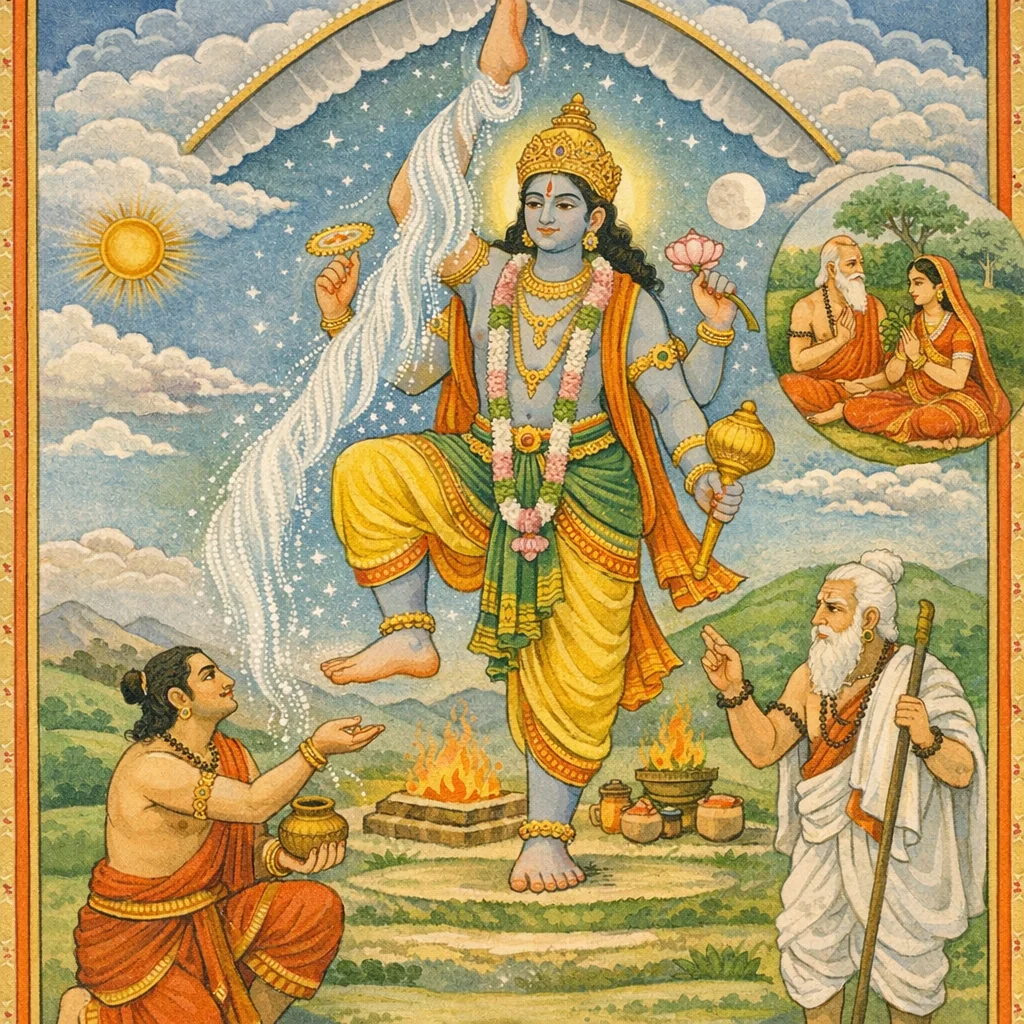
Vāmana’s Advent, Aditi’s Hymn, Bali’s Gift, and the Mahatmya of Bhū-dāna
Nārada asks how a forest-fire spared Aditi; Sanaka explains that devotion to Hari sanctifies a person and their place, making it a refuge where calamity, disease, thieves, and malevolent beings cannot prevail. Viṣṇu appears to Aditi, grants boons, and receives her long stotra praising His nirguṇa/saguṇa supremacy, cosmic body, embodiment of the Vedas, and unity with Śiva. He promises to be born as her son and teaches the inner marks of those who “bear” Him: non-harming, truthfulness, fidelity, service to the guru, love of tīrthas, Tulasi worship, nāma-saṅkīrtana, and cow-protection. Aditi gives birth to Vāmana; Kaśyapa extols Him. At Bali’s Soma-sacrifice, Śukra warns against giving, but Bali upholds dāna to Viṣṇu as dharma. Vāmana asks for three steps of land, teaches detachment and the antaryāmin doctrine, and unfolds a long bhū-dāna Mahatmya with the Bhadramati–Sughoṣa exemplum and graded merits. Viṣṇu expands, measures the worlds, pierces the cosmic egg, and Gaṅgā arises from His foot-water; Bali is bound yet granted Rasātala with Viṣṇu as gatekeeper. The chapter ends by praising Gaṅgā and the merit of hearing this account.
Shlokas
Verse 1
नारद उवाच । अहो ह्यत्यद्भुतं प्रोक्तं त्वया भ्रातरिदं मम । स वह्निरदितिं मुक्त्वा कथं तानदहत्क्षणात् ॥ १ ॥
Narada said: “Ah! What you have told me, O brother, is truly most astonishing. How did that fire, after sparing Aditi, burn them up in an instant?”
Verse 2
वदादितेर्महासत्त्वं विशेषाश्चर्यकारणम् । परोपदेशनिरताः सज्जना हि मुनीश्वराः ॥ २ ॥
Speak of Aditi’s great nobility—an extraordinary cause of wonder; for the true and saintly sages are ever devoted to instructing others for their good.
Verse 3
सनक उवाच । श्रृणु नारद माहात्म्यं हरिभक्तिरतात्मनाम् । हरिध्यानपरान्साधून्कः समर्थः प्रबाधितुम् ॥ ३ ॥
Sanaka said: Listen, O Nārada, to the greatness of those whose very selves are absorbed in devotion to Hari. Who is capable of afflicting the holy ones who are devoted to meditation on Hari?
Verse 4
हरिभक्तिपरो यत्र तत्र ब्रह्मा हरिः शिवः । देवाः सिद्धा मुनीश्वाश्च नित्यं तिष्टंति सत्तमाः ॥ ४ ॥
Wherever a person is devoted to Hari, there indeed are Brahmā, Hari, and Śiva; and there the Devas, the Siddhas, and the best of sages ever abide.
Verse 5
हरिरास्ते महाभाग हृदये शान्तचेतसाम् । हरिनामपराणां च किमु ध्यानरतात्मनाम् ॥ ५ ॥
O noble one, Hari dwells in the hearts of those whose minds are tranquil. And if this is so for those devoted to the name of Hari, how much more for those whose very selves are absorbed in meditation.
Verse 6
शिवपूजारतो वाऽपि विष्णुपूजापरोऽपि वा । यत्र तिष्टति तत्रैव लक्ष्मीः सर्वाश्च देवताः ॥ ६ ॥
Whether one is devoted to the worship of Śiva or dedicated to the worship of Viṣṇu—wherever such a devotee dwells, there indeed abide Lakṣmī and all the gods.
Verse 7
यत्र पूजापरो विष्णोर्वह्निस्तत्र न बाधते । राजा वा तस्करो वापि व्याधयश्च न सन्ति हि ॥ ७ ॥
Where one is devoted to the worship of Viṣṇu, fire does not cause harm there; neither the king nor thieves trouble that place, and indeed diseases are not present.
Verse 8
प्रेताः पिशाचाः कूष्माण्डग्रहा बालग्रहास्तथा । डाकिन्यो राक्षसाश्चैव न बाधन्तेऽच्युतार्चकम् ॥ ८ ॥
Ghosts, ghouls, Kūṣmāṇḍa-spirits, child-afflicting grahas, ḍākinīs, and even rākṣasas do not trouble the worshipper of Acyuta (Viṣṇu).
Verse 9
परपीडारता ये तु भूतवेतालकादयः । नश्यन्ति यत्र सद्भक्तो हरिलक्ष्म्यर्चने रतः ॥ ९ ॥
But those beings who delight in tormenting others—such as bhūtas and vetālas—are destroyed wherever a true devotee is devoted to the worship of Hari together with Lakṣmī.
Verse 10
जितेन्द्रियः सर्वहितो धर्मकर्मपरायणः । यत्र तिष्टति तत्रैव सर्वतीर्थानि देवताः ॥ १० ॥
One who has conquered the senses, who is devoted to the welfare of all, and who is steadfast in righteous duties—wherever such a person dwells, there itself are present all sacred pilgrimage places and the gods.
Verse 11
निमिषं निमिषार्द्धं वा यत्र तिष्टन्ति योगिनः । तत्रैव सर्वश्रेयांसि तत्तीर्थं तत्तपोवनम् ॥ ११ ॥
Wherever yogins abide—even for a moment or half a moment—there itself are all auspicious attainments; that very place becomes a tīrtha, a sacred ford, and a tapovana, a grove of austerity.
Verse 12
यन्नामोच्चारणादेव सर्वे नश्यन्त्युपद्रवाः । स्तोत्रैर्वाप्यर्हणाभिर्वा किमु ध्यानेन कथ्यते ॥ १२ ॥
By the mere utterance of His Name, all troubles and calamities are destroyed. If this is so through hymns of praise or acts of worship, what need is there to speak further of the power of meditation?
Verse 13
एवं तेनाग्निना विप्र दग्धं सासुरकाननम् । सादितिर्नैव दग्धाभूद्विष्णुचक्राभिरक्षिता ॥ १३ ॥
Thus, O brāhmaṇa, that fire burned up the forest along with the asuras; yet Aditi was not burned at all, for she was protected by Viṣṇu’s discus.
Verse 14
ततः प्रसन्नवदनः पह्मपत्रायतेक्षणः । प्रादुरासीत्समीपेऽस्याः शङ्खचक्रगदाधरः ॥ १४ ॥
Then, with a serene face and lotus-petal-like eyes, the Lord—bearing the conch, discus, and mace—manifested close beside her.
Verse 15
ईषद्वास्यस्फुरद्दन्तप्रभाभाषितदिङ्मुखः । स्पृशन्करेण पुण्येन प्राह कश्यपवल्लभाम् ॥ १५ ॥
With his mouth slightly opened, the radiance of his teeth made the quarters shine; touching Kaśyapa’s beloved with his holy hand, he spoke.
Verse 16
श्रीभगवाननवाच । देवमातः प्रसन्नोऽस्मि तपसाराधितस्त्वया । चिरं श्रान्तासि भद्रं ते भविष्यति न संशयः ॥ १६ ॥
The Blessed Lord said: “O Mother of the gods, I am pleased, for you have worshiped Me through austerity. Long have you endured hardship; surely auspiciousness will come to you—of this there is no doubt.”
Verse 17
वरं वरय दास्यामि यत्ते मनसि रोचते । मा भैर्भद्रे महाभागे ध्रुवं श्रेयो भविष्यति ॥ १७ ॥
“Choose a boon; I shall grant whatever pleases your mind. Do not fear, auspicious and noble lady—surely your highest good will come to pass.”
Verse 18
इत्युक्तादेवमाता सा देवदेवेन चक्रिणा । तुष्टाव प्रणिपत्यैनं सर्वलोकसुखावहम् ॥ १८ ॥
Thus addressed by the Lord of gods—the Supreme, bearing the discus—Mother Devī bowed down to Him and praised Him, the bestower of happiness upon all worlds.
Verse 19
अदितिरुवाच । नमस्ते देवदेवेश सर्वव्यापिञ्जनार्दना । सत्त्वादिगुणभेदेन लोकव्यापारकारण ॥ १९ ॥
Aditi said: “Salutations to You, O Lord of lords, O all-pervading Janārdana—You who, through the distinctions of the guṇas beginning with sattva, become the very cause of the world’s manifold activities.”
Verse 20
नमस्ते बहुपरुपायारुपाय च महात्मने । सर्वैकरुपरुपाय निर्गुणाय गुणात्मने ॥ २० ॥
“Salutations to You, the great-souled One—who are of many supreme forms and also beyond all form; who are the One Form that becomes all forms; who are without attributes, yet the very essence of all attributes.”
Verse 21
नमस्ते लोकनाथाय परमज्ञानरुपिणे । सद्भक्तजनवात्सल्यशालिने मङ्गलात्मने ॥ २१ ॥
Salutations to You, Lord of the worlds, whose very nature is supreme knowledge—abounding in tender affection for true devotees, and whose essence is auspiciousness itself.
Verse 22
यस्यावताररुपाणि ह्यर्चयन्ति मुनीश्वराः । तमादिपुरुषं देवं नमामि ह्यर्थसिद्धये ॥ २२ ॥
I bow to that divine Primordial Person, the Ādi-Puruṣa—the Lord whose incarnate forms are worshipped by the great sages—so that my purpose may be fulfilled.
Verse 23
श्रुतयो यं न जानन्ति न जानन्ति च सूरयः । तं नमामि जगद्धेतुं समायं चाप्यमायिनम् ॥ २३ ॥
I bow to Him whom even the Vedas do not fully know, and whom even the sages do not fully know—unto that Cause of the universe, impartial to all, and yet free from all deception of māyā.
Verse 24
यस्यावलोकनं चित्रं मायोपद्रवकारणम् । जगद्रूपं जगद्धेतुं तं वन्दें सर्ववन्दितम् ॥ २४ ॥
I bow to Him—revered by all—whose wondrous glance becomes the cause of māyā’s stirring; who is the very form of the universe and also the cause of the universe.
Verse 25
यत्पादाम्बुजकिञ्जल्कसेवारक्षितमस्तकाः । अवापुः परमां सिद्धिं तं वन्दे कमलाधवम् ॥ २५ ॥
I bow to Kamalādhava (Viṣṇu): His devotees—whose heads are safeguarded by service to the pollen-dust of His lotus feet—attain the supreme perfection.
Verse 26
यस्य ब्रह्मादयो देवा महिमानं न वै विदुः । अत्यासन्नं च भक्तानां तं वन्दे भक्तसंगिनम् ॥ २६ ॥
I bow to Him whose greatness even Brahmā and the other gods do not truly know—yet who is exceedingly near to His devotees, ever in the company of the devoted.
Verse 27
यो देवस्त्यक्तसङ्गानां शान्तानं करुणार्णवः । करोति ह्यात्मनः सङ्गं तं देवं सङ्गवर्जितम् ॥ २७ ॥
That God—an ocean of compassion for the peaceful who have renounced attachment—indeed takes them into His own intimate fellowship; that very God is Himself free from all attachment.
Verse 28
यज्ञेश्वरं यज्ञकर्म यज्ञकर्मसु निष्टितम् । नमामि यज्ञफलदं यज्ञकर्मप्रबोधकम् ॥ २८ ॥
I bow to the Lord of sacrifice—He who is Himself the sacrificial act, who abides firmly within all sacrificial rites; the giver of the fruits of sacrifice, and the awakener and illuminator of sacrificial action.
Verse 29
अजामिलोऽपि पापात्मा यन्नामोच्चारणादनु । प्राप्तवान्परमं धाम तं वन्दे लोकसाक्षिणम् ॥ २९ ॥
Even Ajāmila—though a sinful man—attained the supreme abode merely by uttering His Name. I bow to that Lord who is the witness of all worlds.
Verse 30
हरिरुपी महादेवः शिवरुपी जनार्दनः । इति लोकस्य नेता यस्तं नमामि जगद्गुरुम् ॥ ३० ॥
Mahādeva is of the form of Hari, and Janārdana is of the form of Śiva. Knowing thus that He is the guide of the world, I bow to that Jagadguru, the Teacher of the universe.
Verse 31
ब्रह्माद्या अपि देवेशा यन्मायापाशयन्त्रिताः । न जानन्ति परं भावं तं वन्दे सर्वनायकम् ॥ ३१ ॥
Even Brahmā and the other lords of the gods—ensnared by the noose of His Māyā—do not know His supreme Reality. I bow to that Lord, the leader of all.
Verse 32
ह्यत्पह्मस्थोऽपिञ्योग्यानां दूरस्थ इव भासते । प्रमाणातीतसद्भावस्तं वन्दे ज्ञानसाक्षिणम् ॥ ३२ ॥
Though abiding in the lotus of the heart, to the unfit He appears as if far away. Transcending all means of proof, established as pure Reality, I bow to that Witness of Consciousness.
Verse 33
यन्मु खाद्ब्राह्यणो जातो बाहुभ्यां क्षत्रियोऽजनि । ऊर्वोर्वैश्यः समुत्पन्नः पद्यां शूद्रोऽभ्यजायत ॥ ३३ ॥
From His mouth the Brāhmaṇa was born; from His arms the Kṣatriya came into being. From His thighs the Vaiśya arose, and from His feet the Śūdra was produced.
Verse 34
मनसश्चन्द्रमा जातो जातः सूर्यश्च चक्षुषः । मुखादग्निस्तर्थेन्द्रश्च प्राणाद्वायुरजायत ॥ ३४ ॥
From the mind the Moon was born; from the eye the Sun came forth. From the mouth arose Fire and also Indra; and from the vital breath (prāṇa) Wind was produced.
Verse 35
ऋग्यजुःसामरुपाय सत्यस्वरगतात्मने । षडङ्गरुपिणे तुभ्यं भूयोभूयो नमो नमः ॥ ३५ ॥
Again and again I bow to You—embodied as the Ṛg, Yajur, and Sāma Vedas; whose very essence abides in the true Vedic accents and sounds; and who manifest as the six Vedāṅgas. Namo, namah!
Verse 36
त्वमिन्द्रः पवनः सोमस्त्वमीशानस्त्वमन्तकः । त्वमग्निर्निर्ऋतिश्चैव वरुणस्त्वं दिवाकरः ॥ ३६ ॥
You are Indra; You are the Wind; You are Soma. You are Īśāna, and You are Antaka (Death). You are Agni, and also Nirṛti; You are Varuṇa, and You are the Sun (Divākara).
Verse 37
देवाश्च स्थावराश्चैव पिशाचाश्चैव राक्षसाः । गिरयः सिद्धगंधर्वानद्यो भूमिश्च सागराः ॥ ३७ ॥
The gods and the immobile beings, the piśācas and the rākṣasas; the mountains, the siddhas and gandharvas; the rivers, the earth, and the oceans—all are included.
Verse 38
त्वमेव जगतामीशो यत्रासि त्वं परात्परः । त्वद्रूपमखिलं देव तस्मान्नित्यं नमोऽस्तु ते ॥ ३८ ॥
You alone are the Lord of all worlds; wherever You are, You are the Supreme beyond the supreme. O God, the entire universe is Your very form—therefore, to You, my constant salutation be.
Verse 39
अनाथानाथ सर्वज्ञ भूतदेवेन्द्रविग्रह । दैतेयैर्बाधितान्पुत्रान्मम पाहि जनार्दन ॥ ३९ ॥
O refuge of the refuge-less, O all-knowing One, whose form is revered by beings, gods, and Indra—O Janārdana, protect my sons who are being oppressed by the Daityas.
Verse 40
इति स्तुत्वा देवमाता देवं नत्वा पुनः पुनः । उवाच प्राञ्जलिर्भूत्वा हर्षाश्रुक्षालितस्तनी ॥ ४० ॥
Having thus praised the Divine, the Mother of the gods repeatedly bowed to the Lord. Then, standing with folded hands—her breasts washed by tears of joy—she spoke.
Verse 41
अनुग्राह्यास्मि देवेंश त्वया सर्वादिकारण । अकण्टकां श्रियां देहि मत्सुतानां दिवौकसाम् ॥ ४१ ॥
O Lord of the gods, O primal cause of all, may I be a recipient of Your grace. Grant my sons, the dwellers of heaven, an unimpeded prosperity, free from every obstacle.
Verse 42
अन्तर्य्यामिञ्जगद्रूप सर्वज्ञा परमेश्वर । अज्ञातं किं तव श्रीश किं मामीहयसि प्रभो ॥ ४२ ॥
O Antaryāmin, Inner Controller whose form is the universe—O all-knowing Supreme Lord! O Śrīśa, Lord of Lakṣmī, what could ever be unknown to You? O Master, why do You test me here?
Verse 43
तथापि तव वक्ष्यामि यन्मे मनसि रोचते । वृथापुत्रास्मि देवेश दैतेयैः परिपीडिता ॥ ४३ ॥
Even so, I will speak what pleases my heart. O Lord of the gods, I am a woman whose motherhood has been in vain, tormented and oppressed by the Daityas.
Verse 44
तान्न हिंसितुमिच्छामि यतस्तेऽपि सुता मम । तानहत्वा श्रियं देहि मत्सुतेभ्यः सुरेश्वर ॥ ४४ ॥
I do not wish to harm them, for they too are my sons. Without killing them, O Lord of the gods, grant prosperity and good fortune to my sons.
Verse 45
इत्युक्तो देवेदेवेशः पुनः प्रीतिमुपागतः । उवाच हर्षयन्विप्र देवमातरमादरात् ॥ ४५ ॥
Thus addressed, the Lord of the gods again became pleased; and, gladdening the sage, He respectfully spoke to the Mother of the gods.
Verse 46
श्रीभगवानुवाच । प्रीतोऽस्मि देवि भद्रं ते भविष्यामि सुतो ह्यहम् । यतः सपत्निपुत्रेषु वात्सल्यं देवि दुर्लभम् ॥ ४६ ॥
The Blessed Lord said: “I am pleased, O Goddess; may auspiciousness be yours. Truly, I shall become your son, for, O Goddess, affection toward the son of a co-wife is rare.”
Verse 47
त्वया तु यत्कृतं स्तोत्रं तत्पठान्ति नरास्तु ये । तेषां संपद्वरा पुत्रा न हीयन्ते कदाचन ॥ ४७ ॥
“As for the hymn you have composed—whoever recites it, for them prosperity and excellent offspring never diminish at any time.”
Verse 48
त्वात्मजे वान्यपुत्रे वा यः समत्वेन वर्तते । न तस्य पुत्रशोकः स्यादेष धर्मः सनातनः ॥ ४८ ॥
He who behaves with equal-mindedness toward his own son or another’s son will not be afflicted by grief over a son; this is the eternal Dharma.
Verse 49
अदितिरुवाच । ताह वोढुं क्षमा देव त्वामाद्यपुरुषं परम् । असंख्याताण्डरोमाणं सर्वेशं सर्वकारणम् ॥ ४९ ॥
Aditi said: “O God, be pleased to bear them within Your protection. You are the primordial Supreme Person—whose pores contain innumerable cosmic eggs—Lord of all, and the cause of all causes.”
Verse 50
यत्प्रभावं न जानन्ति श्रुतयः सर्वदेवताः । तमहं देवदेवेशं धारयामि कथं प्रभो ॥ ५० ॥
“O Lord, how can I sustain within myself that God of gods—the Lord of the gods—whose majesty even the Vedas and all the deities do not fully know?”
Verse 51
अणोरणीयांसमजं परात्परतरं प्रभुम् । धारयामि कथं देव त्वामहं पुरुषोत्तमम् ॥ ५१ ॥
O God—O Puruṣottama—how can I sustain You in my mind: You, the unborn Lord, subtler than the subtlest and higher than the Highest?
Verse 52
महापातकयुक्तोऽपि यन्नामस्मृतिमात्रतः । मुच्यते स कथं देवोग्राम्येषु जनिमर्हति ॥ ५२ ॥
Even one burdened with great sins is freed merely by remembering His Name. How, then, could that Divine Lord ever be fit to take birth among ordinary worldly beings?
Verse 53
यथा शूकरमत्स्याद्या अवतारास्तव प्रभो । तथायमपि को वेद तव विश्वेश चेष्टितम् ॥ ५३ ॥
O Lord, just as Your incarnations such as the Boar and the Fish are known, so too—who can truly know this manifestation of Yours, O Lord of the universe, and the mystery of Your divine līlā?
Verse 54
त्वत्पादपह्मप्रणतात्वन्नामस्मृतितत्परा । त्वामेव चिंतये देव यथेच्छासि तथा कुरु ॥ ५४ ॥
Bowing at Your lotus feet and devoted to remembering Your Name, I meditate on You alone, O Lord; do as You wish.
Verse 55
सनक उवाच । तयोक्तं वचनं श्रुत्वा देवदेवो जनार्दनः । दत्त्वाभयं देवमातुरिदं वचनमब्रवीत् ॥ ५५ ॥
Sanaka said: Having heard the words spoken by them, Janārdana—the God of gods—granted fearlessness to the Mother of the gods and spoke these words.
Verse 56
श्रीभगवानुवाच । सत्यमुक्तं महाभागे त्वया नास्त्यत्र संशयः । तथापि श्रृणु वक्ष्यामि गुह्याद्गुह्यतरं शुभे ॥ ५६ ॥
The Blessed Lord said: “What you have spoken is true, O greatly fortunate one—there is no doubt of it. Even so, listen, O auspicious one; I shall speak a teaching more secret than the secret.”
Verse 57
रागद्वेषविहीना ये मद्भक्ता मत्परायणाः । वंहति सततं तें मां गतासूया अदाम्भिकाः ॥ ५७ ॥
Those devotees of Mine who are free from attachment and aversion, who take refuge in Me alone—humble, without envy, and without pretence—constantly carry Me in their hearts.
Verse 58
परोपतापविमुखाः शिवभक्तिपरायणः । मत्कथाश्रवणासक्ता वहन्ति सततं हि माम् ॥ ५८ ॥
Those who turn away from causing pain to others, who are wholly devoted to Śiva-bhakti, and who are attached to listening to the narratives about Me—such people indeed carry Me within them at all times.
Verse 59
पतिव्रताः परिप्राणाः पतिभक्तिपरायणाः । वहन्ति सततं देवि स्त्रियोऽपि त्यक्तप्रत्सराः ॥ ५९ ॥
O Goddess, women too—steadfast in the vow of fidelity to their husbands, holding their husbands as their very life-breath, wholly devoted to service and love of their husbands, and having abandoned fault-finding and contentiousness—continually uphold the order of dharma.
Verse 60
मातापित्रोश्च शुश्रूषुर्गुरुभक्तोऽतिथिप्रियः । हितकृद्बाह्यणानां यः स मां वहति सर्वदा ॥ ६० ॥
One who serves his mother and father, is devoted to his teacher, delights in honoring guests, and works for the welfare of the brāhmaṇas—such a person bears Me at all times.
Verse 61
पुण्यतीर्थरता नित्यं सत्सङ्गनिरतास्तथा । लोकानुग्रहशीलाश्च सततं ते वहन्ति माम् ॥ ६१ ॥
Those who are ever devoted to sacred tīrthas, ever absorbed in sat-saṅga with the virtuous, and ever inclined to the welfare of the world—such people continually bear Me within themselves.
Verse 62
परोपकारविरताः परद्रव्यपराङ्मुखाः । नषुंसकाः परस्त्रीषु ते वहन्ति च मां सदा ॥ ६२ ॥
Those who refrain from harming others, who turn away from another’s wealth, and who are not lustful toward other men’s wives—such people constantly uphold and bear Me within themselves.
Verse 63
तुलस्युपासनरताः सदा नामपरायणाः । गोरक्षणपरा ये च सततं मां वहन्ति ते ॥ ६३ ॥
Those who delight in the worship of Tulasī, who are always devoted to chanting the Lord’s Name, and who are committed to protecting cows—such people continually bear Me in their lives and conduct.
Verse 64
प्रतिग्रहनिवृत्ता ये परान्नविमुखास्तथा । अन्नोदकप्रदातारो वहंति सततं हि माम् ॥ ६४ ॥
Those who refrain from accepting gifts, who do not disdain another’s food (who do not reject hospitality), and who give food and water—such people indeed always bear Me within themselves.
Verse 65
त्वं तु देवि पतिप्राणा साध्वी भूतहिते रता । संप्राप्य पुत्रभावं ते साधयिष्ये मनोरथम् ॥ ६५ ॥
But you, O Goddess, are one whose very life is devoted to your husband—virtuous, and delighting in the welfare of all beings. Therefore, having attained the state of motherhood, I shall fulfill your cherished desire.
Verse 66
इत्युक्त्वा देवेदेवशो ह्यदितिं देवमातरम् । दत्त्वा कण्ठगतां मालामभयं च तिरोदधे ॥ ६६ ॥
Thus having spoken, the Lord of the gods addressed Aditi, the mother of the devas; then, placing upon her the garland that had rested upon His own neck and granting her fearlessness, He vanished from sight.
Verse 67
सा तु संहृष्टमनसा देवसूर्दक्षनन्दिनी । प्रणम्य कमलाकान्तं पुनः स्वस्थानमाव्रजत् ॥ ६७ ॥
Then she—gladdened at heart, Dakṣa’s daughter and mother of the devas—bowed to Kamalākānta (Viṣṇu, beloved of Lakṣmī) and returned once more to her own abode.
Verse 68
ततोऽदितिर्महाभागा सुप्रीता लोकवन्दिता । असूत समये पुत्रं सर्वलोकनमस्कृतम् ॥ ६८ ॥
Then Aditi—the greatly blessed one, delighted and praised by the worlds—gave birth in due time to a son revered and saluted by all the worlds.
Verse 69
शङ्गचक्रधरं शान्तं चन्द्रमण्डलमध्यगम् । सुधाकलशदध्यन्नकरं वामनसंज्ञितम् ॥ ६९ ॥
He is peaceful, bearing conch and discus, abiding in the midst of the lunar orb; holding in His hands a pot of nectar and a bowl of curd-rice—this form is known as Vāmana.
Verse 70
सहस्त्रादित्यसंकाशं व्याकोशकमलेक्षणम् । सर्वाभरणंसंयुक्तं पीताम्बरधरं हरिम् ॥ ७० ॥
One should meditate on Hari—radiant like a thousand suns, with eyes like fully blossomed lotuses, adorned with every ornament, and clad in yellow garments.
Verse 71
स्तुत्यं मुनिगणैर्युक्तं सर्वलोकैकनायकम् । आविर्भूतं हरिं ज्ञात्वा कश्यपो हर्षविह्वलः । प्रणम्य प्रञ्जलिर्भूत्वा स्तोतुं समुपचक्रमे ॥ ७१ ॥
Recognizing that Hari—worthy of praise, attended by hosts of sages, and the sole Lord of all worlds—had manifested, Kāśyapa, overwhelmed with joy, bowed down; and with hands folded in reverence, he began to offer hymns of praise.
Verse 72
कश्यप उवाच । नमोनमस्तेऽखिलकारणाय नमोनमस्तेऽखइलपालकाय । नमोनमस्तेऽमरनायकाय नमोनमो दैतेयविनाशनाय ॥ ७२ ॥
Kaśyapa said: Salutations, salutations to You—the cause of all. Salutations, salutations to You—the protector of all. Salutations, salutations to You—the leader of the immortals (the devas). Salutations, salutations to You—the destroyer of the Daityas.
Verse 73
नमोनमो भक्तजनप्रियाय नमोनमः सज्जनरंजिताय । नमोनमो दुर्जननाशनाय नमोऽस्तु तस्मै जगदीश्वराय ॥ ७३ ॥
Repeated salutations to Him who is dear to His devotees; repeated salutations to Him who delights the virtuous; repeated salutations to Him who destroys the wicked. Salutations be to that Lord of the universe.
Verse 74
नमोनमः कारणवामनाय नारायणायामितविक्रमाय । सशार्ङ्गचक्रासिगदाधाराय नमोऽस्तु तस्मै पुरुषोत्तमाय ॥ ७४ ॥
Repeated salutations to Nārāyaṇa—the causal Vāmana of the universe, of immeasurable stride—who bears the Śārṅga bow, the discus, the sword, and the mace. Salutations to that Supreme Person (Puruṣottama).
Verse 75
नमः पयोराशिनिवासनाय नमोऽस्तु सद्धृत्कमलस्थिताय । नमोऽस्तु सूर्याद्यमितप्रभाय नमोनमः पुण्यकथागताय ॥ ७५ ॥
Salutations to Him who dwells in the Ocean of Milk; salutations to Him who is seated in the lotus of the pure-hearted. Salutations to Him whose boundless radiance surpasses the sun and all else. Repeated salutations to Him who is reached through sacred, meritorious narratives of His deeds.
Verse 76
नमोनमोऽर्केन्दुविलोचनाय नमोऽस्तु ते यज्ञफलप्रदाय । नमोऽस्तु यज्ञाङ्गविराजिताय नमोऽस्तु ते सज्जनवल्लभाय ॥ ७६ ॥
Again and again, salutations to You whose eyes are like the sun and the moon. Salutations to You, bestower of the fruits of yajña. Salutations to You who shine, adorned with the very limbs of yajña. Salutations to You, beloved of the righteous.
Verse 77
नमो जगत्कारणकारणाय नमोऽस्तु शब्दादिविवर्जिताय । नमोऽस्तु ते दिव्यसुखप्रदाय नमो नमो भक्तमनोगताय ॥ ७७ ॥
Salutations to You, the cause behind all causes of the universe. Salutations to You, beyond sound and all sensory categories. Salutations to You, giver of divine bliss. Again and again, salutations to You who dwell within the minds of Your devotees.
Verse 78
नमोऽस्तु ते ध्वान्तविनाशकाय नमोऽस्तु शब्दादिविवर्जिताय । नमोऽस्तु ते ध्वान्तविनाशकाय मन्दरधारकाय । नमोऽस्तु ते यज्ञवराहनाम्ने नमो हिरण्याक्षविदारकाय ॥ ७८ ॥
Salutations to You, destroyer of darkness; salutations to You, beyond sound and all else. Salutations to You, destroyer of darkness, bearer of Mandara. Salutations to You, named Yajña-Varāha, the Boar of sacrifice; salutations to You, who split Hiraṇyākṣa.
Verse 79
नमोऽस्तु ते वामनरुपभाजे नमोऽस्तु ते क्षत्र्रकुलान्तकाय । नमोऽस्तु ते रावणमर्दनाय नमोऽस्तु ते नन्दसुताग्रजाय ॥ ७९ ॥
Salutations to You who bear the form of Vāmana. Salutations to You, destroyer of the kṣatriya clans. Salutations to You, slayer of Rāvaṇa. Salutations to You, the elder brother of Nanda’s son (Kṛṣṇa).
Verse 80
नमस्ते कमलाकान्त नमस्ते सुखदायिने । स्मृतार्तिनाशिने तुभ्यं भूयो भूयो नमोनमः ॥ ८० ॥
Salutations to You, O beloved of Kamalā (Lakṣmī); salutations to You, giver of happiness. To You who destroy the distress of those who remember You—again and again, salutations, salutations.
Verse 81
यज्ञेश यज्ञविन्यास यज्ञविन्घविनाशन । यज्ञरुप यजद्रूप यज्ञाङ्गं त्वां यजाम्यहम् ॥ ८१ ॥
O Lord of yajña, arranger of the sacrificial order, destroyer of all obstacles to sacrifice—O You who are the very form of yajña, the form of the worshipper, and the limbs of the sacrifice—I worship You.
Verse 82
इति स्तुतः स देवेशो वामनो लोकपावनः । उवाच प्रहसन्हर्षं वर्ध्दयन्कश्यपस्य सः ॥ ८२ ॥
Thus praised, that Lord of the gods—Vāmana, the purifier of the worlds—spoke with a smile, increasing Kaśyapa’s joy.
Verse 83
श्रीभगवानुवाच । तात तुष्टोऽस्मि भद्रं ते भविष्यति सुरार्चिता । अचिरात्साधयिष्यामि निखिलं त्वन्मनोरथम् ॥ ८३ ॥
The Blessed Lord said: “Dear child, I am pleased. May auspiciousness be yours, O one revered even by the gods. Before long I shall fulfill completely every desire that dwells in your heart.”
Verse 84
अहं जन्मद्वये त्वेवं युवयोः पुत्रतां गतः । अस्मिञ्जन्मन्यपि तथा सादयाम्युत्तमं सुखम् ॥ ८४ ॥
In two births I have thus become your son; and in this birth too, in the same way, I attain the highest happiness.
Verse 85
अत्रान्तरे बलिर्दैत्यो दीर्घसत्रं महामखम् । आरेभे गुरुणा युक्तः काव्येन च मुनीश्वरैः ॥ ८५ ॥
Meanwhile, Bali, the Daitya, began a long Soma-sacrifice—a great ritual (mahāmakha)—supported by his preceptor, Kāvya (Śukrācārya), and accompanied by the foremost sages.
Verse 86
तस्मिन्मखे समाहूतो विष्णुर्लक्ष्मीसमन्वितः । हविः स्वीकरणार्थाय ऋषिभिर्ब्रह्यवादिभिः ॥ ८६ ॥
In that sacrificial rite, Viṣṇu—accompanied by Lakṣmī—was invoked by the seers, the expounders of Brahman, that He might accept the oblation (havi).
Verse 87
प्रवृद्धैश्वर्यर्दैत्यस्य वर्त्तमाने महाक्रतौ । आमंत्र्य मातापितरौ स बटुर्वामनो ययौ ॥ ८७ ॥
As the Daitya’s great sacrifice proceeded—his sovereignty swollen by ever-growing power—Vāmana, the young ascetic boy, took leave of his mother and father and set out.
Verse 88
स्मितेन मोहयँल्लोकं वामनो भक्तवत्सलः । हविर्भोक्तुमिवायातो बलेः प्रत्यक्षतो हरिः ॥ ८८ ॥
With a gentle smile, Vāmana—the dwarf form, ever affectionate to His devotees—bewildered the world; Hari appeared directly before Bali, as though He had come to partake of the sacrificial oblation (havi).
Verse 89
दुर्वृत्तो वा सुवृत्तो वा जडो वायं हितोऽपि वा । यो भक्तियुक्तस्तस्यान्तः सदा संनिहितो हरिः ॥ ८९ ॥
Whether one is of bad conduct or good conduct, dull-witted or even well-disposed—whoever is endowed with devotion (bhakti), within that person Hari is ever present.
Verse 90
आयान्तं वामनं दृष्ट्वा ऋषयो ज्ञानचक्षुषः । ज्ञात्वा नारायणं देवमुद्ययुः सभ्यसंयुताः ॥ ९० ॥
Seeing Vāmana approaching, the seers—endowed with the eye of spiritual knowledge—recognized Him as Lord Nārāyaṇa; and, accompanied by the assembled elders, they rose to receive Him with honor.
Verse 91
एतज्ज्ञात्वा दैत्यगुरुरेकांते बलिमब्रवीत् । स्वसारमविचार्यैव खलाः कार्याणि कुर्वते ॥ ९१ ॥
Knowing this, the preceptor of the Daityas spoke to Bali in private: “Without reflecting on what is truly beneficial, the wicked act as they please.”
Verse 92
शुक्र उवाच । भो भो दैत्यपते सौम्य ह्यपहर्ता तव श्रियम् । विष्णुर्वामनरुपेण ह्यदितेः पुत्रातां गतः ॥ ९२ ॥
Śukra said: “O gentle lord of the Daityas! The one who will take away your prosperity has arrived—Vishnu, having assumed the form of Vāmana and having been born as the son of Aditi.”
Verse 93
तवाध्वरं स आयाति त्वया तस्यासुरेश्वर । न किंचिदपि दातव्यं मन्मतं श्रृणु पण्डित ॥ ९३ ॥
He is coming to your sacrificial rite; therefore, O lord of the Asuras, you should not give him anything at all. Listen, O wise one, to what I judge to be best.
Verse 94
आत्मबुद्धिः सुखकरी गुरुबुद्धिर्विशेषतः । परबुद्धिर्विनाशाय स्त्रीबुध्दिः प्रलयंकरी ॥ ९४ ॥
Self-directed judgment brings happiness; reverent regard for the Guru brings it all the more. But living by another’s mind leads to ruin, and being ruled by attachment to women is said to be destructive to one’s life.
Verse 95
शत्रूणां हितकृतद्यस्तु स हन्तव्यो विशेषतः ॥ ९५ ॥
But whoever acts as a benefactor to one’s enemies—such a person is to be restrained or punished, most especially.
Verse 96
बलिरुवाच । एवं गुरो न वक्तव्यं धर्ममार्गविरोधतः । यदादत्ते स्वयं विष्णुः किमस्मादधिकं वरम् ॥ ९६ ॥
Bali said: “O Guru, such words should not be spoken, for they oppose the path of dharma. When Vishnu Himself accepts the gift, what boon could be greater than this?”
Verse 97
कुर्वन्ति विदुषो यज्ञान्विष्णुप्रीणनकारणात् । स चेत्साक्षाद्धविर्भोगी मत्तः कोऽभ्यधिको भुवी ॥ ९७ ॥
The wise perform sacrifices to please Vishnu. If He is indeed the direct enjoyer of the oblations, then who on earth could be superior to Him?
Verse 98
दरिद्रेणापि यत्किंचिद्दीयते विष्णवे गुरो । तदेव परमं दानं दत्तं भवति चाक्षयम् ॥ ९८ ॥
O Guru, even if a poor person offers something—however small—to Lord Vishnu or to one’s guru, that alone is the highest gift; once given, it becomes imperishable, bearing inexhaustible merit.
Verse 99
स्मृतोऽपि परया भक्त्या पुनाति पुरुषोत्तमः । येन केनाप्यर्चितश्वेद्ददाति परमां गतिम् ॥ ९९ ॥
Even when merely remembered with supreme devotion, the Supreme Person, Puruṣottama, purifies. And if He is worshiped in any manner whatsoever, He indeed grants the highest destination—liberation.
Verse 100
हरिर्हरति पापानिदुष्टचित्तैरपि स्मृतः । अनिच्छयापि संस्पृष्टो दहत्येव हि पावकः ॥ १०० ॥
Hari removes sins even when remembered by those of impure mind; just as fire surely burns when touched—even unintentionally.
Verse 101
जिह्वाग्रे वसते यस्य हरिरित्यक्षरद्वयम् । स विष्णुलोकमाप्नोति पुनरावृत्तिदुर्लभम् ॥ १ ॥
He upon whose tongue-tip abides the two-syllabled Name “Hari” attains the world of Viṣṇu—rarely returning again to rebirth.
Verse 102
गोविंदेति सदा ध्यायेद्यस्तु रागादिवर्जितः । स याति विष्णुभवनमिति प्राहुर्मनीषिणः ॥ २ ॥
Whoever continually meditates, uttering “Govinda,” free from attachment and the like—such a one goes to the abode of Viṣṇu; so declare the wise.
Verse 103
अग्नौ वा ब्राह्मणे वापिहूयते यद्वविर्गुरो । हरिभक्त्या महाभाग तेन विष्णुः प्रसीदति ॥ ३ ॥
O revered one, whether the oblation is offered into the fire or given to a brāhmaṇa—when it is offered with devotion to Hari, by that Viṣṇu becomes pleased.
Verse 104
अहं तु हरितुष्यद्यर्थं करोम्यध्वरमुत्तमम् । स्वयमायाति चेद्विष्णुः कृतार्थोऽस्मि न संशयः ॥ ४ ॥
But I am performing this excellent sacrifice solely to please Hari. If Viṣṇu comes here of His own accord, then I shall indeed be fulfilled—of this there is no doubt.
Verse 105
एवं वदति दैत्यन्द्रे विष्णुर्वामनरुपधृक् । प्रविवेशाध्वरस्थानं हुतवह्निमनोरमम् ॥ ५ ॥
As the lord of the Daityas spoke thus, Viṣṇu—assuming the form of Vāmana—entered the sacrificial arena, charming with its sacred fire.
Verse 106
तं दृष्ट्वा कोटिसूर्याभं योग्यावयवसुन्दरम् । वामनं सहसोत्थाय प्रत्यगृह्णात्कृताञ्जलिः ॥ ६ ॥
Seeing Vāmana—radiant like ten million suns and beautiful in every well-proportioned limb—he rose at once and received Him with reverent, joined palms.
Verse 107
दत्त्वासनं च प्रक्षाल्य पादौ वामनरुपिणम् । सकुटुंबो वहन्मूर्ध्ना परमां मुदमाप्तवान् ॥ ७ ॥
After offering Him a seat and washing the feet of the Lord who had assumed the form of Vāmana, he—together with his family—bore Him upon his head and attained supreme joy.
Verse 108
विष्णवेऽस्मै जगद्धान्मे दत्त्वार्घ्यं विधिवद्कलिः । रोमाञ्चिततनुर्भूत्वा हर्षाश्रुनयनोऽब्रवीत् । बलिरुवाच ॥ ८ ॥
Having properly offered arghya—an honoring libation—to this Viṣṇu, the abode of the universe, Kali, his body thrilled with gooseflesh and his eyes filled with tears of joy, spoke. Then Bali said:
Verse 109
अद्य मे सफलं जन्म अद्य मे सफलो मरवः । जीवितं सफलं मेऽद्य कृतार्थोऽस्मि न संशयः ॥ ९ ॥
Today my birth has become fruitful; today my very life has become fruitful. Today my living has been fulfilled—there is no doubt that I have attained my purpose.
Verse 110
अमोघामृतवृष्टिर्मे समायातातिदुर्लभा । त्वदागमनमात्रेण ह्यनायासो महोत्सवः ॥ ११० ॥
For me, an unfailing shower of nectar—so exceedingly rare—has now arrived. By Your mere coming, a great festival has arisen effortlessly.
Verse 111
एते च ऋषयः सर्वे कृतार्थां नात्र संशयः । यैः पूर्वं हि तपस्तप्तं तदद्य सफलं प्रभो ॥ ११ ॥
O Lord, all these sages are truly fulfilled—there is no doubt—for the austerities they practiced before have today borne fruit.
Verse 112
कृतार्थोऽस्मि कृतार्थोऽस्मि कृतार्थोऽस्मि न संशयः । तस्मात्तुभ्यं नमस्तुभ्यं नमस्तुभ्यं नमस्तुभ्यं नमोनमः ॥ १२ ॥
I have attained my purpose—indeed I have attained it; I have attained it—there is no doubt. Therefore to You I bow; to You I bow; to You I bow; to You I bow—again and again, my salutations.
Verse 113
त्वदाज्ञया त्वन्नियोगं साधयामीति मन्मनः । अत्युत्साहसमायुक्तं समाज्ञापय मां प्रभो ॥ १३ ॥
“By Your command I shall accomplish the task You have appointed”—with this resolve in my mind, filled with great enthusiasm, instruct me fully, O Lord.
Verse 114
एवमुर्को दीक्षितेन प्रहसन्वामनोऽब्रवीत् । देहि मे तपसि स्थातुं भूमिं त्रिपदसंमिताम् ॥ १४ ॥
Thus addressed by the consecrated sacrificer, Vāmana, the dwarf brāhmaṇa, smiling, replied: “Grant me land measured by three steps, that I may stand upon it for my austerity.”
Verse 115
एतच्छॄत्वा बलिः प्राह राज्यं याचितवान्नहि । ग्रामं वा नगरं चापि धनं वा किं कृतं त्वया ॥ १५ ॥
Hearing this, Bali said: “You have not asked for a kingdom, nor for a village or even a city, nor for wealth. What, then, is your intention?”
Verse 116
तन्निशम्य बलिं प्राह विष्णुः सर्वशरीरभृत् । आसन्नभ्रष्टराज्यस्य वैराग्यं जनयन्निवा ॥ १६ ॥
Hearing this, Viṣṇu—the Sustainer who bears all embodied beings—spoke to Bali, as though awakening in him vairāgya, for his kingdom was about to be lost.
Verse 117
श्रीभगवानुवाचा । श्रृणु दैत्यन्द्र वक्ष्यामि गुह्याद्गुह्यतमं परम् । सर्वसंगविहीनानां किमर्थैः साध्यतेवद ॥ १७ ॥
The Blessed Lord said: “Listen, O lord of the Daityas. I shall declare to you the supreme teaching, more secret than the secret. For those free from all attachments, what can truly be gained by worldly aims and possessions?”
Verse 118
अहं तु सर्वभूतानामन्तर्यामीति भावय । मयि सर्वमिदं दैत्य किमन्यैः साध्यते वद ॥ १८ ॥
Contemplate thus: “I am the Antaryāmin, the Inner Controller within all beings.” O Daitya, since all this rests in Me, tell me—what is to be accomplished by anything else?
Verse 119
रागद्वेषविहीनानां शान्तानां त्यक्तमायिनाम् । नित्यानंदस्वरुपाणां किमन्यैः साध्यते धनैः ॥ १९ ॥
For those free from attachment and aversion, tranquil, having renounced māyā’s delusive display, and whose very nature is eternal bliss—what purpose can be achieved by any other wealth?
Verse 120
आत्मवत्सर्वभूतानि पश्यतां शान्तचेतसाम् । अभिन्नमात्मनः सर्वं को दाता दीयते च किम् ॥ १२० ॥
For those of tranquil mind who see all beings as their own Self, everything is non-different from the Self. Then who is the giver, and what, indeed, can be given?
Verse 121
पृथ्वीयं क्षत्रियवशा इति शास्त्रेषु निश्चितम् । तदाज्ञायां स्थिताः सर्वे लभन्ते परमं सुखम् ॥ २१ ॥
It is established in the śāstras that this earth stands under the authority of the Kṣatriyas. All who abide within their lawful command attain the highest happiness.
Verse 122
दातव्यो मुनिभिश्चापि षष्टांशो भूभुजे बले । महीयं ब्राह्मणानां तु दातव्या सर्व यत्नतः ॥ २२ ॥
Even sages should offer a one-sixth share to the king when he is strong—able to protect and govern. Yet land should be given in dāna to brāhmaṇas with utmost effort and care.
Verse 123
भूमिदानस्य माहात्म्यं न भूतं न भविष्यति । परं निर्वाणमाप्नोति भूमिदो नात्र संशयः ॥ २३ ॥
The greatness of gifting land has had no equal in the past, nor will it in the future. The giver of land attains the supreme liberation—of this there is no doubt.
Verse 124
स्वल्पामपि महीं दत्त्वा श्रोत्रियायाहिताग्नये । ब्रह्मलोकमवाप्नोति पुनरावृत्तिदुर्लभम् ॥ २४ ॥
Even by gifting a very small piece of land to a Veda-learned brāhmaṇa (śrotriya) who maintains the sacred fires, one attains Brahmaloka—a state from which return to repeated birth is difficult.
Verse 125
भूमिदः सर्वदः प्रोक्तो भूमिदो मोक्षभाग्भवेत् । अतिदानं तु तज्ज्ञेयं सर्वपापप्राणाशनम् ॥ २५ ॥
The giver of land is declared to be the giver of everything; one who donates land becomes a sharer in mokṣa. Know this as the highest gift—it destroys the very life-breath of all sins.
Verse 126
महापातकयुक्तो वा युक्तो वा सर्वपातकैः । दशहस्तां महीं दत्त्वा सर्वपापैः प्रमुच्यते ॥ २६ ॥
Whether one is stained by a great sin or burdened with every kind of transgression, by gifting a piece of land measuring ten hastas, one is freed from all sins.
Verse 127
सत्पात्रे भूमिदाता यः सर्वदानफलं लभेत् । भूमिदानसमं नान्यत्त्रिषु लोकेषु विद्यते ॥ २७ ॥
One who donates land to a worthy recipient gains the merit of all forms of charity; in the three worlds, nothing is found equal to the gift of land.
Verse 128
द्विजाय वृत्तिहीनाय यः प्रदद्यान्महीं बले । तस्य पुण्यफलं वक्तुं न क्षमोऽब्दशतैरहम् ॥ २८ ॥
Whoever, with due strength and means, gives land to a twice-born (brāhmaṇa) who is without livelihood—of the merit born from that gift, I am not capable of fully speaking even in hundreds of years.
Verse 129
सक्ताय देवपूजासु वृत्तिहीनाय दैत्यप । स्वल्पामपि महीं दद्याद्यः स विष्णुर्न संशयः ॥ २९ ॥
O lord of the Daityas, whoever gives even a small piece of land to one devoted to the worship of the gods but lacking livelihood—he is to be regarded as Viṣṇu Himself, without doubt.
Verse 130
इक्षुगोधूम तुवरीपूगवृक्षादिसंयुता । पृथ्वी प्रदीयते येन स विष्णुर्नात्र संशयः ॥ १३० ॥
He by whom the earth—endowed with sugarcane, wheat, pulses, areca and other trees—is bestowed is indeed Viṣṇu; of this there is no doubt.
Verse 131
वृत्तिहीनाय विप्राय दरिद्राय कुटुम्बिने । स्वल्पामपि महींदत्त्वा विष्णुसायुज्यमान्पुयात् ॥ ३१ ॥
By giving even a small piece of land to a brāhmaṇa without livelihood—poor and supporting a family—one attains sāyujya, union with Viṣṇu.
Verse 132
सक्ताय देवपूजासु विप्रायाढकिकां महीम् । दत्त्वा लभेत गङ्गायां त्रिरात्रस्नानजं फलम् ॥ ३२ ॥
By gifting to a brāhmaṇa devoted to the worship of the gods a plot of land measuring one āḍhaka, one gains the merit born of bathing in the Gaṅgā for three nights.
Verse 133
विप्राय वृत्तिहीनाय सदाचाररताय च । द्रोणिकां पृथिवीं दत्त्वा यत्फलं लभते श्रृणु ॥ ३३ ॥
Hear now the merit gained by gifting a droṇikā-measure of land to a brāhmaṇa without livelihood and devoted to righteous conduct.
Verse 134
गङ्गातीर्थाश्वमेधानां शतानि विधिवन्नरः । कृत्वा यत्फलमाप्वोति तदाप्नोति स पुष्कलम् ॥ ३४ ॥
Whatever reward one gains by duly performing hundreds of Gaṅgā pilgrimages and Aśvamedha sacrifices, that same abundant merit is attained (through the practice praised here).
Verse 135
ददाति खारिकां भूमिं दरिद्राय द्विजाय यः । तस्य पुण्यं प्रवक्ष्यामि वदतो मे निशामय ॥ ३५ ॥
Whoever gives a khārikā-measure of land to a poor brāhmaṇa—listen as I describe the sacred merit that accrues to him.
Verse 136
अश्वमेधसहस्त्राणि वाजपेयशतानि च । विधाय जाह्नवीतीरे यत्फलं तल्लभेद्धुवम् ॥ ३६ ॥
Whoever performs worship and sacred observances on the bank of the Jāhnavī (Gaṅgā) surely attains the merit that would otherwise be gained by a thousand Aśvamedha sacrifices and a hundred Vājapeya rites.
Verse 137
भूमिदानं महादानमतिदानं प्रकीर्त्तितम् । सर्वपापप्रशमनमपवर्गफलप्रदम् ॥ ३७ ॥
The gift of land is proclaimed as a great gift—indeed, an extraordinary gift. It pacifies all sins and bestows the fruit of liberation.
Verse 138
अत्रोतिहासं वक्ष्यामि श्रृणु दैत्यकुलेश्वर । यच्छुत्वा श्रद्धया युक्तो भूमिदानफलं लभेत् ॥ ३८ ॥
Here I shall relate an ancient account—listen, O lord of the Daitya lineage. Whoever hears it with faith shall obtain the merit that arises from the gift of land.
Verse 139
आसीत्पुरा द्विजवरो ब्राह्मकल्पे महामतिः । दरिद्रो वृत्तिहीनश्च नाम्ना भद्रमतिर्बले ॥ ३९ ॥
In ancient times, during the Brahmā-kalpa, there lived an eminent twice-born brāhmaṇa—high-minded and wise—yet poor and without any livelihood, known by the name Bhadramati, in the land of Bala.
Verse 140
श्रुतानि सर्वशास्त्राणि तेन वेददिवानिशम् । श्रुतानि च पुराणानि धर्मशास्त्राणि सर्वशः ॥ १४० ॥
He had heard all the śāstras; he studied the Veda day and night. He had also heard the Purāṇas and, in every way, the Dharmaśāstras.
Verse 141
अभवंस्तस्य षट्पत्न्यः श्रुतिः सिन्धुर्यशोवती । कामिनी मालिनी चैव शोभा चेति प्रकीर्तिताः ॥ ४१ ॥
He had six wives—Śruti, Sindhu, Yaśovatī, Kāminī, Mālinī, and Śobhā—thus are they traditionally enumerated.
Verse 142
आसु पत्नीषु तस्यासञ्चत्वरिंशच्छतद्वयम् । पुत्राणामसुरश्रेष्ट सर्वे नित्यं बुभुक्षिताः ॥ ४२ ॥
From those wives, O best among the Asuras, he had two hundred and forty-two sons—and all of them were perpetually hungry.
Verse 143
अकिञ्चनो भद्रमतिः क्षुधार्त्तानात्मजान्प्रियाः । पश्यन्स्वयं क्षुधार्त्तश्च विललापाकुलेन्द्रियः ॥ ४३ ॥
Bhadramati, destitute, saw his beloved children tormented by hunger; and being himself afflicted by hunger, he lamented, his senses overwhelmed and unsteady.
Verse 144
धिग्जन्म भाग्यरहितं धिग्जन्म धनवर्जितम् । धिग्जन्म धर्मरहितं धिग्जन्म ख्यातिवर्जितम् ॥ ४४ ॥
Cursed is a birth devoid of good fortune; cursed is a birth bereft of wealth. Cursed is a birth without dharma; cursed is a birth without good repute.
Verse 145
नरस्य बह्वपत्यस्य धिग्जन्मैश्वर्यवार्जितम् । अहो गुणाः सौम्यता च विद्वत्ता जन्म सत्कुले ॥ ४५ ॥
Shame on the birth of a man who, though blessed with many children, is devoid of noble birth and prosperity. Ah—how admirable are virtues: gentleness, learning, and being born in a good family.
Verse 146
दारिद्याम्बुधिमग्नस्य सर्वमेतन्न शोभते । प्रियाः पुत्राश्चपौत्राश्च बान्धवा भ्रातरस्तथा ॥ ४६ ॥
For one who has sunk into the ocean of poverty, none of this seems fitting—neither beloved ones, nor sons and grandsons, nor kinsmen, nor even brothers.
Verse 147
शिष्याश्च सर्वमनुजास्त्यजन्त्यैश्वर्यवार्जितम् । चाण्डालो वा द्विजो वापि भाग्यवानेव पूज्यते ॥ ४७ ॥
Disciples—and indeed all people—abandon one who is bereft of prosperity. Whether one is a caṇḍāla or a twice-born, the fortunate person alone is honored.
Verse 148
दरिद्रः पुरुषो लोके शववल्लोकनिन्दितः । अहो संपत्संमायुक्तो निष्टुरो वाप्यनिष्ठुरः ॥ ४८ ॥
In this world, a poor man is despised by people as though he were a corpse. Ah! But when he becomes endowed with wealth, he is regarded as harsh—or even as not harsh at all, his faults excused.
Verse 149
गुणहीनोऽपि गुणवान्मूर्खो वाप्यथ पण्डितः । ऐश्वर्यगुणयुक्तश्चेत्पूज्य एव न संशयः ॥ ४९ ॥
Whether one is devoid of virtues or endowed with them—whether foolish or learned—if one is possessed of prosperity and recognized qualities, such a person is surely honored; of this there is no doubt.
Verse 150
अहो दरिद्रता दुःखं तत्राप्याशातिदुःखदा । आशाभिभूताः पुरुषा दुःखमश्नुवतेऽक्षयम् ॥ १५० ॥
Alas—poverty is suffering; and even there, hope itself becomes an even greater giver of pain. Overpowered by hope, people come to experience unending sorrow.
Verse 151
आशयादासा ये दासास्ते सर्वलोकस्य । आशा दासी येषां तेषां दासायते लोकः ॥ ५१ ॥
Those enslaved by “hope” become, as it were, servants of the whole world. But for those to whom hope itself is a servant, the world becomes their servant.
Verse 152
मानो हि महतां लोके धनमक्षयमुच्यते । तस्मिन्नाशाख्यरिपुणा माने नष्टे दरिद्रता ॥ ५२ ॥
Honor (good repute) is said to be the imperishable wealth of the great in this world. Yet it has a foe called “Hope/Expectation”; when honor is destroyed, poverty follows.
Verse 153
सर्वशास्त्रार्थवेत्तापि दरिद्रो भाति मूर्खवत् । नैष्किञ्चन्यमहाग्राहग्रस्तानां को विमोचकः ॥ ५३ ॥
Even one who knows the meaning of all śāstras appears like a fool if he is poor. Who can liberate those seized by the great crocodile called “utter destitution” (naiṣkiñcanya)?
Verse 154
अहो दुःखमहो दुःखमहो दुःखं दरिद्रता । तत्रापि पुत्रभार्याणां बाहुल्यमतिदुःखदम् ॥ ५४ ॥
Alas—what misery, what misery, what misery is poverty! And even there, the burden of having many sons and a wife becomes a cause of still greater sorrow.
Verse 155
एवमुक्त्वा भद्रमतिः सर्वशास्त्रार्थपारगः । अन्यमैश्वर्यदं धर्मं मनसाऽचिन्तयत्तदा ॥ ५५ ॥
Having spoken thus, Bhadramati—who had crossed to the far shore of the meanings of all śāstras—then contemplated in his mind another dharma that bestows aiśvarya, lordly prosperity.
Verse 156
भूमिदानं विनिश्चित्य सर्वदानोत्तमोत्तमम् । दानेन योऽनुमंताति स एव कृतवान्पुरा ॥ ५६ ॥
Having ascertained that the gift of land is the most excellent of all gifts, one who approves such giving by his assent and rejoices in it (anumodanā) is regarded as having himself performed that gift in former times.
Verse 157
प्रापकं परमं धर्मं सर्वकामफलप्रदम् । दानानामुत्तमं दानं भूदानं परिकीर्तितम् ॥ ५७ ॥
That gift which leads to the highest dharma and grants the fruits of all righteous desires—among all acts of charity, the supreme gift is proclaimed to be the gifting of land (bhū-dāna).
Verse 158
यद्दत्त्वा समवान्पोति यद्यदिष्टतमं नरः । इति निश्चत्य मतिमान्धीरो भद्रमतिर्बले ॥ ५८ ॥
Having ascertained, “By giving this, a person prospers and attains what is most desired,” the wise and steady man—of auspicious understanding—acts accordingly, with the strength of firm resolve.
Verse 159
कौशाम्बींनाम नगरीं कलत्रापत्ययुग्ययौ । सुघोषनामविप्रेन्द्रं सर्वैश्वर्यसमन्एविलितम् ॥ ५९ ॥
In the city named Kauśāmbī there lived a foremost brāhmaṇa named Sughoṣa, dwelling with his wife and children, endowed with every kind of prosperity.
Verse 160
गत्वा याचितवान्भूमिं पञ्चहस्तायतां बले । सुघोषो धर्मनिरतस्तं निरीक्ष्य कुटुम्बिक्रम् ॥ १६० ॥
Going there, he begged for a plot of land measuring five cubits in extent. Sughoṣa, devoted to dharma, examined that householder and his family circumstances.
Verse 161
मनसा प्रीयमाणेन समभ्यर्च्येदमब्रवीत् । कृतार्थोऽहं भद्रमते सफलं मम जन्म च ॥ ६१ ॥
Pleased at heart, he duly worshipped and then spoke: “O noble-minded one, I am fulfilled; my very birth has become fruitful.”
Verse 162
मत्कुल पावनं जातं त्वदनुग्रहतो द्विज । इत्युक्त्वा तं समभ्यर्च्य सुघोषो धर्मतत्परः ॥ ६२ ॥
“By your grace, O twice-born one, my family line has been purified.” Saying so, Sughoṣa—devoted to dharma—reverently worshipped him.
Verse 163
पञ्चहस्तमितां भूमिं ददौ तस्मै महामतिः । पृथिवी वैष्णवी पुण्या पृथिवीं विष्णुपालिता ॥ ६३ ॥
That great-minded one granted him a plot of land measuring five hastas. For the Earth is sacred and Vaiṣṇava in nature—indeed, the Earth is protected and sustained by Viṣṇu.
Verse 164
पृथिव्यास्तु प्रदानेन प्रीयतां मे जनार्दनः । मन्त्रेणानेन दैत्येन्द्र सुघोषस्तं द्विजोत्तमम् ॥ ६४ ॥
“By the gift of this very earth, may Janārdana be pleased with me.” O lord of the Daityas, with this mantra Sughoṣa thus addressed that best of brāhmaṇas.
Verse 165
विष्णुबुद्ध्या समभ्यर्च्य तावतीं पृथिवीं ददौ । सोऽपि भद्रमतिर्विप्रो धीमता याचितां भुवम् ॥ ६५ ॥
Worshipping with the understanding that the recipient was verily Viṣṇu, he gave away that much land. And the brāhmaṇa Bhadramati too, when the wise man requested it, granted the land that was asked for.
Verse 166
दत्तवान्हरिभक्ताय श्रोत्रियाय कुटुम्बिने । सुघोषो भूमिदानेन कोटिवंशसमन्वितः ॥ ६६ ॥
Sughoṣa, having bestowed land in charity upon a devotee of Hari—a Veda-learned householder—was blessed, by that gift of earth, with a lineage extending through ten million generations.
Verse 167
प्रपेदे विष्णुभवनं यत्र गत्वा न शोचति । बले भद्रमतिश्चापि यतः प्रार्थितवाञ्छ्रियम् ॥ ६७ ॥
He attained the abode of Viṣṇu—having reached which one grieves no more. And Bhadramatī too, though still a child, obtained prosperity (Śrī), for she had prayed for it.
Verse 168
स्थितवान्विष्णुभवने सकुटुम्बो युगायुतम् । तथैव ब्रह्मसदने स्थित्वा कोटियुगायुतम् ॥ ६८ ॥
He dwelt in Viṣṇu’s abode together with his family for ten thousand yugas; and likewise, having stayed in Brahmā’s hall, he remained there for ten million yugas.
Verse 169
ऐन्द्रं पदं समासाद्य स्थितवान्कल्पपञ्चकम् । ततो भुवं समासाद्य सर्वैश्वर्यसमन्वितः ॥ ६९ ॥
Having attained the rank of Indra, he remained there for five kalpas. Then, attaining the earth, he became endowed with every form of sovereignty and prosperity.
Verse 170
जातिस्मरो महाभागो बुभुजे भोगमुत्तमम् । ततो भद्रमतिर्दैत्य निष्कामो विष्णुतत्परः ॥ १७० ॥
That greatly fortunate one, remembering his former births, enjoyed the finest worldly delights; thereafter, the daitya Bhadramatī became free from desire and wholly devoted to Viṣṇu.
Verse 171
पृथिवीं वृत्तिहीनेभ्यो ब्राह्मणेभ्यः प्रदत्तवान् । तस्य विष्णुः प्रसन्नात्मा तत्त्वैश्वर्यमनुत्तमम् ॥ ७१ ॥
He bestowed the earth—land and sustenance—upon Brahmins who were without livelihood. Pleased at heart, Lord Viṣṇu granted him unsurpassed sovereignty, grounded in the true principles of tattva.
Verse 172
कोटिवंशसमेतस्य ददौ मोक्षमनुत्तमम् । तस्माद्दैत्यपते मह्यं सर्वधर्मपरायण ॥ ७२ ॥
He bestowed unsurpassed liberation (mokṣa) even upon one person together with his lineage of crores. Therefore, O lord of the Daityas, O you devoted to all dharmas—grant that same grace to me.
Verse 173
तपश्चरिष्येमोक्षाय देहि मे त्रिपदां महीम् । वैरोचनिस्ततो दृष्टः कलशं जलपूरितम् ॥ ७३ ॥
“I shall undertake austerities for liberation; grant me the land of three paces.” Then Bali, son of Virocana, was seen holding a water-filled pot, ready for the ritual gift.
Verse 174
आददे पृथिवीं दातुं वर्णिने वामनाय । विष्णुः सर्वगतोज्ञात्वा जलधारावरोधिनम् ॥ ७४ ॥
Wishing to grant the earth to the radiant Vāmana, Bali took up the act of donation; but Viṣṇu, the all-pervading Lord, recognized the one who was obstructing the flow of the libation-water (dhārā).
Verse 175
काव्यं हस्तस्थदर्भाग्रं तच्छरे संन्यवेशयत् । दर्भाग्रेऽभून्महाशस्त्रं कोटिसूर्यसमप्रभम् ॥ ७५ ॥
Kāvya set the tip of a darbha-grass blade he held in his hand upon that arrow; and on the very tip of the darbha there arose a mighty weapon, radiant like ten million suns.
Verse 176
अमोघं ब्राह्ममत्युग्रं काव्याक्षिग्रासलोलुपम् । आयाय भार्गवसुरानसुरानेकचक्षुषा ॥ ७६ ॥
That unfailing, supremely fierce Brahmā-weapon—eager to devour the eye of Kāvyā (Śukra)—sped forth, with its single eye, against the Bhārgava (Śukra), the gods, and the asuras.
Verse 177
पश्येति वांदिदेशे च दर्भाग्रं शस्त्रसन्निभम् । बलिर्ददौ महाविष्णोर्महीं त्रिपदसंमिताम् ॥ ७७ ॥
Saying, “Look!”, he pointed out the tip of a darbha blade, sharp like a weapon. Then Bali granted to Mahāviṣṇu the earth—measured by His three strides.
Verse 178
ववृधे सोऽपि विश्वात्मा आब्रह्यभुवनं तदा । अमिमीत महीं द्वाभ्यां पद्भ्यां विश्वतनुर्हरिः ॥ ७८ ॥
Then that Universal Self expanded, pervading all the worlds up to Brahmā’s realm; and Hari, whose body is the entire cosmos, measured the earth with just two steps.
Verse 179
स आब्रह्मकटाहांतपदान्येतानि सप्रभः । पादाङ्गुष्ठाग्रनिर्भिन्नं ब्रह्माण्डं विभिदे द्विधा ॥ ७९ ॥
His radiant footsteps extended up to the very limit of Brahmā’s cosmic ‘cauldron’ (the universe). With the tip of His great toe, He pierced the cosmic egg (brahmāṇḍa) and split it into two.
Verse 180
तद्दारा बाह्यसलिलं बहुधारं समागतम् । धौतविष्णुपदं तोयं निर्मलं लोकपावनम् ॥ १८० ॥
From that cleft, the outer waters gathered in many streams—water that had washed the feet of Viṣṇu—pure, limpid, and cleansing for the worlds.
Verse 181
अजाण्डबाह्यनिलयं धारारुपमवर्त्तत । तज्जलं पावनं श्रेष्टं ब्रह्मादीन्पावयत्सुरान् ॥ ८१ ॥
Dwelling outside the Brahmā-egg, the cosmic sphere, it flowed forth as an unbroken stream. That water—supremely purifying—sanctified even Brahmā and the other gods.
Verse 182
सत्पर्षिसेवितं चैव न्यपतन्मेरुमूर्द्धनि ॥ ८२ ॥
And it fell upon the summit of Mount Meru, a place frequented and revered by noble sages.
Verse 183
एतद्दष्ट्वाद्भुतं कर्म ब्रह्माद्या देवतागणाः । ऋषयो मनवश्चैव ह्यस्तुवन्हर्षविह्वलाः ॥ ८३ ॥
Seeing this wondrous deed, Brahmā and the hosts of gods—along with the sages and the Manus as well—praised it, overwhelmed with joy.
Verse 184
देव ऊचुः । नमः परेशाय परात्मरुपिणे परात्परायापररुपधारिणे । ब्रह्मात्मने ब्रह्मरतात्मबुद्धये नमोऽस्तु तेऽव्याहतकर्मशीलिने ॥ ८४ ॥
The Devas said: Salutations to the Supreme Lord, whose very nature is the Supreme Self; to the One beyond even the beyond, who yet assumes manifest forms. Salutations to You, whose essence is Brahman, whose inward awareness is absorbed in Brahman—salutations to You, whose deeds and holy conduct are never obstructed.
Verse 185
परेश परमानन्द परमात्मन्परात्पर । सर्वात्मने जगन्मूर्त्ते प्रमाणातीत ते नमः ॥ ८५ ॥
Salutations to You—O Supreme Lord, Supreme Bliss, the Supreme Self beyond the beyond; to You who are the Self of all, whose form is the universe, and who transcend all means of proof.
Verse 186
विश्वतश्चक्षुषे तुभ्यं विश्वतो बाहवे नमः । विश्वतः शिरसे चैव विश्वतो गतये नमः ॥ ८६ ॥
Salutations to You whose eyes are everywhere; salutations to You whose arms extend everywhere. Salutations to You whose head is everywhere, and salutations to You whose movement and course pervade everywhere.
Verse 187
एवं स्तुतो महाविष्णुर्ब्रह्याद्यैः स्वर्द्दवौकसाम् । दत्त्वाभयं च मुमुदे देवदेवः सनातनः ॥ ८७ ॥
Thus praised by Brahmā and the other celestial dwellers, Mahāviṣṇu—the eternal God of gods—granted them fearlessness and was pleased.
Verse 188
विरोचनात्मजं दैत्यं पदैकार्थं बबन्ध ह । ततः प्रपन्नं तु बलिं ज्ञात्वा चास्मै रसातलम् । ददौ तद्वारपालश्च भक्तवश्यो बभूव ह ॥ ८८ ॥
He bound that Daitya—Bali, the son of Virocana—by the power of a single step. Then, recognizing Bali as one who had surrendered, He granted him Rasātala; and becoming subservient to His devotee, He Himself stood as the gatekeeper there.
Verse 189
नारद उवाच । रसातले महाविष्णुर्विरोचनसुतस्य वै । किं भोज्यं कल्पयामास घोरे सर्पभयाकुले ॥ ८९ ॥
Narada said: In Rasātala, what food did Mahāviṣṇu prepare for the son of Virocana, in that dreadful place filled with fear of serpents?
Verse 190
सनक उवाच । अमन्त्रितं हविर्यत्तु हूयते जातवेदसि । अपात्रे दीयते यच्च तद्धोरं भोगसाधनम् ॥ १९० ॥
Sanaka said: Any oblation offered into Jātavedas (Agni) without the proper mantras, and any gift given to an unworthy recipient—both become dreadful, serving only as instruments of worldly enjoyment and bondage, not as true merit.
Verse 191
हुतं हविरशुचिना दृत्तं सत्कर्म यत्कृतम् । तत्सर्वं तत्र भोगार्हमधः पातफलप्रदम् ॥ ९१ ॥
Any oblation offered with impure sacrificial substances, and any so‑called meritorious act performed in such an impure manner—everything of that kind becomes fit to be “enjoyed” only in the lower realms and yields the fruit of a downward fall.
Verse 192
एवं रसातलं विष्णुर्बलये सासुराय तु । दत्त्वाभयं च सर्वेषां सुराणां त्रिदिवं ददौ ॥ ९२ ॥
Thus Viṣṇu consigned Bali—together with his asura host—to Rasātala; and, having granted fearlessness to all the gods, He restored to them the heavenly world, Tridiva.
Verse 193
पूज्यमानोऽमरगणैः स्तूयमानो महर्षिभिः । गंधर्वैर्गीयमानश्च पुनर्वामनतां गतः ॥ ९३ ॥
Honored by the hosts of gods, praised by the great seers, and sung by the Gandharvas, He again assumed the form of Vāmana.
Verse 194
एतद्दृष्ट्वा महत्कर्ममुनयो ब्रह्मवादिनः । परस्परं स्मितमुखाः प्रणेभुः पुरुषोत्तमम् ॥ ९४ ॥
Seeing this great deed, the sages—the expounders of Brahman—smiled at one another and bowed in reverence to Puruṣottama, the Supreme Person.
Verse 195
सर्वभूतात्मको विष्णुर्वामनत्वमुपागतः । मोहयन्निखिलं लोकं प्रपेदे तपसे वनम् ॥ ९५ ॥
Viṣṇu, the Self of all beings, assumed the form of Vāmana; and, deluding the entire world, He went to the forest to perform tapas, sacred austerities.
Verse 196
एवं प्रभावा सा देवी गङ्गा विष्णुपदोद्भवा । यस्याः स्मरणमात्रेण मुच्यते सर्वपातकैः ॥ ९६ ॥
Such is the glory of the Goddess Gaṅgā, who arose from the foot of Viṣṇu; by merely remembering her, one is freed from all sins.
Verse 197
इदं तु गङ्गामाहात्म्यं यः पठेच्छृणुयादपि । देवालये नदीतीरे सोऽश्वमेधफलं लभेत् ॥ ९७ ॥
Whoever recites—or even listens to—this account of Gaṅgā’s greatness, in a temple or upon a riverbank, attains the merit of the Aśvamedha sacrifice.
Frequently Asked Questions
Sanaka teaches that where a devotee absorbed in Hari abides, Brahmā–Hari–Śiva and the devas are present; such presence transforms ordinary geography into a living sacred ford (tīrtha) and tapovana because the mind settled in Hari becomes the locus of sanctity, overriding external dangers and impurity.
The chapter frames land as the support of beings and sacrifice; therefore giving land is symbolically giving all supports of life and ritual. It is praised as uniquely sin-destroying and liberation-yielding when given to a worthy brāhmaṇa lacking livelihood, with graded fruits illustrating how minimal land-gifts can rival major sacrifices in merit.
When Vāmana expands and pierces the cosmic egg with His toe, the water that washes Viṣṇu’s foot flows outward and descends, becoming Gaṅgā. The avatāra act thus becomes a cosmographic etiology for Gaṅgā’s purifying status, linking bhakti-itihāsa with tīrtha theology.