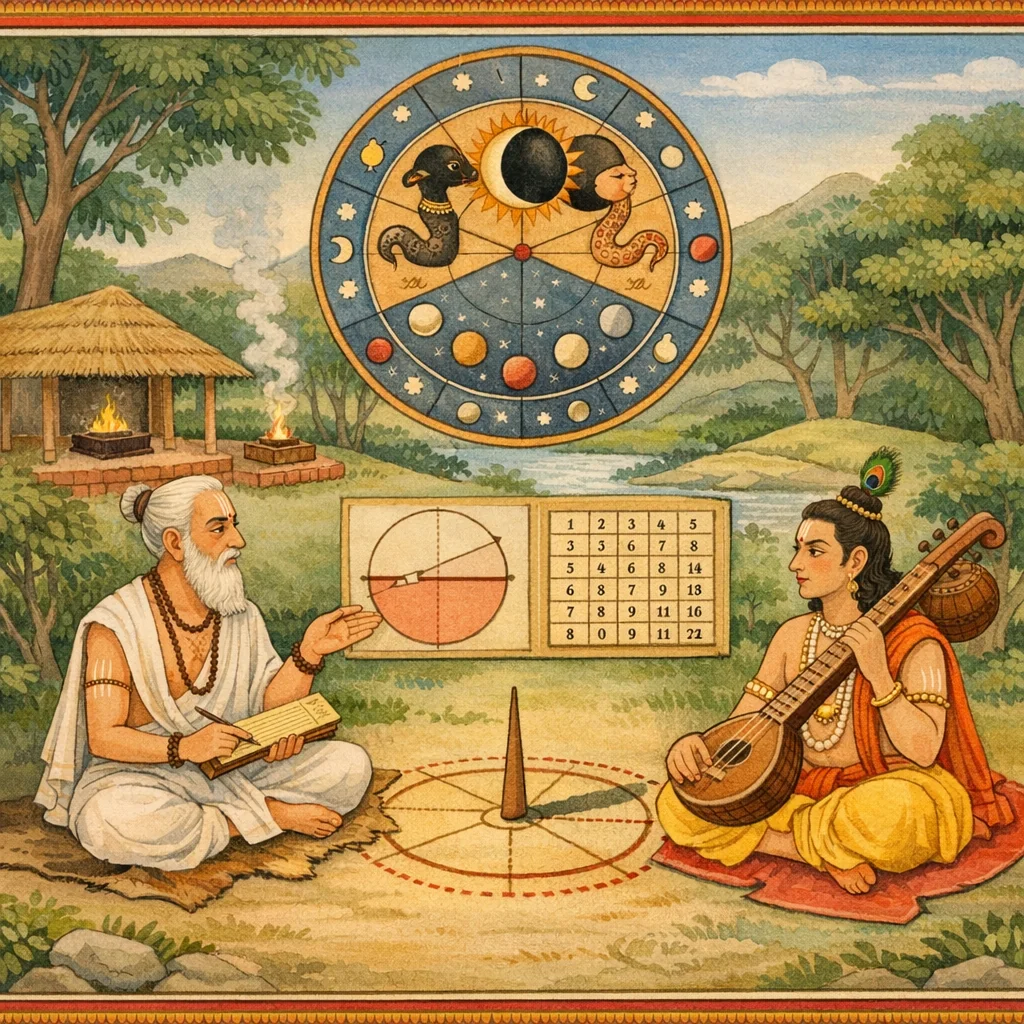
Jyotiṣa-śāstra Saṅgraha: Threefold Division, Gaṇita Methods, Muhūrta, and Planetary Reckoning
Sanandana teaches Nārada that Jyotiṣa is the sacred knowledge taught by Brahmā, granting success in dharma. He defines its three branches—Gaṇita, Jātaka, and Saṃhitā—and surveys Gaṇita: computations, true planetary positions, eclipses, roots, fractions, proportional rules, geometry of fields and circles, jyā/trijyā (sine) calculations, and direction-finding by the śaṅku (gnomon). He then links astronomy to calendrics through yuga/manvantara scales, months and weekdays, adhimāsa, tithi-kṣaya/āyāma, and yoga calculations. Saṃhitā and muhūrta appear via omens, saṃskāras from garbhādhāna to upanayana, travel and house signs, and electional factors such as saṅkrānti, gocara, lunar strength, and Rāhu. The chapter culminates in procedures for sines, krānti (declination), nodes/pāta, conjunction timing, and eclipse measures, before turning toward rāśi-saṃjñā and a fuller Jātaka exposition.
Shlokas
Verse 1
सनंदन उवाच । ज्योतिषांगं प्रवक्ष्यामि यदुक्तं ब्रह्मणा पुरा । यस्य विज्ञान मात्रेण धर्मसिद्धिर्भवेन्नृणाम् ॥ १ ॥
Sanandana said: I shall expound the limb of knowledge called Jyotiṣa, as it was formerly taught by Brahmā; by merely understanding it, human beings attain success in dharma.
Verse 2
त्रिस्कंधं ज्यौतिषां शास्त्रं चतुर्लक्षमुदाहृतम् । गणितं जातकं विप्र संहितास्कंधसंज्ञिताः ॥ २ ॥
O brāhmaṇa, the science of Jyotiṣa is declared to be threefold in its divisions and to extend to four hundred thousand (units of teaching). Its branches are known as Gaṇita, Jātaka, and Saṃhitā.
Verse 3
गणिते परिकर्मादि खगमध्यस्फुटक्रिंये । अनुयोगश्चंद्रसूर्यग्रहणं तचोदस्याकम् ॥ ३ ॥
In Gaṇita are taught the preliminary operations (parikarman) and the precise procedures for determining the true positions of the heavenly bodies; it also includes applied problems, the computation of lunar and solar eclipses, and the methods for ascertaining their causes.
Verse 4
छाया श्रृङ्गोन्नतियुती पातसाधानमीरितम् । जातके राशिभेदाश्च ग्रहयोनिश्च योनिजम् ॥ ४ ॥
The methods employing shadow (gnomon), the horn-like instrument, and elevation measurements are taught for determining the “pāta” (astronomical fall/declination). In the jātaka (birth-chart) as well, the distinctions of the rāśis (zodiacal signs), the planetary sources (graha-yoni), and what is born from those sources (yoni-ja) are explained.
Verse 5
निषेकजन्मारिष्टानि ह्यायुर्दायो दशाक्रमः । कर्माजीवं चाष्टवर्गो राजयोगाश्च नाभसाः ॥ ५ ॥
Indeed, it speaks of omens at conception and at birth, signs of misfortune, the allotment of lifespan, the ordered course of the daśā periods, livelihood as shaped by karma, the aṣṭakavarga system, royal combinations (rāja-yogas), and the nābhasa yogas.
Verse 6
चंद्रयोगाः प्रव्रज्याख्या राशिशीलं च दृक्फलम् । ग्रहभावफलं चैवाश्रययोगप्रकीर्णके ॥ ६ ॥
In the section on miscellaneous āśraya-yogas are described the lunar combinations (candra-yogas), the yoga called “pravrajyā” (renunciation), the nature and conduct shown by the rāśis, the results arising from planetary aspects, and also the fruits of planets and houses (bhāvas).
Verse 7
अनिष्टयोगाः स्रीजन्मपलं निर्याणमेव च । नष्टजन्मविधानं च तथा द्रेष्काणलक्षणम् ॥ ७ ॥
Next are explained: inauspicious yogas, the results indicating birth as a woman, signs of death, the method for determining unknown (lost) birth details, and the characteristics of the dreṣkāṇa—the one-third division of a zodiacal sign.
Verse 8
संहिताशास्त्ररूपं च ग्रहचारोऽब्दलक्षणम् । तिथिवासरनक्षत्रयोगतिथ्यर्द्धसंज्ञकाः ॥ ८ ॥
It comprises the form of the Saṃhitā-śāstra, the courses of the planets, and the characteristics of the year—tithi (lunar day), vāra (weekday), nakṣatra (lunar mansion), yoga, and the technical designations concerning the half-tithi (tithy-arddha).
Verse 9
मुहूर्तोपग्रहाः सूयसंक्रांतिर्गोचरः क्रमात् । चंद्रता राबलं चैव सर्वलग्रार्तवाह्वयः ॥ ९ ॥
In due order one should consider: the subsidiary factors of a muhūrta (electional time), the Sun’s saṅkrānti (ingress), planetary transits (gocara), the Moon’s condition, the strength of Rāhu, and the indications drawn from all ascendants (lagnas) and seasonal periods.
Verse 10
आधानपुंससीमंतजातनामान्नभुक्तयः । चौलङ्कर्ण्ययणं मौंजी क्षुरिकाबंधनं तथा ॥ १० ॥
The prescribed saṃskāras are: ādhāna (the consecration for conception), puṃsavana (the rite for begetting a male child), sīmantonnayana (the parting-of-the-hair ceremony during pregnancy), jātakarma (the birth-rite), nāmakaraṇa (the naming), and annaprāśana (the first feeding of solid food); likewise cūḍā (tonsure), karṇavedha (ear-piercing), upanayana (initiation into Vedic study), the investiture with muñja/yajñopavīta (the sacred thread), and also the tying on of the razor for the first shaving—these are the ordained saṃskāras.
Verse 11
समावर्तिनवैवाहप्रतिष्टासद्मलक्षणम् । यात्राप्रवेशनं सद्योवृष्टिः कर्मविलक्षणम् ॥ ११ ॥
The signs (omens) pertain to samāvartana, the return after completing studentship, to marriage, to pratiṣṭhā (the consecration of an image or shrine), and to the auspicious marks of a house. They also pertain to setting out on a journey and to entering a place; likewise, an immediate rainfall—these are distinctive indicators connected with rites and actions.
Verse 12
उत्पत्तिलक्षणं चैव सर्वं संक्षेपतो ब्रुवे । एकं दश शतं चैव सहस्रायुतलक्षकम् ॥ १२ ॥
I shall state, in brief, the defining features of creation. First, understand the measures of number: one, ten, a hundred, a thousand, ten-thousand, and a lakh (one hundred thousand).
Verse 13
प्रयुतं कोटिसंज्ञां चार्बुदमब्जं च रर्ववकम् । निरवर्व च महापद्मं शंकुर्जलधिरेव च ॥ १३ ॥
“(Beyond the earlier counts) come: prayuta; then that which is called koṭi; then arbuda; then abja; then rarvavaka; then niravarva; then mahāpadma; then śaṅku; and then jaladhi (ocean)—these are the successive names of ever-greater numbers.”
Verse 14
अत्यं मध्यं परार्द्धं च संज्ञा दशगुणोत्तराः । क्रमादुत्क्रमतो वापि योगः कार्योत्तरं तथा ॥ १४ ॥
“Atya,” “Madhya,” and “Parārdha” are designations that increase tenfold. Their combination (yoga/aggregation) is to be performed either in forward order or in reverse; likewise, the operation should proceed step by step, each stage yielding the next result.
Verse 15
हन्याद्गुणेन गुण्यं स्यात्तैनैवोपांतिमादिकान् । शुद्धेद्धरोयद्गुणश्चभाज्यांत्यात्तत्फलं मुने ॥ १५ ॥
Let virtue be used to overcome what stands opposed to virtue; by that very virtue one should also subdue subsidiary faults and the like. When conduct is purified, whatever virtue is established therein yields its fruit in due measure, O sage.
Verse 16
समांकतोऽथो वर्गस्यात्तमेवाहुः कृतिं बुधाः । अंत्यात्तु विषमात्त्यक्त्वा कृतिं मूलंन्यसेत्पृथक् ॥ १६ ॥
From equal (even) digits one obtains the square; the learned call that the “kṛti” (square). But if the last digit is odd, then after discarding it one should set the kṛti apart as a separate “mūla” (root/base) portion.
Verse 17
द्विगुणेनामुना भक्ते फलं मूले न्यसेत्क्रमात् । तत्कृतिं च त्यजेद्विप्र मूलेन विभजेत्पुनः ॥ १७ ॥
O devotee, step by step, place the resulting gain back into the “mūla” (principal) by doubling it. Then, O brāhmaṇa, discard the intermediate product and again distribute (recalculate) on the basis of the principal.
Verse 18
एवं मुहुर्वर्गमूलं जायते च मुनीश्वर । समत्र्यङ्कहतिः प्रोक्तो घनस्तत्रविधिः पदे ॥ १८ ॥
Thus, O lord of sages, the square root is obtained again and again. And the product of three equal digits is called the “ghana” (cube); in that case, the procedure is to be applied step by step.
Verse 19
प्रोच्यते विषमं त्वाद्यं समे द्वे च ततः परम् । विशोध्यं विषमादंत्याद्धनं तन्मूलमुच्यते ॥ १९ ॥
The first term is declared to be odd; thereafter the next two are even. From the final odd term one should subtract what is required; the remainder is proclaimed to be the root (foundation) of that wealth.
Verse 20
त्रिघ्नाद्भजन्मूलकृत्या समं मूले न्यसेत्फलम् । तत्कृतित्वेन निहतान्निघ्नीं चापि विशोधयेत् ॥ २० ॥
From the plant called Trighnā, one should prepare a root-based kṛtyā rite and place a fruit together with it at the root. By the potency of that act, those struck down by hostile rites are relieved, and even the afflicting force (nighnī) is purified and neutralized.
Verse 21
घनं च विषमादेवं घनमूलं मुर्हुभवेत् । अन्योन्यहारनिहतौ हरांशौ तु समुच्छिदा ॥ २१ ॥
Thus, when the cube (power) is taken from an odd quantity, its cube-root is obtained repeatedly by the prescribed procedure. And when the divisor and the dividend (or their parts) are acted on by each other’s divisor, the divisor and the fractional part are completely reduced and cancelled.
Verse 22
लवा लवघ्नाश्च हरा हरघ्ना हि सवर्णनम् । भागप्रभागे विज्ञेयं मुने शास्रार्थचिंतकैः ॥ २२ ॥
O sage, the terms ‘lava’ and ‘lavaghnā’, and likewise ‘harā’ and ‘haraghnā’, are to be understood as names of the same class (akin and equivalent). Those who contemplate the meaning of the śāstras should recognize this especially in the context of fractions and sub-fractions.
Verse 23
अनुबंधेऽपवाहे चैकस्य चेदधिकोनकः । भागास्तलस्थहारेण हरं स्वांशाधिकेन तान् ॥ २३ ॥
In cases of addition (anubandha) and subtraction (apavāha), if one term is greater or lesser, then compute the parts by taking as harā the divisor placed ‘below’; and divide those parts by that divisor increased by its own portion.
Verse 24
ऊनेन चापि गुणयेद्धनर्णं चिंतयेत्तथा । कार्यस्तुल्यहरां शानां योगश्चाप्यंततो मुने ॥ २४ ॥
Even if a quantity be deficient, one should still compute it by multiplication, and likewise ponder carefully the remaining balance or debt. One should also equalize the divisors and the parts; and finally, O sage, perform the concluding addition to obtain the final total.
Verse 25
अहारराशौ रूप्यं तु कल्पयेद्धरमप्यथा । अंशाहतिश्छेदघातहृद्भिन्नगुणने फलम् ॥ २५ ॥
In the collection of divisors (ahāra-rāśi), one should also compute the term called “rūpya,” and likewise the term called “dhara.” The result is obtained by multiplying the fractional parts, applying division and multiplication, and by reckoning with quantities separated within the heart—that is, mentally.
Verse 26
छेदं चापि लवं विद्वन्परिवर्त्य हरस्य च । शेषः कार्यो भागहारे कर्तव्यो गुणनाविधिः ॥ २६ ॥
O learned one, interchange the divisor and the dividend, and then remove the divisor. The remainder is to be obtained by the method of division, and thereafter the procedure of multiplication is to be applied.
Verse 27
हारांशयोः कृती वर्गे घनौ घनविधौ मुने । पदसिद्ध्यै पदे कुर्यादथोरवं सर्वतश्च रवम् ॥ २७ ॥
O sage, in the practice of recitation by the methods called hāra and aṃśa, and in the kṛti-class, one should apply the ghanas according to the ghana-procedure. For the accomplishment of a word (pada-siddhi), one should utter each word with proper sound, and then send forth a resonant tone in every direction.
Verse 28
छेदं गुणं गुणं छेदं वर्गं मूलं पदं कृतिम् । ऋणं स्वं स्वमृणं कुर्यादृश्ये राशिप्रसिद्धये ॥ २८ ॥
To make the result evident and to establish the quantity clearly: treat division as multiplication and multiplication as division; take a square into its root and a root into its square; reduce a power to its base and a base into its power; and make what is negative positive, and what is positive negative.
Verse 29
अथ स्वांशाधिकोने तु लवाढ्यो नो हरो हरः । अंशस्त्वविकृतस्तत्र विलोमे शेषमुक्तवत् ॥ २९ ॥
Now, when (the divisor) is less than one’s own aṁśa by an extra part, the quotient (hara) is not to be taken; rather, the lavas are to be increased. In that procedure the aṁśa remains unchanged; and in the reverse method (viloma), the remainder is to be stated as previously explained.
Verse 30
उद्दिष्टाराशिः संक्षिप्तौ हृतोंऽशै रहितो युतः । इष्टघ्नदृष्टेनैतेन भक्तराशिरनीशितः ॥ ३० ॥
The ‘given quantity’ (uddiṣṭa-rāśi), when reduced, divided by parts (aṁśa), and then adjusted by subtracting or adding as required—by this method of “multiplying by the desired factor” (iṣṭa-ghna) and applying the computed result, the quotient-quantity (bhakta-rāśi) is correctly determined.
Verse 31
योगोन्तरेणोनयुतोद्वितोराशीतसंक्रमे । राश्यंतरहृतं वर्गोत्तरं योसुतश्च तौ ॥ ३१ ॥
At the time of the Sun’s passage into a zodiacal sign, take eighty-two; multiply it by two, add nine, and reduce it by the interval of the yoga. Divide that result by the difference between the signs; the quotient together with the remainder is to be taken as the computed value.
Verse 32
गजग्रीष्टकृतिर्व्यैका दलिता चेष्टभाजिता । एकोऽस्य वर्गो दलितः सैको राशिः परो मतः ॥ ३२ ॥
A single unit is taken as the operative base; when it is reduced and then divided according to the rule of operation, the square of that reduced quantity is obtained. That same single unit is then regarded as the resulting rāśi, as taught by the sages.
Verse 33
द्विगुणेष्टहृतं रूपं श्रेष्टं प्राग्रूपकं परम् । वर्गयोगांतरे व्येके राश्योर्वर्गोस्त एतयोः ॥ ३३ ॥
The form obtained by doubling and then dividing by the desired quantity is declared the best and supreme preliminary method. In the procedure involving the addition of squares, some state that the squared result pertains to these two quantities taken together.
Verse 34
इष्टवगेकृतिश्चेष्टघनोष्टग्रौ च सौककौ । एषीस्यानामुभे व्यक्ते गणिते व्यक्तमेव च ॥ ३४ ॥
Also taught are the desired classifications and their constructions; the measures of motion and density; the rules concerning lips and throat; and the two—eṣī and īsyā—made explicit. In mathematics too, only the “explicit” method is set forth clearly.
Verse 35
गुणघ्नमूलोनयुतः सगुणार्द्धे कृतं पदम् । दृष्टस्य च गुणार्द्धो न युतं वर्गीकृतं गुणः ॥ ३५ ॥
When the square root is combined with the subtractive term multiplied by the coefficient, and this is applied together with half the coefficient, the (next) step is formed. For the quantity in view, half the coefficient—if not added to the root—becomes, after being squared, the coefficient.
Verse 36
यदा लवोनपुम्राशिर्दृश्यं भागोनयुग्भुवा । भक्तं तथा मूलगुणं ताभ्यां साध्योथ व्यक्तवत् ॥ ३६ ॥
When the observable aggregate is taken as a part—defined through division and arrangement—then the root-quality (mūla-guṇa) is likewise determined. From these two, the manifested state is established as though it were directly evident.
Verse 37
प्रमाणेच्छे सजातीये आद्यंते मध्यगं फलम् । इच्छघ्नमाद्यहृत्सेष्टं फलं व्यस्ते विपर्ययात् ॥ ३७ ॥
When the desire is for pramāṇa, a valid means of knowledge, and is directed toward something of the same kind, the result arises in the middle—between the beginning and the end. But when desire itself is destroyed, the fruit is what remains after the first impulse is removed; and if the order is reversed, the outcome is the opposite.
Verse 38
पंचरास्यादिकेऽन्योन्यपक्षं कृत्वा फलच्छिदाम् । बहुराशिवधं भक्ते फलं स्वल्पवधेन च ॥ ३८ ॥
In systems such as the doctrine of the five zodiacal signs, by arranging mutually opposing “sides” (classifications) so as to cut off unwanted results, one can neutralize the fruit of many adverse sign-combinations through the cancellation of only a few.
Verse 39
इष्टकर्मवधेमूलं च्युतं मिश्रात्कलांतरे । मानघ्नकालश्चातीतकालाघ्नफलसंहृताः ॥ ३९ ॥
The very root that destroys the merit of desired rites falls away, in the course of time, from that which is mixed with other motives and conditions. And when the hour that shatters pride arrives, the fruits already being cut down by passing time are gathered up completely—exhausted to the end.
Verse 40
स्वयोगभक्तानिघ्नाः स्युः संप्रयुक्तदलानि च । बहुराशिपलात्स्वल्पराशिमासफलं बहु ॥ ४० ॥
Leaves rightly employed in worship, as offerings, become destroyers of obstacles for those devoted to their own yoga and bhakti. And from a great heap of leaves thus offered, even a small monthly observance yields abundant fruit.
Verse 41
चेद्राशिविवरं मासफलांतरहृतं च यः । क्षेपा मिश्रहताः क्षेपोयोगभक्ताः फलानि च ॥ ४१ ॥
If the interval between zodiacal signs is divided by the difference of the monthly results, then the addends (kṣepa) are to be multiplied by the mixed value (miśra); and the values thus obtained are the results found by dividing by the sum of the addends.
Verse 42
भजेच्छिदोंशैस्तैर्मिश्रै रूपं कालश्च पूर्तिकृत् । पूर्णोगच्छेत्समेध्यव्येसमेवर्गोर्द्धितेत्यतः ॥ ४२ ॥
One should worship the Lord through those mixed, fractional portions—by means of the sacred Form (mūrti), by time, and by acts that complete what is lacking. Thus, in what is fit to be rightly kindled and sanctified, one attains fullness; and likewise the spiritual order is increased and brought to perfection.
Verse 43
व्यस्तं गच्छतं फलं यद्गुणवर्गं भचहि तत् । व्येकं व्येकगुणाप्तं च प्राध्नं मानं गुणोत्तरे ॥ ४३ ॥
When a result is to be obtained by a stepwise procedure, divide that result by the applied group of factors (guṇa-varga). Then, taking each factor singly, the corresponding measure is obtained; and in the higher operation involving factors, the principal measure is determined accordingly.
Verse 44
भुजकोटिकृतियोगमूलं कर्णश्च दोर्भवेत् । श्रुतिकृत्यंतरपद कोटिर्दोः कर्णवर्गयोः ॥ ४४ ॥
The root of the “yoga” formed by the joining at the arm’s tip is said to be the ear, and the arm itself corresponds to it. Between ear and arm lies the intermediate station called “koṭi” (joint/angle), belonging to the groupings of arm and ear.
Verse 45
विंवरात्तत्कर्णपदं क्षेत्रे त्रिचतुरस्रके । राश्योरंतरवर्गेण द्विघ्ने घाते युते तयोः ॥ ४५ ॥
In a triangular or quadrilateral figure, the measure corresponding to the “karṇa” (diagonal) is obtained by the “viṃvara” method: take the squares of the two component measures, add them, and where required apply twice the square of their difference to yield the computed result.
Verse 46
वर्गयोगोथ योगांतहंतिर्वर्गांतरं भवेत् । व्यास आकृतिसंक्षण्णोव्यासास्यात्परिधिर्मुने ॥ ४६ ॥
The sum of squares (varga-yoga) is obtained, and by the product’s “end-reduction” the difference of squares arises. O sage, the diameter (vyāsa) is determined according to the figure considered; and from the diameter the circumference/perimeter (paridhi) is obtained.
Verse 47
ज्याव्यासयोगविवराहतमूलोनितोऽर्द्धितः । व्यासः शरः शरोनाञ्च व्यासाच्छरगुणात्पदम् ॥ ४७ ॥
Take the square-root of the difference formed by subtracting the radius-squared from the chord-squared (jyā), and then halve it—this is the arrow (śara). From the arrow together with the diameter (vyāsa), by the property of the bow-string, the required measure (pada) is obtained.
Verse 48
द्विघ्नं जीवाथ जीवार्द्धवर्गे शरहृते युते । व्यासोष्टतेभवेदेवं प्रोक्तं गणितकोविदैः ॥ ४८ ॥
“First double the quantity called jīva; then add it to the square of half of jīva, and also add the amount obtained after subtracting five. In this way the result becomes ‘twenty‑eight’,” thus have the masters of mathematics declared.
Verse 49
चापोननिघ्नः परिधिः प्रगङ्लः परिधेः कृते । तुर्यांशेन शरध्नेनाघेनिनाधं चतुर्गणम् ॥ ४९ ॥
The circumference (paridhi) is obtained by multiplying the diameter by the prescribed coefficient. To determine the circumference, apply the quarter-part adjustment according to the stated rule of computation, thus forming the fourfold operation (caturgaṇa).
Verse 50
व्यासध्नं प्रभजेद्विप्र ज्या काशं जायते स्फुटा । ज्यांघ्रीषुध्नोवृत्तवर्गोबग्धिघ्नव्यासाढ्यमौर्विहृत् ॥ ५० ॥
O brāhmaṇa, divide the diameter; from that the chord (jyā) is obtained distinctly. By the chord and related measures—employing the circle, the square (of measures), and the diameter—one determines the needed result according to the rule of the bow-string (jyā).
Verse 51
लब्धोनवृत्तवर्गाद्रिपदेर्धात्पतिते धनुः । स्थूलमध्यापृवन्नवेधो वृत्तांकाशेषभागिकः ॥ ५१ ॥
When the bow (dhanuḥ) is obtained by taking the cube-root from the square of the circle’s remainder, it is then to be applied. For a circle with a thick middle, the “new piercing/measurement” (nava-vedha) is determined by dividing according to the remaining portion of the circle’s measure.
Verse 52
वृत्तांगांशकृतिर्वेधनिप्रीयनकरामितौ । वारिव्यासहतं दैर्ध्यंवेधांगुलहतं पुनः ॥ ५२ ॥
The circumference is obtained by multiplying the diameter by the established constant (an approximation). The diameter is measured by the finger-breadth (aṅgula) up to the nails; and the length, again, is computed by multiplying according to the aṅgula-units.
Verse 53
खरवेंदुरामविहतं मानं द्रोणादिवारिणः । विस्तारायामवेधानांमंगुल्योन्यनाडिघ्नाः ॥ ५३ ॥
The standard measure for liquids—beginning with the droṇa—is fixed by established reckoning. For measures of breadth, length, and piercing (depth), the units rest on the aṅgula (finger-breadth) and successive subdivisions, up to the nāḍī that regulates and harmonizes mutual discrepancies.
Verse 54
रसांकाभ्राब्धिभिर्भक्ता धान्ये द्रोणादिकामितिः । उत्सेधव्यासदैर्ध्याणामंगुल्यान्यस्य नो द्विज ॥ ५४ ॥
O twice-born one, when the grain-measure is divided by the numbers denoted by the words “rasa,” “aṅka,” “abhra,” and “abdhi,” the desired measures beginning with the droṇa are obtained; and for height, breadth, and length, its unit is the aṅgula (finger-breadth).
Verse 55
मिथोघ्नाति भजेत्स्वाक्षेशैर्द्रोणादिमितिर्भवेत् । विस्ताराद्यं गुलान्येवं मिथोघ्नान्यपसांभवेत् ॥ ५५ ॥
By dividing the measure called mithoghnā by one’s own aṅgulas (finger-breadths), the standard measures beginning with the droṇa are obtained. Likewise, starting from breadth and other linear measures, the gulā and related sub-measures are produced by such proportional divisions.
Verse 56
वाणेभमार्गणैर्लब्धं द्रोणाद्यं मानमादिशेत् । दीपशंकुतलच्छिद्रघ्नः शंकुर्भैवंभवेन्मुने ॥ ५६ ॥
From the standard obtained by the measuring-rod and the measuring-line, one should prescribe the set of measures beginning with the droṇa. O sage, the śaṅku (measuring peg/gnomon) should be of the Bhaiva type—one that eliminates defects such as errors from the lamp, the peg, the surface, and holes.
Verse 57
नरोन दीपकशिखौच्यभक्तो ह्यथ भोद्वने । शंकौनृदीपाधश्छिद्रघ्नैर्दीपौच्च्यं नरान्विते ॥ ५७ ॥
A person devoted to keeping the lamp-flame raised and steady should, in the forest, place protective coverings beneath the lamp-stand; by using measures that remove defects (such as gaps and leakages), the lamp is kept properly elevated and secure among people.
Verse 58
विंशकुदीपौच्चगुणाच्छाया शंकूद्धृता भवेत् । दीपशंक्वंतरं चाथ च्छायाग्रविवरघ्नभा ॥ ५८ ॥
The shadow, measured with the śaṅku (gnomon), should be taken as twenty times the height of the lamp. Then, the interval between the lamp and the śaṅku is to be determined by the (computed) light that removes the gap up to the tip of the shadow.
Verse 59
मानांतरद्रुद्भूमिः स्यादथोभूनराहतिः । प्रभाप्ता जायते दीपशिखौच्च्यं स्यात्त्रिराशिकात् ॥ ५९ ॥
By converting one unit of measure into another, the corresponding area is determined; likewise, the resulting quantity is obtained. From the illumination thus obtained, the height of a lamp’s flame is found by the rule of three (proportional calculation).
Verse 60
एतत्संक्षेपतः प्रोक्तं गणिते परिकर्मकम् । ग्रहमध्यादिकं वक्ष्ये गणिते नातिविस्तरान् ॥ ६० ॥
Thus, the preliminary operations of mathematical calculation have been stated in brief. Now I shall explain, in mathematical terms and without excessive elaboration, matters such as the mean positions of the planets and related computations.
Verse 61
युगमानं स्मृतं विप्र खचतुष्करदार्णवाः । तद्दशांशास्तु चत्वारः कृताख्यं पादमुच्यते ॥ ६१ ॥
O brāhmaṇa, the measure of a Yuga is remembered as ‘kha–catuṣkara–dārṇava’. Of its ten parts, four parts are declared to be the Kṛta (Satya) Yuga quarter.
Verse 62
त्रयस्रेता द्वापरः द्वौ कलिरेकः प्रकीर्तितः । मनुकृताब्दसहिता युगानामेकसप्ततिः ॥ ६२ ॥
Three are called Tretā-yugas, two are Dvāpara-yugas, and only one is Kali-yuga. Together with the years assigned to a Manu, these yugas are said to total seventy-one (in a Manvantara).
Verse 63
विधेर्द्दिने स्युर्विप्रेंद्र मनवस्तु चतुर्दश । तावत्येव निशा तस्य विप्रेंद्र परिकीर्तिता ॥ ६३ ॥
O best of brāhmaṇas, within a single day of the Creator (Brahmā) there are said to be fourteen Manus; and the night of that (Brahmā) is declared to be of the same duration.
Verse 64
स्वयंभुवा शरगतानब्दान्संपिंड्य नारद । खचरानयनं कार्यमथवेष्टयुगादितः ॥ ६४ ॥
O Nārada, as taught by the Self-born Brahmā, having compacted the sounds that have entered the arrows, one should then perform the rite of “bringing back the sky-moving forces,” beginning with the paired wrappings.
Verse 65
युगे सूर्यज्ञशुक्राणां खचतुष्करदार्णवाः । पूजार्किगुरुशुक्राणां भगणापूर्वपापिनाम् ॥ ६५ ॥
In every yuga, for those burdened by former sins, there are prescribed the computations of the Sun, of sacrificial rites (yajña), and of Śukra (Venus); the reckoning of the four celestial motions and ocean-like cycles; and the worship of Śani (Saturn), Guru/Bṛhaspati (Jupiter), and Śukra—together with the counting of planetary groups.
Verse 66
इंदोरसाग्नित्रिषु सप्त भूधरमार्गणाः । दस्रत्र्याष्टरसांकाश्विलोचनानि कुजस्य तु ॥ ६६ ॥
For the Moon, the number is seven, as indicated by the expression “asa–agni–tri.” And for Kuja (Mars), the measure is encoded by “dasra–tri–aṣṭa–rasa,” indicating the count of its “eyes,” that is, its observable marks or units.
Verse 67
बुधशीघ्रस्य शून्यर्तुखाद्रित्र्यंकनगेंदवः । बृहस्पतेः खदस्राक्षिवेदस्रङ्हूयस्तथा ॥ ६७ ॥
For Budha’s (Mercury’s) “quick” (śīghra) measure, the digits are encoded in the word-group “śūnya–ṛtu–kha–adri–tri–aṅka–naga–indu.” Likewise, for Bṛhaspati (Jupiter), the digits are encoded by “kha–daśra–akṣi–veda–sraṅ–hūya.”
Verse 68
शितशीघ्रस्य यष्णसत्रियमाश्विस्वभूधराः । शनेर्भुजगषट्पचरसवेदनिशाकराः ॥ ६८ ॥
For Śita (Śukra/Venus) and Śīghra (Budha/Mercury), the associated groups are named Yaṣṇa, Satriya, Āśvi, Sva, and Bhūdhara; and for Śani (Saturn) they are Bhujaga, Ṣaṭpacara, Saveda, and Niśākara.
Verse 69
चंद्रोञ्चस्याग्निशून्याक्षिवसुसर्पार्णवा युगे । वामं पातस्य च स्वग्नियमाश्विशिखिदस्रकाः ॥ ६९ ॥
In the yuga-count the sequence is declared as: “moon, ascent, fire, zero, eye, the Vasus, serpents, and oceans”; and for the left side of the “descent/fall” sequence it is said: “one’s own, fire, Yama, the Aśvins, Śikhī (Agni), and the Dasras.”
Verse 70
उदयादुदयं भानोर्भूमैः साचेन वासराः । वसुव्द्यष्टाद्रिरूपांकसप्ताद्रितिथयो युगे ॥ ७० ॥
From one sunrise of the Sun to the next, that earthly measure is called a “vāsara” (a day). In a yuga, the tithis (lunar days) are counted by the word‑numerals: vasu, dvi, aṣṭa, adri, rūpāṅka, sapta, adri.
Verse 71
षड् वहित्रिहुताशांकतिथयश्चाधिमासकाः । तिथिक्षयायमार्थाक्षिद्व्यष्टव्योमशराश्विनः ॥ ७१ ॥
The intercalary month (adhimāsa) is understood through specific calendrical counts—such as “six”—and through numerical markers indicated by terms like “vahitri,” “hutāśa,” “aṅka,” and “tithi.” Likewise, the loss of a lunar day (tithi-kṣaya) and the extension of a lunar day (tithi-āyāma) are determined by the stated numerical indicators.
Verse 72
रवचतुष्का समुद्राष्टकुर्पचरविमासकाः । षट्त्र्यग्निवेदग्निपंचशुभ्रांशुमासकाः ॥ ७२ ॥
“Rava-catuṣkā,” “Samudra-aṣṭa,” “Kurpa-cara,” and “Ravi-māsaka”; likewise “Ṣaṭ-try-agni,” “Veda-agni,” and “Pañca-śubhrāṃśu-māsaka”—these are named classes of māsakas, standard units used in ritual calculation and in the measure of gifts.
Verse 73
प्रागातेः सूर्यमंदस्य कल्पेसप्ताष्टवह्नयः । कौजस्य वेदस्वयमा बौधस्याष्टर्तुवह्नयः ॥ ७३ ॥
In the kalpa of Sūryamanda there are seven and eight sacred fires, each in its proper arrangement. In the (kalpa) of Kauja, the Vedas are self-manifest; and in the (kalpa) of Baudha there are eight seasonal fires, aligned with the ṛtus.
Verse 74
रवरवरंध्राणि जैवस्य शौक्रस्यार्धगुणेषवः । गोग्नयः शनिमंदस्य पातानामथवा मतः ॥ ७४ ॥
According to tradition, “Rava, Ravara, and Randhra” are the divisional indicators for Jupiter; for Venus they are “half-measures” and “arrows”; and for slow-moving Saturn they are “cows” and “fires”—such is the stated classification of these pātāni (falls/declensions).
Verse 75
मनुदस्रास्तु कौजस्य बौधस्याष्टाष्टसागराः । कृताद्रिचंद्राजैवस्य रवैकस्याग्निरवनंदकाः ॥ ७५ ॥
For Kauja there were the Manudasras; for Baudha there were the eight “Eight-Sāgaras”. For Kṛtādri, Candrāja, and Aivasya; and for Ravaika there were Agni, Rava, and Nandaka.
Verse 76
शनिपातस्य भगणाः कल्पे यमरसर्तवः । वर्तमानयुगे पानावत्सराभगणाभिधाः ॥ ७६ ॥
In a Kalpa, the cycles (bhagaṇas) connected with Saturn’s conjunctions are designated by the names “Yama–Rasa–Ṛtavaḥ”; and in the present Yuga they are known by the designation “Pānāvat-sarā-bhagaṇa”.
Verse 77
मासीकृतायुता मासैर्मधुशुक्लादिभिर्गतैः । पृथक्त्थासिधिमासग्रासूर्यमासविभाजिताः ॥ ७७ ॥
When the reckoning is converted into months—counted through the months known as Madhu, Śukla, and the rest—it is further distinguished into separate kinds: the Sthāsi (civil) month, the Dhi (lunar) month, the Grāsa (synodic) month, and the Sūrya (solar) month.
Verse 78
अथाधिमासकैर्युक्ता दिनीकृत्य दिनान्विताः । द्विस्थास्तितिक्षयाभ्यस्ताश्चांद्रवासरभाजिताः ॥ ७८ ॥
Then, after being adjusted by intercalary months (adhimāsa), the (lunar reckonings) are converted into day-counts and expressed in days; they are arranged in two positions, trained by the principles of extension and reduction (tithi-increase and tithi-loss), and are distributed according to lunar weekdays—the lunar day-count system.
Verse 79
लथोनरात्रिरहितालंकार्यामर्द्धरात्रिकाः । सावनोद्यूगसारर्कादिर्दिनमासाब्दयास्ततः ॥ ७९ ॥
From those earlier divisions of time arise the names: night, the state without night, the “ornamented” (special) night, the middle of the night, and the half-night. Thereafter are reckoned the sāvana (civil) day, the yuga, the essence of the year, the Sun’s course, and finally the measures of day, month, and year.
Verse 80
सप्तिभिः क्षपितः शेषः मूर्याद्योवासरेश्वरः । मासाब्ददिनसंख्यासंद्वित्रिघ्नं रूपसंयुतम् ॥ ८० ॥
Dividing the remainder by seven yields the lord of the weekday, beginning with Sūrya (Sunday). Then, taking the counts of months, years, and days, and applying the appropriate doubling or tripling, one arrives at the required computed value.
Verse 81
सप्तोर्द्धनावशेषौ तौ विज्ञेयौ मासवर्षपौ । स्नेहस्य भगणाभ्यस्तो दिनराशिः कुवासरैः ॥ ८१ ॥
Those two remainders, leaving seven and a half over, are to be understood as the month and the year. And the total number of days—obtained by applying the cycles (bhagaṇa) to the given quantity—should be expressed in terms of the resulting weekdays (vāras).
Verse 82
विभाजितो मध्यगत्या भगणादिर्ग्रहो भवेत् । एवं ह्यशीघ्रमंदाञ्चये प्रोक्ताः पूर्वपापिनः ॥ ८२ ॥
When the computed value is divided by the mean motion, it yields the planet, beginning with (the Sun) in the bhagaṇa cycle. Thus, for accumulating the corrections for non-fast and slow motions, the earlier steps have been set forth.
Verse 83
विलोमगतयः पातास्तद्वञ्चक्राष्विशोधिताः । योजनानि शतान्यष्टौ भूकर्णौ द्विगुणाः स्मृतः ॥ ८३ ॥
The regions of Pātāla are said to have contrary (reverse) courses; and there the deceptive wheels (cycles) are not purified, remaining confounding. The “ears of the earth” are remembered as measuring eight hundred yojanas, and the next measure is declared to be double of that.
Verse 84
तद्वर्गतो दशगुणात्पद भूपरिधिर्भवेत् । लंबज्याघ्नस्वजीवाप्तः स्फुटो भूपरिधिः स्वकः ॥ ८४ ॥
From ten times the square of that value, one obtains a step-wise (approximate) circumference of the earth. But the accurate circumference is obtained by multiplying by the sine of the zenith distance (lamba-jyā) and then dividing by one’s own jīva (sine) value.
Verse 85
तेन देशांतराभ्यस्ता ग्रहभुक्तिर्विभाजिता । कलादितत्फलं प्रार्च्याः ग्रहेभ्यः परिशोधयेत् ॥ ८५ ॥
By that method, the planetary period experienced due to travel to another region is apportioned; and one should rectify (purify) the resulting effects—beginning with the kalā (fractional portions)—by duly worshipping the planets.
Verse 86
रेखाप्रतीचिसंस्थाने प्रक्षिपेत्स्युः स्वदेशतः । राक्षसातपदेवौकः शैलयोर्मध्यसूत्रगाः ॥ ८६ ॥
From one’s own region, one should project (place) them in the arrangement of the western line: the dwellings of the Rākṣasas, the Ātapas, and the Devas are to be set along the middle cord between the two mountains.
Verse 87
अवंतिकारोहतिकं तथा सन्निहितं सरः । वारप्रवृत्तिवाग्देशे क्षयार्द्धेभ्यधिको भवेत् ॥ ८७ ॥
Likewise, the Avantikā-rohatika tīrtha and the nearby sacred lake—when visited at the place called Vāra-pravṛtti-vākdeśa—are said to yield merit greater than that obtained from ordinary expiations performed during the waning half of the lunar month.
Verse 88
तद्देशांतरनाडीभिः पश्चादूने विनिर्दिशेत् । इष्टनाडीगुणा भुक्तिः षष्ट्या भक्ता कलादिकम् ॥ ८८ ॥
Using the nāḍīs that correspond to the difference between places, one should state the later time as diminished accordingly. The ‘bhukti’ is obtained by multiplying by the desired nāḍī-factor; and when divided by sixty, it yields kalā and the other smaller time-units.
Verse 89
गते शोद्ध्यं तथा योज्यं गम्ये तात्कालिको ग्रहः । भचक्रलिप्ताशीत्यंशः परमं दक्षिणोत्तरम् ॥ ८९ ॥
For what has already elapsed, it is to be subtracted; likewise, for what is yet to be reached, it is to be added. For what is to be ascertained, one should take the planet’s position at that very time. The zodiacal circle is reckoned in degrees and minutes; its extreme limit is eighty degrees, marking the utmost southern and northern extent.
Verse 90
विक्षिप्यते स्वपातेन स्वक्रांत्यंतादनुष्णगुः । तत्र वासं द्विगुणितजीवस्रिगुणितं कुजः ॥ ९० ॥
From the end-point of its own revolution, Anuṣṇagu is displaced by its own fall (pāta). In the position thus obtained, Kuja (Mars) is to be set at a distance equal to three times that of Jīva (Jupiter), after first taking it as doubled.
Verse 91
बुधशुक्रार्कजाः पातैर्विक्षिप्यंते चतुर्गुणम् । राशिलिप्ताष्टमो भागः प्रथमं ज्यार्द्धमुच्यते ॥ ९१ ॥
Mercury (Budha), Venus (Śukra), and Saturn (Arkajā) are to be adjusted by their pāta (nodes) and then taken fourfold. One-eighth of a rāśi, expressed in degrees and minutes, is called the first half-chord (jyā-ardha).
Verse 92
ततो द्विभक्तलब्धोनमिश्रितं तद्द्वितीयकम् । आद्येनैव क्रमात्पिंडान्भक्ताल्लब्धोनितैर्युतान् ॥ ९२ ॥
Then the second portion is to be formed by mixing in what remains after dividing into two. In the same way, using the first standard step by step, the piṇḍa-balls are to be arranged—each joined with the remainder obtained after dividing the given portion.
Verse 93
खंडकाः स्युश्चतुर्विशा ज्यार्द्धपिंडाः क्रमादमी । परमा पक्रमज्या तु सप्तरंध्रगुणेंदवः ॥ ९३ ॥
These are called “khaṇḍakas,” twenty-four in number, and in due order they are the “jyā-ardha-piṇḍas,” the half-lumps of the jyā. The supreme “pakrama-jyā” (stepwise jyā) is measured as the moons multiplied by the seven apertures—an established technical standard expressed through a sevenfold measure.
Verse 94
तद्गुमज्या त्रिजिवाप्ता तञ्चापं क्रांतिरुच्यते । ग्रहं संशोध्य मंदोञ्चत्तथा शीघ्नाद्विशोध्य च ॥ ९४ ॥
The computed “gumajyā” (sine), when taken with the radius (tri-jivā), yields the arc; that arc is called the planet’s “krānti” (declination). Then, after correcting the planet’s position, one should also apply the correction due to the slow apogee (manda-ucca) and likewise the correction due to the fast anomaly (śīghra).
Verse 95
शेषं कंदपदंतस्माद्भुजज्या कोटिरेव च । गताद्भुजज्याविषमे गम्यात्कोटिः पदे भवेत् ॥ ९५ ॥
From that remainder subtract the “kandapada” (root-term); then the “bhujajyā” (sine) and the “koṭi” (cosine) are obtained. In the unequal case of a traversed sine, the cosine is to be determined at the corresponding step (pada).
Verse 96
समेति गम्याद्वाहुदज्या कोटिज्यानुगता भवेत् । लिप्तास्तत्त्वयमैर्भक्ता लब्धज्यापिंडकं गतम् ॥ ९६ ॥
When the “gamyā” is obtained, the arm-like “bhujajyā” (sine) becomes consistent with the “koṭijyā” (cosine). Dividing by the prescribed true measures and expressing it in minutes (liptāḥ), one arrives at the resulting aggregate (piṇḍa) of the jyā that has been obtained.
Verse 97
गतगम्यांतराभ्यस्तं विभजेत्तत्त्वलोचनैः । तदवाप्तफलं योज्यं ज्यापिंडे गतसंज्ञके ॥ ९७ ॥
What has been repeatedly practiced as the interval between the “gone” (gata) and the “to-be-gone” (gamyā) should be analytically divided by those who see the principles clearly; and the result thus obtained should then be applied to the cord-aggregate (jyā-piṇḍa) known as the “gone” (gata).
Verse 98
स्यात्क्रमज्याविधिश्चैवमुत्क्रमज्यागता भवेत् । लिप्तास्तत्त्वयमैर्भक्ता लब्धज्या पिंडकं गतम् ॥ ९८ ॥
Thus is the procedure for obtaining the successive sine (kramajyā); by the same method one may obtain the reversed sine (utkramajyā) as well. The minutes (liptāḥ), divided by the true divisors (tattva-yama), yield the computed sine; it is then carried into the aggregate (piṇḍaka), i.e., added into the running total.
Verse 99
गतगम्यांतराभ्यस्तं विभजेत्तत्त्वलोचनैः । तदवाप्तफलं योज्यं ज्यापिंडे गतसंज्ञके ॥ ९९ ॥
With the discerning eye that beholds the tattvas, one should distinguish what has passed, what is yet to be reached, and what lies between as practiced; then the fruit thus obtained should be applied to the jyāpiṇḍa, the “string-lump,” known as gata, “the gone.”
Verse 100
स्यात्क्रमज्याविधिश्चैवमुक्रमज्यास्वपिस्मृतः । ज्यां प्रोह्य शेषं तत्त्वताश्वि हंतं तद्विवरोद्धृम् ॥ १०० ॥
Thus is stated the procedure for the successive sines (krama-jyā); and the method for the reverse successive sines (u-krama-jyā) is also preserved in memory. Having subtracted the jyā (sine), one should take the remainder precisely, strike it swiftly, and then extract (compute) the corresponding difference.
Verse 101
संख्यातत्त्वाश्विसंवर्ग्यसंयोज्यं धनुरुच्यते । रवेर्मंदपरिध्यंशा मनवः शीतगोरदाः ॥ १०१ ॥
When the enumerated principles (tattvas) are gathered and joined, that aggregate is called a Dhanus, a unit in cosmic reckoning. The Manus are said to be portions of the Sun’s slow circuit, and they bestow coolness and cattle—prosperity and the sustaining order of the world.
Verse 102
युग्मांते विषमांते तुनखलिप्तोनितास्तयोः । युग्मांतेर्थाद्रयः खाग्निसुराः सूर्यानवार्णवाः ॥ १०२ ॥
At the end of an even count, and likewise at the end of an odd count, the respective indications are: nail-marks, anointing with unguents, and blood. And again, at the end of an even count, the significations are: wealth, mountains, space, fire, the gods, the sun, and the ocean.
Verse 103
ओजेद्व्यगा च सुयमारदारुद्रागजाब्धयः । कुजादीनामतः शौघ्न्यायुग्मांतेर्थाग्निदस्रकाः ॥ १०३ ॥
Also, the following technical appellations are given: Ojedvyagā, Suyamā, Ardā, Rudrā, Gajā, and Abdhayaḥ. Thus, for Mars and the other planets as well, these are stated—Śaughnyā, Ayugmā, and at the end: Rthā, Agni, and Dasraka.
Verse 104
गुणाग्निचंद्राः खनगाद्विरसाक्षीणि गोऽग्रयः । ओजांते द्वित्रियमताद्विविश्वेयमपर्वताः ॥ १०४ ॥
These are the groups named Guṇa, Agni, and Candra; also the Khana and Gāda groups; the Virasākṣīṇa and the foremost “Go” group. At the end are those counted as two and three; likewise the Viśva group—these are declared “without mountains” (aparvata).
Verse 105
खर्तुदस्नाविपद्वेदाः शीघ्नकर्मणि कीर्तिताः । ओजयुग्मांतरगुणाभुजज्यात्रिज्ययोद्धृताः ॥ १०५ ॥
The technical Vedic terms—such as khartu, dasnā, and vipad—are stated in connection with the rules of swift computation. They are derived by taking the intermediate factors of the pair of ojas (odd terms) and by employing the measures known as bhuja-jyā and tri-jyā (the sine and the tri-sine).
Verse 106
युग्मवृत्तेधनर्णश्यादोजादूनेऽधिके स्फुटम् । तद्गुणे भुजकोटिज्येभगणांशविभाजिते ॥ १०६ ॥
In an even (yugma) circle, the result is to be treated as positive or negative: when the odd part is deficient it is increased, and when it is excessive it is reduced, yielding a clear (corrected) value. Multiplying by that, the bhuja-jyā (sine of the base) and the koṭi-jyā (sine of the perpendicular) are obtained after division by the appropriate fraction of the zodiacal revolutions (bhagaṇa-aṃśa).
Verse 107
तद्भुजज्याफलधनुर्मांदं लिप्तादिकं फलम् । शैऽयकोटिफलं केंद्रे मकरादौ धनं स्मृतम् ॥ १०७ ॥
From that computed arm, the sine-result (jyā-phala) and the bow-measure (dhanus-māna) are obtained; the result is expressed in lipta (minutes) and the like. The value called śai’yakoṭi-phala, when placed in a kendra (angular position), is regarded as “wealth” beginning from Makara (Capricorn) and onward.
Verse 108
संशोध्यं तु त्रिजीवायां कर्कादौ कोटिजं फलम् । तद्बाहुफलवर्गैक्यान्मूलकर्णश्चलाभिधः ॥ १०८ ॥
But in the tri-jīvā procedure, beginning with Karka (Cancer) and onward, the result derived from the koṭi (perpendicular) is to be corrected. From the combined total of the squares of the bāhu (arm) and the computed phala (result), the mūla-karṇa—called calā, the “moving hypotenuse”—is obtained.
Verse 109
त्रिज्याभ्यस्तं भुजफलं मकरादौ धनं स्मृतम् । संशोध्यं तु त्रिजीवायां कर्कादौ कोटिजं फलम् ॥ १०९ ॥
The sine (bhujā) multiplied by the radius (trijyā) is called “dhana” when the arc/sign begins from Makara (Capricorn). After the proper correction with respect to the radius, from Karka (Cancer) onward it becomes the result for the cosine (koṭi).
Verse 110
तद्बाहुफलवर्गैक्यान्मूलं कर्णश्चलाभिधः । त्रिज्याभघ्यस्तं भुजफलं पलकर्णविभाजितम् ॥ ११० ॥
The square root of the sum of the squares of those two side-results is called the hypotenuse (karṇa), also termed calā. The desired side-result (bhujaphala) is obtained by multiplying by the radius (trijyā) and then dividing by the hypotenuse (here called pala-karṇa).
Verse 111
लब्धस्य चापं लिप्तादि फलं शैध्र्यमिदं स्मृतम् । एतदादौ कुजादीनां चतुर्थे चैव कर्मणि ॥ १११ ॥
For one who has obtained the relevant condition, “cāpa” (the bow) and the like—such as “lipta” (smeared or tainted)—are said to yield the result called śaidhrya, a weakening or loosening. This is taught as applying at the outset for Mars and the others, and likewise in the fourth kind of rite or operation.
Verse 112
मांद्यं कर्मैकमर्केंद्वोर्भौद्वोर्भौमादीनामाथोच्यते । शैध्र्यं माद्यं पुनर्मांद्यं शैघ्र्यं चत्वार्यनुक्रमात् ॥ ११२ ॥
Now is taught the single operation called māṃdya, “slowness,” pertaining to the Sun and the Moon, and likewise to Mercury, Venus, Mars, and the rest. In due sequence there are four states: śaidhrya (slackening), mādya (confusion or intoxication), māṃdya (slowness), and śaighrya (swiftness).
Verse 113
अजादिकेंद्रे सर्वेषां मांद्ये शैघ्र्ये च कर्मणि । धनं ग्रहाणां लिप्तादि तुलादावृणमेव तत् ॥ ११३ ॥
When all the planets are placed in the angular houses (kendra) beginning with Aries, their effects in actions manifest as slowness (māṃdya) or swiftness (śaighrya). As for “dhana,” the planets’ measures such as liptā—starting from Libra—are to be treated as indicating debt (ṛṇa) alone.
Verse 114
अर्कबाहुफलाभ्यस्ता ग्रहभुक्तिविभाजिताः । भचक्रकलिकाभिस्तु लिप्ताः कार्या ग्रहेऽर्कवत् ॥ ११४ ॥
Prepared from the fruit of the arka plant and apportioned according to each graha’s period of influence (bhukti), these are to be smeared with the small segments of the zodiacal wheel (bhacakra); for every planet they are applied in the same manner as for the Sun.
Verse 115
ग्रहभक्तः फलं कार्यं ग्रहवन्मंदकर्मणि । कर्कादौ तद्धनं तत्र मकरादावृणं स्मृतम् ॥ ११५ ॥
One devoted to the grahas should read the outcome in accord with that planet’s influence, especially when karma is weak or deficient. From Cancer (Karka) onward it is said to signify wealth there, while from Capricorn (Makara) onward it is remembered as signifying debt.
Verse 116
दोर्ज्योत्तरगुणाभुक्तिस्तत्त्वनेत्रोद्धृता पुनः । स्वमंदपरिधिक्षुण्णा भगणांशोद्धृताःकलाः ॥ ११६ ॥
Then, the arc (bhukti) obtained by applying the higher guṇa to the chord is again extracted by the “tattva-netra” method; next, after adjustment by one’s own manda-correction (slow-motion correction) and by the circumference, the minutes (kalāḥ) are derived from the corresponding portion of the planetary cycle (bhagaṇa-aṃśa).
Verse 117
मंदस्फुटकृता भुक्तिः शीघ्नोच्चभुक्तितः । तच्छेषं विवरेणाथ हन्यात्रिज्यांककर्णयोः ॥ ११७ ॥
The arc (bhukti) produced by the slow (manda) motion is obtained from the arc of the swift, higher (śīghra-ucca) motion; then, using the remaining difference as a correction, one should adjust the values of the trijyā (radius), aṅka (computed term), and karṇa (hypotenuse/chord).
Verse 118
चक्रकर्णहृतं भुक्तौ कर्णे त्रिज्याधिके धनम् । ऋणमूनेऽधिके प्रोह्य शेषं वक्रगतिर्भवेत् ॥ ११८ ॥
In the computation, divide by the circle’s karṇa (diameter/diagonal). When the karṇa exceeds the trijyā (radius), the result is treated as a positive amount (dhana). Then, subtracting or adding according to deficit (ṛṇa) or excess, the remainder indicates vakra-gati, the curved or retrograde course.
Verse 119
कृतर्तुचंद्रैर्वेदेंद्रैः शून्यत्र्येकैर्गुणाष्टभिः । शररुद्रैश्चतुर्यांशुकेंद्रांशेर्भूसुतादयः ॥ ११९ ॥
By the customary code‑words—seasons and moons, lords of the Vedas, zero–three–one, the eight guṇas, arrows and Rudras, and the four rays—one is to understand the numbers; thus are indicated Bhūsuta (Mars) and the other planets, together with their degrees, signs, and divisions.
Verse 120
वक्रिणश्चक्रशुद्धैस्तैरंशैरुजुतिवक्रताम् । क्रमज्या विषुवद्भाघ्नी क्षितिज्या द्वादशोद्धृता ॥ १२० ॥
From those corrected degrees of the planet’s orbit, one should determine its deviation from straight (direct) motion into retrograde. The successive sine (kramajyā) is multiplied by the equinoctial factor, and the horizon sine (kṣitijyā) is obtained by dividing by twelve.
Verse 121
त्रिज्यागुणा दिनव्यासभक्ता चापं च शत्रवः । तत्कार्मुकमुदक्रांतौ धनहीनो पृथक्क्षते ॥ १२१ ॥
Endowed with the threefold measure (trijyā) and divided by the day’s extent, one should also consider the bow and the enemies; when that bow (kārmuka) rises, the one bereft of wealth suffers distinct harm.
Verse 122
स्वाहोरात्रचतुर्भागेदिनरात्रिदले स्मृते । याम्यक्रांतौ विपर्यस्ते द्विगुणैते दिनक्षये ॥ १२२ ॥
In dividing a full day-and-night into four parts, each half (day and night) is to be understood accordingly. But when the sun’s southern course (dakṣiṇāyana) prevails, these are reversed; and at the waning of the day, they become doubled.
Verse 123
भभोगोऽष्टशतीर्लिप्ताः स्वाशिवशैलोस्तथात्तिथेः । ग्रहलिप्ता भगाभोगाभानि भुक्त्यादिनादिकम् ॥ १२३ ॥
‘Bhabhoga’ consists of eight hundred (units); “liptā” (minutes) are also stated. Likewise there are measures such as svāśiva, śaila, and those connected with the tithi. There are also “graha‑liptā” (planetary minutes), and terms such as bhaga, bhoga, and bhāni, along with “bhukti” and other related divisions.
Verse 124
रवींदुयोगलिप्तास्तु योगाभभोगभाजिताः । गतगम्याश्च षष्टिघ्ना भुक्तियोगाप्तनाडिकाः ॥ १२४ ॥
Nāḍikās (time-units) are reckoned by the conjunctions of the Sun and the Moon; they are apportioned by the yogas and the lunar mansions (nakṣatras), together with the experienced share (bhoga). They are known as elapsed and remaining; and, multiplied by sixty, they yield the full measure obtained through the bhukti-yoga computation.
Verse 125
अर्कोनचंद्रलिप्तास्तु तिथयो भोगभाजिताः । गतगम्याश्च षष्टिघ्ना नाऽतोभुक्ततरोद्धृताः ॥ १२५ ॥
The tithis (lunar days) are computed from the longitudes of the Sun and the Moon; by dividing by the “bhoga” (the traversed arc) their portions are obtained. The elapsed and remaining parts are then multiplied by sixty (to yield kalās) and extracted according to what has been enjoyed and what yet remains to be enjoyed.
Verse 126
तिथयः शुक्लप्रतिपदो द्विघ्नाः सैका न गाहताः । शेषं बवो बालवश्च कौलवस्तैतिलो गरः ॥ १२६ ॥
Beginning with Pratipadā of the bright fortnight (Śukla), the tithis are said to be “Dvi-ghnā” (obstructive), except for one which should not be counted so. In the remaining cases, the karaṇas are: Bava, Bālava, Kaulava, Taitila, and Gara.
Verse 127
वणिजोभ्रे भवेद्विष्टिः कृष्णभूतापरार्द्धतः । शकुनिर्नागाश्च चतुष्पद किंस्तुघ्नमेव च ॥ १२७ ॥
When the karaṇa called Viṣṭi arises in the Vanija segment, and from the latter half associated with Kṛṣṇa-bhūta, it portends inauspicious signs—ominous birds, serpents, and quadrupeds—and is said to slay undertakings.
Verse 128
शिलातलेवसंशुद्धे वज्रलेपेतिवासमे । तत्र शकांगुलैरिष्टैः सममंडलमालिखेत् ॥ १२८ ॥
On a stone surface, well cleansed and coated with a hard, vajra-like plaster, one should then draw there an even and symmetrical circle, using the prescribed finger-measures.
Verse 129
तन्मध्ये स्थापयेच्छंकुं कल्पना द्द्वादशांगुलम् । तच्छायाग्रं स्पृशेद्यत्र दत्तं पूर्वापराह्णयोः ॥ १२९ ॥
In the midst of that marked place, one should set up a gnomon—a vertical peg—measuring, by convention, twelve finger-breadths. Wherever the tip of its shadow touches in the forenoon and in the afternoon, there the point should be marked.
Verse 130
तत्र बिंदुं विधायोभौ वृत्ते पूर्वापराभिधौ । तन्मध्ये तिमिना रेखा कर्तव्या दक्षिणोत्तत ॥ १३० ॥
There, having placed a dot in each of the two circles—designated as the eastern and the western—one should, midway between them, draw with a measuring cord (timina) a line running from the south toward the north.
Verse 131
याम्योत्तरदिशोर्मध्ये तिमिना पूर्वपश्चिमा । दिग्मध्यमत्स्यैः संसाध्या विदिशस्तद्वदेव हि ॥ १३१ ॥
Between the southern and northern quarters, the east–west direction is established by the timina; likewise, the intermediate directions are determined in the very same way by the “fishes” stationed in the middle of the quarters.
Verse 132
चतुरस्तं बहिः कुर्यात्सूत्रैर्मध्याद्विनिःसृतैः । भुजसूत्रांगुलैस्तत्र दत्तैरिष्टप्रभा मता ॥ १३२ ॥
From the center, let threads be drawn outward and a square be formed on the outside. When, there, the side-threads are set out in finger-measures, the desired radiance—proper proportion and appearance—is held to be attained.
Verse 133
प्रांक्पश्चिमाश्रिता रेखा प्रोच्यते सममंडलम् । भमंडलं च विषुवन्मंडलं परिकीर्तितम् ॥ १३३ ॥
The line extending along the east–west direction is called the samamaṇḍala, the equinoctial circle. It is also known as the bhamaṇḍala, the celestial circle, and is spoken of as the viṣuvanmaṇḍala, the equator.
Verse 134
रेखा प्राच्यपरा साध्या विषुवद्भाग्रया तथा । इष्टच्छायाविषुवतोर्मध्येह्यग्राभिधीयते ॥ १३४ ॥
Draw a line facing east, and likewise one aligned with the equinoctial (east–west) line. The point called “agrā” is said to lie midway between the desired shadow-mark and the equinoctial shadow-mark.
Verse 135
शंकुच्छायाकृतियुतेर्मूलं कंर्णोऽय वर्गतः । प्रोह्य शंकुकृते मूलं छाया शेकुविपर्ययात् ॥ १३५ ॥
In the right-angled figure formed by the śaṅku (gnomon) and its shadow, the diagonal (karṇa, hypotenuse) is obtained from the sum of squares. Conversely, when the diagonal is known, the shadow is found by subtracting the square of the śaṅku—thus reversing the procedure with respect to the gnomon.
Verse 136
त्रिंशत्कृत्योयुगे भानां चक्रं प्राक्परिलंबते । तद्गुणाद्भदिनैर्भक्त्या द्युगणाद्यदवाप्यते ॥ १३६ ॥
In a yuga, the solar cycle—the wheel of the luminaries—completes its revolution after thirty repetitions; and by its own nature the total of days is obtained through the reckoning of day-groups, pursued with diligent, devotional attention.
Verse 137
तद्दोस्रिव्नादशाध्नांशा विज्ञेया अयतानिधाः । तत्संस्वकृताद्धहात्कांतिच्छायावरदलादिकम् ॥ १३७ ॥
From this, the twelve divisions and their subsidiary parts are to be understood as proper repositories of knowledge. From their well-ordered application arise radiance, shadow, excellence, strength, and other effects.
Verse 138
शंकुच्छायाहते त्रिज्ये विषुवत्कर्कभाजिते । लंबाक्षज्ये तयोस्छाये लंबाक्षौ दक्षिमौ सदा ॥ १३८ ॥
When the trijyā (radius) is multiplied by the śaṅku’s shadow (śaṅku-chāyā) and then divided by the standard measures of the equinox and of Cancer, the resulting quantity is the lambākṣa-jyā—the sine of the latitude. From the two shadows thus obtained, the two latitudes are always to be taken as southern (dakṣiṇa).
Verse 139
साक्षार्कापक्रमयुतिर्द्दिक्साम्येंतरमन्यथा । शेषह्यानांशाः सूर्यस्य तद्वाहुज्याथ कोटिजाः ॥ १३९ ॥
When the Sun’s apakrama (declination) is directly combined with the equinoctial equal direction (dik-sāmya), the result is obtained; otherwise it is computed by another method. The remaining portions are the Sun’s subtle aṇāṃśas, and from them one derives the bahu-jyā (sine/cord measure) and the koṭi-jyā (cosine measure).
Verse 140
शंकुमानांगुलाभ्यस्ते भुजत्रिज्ये यथांक्रमम् । कोटीज्ययाविभज्याप्ते छायाकर्माबहिर्द्दले ॥ १४० ॥
When the bhujā (base) and the trijyā (radius/hypotenuse) are multiplied in order by the śaṅku (gnomon) measure in aṅgulas, and the products are divided by the koṭi-jyā, the value obtained is to be applied in the outer step of the shadow-calculation procedure (chāyā-karma).
Verse 141
स्वाक्षार्कनतभागानां दिक्साम्येऽतरमन्यथा । दिग्भेदोपक्रमः शेषस्तस्य ज्या त्रिज्यया हता ॥ १४१ ॥
When the directional condition is symmetrical, one proceeds by the alternate case; otherwise, the remainder is handled beginning from the difference of directions. The jyā (sine) of that remainder, multiplied by the trijyā (radius), yields the required value.
Verse 142
परमोपक्रमज्याप्त चापमेपादिगो रविः । कर्कादौ प्रोह्यचक्रार्द्धात्तुलादौ भार्द्धसंयुतात्त ॥ १४२ ॥
The Sun (Ravi), moving through a quarter of the circle, is to be computed by taking the arc obtained from the supreme upakrama-jyā procedure; in Cancer and the signs that follow one should subtract from the half-circle, while from Libra onward one should take the result conjoined with the half, according to the half-circle rule.
Verse 143
मृगादौ प्रोह्यचक्रात्तु मध्याह्नेऽर्कः स्फुटो भवेत् । तन्मंदमसकृद्धामंफलं मध्यो दिवाकरः ॥ १४३ ॥
When the Sun has advanced in the cycle from the sign beginning with Mṛga (Mṛgaśīrṣa, “the Deer”), at midday the Sun becomes clearly manifest. Then its influence is gentle and its radiance not excessive; such is the result when Divākara, the maker of day, stands in the middle of his course.
Verse 144
ग्रहोदयाः प्राणहताः खखाष्टैकोद्धता गतिः । चक्रासवो लब्धयुती स्व्रहोरात्रासवः स्मृताः ॥ १४४ ॥
The risings of the planets are called “prāṇahata,” and the computed motion is termed “khakhāṣṭaikoddhatā-gati.” Their revolutions are known as “cakrāsava,” joined with “labdhi” (the obtained result); and likewise the measures of day and night are remembered as “ahorātrāsava.”
Verse 145
त्रिभद्युकर्णार्द्धगुणा स्वाहोरात्रार्द्धभाजिताः । क्रमादेकद्वित्रिभघाज्या तच्चापानि पृथक् पृथक् ॥ १४५ ॥
These (units) are computed by taking three parts, applying the “half-of-karṇa” multiplier, and then dividing by half of one’s own day-and-night. In due order they yield the one-, two-, and three-fold “gha” measures; and their corresponding portions are to be kept distinct, each separately.
Verse 146
स्वाधोधः प्रविशोध्याथ मेषाल्लंकोदयासवः । स्वागाष्टयोर्थगोगैकाः शरत्र्येकं हिमांशवः ॥ १४६ ॥
Having entered the southern course, then—counting from the Sun’s rising in Meṣa (Aries)—the months are reckoned thus: eight belong to the southern movement; one is autumnal; and one pertains to the winter season, O listener.
Verse 147
स्वदेशचरखंडोना भवंतीष्टोदयासवः । व्यस्ताव्यस्तैर्युतास्तैस्तैः कर्कटाद्यास्ततस्तु यः ॥ १४७ ॥
In one’s own region, the ascensional measures (rising-times) are determined by local divisions and corrections; then, by combining them through specific direct and inverse arrangements, one obtains the results beginning with Karkaṭa (Cancer) and the other zodiacal signs.
Verse 148
उत्क्रमेण षडेवैते भवंतीष्टास्तुलादयः । गतभोग्यासवः कार्याः सायनास्स्वेष्टभास्कराः ॥ १४८ ॥
In due order, these six become the preferred choices, beginning with Tulā (Libra) and the rest. One should compute the elapsed (already-enjoyed) portion of the life-period, and determine the “sāyana” (setting/declination) of one’s chosen Sun—that is, the relevant solar point for the calculation.
Verse 149
स्वोदयात्सुहता भक्ता भक्तभोग्याः स्वमानतः । अभिष्टधटिकासुभ्यो भोग्यासून्प्रविशोधयेत् ॥ १४९ ॥
From one’s own auspicious rising, the bhakta—subduing the senses and restraining himself—should purify the prāṇas (vital energies) meant to be offered for devotional enjoyment, by the desired measured intervals (muhūrta/ghaṭikā).
Verse 150
तद्वदेवैष्यलग्नासूनेवं व्याप्तास्तथा क्रमात् । शेषं त्रिंशत्क्रमाद्ध्यस्तमशुद्धेन विभाजितम् ॥ १५० ॥
In the same way, for the forthcoming ascendants too, one should proceed step by step. Then the remainder, set successively in units of thirty, is to be divided by the (previous) uncorrected value.
Verse 151
भागयुक्तं च हीनं च व्ययनांशं तनुः कुजे । प्राक्पश्चान्नतनाडीभ्यस्तद्वल्लंकोदयासुभिः ॥ १५१ ॥
When Mars (Kuja) is in the ascendant, one should compute the ‘vyaya-aṃśa’ (the subtractive/deficiency portion) as both increased and decreased by the required fraction; likewise it is to be derived from the eastern and western ‘nata-nāḍīs’ (gnomon/shadow measures), and in the same manner from the ‘Laṅkā-udaya-asus’ (standard reference rising-time units).
Verse 152
भानौ क्षयधने कृत्वा मध्यलग्नं तदा भवेत् । भोग्यासूनूनकस्याथ भुक्तासूनधिकस्य च ॥ १५२ ॥
When the Sun (Bhānu) is placed in the ‘kṣaya’ (diminishing) sign, the madhya-lagna (mid-heaven ascendant) is then to be determined. This rule applies both when the remaining prāṇas to be experienced are fewer and when the already-expended prāṇas are greater.
Verse 153
सपिंड्यांतरलग्नासूनेवं स्यात्कालसाधनम् । विराह्वर्कभुजांशाश्चेदिंद्राल्पाः स्याद् ग्रहो विधोः ॥ १५३ ॥
Thus, by applying the rule of the interval (antara) between the piṇḍa and the ascendant, the determination of time is obtained. And if the computed arc-measures—such as the separation and the Sun’s arc with its bhujāṃśa—are less than an indra (a small unit), then the Moon’s ‘seizer’ (i.e., the lunar node/affliction) is to be taken as operative.
Verse 154
तेषां शिवघ्नाः शैलाप्ता व्यावर्काजः शरोंगुलैः । अर्कं विधुर्विधुं भूभा छादयत्यथा छन्नकम् ॥ १५४ ॥
Among them were foes who slew Śiva—mountain-born, wolf-like in ferocity—who with arrows measured by the finger’s span struck down the Sun; and as the earth’s radiance veils the Moon, so the Moon too was obscured, as though covered over.
Verse 155
छाद्यछादकमानार्धं शरोनं ग्राह्यवर्जितम् । तत्स्वच्छन्नं च मानैक्यार्द्धांशषष्टं दशाहतम् ॥ १५५ ॥
Take half the measure of what is to be covered and half the measure of the covering material; remove what is not admissible; then, from that properly covered quantity, compute the result by taking one-sixtieth of the combined measure and multiplying it by ten.
Verse 156
छन्नघ्नमस्मान्मूलं तु खांगोनग्लौवपुर्हृतम् । स्थित्यर्द्धं घटिकादिस्याद्व्यंगबाह्वंशसंमितैः ॥ १५६ ॥
From this procedure the ‘root’ value is obtained by striking off the concealed factor and removing the terms denoted by the symbols kha, aṅga, na, gla, and vapu. Then the half-duration is determined in ghaṭikās and related units, measured by the adjusted arm-measure and its subdivisions.
Verse 157
इष्टैः पलैस्तदूनाढ्यं व्यगावूनेऽर्कषङ्गुणः । तदन्यथाधिके तस्मिन्नेवं स्पष्टे सुखांत्यगे ॥ १५७ ॥
When the prescribed number of palas is deficient or excessive, the result becomes correspondingly defective; and when the deficiency amounts to one vyagāva, the result is multiplied by the Sun’s factor of six. If, on the contrary, it is in excess, the result is adjusted accordingly—thus the computation is stated clearly, ending in the allotment of pleasure, the worldly fruition.
Verse 158
ग्रासेन स्वाहतेच्छाद्यमानामे स्युर्विशोपकाः । पूर्णांतं मध्यमत्र स्याद्दर्शांतेंजं त्रिभोनकम् ॥ १५८ ॥
When the Moon’s portions (kalā) are covered by the Moon’s own ‘bite’ during an eclipse, they are called viśopakāḥ. In this reckoning, the ‘end of fullness’ is taken as the midpoint, and at the end of the fortnight (darśānta) the ‘unborn’ (aja) is declared to be threefold (tribhonaka).
Verse 159
पृथक् तत्क्रांत्यक्षभागसंस्कृतौ स्युर्नतांशकाः । तद्दिघ्नांशकृतिद्व्यूनार्द्धार्कयुता हरिः ॥ १५९ ॥
When the Sun’s krānti (declination) and the share of the akṣa (terrestrial latitude) are computed separately, the resulting quantities are called “natāṃśakas,” the parts of declination. The divisor, called harī, is obtained by taking twice the square of the degrees multiplied by that value, subtracting two, and then adding half of the solar measure used in the computation.
Verse 160
त्रिभानांगार्कविश्लेषांशोंशोनघ्नाः । पुरंदराः । हराप्तालंबनं स्वर्णवित्रिभेर्काधिकोनके ॥ १६० ॥
As transmitted, this verse appears badly corrupt and fragmented, more like a damaged mnemonic list (perhaps of names, epithets, or technical terms) than a syntactically complete śloka. A secure, coherent translation cannot be given without consulting a critical edition or parallel manuscripts.
Verse 161
विश्वघ्नलंबनकलाढ्योनस्तु तिथिवद्यगुः । शरोनोलंबनषडघ्ने तल्लवाढ्योनवित्रिभात् ॥ १६१ ॥
When the remainder is increased by the kalā (minute) and adjusted by the laṃbana (equational correction), it yields the tithi. When that remainder is treated with the “ṣaḍ-aghna” (sixfold multiplier), corrected by laṃbana, and augmented by the corresponding lava, the result does not deviate from the proper tri-bhāga (threefold division).
Verse 162
नतांशास्तजांसाने प्राधृतस्तद्विवर्जित । शब्देंदुलिप्तैः षड्भिस्तु भक्तानतिर्नतिर्नतांशदिक् ॥ १६२ ॥
When the natāṃśa is firmly established, free from that contrary defect, then—by six syllabic units “anointed with the moon of sound”—the devotee’s prostration becomes a perfected namaskāra, a reverent salutation in all directions.
Verse 163
तयोर्नाट्योहभिन्नैकदिक् शरः स्फुटतां व्रजेत् । ततश्छन्नस्थितिदले साध्ये स्थित्यर्द्धषट्त्रिभिः ॥ १६३ ॥
Between those two, the “arrow” (indicator) fixed in a single direction should become distinct and clearly defined. Then, when the concealed “state-petal” is to be established, it is to be accomplished by steadiness measured as three and a half times six (units).
Verse 164
अंशस्तैर्विंत्रिभंद्विस्थंलंबनेतयोः पूर्ववत् । संस्कृतेस्ताभ्यां स्थित्यर्द्धे भवतः स्फुटे ॥ १६४ ॥
By those degrees, place the result in the second position within the triad; and in computing the two declinations proceed as before. From those two, at the midpoint of their steadiness, the true value becomes clearly manifest.
Verse 165
ताभ्यां हीनयुतो मध्यदर्शः कालौ मुखांतगौ । अर्काद्यूना विश्व ईशा नवपंचदशांशकाः ॥ १६५ ॥
When one is reduced and increased by those two, the reckoning called “middle-seeing” is obtained; and time is to be understood as having a mukha (beginning) and an anta (end). From the Sun onward, the cosmic measures are stated as nine and fifteen parts (aṃśas).
Verse 166
कालांशास्तैरूनयुक्ते रवौ ह्यस्तोदयौ विधोः । दृष्ट्वा ह्यादौ खेटबिंबं दृगौञ्च्ये लंबमीक्ष्य च ॥ १६६ ॥
When the Sun’s time-portion (kālāṃśa) has been duly adjusted by subtraction and addition, one should determine the Moon’s setting and rising. First, having sighted the planetary or lunar disc, one should also observe the vertical line (lamba) by aligning the eyes.
Verse 167
तल्लुंबपापबिंबांतर्दृणौ व्याप्तरविघ्नभाः । अस्ते सावयवा ज्ञेया गतैष्यास्तिथयो बुधैः ॥ १६७ ॥
When the Moon’s disk is seen at setting with a blemished orb—its inner portion pierced by the Sun’s obstructing radiance—then the learned should recognize that the tithis are to be ascertained in their complete parts, distinguishing what has elapsed from what is yet to come.
Verse 168
व्यस्ते युक्तांतिभागैश्च द्विघ्नतिथ्याहृता स्फुटम् । संस्कारदिकलंबनमंगुलाद्यं प्रजायते ॥ १६८ ॥
When the computed quantity is set out and combined with the appropriate terminal fractions, and then clearly divided by the tithi multiplied by two, there arises a refined measure that serves as the basis for ritual operations—beginning with the aṅgula and other units.
Verse 169
सेष्वशोनाः सितं तिथ्यो बलन्नाशोन्नतं विधोः । श्रृङ्गमन्यत्र उद्वाच्यं बलनांगुललेखनात् ॥ १६९ ॥
On the remaining days, the Moon’s portions are to be understood as “white and bright” according to the tithis; its waxing and waning are inferred from its rising and falling. The direction of the Moon’s “horn” (the crescent-tip) is stated differently elsewhere, based on the mark made by the fingers—by practical measure and observation.
Verse 170
पंचत्वे गोंकविशिखाः शेषकर्णहताः पृथक् । विकृज्यकांगसिद्धाग्निभक्तालब्धोनसंयुताः ॥ १७० ॥
In the fivefold classification there are distinct classes such as the Goṅkaviśikhās and the Śeṣakarṇahatās; and there are others as well—those with altered limbs, those perfected through discipline, those devoted to Agni (the sacred fire), those devoted to worship, and those who have attained what was formerly unattained—each endowed with its own defining marks.
Verse 171
त्रिज्याधिकोने श्रवणे वपूंषि स्युर्हृताः कुजात् । ऋज्वोरनृज्वोर्विवरं गत्यंतरविभाजितम् ॥ १७१ ॥
When the lunar mansion Śravaṇa stands in the trijyādhikona configuration, bodies are said to be seized by a malefic force. The gap between the straight and the not-straight is determined by the division of differing motions (trajectories).
Verse 172
वक्रर्त्वोर्गतियोगामं गम्येतीते दिनादिकम् । खनत्यासंस्कृतौव्वेषूदक्साम्येन्येंतरं युतिः ॥ १७२ ॥
By the conjunction of a planet’s motion with its season of retrograde movement, one should determine the elapsed and remaining measures of time—days and the like. In computations involving excavation and other unrefined operations, the correction is obtained by taking the mean in accordance with the equality of the directions (the quarters).
Verse 173
याम्योदक्खेटविवरं मानौक्याद्धोल्पकं यदा । यदा भेदोलंबनाद्यं स्फुटार्थं सूर्यपर्ववत् ॥ १७३ ॥
When, through measurement and careful observation, the southern and northern apertures and their divisions are clearly understood—distinct and well-defined, like the marked segments of the Sun’s course—then the indicated instrument or indicator becomes trustworthy for precise determination.
Verse 174
एकायनगतौ स्यातां सूर्याचन्द्रमसौ यदा । तयुते मंडले क्रांत्यौ तुल्यत्वे वै धृताभिधः ॥ १७४ ॥
When the Sun and the Moon move along the same ayana (course), and within that maṇḍala their longitudes (krānti) become equal, that yoga is indeed called Dhṛta.
Verse 175
विपटीतायनगतौ चंद्रार्कौ क्रांतिलिप्तिकाः । समास्तदा व्यतीपातो भगणार्द्धे तपोयुतौ ॥ १७५ ॥
When the Moon and the Sun move in opposite ayanas, with their longitudes (krānti) recorded down to minutes, and they align exactly so, then the yoga called Vyatīpāta occurs—at the half‑cycle of the planetary revolution—endowed with the potency of tapas (austerity).
Verse 176
भास्करेंद्वो र्भचक्रांत चक्रार्द्धावधिसंस्थयोः । दृक्कल्पसाधितांशादियुक्तयोः स्वावपक्रमौ ॥ १७६ ॥
For the Sun and the Moon—when they are placed at the end of the zodiacal circle, or at the boundary of the half‑circle—one should determine their respective apakrama (declinations) by applying the degrees and related values computed according to the dṛkkalpa (observational procedure).
Verse 177
अथोजपदगम्येंदोः क्रांतिर्विक्षेपसंस्कृताः । यदि स्यादधिका भानोः क्रांतेः पातो गतस्तदा ॥ १७७ ॥
Now, when the Moon reaches the ajapada (nodal point), its krānti (declination), adjusted by the vikṣepa (latitude correction), is considered. If that corrected declination becomes greater than the Sun’s, then pāta—the passage through the node—is understood to have occurred at that time.
Verse 178
न्यूना चेत्स्यात्तदा भावी वामं युग्मपदस्य च । यदान्यत्वं विधोः क्रांतिः क्षेपाच्चेद्यदि शुद्ध्यति ॥ १७८ ॥
If the computed quantity is deficient, the correction should be applied to the left (preceding) member of the pair; and when the Moon’s krānti in its transit becomes different, it should be corrected by adding kṣepa, provided that by such addition it becomes accurate.
Verse 179
क्रांत्योर्जेत्रिज्ययाभिस्ते परमायक्रमोद्धते । तच्चापांतर्मर्द्धवायोर्ज्यभाविनशीतगौ ॥ १७९ ॥
From the measures drawn from the chord and the sine of the solstitial declinations, one attains the supreme and exalted method of computation. Thereafter, working within the arc—by the action of the “inner wind,” the operative force of calculation—the resulting sines disclose cold and heat, the effects of the seasons.
Verse 180
शोध्यं चंद्राद्गते पाते तत्सूयगतिताडितम् । चंद्रभुक्त्या हृतं भानौ लिप्तादिशशिवत्फलम् ॥ १८० ॥
When a lunar pāta has passed, the remaining quantity to be corrected should be multiplied by the Sun’s rate of motion. Then, dividing by the arc traversed by the Moon (candra-bhukti), one obtains the result in liptā and other units, yielding the desired value.
Verse 181
तदूच्छशांकपातस्य फलं देयं विपर्ययात् । कर्मैतदसकृत्तावत्क्रांती यावत्समेतयोः ॥ १८१ ॥
For the fall of the raised indicator and the suspected descent, the result should be assigned in the reverse manner. This operation is to be repeated again and again, until the successive transitional steps between the two converge.
Verse 182
क्रांत्योः समत्वे पातोऽथ प्रक्षिप्तांशोनिते विधौ । हीनेऽर्द्वरात्रघिकाघतो भावी तात्कालिकेऽधिका ॥ १८२ ॥
When the two declinations become equal, that point is called a pātā, the falling or intersecting point. In the method using corrected degrees, if the computed value is deficient, add half a night and one ghaṭikā; in the predictive (future) case it is greater, while in the immediate (present-time) case it is an excess correction.
Verse 183
स्थिरीकृतार्द्धरा त्रार्द्धौ द्वयोर्विवरलिप्तकाः । षष्टिश्चाचंद्रभुक्ताप्ता पातकालस्य नाडिकाः ॥ १८३ ॥
When the half-measure is fixed, two trārdha units together form the interval called liptā. And sixty such units, obtained through the lunar computation, constitute the nāḍikā time-units of pātakāla, a defined division of time.
Verse 184
रवींद्वोर्मानयोगार्द्धं षष्ट्या संगुण्य भाजयेत् । तयोर्भुक्तयंतरेणाप्तं स्थित्यमर्द्धां नाडिकादिवत् ॥ १८४ ॥
Take half of the combined measure of the Sun and the Moon, multiply it by sixty, and then divide; when that result is divided by the difference of their daily motions, it yields the half-duration of their “stay” (the time of conjunction or opposition), expressed in nāḍikās and the like.
Verse 185
पातकालः स्फुटो मध्यः सोऽपि स्थित्यर्द्धवर्जितः । तस्य संभवकालः स्यात्तत्संयोगेक्तसंज्ञकः ॥ १८५ ॥
The “pātakāla” is the clearly ascertained middle instant; even that is taken apart from half of the duration of continuance. The time of its arising is, in technical usage, called the “named conjunction” (saṃyoga).
Verse 186
आद्यंतकालयोर्मध्ये कालो ज्ञेयोऽतिदारुणः । प्रज्वलज्ज्वलनाकारः सर्वकर्मसु गर्हितः ॥ १८६ ॥
Between the time of beginning and the time of ending, Kāla—Time—should be known as exceedingly dreadful: blazing like a raging fire, and censured in all undertakings, for it consumes and brings actions to ruin.
Verse 187
इत्येतद्गणितो किंचित्प्रोक्तं संक्षेपतो द्विज । जातकं वाच्मि समयाद्राशिसंज्ञापुरःसरम् ॥ १८७ ॥
Thus, O twice-born one, I have briefly stated a little of this mathematical computation. Now, in due sequence, beginning with the definitions and names of the rāśis (zodiacal signs), I shall explain jātaka, natal astrology.
Frequently Asked Questions
Because correct dharma depends on correct kāla (time) and correct nirṇaya (determination): the chapter ties computation of planetary motions, tithi–nakṣatra–yoga, and muhūrta factors to the proper performance of saṃskāras and rites, making technical knowledge a practical instrument for righteous action.
Gaṇita (astronomical computation), Jātaka (natal astrology and life-results), and Saṃhitā (mundane omens, calendrics, and predictive compendia including muhūrta and public/ritual indicators).
The śaṅku (gnomon) and its shadow: the text describes marking shadow points, establishing east–west and north–south lines, and using these measures for further computations connected with latitude/declination and time-reckoning.