Nirukta, Phonetic Variants, and Vedic Dhātu–Svara Taxonomy
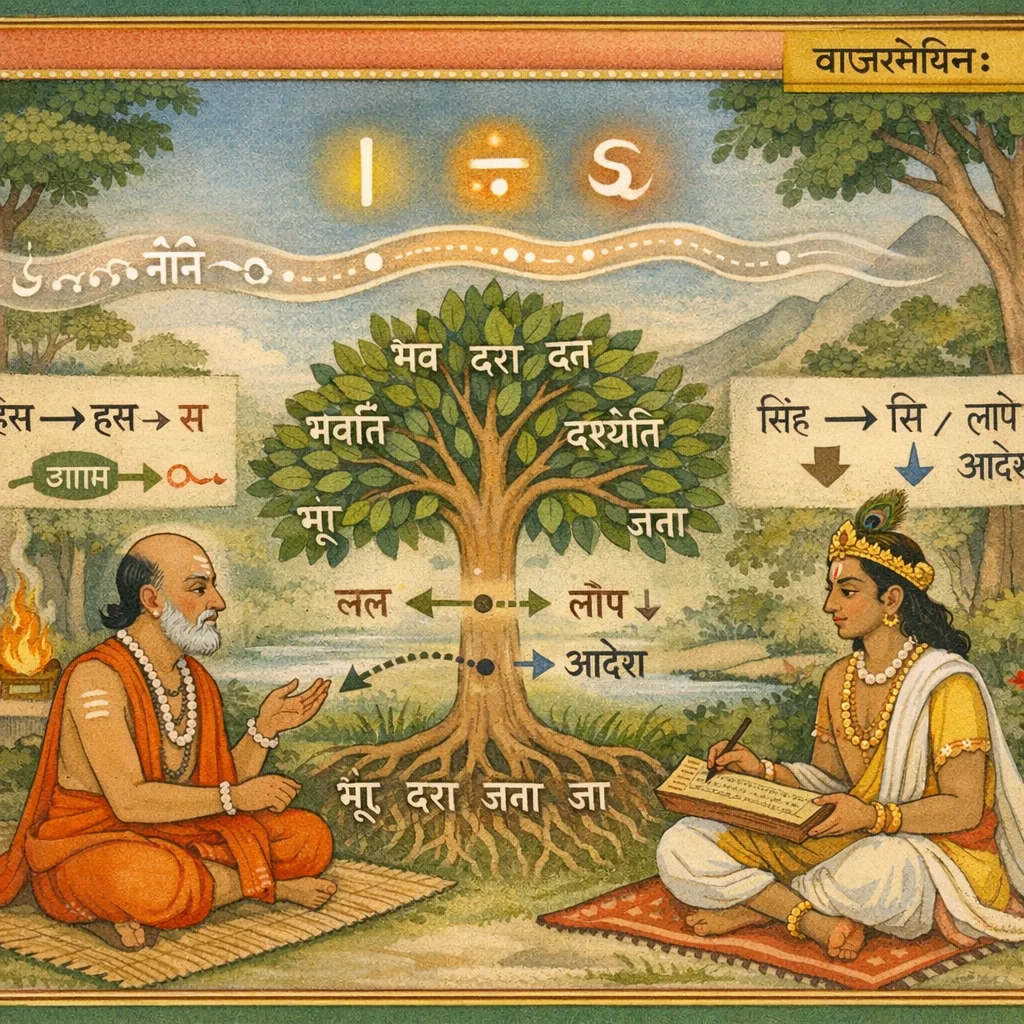
Sanandana teaches Nārada Nirukta as a Vedic auxiliary discipline grounded in dhātus (roots) and word-formation. He explains that seeming corruptions—extra syllables, letter reversal, distortion, and elision—are resolved through accepted grammatical operations, illustrating with forms like haṃsa/siṃha. He notes saṃyoga (conjunct combinations) and recitational features such as pluta vowels, nasalization, and metrical attestation. Some irregularities are sanctioned by bāhulaka (prevalent usage) and by tradition-specific forms, including Vājasaneyin usages. The chapter then turns into a dense technical catalogue: parasmaipada versus ātmanepada assignments, gaṇa/class listings, and accent rules (udātta, anudātta, svarita), with root lists and special markers (it, kiṭ, ṇi, ṭoṅ). It concludes that lexicography and correct form-determination depend on sacred recitation and analysis via prakṛti–pratyaya, ādeśa, lopa, and āgama, while acknowledging the subject’s practical infinitude.
Shlokas
Verse 1
सनंदन उवाच । निरुक्तं ते प्रवक्ष्यामि वेदं श्रोत्रांगमुत्तमम् । तत्पंचविधमाख्यातं वैदिकं धातुरूपकम् ॥ १ ॥
Sanandana said: I shall explain to you Nirukta, the excellent auxiliary limb of the Veda, concerned with right hearing and understanding. It is declared to be fivefold, Vedic in character, and grounded in verbal roots (dhātu) and their forms.
Verse 2
क्वचिदूर्णागमस्तत्र क्वचिद्वर्णविपर्ययः । विकारः क्वापि वर्णानां वर्णनाशः क्वचिन्मतः ॥ २ ॥
In some places there is the intrusion of extraneous syllables; in some places there is a reversal of letters. Somewhere there is distortion of letters, and elsewhere—so it is held—there is even loss of letters.
Verse 3
तथा विकारनाशाभ्यां वर्णानां यत्र नारद । धातोर्योगातिशयी च संयोगः परिकीर्तितः ॥ ३ ॥
Likewise, O Nārada, where in syllables there is both alteration and elision, and where an intensified junction arises from combination with a verbal root (dhātu)—that is proclaimed to be ‘saṃyoga’ (conjunction).
Verse 4
सिद्धेद्वर्णागमाद्धंसः सिंहो वर्णविपर्ययात् । गूढोत्मा वर्णविकृतेर्वर्णनांशात्पृषोदरः ॥ ४ ॥
‘Haṃsa’ (swan) becomes established by the addition of a letter; ‘siṃha’ (lion) is obtained by the transposition of letters. ‘Gūḍhātmā’ results from the alteration of letters, and ‘pṛṣodara’ from the partial loss of letters—thus are words accounted for by these grammatical operations.
Verse 5
भ्रमरादुषु शब्देषु ज्ञेयो योगो हि पञ्चमः । बहुलं छन्दसीत्युक्तमत्र वाच्यं पुनर्वसू ॥ ५ ॥
The fifth form of yoga is to be understood as meditation upon sounds such as the humming of bees and the like. Here, O Puṇarvasu, it is taught that such a practice is widely spoken of in the Vedic metres (chandas).
Verse 6
नभस्वद्वृषणश्चैवापरस्मैपदि चापि हि । परं व्यवहिताश्चापि गतिसंज्ञास्तथा हि आ ॥ ६ ॥
‘Nabhasvat’ and ‘vṛṣaṇa’ are also treated as verbs of the parasmaipada class. Likewise, forms that are “para” (subsequent) and even those that are “vyavahita” (separated/intervened) are designated by the technical term gati as well—so indeed it is taught.
Verse 7
विभक्तीनां विपर्यासो यथा दधना जुहोति हि । अभ्युत्सादयामकेतुर्ध्वनयीत्प्रमुखास्तथा । निष्टर्क्यान्द्यास्तथोक्ताश्च गृभायेत्यादिकास्तथा ॥ ७ ॥
The reversal of grammatical case-endings (vibhakti) is an error, as in the faulty expression “dadhanā juhoti” (“he offers with curd”). Likewise, mistakes such as “abhyutsādayāmaketuḥ,” “dhvanayīt,” and other prominent mispronounced or malformed forms are stated—along with usages like “gṛbhāye” and similar examples.
Verse 8
सुप्तिङुपग्रहलिंगनराणां कालहलूचूस्वरकर्तृयडां च । व्यत्ययमिच्छति शास्रकृदेषां सोऽपि च सिद्ध्यति बाहुलकेन ॥ ८ ॥
For items such as nominal case-endings (suP), verbal endings (tiṅ), prefixes (upagraha), gender and persons/agents, as well as tense (kāla), the letters ha, lu, cū, the accent (svara), the agent-doer (kartṛ), and the letter yaḍ—when the author of the grammatical śāstra intends a reversal or interchange among these, that too becomes established on the basis of common usage (bāhulaka).
Verse 9
रात्री विम्बी च कद्रूश्चाविष्ट्वौ वाजसनेयिनः ॥ ९ ॥
‘Rātrī’, ‘Vimbī’, and ‘Kadrū’, as well as ‘Āviṣṭu’—these are names/terms used among the Vājasaneyins (followers of the Śukla-Yajurveda tradition).
Verse 10
कर्णेभिश्च यशोभाग्य इत्याद्याश्चतुरक्षरम् । देवासोऽथो सर्वदेवतातित्वावत इत्यपि ॥ १० ॥
And (the sacred formula) beginning with “karṇebhiḥ” and “yaśo-bhāgya,” as well as other four-syllabled mantras; and also (those beginning with) “devāsaḥ,” and even (the one expressing) “endowed with the state of transcending all deities”—these too are to be understood in this teaching.
Verse 11
उभयाविन माद्याश्च प्रलयाद्याश्च स्तृचं तथा । अपस्पृधेथां नो अव्यादायो अस्मान्मुखास्तथा ॥ ११ ॥
May the destructive forces that arise from both kinds (internal and external), and the calamities beginning with dissolution (pralaya) and the like, together with all afflictions, not touch us. May diseases not harm us; and may our mouths—our speech—likewise be protected.
Verse 12
सगर्भ्योस्थापदी ऋत्व्योरजिष्टं त्रिपंचकम् । हिरण्ययेन नरं च परमे व्योमनित्यपि ॥ १२ ॥
The recitations known as Sagarbhya and Sthāpadī, the Ṛtvyora hymn, the most excellent Tripañcaka, the Hiraṇyaya, and the Nara—these too are to be contemplated and recited as eternally established in the supreme heaven, the highest spiritual realm.
Verse 13
उर्विया स्वप्रया वारवध्वाददुहवैवधी । यजध्वैनमेमसि च स्नात्वी गत्वा पचास्थभौः ॥ १३ ॥
With the earth as the altar-ground, and by one’s own devoted effort—like a bride of the waters—one should worship Him. Having bathed, one should go forth and perform the prescribed rite, firmly established in purity.
Verse 14
गोनांचापरिह्रवृत्ताश्चातुरिर्ग्रसितादिका । पश्येदधद्ब्रभूथापि प्रमिणांतित्यवीवृधत् ॥ १४ ॥
Even when the words seem distorted—through irregular turns of expression, swallowed syllables, or other corruptions—one should still recognize the intended sense, for the underlying measure and meaning remain, even if the reciter’s utterance appears defective.
Verse 15
मित्रयुश्च दुरस्वा वा हात्वा सुधितमित्यपि । दधर्त्याद्या स्ववद्भिश्च ससूवेति च धिष्व च ॥ १५ ॥
Even forms such as “mitrayuḥ”, “durasvā”, “hātvā”, and “sudhitam” are to be understood; likewise, one should know the correct usage of expressions like “dadharti”, “ādyā”, “svavadbhiḥ”, “sasūve”, and “dhiṣva”.
Verse 16
प्रप्रायं च हरिवतेक्षण्वतः सुपर्थितरः । रथीतरी नसताद्या अम्नर्भुवरथो इति ॥ १६ ॥
And he set forth again and again—his gaze turned toward Hari—while the well-prepared devotees prayed with earnest longing; thus he is praised as Rathītara, as Nasatā and the rest, known as Amnarbhuvaratha.
Verse 17
ब्रूह्याद्यादेः परस्याप्यौ श्रावयेत्यादिके प्लुतः । दाश्वांश्व स्वतवान्यापौत्रिभिष्ट्वं च नृभिष्टुतः ॥ १७ ॥
In forms beginning with “brūhi” and the like, and also in the following word “au,” as well as in expressions beginning with “śrāvayet,” the vowel is to be uttered as a pluta (protracted) sound. Likewise, in forms such as “dāśvāṃśva,” “svatavān,” and in the cluster “yā‑pautri‑,” the sound “tvaṃ” is employed; and in “nṛbhiṣṭutaḥ” the appropriate phonetic rule is prescribed.
Verse 18
अभीषुण ऋतावाहं न्यषीदन्नृमणा अपि । चतुर्विधाद्बाहुलकात्प्रवृत्तेरप्रवृत्तितः ॥ १८ ॥
Even the wise, beholding the “seasonal current”—the momentum of time—sit down, restraining themselves; for from action and from inaction arises an excessive multiplicity, in its fourfold forms.
Verse 19
विभाषयान्यथाभावात्सर्वं सिद्ध्येञ्च वैदिकम् । भूवाद्या धातवो ज्ञेयाः परस्मैपदिनस्स्मृताः ॥ १९ ॥
Because of optional forms (vibhāṣā) and the possibility of alternative usage, all Vedic expressions can still be established as valid. The verbal roots beginning with bhū (“to be”) are to be understood, as tradition teaches, as taking parasmaipada (active) endings.
Verse 20
एधाद्या आत्मनेभाषा उदात्ताः षट्त्रिंशसंख्यकाः । अतादयोऽष्टत्रिंशञ्च परस्मैपदिनो मुने ॥ २० ॥
O sage, the Ātmanepada class beginning with edh‑ consists of thirty-six roots marked with the udātta accent; and the Parasmaipada class beginning with atā‑ consists of thirty-eight roots.
Verse 21
लोकृपूर्वा द्विचत्वारिंशदुक्ता च ह्यात्मने पदे । उदात्तेतरतु पंचाशत्फक्काद्याः परिकीर्तिताः ॥ २१ ॥
Those beginning with “lokṛ‑” are said to be forty-two in the Ātmanepada forms; and, with respect to udātta and the other accent-types, fifty items beginning with “phakka‑” are enumerated.
Verse 22
वर्चाद्या अनुदात्तेत एकविंशतिरीरीताः । गुपादयो द्विचत्वारिंशदुदात्तेताः समीरिताः ॥ २२ ॥
Beginning with the group headed by “varc-”, twenty-one items are declared to bear anudātta (low accent). Beginning with the group headed by “gup-”, forty-two items are stated to bear udātta (raised accent).
Verse 23
धिण्यादयोऽनुदात्तेतो दश प्रोक्ता हि शाब्दिकैः । अणादयोप्युदात्तेतः सप्तविंशतिधातवः ॥ २३ ॥
The grammarians (śābdikas) declare that ten verbal roots beginning with “dhiṇya-” are marked with anudātta (low accent). Likewise, they state that twenty-seven verbal roots beginning with “aṇa-” are marked with udātta (raised accent).
Verse 24
अमादयः समुद्दिष्टाश्चतुर्स्रिंशद्धिशाब्दिकैः । द्विसप्ततिमिता मव्यमुखाश्चोदात्तबंधना ॥ २४ ॥
Thus the series beginning with “amā” has been set forth by the śābdikas—thirty-two in number, expressed in the technical terms of phonetic science. It is measured as seventy-two (units), begins with the syllable “ma,” and is bound to udātta (raised accent).
Verse 25
स्वारितेद्धावुधातुस्तु एक एव प्रकीर्तितः । क्षुधादयोऽनुदात्तेतो द्विषपंचाशदुदाहृताः ॥ २५ ॥
Among the verbal roots marked with the svarita accent, only one is declared—“iddhāvu”. But among those marked with anudātta, beginning with “kṣudh”, fifty-two are stated.
Verse 26
घुषिराद्या उदात्ततोऽष्टाशीतिर्धातवो मताः । द्युताद्या अनुदात्तेतो द्वाविंशतिरतो मताः ॥ २६ ॥
From the group beginning with “ghuṣira”, eighty-eight verbal roots are regarded as bearing udātta (raised accent). From the group beginning with “dyut”, twenty-two are regarded as bearing anudātta (low accent).
Verse 27
षितस्रयोदश घटादिष्वेनुदत्तेत ईरितः । ततो ज्वलदुदात्तेतो द्विपंचाशन्मितास्तथा ॥ २७ ॥
In measures such as the ghaṭa and the rest, the anudātta (low, grave accents) are declared to be thirteen. Thereafter, the blazing udātta—jvalad-udātta (highly raised accents)—is likewise said to measure fifty-two.
Verse 28
स्वरितेद्राजृसंप्रोक्त स्तनहेभ्राजृतस्रयः । अनुदात्तेत अख्याता भाद्युतात्ता इतः स्यमात् ॥ २८ ॥
In the svarita (undulating accent), the sound is proclaimed as “drājṛ-saṃprokta” and is set upon a sequence such as “stanahe-bhrājṛta-srayaḥ”. In the anudātta (grave accent), it is explained as “eta”, marked by lowness. Hence the udātta (raised accent) is to be understood as the remaining, distinct one.
Verse 29
सहोऽनुदात्तेदेकस्तु रमैकोऽप्यात्मनैपदी । सदस्रय उदात्तेतः कुचाद्वेदा उदात्त इत् ॥ २९ ॥
In the phonetic rule-set: “saha” is treated as bearing anudātta (the grave accent); “rama” is of a single form and also takes ātmanepada. “sadasraya” is marked with udātta; and from “kuca”, the form “vedā” too is to be taken as udātta-marked.
Verse 30
स्वरितेतः पञ्चत्रिंशद्धिक्काद्याश्च ततः परम् । स्वरितेच्छिञ्भृञाद्याश्चत्वार स्वरितेत्ततः ॥ ३० ॥
From the set marked with the svarita accent, there are thirty-five items beginning with “dhik…”. After them, again under svarita, there are four beginning with “cchiñ, bhṛñ…”, and these too are to be recited with the svarita accent.
Verse 31
धेटः परस्मैपदिनः षट्चत्वारिंशदुदीरिताः । अष्टादश स्मिङाद्यास्तु आमनेपदिनो मताः ॥ ३१ ॥
Of the verbal roots beginning with “dheṭ”, forty-six are declared to take Parasmaipada endings; and eighteen—beginning with “smiṅ” and the rest—are regarded as Ātmanepada (Āmanepada).
Verse 32
ततस्रयोऽनुदात्तेतः पूङाद्याः परिकीर्तिताः । हृपरस्मैपदी चात्मनेभाषास्तु गुपात्रयः ॥ ३२ ॥
Thereafter, the three classes beginning with “pūṅ-” are declared to bear anudātta (the grave accent). The root-group beginning with “hṛ-” is Parasmaipada; while the three “gu-” groups are taught as Ātmanepada (middle-voice usage).
Verse 33
रभद्यब्दयनुदात्तेतो ञिक्ष्विदोतात्त इन्मतः । परस्मैपदिनः पंच दश स्कंम्भ्वादयस्तथा ॥ ३३ ॥
From the root-group beginning with rabh and from the abda class, those marked as anudātta are stated; and from the root-group beginning with kṣvid, bearing the it-marker ṇi and having udātta—according to this view—there are fifteen Parasmaipada roots, beginning with skambh and the rest.
Verse 34
कितधातुरुदात्तेञ्च दानशानोभयात्मकौ । स्वरितेतः पचाद्यंकाः परस्मैपदिनो मताः ॥ ३४ ॥
Roots marked with ‘kiṭ’, and those bearing udātta, are taught as belonging to both voices (usable in both Parasmaipada and Ātmanepada). But those with svarita accent, and the roots of the ‘pac-ādi’ class, are regarded as Parasmaipada (active-voice) roots.
Verse 35
स्वरितेतस्त्रयश्चैतौ वदवची परिभाषिणौ । भ्वाद्या एते षडधिकं सहस्रं धातवो मताः ॥ ३५ ॥
These three—Svara, Ita, and Svarita—are regarded as technical designations (paribhāṣā terms) in grammatical convention. Beginning with the Bhvādi class, the dhātus (verbal roots) are held to be a little over six thousand in number.
Verse 36
परस्मैपदिनः प्रोक्ता वदाश्चापि हनेति च । स्वरितेतो द्विषाद्यास्तु चत्वारो धातवो मताः ॥ ३६ ॥
It is taught that roots such as vad (“to speak”) and han (“to strike/kill”) take Parasmaipada endings; and among the roots beginning with dviṣ (“to hate”), those marked with the svarita accent are considered to be four in this class, according to the grammatical tradition.
Verse 37
चक्षिङेकः समाख्यातो धातुरत्रात्मनेपदी । इरादयोऽनुदात्तेतो धातवस्तु त्रयोदश ॥ ३७ ॥
Here, the single verbal root “cakṣiṅ” is declared to be Ātmanepada (taking middle endings). And the roots beginning with “irā-” are marked with the anudātta accent; in all, they are thirteen.
Verse 38
आत्मनेपदिनौ प्रोक्तौ षूङ्शीङ्द्वौ शाब्दिकैर्मुने । परस्मैपदिनः प्रोक्ता षुमुखाः सप्त धातवः ॥ ३८ ॥
O sage, the grammarians declare the two roots “ṣūṅ” and “śīṅ” to be Ātmanepada; and they declare seven roots beginning with “ṣu-” to be Parasmaipada (active).
Verse 39
स्वरितेदुर्णुञाख्यातो धातुरेको मुनीश्वर । घुमुखास्त्रय उद्दिष्टाः परस्मैपदिनस्तथा ॥ ३९ ॥
O lord of sages, there is a single verbal root known as “svarita–ed–ur–ṇuñ”; likewise, three forms beginning with “ghu-” are taught, and these too are treated as Parasmaipada (active).
Verse 40
ष्टुञेकस्तु समा ख्यातः स्मृते नारद शाब्दिकैः ॥ ४० ॥
O Nārada, among the grammarians it is remembered in the Smṛti and well known that the form called “ṣṭuñeka” is equivalent to “samā”, that is, one year.
Verse 41
अष्टादश राप्रभृतयः परस्मैपदिनः स्मृताः । इङ्ङात्मनेपदी प्रोक्तो धातुर्नारद केवलः ॥ ४१ ॥
Eighteen verbal roots—beginning with the group headed by “rā-”—are remembered as taking Parasmaipada (active) endings; while the root “iṅ”, O Nārada, is taught as exclusively Ātmanepada.
Verse 42
विदाद यस्तु चत्वारः परस्मैपदिनो मताः । ञिष्वप्शये समुद्दिष्टः परस्मैपदिकस्तथा ॥ ४२ ॥
Among these, four verbal forms beginning with “vidāda” are held to be parasmaipada (active-voice) forms; and the form taught as “ñiṣvapśaya” is likewise to be understood as parasmaipadika, belonging to the parasmaipada class.
Verse 43
परस्मैपदिनश्चैव ते मयोक्ताः स्यमादयः । दीधीङ्वेङ्स्मृतौ धातू आत्मनेपदिनौ मुने ॥ ४३ ॥
O sage, the roots beginning with “syam” that I have stated are indeed parasmaipada, taking the active endings. But the two roots dīdhīṅ and veṅ, in the sense of “remembering,” are ātmanepada, taking the middle endings.
Verse 44
प्रथादयस्रयश्चापि उदात्तेतः प्रकीर्तिताः । चर्करीतं च ह्नुङ् प्रोक्तोऽनुदात्तेन्मुनिसत्तम ॥ ४४ ॥
The forms beginning with “prathā-” are also declared to be udātta, bearing the raised Vedic accent. And “carkarīta” and “hnuṅ” are said to be anudātta, bearing the lowered accent, O best of sages.
Verse 45
त्रिसप्तति समाख्याता धातवोऽदादिके गणे । दादयो धातवो वेदाः परस्मैपदिनो मताः ॥ ४५ ॥
In the Adādi class, seventy-three verbal roots are enumerated. The roots beginning with “dā-” are known in the grammatical tradition, and they are regarded as Parasmaipada, taking endings for action directed toward another.
Verse 46
स्वरितेद्वै भृञाख्यात उदात्तेद्धाक् प्रकीर्तितः । माङ्हाङ्द्वावनुदात्तेतौ स्वरितेद्दानधातुषु ॥ ४६ ॥
With the svarita accent, the root “bhṛñ” is stated; with the udātta accent, “iddhāk” is declared. The two roots “māṅ” and “hāṅ” are treated as anudātta, while for the roots of the “dān” group the rule of svarita is set forth.
Verse 47
वाणितिराद्यास्रयश्वापि स्वरितेत उदाहृताः । घृमुखा द्वादश तथा परस्मैपतिनो मताः ॥ ४७ ॥
The forms beginning with “vāṇitira,” and those that rest upon that recitational basis, are declared to bear the svarita intonation. Likewise, the twelve beginning with “ghṛmukha” are held to be parasmaipada, taking the “for another” set of endings.
Verse 48
द्वाविँशतिरिहोद्दिष्टा धातवो ह्वादिके गणे । परस्मैपदिनः प्रोक्ता दिवाद्याः पंचविंशतिः ॥ ४८ ॥
Here, twenty-two verbal roots (dhātu) are enumerated in the Hvādika group; and twenty-five beginning with Divādi are declared to be parasmaipada, employing the active set of endings.
Verse 49
आत्मनेपदिनौ धातू षूङ्दूङ्द्वावपि नारद । ओदितः पूङ्मुखाः सप्त आत्मनेदपिनो मताः ॥ ४९ ॥
O Nārada, the two verbal roots Ṣūṅ and Dūṅ are classified as ātmanepada, taking the “for oneself” endings. Likewise, the root “O” and the seven roots beginning with “Pūṅ” are also regarded as ātmanepada.
Verse 50
आत्मनेपदिनो विप्र दीङ्मुखास्त्विह कीर्तिताः । स्यतिप्रभृतयो वेदाः परस्मैपदिनो मताः ॥ ५० ॥
O brāhmaṇa, the forms beginning with “dīṅ-” are taught here as ātmanepada; while those beginning with “syati” and the like are regarded as parasmaipada, according to the grammatical tradition.
Verse 51
जन्यादयः पंचदश आत्मनेपदिनो मुने । मृषाद्याः स्वरितेतस्तु धातवः पंच कीर्तिताः ॥ ५१ ॥
O sage, the roots beginning with jani are fifteen and take ātmanepada endings; and the five roots beginning with mṛṣ are declared to be svarita-ita, marked by the indicatory svarita accent.
Verse 52
एकादश पदाद्यास्तु ह्यात्मनेपदिनो मताः । राधोः कर्मक एवात्र वृद्धौ स्वादिचुरादिके ॥ ५२ ॥
The first eleven verb-forms, beginning with “pada,” are held to be Ātmanepada forms. Here the root “rādha” is treated as transitive (taking an object), and this classification applies in the vṛddhi (strengthened) formation within the Svādi and Curādi groups.
Verse 53
उदात्तेतस्तुदाद्यास्तु त्रयोदश समीरिताः । परस्मैपदिनोऽष्टात्र रधाद्याः परिकीर्तिताः ॥ ५३ ॥
Beginning with the group called Udātteta and the Tudā-class, thirteen groups are declared. And here, eight groups as well are stated to belong to the Parasmaipada (active) conjugation, beginning with the Radhā-group.
Verse 54
समाद्याश्चाप्युदात्तेतः षट्चत्वारिंशदुदीरिताः । चत्वारिशच्छतं चापि दिवादौ धातवो मताः ॥ ५४ ॥
Further, beginning with the “sam-ādi” class and including those marked with the udātta accent, forty-six are stated. And beginning with the divādi class, the verbal roots are held to be four hundred and forty in number.
Verse 55
स्वादयः स्वरितेत्तोंका धातवः परिकीर्तिताः । सप्ताख्यातो दुनोतिस्तु परस्मैपदिनो मुने ॥ ५५ ॥
The verbal roots beginning with “svād” are declared to bear the svarita accent and to be marked with the it ṭoṅ. And the root “dunoti,” O sage, is said to belong to the seventh class and to take Parasmaipada (active) endings.
Verse 56
अष्टिघावनुदात्तेतौ धातू द्वौ परिकीर्तितौ । परस्मैपदिनस्त्वत्र तिकाद्यास्तु चतुर्दश ॥ ५६ ॥
Here, two verbal roots—“aṣṭi” and “ghāva”—are declared as belonging to the class marked by anudātta (low tone). In this context, the Parasmaipada (active) roots beginning with “tika” are stated to be fourteen in number.
Verse 57
द्वात्रिंशद्धातवः प्रोक्ता विप्रेन्द्र स्वादिके गणे । स्वरितेतः षङाख्यातास्तुदाद्या मुनिसत्तम ॥ ५७ ॥
O best of brāhmaṇas, in the Svādi gaṇa thirty‑two verbal roots (dhātu) are taught; and, O foremost of sages, beginning with Tudādi, six verb‑classes are declared to bear the “svarita” accent.
Verse 58
ऋष्युदात्तेज्जुषीपूर्वा अत्मनेपदिनोर्णवाः । व्रश्चादय उदात्तेतः प्रोक्ताः पंचाधिकं शतम् ॥ ५८ ॥
Beginning with the group called Ṛṣyudātta and continuing with those that take Juṣī as a prefix, the class known as “the ocean of Ātmanepada forms” is described. Likewise, beginning with the root Vraśc, the roots marked with the udātta accent are stated to be one hundred and five in number.
Verse 59
गूर्युदात्तेदिहोद्दिष्टो धातुरेको मुनीश्वर । णूमुखाश्चैव चत्वारः परस्मैपदिनो मताः ॥ ५९ ॥
O lord of sages, here a single verbal root is stated to bear the udātta accent; and four forms/affixes beginning with “ṇu” are held to be Parasmaipada, taking the ‘for another’ endings.
Verse 60
कुङाख्यातोनुदात्तेञ्च कुटाद्याः पूर्तिमागताः । पृङ् मृङ् चात्मनेभाषौ षट् परस्मैपदे रिपेः ॥ ६० ॥
The root “kuṅ”, when used as an ākhyāta (finite verb), is employed with the anudātta accent; and the roots beginning with “kuṭ” are regarded as complete in usage. The roots “pṛṅ” and “mṛṅ” are used in Ātmanepada, while six forms/usages occur in Parasmaipada in the sense of “enemy” (ripu).
Verse 61
आत्मनेपदिनो धातू दृङ्धृङ्द्वौ चाप्युदाहृतौ । प्रच्छादिषोडशाख्याताः परस्मैपदिनो मुने ॥ ६१ ॥
The roots that take Ātmanepada endings have been stated; and the two roots dṛṅ and dhṛṅ are also declared. O sage, the sixteen roots beginning with pracch are taught as Parasmaipada (active‑ending) roots.
Verse 62
स्वरितेतः षट् ततश्च प्रोक्ता मिलमुखा मुने । कृतीप्रभृतय श्चापि परस्मैपदिनस्रयः ॥ ६२ ॥
From the svarita‑accented set, six forms are next taught, O sage; and the series beginning with milamukha is also proclaimed. The forms beginning with kṛtī likewise are to be understood as belonging to the parasmaipada (active) usage.
Verse 63
सप्त पंचाशदधिकास्तुदादौ धातवः शतम् । स्वरितेतो रुधोनंदा परस्मैभाषितः कृती ॥ ६३ ॥
In the Tudādi group, the verbal roots number one hundred and fifty‑seven. The roots beginning with “svar,” and those such as “rudh” and “nand,” are described as conjugated in the parasmaipada (active) forms and as taking kṛt (primary) derivatives.
Verse 64
ञिइंधीतोऽनुदातेतस्रयो धातव ईरिताः । उदात्तेतः शिषपिषरुधाद्याः पंचविंशतिः ॥ ६४ ॥
It is stated that three verbal roots bear an anudātta (low) accent—namely ñi, iṃdhī, and to. Those bearing an udātta (raised) accent are twenty‑five in number, beginning with śiṣ, piṣ, and rudh.
Verse 65
स्वरितेतस्तनोः सप्त धातवः परिकीर्तिताः । मनुवन्वात्मनेभाषौ स्वरितेत्त्कृञुदाहृतः ॥ ६५ ॥
From the verbal root “tan” in its svarita‑accented form, seven derivative verbal bases are enumerated. In ātmanepada usage, the forms “manu” and “van” are stated; and the form “kṛñ” is also taught in this connection.
Verse 66
ततो द्वौ कीर्तितौ विप्र धातवो दश शाब्दिकैः । क्याद्याः सप्तोभयेभाषाः सौत्राः स्तंभ्वादिकास्तथा ॥ ६६ ॥
Then, O brāhmaṇa, the grammarians also described the ten classes of verbal roots—beginning with the ‘kya’ group—together with the seven kinds that operate in both voices, and the sūtra‑based groupings such as those beginning with ‘stambh’ and others.
Verse 67
परस्मैपदिनः प्रोक्ताश्चत्वारोऽपि मुनीश्वर । द्वाविंशतिरुदात्तेतः कुधाद्या धातवो मताः ॥ ६७ ॥
O lord among sages, all four (classes) are declared to be Parasmaipada; and twenty-two roots, beginning with “kudhā”, are regarded as bearing the Udātta accent.
Verse 68
वृङ्ङात्मनेपदी धातुः र्श्रथाद्याश्चैकविंशतिः । परस्मैपदिनश्चाथ स्वरितेद्ग्रह एव च ॥ ६८ ॥
The verbal root “vṛṅ” is Ātmanepada (middle voice). The set beginning with “rśrath” comprises twenty-one roots. Next come Parasmaipada roots; and for a root marked with the svarita accent, only the ‘it’ marker is to be taken as the operative grammatical sign.
Verse 69
क्र्यादिकेषु द्विपंचाशद्धातवः कीर्तिता बुधैः । चुराद्या धातवो ञ्यंता षट्र्त्रिंशदधिकः शतम् ॥ ६९ ॥
In the verb classes beginning with Kriyādi, the learned have declared fifty roots (dhātus). In the class beginning with Curādi, the roots are of the “ñyanta” (causative/derived) type, numbering one hundred and thirty-six.
Verse 70
चित्याद्यष्टादशाख्याता आत्मनेपदिनो मुने । चर्चाद्या आधृषीयास्तु प्यंता वा परिकीर्तिताः ॥ ७० ॥
O sage, the eighteen forms beginning with “city-” are declared to be Ātmanepada (middle voice). Those beginning with “carcā-”, however, are said to be of the Ādhṛṣīya type, or else are classified as “pyaṃtā”.
Verse 71
अदंता धातवश्चैव चत्वारिंशत्तथाष्टं च । पदाद्यास्तु दश प्रोक्ता धातवो ह्यात्मनेपदे ॥ ७१ ॥
There are forty-eight verbal roots that do not end in the letter ‘d’. And ten roots, beginning with the group headed by ‘pad’, are taught as belonging to Ātmanepada (middle voice).
Verse 72
सूत्राद्या अष्ट चाप्यत्र ञ्यन्ता प्रोक्ता मनीषिभिः । धात्वर्थे प्रातिपदिकाद्वहुलं चेष्टवन्मतम् ॥ ७२ ॥
Here the learned also teach eight derivative formations beginning with “sūtra”, known as the “ñyanta” forms. And when the intended sense is that of a verbal root (action or operation), it is widely accepted—according to the view of Ceṣṭavat—that such usage may be derived from a nominal stem as well.
Verse 73
तत्करोति तदाचष्टे हेतुमत्यपि णिर्मतः । धात्वर्थे कर्तृकरणाञ्चित्राद्याश्चापि धातवः ॥ ७३ ॥
“It does that” and “it makes that known”—thus the verbal root is defined, even when it bears a causative sense. With respect to root-meaning, there are roots that chiefly convey the agent and the instrument, and there are also other roots of diverse kinds.
Verse 74
अष्ट संग्राम आख्यातोऽनुदात्तेच्छब्दिकैर्बुधैः । स्तोमाद्याः षोडश तथा अंदतस्यं निदर्शनम् ॥ ७४ ॥
The learned authorities on Vedic phonetics and terminology also describe eight kinds of saṃgrāma. Likewise they set forth the sixteen classifications beginning with stoma—this is presented as an illustration of that technical doctrine.
Verse 75
तथा बाहुलकादन्ये सौत्रलौकिकवैदिकाः । सर्वे सर्वगणीयाश्च तथानेकार्थवाचिनः ॥ ७५ ॥
Likewise, owing to prevalent usage (bāhulaka), other expressions are regarded as belonging to the sūtra tradition, the worldly register (laukika), or the Vedic register (vaidika). All of them are to be included under the relevant grammatical classes, and many of them convey multiple meanings.
Verse 76
सनाद्यंता धातवश्च तथा वै नामधातवः । एवमानंत्यमुद्भाव्यं धातूनामिह नारद । संक्षेपोऽयं समुद्दिष्टो विस्तरस्तत्र तत्र च ॥ ७६ ॥
Thus are accounted for the verbal roots that take the sanādi affixes, and also the so‑called nāmadhātus (denominative roots). In this way, O Nārada, the vast scope—almost endless—of the roots is indicated here. This is the concise statement; the detailed exposition is given in the respective places.
Verse 77
ऊदृदंतैर्यौति रुक्ष्णुशूङ्स्नुनुक्षुश्चिडीङ्श्रिभिः । वृङ्वृञ्भ्यां च विनैकाचोऽजंतेषु निहताः स्मृताः ॥ ७७ ॥
With the operation marked by ū-, dṛ-, and dant-, and in forms such as “yauti,” likewise with the roots rukṣṇu, śūṅ, snunukṣu, and with the markers ciḍ, īṅ, and śri—also with vṛṅ and vṛñ—except where there is but a single vowel (eka-ac): in the non-ātmanepada endings (a-jaṃta), those markers are to be understood as “dropped, suppressed.”
Verse 78
शक्लपचूमुचार्रच्वच्विच्सिच्प्रच्छित्यज्निजिर् भजः । भञ्ज्भुज्भ्रस्ज्मत्जियज्युज्रुज्रञ्जविजिर्स्वञ्जिसञ्ज्सृजः ॥ ७८ ॥
“(Now follow) the verbal roots: śak, klap, pac, ū, muc, ār, rac, vac, vic, sic, pracch, itya, aj, nij, ir, bhaj; and also bhañj, bhuj, bhrasj, mat, ji, yaj, yuj, ruj, rañj, vij, svañj, sañj, and sṛj.”
Verse 79
अदक्षुद्खिद्छिद्तुदिनुदः पद्यभिद्विद्यतिर्विनद् । शद्सदी स्विद्यतिस्स्कन्दिर्हदी क्रुध्क्षुधिबुध्यती ॥ ७९ ॥
“(The verbal forms/roots are:) adakṣud; khid; chid; tudi; nuda; (also) padya; bhid; vidyati; vinad; and śad/sadī; svidyati; skandi; hadī; along with krudh, kṣudhi, and budhyatī.”
Verse 80
बंधिर्युधिरुधीराधिव्यध्शुधः साधिसिध्यती । मन्यहन्नाप्क्षिप्छुपितप्तिपस्तृप्यतिदृप्यती ॥ ८० ॥
One becomes deaf; the blood is thrown into turmoil; the mind grows unsteady; grievous afflictions arise; and even one’s efforts and attainments are obstructed. Anger, striking out, harsh rejection, hidden agitation, burning distress, and at last desire turning into intoxicated pride—thus the inner disorder increases.
Verse 81
लिब्लुव्वपूशप्स्वपूसृपियभरभगम्नम्यमो रभिः । क्रुशिर्दंशिदिशी दृश्मृश्रिरुश्लिश्विश्स्पृशः कृषिः ॥ ८१ ॥
“(Here are further verbal roots:) lib, luv, vapu, śap, svap, ū, sṛp, i, bhara, bhaga, gam, nam, yam, and rabhi; also kruśi, daṃśi, diśī, dṛś, mṛś, śri, ruś, liś, viś, spṛś, and kṛṣi.”}]}
Verse 82
त्विष्तुष्दुष्पुष्यपिष्विष्शिष्शुष्श्लिष्यतयो घसिः । वसतिर्दहदिहिदुहो नह्मिह्रुह्लिह्वहिस्तथा ॥ ८२ ॥
“The verbal roots are: tviṣ, tuṣ, duṣ, puṣya, piṣ, viṣ, śiṣ, śuṣ, śliṣ, and yata; also ghas. Likewise there are the roots vas, dah, dih, duh, nah, mi, hru, hli, and hvah.”
Verse 83
अनुदात्ता हलंतेषु धातवो द्व्यधिकं शतम् । चाद्या निपाता गवयः प्राद्या दिग्देशकालजाः ॥ ८३ ॥
Among roots that end in a consonant, the accent is anudātta (grave). The verbal roots are a little more than two hundred in number. Indeclinables begin with ca-, and the so‑called “gavaya” group begins with pra-—arising from (expressing) direction, place, and time.
Verse 84
शब्दाः प्रोक्ता ह्यनेकार्थाः सर्वलिंगा अपि द्विज । गणपाठः सूत्रपाठो धातुपाठस्तथैव च ॥ ८४ ॥
O twice-born one, words are taught as having many meanings and as applicable to all genders; likewise there are the Gaṇa-lists, the recitation of sūtras, and also the Dhātu-list (of verbal roots).
Verse 85
पाठोनुनासिकानां च परायणमिहोच्यते । शब्दाः सिद्धा वैदिकास्तु लौकिकाश्चापि नारद ॥ ८५ ॥
Here the proper method of recitation—including the correct use of nasalized sounds (anunāsika)—is taught. O Nārada, sounds and words are established as valid both in the Vedic tradition and also in common (worldly) usage.
Verse 86
शब्दपारायणं तस्मात्कारणं शब्दसंग्रहे । लघुमार्गेण शब्दानां साधूनां संनिरूपणम् ॥ ८६ ॥
Therefore, recitation and close study of words is the very basis for compiling a lexicon; it is the concise method for clearly determining the correct and proper forms of words.
Verse 87
प्रकृतिप्रत्ययादेशलोपागममुखैः कृतम् ॥ ८७ ॥
It is accomplished through means such as the prakṛti (base), pratyaya (affixes), ādeśa (substitution), lopa (elision), and āgama (augmentation).
Verse 88
इत्थमेतत्समाख्यातं निरुक्तं किंचिदेवते । कात्स्न्येर्न वक्तुमानंत्यात्कोऽपिशक्तो न नारद ॥ ८८ ॥
Thus, O divine one, this has been explained and only briefly interpreted. Since its full extent is endless, no one—even Nārada—can describe it completely.
Frequently Asked Questions
They function as pedagogical examples for Nirukta/Vyākaraṇa: haṃsa illustrates formation by addition of a letter, while siṃha illustrates transposition, demonstrating how apparent surface variation can be explained through standard operations without losing semantic intent.
Bāhulaka indicates that certain reversals/interchanges or irregular-looking formations are accepted because they are attested in widespread usage—especially in Vedic transmission—so grammatical authority recognizes them as valid within the śāstra framework.
It lays out technical distinctions among udātta, anudātta, and svarita, gives root-group enumerations under each accent, and ties accent to voice behavior and markers, reflecting a Dhātupāṭha-like taxonomy used for correct recitation and interpretation.
Meaning and correctness are determined through systematic analysis—prakṛti and pratyaya plus operations like ādeśa, lopa, and āgama—supported by recitational discipline (svara, pluta, nasalization) and validated attestations in Vedic and laukika usage.