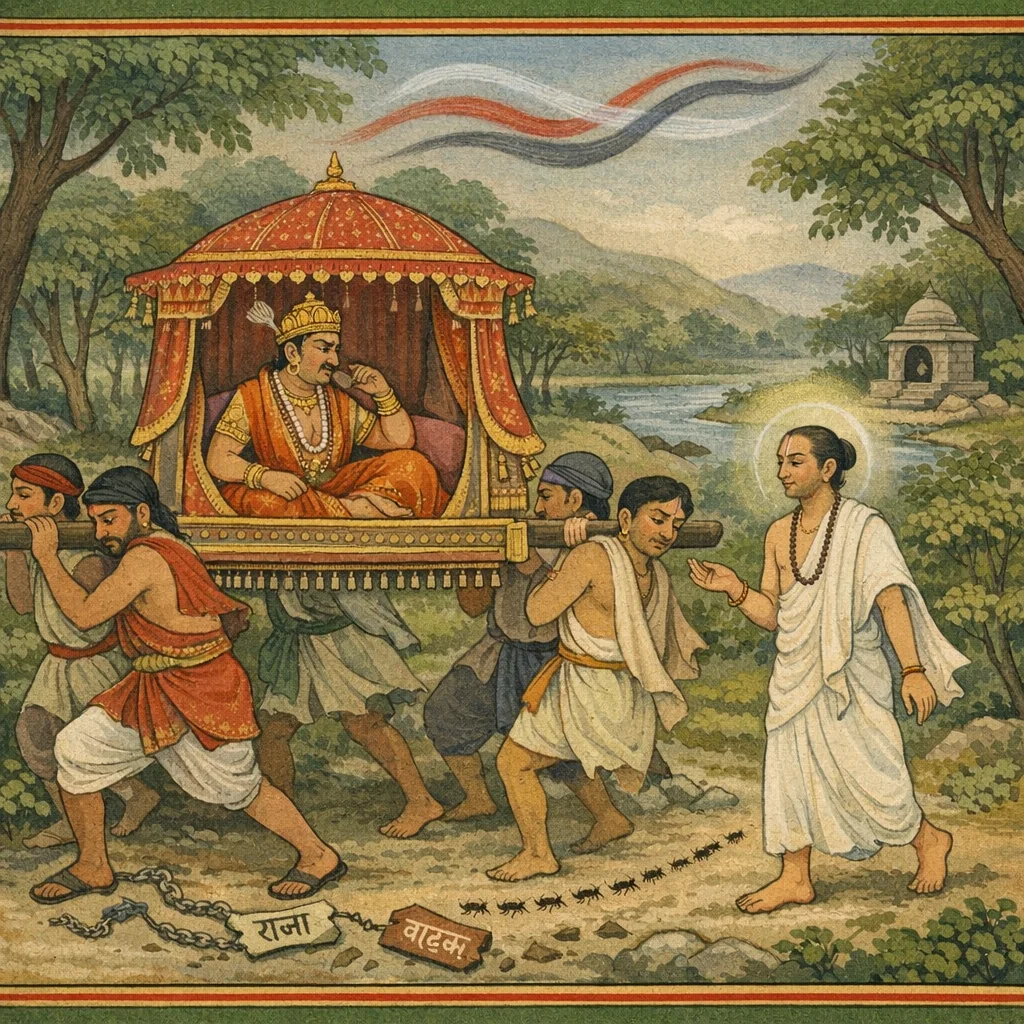
Bharata’s Attachment and the Palanquin Teaching on ‘I’ and ‘Mine’
Nārada admits that even after hearing remedies for the threefold afflictions his mind is still unsteady, and he asks how to endure humiliation and the cruelty of wicked people. Sūta introduces Sanandana, who answers with an ancient account to re-ground the mind. He tells of King Bharata, descendant of Ṛṣabha: ruling by dharma, worshipping Adhokṣaja, then renouncing and living as an ascetic at Śālagrāma, daily adoring Vāsudeva with strict observances. A pregnant doe miscarries in fear; Bharata rescues the fawn, becomes attached, and dies with his mind fixed on it, thus being reborn as a deer. Remembering former births, he returns to Śālagrāma, performs expiation, and is reborn as a brāhmaṇa endowed with jñāna. He feigns dullness, bears public contempt, and is forced into palanquin-bearing for the king of Sauvīra. When the king complains of uneven carrying, the brāhmaṇa delivers a piercing teaching on agency and identity: the burden rests on bodily parts and the earth; “strong/weak” is secondary; beings move in the stream of guṇas under karma; the Ātman is pure, changeless, beyond Prakṛti; “king” and “bearer” are mere conceptual labels—so, under tattva-vicāra, the notions of “I” and “mine” collapse.
Shlokas
Verse 1
नारद उवाच । श्रुतं मया महामाग तापत्रयचिकित्सितम् । तथापि मे मनो भ्रांतं न स्थितिं लभतेंऽजसा ॥ १ ॥
Nārada said: “O greatly fortunate one, I have heard the remedy for the threefold afflictions; yet my mind remains unsettled and does not easily attain steadiness.”
Verse 2
आत्मव्यतिक्रमं ब्रह्मन्दुर्जनाचरितं कथम् । सोढुं शक्येत मनुजैस्तन्ममाख्याहि मानद ॥ २ ॥
O Brahman, how can human beings endure affronts to their own dignity and the cruel conduct of the wicked? Tell me this, O giver of honor.
Verse 3
सूत उवाच । तच्छ्रृत्वा नारदेनोक्तं ब्रह्मपुत्रः सनंदनः । उवाच हर्षसंयुक्तः स्मरन्भरतचेष्टितम् ॥ ३ ॥
Sūta said: Having heard what Nārada spoke, Sanandana, Brahmā’s son—filled with joy and recalling Bharata’s exemplary conduct—then spoke.
Verse 4
सनंदन उवाच । अत्र ते कथयिष्यामि इतिहासं पुरातनम् । यं श्रुत्वा त्वन्मनो भ्रांतमास्थानं लभते भृशम् ॥ ४ ॥
Sanandana said: Here I shall tell you an ancient sacred history; by hearing it, your mind—now confused—will firmly regain its proper grounding.
Verse 5
आसीत्पुरा मुनिश्रेष्ट भरतो नाम भूपतिः । आर्षभो यस्य नाम्नेदं भारतं खण्डमुच्यते ॥ ५ ॥
O best of sages, in former times there was a king named Bharata, a descendant of Ṛṣabha; after his name this region is called Bhārata-khaṇḍa, the land of Bharata.
Verse 6
स राजा प्राप्तराज्यस्तु पितृपैतामहं क्रमात् । पालयामास धर्मेण पितृवद्रंजयन् प्रजाः ॥ ६ ॥
Having obtained the kingdom in the hereditary order of his father and grandfather, that king ruled righteously, delighting the subjects as a father would.
Verse 7
ईजे च विविधैर्यज्ञैर्भगवंतमधोक्षजम् । सर्वदेवात्मकं ध्यायन्नानाकर्मसु तन्मतिः ॥ ७ ॥
He worshipped the Lord Adhokṣaja through sacrifices of many kinds; meditating on Him as the very Self of all the gods, his mind remained fixed on Him even amid diverse actions.
Verse 8
ततः समुत्पाद्य सुतान्विरक्तो विषयेषु सः । मुक्त्वा राज्यं ययौ विद्वान्पुलस्त्यपुहाश्रमम् ॥ ८ ॥
Then, after begetting sons, he grew dispassionate toward sense-objects; abandoning the kingdom, the wise man went to the hermitage of Pulastya’s son.
Verse 9
शालग्रामं महाक्षेत्रं मुमुक्षुजनसेवितम् । तत्रासौ तापसो तापसो भूत्वा विष्णोराराधनं मुने ॥ ९ ॥
Śālagrāma is a great sacred region, frequented by seekers of liberation. There, that ascetic—having become a true practitioner of austerity—performed worship of Lord Viṣṇu, O sage.
Verse 10
चकार भक्तिभावेन यथालब्धसपर्यया । नित्यं प्रातः समाप्लुत्य निर्मलेऽभलि नारद ॥ १० ॥
O Nārada, with a spirit of devotion he performed worship with whatever offerings were at hand; and every morning, after bathing well in pure, clean water, he continued his daily observances.
Verse 11
उपतिष्टेद्रविं भक्त्या गृणन्ब्रह्माक्षरं परम् । अथाश्रमे समागत्य वासुदेवं जगत्पतिम् ॥ ११ ॥
With devotion one should stand before the Sun, reciting the supreme imperishable syllable of Brahman; then, having returned to the hermitage, one should worship Vāsudeva, the Lord of the universe.
Verse 12
समाहृतैः स्वयं द्रव्यैः समित्कुशमृदादिभिः । फलैः पुष्पैंस्तथा पत्रैस्तुलस्याः स्वच्छवारिभिः ॥ १२ ॥
With materials gathered by oneself—such as sacrificial fuel-sticks, kuśa grass, clay and the like—together with fruits, flowers, and leaves, and with pure water offered along with tulasī, one should perform worship.
Verse 13
पूजयन्प्रयतो भूत्वा भक्तिप्रसरसंप्लुतः । सचैकदा महाभागः स्नात्वा प्रातः समाहितः ॥ १३ ॥
Engaged in worship, disciplined and pure, and flooded by the widening flow of bhakti—once that noble soul, after bathing at dawn, sat down composed, with mind gathered and steady.
Verse 14
चक्रनद्यां जपंस्तस्थौ मुहुर्तत्रयमंबुनि । अथाजगाम तत्तीरं जलं पातुं पिपासिता ॥ १४ ॥
In the river Cakranadī she remained immersed, continually reciting japa for three muhūrtas. Then, overcome by thirst, she came to that bank to drink water.
Verse 15
आसन्नप्रसवा ब्रह्मन्नैकैव हिणी वनात् । ततः समभवत्तत्र पीतप्राये जले तया ॥ १५ ॥
O Brāhmaṇa, a single doe, close to giving birth, came out from the forest. Then, right there, by the water she had almost drunk up, she gave birth.
Verse 16
सिंहस्य नादः सुमहान् सर्वप्राणिभयंकरः । ततः सा सिंहसन्नादादुत्प्लुता निम्नगातटम् ॥ १६ ॥
The lion’s roar was exceedingly great, striking fear into all living beings. Hearing that lion-like thunder, she sprang up and leapt to the low riverbank.
Verse 17
अत्युञ्चारोहणेनास्या नद्यां गर्भः पपात ह । तमुह्यमानं वेगेन वीचिमालापरिप्लुतम् ॥ १७ ॥
Because she climbed up too abruptly, the fetus fell into the river. Swept along by the force of the current, it was engulfed by a garland of waves.
Verse 18
जग्राह भरतो गर्भात्पतितं मृगपोतकम् । गर्भप्रच्युतिदुःखेन प्रोत्तुंगाक्रणेन च ॥ १८ ॥
Bharata took up the young fawn that had fallen from its mother’s womb, pained by the suffering caused by the miscarriage and by the loud, anguished cries.
Verse 19
मुनीन्द्र सा तु हरिणी निपपात ममार च । हरिणीं तां विलोक्याथ विपन्नां नृपतापसः ॥ १९ ॥
O best of sages, that doe collapsed and then died. Seeing the deer lying dead, the king—now living as an ascetic—was overcome with distress.
Verse 20
मृगपोतं समागृह्य स्वमाश्रममुपागतः । चकारानुदिनं चासौ मृगपोतस्य वै नृपः ॥ २० ॥
Taking the fawn into his care, the king returned to his own hermitage; and day after day he attended to that young deer’s needs.
Verse 21
पोषणं पुष्यमाणश्च स तेन ववृधे मुने । चचाराश्रमपर्यंतं तृणानि गहनेषु सः ॥ २१ ॥
Nourished and continually being sustained, he grew thereby, O sage; and he moved about up to the boundaries of the hermitage, grazing on grasses in the dense thickets.
Verse 22
दूरं गत्वा च शार्दूलत्रासादभ्याययौ पुनः । प्रातर्गत्वादिदूरं च सायमायात्यथाश्रमम् ॥ २२ ॥
Having gone far away, yet again returning out of fear of a tiger, he would set out at dawn and travel very far; but by evening he would come back once more to the hermitage.
Verse 23
पुनश्च भरतस्याभूदाश्रमस्योटजांतरे । तस्यतस्मिन्मृगे दूरसमीपपरिवर्तिनि ॥ २३ ॥
And again, within the precincts of Bharata’s hermitage—between the huts—his attention kept turning toward that deer, as it moved sometimes far away and sometimes near.
Verse 24
आसीञ्चेतः समासक्तं न तथा ह्यच्युते मुने । विमुक्तराज्यतनयः प्रोज्झिताशेषबांधवः ॥ २४ ॥
O sage, his mind became deeply attached there, yet not in the same way to Acyuta, the Lord. Though he had renounced kingdom and son and cast off all remaining kin, his heart did not become equally devoted to the Imperishable One.
Verse 25
ममत्व स चकारोञ्चैस्तस्मिन्हरिणपोतके । किं वृकैभक्षितो व्याघ्नैः किं सिंहेन निपातितः ॥ २५ ॥
He cried out, seized by possessive attachment to that young fawn, wondering: “Has it been eaten by wolves? Has it been seized by tigers? Or has it been struck down by a lion?”
Verse 26
चिरायमाणे निष्कांते तस्यासीदिति मानसम् । प्रीतिप्रसन्नवदनः पार्श्वस्थे चाभवन्मृगे ॥ २६ ॥
When he was long delayed and did not come forth, this thought arose in her mind: “Has something happened to him?” And the deer, its face bright with affection and joy, remained standing close by her side.
Verse 27
समाधिभंगस्तस्यासीन्ममत्वाकृष्टमानसः । कालेन गच्छता सोऽथ कालं चक्रे महीपतिः ॥ २७ ॥
His samādhi was broken, for his mind was drawn by the sense of “mine.” Then, as time moved on, that king in due course met his end, falling under the power of Kāla (Time).
Verse 28
पितेव सास्त्रं पुत्रेण मृगपोतेन वीक्षितः । मृगमेव तदाद्राक्षीत्त्यजन्प्राणानसावपि ॥ २८ ॥
Like a father gazing upon his son, he looked upon the fawn. In that moment he saw only the deer—and even as he gave up his life-breath, his mind remained fixed upon it.
Verse 29
मृगो बभूव स मुने तादृशीं भावनां गतः । जाति स्मरत्वादुद्विग्नः संसारस्य द्विजोत्तम ॥ २९ ॥
O sage, he became a deer, having fallen into such a state of mind. And because he remembered his former birth, O best of the twice-born, he grew distressed by saṃsāra, the worldly round.
Verse 30
विहाय मातरं भूयः शालग्राममुपाययौ । शुष्कैस्तृणैस्तथा पर्णैः स कुर्वन्नात्मपोषणम् ॥ ३० ॥
Leaving his mother behind once again, he went to Śālagrāma. There he sustained himself, making his nourishment from dry grass and leaves.
Verse 31
मृगत्वहेतुभूतस्य कर्मणो निष्कृतिं ययौ । तत्र चोत्सृष्टदेहोऽसौ जज्ञे जातिस्मरो द्विजः ॥ ३१ ॥
He underwent expiation for the karma that had become the cause of his deerhood. And there, after casting off that body, he was born again as a twice-born (brāhmaṇa), endowed with remembrance of former births.
Verse 32
सदाचारवतां शुद्धे यागिनां प्रवरे कुले । सर्वविज्ञान संपन्नः सर्वशास्त्रार्थतत्त्ववित् ॥ ३२ ॥
Born in a pure and most excellent lineage of the virtuous and of accomplished performers of yajña, he is endowed with complete knowledge and truly knows the essential principles and meanings of all the śāstras.
Verse 33
अपश्यत्स मुनिश्रेष्टः स्वात्मानं प्रकृतेः परम् । आत्मनोधिगतज्ञानाद्द्वेवादीनि महामुने ॥ ३३ ॥
Then that best of sages beheld his own Self (Ātman) as transcending Prakṛti; and, O great muni, through knowledge realized within the Self, hatred and the other afflictive impulses were dispelled.
Verse 34
सर्वभूतान्यभे देन ददर्श स महामतिः । न पपाठ गुरुप्रोक्तं कृतोपनयनः श्रुतम् ॥ ३४ ॥
That great-minded one beheld all beings as non-different from the one Reality. Yet, even after undergoing the rite of upanayana, he did not study the śruti—the sacred learning taught by his teacher.
Verse 35
न ददर्श च कर्माणि शास्त्राणि जगृहे न च । उक्तोऽपि बहुशः किंचिज्जंड वाक्यमभाषत ॥ ३५ ॥
He did not even look toward the prescribed duties, nor did he take up the śāstras; and though instructed many times, he uttered only a few dull, senseless words.
Verse 36
तदप्यसंस्कारगुणं ग्रामभाषोक्तिसंयुतम् । अपद्धस्तवपुः सोऽपि मलिनांबरधृङ् मुने ॥ ३६ ॥
Even his speech is devoid of refinement and good culture, mixed with rustic, colloquial expressions; and he too, O muni, has an unkempt appearance and wears soiled garments.
Verse 37
क्लिन्नदंतांतरः सर्वैः परिभूतः स नागरैः । संमानेन परां हानिं योगर्द्धेः कुरुते यतः ॥ ३७ ॥
With the spaces between his teeth fouled, appearing unclean, he is despised by all the townspeople; for through such dishonor one suffers a great loss of yogic attainment and prosperity.
Verse 38
जनेनावमतो योगी योगसिद्धिं च विंदति । तस्माञ्चरेत वै योगी सतां धर्ममदूषयन् ॥ ३८ ॥
Even when despised by people, a yogin attains perfection in yoga. Therefore, let the yogin conduct himself without disparaging the righteous dharma upheld by the virtuous.
Verse 39
जना यथावमन्येयुर्गच्छेयुर्नैव संगतिम् । हिरण्यगर्भवचनं विचिंत्येत्थं महामतिः ॥ ३९ ॥
Even if people were to despise him and avoid his company, the great-minded one should reflect in this way upon the teaching spoken by Hiraṇyagarbha (Brahmā).
Verse 40
आत्मानं दर्शयामास जडोन्मत्ताकृतिं जने । भुंक्ते कुल्माषवटकान् शाकं त्रन्यफलं कणान् ॥ ४० ॥
He presented himself before people in the guise of one dull-witted or mad; and he lived on coarse fare—balls of boiled grains, greens, wild fruits, and scattered morsels.
Verse 41
यद्यदाप्नोति स बहूनत्ति वै कालसंभवम् । पितर्युपरते सोऽथ भ्रातृभ्रातृव्यबांधवैः ॥ ४१ ॥
Whatever wealth a man acquires is indeed consumed by many, for it is a product of time. And when the father has passed away, that wealth is then taken up and used by brothers, cousins, and other relatives.
Verse 42
कारितः क्षेत्रकर्मादि कदन्नाहारपोषितः । सरूक्षपीनावयवो जडकारी च कर्मणि ॥ ४२ ॥
Driven into farm-labour and like toil, sustained on coarse and inferior fare, his limbs dry and emaciated—he became dull and slow in his work.
Verse 43
सर्वलोकोपकरणं बभूवाहारवेतनः । तं तादृशमसंस्कारं विप्राकृतिविचेष्टितम् ॥ ४३ ॥
He became a servant useful to all, working for mere food as his wage. Yet he remained uncultivated and unrefined, behaving in ways unbecoming of one who was, by nature, a brāhmaṇa.
Verse 44
क्षत्ता सौवीरराज्यस्य विष्टियोग्यममन्यत । स राजा शिबिकारूढो गंतुं कृतमतिर्द्विज ॥ ४४ ॥
O brāhmaṇa, the royal attendant (kṣattā) of the kingdom of Sauvīra deemed that man fit for forced labour (viṣṭi). The king, seated in a palanquin, had resolved to proceed on his journey.
Verse 45
बभूवेक्षुमतीतीरे कपिलर्षेर्वराश्रमम् । श्रेयः किमत्र संसारे दुःखप्राये नृणामिति ॥ ४५ ॥
On the bank of the Ikṣumatī stood the excellent hermitage of Sage Kapila. He reflected: “In this cycle of saṁsāra, mostly filled with suffering, what true good is there for human beings?”
Verse 46
प्रष्टुं तं मोक्षधर्मज्ञं कपिलाख्यं महामुनिम् । उवाह शिबिकामस्य क्षत्तुर्वचनचोदितः ॥ ४६ ॥
Wishing to question the great sage Kapila, well-versed in the dharma of liberation (mokṣa), he bore the palanquin—urged on by the chamberlain’s command.
Verse 47
नृणां विष्टिगृहीतानामन्येषां सोऽपि मध्यगः । गृहीतो विष्टिना विप्र सर्वज्ञानैकभाजनम् ॥ ४७ ॥
Among men seized by the baleful influence called Viṣṭi—and among others as well—even that sage, though standing in the midst, was caught by Viṣṭi, O brāhmaṇa, he who is the single vessel of all knowledge.
Verse 48
जातिस्मरोऽसौ पापस्य क्षयकाम उवाह ताम् । ययौ जडगतिस्तत्र युगमात्रावलोकनम् ॥ ४८ ॥
Remembering his former births and longing for the destruction of his sins, he married her. Thereafter he moved about as though dull and inert, and stayed there merely watching, as if for the span of a yuga.
Verse 49
कुर्वन्मतिमतां श्रेष्टस्ते त्वन्ये त्वरितं ययुः । विलोक्य नृपतिः सोऽथ विषमं शिबिकागतम् ॥ ४९ ॥
While the best among the wise was still deliberating, the others hurried on. Then the king, observing the palanquin’s uneven movement, took notice.
Verse 50
किमेतदित्याह समं गम्यतां शिबिकावहाः । पुनस्तथैव शिबिकां विलोक्य विषमां हसन् ॥ ५० ॥
“What is this?” he said. “O bearers of the palanquin, walk evenly.” Then, seeing the palanquin again become uneven in the same way, he laughed.
Verse 51
नृपः किमेऽतदित्याह भवद्भिर्गम्यतेऽन्यथा । भूपतेर्वदतस्तस्य श्रुत्वेत्थं बहुशो वचः । शिबिकावाहकाः प्रोचुरयं यातीत्यसत्वरम् ॥ ५१ ॥
The king said, “What is this? You are going the wrong way.” Hearing the lord of the land speak such words again and again, the palanquin-bearers replied, “He is proceeding,” and they moved on without haste.
Verse 52
राजोवाच । किं श्रांतोऽस्यल्पमध्वानं त्वयोढा शिबिका मम । किमायाससहो न त्वं पीवा नासि निरीक्ष्यसे ॥ ५२ ॥
The king said: “Though the road is short, have you grown weary from bearing my palanquin? Can you not endure exertion? Are you not stout? When I look at you, you do not appear so.”
Verse 53
ब्राह्मण उवाच । नाहं पीवा न चैवोढा शिबिका भवतो मया । न श्रांतोऽस्मि न चायासो वोढान्योऽस्ति महीपते ॥ ५३ ॥
The brāhmaṇa said: “I am neither a drinker nor am I the bearer of your palanquin. I am not tired, nor do I feel strain. O king, another is the carrier.”
Verse 54
राजोवाच । प्रत्यक्षं दृश्यते पीवात्वद्यापि शिबिका त्वयि । श्रमश्च भारो द्वहने भवत्येव हि देहिनाम् ॥ ५४ ॥
The king said: “It is plainly seen—even today—that the palanquin still weighs upon you. For embodied beings, fatigue and burden surely arise when carrying a load.”
Verse 55
ब्राह्मण उवाच । प्रत्यक्षं भवता भूप यद्दृष्टं मम तद्वद । बलवानबलश्चेति वाच्यं पश्चाद्विशेषणम् ॥ ५५ ॥
The brāhmaṇa said: “O King, speak of what you yourself have directly seen. The qualifiers ‘strong’ and ‘weak’ should be stated afterward, as secondary distinctions.”
Verse 56
त्वयोढा शिबिका चेति त्वय्यद्यापि च संस्थिता । मिथ्या तदप्यत्र भवान् श्रृणोतु वचनं मम ॥ ५६ ॥
“The notion ‘you carried the palanquin’ still remains fixed in you even today. Yet it is false. In this matter, please listen to my words.”
Verse 57
भूमौ पादयुगं चाथ जंघे पादद्वये स्थिते । ऊरु जंघाद्वयावस्थौ तदाधारं तथोदरम् ॥ ५७ ॥
Upon the earth is set the pair of feet; upon the two feet stand the shanks. The thighs rest upon the two shanks, and their support is the belly—the trunk of the body.
Verse 58
वक्षस्थलं तथा बाहू स्कंधौ चोदरसंस्थितौ । स्कंधाश्रितयें शिबिका ममाधारोऽत्र किंकृतः ॥ ५८ ॥
The chest and the arms, and the shoulders set upon the belly—this palanquin rests upon the shoulders. What, then, is the support of “me” here, and what is truly being carried?
Verse 59
शिबिकायां स्थितं चेदं देहं त्वदुपलक्षितम् । तत्र त्वमहमप्यत्रेत्युच्यते चेदमन्यथा ॥ ५९ ॥
If this body, seated in a palanquin, is identified as “you,” then one may also say, “you are there and I am here”—yet in truth the matter is otherwise.
Verse 60
अहं त्वं च तथान्ये च भूतैरुह्याश्च पार्थिव । गुणप्रवाहपतितो भूतवर्गोऽपि यात्ययम् ॥ ६० ॥
O king, I and you, and others as well—even hosts of beings such as plants—this entire multitude of creatures, having fallen into the current of the guṇas, passes on in change and dissolution.
Verse 61
कर्मवश्या गुणश्चैते सत्त्वाद्याः पृथिवीपते । अविद्यासंचितं कर्मतश्चाशेषेषु जंतुषु ॥ ६१ ॥
O lord of the earth, these guṇas—beginning with sattva—are themselves governed by karma; from ignorance (avidyā) karma accumulates, and thus it operates in all living beings without exception.
Verse 62
आत्मा शुद्धोऽक्षरः शांतो निर्गुणः प्रकृते परः । प्रवृद्ध्यपचयौ न स्त एकस्याखिलजंतुषु ॥ ६२ ॥
The Ātman is pure, imperishable, and serene—without qualities and beyond Prakṛti. For that One Self, abiding in all beings, there is neither increase nor decline.
Verse 63
यदा नोपचयस्तस्य नचैवापचयो नृप । तदापि बालिशोऽसि त्वं कया युक्त्या त्वयेरितम् ॥ ६३ ॥
O king, when for Him there is neither increase nor decrease, even then you remain childish—by what reasoning have you spoken thus?
Verse 64
भूपादजंघाकट्यूरुजठरादिषु संस्थिता । शिबिकेयं यदा स्कंधे तदा भारः समस्त्वया ॥ ६४ ॥
So long as this palanquin rests upon the earth—upon feet, shins, hips, thighs, belly, and the like—it is supported by many. But when this palanquin is placed upon your shoulder, then the entire burden is borne by you alone.
Verse 65
तथान्यजंतुभिर्भूप शिबिकोढान केवलम् । शैलद्रुमगृहोत्थोऽपि पृथिवीसंभवोऽपि च ॥ ६५ ॥
So too, O king, the palanquin and the act of bearing it are merely the work of other creatures. Even what is produced from mountains, trees, and houses is also born of the earth.
Verse 66
यथा पुंसः पृथग्भावः प्राकृतैः करणैर्नृप । सोढव्यः सुमहान्भारः कतमो नृप ते मया ॥ ६६ ॥
O King, just as a man’s sense of separateness is produced by his material faculties, so too an exceedingly great burden is borne. Tell me, O King: which burden of yours is it that I should carry?
Verse 67
यद्द्रव्यो शिबिका चेयं तद्द्रव्यो भूतसंग्रहः । भवतो मेऽखिलस्यास्य समत्वेनोपबृंहितः ॥ ६७ ॥
The very substance from which this palanquin is made is the same substance as the aggregate of all living beings. By your instruction, my understanding of this entire world has been strengthened through the vision of equality (samatā).
Verse 68
सनंदन उवाच । एवमुक्त्वाऽभवंन्मौनी स वहञ्शिबिकां द्विजः । सोऽपि राजाऽवतीर्योर्व्यां तत्पादौ जगृहे त्वरन् ॥ ६८ ॥
Sanandana said: Having spoken thus, that brāhmaṇa fell silent and continued carrying the palanquin. The king too quickly descended to the ground and hastened to clasp his feet in reverence.
Verse 69
राजोवाच । भो भो विसृज्य शिबिकां प्रसादं कुरु मे द्विज । कथ्यतां को भवानत्र जाल्मरुपधरः स्थितः ॥ ६९ ॥
The king said: “Hey! Hey! Set down the palanquin and show me favor, O twice-born one. Tell me—who are you, standing here in this wretched disguise?”
Verse 70
यो भवान्यदपत्यं वा यदागमनकारणम् । तत्सर्वं कथ्यतां विद्वन्मह्यं शुश्रूषवे त्वया ॥ ७० ॥
O wise one, whether it concerns the offspring of Bhavānī or the reason for your coming—please tell me all of it, for I am eager to hear you.
Verse 71
ब्राह्मण उवाच । श्रूयतां कोऽहमित्येतद्वक्तुं भूप न शक्यते । उपयोगनिमित्तं च सर्वत्रागमनक्रिया ॥ ७१ ॥
The Brāhmaṇa said: “Listen, O king; it is not possible to state ‘who I am’ in that manner. In every case, a person’s coming and going is prompted by some purpose (utility).”
Verse 72
सुखदुःखोपभोगौ तु तौ देहाद्युपपादकौ । धर्माधर्मोद्भवौ भोक्तुं जंतुर्देहादिमृच्छति ॥ ७२ ॥
The experiences of pleasure and pain indeed bring about the body and all other conditions of embodied life. Born of dharma and adharma, the living being attains a body and further states in order to undergo those fruits.
Verse 73
सर्वस्यैव हि भूपाल जंतोः सर्वत्र कारणम् । धर्माधर्मौ यतस्तस्मात्कारणं पृच्छ्यते कुतः ॥ ७३ ॥
O king, for every embodied being, in every circumstance, dharma and adharma themselves are the cause. Therefore, from where could a separate “cause” be asked?
Verse 74
राजोवाच । धर्माधर्मौ न संदेहः सर्वकार्येषु कारणम् । उपभोगनिमित्तं च देहाद्देहांतरागमः ॥ ७४ ॥
The King said: There is no doubt that dharma and adharma are the causes behind all actions and their fruits; and for the sake of experiencing karmic results, the embodied being passes from one body to another.
Verse 75
यत्त्वेतद्भवता प्रोक्तं कोऽहमित्येतदात्मनः । वक्तुं न शक्यते श्रोतुं तन्ममेच्चा प्रवर्तते ॥ ७५ ॥
What you have spoken—the inquiry into the Self, “Who am I?”—cannot truly be expressed, nor even fully heard; yet within me the longing to pursue it has arisen.
Verse 76
योऽस्ति योऽहमिति ब्रह्मन्कथं वक्तुं न शक्यते । आत्मन्येव न दोषाय शब्दोऽहमिति यो द्विजा ॥ ७६ ॥
O Brahmin, it cannot truly be put into words—who it is that exists, and who it is that is called “I.” Yet the word “I,” when applied to the Self alone, is no fault, O twice-born ones.
Verse 77
ब्राह्मण उवाच । शब्दोऽहमिति दोषाय नात्मन्येवं तथैव तत् । अनात्मन्यात्मविज्ञानं शब्दो वा श्रुतिलक्षणः ॥ ७७ ॥
The Brāhmaṇa said: “To say, ‘I am the word,’ leads to error; and so it is not with the Ātman. To cast Self-knowledge upon what is not the Self is a fault; ‘word’ is merely a designation acknowledged in the Śruti.”
Verse 78
जिह्वा ब्रवीत्यहमिति दंतौष्टतालुक नृप । एतेनाहं यतः सर्वे वाङ्निष्पादनहेतवः ॥ ७८ ॥
“The tongue says, ‘I (speak),’ O king, though the teeth, lips, and palate also act. Yet this ‘I’ is asserted through the tongue, for all the rest are merely causes that assist in producing speech.”
Verse 79
किं हेतुभिर्वदूत्येषा वागेवाहमिति स्वयम् । तथापि वागहमेद्वक्तुमित्थं न युज्यते ॥ ७९ ॥
“Why speak at all by means of reasons? Speech itself, of its own accord, declares, ‘I am speech.’ Even so, it is not proper to state it in this manner—‘I am speech.’”
Verse 80
पिंडः पृथग्यतः पुंसः शिरःपाण्यादिलक्षणः । ततोऽहमिति कुत्रैनां संज्ञां राजन्करोम्यहम् ॥ ८० ॥
“O King, since this bodily mass—marked by head, hands, and the like—is distinct from the person (the Ātman), where, then, can I rightly apply to it the designation ‘I’?”
Verse 81
यद्यन्योऽस्ति परः कोऽपि मत्तः पार्थिवसत्तम् । न देहोऽहमयं चान्ये वक्तुमेवमपीष्यते ॥ ८१ ॥
“O best of kings, if there were anyone at all higher than I, then others might indeed speak thus; but the claim ‘I am not this body’ is not fit to be made by anyone else.”
Verse 82
यदा समस्तदेहेषु पुमानेको व्यवस्थितः । तददा हि को भवान्कोऽहमित्येतद्विफलं वचः ॥ ८२ ॥
When it is understood that the one Self (Puruṣa) abides in all bodies, then the talk, “Who are you, and who am I?” becomes meaningless.
Verse 83
त्वं राजा शिबिका चेयं वयं वाहाः पुरः सराः । अयं च भवतो लोको न सदेतन्नृपोच्यते ॥ ८३ ॥
“You are the king; this is the palanquin; we are its bearers who go before and carry it. Yet this ‘kinghood’ in your case is not truly real—therefore you are not, in the highest sense, called a king.”
Verse 84
वृक्षाद्दारु ततश्चेयं शिबिका त्वदधिष्टिता । क्व वृक्षसंज्ञा वै तस्या दारुसंज्ञाथवा नृप ॥ ८४ ॥
From a tree comes timber, and from that timber this palanquin has been made, upon which you are seated. So where, O king, is the name “tree” for it now—or even the name “timber”?
Verse 85
वृक्षारूढो महाराजो नायं वदति ते जनः । न च दारुणि सर्वस्त्वां ब्रवीति शिबिकागतम् ॥ ८५ ॥
O great king, when you are up in a tree, these people do not speak to you; and when you are seated in a palanquin, no one addresses you as though you were on the ground.
Verse 86
शिबिकादारुसंघातो स्वनामस्थितिसंस्थितः । अन्विष्यतां नृपश्रेष्टानन्ददाशिबिका त्वया ॥ ८६ ॥
This palanquin is but a bundle of wooden pieces, merely arranged so as to bear the name “palanquin.” O best of kings, let it be examined by you—searching out its reality—and you will find it to be a giver of understanding and delight through right discernment.
Verse 87
एवं छत्रं शलाकाभ्यः पृथग्भावो विमृश्यताम् । क्व जातं छत्रमित्येष न्यायस्त्वयि तथा मयि ॥ ८७ ॥
In the same way, let the supposed separateness of the umbrella from its ribs be carefully examined. “Where is the umbrella born from?”—this very line of reasoning applies to you, and equally to me.
Verse 88
पुमान्स्त्री गौरजा बाजी कुंजरो विहगस्तरुः । देहेषु लोकसंज्ञेयं विज्ञेया कर्महेतुषु ॥ ८८ ॥
Man and woman; cow, goat, and horse; elephant, bird, and tree—such worldly designations are to be understood as pertaining to bodies, and they are to be known as arising from the causes of karma.
Verse 89
पुमान्न देवो न नरो न पशुर्न च पादपः । शरीराकृतिभेदास्तु भूपैते कर्मयोनयः ॥ ८९ ॥
The Self is not (in truth) a god, nor a human, nor an animal, nor even a plant. O king, these are merely differences of bodily form—arising from the womb of karma (the causal source of embodiment).
Verse 90
वस्तु राजेति यल्लेके यञ्च राजभटात्मकम् । तथान्यश्च नृपेत्थं तन्न सत्यं कल्पनामयम् ॥ ९० ॥
That which people in the world call “the king” as a real entity—and that which is constituted as “king and servants (retinue)”—and likewise whatever else is thought to be ‘the ruler’ in this manner: it is not ultimate truth; it is made of imagination (conceptual construction).
Verse 91
यस्तु कालांतरेणापि नाशसंज्ञामुपैति वै । परिणामादिसंभूतं तद्वस्तु नृप तञ्च किम् ॥ ९१ ॥
But that which, even after some time, comes to be designated as ‘destroyed’—being produced by transformation and the like—what indeed is that thing, O king?
Verse 92
त्वं राजा सर्वसोकस्य पितुः पुत्रो रिपो रिपुः । पत्न्याः पतिः पिता सूनोः कस्त्वं भूप वदाम्यहम् ॥ ९२ ॥
You are the king of all sorrow; to your father you are a son, to your enemy you are an enemy; to your wife you are a husband, and to your child you are a father. So who are you, O king? I shall tell you.
Verse 93
त्वं किमेतच्चिरः किं तु शिरस्तव तथो दरम् । किमु पादादिकं त्वेतन्नैव किं ते महीपते ॥ ९३ ॥
What is this head of yours? And what, indeed, is your head—and likewise your belly? And what are these feet and other limbs? In truth, O lord of the earth, what of you is really ‘yours’?
Verse 94
समस्तावयवेभ्यस्त्वं पृथग्भूतो व्यवस्थितः । कोऽहमित्यत्र निपुणं भूत्वा चिंतय पार्थिव ॥ ९४ ॥
You stand distinct, separate from all the bodily parts and their constituents. Therefore, O king, become skilled in this inquiry and contemplate deeply: “Who am I?”
Verse 95
एवं व्यवस्थिते तत्त्वे मयाहमिति भावितुम् । पृथकूचरणनिष्पाद्यं शक्यं तु नृपते कथम् ॥ ९५ ॥
When Reality (tattva) is established in this way, how, O king, can one possibly maintain the notion of “I” and “mine,” as though it were something to be produced and upheld by separate, individual effort?
Frequently Asked Questions
The chapter frames the danger not in compassion itself but in mamatā (possessive ‘mine-ness’) that displaces devotion to Acyuta; the mind’s fixation at death (antya-smṛti) crystallizes karmic continuity, demonstrating how attachment can redirect the trajectory of sādhana into saṃsāra.
It dismantles the assumption of a fixed agent (‘I carry’/‘you are carried’) by tracing ‘burden’ through bodily parts and material supports, then relocating reality in the nirguṇa Ātman beyond Prakṛti; social identities like ‘king’ and ‘bearer’ are shown as conceptual designations that dissolve under tattva-vicāra.