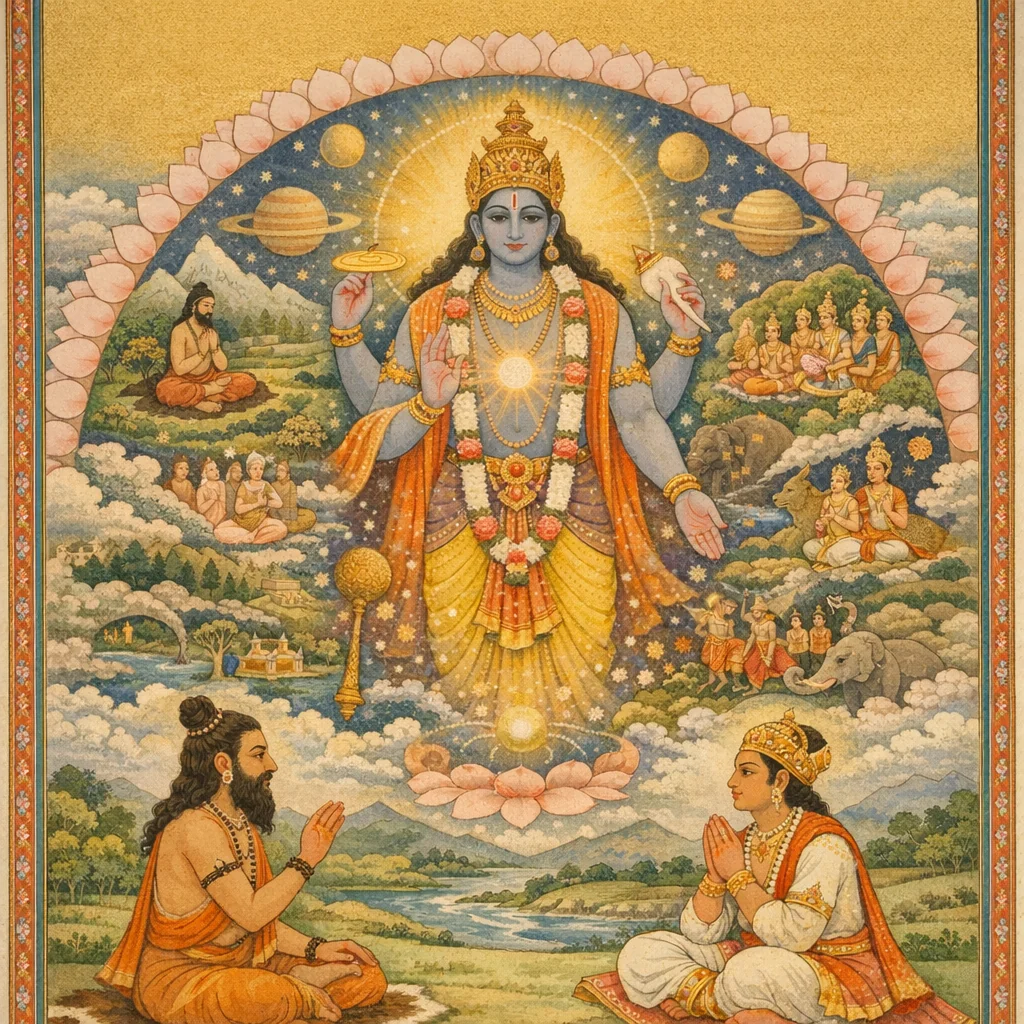
योगस्वरूप-धारणा-समाधि-वर्णनम् (केशिध्वजोपदेशः)
Sanandana recounts a dialogue in which King Keśidhvaja, famed as an authority in Nimi’s line, instructs King Khāṇḍikya on the nature of Yoga. Yoga is the deliberate joining of the mind with Brahman: when the mind clings to sense-objects it binds, and when withdrawn it liberates. The discipline proceeds in stages—yama and niyama (five each) as the ethical base; prāṇāyāma (sabīja/abīja) and pratyāhāra to master prāṇa and the senses; then dhāraṇā upon an auspicious support. Keśidhvaja distinguishes supports as higher/lower, with form/without form, and teaches a threefold bhāvanā (Brahman-oriented, karma-oriented, and mixed). Since the formless is not grasped without yogic discipline, the yogin meditates on Hari’s tangible form and the Viśvarūpa embracing the cosmic order and all beings. Dhāraṇā ripens into samādhi, culminating in non-difference from Paramātman as discriminating knowledge ceases. Both kings seek liberation: Khāṇḍikya renounces, installs his son, and is absorbed in Viṣṇu; Keśidhvaja acts without motive, burns karma, and becomes free from the threefold afflictions.
Shlokas
Verse 1
सनन्दन उवाच । एतदध्यात्ममानाढ्यं वचः केशिध्वजस्य सः । खाडिक्योऽमृतवच्छ्रुत्वा पुनराह तमीरयन् 1. ॥ १ ॥
Sanandana said: Having heard those words of Keśidhvaja—rich in the dignity of spiritual wisdom—Khāḍikya received them as nectar and spoke to him again, seeking further instruction.
Verse 2
खाण्डिक्य उवाच । तद् ब्रूहि त्वं महाभाग योगं योगविदुत्तम । विज्ञातयोगशास्त्रार्थस्त्वमस्यां निमिसन्ततौ ॥ २ ॥
Khāṇḍikya said: “Therefore, O greatly fortunate one—O best among the knowers of Yoga—teach me that Yoga. You have fully understood the purport of the Yoga-śāstras, and in this lineage of Nimi you stand as an authoritative guide.”
Verse 3
केशिध्वज उवाच । योगस्वरूपं खाण्डिक्य श्रूयतां गदतो मम । यत्र स्थितो न च्यवते प्राप्य ब्रह्मलयं मुनिः ॥ ३ ॥
Keśidhvaja said: “O Khāṇḍikya, listen as I describe the true nature of Yoga—the state in which, once established, a sage does not fall away, having attained absorption into Brahman.”
Verse 4
मन एव मनुष्याणां कारणं बन्धमोक्षयोः । बंधस्य विषयासङ्गि मुक्तेर्निर्विषयं तथा ॥ ४ ॥
The mind alone is the cause for human beings of both bondage and liberation. Clinging to sense-objects it brings bondage; free from objects, it is indeed liberation.
Verse 5
विषयेभ्यः समाहृत्य विज्ञानात्मा बुधो मनः । चिन्तयेन्मुक्तये तेन ब्रह्मभूतं परेश्वरम् ॥ ५ ॥
Having withdrawn the mind from the objects of sense, the wise one—whose very nature is true discernment—should, for the sake of liberation, contemplate the Supreme Lord, established as Brahman.
Verse 6
आत्मभावं नयेत्तेन तद्ब्रह्माध्यापनं मनः । विकार्यमात्मनः शक्त्या लोहमाकर्षको यथा ॥ ६ ॥
By that discipline, one should lead the mind into the sense of the Self; then the mind becomes absorbed in Brahman. By the power of one’s own inner energy it becomes transformable—just as a magnet draws iron.
Verse 7
आत्मप्रयत्नसापेक्षा विशिष्टा या मनोगतिः । तस्या ब्रह्मणि संयोगो योग इत्यभिधीते ॥ ७ ॥
That distinctive movement of the mind which depends upon one’s own deliberate effort—its union with Brahman is what is called “yoga.”
Verse 8
एवमत्यन्तवैशिष्ट्ययुक्तधर्मोपलक्षणम् । यस्य योगः स वै योगी मुमुक्षुरमिधीयते ॥ ८ ॥
Thus, the defining mark of one whose dharma is endowed with the highest distinction is this: the person in whom Yoga is present is truly called a yogin—a mumukṣu, one who longs for liberation.
Verse 9
योगयुक् प्रथमं योगी युञ्जमानोऽभिधीयते । विनिष्पन्नसमाधिस्तु परब्रह्मोपलब्धिमान् ॥ ९ ॥
A yogin is first called “yoga-yukta” when he is engaged in the practice of yoga. But when his samādhi has been fully accomplished, he becomes one who has realized the Supreme Brahman.
Verse 10
यद्यन्तरायदोषेण दूष्यते नास्य मानसम् । जन्मान्तरैरभ्यसनान्मुक्तिः पूर्वस्य जायते ॥ १० ॥
Even if, through the fault of obstacles, his mind becomes tainted, the liberation once cultivated before arises again by continued practice across successive births.
Verse 11
विनिष्पन्नसमाधिस्तु मुक्तिस्तत्रैव जन्मनि । प्राप्नोति योगी योगाग्निदग्धकर्मचयोऽचिरात् ॥ ११ ॥
But the yogin whose samādhi has fully matured attains liberation in that very lifetime, for his accumulated karmas are quickly burned away by the fire of yoga.
Verse 12
ब्रह्मचर्यमहिंसां च सत्यास्तेयापरिग्रहान् । सेवेतयोगी निष्कामो योगितां स्वमनो नयन् ॥ १२ ॥
The desireless yogin should practice celibacy, non-violence, truthfulness, non-stealing, and non-possessiveness—guiding his own mind into the discipline of Yoga.
Verse 13
स्वाध्यायशौचसन्तोषतपांसि नियमान्यमान् । कुर्व्वीत ब्रह्मणि तथा परस्मिन्प्रवणं मनः ॥ १३ ॥
One should practice the yamas and niyamas—self-study, purity, contentment, and austerity—and likewise incline the mind toward the Supreme Brahman.
Verse 14
एते यमाश्च नियमाः पञ्च पञ्चप्रकीर्तिताः । विशिष्टफलदाः काम्या निष्कामानां विमुक्तिदाः ॥ १४ ॥
Thus the yamas and the niyamas have been declared—five and five. Practiced with desire, they grant specific sought-after results; but for the desireless, they bestow liberation.
Verse 15
एवं भद्रा सनादीनां समास्थाय गुणैर्युतः । यमाख्यैर्नियमाख्यैश्च युञ्जीत नियतो यतिः ॥ १५ ॥
Thus, the self-restrained renunciant—firmly established in the auspicious disciplines taught by Sanaka and the others, and endowed with the needed virtues—should, with steady resolve, apply himself to practice through the observances called yamas and the disciplines called niyamas.
Verse 16
प्राणाख्यमवलंबस्थमभ्यासात्कुरुते तु यत् । प्राणायामः स विज्ञेयः सबीजोऽबीज एव च ॥ १६ ॥
That practice by which, through repeated exercise, one regulates the life-breath (prāṇa) while remaining established upon its proper basis is known as prāṇāyāma; and it is of two kinds—“with seed” (sabīja) and “without seed” (abīja).
Verse 17
परस्परेणाभिभवं प्राणापानौ यदानिलौ । कुरुतः सद्विधानेन तृतीयः संयमात्तयोः ॥ १७ ॥
When the two airs—prāṇa and apāna—properly regulated, begin to restrain and overcome one another, then by mastery (saṃyama) of them both, a third movement of vāyu arises.
Verse 18
तस्य चालंबनवत्स्थूलं रूपं द्विषत्पते । आलंबनमनन्तस्य योगिनोऽभ्यसतः स्मृतम् ॥ १८ ॥
O lord among foes, it is taught that the practising yogin should take as a support (ālambana) a tangible, gross form of That Infinite One—like a prop by which the mind is held steady.
Verse 19
शब्दादिष्वनुरक्तानि निगृह्याक्षाणि योगवित् । कुर्य्याच्चित्तानुकारीणि प्रत्याहारपरायणः ॥ १९ ॥
The knower of Yoga, intent on pratyāhāra (withdrawal of the senses), should restrain the sense-organs that cling to sound and other objects, and make them follow the mind rather than the external world.
Verse 20
वश्यता परमा तेन जायते निश्चलात्मनाम् । इन्द्रि याणामवश्यैस्तैर्न योगी योगसाधकः ॥ २० ॥
Through that discipline, supreme self-mastery arises in those whose minds are steady. But one whose senses remain uncontrolled is not a yogin, nor a true practitioner of yoga.
Verse 21
प्राणायामेन पवनैः प्रत्याहरेण चेन्द्रि यैः । वशीकृतैस्ततः कुर्यात्स्थिरं चेतः शुभाश्रये ॥ २१ ॥
Having brought the vital airs under control through prāṇāyāma, and having mastered the senses through pratyāhāra, one should then make the mind steady, resting it upon an auspicious support.
Verse 22
खाण्डिक्य उवाच । कथ्यतां मे महाभाग चेतसो यः शुभाश्रयः । यदाधारमशेषं तु हन्ति दोषसमुद्भवम् ॥ २२ ॥
Khāṇḍikya said: O great one, please tell me of that auspicious refuge of the mind—upon which, when it is taken as one’s support, the entire arising of faults is destroyed.
Verse 23
केशिध्वज उवाच । आश्रयश्चेतसो ज्ञानिन् द्विधा तच्च स्वरूपतः । रूपं मूर्तममूर्तं च परं चापरमेव च ॥ २३ ॥
Keśidhvaja said: O knower of truth, the mind’s support is, by its very nature, twofold: it is of the nature of form—both embodied and unembodied—and it is also higher and lower.
Verse 24
त्रिविधा भावना रूपं विश्वमेतत्त्रिधोच्यते । ब्रह्माख्या कर्मसंज्ञा च तथा चैवोभयात्मिका ॥ २४ ॥
This universe, whose very form is shaped by bhāvanā (cognition and contemplation), is described as threefold: (1) that called Brahman, (2) that termed karma (action and ritual duty), and (3) that which is of a dual nature, partaking of both.
Verse 25
कर्मभावात्मिका ह्येका ब्रह्मभावात्मिका परा । उभयात्मिका तथैवान्या त्रिविधा भावभावना ॥ २५ ॥
Indeed, one cultivation of contemplation (bhāvanā) is oriented to the disposition of action (karma-bhāva); another, higher, is oriented to the disposition of Brahman (brahma-bhāva). Yet another is of a mixed nature. Thus, contemplative cultivation is threefold.
Verse 26
सनकाद्यासदा ज्ञानिन् ब्रह्मभावनया युताः । कर्मभावनया चान्ये देवाद्याः स्थावराश्चराः ॥ २६ ॥
Sanaka and the other sages are ever established in knowledge, endowed with contemplation of Brahman (brahma-bhāvanā); whereas other beings—beginning with the gods, both moving and unmoving—are oriented by contemplation of action (karma-bhāvanā).
Verse 27
हिरण्यगर्भादिषु च ब्रह्मकर्मात्मिका द्विधा । अधिकारबोधयुक्तेषु विद्यते भावभावना ॥ २७ ॥
Even among Hiraṇyagarbha and others, this orientation is twofold—grounded in Brahman and in ritual action (karma). In those who possess awareness of spiritual eligibility (adhikāra), there arises the cultivation of the right inner disposition.
Verse 28
अक्षीणेषु समस्तेषु विशेषज्ञानकर्मसु । विश्वमेतत्परं चान्यद्भेदभिन्नदृशां नृप ॥ २८ ॥
O King, so long as all particularized knowledges and actions remain unexhausted (persisting as limiting tendencies), this universe appears as one thing and the Supreme as another to those whose vision is split by distinctions.
Verse 29
प्रत्यस्तमितभेदं यत्सत्तामात्रमगोचरम् । वचसामात्मसन्तोद्यं तज्ज्ञानं ब्रह्मसंज्ञितम् ॥ २९ ॥
That knowledge is called “Brahman”: wherein all distinctions have subsided, which is sheer Being alone beyond the reach of the senses, not an object of speech, but the inward awakening of the Self.
Verse 30
तच्च विष्णोः परं रूपमरूपस्याजनस्य च । विश्वस्वरूपवैरूप्यलक्षणं परमात्मनः ॥ ३० ॥
That indeed is the supreme form of Viṣṇu—of the Formless and Unborn One: the mark of the Paramātman, whose very nature is the universe itself, appearing in manifold forms and diverse manifestations.
Verse 31
न तद्योगयुजा शक्यं नृप चिन्तयितुं यतः । ततः स्थूलं हरे रूपं चिन्त्यं यच्चक्षुगोचरम् ॥ ३१ ॥
O King, since that subtle, formless reality cannot be contemplated by one undisciplined in Yoga, therefore one should meditate upon the tangible form of Hari—the form that is accessible to the eye.
Verse 32
हिरण्यगर्भो भगवान्वासवोऽथ प्रजापतिः । मरुतो वसवो रुद्रा भास्करास्तारका ग्रहाः ॥ ३२ ॥
The Blessed Hiraṇyagarbha (Brahmā), then Vāsava (Indra) and Prajāpati; the Maruts, the Vasus, the Rudras; the suns, the stars, and the planets—all these constitute the divine cosmic order.
Verse 33
गन्धार्वा यक्षदैत्याश्च सकला देवयोनयः । मनुष्याः पशवः शैला समुद्रा ः सरितो द्रुमाः ॥ ३३ ॥
Gandharvas, Yakṣas, and Daityas—indeed all classes born of divine origins—along with human beings and animals; mountains, oceans, rivers, and trees: all these are encompassed within this cosmic arrangement.
Verse 34
भूप भूतान्यशेषाणि भूतानां ये च हेतवः । प्रधानादिविशेषान्ताश्चेतनाचेतनात्मकम् ॥ ३४ ॥
O King, all beings without exception—and also the causes of beings—ranging from Pradhāna up to the specific differentiating principles (Viśeṣa), are of the nature of both the sentient and the insentient.
Verse 35
एकपादं द्विपादं च बहुपादमपादकम् । मूर्त्तमेतद्धरे रूपं भावनात्रितयात्मकम् ॥ ३५ ॥
One-footed, two-footed, many-footed, and even footless—this is the manifest form (mūrti) of Hari, constituted of the threefold mode of contemplation (bhāvanā).
Verse 36
एतत्सर्वमिदं विश्वं जगदेतच्चराचरम् । परब्रह्मस्वरूपस्य विष्णोः शक्तिसमन्वितम् ॥ ३६ ॥
This entire universe—this world of moving and unmoving beings—is pervaded and sustained by the Śakti of Viṣṇu, whose very nature is the Supreme Brahman.
Verse 37
विष्णुशक्तिः परा प्रोक्ता क्षेत्रज्ञाख्या तथापरा । अविद्याकर्मसंज्ञान्या तृतीया शक्तिरिष्यते ॥ ३७ ॥
Viṣṇu’s Śakti is declared to be supreme (parā). Another is called the Śakti of the Knower of the Field (kṣetrajña). The third Śakti is recognized as that which is known as ignorance and action (avidyā and karma).
Verse 38
येयं क्षेत्रज्ञशक्तिः सा चेष्टिता नृप कर्मजा । असारभूते संसारे प्रोक्ता तत्र महामते ॥ ३८ ॥
This Śakti of the Knower of the Field (kṣetrajña) is called ceṣṭā, “activity,” O king, and it arises from karma. It is taught thus in the insubstantial world of saṃsāra, O great-minded one.
Verse 39
संसारतापानखिलानवाप्नोत्यनुसंज्ञितान् । तया तिरोहितत्वात्तु शक्तिः क्षेत्रज्ञसंज्ञिता ॥ ३९ ॥
It is not touched by all the manifold torments and burning pains of saṃsāra that are known in experience. Yet, because it is veiled by that power, the Śakti is designated as the “Knower of the Field” (kṣetrajña).
Verse 40
सर्वभूतेषु भूपाल तारतम्येन लक्ष्यते । अप्राणवत्सु खल्वल्पा स्थावरेषु ततोऽधिका ॥ ४० ॥
O king, among all beings it is perceived in graded degrees. In the non-living it is exceedingly slight, and in the immobile (plants and fixed beings) it is greater than that.
Verse 41
सरीसृपेषु तेभ्योऽन्याप्यतिशक्त्या पतत्त्रिषु । पतत्त्रिभ्यो मृगास्तेभ्यः स्वशक्त्या पशवोऽधिकाः ॥ ४१ ॥
Among creeping creatures, those endowed with greater power are the birds. Superior to birds are the wild animals; and superior to those, by their own inherent strength, are the domesticated beasts (cattle and the like).
Verse 42
पशुभ्यो मनुजाश्चातिशक्त्या पुंसः प्रभाविताः । तेभ्योऽपि नागगन्धर्वयक्षाद्या देवता नृप ॥ ४२ ॥
Men surpass animals by a far greater power and capacity. Even beyond men, O king, are the divine classes such as the Nāgas, Gandharvas, Yakṣas, and others.
Verse 43
शक्रः समस्तदेवेभ्यस्ततश्चातिप्रजापतिः । हिरण्यगर्भोऽपि ततः पुंसः शक्त्युपलक्षितः ॥ ४३ ॥
Among all the gods He is called Śakra (Indra); beyond them He is (also) Prajāpati. Beyond that again, He is known as Hiraṇyagarbha—thus that Supreme Person is distinguished by His powers and functions.
Verse 44
एतान्यशेषरूपाणि तस्य रूपाणि पार्थिव । यतस्तच्छक्तियोगेन युक्तानि नभसा यथा ॥ ४४ ॥
O earthly one, all these innumerable forms are indeed His forms, for they are connected to Him through the union of His own power—just as all things are held and borne by space.
Verse 45
द्वितीयं विष्णुसंज्ञस्य योगिध्येयं महामते । अमूर्तं ब्रह्मणो रूपं यत्सदित्युच्यते बुधैः ॥ ४५ ॥
O great-minded one, the second mode of contemplation of Him who is known as Viṣṇu—worthy of yogins’ meditation—is the formless form of Brahman, which the wise call “Sat,” pure Being.
Verse 46
समस्ताः शक्तयश्चैता नृप यत्र प्रतिष्ठिताः । नहि स्वरूपरूपं वै रूपमन्यद्धरेर्महत् ॥ ४६ ॥
O King, all these powers (śaktis) are firmly established in Him. Indeed, there is no other great form of Hari apart from His own essential form.
Verse 47
समस्तशक्तिरूपाणि तत्करोति जनेश्वर । देवतिर्यङ्मनुष्यादिचेष्टावन्ति स्वलीलया ॥ ४७ ॥
O Lord of beings, He manifests in the forms of all powers and performs that cosmic activity. By His own divine play (līlā), the gods, animals, humans, and others become active in their respective functions.
Verse 48
जगतामुपकाराय तस्य कर्मनिमित्तजा । चेष्टा तस्याप्रमेयस्य व्यापिन्यविहितात्मिका ॥ ४८ ॥
For the welfare of all worlds, the activity of that immeasurable Lord arises in connection with karma and action; yet, being all-pervading, it is of an unconditioned nature.
Verse 49
तद्रू पं विश्वरूपस्य चिन्त्यं योगयुजा नृप । तस्य ह्यात्मविशुर्द्ध्य्थं सर्वकिल्बिषनाशनम् ॥ ४९ ॥
O King, the yogin should contemplate that form of the Viśvarūpa, the Universal Form; for it purifies the self and destroys all sin and impurity.
Verse 50
यथाग्निरुद्धतशिखः कक्षं दहति सानिलः । तथा चित्तस्थितो विष्णुर्योगिनां सर्वकिल्बिषम् ॥ ५० ॥
As fire, its flames driven high by the wind, burns up dry brushwood, so Vishnu—when established within the mind—burns away all the sins and impurities of yogins.
Verse 51
तस्मात्समस्तशक्तीनामाद्यान्ते तत्र चेतसः । कुर्वीत संस्थितं साधु विज्ञेया शुद्धलक्षणा ॥ ५१ ॥
Therefore, at the beginning and at the end, one should steadily establish the mind there—upon the primal Power of all powers; that steadfast absorption is to be known as the mark of purity.
Verse 52
शुभाश्रयः सचित्तस्य सर्वगस्य तथात्मनः । त्रिभावभावनातीतो मुक्तये योगिनां नृप ॥ ५२ ॥
O king, that Reality is the auspicious refuge of the mind; it pervades all and is the very Self. Transcending all contemplation of the three states, it becomes the means of liberation for yogins.
Verse 53
अन्ये तु पुरुषव्याघ्र चेतसो ये व्यपाश्रयाः । अशुद्धास्ते समस्तास्तु देवाद्याः कर्मयोनयः ॥ ५३ ॥
But others, O tiger among men, who take refuge in mere mental constructions, are all impure; even the gods and the rest are births arising from karma.
Verse 54
मूर्त्तं भगवतो रूपं सर्वापाश्रयनिस्पृहः । एषा वै धारणा ज्ञेया यच्चित्तं तत्र धार्यते ॥ ५४ ॥
Know this to be true dhāraṇā (concentration): when, free from craving for any other refuge or support, one steadies the mind upon the manifest form of Bhagavān.
Verse 55
तत्र मूर्त्तं हरे रूपं यादृक् चिन्त्यं नराधिप । तच्छ्रूयतामनाधारे धारणा नोपपद्यते ॥ ५५ ॥
There, O king, hear of the embodied form of Hari that is to be contemplated; for without a support (an object of meditation), dhāraṇā—steady concentration—cannot properly arise.
Verse 56
प्रसन्नचारुवदनं पद्मपत्रायतेक्षणम् । सुकपोलं सुविस्तीर्णं ललाटफलकोज्ज्वलम् ॥ ५६ ॥
He had a serene and lovely face, eyes elongated like lotus-petals, well-shaped cheeks, and a broad, radiant forehead.
Verse 57
समकर्णांसविन्यस्तचारुकर्णोपभूषणम् । कम्बुग्रीवं सुविस्तीर्णश्रीवत्साङ्कितवक्षसम् ॥ ५७ ॥
He is adorned with beautiful ear-ornaments set in perfect symmetry along the line of the ears and shoulders; his neck is shaped like a conch, and his broad chest bears the sacred Śrīvatsa mark.
Verse 58
बलित्रिभङ्गिना भुग्ननाभिना चोदरेण वै । प्रलम्बाष्टभुजं विष्णुमथवापि चतुर्भुजम् ॥ ५८ ॥
One may meditate upon Viṣṇu in the graceful triple-bend posture (tribhaṅga), with a slightly curved navel and a rounded belly—either as the majestic eight-armed Lord, or else as the four-armed Lord.
Verse 59
समस्थितोरुजघनं सुस्थिराङिघ्रकराम्बुजम् । चिन्तयेद्ब्रह्मभूतं तं पीतनिर्मलवाससम् ॥ ५९ ॥
One should meditate upon that Lord, realized as Brahman—whose broad hips and thighs are held in perfect poise, whose lotus-feet and lotus-hands are steady and composed, and who is clad in spotless yellow garments.
Verse 60
किरीटचारुकेयूरकटकादिविभूषितम् । शार्ङ्गशङ्खगदाखड्गप्रकाशवलयाञ्चितम् ॥ ६० ॥
Adorned with a splendid crown, lovely armlets, bracelets, and other ornaments; and encircled by the radiant emblems—Śārṅga (the bow), the conch, the mace, and the sword.
Verse 61
चिन्तयेत्तन्मयो योगी समाधायात्ममानसम् । तावद्यावद् दृढीभूता तत्रैव नृप धारणा ॥ ६१ ॥
Having steadied his inner mind in samādhi, the yogin should contemplate the Supreme until he becomes wholly absorbed in That. O King, this is dhāraṇā—remaining fixed there until the concentration becomes firm.
Verse 62
वदतस्तिष्ठतो यद्वा स्वेच्छया कर्म कुर्वतः । नापयाति यदा चित्तात्सिद्धां मन्येत तां तदा ॥ ६२ ॥
Whether one is speaking, standing, or acting by one’s own choice—when that inner awareness no longer departs from the mind, then one should know it to be perfected (siddhā).
Verse 63
ततः शङ्खगदाचक्रशार्ङ्गादिरहितं बुधः । चिन्तयेद्भगवद्रू पं प्रशान्तं साक्षसूत्रकम् ॥ ६३ ॥
Then the wise person should contemplate the form of the Blessed Lord as free from the conch, mace, discus, and Śārṅga bow and the like—utterly tranquil, and directly bearing the sacred thread.
Verse 64
सा यदा धारणा तद्वदवस्थानवती ततः । किरीटकेयूरमुखैर्भूषणैः रहितं स्मरेत् ॥ ६४ ॥
When that concentration (dhāraṇā) becomes steady and firmly established, then one should contemplate the Lord as free from ornaments—such as crown and armlets—and the like.
Verse 65
तदेकावयवं चैवं चेतसा हि पुनर्बुधः । कुर्यात्ततोऽवयविनि प्रणिधानपरो भवेत् ॥ ६५ ॥
Thus the wise one should again take up in the mind a single part as the focus, and from that proceed to the whole that possesses the parts; then he becomes devoted to praṇidhāna, deep concentration upon that whole.
Verse 66
तद्रू पप्रत्यये चैकसंनतिश्चान्यनिःस्पृहा । तद्ध्य्नां प्रथमैरङ्गैः षड्भिर्निष्पाद्यते नृप ॥ ६६ ॥
O king, steadiness in the perception of His very form, one-pointed absorption, and freedom from craving for anything else—this meditation on Him is accomplished through the first six limbs, the preliminary disciplines.
Verse 67
तस्यैवं कल्पनाहीनं स्वरूपग्रहणं हि यत् । मनसा ध्याननिष्पाद्यं समाधिः सोऽभिधीयते ॥ ६७ ॥
When, in this way, the mind—through contemplative meditation—apprehends That Reality’s essential nature, free from all mental constructions, this is called samādhi.
Verse 68
विज्ञानं प्रापकं प्राप्ये परे ब्रह्मणि पार्थिव । प्रापणीयस्तथैवात्मा प्रक्षीणाशेषभावनः ॥ ६८ ॥
O king, with regard to the Supreme Brahman—the goal to be attained—vijñāna, discriminative knowledge, is the means of attainment; and the Self is indeed what is attained when all residual bhāvanās have been completely exhausted.
Verse 69
क्षेत्रज्ञकरणीज्ञानं करणं तेन तस्य तत् । निष्पाद्य मुक्तिकार्यं वै कृतकृत्यो निवर्तते ॥ ६९ ॥
The knowledge to be cultivated concerning the Knower of the Field (kṣetrajña) becomes the seeker’s instrument. Having accomplished the work of liberation, he is fulfilled in purpose and withdraws from further striving.
Verse 70
तद्भावभावनापन्नस्ततोऽसौ परमात्मनः । भवत्यभेदी भेदश्च तस्याज्ञानकृतो भवेत् ॥ ७० ॥
Absorbed in the contemplation of That (the Supreme Reality), he then becomes non-different from the Paramātman. Any sense of difference with regard to That arises only from ignorance.
Verse 71
विभेदजनके ज्ञाने नाशमात्यन्तिकं गते । आत्मनो ब्रह्मणाभेदं संमतं कः करिष्यति ॥ ७१ ॥
When the knowledge that produces differentiation has completely ceased, who will maintain the accepted view of the self’s non-difference from Brahman?
Verse 72
इत्युक्तस्ते मया योगः खाण्डिक्य परिपृच्छतः । संक्षेपविस्तराभ्यां तु किमन्यत्क्रियतां तव ॥ ७२ ॥
Thus, O Khāṇḍikya, the Yoga has been explained to you by me—since you inquired—both in brief and in detail. What else would you have me do for you?
Verse 73
खाण्डिक्य उवाच । कथितो योगसद्भावः सर्वमेव कृतं मम । तवोपदेशात्सकलो नष्टश्चित्तमलो मम ॥ ७३ ॥
Khāṇḍikya said: “You have explained the true nature of Yoga; for me, everything has been accomplished. Through your instruction, the entire impurity of my mind has been destroyed.”
Verse 74
ममेति यन्मया प्रोक्तमसदेतन्न चान्यथा । नरेन्द्र गदितुं शक्यमपि विज्ञेयवेदिभिः ॥ ७४ ॥
“Mine”—whatever I have described in that way—is unreal, and it is not otherwise. O king of men, even those who are skilled in what is to be known cannot truly state it as ultimately real.
Verse 75
अहं ममेत्यविद्येयं व्यवहारस्तथानयोः । परमार्थस्त्वसंलाप्यो वचसां गोचरो न यः ॥ ७५ ॥
The transactional notion of “I” and “mine” is born of ignorance—thus do the dealings of embodied beings proceed. But the Supreme Reality (paramārtha) is beyond verbal negotiation; it is not an object within the range of speech.
Verse 76
तद्गच्छ श्रेयसे सर्वं ममैतद्भवता कृतम् । यद्विमुक्तिपरो योगः प्रोक्तः केशिध्वजाव्ययः ॥ ७६ ॥
Therefore, go on for the highest good; all this has been accomplished for me by you—because you have expounded the imperishable yoga whose aim is complete liberation, O Keśidhvaja.
Verse 77
सनन्दन उवाच । यथार्हपूजया तेन खाण्डिक्येन स पूजितः । आजगाम पुरं ब्रह्मंस्ततः केशिध्वजो नृपः ॥ ७७ ॥
Sanandana said: Having been honored by that Khāṇḍikya with fitting hospitality and worship, King Keśidhvaja then came to the city, O Brahmin.
Verse 78
खाण्डिक्योऽपि सुतं कृत्वा राजानं योगसिद्धये । विशालामगमत्कृष्णे समावेशितमानसः ॥ ७८ ॥
Khāṇḍikya too, having installed his son as king for the sake of attaining perfection in yoga, went to Viśālā—his mind fully absorbed in Kṛṣṇa.
Verse 79
स तत्रैकान्तिको भूत्वा यमादिगुणसंयुतः । विष्ण्वाख्ये निर्मले ब्रह्मण्यवाप नृपतिर्लयम् ॥ ७९ ॥
There, becoming single-minded (in devotion) and endowed with the virtues beginning with the yamas, the king attained laya—final dissolution—in the stainless Supreme Reality known as Viṣṇu.
Verse 80
केशिध्वजोऽपि मुक्त्यर्थं स्वकर्मक्षपणोन्मुखः । बुभुजे विषयान्कर्म चक्रे चानभिसन्धितम् ॥ ८० ॥
Even Keśidhvaja, intent on liberation and set on wearing away the residue of former karma, partook of worldly objects; yet he acted without ulterior motive and without expectation of results.
Verse 81
स कल्याणोपभोगैश्च क्षीणपापोऽमलस्ततः । अवाप सिद्धिमत्यन्तत्रितापक्षपणीं मुने ॥ ८१ ॥
Then, his sins exhausted and his being made stainless, he enjoyed auspicious attainments and, O sage, obtained a perfection that utterly destroys the threefold afflictions.
Verse 82
एतत्ते कथितं सर्वं यन्मां त्वं परिपृष्टवान् । तापत्रयचिकित्सार्थं किमन्यत्कथयामि ते ॥ ८२ ॥
All that you asked of me I have told you in full. For the curing of the threefold afflictions, what more is there for me to explain to you?
Verse 83
इति श्रीबृहन्नारदीयपुराणे पूर्वभागे द्वितीयपादे सप्तचत्वारिंशत्तमोऽध्यायः ॥ ४७ ॥
Thus ends the forty-seventh chapter of the sacred Bṛhannāradīya Purāṇa, in the First Part (Pūrvabhāga), Second Section (Dvitīya-pāda).
Frequently Asked Questions
Because the formless, unborn Sat-Brahman is said to be inaccessible to one not yet disciplined in Yoga; therefore a gross, visible ālambana (Hari’s form/Viśvarūpa) stabilizes the mind until dhāraṇā matures into construction-free samādhi.
Yoga is defined as the distinctive, effort-dependent movement of the mind whereby it is united with Brahman—i.e., intentional mental integration culminating in absorption.
When practiced with desire, they yield specific sought-after results; when practiced without desire (as a mumukṣu), they become direct supports for liberation by purifying and steadying the mind for higher limbs of Yoga.