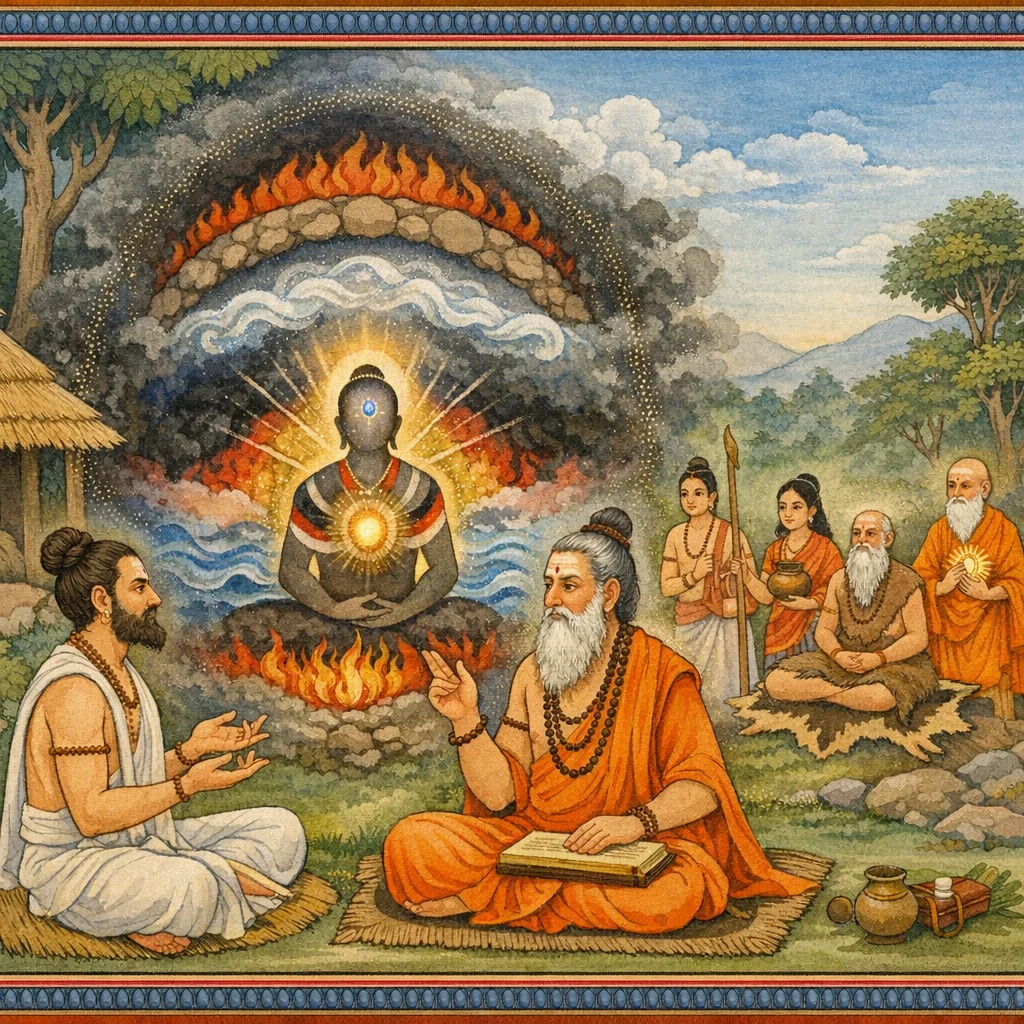
Jīva–Ātman Inquiry; Kṣetrajña Doctrine; Karma-based Varṇa; Four Āśramas and Sannyāsa Discipline
Bharadvāja begins with a skeptical question: if prāṇa (vāyu) and bodily heat (agni/tejas) explain life, why posit a separate jīva? Through Sanandana’s narrative turn, Bhṛgu replies that prāṇa and bodily functions are not the Self; the embodied being transmigrates while the gross body dissolves into the elements. Pressed for the jīva’s defining mark amid the five elements and the mind–sense junction, Bhṛgu points to the Inner Ātman as the knower of sense-objects, the indwelling Lord who alone tastes joy and sorrow; He is called Kṣetrajña, and the three guṇas (sattva/rajas/tamas) condition the jīva’s states. The teaching then moves to creation and social order: varṇa is not innate but grounded in karma and conduct, with brāhmaṇa, kṣatriya, vaiśya, and śūdra defined by ethical discipline. Bhṛgu commends restraint of greed and anger, truth, compassion, and dispassion as supports of mokṣa-dharma. Finally he sets dharma within the four āśramas—brahmacarya, gṛhastha, vānaprastha, sannyāsa—describing duties, hospitality, non-violence, and the renunciant’s inner Agnihotra culminating in Brahmaloka.
Shlokas
Verse 1
भरद्वाज उवाच । यदि प्राणपतिर्वायुर्वायुरेव विचेष्टते । श्वसित्याभाषते चैव ततो जीवो निरर्थकः ॥ १ ॥
Bharadvāja said: If Vāyu, the vital air, is the lord of prāṇa, and if Vāyu alone performs all activity—breathing and even speech—then the jīva becomes meaningless as an independent principle.
Verse 2
य ऊष्मभाव आग्नेयो वह्निनैवोपलभ्यते । अग्निर्जरयते चैतत्तदा जीवो निरर्थकः ॥ २ ॥
That state of heat, fiery in nature, is known only through fire itself. And when that fire consumes and ages this body, then the jīva—if taken to be merely that heat-life—proves meaningless as an identity.
Verse 3
जंतोः प्रम्नियमाणस्य जीवो नैवोपलभ्यते । वायुरेव जहात्येनमूष्मभावश्च नश्यति ॥ ३ ॥
When a living being is carried off by death, the ‘jīva’ is not perceived at all; only the vital wind departs from him, and the body’s warmth-state also vanishes.
Verse 4
यदि वाथुमयो जीवः संश्लेषो यदि वायुना । वायुमंजलवत्पश्येद्गच्छेत्सह मरुद्गुणैः ॥ ४ ॥
If the jīva were truly made of wind, or merely an aggregate formed by wind, then it would be seen like a cluster of air and would move along together with the properties of the wind.
Verse 5
संश्लेषो यदि वा तेन यदि तस्मात्प्रणश्यति । महार्णवविमुक्तत्वादन्यत्सलिलभाजनम् ॥ ५ ॥
Whether one remains in contact with it or is ruined because of it—once freed from the great ocean, it becomes something else: merely a vessel of water.
Verse 6
कृपे वा सलिलं दद्यात्प्रदीपं वा हुताशने । क्षिप्रं प्रविश्य नश्येत यथा नश्यत्यसौ तथा ॥ ६ ॥
If one were to pour water into a well, or place a lamp into fire, it would quickly enter and be destroyed; in the same way, that perishes.
Verse 7
पंचधारणके ह्यस्मिञ्छरीरे जीवितं कृतम् । येषामन्यतराभावाञ्चतुर्णां नास्ति संशयः ॥ ७ ॥
Indeed, life in this body is established upon five sustaining supports. Of these, if any one of the four is absent, there is no doubt that life cannot continue.
Verse 8
नश्यंत्यापो ह्यनाहाराद्वायुरुच्छ्वासनिग्रहात् । नश्यते कोष्टभेदार्थमग्रिर्नश्यत्यभोजनात् ॥ ८ ॥
Watery elements waste away through fasting; the vital wind is checked by restraining the breath. For cleansing, the bodily channels are opened, and the digestive fire is extinguished by not eating.
Verse 9
व्याधित्रणपरिक्लेशैर्मेदिनी चैव शीर्यते । पीडितेऽन्यतरे ह्येषां संघातो याति पंचताम् ॥ ९ ॥
Through the torments of illness, injury, and affliction, the body indeed decays; for when even one of these is severely struck, this aggregate goes to dissolution—returning to the state of the five elements.
Verse 10
तस्मिन्पंचत्वमापन्ने जीवः किमनुधावति । किं खेदयति वा जीवः किं श्रृणोति ब्रवीति च ॥ १० ॥
When that body has fallen into the state of the five elements—when death has come—what can the jīva then pursue? For what can the jīva grieve? What can the jīva hear, and what can it speak?
Verse 11
एषा गौः परलोकस्थं तारयिष्यतिमामिति । यो दत्त्वा म्रियते जंतुः सा गौः कं तारयिष्यति ॥ ११ ॥
Thinking, “This cow will deliver me in the next world,” a person gives it away and then dies; but if he dies immediately after giving, whom will that cow deliver?
Verse 12
गौश्चप्रतिग्रहीता च दाता चैव समं यदा । इहैव विलयं यांति कुतस्तेषां समागमः ॥ १२ ॥
When the cow, the receiver of the gift, and the giver all come together at the same time, they perish here itself; how, then, could there be any auspicious “coming together” or good result for them?
Verse 13
विहगैरुपभुक्तस्य शैलाग्रात्पतितस्य च । अग्निना चोपयुक्तस्य कुतः संजीवनं पुनः ॥ १३ ॥
How could there be life again for one already eaten by birds, for one who has fallen from a mountain peak, or for one who has been consumed by fire?
Verse 14
छिन्नस्य यदि वृक्षस्य न मूलं प्रतिरोहति । जीवन्यस्य प्रवर्तंते मृतः क्व पुनरेष्यति ॥ १४ ॥
If, when a tree is cut down, its root does not grow back, then the activities of a living being proceed only so long as life remains; once he is dead, how could he ever return again?
Verse 15
जीवमात्रं पुरा सृष्टं यदेतत्परिवर्तते । मृताः प्रणश्यंति बीजाद्बीजं प्रणश्यति ॥ १५ ॥
In the beginning, only embodied living beings were created; and this world-process keeps turning on. The dead pass away, and even the seed—though producing a seed—perishes.
Verse 16
इति मे संशयो ब्रह्मन्हृदये परिधावति । त निवर्तय सर्वज्ञ यतस्त्वामाश्रितो ह्यहम् ॥ १६ ॥
Thus, O Brahman, this doubt keeps racing about in my heart. Dispel it, O all-knowing one, for I have indeed taken refuge in you.
Verse 17
सनंदन उवाच । एवं पृष्टस्तदानेन स भृगर्ब्रह्मणः सुतः । पुनराहु मुनिश्रेष्ट तत्संदेहनिवृत्तये ॥ १७ ॥
Sanandana said: Thus questioned by him at that time, that son of Bhṛgu—born of Brahmā—spoke again, O best of sages, in order to remove that doubt.
Verse 18
भृगुरुवाच । न प्राणाः सन्ति जीवस्य दत्तस्य च कृतस्य च । याति देहांतरं प्राणी शरीरं तु विशीर्यते ॥ १८ ॥
Bhṛgu said: The life-breaths are not the true self of the jīva—nor are they the same as what is ‘given’ or what is ‘done’ (merit and action). The embodied being passes into another body, while this physical body only falls apart and perishes.
Verse 19
न शरीराश्रितो जीवस्तस्मिन्नष्टे प्रणश्यति । समिधामग्निदग्धानां यथाग्रिर्द्दश्यते तथा ॥ १९ ॥
The jīva (Self) is not dependent on the body; it does not perish when the body is destroyed. Just as fire is seen in pieces of fuel even after they have been burnt by fire, so too is the Self understood to persist beyond the body’s destruction.
Verse 20
भरद्वाज उवाच । अग्नेर्यथा तस्य नाशात्तद्विनाशो न विद्यते । इन्धनस्योपयोगांते स वाग्निर्नोपलभ्यते ॥ २० ॥
Bharadvāja said: Just as, when the manifest flame ceases, the fire-principle itself is not destroyed; and when the fuel has been wholly consumed, that same fire is no longer perceived—so too the Reality remains, though its appearance comes to an end.
Verse 21
नश्यतीत्येव जानामि शांतमग्निमनिन्धनम् । गतिर्यस्य प्रमाणं वा संस्थानं वा न विद्यते ॥ २१ ॥
I know only that it is said to “cease”—like a fire grown tranquil, with no fuel remaining. For it has no course of movement, no measurable extent, and no fixed form.
Verse 22
भृगुरुवाच । समिधामुपयोगांते स चाग्निर्नोपलभ्यते । नश्यतीत्येव जानामि शांतमग्निमनिंधनम् ॥ २२ ॥
Bhṛgu said: “When the fuel-sticks have been used up, that fire is no longer found. I understand that it has ‘perished’—having become extinguished, with no further fuel.”
Verse 23
गतिर्यस्य प्रमाणं वा संस्थानं वा न विद्यते । समिधामुपयोगांते यथाग्निर्नोपलभ्यते ॥ २३ ॥
That Supreme Reality has no course of movement, no measurable proof, and no definable form—just as fire is no longer found when the fuel-sticks have been completely consumed.
Verse 24
आकाशानुगतत्वाद्धि दुर्ग्राह्यो हि निराश्रयः । तथा शरीरसंत्यागे जीवो ह्याकाशवत्स्थितः ॥ २४ ॥
Because it accords with the nature of space (ākāśa), it is indeed hard to grasp and has no material support. Likewise, upon abandoning the body, the jīva remains situated like space.
Verse 25
न नश्यते सुसूक्ष्मत्वाद्यथा ज्योतिर्न संशयः । प्राणान्धारयते ह्यग्निः स जीव उपधार्यताम् ॥ २५ ॥
Because it is exceedingly subtle, it does not perish—just as light does not perish; of this there is no doubt. For fire indeed sustains the vital breaths (prāṇa); therefore understand that sustaining principle to be the jīva, the living self embodied.
Verse 26
वायुसंधारणो ह्यग्निर्नश्यत्युच्छ्वासनिग्रहात् । तस्मिन्नष्टे शरीराग्नौ ततो देहमचेतनम् ॥ २६ ॥
The bodily fire (digestive vitality) is sustained by the vital air, yet it is destroyed when exhalation is forcibly restrained. When that bodily fire is extinguished, the body then becomes insentient.
Verse 27
पतितं याति भूमित्वमयनं तस्य हि क्षितिः । जगमानां हि सर्वेषां स्थावराणां तथैव च ॥ २७ ॥
Whatever falls down becomes ‘earth’, for the ground (kṣiti) is indeed its resting place. This holds for all moving beings, and likewise for the immobile ones.
Verse 28
आकाशं पवनोऽन्वेति ज्योतिस्तमनुगच्छति । तेषां त्रयाणामेकत्वाद्वयं भूमौ प्रतिष्टितम् ॥ २८ ॥
Air follows and depends upon space, and fire follows and depends upon that air. Because these three are essentially one interconnected reality, the remaining pair (water and earth) becomes established on the earth-plane as a stable support.
Verse 29
यत्र खं तत्र पवनस्तत्राग्निर्यत्र मारुतः । अमूर्तयस्ते विज्ञेया मूर्तिमंतः शरीरिणः ॥ २९ ॥
Wherever there is space, there is air; and where there is air, there is fire. These (subtle elements) are to be understood as formless, whereas embodied beings possess form.
Verse 30
भरद्वाज उवाच । यद्यग्निमारुतौ भूमिः खमापश्च शरीरिषु । जीवः किंलक्षणस्तत्रेत्येतदाचक्ष्व मेऽनघ ॥ ३० ॥
Bharadvāja said: “If, within embodied beings, earth, water, space, and also fire and wind are present, then what is the defining mark of the jīva there? O sinless one, explain this to me.”
Verse 31
पंचात्मके पञ्चरतौ पञ्चविज्ञानसंज्ञके । शरीरे प्राणिनां जीवं वेत्तुभिच्छामि यादृशम् ॥ ३१ ॥
In this body of living beings—fivefold in nature, delighting in the five sense-objects, and designated as fivefold cognition—I wish to know what the jīva is like.
Verse 32
मांसशोणितसंघाते मेदःस्नाय्वस्थिसंचये । भिद्यमाने शरीरे तु जीवो नैवोपलभ्यते ॥ ३२ ॥
In this body—an aggregate of flesh and blood, a mass of fat, sinews, and bones—even when it is cut open and examined, the jīva is not found at all.
Verse 33
यद्यजीवशरीरं तु पञ्चभूतसमन्वितम् । शरीरे मानसे दुःख कस्तां वेदयते रुजम् ॥ ३३ ॥
If the body is in fact insentient, composed of the five great elements, then when sorrow arises in the body and in the mind—who is it that actually feels that pain?
Verse 34
श्रृणोति कथितं जीवः कर्णाभ्यांन श्रृणोति तत् । महर्षे मनसि व्यग्रे तस्माज्जीवो निरर्थकः ॥ ३४ ॥
The jīva hears what is spoken, yet does not truly hear it with the ears; O great sage, when the mind is distracted, that living being becomes incapable of any real purpose.
Verse 35
सर्वे पश्यंति यदृश्यं मनोयुक्तेन चक्षुषा । मनसि व्याकुले चक्षुः पश्यन्नपि न पश्यति ॥ ३५ ॥
All beings see what is to be seen only with eyes joined to the mind. When the mind is disturbed, the eye—even while looking—does not truly see.
Verse 36
न पश्यति न चाघ्राति न श्रृणोति न भाषते । न च स्मर्शमसौ वेत्ति निद्रावशगतः पुनः ॥ ३६ ॥
When overcome by sleep, one neither sees nor smells, neither hears nor speaks; nor does one even perceive touch, being wholly under the sway of sleep.
Verse 37
हृष्यति क्रुद्ध्यते कोऽत्र शोचत्युद्विजते च कः । इच्छति ध्यायति द्वेष्टि वाक्यं वाचयते च कः ॥ ३७ ॥
Who here truly rejoices or grows angry? Who grieves, and who becomes anxious? Who desires, who contemplates, who hates—and who is it that speaks words or causes words to be spoken?
Verse 38
भृगुरुवाच । तं पंचसाधारणमत्र किंचिच्छरीरमेको वहतेंऽतरात्मा । स वेत्ति गंधांश्च रसाञ्छुतीश्च स्पर्शं च रूपं च गुणांश्च येऽल्ये ॥ ३८ ॥
Bhṛgu said: Here, the one Inner Self alone bears this body, which is common to the five sense-faculties. That Self knows smell and taste, sound, touch, and form—and whatever other qualities there may be.
Verse 39
पंचात्मके पंचगुणप्रदर्शी स सर्वगात्रानुगतोंऽतरात्मा । सवेति दुःखानि सुखानि चात्र तद्विप्रयोगात्तु न वेत्ति देहम् ॥ ३९ ॥
The inner Self, present within the fivefold body and revealing the five sense-qualities, pervades all the limbs as the indwelling Ātman. It is that Self which knows the joys and sorrows here; but when separated from it, the body itself knows nothing.
Verse 40
यदा न रूपं न स्पर्शो नोष्यभवश्च पावके । तदा शांते शरीराग्नौ देहत्यागेन नश्यति ॥ ४० ॥
When, in the fire, there is neither form nor touch nor the condition of heat, then—when the bodily fire has grown calm and is extinguished—it perishes through the casting off of the body.
Verse 41
आपोमयमिदं सर्वमापोमूर्तिः शरीरिणाम् । तत्रात्मा मानसो ब्रह्मा सर्वभूतेषु लोककृत् ॥ ४१ ॥
All this is pervaded by water; embodied beings too are forms constituted of water. Within that watery constitution, the Self is the mind-born Brahmā—present in all beings as the maker of the world-order.
Verse 42
आत्मानं तं विजानीहि सर्वलोकहितात्मकम् । तस्मिन्यः संश्रितो देहे ह्यब्बिंदुरिव पुष्करे ॥ ४२ ॥
Know that Self as the very embodiment of the welfare of all worlds. One who takes refuge in That while living in the body remains untouched—like a drop of water resting upon a lotus leaf.
Verse 43
क्षेत्रज्ञं तं विजानीहि नित्यं लोकहितात्मकम् । तमोरजश्च सत्त्वं च विद्धि जीवगुणानिमाम् ॥ ४३ ॥
Know Him as the Kṣetrajña (the Knower of the field), eternal and devoted to the welfare of the worlds. And understand that tamas, rajas, and sattva are these qualities belonging to the individual soul (jīva).
Verse 44
अचेतनं जीवगुणं वदंति स चेष्टते चेष्टयते च सर्वम् । अतः परं क्षेत्रविदो वदंति प्रावर्तयद्यो भुवनानि सप्त ॥ ४४ ॥
They say that the life-force, as a mere quality, is insentient; yet it moves and also sets everything into motion. Therefore, the knowers of the kṣetra declare something higher than that—the Kṣetrajña who impels the seven worlds into activity.
Verse 45
न जीवनाशोऽस्ति हि देहभेदे मिथ्यैतदाहुर्मुन इत्यबुद्धाः । जीवस्तु देहांतरितः प्रयाति दशार्द्धतस्तस्य शरीरभेदः ॥ ४५ ॥
Truly there is no destruction of the jīva when the body is changed; those who say so speak falsely—though called munis, they are unwise. The jīva departs and takes up another body; its bodily distinctions arise according to its states and conditions.
Verse 46
एवं भूतेषु सर्वेषु गूढश्चरति सर्वदा । दृश्यते त्वग्र्या बुध्यासूक्ष्मया तत्त्वदर्शिभिः ॥ ४६ ॥
Thus He (the Antaryāmin, the inner indweller) moves ever, hidden within all beings. Yet the seers of truth perceive Him through a subtle, supreme intellect.
Verse 47
तं पूर्वापररात्रेषु युंजानः सततं बुधः । लब्धाहारो विशुद्धात्मा पश्यत्यात्मानमात्मनि ॥ ४७ ॥
A wise person, ever applying himself to that meditation in the early and later parts of the night, taking food only as obtained—moderately and without craving—and being pure in mind, comes to behold the Self within the Self.
Verse 48
चित्तस्य हि प्रसादेन हित्वा कर्म शुभाशुभम् । प्रसन्नात्मात्मनि स्थित्वा सुखमानंत्यमश्नुते ॥ ४८ ॥
For by the serenity of the mind one abandons actions deemed good or bad; established in the Self with a tranquil inner being, one attains bliss that is endless.
Verse 49
मानसोऽग्निः शरीरेषु जीव इत्यभिधीयते । सृष्टिः प्रजापतेरेषा भूताध्यात्मविनिश्चये ॥ ४९ ॥
Within embodied beings, the “fire of the mind” is spoken of as the jīva. This is the creation of Prajāpati, as determined in the inquiry into the elements and the inner Self.
Verse 50
असृजद्ब्राह्मणानेव पूर्वं ब्रह्मा प्रजापतिः । आत्मतेजोऽभिनि र्वृत्तान्भास्कराग्निसमप्रभान् ॥ ५० ॥
In the beginning, Brahmā—the Lord of progeny (Prajāpati)—created the Brāhmaṇas first, born of his own radiance, shining with splendor like the sun and fire.
Verse 51
ततः सत्यं च धर्मं च तथा ब्रह्म च शाश्वतम् । आचारं चैव शौचं च स्वर्गाय विदधे प्रभुः ॥ ५१ ॥
Thereafter, the Lord ordained truth and dharma, and also the eternal Brahman; and He established right conduct (ācāra) and purity (śauca) as the means to attain heaven (svarga).
Verse 52
देवदानवगंधर्वा दैत्यासुरमहोरगाः । यक्षराक्षसनागाश्च पिशाचा मनुजास्तथा ॥ ५२ ॥
Devas, Dānavas, Gandharvas, Daityas, Asuras, and great serpents; Yakṣas, Rākṣasas, Nāgas, Piśācas, and likewise human beings—all are included.
Verse 53
ब्राह्मणाः क्षत्रिया वैश्याः शूद्राणामसितस्तथा । भरद्वाज उवाच । चातुर्वर्ण्यस्य वर्णेन यदि वर्णो विभिद्यते ॥ ५३ ॥
“Brāhmaṇas, Kṣatriyas, Vaiśyas, and Śūdras—and likewise those of dark complexion.” Bharadvāja said: “If, within the fourfold order (cāturvarṇya), varṇa is differentiated by ‘color’ (varṇa)…”
Verse 54
स्वेदमूत्रपुरीषाणि श्लेष्मा पित्त सशोणितम् । त्वन्तः क्षरति सर्वेषां कस्माद्वर्णो विभज्यते ॥ ५४ ॥
Sweat, urine, and feces—phlegm (śleṣma), bile (pitta), and blood as well—ooze from within the skin of everyone alike. If the bodily substances are common to all, then on what basis are people divided into ‘varṇas’?
Verse 55
जंगमानामसंख्येयाः स्थावराणां च जातयः । तेषां विविधवर्णानां कुतो वर्णविनिश्चयः ॥ ५५ ॥
Innumerable are the species of moving beings, and innumerable too are the kinds of immovable ones. When their colors and forms are so diverse, how can any fixed determination of “varṇa” be made?
Verse 56
भृगुरुवाच । न विशेषोऽस्ति वर्णानां सर्वं ब्रह्ममयं जगत् । ब्रह्मणा पूर्वसृष्टं हि कर्मणा वर्णतां गतम् ॥ ५६ ॥
Bhṛgu said: There is no inherent distinction among the varṇas, for this entire world is pervaded by Brahman. Indeed, what Brahmā created in the beginning comes to be called varṇa only through karma, through one’s deeds.
Verse 57
कामभोगाः प्रियास्तीक्ष्णाः क्रोधताप्रियसाहसाः । त्यक्तस्वकर्मरक्तांगास्ते द्विजाः क्षत्रतां गताः ॥ ५७ ॥
Those twice-born who grew fond of sensual pleasures, became harsh, delighted in anger and rash daring, and abandoned their own prescribed duty—those brāhmaṇas fell into the state of kṣatriyahood.
Verse 58
गोभ्यो वृत्तिं समास्थाय पीताः कृष्युपजीविनः । स्वधर्म्मन्नानुतिष्टंति ते द्विजा वैश्यतां गताः ॥ ५८ ॥
Those twice-born who take up their livelihood from cattle and live by agriculture, yet do not follow their own prescribed duty, are said to have fallen into the status of Vaiśyas.
Verse 59
र्हिसानृतपरा लुब्धाः सर्वकर्मोपजीविनः । कृष्णाः शौचपारिभ्राष्टास्ते द्विजाः शूद्रतां गताः ॥ ५९ ॥
Given over to violence and falsehood, greedy, living by every kind of work, darkened in conduct and fallen away from purity—those twice-born indeed sink into the state of śūdras.
Verse 60
इत्येतैः कर्मभिर्व्याप्ता द्विजा वर्णान्तरं गताः । ब्राह्मणा धर्मतन्त्रस्थास्तपस्तेषां न नश्यति ॥ ६० ॥
Thus, when the twice-born become absorbed in such acts, they drift into another social order; but for those Brahmins who remain established in the discipline of dharma, their tapas (austerity) does not perish.
Verse 61
ब्रह्म धारयतां नित्यं व्रतानि नियमांस्तथा । ब्रह्म चैव पुरा सृष्टं येन जानंति तद्विदः ॥ ६१ ॥
For those who constantly uphold Brahman (the supreme Reality), vows (vrata) and disciplines (niyama) are ever to be maintained. Indeed, Brahman alone was first manifested as the primal principle, by which the knowers of Truth come to know.
Verse 62
तेषां बहुविधास्त्वन्यास्तत्र तत्र द्विजातयः । पिशाचा राक्षसाः प्रेता विविधा म्लेच्छजातयः । सा सृष्टिर्मानसी नाम धर्मतंत्रपरायणा ॥ ६२ ॥
Among them there are also many other kinds of beings, appearing in various places—twice-born communities, piśācas, rākṣasas, pretas, and diverse mleccha lineages. This creation is called the “mental” (mānasī) creation, oriented toward the ordering principles of dharma.
Verse 63
भरद्वाज उवाच । ब्राह्मणः केन भवति क्षत्रियो वा द्विजोत्तम । वैश्यः शूद्रश्च विप्रर्षे तद्ब्रूहि वदतां वर ॥ ६३ ॥
Bharadvāja said: “By what does one become a Brāhmaṇa, or a Kṣatriya, O best among the twice-born? And by what does one become a Vaiśya or a Śūdra, O sage among Brahmins? Tell me that, O foremost of speakers.”
Verse 64
भृगुरुवाच । जातकर्मादिभिर्यस्तु संस्कारैः संस्कृतः शुचिः । वेदाध्ययनसंपन्नो ब्रह्मकर्मस्ववस्थितः ॥ ६४ ॥
Bhṛgu said: He who has been purified by the sacraments (saṃskāra) beginning with the birth-rites (jātakarma), who is pure, accomplished in Vedic study, and firmly established in the duties of Brahman (brahma-karma)—
Verse 65
शौचाचारस्थितः सम्यग्विद्याभ्यासी गुरुप्रियः । नित्यव्रती सत्यपरः स वै ब्राह्मण उच्यते ॥ ६५ ॥
One who is firmly established in purity and right conduct, who diligently practices sacred learning, who is dear to the guru, who regularly observes vows, and who is devoted to truth—such a one is truly called a brāhmaṇa.
Verse 66
सत्यं दानमथोऽद्रोह आनृशंस्यं कृपा घृणा । तपस्यां दृश्यते यत्र स ब्राह्मण इति स्मृतः ॥ ६६ ॥
He in whom are seen truthfulness, charity, non-hostility (ahimsā), kindness, compassion, and righteous restraint—and who is established in austerity (tapas)—is remembered as a true Brāhmaṇa.
Verse 67
क्षत्रजं सेवते कर्म वेदाध्ययनसंगतः । दानादानरतिर्यस्तु स वै क्षत्रिय उच्यते ॥ ६७ ॥
One who follows the duties born of kṣatra (royal power), devoted to Vedic study, and delighting in giving and receiving according to dharma in rightful governance—is indeed called a Kṣatriya.
Verse 68
विशत्याशु पशुभ्यश्च कृष्यादानरतिः शुचिः । वेदाध्ययनसंपन्नः स वैश्य इति संज्ञितः ॥ ६८ ॥
One who promptly engages in the care of cattle and other livestock, who delights in agriculture and in giving, who is pure in conduct, and who is accomplished in Vedic study—such a person is designated as a Vaiśya.
Verse 69
सर्वभक्षरतिर्नित्यं सर्वकर्मकरोऽशुचिः । त्यक्तवेदस्त्वनाचारः स वै शूद्र इति स्मृतः ॥ ६९ ॥
One who constantly delights in eating anything whatsoever, performs any and every kind of work, is impure, has abandoned the Veda, and is devoid of right conduct—such a person is remembered in the tradition as a Śūdra.
Verse 70
शूद्रे चैतद्भवेल्लक्ष्म द्विजे तच्च न विद्यते । न वै शूद्रो भवेच्छूद्रो ब्राह्मणो ब्राह्मणो न च ॥ ७० ॥
O Lakṣmī, this true spiritual mark may be found in a Śūdra, yet it may not be found in a twice-born. Indeed, a Śūdra is not necessarily a Śūdra, nor is a Brāhmaṇa necessarily a Brāhmaṇa.
Verse 71
सर्वोपायैस्तु लोभस्य क्रोधस्य च विनिग्रहः । एतत्पवित्रं ज्ञानानां तथा चैवात्मसंयमः ॥ ७१ ॥
By every possible means, one should restrain greed and anger. This is the purifier of all forms of knowledge—and so too is inner self-control.
Verse 72
वर्ज्यौ सर्वात्मना तौ हि श्रेयोघातार्थमुद्यतौ । नित्यक्रोधाच्छ्रियं रक्षेत्तपो रक्षेत्तु मत्सरात् ॥ ७२ ॥
Therefore, those two should be avoided with one’s whole being, for they are poised to destroy one’s highest good. Protect prosperity from constant anger, and protect tapas (austerity, spiritual merit) from envy.
Verse 73
विद्यां मानापमानाभ्यामात्मानं तु प्रमादतः ॥ ७३ ॥
Through carelessness, one lets both one’s learning and one’s very self be swayed by honor and dishonor.
Verse 74
यस्य सर्वे समारंभा निराशीर्बंधना द्विज । त्यागे यस्य हुतं सर्वं स त्यागी स च बुद्धिमान् ॥ ७४ ॥
O twice-born one, he whose every undertaking is free from craving and bondage—whose all has been, as it were, offered into the fire of renunciation—he alone is a true renouncer, and he is wise.
Verse 75
अहिंस्त्रः सर्वभूतानां मैत्रायण गतश्चरेत् । परिग्रहात्परित्यज्य भवेद्बद्ध्या जितेंद्रियः ॥ ७५ ॥
Be non-violent toward all beings and move through life with friendliness. Casting off possessiveness and attachment, one becomes self-controlled—having conquered the senses through right understanding.
Verse 76
अशोकस्थानमाति वेदिह चामुत्र चाभयम् । तपोनित्येन दांतेन मुनिना संयतात्ममना ॥ ७६ ॥
A self-controlled sage—ever devoted to austerity and perfected in restraint—attains the sorrowless state and realizes fearlessness both here and hereafter.
Verse 77
अजितं जेतुकामेन व्यासंगेषु ह्यसंगिना । इन्द्रियैर्गृह्यते यद्यत्तत्तद्व्यक्तमिति स्थितिः ॥ ७७ ॥
For one who longs to conquer the Unconquerable (the Self), remain unattached amid all contacts. Whatever is apprehended by the senses—know that alone to be the ‘manifest’. This is the settled doctrine.
Verse 78
अव्यक्तमिति विज्ञेयं लिंगग्राह्यमतींद्रियम् । अविश्रंभेण मंतव्यं विश्रंभे धारयेन्मनः ॥ ७८ ॥
Know That Reality as the Unmanifest—beyond the senses, grasped only through subtle indications. Contemplate It with vigilance, without complacency; and when true confidence and steadiness arise, hold the mind firmly there.
Verse 79
मनः प्राणेन गृह्णीयात्प्राणं ब्रह्मणि धारयेत् । निवेदादेव निर्वाणं न च किंचिद्विच्चितयेत् ॥ ७९ ॥
Restrain the mind through the breath, and steady the breath in Brahman. By complete surrender alone comes liberation (nirvana); therefore entertain no other thought whatsoever.
Verse 80
सुखं वै ब्रह्मणो ब्रह्मन्निर्वेदेनाधिगच्छति । शौचे तु सततं युक्तः सदाचारसमन्वितः ॥ ८० ॥
O Brahmin, one truly attains the bliss of Brahman through dispassion (nirveda). Ever devoted to purity and endowed with good conduct, he advances upon that path.
Verse 81
स्वनुक्रोशश्च भूतेषु तद्द्विजातिषु लक्षणम् । सत्यंव्रतं तपः शौचं सत्यं विसृजते प्रजा ॥ ८१ ॥
Compassion toward all living beings—this is the defining mark of the twice-born (dvija). Yet people abandon truth: the vow of truthfulness, austerity (tapas), purity, and truth itself are cast aside by society.
Verse 82
सत्येन धार्यते लोकः स्वः सत्येनैव गच्छति । अनृतं तमसो रूपं तमसा नीयते ह्यधः ॥ ८२ ॥
By truth the world is sustained, and by truth alone one reaches heaven (svarga). Falsehood is a form of darkness, and by that darkness one is indeed led downward.
Verse 83
तमोग्रस्तान पश्यंति प्रकाशंतमसावृताः । सुदुष्प्रकाश इत्याहुर्नरकं तम एव च ॥ ८३ ॥
Those seized by tamas (darkness) perceive even what is luminous as though it were veiled by darkness. They call it “hard to illuminate,” and that very darkness itself is hell.
Verse 84
सत्यानृतं तदुभयं प्राप्यते जगतीचरैः । तत्राप्येवंविधा लोके वृत्तिः सत्यानृते भवेत् ॥ ८४ ॥
Worldly beings encounter truth, untruth, and even a mixture of both. Therefore, in society too, one’s practical conduct comes to be shaped in relation to truth and falsehood, as circumstances arise.
Verse 85
धर्माधर्मौ प्रकाशश्च तमो दुःखसुखं तथा । शारीरैर्मानसैर्दुःखैः सुखैश्चाप्यसुखोदयैः ॥ ८५ ॥
Righteousness and unrighteousness, light and darkness, and likewise pain and pleasure—all these are experienced through bodily and mental pains and pleasures; and even pleasure itself can become the source from which further displeasure arises.
Verse 86
लोकसृष्टं प्रपश्यन्तो न मुह्यंति विचक्षणाः । तत्र दुःखविमोक्षार्थं प्रयतेत विचक्षणः ॥ ८६ ॥
The discerning, seeing the world as a created (conditioned) manifestation, do not fall into delusion. Therefore, a wise person should strive here, in this very life, for release from suffering.
Verse 87
सुखं ह्यनित्यं भूतानामिह लोके परत्र च । राहुग्रस्तस्य सोमस्य यथा ज्योत्स्ना न भासते ॥ ८७ ॥
Happiness is indeed impermanent for living beings—both in this world and in the next; just as moonlight does not shine when the moon is seized by Rāhu.
Verse 88
तथा तमोभिभूतानां भूतानां नश्यते सुखम् ॥ ८८ ॥
Likewise, for beings overcome by darkness (tamas), happiness is destroyed.
Verse 89
तत्खलु द्विविधं सुखमुच्यचते शरीरं मानसं च । इह खल्वमुष्मिंश्च लोके वस्तुप्रवृत्तयः सुखार्थमभिधीयन्ते नहीतः परत्रापर्वगफलाद्विशिष्टतरमस्ति । स एव काम्यो गुणविशेषो धर्मार्थगुणारंभगस्तद्धेतुरस्योत्पत्तिः सुखप्रयोजनार्थमारंभाः । भरद्वाज उवाच । वदैतद्भवताभिहितं सुखानां परमा स्थितिरिति ॥ ८९ ॥
Happiness is indeed said to be of two kinds: bodily and mental. In this world and in the next, all undertakings are described as being for the sake of happiness; yet nothing is superior to the fruit of mokṣa, liberation. That alone is the desirable excellence of qualities—the beginning of the virtues of dharma and artha; from it arises its cause, and all efforts are undertaken with happiness as their aim. Bharadvāja said: “Explain, as you have stated, what the supreme state of happiness is.”
Verse 90
न तदुपगृह्णीमो न ह्येषामृषीणां महति स्थितानाम् ॥ ९० ॥
We do not accept that view, for it is not fitting for these great seers who abide in an exalted spiritual state.
Verse 91
अप्राप्य एष काम्य गुणविशेषो न चैनमभिशीलयंति । तपसि श्रूयते त्रिलोककृद्ब्रह्मा प्रभुरेकाकी तिष्टति ब्रह्मचारी न कामसुखोष्वात्मानमवदधाति ॥ ९१ ॥
That exceptional quality sought through desire-driven aims is not attained, nor do people truly cultivate it. In the tradition of austerity it is heard that Brahmā—the lord who created the three worlds—abides alone as a celibate brahmacārī and does not set his mind upon pleasures born of kāma.
Verse 92
अपि च भगवान्विश्वेश्वर उमापतिः काममभिवर्तमानमनंगत्वेन सममनयत् ॥ ९२ ॥
Moreover, the Blessed Lord—Viśveśvara, the consort of Umā—brought Kāma, who had advanced to attack, into the state of being bodiless (Anaṅga).
Verse 93
तस्माद्भूमौ न तु महात्मभिरंजयति गृहीतो न त्वेष तावद्विशिष्टो गुणविशेष इति ॥ ९३ ॥
Therefore, the great-souled do not anoint him with honor merely because he has obtained land; for this, in itself, is not any truly distinguishing excellence of character.
Verse 94
नैतद्भगवतः प्रत्येमि भवता तूक्तं सुखानां परमाः स्त्रिय इति लोकप्रवादो हि द्विविधः । फलोदयः सुकृतात्सुखमवाप्यतेऽन्यथा दुःखमिति ॥ ९४ ॥
I do not accept, O venerable one, what you have said—that women are the supreme source of pleasures. For popular sayings are of two kinds. The ripening of results is this: from meritorious deeds one attains happiness; otherwise, suffering.
Verse 95
भृगुरुवाच । अत्रोच्यते अनृतात्खलु तमः प्रादुर्भूतं ततस्तमोग्रस्ता अधर्ममेवानुवर्तंते न धर्मं । क्रोधलोभमोहहिंसानृतादिभिखच्छन्नाः खल्वस्मिंल्लोके नामुत्र सुखमाप्नुवंति । विविधव्याधिरुजोपतापैरवकीर्यन्ते वधबन्धनपरिक्लेशादिभिश्च क्षुत्पिपासाश्रमकृतैरुपतापैरुपतप्यंते । वर्षवातात्युष्णातिशीतकृतैश्च प्रतिभयैः शारीरैर्दुःखैरुपतप्यंते बंधुधनविनाशविप्रयोगकृतैश्च मानसैः शौकैरभिभूयंते जरामृत्युकृतैश्चान्यैरिति यस्त्वेतैः ॥ ९५ ॥
Bhṛgu said: Here it is taught that from falsehood (anṛta) indeed arises darkness (tamas); and those seized by that darkness follow only adharma, not dharma. Veiled by anger, greed, delusion, violence, falsehood, and the like, they attain happiness neither in this world nor in the next. They are scattered and afflicted by many diseases and pains; they are tormented by hardships such as killing, imprisonment, and other troubles, and by sufferings caused by hunger, thirst, and exhaustion. They are further distressed by bodily miseries and fears produced by rain, wind, excessive heat, and extreme cold; they are overwhelmed by mental sorrows born of the destruction of relatives and wealth and by separation; and also by other sufferings arising from old age and death.
Verse 96
शारीरं मानसं नास्ति न जरा न च पातकम् । नित्यमेव सुखं स्वर्गे सुखं दुःखमिहोभयम् ॥ ९६ ॥
In heaven there is neither bodily nor mental affliction; neither old age nor sin is found there. In heaven happiness is constant; but here, in the mortal world, there is a mixture of happiness and sorrow.
Verse 97
नरके दुःखमेवाहुः सुखं तत्परमं पदम् । पृथिवी सर्वभूतानां जनित्री तद्विधाः स्त्रियः ॥ ९७ ॥
They declare that in hell there is only suffering, while happiness is that supreme abode. The Earth is the mother of all beings, and women are of that very nature—motherly and life-giving.
Verse 98
पुमान्प्रजापतिस्तत्रशुक्रं तेजोमयं विदुः । इत्येतल्लोकनिर्माता धर्मस्य चरितस्य च ॥ ९८ ॥
There, they know the Person as Prajāpati—Śukra, made of pure radiance. Thus, this very one is the maker of the worlds, and also the originator of Dharma and its course of conduct.
Verse 99
तपसश्च सुतप्तस्य स्वाध्यायस्य हुतस्य च । हुतेन शाम्यते पापं स्वाध्याये शांतिरुत्तमा ॥ ९९ ॥
By well-performed austerity (tapas), by sacred self-study (svādhyāya), and by offerings made into the fire (homa): through the fire-offering sin is pacified, and through svādhyāya the highest peace is attained.
Verse 100
दानेन भोगानित्याहुस्त पसा स्वर्गमाप्नुयात् । दानं तु द्विविधं प्राहुः परत्रार्थमिहैव च ॥ १०० ॥
They say that by dāna (sacred giving) one gains enjoyments, and by tapas (austerity) one attains heaven. Yet giving is declared to be of two kinds—one aimed at the hereafter, and one that bears fruit here itself.
Verse 101
सद्भ्यो यद्दीयते किंचित्तत्परत्रोपतिष्टते । असद्भ्यो दीयते यत्तु तद्दानमिह भुज्यते । यादृशं दीयते दानं तादृशं फलमश्नुते ॥ १०१ ॥
Whatever little is given to the virtuous endures for the hereafter. But what is given to the unworthy is consumed here itself, yielding only worldly return. As the gift is given, so is the fruit that one enjoys.
Verse 102
भरद्वाज उवाच । किं कस्य धर्मचरणं किं वा धर्मस्य लक्षणम् । धर्मः कतिविधो वापि तद्भवान्वक्तुमर्हति ॥ १०२ ॥
Bharadvāja said: “What constitutes the practice of dharma, and for whom is it meant? What is the defining mark of dharma? And into how many kinds is dharma divided? Kindly explain this to me.”
Verse 103
भृगुरुवाच । स्वधर्माचरणे युक्ता ये भवंति मनीषिणः । तेषां स्वर्गपलावाप्तिर्योऽन्यथा स विमुह्यते ॥ १०३ ॥
Bhṛgu said: Those wise ones who are devoted to the practice of their own prescribed duty (svadharma) attain the fruit of heaven; but one who acts otherwise becomes deluded.
Verse 104
भरद्वाज उवाच । यदेतञ्चातुराश्रम्यं ब्रह्मर्षिविहितं पुरा । तेषां स्वे स्वे समाचारास्तन्मे वक्तुमिहार्हसि ॥ १०४ ॥
Bharadvāja said: “This system of the four āśramas (cāturāśrama), established long ago by the Brahmarṣis—please explain to me here the proper conduct and customary duties belonging to each of them.”
Verse 105
भृगुरुवाच । पूर्वमेव भगवता ब्रह्मणा लोकहितमनुतिष्टता धर्मसंरक्षणार्थमाश्रमाश्चत्वारोऽभिनिर्द्दिष्टाः । १ ॥ ०५ ॥
Bhṛgu said: Long ago, the Blessed Lord Brahmā—acting for the welfare of the worlds—set forth the four āśramas (stages of life) for the protection and preservation of dharma.
Verse 106
तत्र गुरुकुलवासमेव प्रथममाश्रममाहरंति सम्यगत्र शौचसस्कारनियमव्रतविनियतात्मा उभे संध्ये भास्कराग्निदैवतान्युपस्थाय विहाय तद्ध्यालस्यं गुरोरभिवादनवेदाब्यासश्रवणपवित्रघीकृतांतरात्मा त्रिषवणमुपस्पृश्य ब्रह्मचर्याग्निपरिचरणगुरुशुश्रूषा । नित्यभिक्षाभैक्ष्यादिसर्वनिवेदितांतरात्मा गुरुवचननिदेशानुष्टानाप्रतिकूलो गुरुप्रसादलब्धस्वाध्यायतत्परः स्यात् ॥ १०६ ॥
Here they declare that residence in the teacher’s household (gurukula) is indeed the first āśrama. In it, the student—self-restrained by purity, right conduct, observances, and vows—should at both dawn and dusk duly worship the deities of the Sun and Fire, abandoning laziness in such meditation. With an inner being purified by saluting the teacher and by hearing and practicing the Veda, he should perform the thrice-daily purificatory sipping/ablutions, maintain brahmacarya, tend the sacred fire, and serve the guru. Ever offering his whole life through daily alms and all such acts, never opposing the performance of the guru’s instructions, he should be devoted to svādhyāya (scriptural study) obtained by the guru’s grace.
Verse 107
भवति चात्र श्लोकः । गुरुं यस्तु समाराध्य द्विजो वेदमावान्पुयात् । तस्य स्वर्गफलावाप्तिः सिद्ध्यते चास्य मानसम् । इति गार्हस्थ्यं खलु द्वितीयमाश्रमं वदंति ॥ १०७ ॥
Here, a verse is recited: A twice-born man who, having duly served and pleased his guru, attains the Veda and thereby becomes purified—he gains the fruit of heaven, and his inner mind also becomes perfected. Thus, they indeed declare householdership (gārhasthya) to be the second āśrama (stage of life).
Verse 108
तस्य सदा चारलक्षणं सर्वमनुव्याख्यास्यामः । समावृतानां सदाचाराणां सहधर्मचर्यफलार्थिनां गृहाश्रमो विधीयते ॥ १०८ ॥
Now we shall explain in full the characteristics of right conduct (sadācāra). For those who have completed their studentship and seek the fruits of living together with dharma—through righteous household life—the stage of the householder (gṛhastha-āśrama) is enjoined.
Verse 109
धर्मार्थकामावाप्तिर्ह्य. त्र त्रिवर्गसाधनमपेक्ष्यागर्हितकर्मणा धनान्यादाय स्वाध्यायोपलब्धप्रकर्षेण वा । ब्रह्मर्षिनिर्मितेन वा अद्भिः सागरगतेन वा द्रव्यनियमाभ्यासदैवतप्रसादोपलब्धेन वा धनेन गृहस्थो गार्हस्थ्यं वर्तयेत् ॥ १०९ ॥
Here, the attainment of dharma, artha, and kāma depends upon the means that accomplish the three aims of life. Therefore, a householder should sustain the gārhasthya-āśrama with wealth acquired through blameless work, or through excellence gained by self-study, or with wealth established by Brahmarṣis, or found in the ocean and brought up by waters, or obtained through disciplined regulation of resources and by the grace of the deity.
Verse 110
तद्धि सर्वाश्रमणां मूलमुदाहरंति गुरुकुलनिवासिनः परिव्राजका येऽन्ये । संकल्पितव्रतनियमधर्मानुष्टानिनस्तेषामप्यंतरा च भिक्षाबलिसंविभागाः प्रवर्तंते ॥ ११० ॥
For this is proclaimed to be the very root of all the āśramas: the wandering renunciants (parivrājakas), and likewise the other dwellers in the teacher’s household (gurukula), affirm it. Even for those who, by deliberate resolve, undertake vowed disciplines, restraints, and dharmic observances, the sharing of alms and the distribution of food-offerings (bali) continues as an integral duty.
Verse 111
वानप्रस्थानां च द्रव्योपस्कार इति प्रायशः खल्वेते साधवः साधुपथ्योदनाः । स्वाध्यायप्रसंगिनस्तीर्थाभिगमनदेशदर्शनार्थं पृथिवीं पर्यटंति ॥ १११ ॥
For forest-dwellers (vānaprasthas), their “equipment” is generally only a few simple necessities; they are virtuous men who subsist on wholesome food in accord with dharma. Engaged in svādhyāya—study and sacred recitation—they wander over the earth to visit tīrthas and to behold various regions.
Verse 112
तेषां प्रत्युत्थानाभिगमनमनसूयावाक्यदानसुखसत्कारासनसुखशयनाभ्यवहारसत्क्रिया चेति ॥ ११२ ॥
For them—the venerable ones—one should practice: rising in respect, going forth to greet them, speaking without envy, giving in charity, offering pleasant hospitality and honor, providing a seat, arranging comfortable rest, serving food and drink, and performing the due acts of service—thus.
Verse 113
भवति चात्र श्लोकः । अतिथिर्यस्य भग्नाशो गृहात्प्रतिनिवर्तते । स दत्त्वा दुष्कृतं तस्मै पुण्यमादाय गच्छति ॥ ११३ ॥
And here there is a verse: “If a guest, his hopes disappointed, turns back from someone’s house, he departs after transferring his demerit to that householder and taking away the householder’s merit.”
Verse 114
अपि चात्र यज्ञक्रियाभिर्देवताः प्रीयंते निवापेन पितरो । विद्याभ्यासश्रवणधारणेन ऋषयः अपत्योत्पादनेन प्रजापतिरिति ॥ ११४ ॥
Moreover, in this context: the devas are pleased by the performance of sacrificial rites (yajña); the ancestors (pitṛs) by the offering of food-oblations (nivāpa); the sages (ṛṣis) by study, listening to, and retaining sacred knowledge; and Prajāpati by the begetting of offspring.
Verse 115
लोकौ चात्र भवतः । वात्सल्याः सर्वभूतेभ्यो वायोः श्रोत्रस्तथा गिरा । परितापोदपघातश्च पारुष्यं चात्र गर्हितम् ॥ ११५ ॥
Here there are two courses. One should cultivate affectionate kindness (vātsalya) toward all beings, and restrain both the ear and speech. Causing distress, striking or harming, and harsh words are condemned here.
Verse 116
अवज्ञानमहंकारो दंभश्चैव विगर्हितः । अहिंसा सत्यमक्रोदं सर्वाश्रमगतं तपः ॥ ११६ ॥
Disrespect, egoism (ahaṃkāra), and hypocrisy (dambha) are indeed condemned. Non-violence (ahiṃsā), truthfulness, and freedom from anger—this is the austerity (tapas) that applies to all āśramas.
Verse 117
अपि चात्र माल्याभरणवस्त्राभ्यंगनित्योपभोगनृत्यगीतवादित्रश्रुतिसुखनयनस्नेहरामादर्शनानां । प्राप्तिर्भक्ष्यभोज्यलेह्यपेयचोष्याणामभ्यवहार्य्याणां विविधानामुपभोगः ॥ ११७ ॥
Moreover, in this state of worldly fruition, one attains garlands, ornaments, garments, oil-massage, and continual enjoyments—dance, song, musical instruments, pleasing sounds, delightful sights, affection, and the vision of beautiful women; and one partakes of many kinds of consumables—foods to bite, meals to eat, things to lick, drinks to sip, and items to suck—indeed, diverse edible pleasures.
Verse 118
स्वविहारसंतोषः कामसुखावाप्तिरिति । त्रिवर्गगुणनिर्वृत्तिर्यस्य नित्यं गृहाश्रमे । स सुखान्यनुभूयेह शिष्टानां गतिमाप्नुयात् ॥ ११८ ॥
Content with his own rightful pleasures and having attained the joys of love, and with the excellences of the three aims (dharma, artha, kāma) steadily fulfilled in the householder’s āśrama—such a person enjoys happiness here and attains the destined course of the righteous (śiṣṭas).
Verse 119
उंछवृत्तिर्गृहस्थो यः स्वधर्म चरणे रतः । त्यक्तकामसुखारंभः स्वर्गस्तस्य न दुर्लभः ॥ ११९ ॥
That householder who lives by uñcha-vṛtti (a humble gleaning livelihood), steadfast in practicing his own duty (svadharma), and who has renounced undertakings driven by sensual pleasure—he finds heaven not difficult to attain.
Verse 120
वानप्रस्थाः खल्वपि धर्ममनुसरंतः पुण्यानि तीर्थानि नदीप्रस्रवणानि स्वभक्तेष्वरण्येषु । मृगवराहमहिष शार्दूलवनगजाकीर्णेषु तपस्यंते अनुसंचरंति ॥ १२० ॥
Even those who have entered the forest-dweller stage (vānaprastha), following dharma, journey to sacred tīrthas and holy river-springs, dwelling in forests dear to their chosen bhakti; in wildernesses thronged with deer, boars, buffaloes, tigers, and wild elephants, they practice tapas and continue their disciplined wandering.
Verse 121
त्यक्तग्राम्यवस्त्राभ्यवहारोपभोगा वन्यौषधिफलमूलपर्णपरिमितविचित्रनियताहाराः । स्थानासनिनोभूपाषाणसिकताशर्करावालुकाभस्मशायिनः काशुकुशचर्मवल्कलसंवृतांगाः । केशश्यश्रुनखरोमधारिणो नियतकालोपस्पर्शनाःशुष्कबलिहोमकालानुष्टायिनः । समित्कुशकुसुमापहारसंमार्जनलब्धविश्रामाः शीतोष्णपवनविष्टं भविभिन्नसर्वत्वचो । विविधनियमयोगचर्यानुष्टानविहितपरिशुष्कमांसशोणितत्वगस्थिभूता धृतिपराः सत्त्वयोगाच्छरीराण्युद्वहंते ॥ १२१ ॥
Having renounced worldly clothing, conduct, and enjoyments, they live on a measured, disciplined diet of forest herbs, fruits, roots, and leaves. They remain fixed in one place and posture, lying on bare ground, stone, sand, gravel, dust, or ashes, with their limbs covered only by kāśa reeds, kuśa-grass, skins, or bark. Keeping hair, beard, nails, and body-hair uncut, bathing only at prescribed times, and performing the scheduled rites of dry offerings and homa, they find rest only after gathering fuel-sticks, kuśa and flowers, and after cleaning and sweeping. Enduring cold, heat, and wind, their skin becomes cracked and rough; by diverse restraints and yogic disciplines their flesh, blood, skin, and even bones grow exceedingly emaciated—yet, established in fortitude, they sustain their bodies through the power of sattva (purity and inner steadiness).
Verse 122
यस्त्वेतां नियतचर्यां ब्रह्मर्षिविहितां चरेत् । स दहेदग्निवद्दोषाञ्जयेल्लोकांश्च दुर्जयान् ॥ १२२ ॥
But whoever practices this disciplined regimen, as enjoined by the Brahmarishis, burns away faults like fire and conquers even those worlds that are difficult to conquer.
Verse 123
परिव्राजकानां पुनराचारः तद्यथा । विमुच्याग्निं धनकलत्रपरिबर्हसंगेष्वात्मानं स्नेहपाशानवधूय परिव्रजंति । समलोष्टाश्मकांचनास्त्रिवर्गप्रवृत्तेष्वसक्तबुद्धयः ॥ १२३ ॥
Now, the proper discipline of wandering renunciants is as follows: having relinquished the sacred fires, and having shaken off the bonds of attachment to wealth, spouse, and possessions, they wander forth. To them, a clod of earth, a stone, and gold are all the same; and their minds remain unattached even toward pursuits connected with the three aims of worldly life.
Verse 124
अरिमित्रोदासीनां तुल्यदर्शनाः स्थावरजरायुजांडजस्वेदजानां भूतानां वाङ्मनृःकर्मभिरनभिरनभिद्रोहिणोऽनिकेताः । पर्वतपुलिनवृक्षमूलदेवायतनान्यनुसंचरंतो वा सार्थमुपेयुर्नगरं ग्रामं वा न क्रोधदर्पलोभमोहकार्पण्यदंभपरिवादाभिमाननिर्वृत्तहिंसा इति ॥ १२४ ॥
Having equal vision toward enemies, friends, and neutrals; not harming living beings—whether immobile or born from a womb, from eggs, from sweat, or from sprouts—by speech, mind, or bodily actions; non-hostile and without a fixed abode; wandering along mountains, riverbanks, the roots of trees, and temples; they may join a caravan and go to a city or a village—free from violence that arises from anger, pride, greed, delusion, miserliness, hypocrisy, slander, and conceit.
Verse 125
भवंति चात्र श्लोकाः । अभयं सर्वभूतेभ्यो दत्त्वा यश्चरते मुनिः । न तस्य सर्वभूतेभ्यो भयमुत्पद्यते क्वचित् ॥ १२५ ॥
And in this regard, verses are recited: the sage who lives having granted fearlessness (abhaya) to all beings—toward him, fear from any being never arises at any time.
Verse 126
कृत्वाग्निहोत्रं स्वशरीरसंस्थं शरीरमग्निं स्वमुखे जुहोति । विप्रस्तु भैक्षोपगतैर्हविर्भिश्चिताग्निना संव्रजते हि सोकान् ॥ १२६ ॥
Having performed the Agnihotra established within his own body, he offers his very body—like fire—into his own mouth. And that brāhmaṇa, with oblations (havis) obtained by alms, departs from the world, for the funeral-pyre fire (citāgni) indeed consumes sorrows.
Verse 127
मोक्षाश्रमं यश्चरते यथोक्तं शुचिः स्वसंकल्पितयुक्तबुद्धिः । अनिंधनं ज्योतिरिव प्रशांतं स ब्रह्मलोकं श्रयते द्विजातिः ॥ १२७ ॥
The twice-born who lives in the āśrama of liberation exactly as prescribed—pure, with an intellect disciplined by rightly formed resolve—becomes serene like a flame that needs no fuel, and attains refuge in Brahmaloka.
Frequently Asked Questions
Because if breathing, speech, and all activity are fully explained by vāyu/prāṇa and bodily heat, then there is no need to posit an additional, independent conscious principle; the chapter treats this as a serious challenge to be answered by Ātman/Kṣetrajña doctrine.
Bhṛgu presents the Inner Self as the indweller who knows sound, touch, form, taste, and smell, pervading the limbs; the senses function meaningfully only when connected to mind and illuminated by the Self—hence sleep, distraction, and agitation disrupt cognition.
It explicitly denies inherent substance-based difference and explains varṇa classification through karma and conduct: deviation from one’s discipline leads to ‘falling’ into other social functions, while ethical qualities and saṃskāra-supported study and conduct define the brāhmaṇa ideal.
The endpoint is mokṣa-oriented renunciation (sannyāsa): relinquishing external fires and attachments, practicing non-violence and equanimity, and internalizing sacrifice as ‘Agnihotra in the body,’ culminating in serenity and refuge in Brahmaloka.