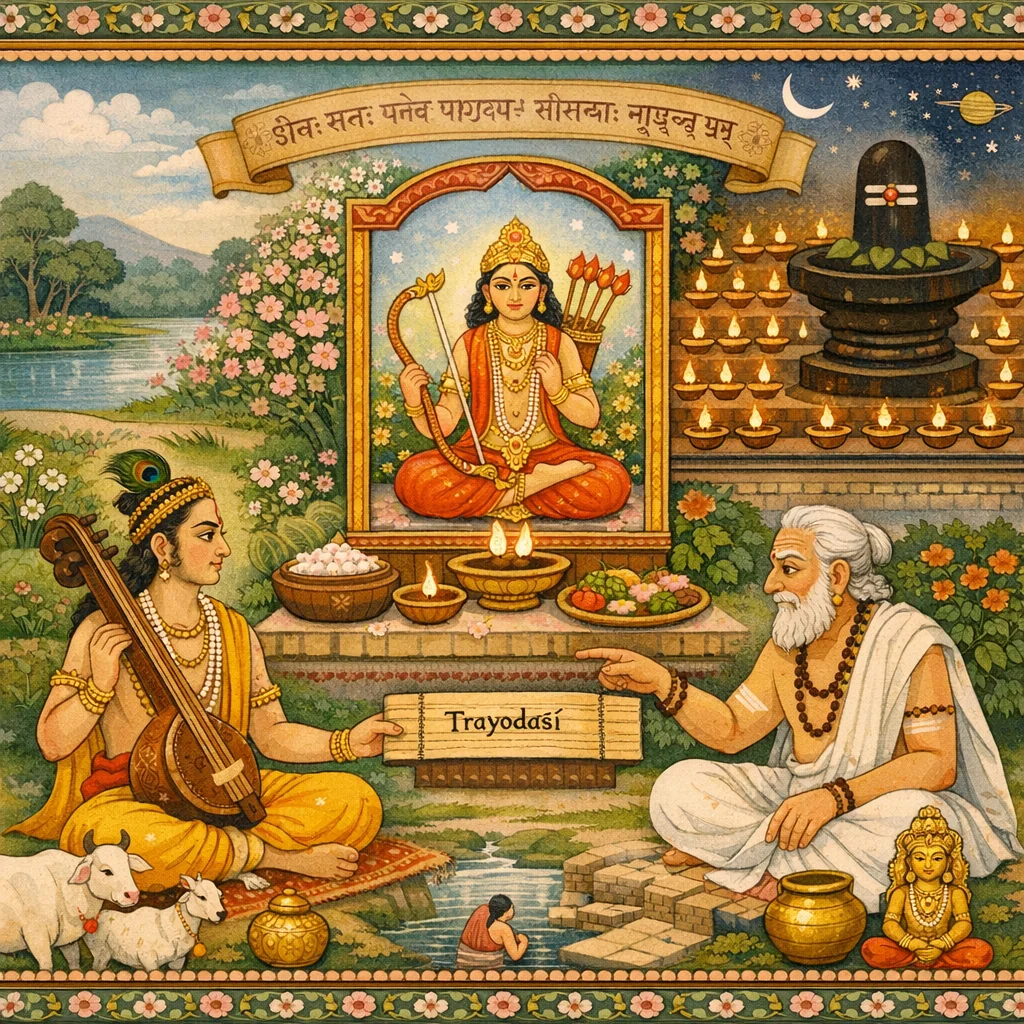
The Narration of the Trayodaśī Vow Observed Throughout the Twelve Months
Sanātana instructs Nārada in the Trayodaśī vow (the thirteenth lunar day) arranged by months and seasons. It begins with the bright Trayodaśī of Madhu/Caitra: worship of Madana/Ananga (Kāmadeva) by fashioning sandalwood forms and painted images with flower-bow and arrows, performing midday pūjā with Vasanta- and Śiva-linked epithets, offering mantra salutations, and honoring a brāhmaṇa couple. The teaching then unfolds into a yearlong cycle of Kāma’s names, offerings, and prescribed gifts (notably goats), with merit also tied to bathing in sacred rivers. Special auspicious enhancers are noted: Mahā Vāruṇī (Vāruṇī coinciding with Saturday) and Mahāmahā (Śatabhiṣaj + Saturday + bright fortnight in Phālguna/Madhu). Distinct vratas follow—Kāmadeva-vrata (Rādha month), Daurbhāgya-śamana (Jyeṣṭha bright Trayodaśī) using Sun-associated flowers and prayers, a multi-day Umā–Maheśvara installation with a five-year cycle, the Rati–Kāma vow (Nabhas/Śrāvaṇa) completed in fourteen years with pratimā and cow-gifts, the three-night Gotrirātra Lakṣmī–Nārāyaṇa vow (Bhādrapada) with pañcāmṛta and cow-dāna mantras, and the Aśoka-vrata (Īṣa) protecting women from widowhood. The Kārttika Trayodaśī pradoṣa sequence emphasizes lamp-offerings and culminates in a Śiva-śatanāma hymn. The chapter closes with further monthly prescriptions—Mārgaśīrṣa Ananga worship, Pauṣa ghee-vessel dāna to Hari, Māgha three-day bathing, and Phālguna Kubera worship with cloth-icon and golden pratimā—affirming that these observances grant prosperity, protection, and ultimately Śiva’s abode.
Shlokas
Verse 1
सनातन उवाच । अथातः संप्रवक्ष्यामि त्रयोदश्या व्रतानि ते । यानि कृत्वा नरो भक्त्या सुभगो जायते भुवि ॥ १ ॥
Sanātana said: Now I shall fully explain to you the vows observed on Trayodaśī, the thirteenth lunar day. By performing them with devotion (bhakti), a person becomes fortunate and prosperous in this world.
Verse 2
मधौ शुक्लत्रयोदश्यां मदनं चन्दनात्मकम् । कृत्वा संपूज्य यत्नेन वीजेयव्द्यजनेन च ॥ २ ॥
On the bright Trayodaśī of the month of Madhu, one should fashion Madana, the deity of love, in sandalwood, worship him carefully with due effort, and then fan him with a ceremonial fan.
Verse 3
ततः संक्षुधितः कामः पुत्रपौत्रविवर्द्धनः । अनंगपूजाप्यत्रोक्ता तां निबोध मुनीश्वर ॥ ३ ॥
Then the matter of Kāma—desire—when it is intensely aroused and is said to foster the increase of sons and grandsons, is spoken of; and here too the worship of Ananga (Kāma) is taught. Understand that teaching, O lord among sages.
Verse 4
सिन्दूररजनीरागैः फलकेऽनंगमालिखेत् । रतिप्रीतियुतं श्लक्ष्णं पुष्पचापेषुधारिणम् ॥ ४ ॥
Using the pigments of vermilion and turmeric, one should draw Ananga (Kāma) on a board—gentle and handsome, accompanied by Rati and Prīti, holding a bow of flowers and flower-arrows.
Verse 5
कामदेवं वसन्तं च वाजिवक्त्रं वृषध्वजम् । मध्याह्ने पूजयेद्भक्त्या गंधस्रग्भूषणांशुकैः ॥ ५ ॥
At midday, one should worship with devotion Kāma-deva, Vasanta (Spring), Vājivaktra (the horse-faced deity), and Vṛṣadhvaja (Śiva, whose emblem is the bull), offering fragrances, garlands, ornaments, and fine garments.
Verse 6
क्षभ्यैर्नानाविधैस्चापि मन्त्रेणानेन नारद । नमो माराय कामाय कामदेवस्य मूर्त्तये ॥ ६ ॥
O Nārada, with offerings of many kinds as well, by this mantra: “Salutation to Māra, to Kāma—unto the embodied form of Kāmadeva.”
Verse 7
ब्रह्मविष्णुशिवेंद्राणां मनःभोभकराय वै । तत्तस्याग्रतो भक्त्या पूजयेदंगनापतिम् ॥ ७ ॥
With devotion one should worship Aṅganāpati before that deity, for he is indeed the mind-born son of Brahmā, Viṣṇu, Śiva, and Indra.
Verse 8
वस्त्रमाल्याविभूषाद्यैः कामोऽयमिति चिंतयेत् । संपूज्य द्विजदांपत्यं गंधवस्त्रविभूषणैः ॥ ८ ॥
With garments, garlands, ornaments and the like, one should contemplate, “This is Kāma.” Then, having duly worshipped the Brahmin couple with perfumes, clothes, and ornaments, one should proceed accordingly.
Verse 9
एवं यः कुरुते विप्र वर्षे वर्षे महोत्सवम् । वसंतसमये प्राप्ते हृष्टः पुष्टः सदैव सः ॥ ९ ॥
Thus, O Brahmin, whoever performs this great festival year after year—when the spring season arrives—remains ever joyful and well-nourished, prosperous and strengthened.
Verse 10
प्रतिमासं पूजयेद्वा यावद्वर्षं समाप्यते । मदनं हृद्भवं कामं मन्मथं च रतिप्रियम् ॥ १० ॥
Or one should worship him each month until a year is completed—Madana, the heart-born one; Kāma; Manmatha; the beloved of Rati.
Verse 11
अनंगं चैव कंदर्पं पूजयेन्मकरध्वजम् । कुसुमायुधसंज्ञं च ततः पश्चान्मनोभवम् ॥ ११ ॥
One should worship Kāma also as Anaṅga and Kandarpa; then as Makaradhvaja, as the one famed as Kusumāyudha, and thereafter as Manobhava.
Verse 12
विषमेषु तथा विप्र मालतीगप्रियमित्यपि । अजाया दानमप्युक्तं स्नात्वा नद्या विधानतः ॥ १२ ॥
Likewise, O brāhmaṇa, on inauspicious (uneven) days it is said one should offer what is dear—such as mālatī (jasmine) flowers; and the gift of a she-goat is also prescribed, after bathing in a river according to due rite.
Verse 13
अजाः पयस्विनीर्दद्याद्दरिद्राय कुटुंबिने । भूयस्त्वनेन दानेन स लोके नैव जायते ॥ १३ ॥
One should give milk-yielding goats to a poor householder. By the merit of this gift, that donor is not born again in this world.
Verse 14
यदीयं शनिना युक्ता सा महावारुणी स्मृता । गंगायां यदि लभ्येत कोटिसूर्यग्रहाधिका ॥ १४ ॥
When this Vāruṇī observance/time is conjoined with Saturn (Śani), it is remembered as the Great Vāruṇī. If it is obtained on the Gaṅgā, its merit surpasses that of millions of solar eclipses.
Verse 15
शुभयोगः शतर्क्षं च शनौ कामे मधौ सिते । महामहेति विख्याता कुलकोटिविमुक्तिदा ॥ १५ ॥
When the auspicious Yoga coincides with the Śatabhiṣaj (Śatārkṣa) constellation—on a Saturday, in the month of Kāma (Phālguna) or Madhu (Caitra), during the bright fortnight—it is renowned as “Mahāmahā.” It is said to grant liberation to crores of one’s lineage.
Verse 16
राधशुक्लत्रयोदश्यां कामदेवव्रतं स्मृतम् । तत्र गंधादिभिः कामं पूजयेदुपवासवान् ॥ १६ ॥
On the bright (waxing) thirteenth lunar day (Trayodaśī) of the month of Rādha, the vow known as the Kāmadeva-vrata is enjoined. On that day, one who is fasting should worship Kāma with perfumes and kindred offerings.
Verse 17
प्रतिमासं ततः पश्चात्त्रयोदश्यां सिते दले । एवमेव व्रतं कार्यं वर्षांते गामलंकृताम् ॥ १७ ॥
Thereafter, every month—on Trayodaśī of the bright fortnight—one should perform this vow in the same manner; and at the end of the year, one should offer, as the concluding gift, a cow duly adorned.
Verse 18
दद्याद्विप्राय सत्कृत्य व्रतसांगत्वसिद्धये । ज्येष्ठशुक्लत्रयोदश्यां दौर्भाग्यशमनं व्रतम् ॥ १८ ॥
To ensure the vow is fulfilled with all its proper observances, one should respectfully give a gift to a learned brāhmaṇa. This vow, performed on Trayodaśī of the bright fortnight of Jyeṣṭha, is called the ‘Daurbhāgya-śamana’ rite, meant to pacify misfortune.
Verse 19
तत्र स्नात्वा नदीतोये पूजयेच्छुचिदेशजम् । श्वेतमंदारमर्कं वा करवीरं च रक्तकम् ॥ १९ ॥
There, after bathing in the river-water, one should worship with pure offerings gathered from a clean place—such as white mandāra flowers, arka blossoms, or karavīra and red flowers.
Verse 20
निरीक्ष्य गगने सूर्यं प्रार्थयेन्मंत्रतस्तदा । मंदारकरवीरार्का भवंतो भास्करांशजाः ॥ २० ॥
Then, looking up at the Sun in the sky, one should pray with the prescribed mantras: “O Mandāra, Karavīra, and Arka—born of Bhāskara’s rays—be gracious.”
Verse 21
पूजिता मम दौर्भाग्यं नाशयंतु नमोऽस्तु वः । इत्थं योऽर्चयते भक्त्या वर्षे वर्षे द्रुमत्रयम् ॥ २१ ॥
When you are worshipped, may you destroy my misfortune—salutations to you. Thus, whoever worships with bhakti, year after year, the triad of sacred trees…
Verse 22
नश्यते तस्य दौर्भाग्यं नात्र कार्या विचारणा । शुचिशुक्लत्रयोदश्यामेकभक्तं समाचरेत् ॥ २२ ॥
His misfortune is destroyed—there is no need for doubt. On the pure Trayodaśī, the thirteenth lunar day of the bright fortnight, one should duly observe eka-bhakta, eating only once.
Verse 23
पूजयित्वा जगन्नाथावुमामाहेश्वरी तनूः । हैम्यौ रौप्यौ च मृन्मप्यौ यथाशक्त्या विधाय च ॥ २३ ॥
Having worshipped Jagannātha, the Lord of the universe, one should also worship the embodiments of Umā and Maheśvara; and, according to one’s means, fashion them in gold, in silver, or even in clay.
Verse 24
सिंहोक्षस्थे देवगृहे गोष्ठे ब्राह्मणवेश्मनि । स्थापयित्वा प्रतिष्ठाप्य दैवमंत्रेण नारद ॥ २४ ॥
O Nārada, having placed it and duly consecrated it with the divine mantra—whether upon a lion-seat or a bull-seat, in a temple, in a cowshed, or in a Brāhmaṇa’s house—one should perform the prescribed installation.
Verse 25
ततः पंचदिनं पूजा चैकभक्तं व्रतं तथा । तृतीयदिवसे प्रातः स्नात्वा संपूज्य तौ पुनः ॥ २५ ॥
Then one should perform worship for five days, and likewise observe the vow of eka-bhakta, eating only once each day. On the third day, in the morning, having bathed, one should again worship those two with full rites.
Verse 26
समर्पणीयौ विप्राय वेदवेदांगशालिने । वर्षे वर्षे ततः पश्चाद्विधेयं वर्षपंचकम् ॥ २६ ॥
They should be offered to a brāhmaṇa learned in the Vedas and the Vedāṅgas. Thereafter, year after year, a five-year cycle of observance is to be performed.
Verse 27
तदंते धेनुयुग्मेन सहितौ तौ प्रदापयेत् । इत्थं नरो वा नारी वा कृत्वा व्रतमिदं शुभम् ॥ २७ ॥
At its conclusion, one should donate those two, together with a pair of cows. Thus, whether man or woman, having performed this auspicious vow in this manner, one attains merit.
Verse 28
नैव दांपत्यविच्छेदं लभते सप्तजन्मसु । नभः शुक्लत्रयोदश्यां रतिकामव्रतं शुभम् ॥ २८ ॥
One who observes this auspicious Rati–Kāma vow on the bright Trayodaśī (thirteenth lunar day) of the month of Nabhas (Śrāvaṇa) does not suffer separation in married life for seven births.
Verse 29
वैधव्यवारणं स्त्रीणां तथा संतानवर्धनम् । कृतोपवासा कन्यैव नारी वा द्विजसत्तम ॥ २९ ॥
It wards off widowhood for women and also increases progeny. O best of the twice-born, whether maiden or married woman, having observed the fast (upavāsa), she gains these results.
Verse 30
ताम्रे वा मृन्मये वापि सौवर्णे राजते तथा । रतिकामौ प्रविन्यस्य गंधाद्यैः सम्यगर्चयेत् ॥ ३० ॥
Whether in copper, clay, gold, or silver, one should properly install the pair Rati and Kāma, and then worship them duly with perfumes and other offerings.
Verse 31
ततस्तु द्विजदांपत्यं चतुर्दश्यां निमंत्र्य च । सतकृत्य भोज्य प्रतिमे दद्यात्ताभ्यां सदक्षिणे ॥ ३१ ॥
Then, on the fourteenth lunar day (caturdaśī), one should invite a Brahmin couple; having duly honored them and fed them, one should present them with two sacred images (pratimās), together with a fitting dakṣiṇā (priestly fee).
Verse 32
एवं चतुर्दशाब्दं च कृत्वा व्रतमनुत्तमम् । धेनुयुग्मान्विते देये व्रतसंपूर्तिहेतवे ॥ ३२ ॥
Thus, having observed this unsurpassed vow for fourteen years, one should, as the means of completing it in full, make a gift accompanied by a pair of cows.
Verse 33
भाद्रशुक्लत्रयोदश्यां गोत्रिरात्रव्रतं स्मृतम् । लक्ष्मीनारायणं कृत्वा सौवर्णं वापि राजतम् ॥ ३३ ॥
On the thirteenth lunar day (trayodaśī) of the bright fortnight of Bhādrapada, the vow remembered as the “three-night vow” is prescribed. One should fashion an image of Lakṣmī–Nārāyaṇa, of gold or else of silver.
Verse 34
पंचामृतेन संस्नाप्य मण्डलेऽष्टदले शुभे । पीठे विन्यस्य वस्त्राढ्यं गंधाद्यैः परिपूजयेत् ॥ ३४ ॥
After bathing (the deity or sacred emblem) with pañcāmṛta, within an auspicious eight-petalled maṇḍala, one should place it upon a pīṭha, adorn it with garments, and then worship it fully with fragrances and other offerings.
Verse 35
आरार्तिकं ततः कृत्वा दद्यात्सान्नोदकं घटम् । एवं दिनत्रयं कृत्वा व्रतांते मासमर्च्य च ॥ ३५ ॥
Then, having performed the ārati, one should offer a pot (ghaṭa) filled with water together with cooked food. Having done so for three days, and at the conclusion of the vow, one should also worship (the deity) for a full month.
Verse 36
सम्यगर्थं च संपाद्य दद्यान्मंत्रेण नारद । पंचगावः समुत्पन्ना मथ्यमाने महोदधौ ॥ ३६ ॥
Having duly prepared the required offering, O Nārada, one should present it with the prescribed mantra. The five sacred cow-products (pañcagavya) arose when the great ocean was churned.
Verse 37
तासां मध्ये तु या नंदा तस्यै धेन्वै नमो नमः । प्रदक्षिणीकृत्य ततो दद्याद्विप्राय मंत्रतः ॥ ३७ ॥
Among those cows, the one named Nandā—unto that cow one should offer salutations again and again. Then, having reverently circumambulated her (pradakṣiṇā), one should, with the proper mantras, gift the cow to a learned brāhmaṇa.
Verse 38
गावो ममाग्रतः सन्तु गावो मे संतु पृष्ठतः । गावो मे पार्श्वतः संतु गवां मध्ये वसाम्यहम् ॥ ३८ ॥
May cows be before me; may cows be behind me. May cows be at my sides; may I dwell in the midst of cows.
Verse 39
ततश्च द्विजदांपत्यं सम्यगभ्यर्च्य भोजयेत् । लक्ष्मीनारायणं तस्मै सत्कृत्य प्रतिपादयेत् ॥ ३९ ॥
Then one should properly honor and feed a brāhmaṇa couple; and, after respectfully venerating them, one should present to them an image (or representation) of Lakṣmī-Nārāyaṇa.
Verse 40
अश्वमेधसहस्राणि राजसूयशतानि च । कृत्वा यत्फलमाप्नोति गोत्रिरात्रव्रताच्च तत् ॥ ४० ॥
The very merit gained by performing a thousand Aśvamedha sacrifices and a hundred Rājasūya sacrifices—one attains that same fruit also through the Gotrirātra vow (vrata).
Verse 41
इषे शुक्लत्रयोदश्यां त्रिरात्रशोककव्रतम् । हैमं ह्यशोकं निर्माय पूजयित्वा विधानतः ॥ ४१ ॥
On the thirteenth day of the bright fortnight in the month of Īṣa, one should undertake the three-night vow called the Aśoka-vrata; having fashioned a golden form of Aśoka (tree/deity-form), one should worship it according to the prescribed rite.
Verse 42
उपवासपरा नारी नित्यं कुर्यात्प्रदक्षिणाः । अष्टोत्तरशतं विप्र मंत्रेणानेन सादरम् ॥ ४२ ॥
O brāhmaṇa, a woman devoted to fasting should daily perform circumambulations—one hundred and eight of them—reverently, while reciting this very mantra.
Verse 43
हरेण निर्मितः पूर्वं त्वमशोक कृपालुना । लोकोपकारकरणस्तत्प्रसीद शिवप्रिय ॥ ४३ ॥
O Aśoka, you were formerly created by the compassionate Hari for the welfare of the world; therefore be gracious—O beloved of Śiva.
Verse 44
ततस्तृतीये दिवसे वृक्षे तस्मिन्वृषध्वजम् । समभ्यर्च्य विधानेन द्विजं संभोज्य दापयेत् ॥ ४४ ॥
Then, on the third day, one should worship Vṛṣadhvaja upon that very tree according to the prescribed rite; having fed a brāhmaṇa, one should also give him a proper gift (dakṣiṇā).
Verse 45
एवं कृतव्रता नारी वैधव्यं नाप्नुयात्क्वचित् । पुत्रपौत्रादि सहिता भर्तुश्च स्यात्सुवल्लभा ॥ ४५ ॥
A woman who observes the vow in this manner would never, at any time, fall into widowhood; endowed with sons, grandsons, and the like, she would also become exceedingly dear to her husband.
Verse 46
ऊर्ज्जकृष्णत्रयोदश्यामेकभक्तः समाहितः । प्रदोषे तैलदीपं तु प्रज्वाल्याभ्यर्च्य यत्नतः ॥ ४६ ॥
On the thirteenth lunar day (Trayodaśī) of the dark fortnight in the month of Ūrjja (Kārttika), one should be calm and intent, taking only a single meal; and at twilight (pradoṣa), having lit an oil lamp, one should worship with careful diligence.
Verse 47
गृहद्वारे बहिर्दद्याद्यमो मे प्रीयतामिति । एवं कृते तु विप्रेंद्र यमपीडा न जायते ॥ ४७ ॥
One should place an offering outside at the doorway, saying, “May Yama be pleased with me.” When this is done, O best of brāhmaṇas, the torment of Yama does not arise.
Verse 48
ऊर्ज्शुक्लत्रयोदश्यामेकभोजी द्विजोत्तम । पुनः स्नात्वा प्रदोषे तु वाग्यतः सुसमाहितः ॥ ४८ ॥
O best of the twice-born, on the thirteenth day (Trayodaśī) of the bright fortnight of Ūrja, he should eat only once; then, bathing again at twilight (pradoṣa), he should restrain his speech and remain firmly composed in mind.
Verse 49
प्रदीपानां सहस्रेण शतेनाप्यथवा द्विज । प्रदीपयेच्छिवं वापि द्वात्रिंशद्दीपमालया ॥ ४९ ॥
O twice-born one, with a thousand lamps—or even with a hundred—one should illuminate Śiva; or else one may illuminate him with a garland of thirty-two lamps.
Verse 50
घृतेन दीपयेद्द्वीपान्गंधाद्यैः पूजयेच्छिवम् । फलैर्नानाविधैश्चैव नैवेद्यैरपि नारद ॥ ५० ॥
O Nārada, one should light the lamps set upon their stands with ghee, worship Śiva with fragrances and the like, and also offer various fruits and food-offerings (naivedya).
Verse 51
ततः स्तुवीत देवेशं शिवं नाम्नां शतेन च । तानि नामानि कीर्त्यंते सर्वाभीष्टप्रदानि वै ॥ ५१ ॥
Then one should praise Śiva, Lord of the gods, with a hundred names; those names are to be recited, for they truly bestow every desired blessing.
Verse 52
नमो रुद्राय भीमाय नीलकंठाय वेधसे । कपर्द्दिने सुरेशाय व्योमकेशाय वै नमः ॥ ५२ ॥
Salutations to Rudra, the Terrible One; to Nīlakaṇṭha, the Blue-throated Lord; to Vedhas, the Creator and Ordainer. Salutations to Kapardin, the matted-haired One; to Sureśa, Lord of the gods; to Vyomakeśa, whose hair is the very sky.
Verse 53
वृषध्वजाय सोमाय सोमनाथाय वै नमः । दिगंबराय भृंगाय उमाकांताय वर्द्धिने ॥ ५३ ॥
Salutations to the Bull-bannered Lord; to Soma; to Somanātha. Salutations to Digambara, the sky-clad ascetic; to Bhṛṅga; and to Umākānta, who ever increases and bestows growth.
Verse 54
तपोमयाय व्याप्ताय शिपिविष्याय वै नमः । व्यालप्रियाय व्यालाय व्यालानां पतये नमः ॥ ५४ ॥
Salutations to Him who is made of austerity, who pervades all, and who is Śipiviṣṭa. Salutations to Him who is dear to serpents, who is Himself the mighty Serpent, and who is the Lord of all serpents.
Verse 55
महीधराय व्योमाय पशूनां पतये नमः । त्रिपुरघ्नाय सिंहाय शार्दूलायार्षभाय च ॥ ५५ ॥
Salutations to Mahīdhara, Bearer of the earth; to Vyoma, the vast sky; and to Paśupati, Lord of all beings. Salutations to the Slayer of Tripura; to the Lion; to the Tiger; and also to the Bull.
Verse 56
मिताय मितनाथाय सिद्धाय परमेष्ठिने । वेदगीताय गुप्ताय वेदगुह्याय वै नमः ॥ ५६ ॥
Salutations to Him who is measured (yet immeasurable), the Lord of all measures; the Perfected One, the Supreme Ruler. Sung by the Vedas, hidden, the Vedas’ most secret mystery—to Him indeed, homage.
Verse 57
दीर्घाय दीर्घरूपाय दीर्घार्थाय महीयसे । नमो जगत्प्रतिष्ठाय व्योमरूपाय वै नमः ॥ ५७ ॥
Salutations to You—the Infinite; of boundless form and immeasurable purpose; the Great One. Salutations to the foundation of the universe; salutations indeed to Him whose form is the sky, the very space.
Verse 58
कल्याणाय विशिष्याय शिष्टाय परमात्मने । गजकृत्ति धरायाथ अंधकासुरभेदिने ॥ ५८ ॥
Salutations to the Supreme Self (Paramātman)—auspicious, most excellent, revered by the virtuous—who wears an elephant-hide and who split and destroyed the demon Andhaka.
Verse 59
नीललोहितशुक्लाय चडमुंडप्रियाय च । भक्तिप्रियाय देवाय यज्ञांतायाव्ययाय च ॥ ५९ ॥
Salutations to the Divine One—blue, red, and white; beloved of Caṇḍa and Muṇḍa; delighting in bhakti; the God; the consummation of yajña; and the imperishable.
Verse 60
महेशाय नमस्तुभ्यं महादेवहराय च । त्रिनेत्राय त्रिवेदाय वेदांगाय नमो नमः ॥ ६० ॥
Salutations to You, Mahesha; salutations also to Mahādeva, Hara. Homage again and again to the Three-eyed One, to Him who is the very form of the three Vedas, and to Him who embodies the Vedāṅgas.
Verse 61
अर्थायार्थस्वरूपाय परमार्थाय वै नमः । विश्वरूपाय विश्वाय विश्वनाथाय वै नमः ॥ ६१ ॥
Salutations indeed to Him who is the meaning and the goal, whose very nature is meaning, and who is the Supreme Meaning. Salutations indeed to Him whose form is the universe, who is the universe, and who is the Lord of the universe.
Verse 62
शंकराय च कालाय कालावयवरूपिणे । अरूपाय विरूपाय सूक्ष्मसूक्ष्माय वै नमः ॥ ६२ ॥
Salutations indeed to Śaṅkara—who is also Time—whose form is constituted of the very limbs of Time; who is formless, yet beyond all forms, and who is subtler than the subtlest.
Verse 63
श्मशानवासिने तुभ्यं नमस्ते कृत्तिवाससे । शशांकशेखरायाथ रुद्रभूमिश्रिताय च ॥ ६३ ॥
Salutations to you who dwell in the cremation-ground; salutations to you who are clad in a hide. Salutations also to the Moon-crested One, and to him who abides in the sacred land of Rudra.
Verse 64
दुर्गाय दुर्गपाराय दुर्गावयवसाक्षिणे । लिंगरूपाय लिंगाय लिंगानपतये नमः ॥ ६४ ॥
Salutations to the One who is the Protecting Power (Durgā), who carries beings across all difficulties, who is the witness of every limb and faculty; salutations to the One whose very form is the Liṅga, who is the Liṅga itself, the Lord of all liṅgas.
Verse 65
नमः प्रभावरूपाय प्रभावार्थाय वै नमः ॥ ६५ ॥
Salutations to the One whose very form is divine majesty; indeed, salutations to Him whose purpose is to bestow and manifest that majesty.
Verse 66
नमो नमः कारणकारणाय ते मृत्युंजयायात्मभवस्वरूपिणे । त्रियंबकाय शितिकंठभार्गिणे गौरीयुजे मंगलहेतवे नमः ॥ ६६ ॥
Salutations, salutations to You—the cause of all causes; the Conqueror of Death; the One whose very nature is the Self and the source of all becoming; the Three‑eyed Lord, blue‑throated, bearer of the Bhārgī axe; the Consort of Gaurī; the fountainhead of all auspiciousness—salutations to You.
Verse 67
नाम्नां शतमिदं विप्र पिनाकिगुणकीर्तनम् । पठित्वा दक्षिणीकृत्य प्रायान्निजनिकेतनम् ॥ ६७ ॥
O brāhmaṇa, having recited this set of a hundred names—this hymn that proclaims the virtues of Pinākin (Śiva)—and having duly offered the customary dakṣiṇā, he then departed for his own abode.
Verse 68
एवं कृत्वा व्रतं विप्र महादेवप्रसादतः । भुक्त्वेह भोगानखिलानंते शिवपदं लभेत् ॥ ६८ ॥
O brāhmaṇa, having performed the vow in this manner, by the grace of Mahādeva one enjoys all pleasures here in this world, and in the end attains the state (abode) of Śiva.
Verse 69
मार्गशुक्लत्रयोदश्यां योऽनंगं विधिना यजेत् । त्रिकालमेककालं वा शिवसंगमसंभवम् ॥ ६९ ॥
Whoever, on Trayodaśī—the thirteenth lunar day—of the bright fortnight of Mārgaśīrṣa, worships Anaṅga (Kāma) according to proper rite, whether three times a day or even once, worships the one born from the union of Śiva (and Śakti).
Verse 70
गन्धाद्यैरुपचारैस्तु पूजयित्वा विधानतः । घटे मंगलपट्टे वा भोजयेद्द्विजदंपती ॥ ७० ॥
After worshipping them properly according to the prescribed rite with offerings such as fragrance and other reverent services, one should feed the brāhmaṇa couple—either before a sanctified water‑pot (ghaṭa) or in the presence of an auspicious ceremonial cloth (maṅgala‑paṭṭa).
Verse 71
ततश्च दक्षिणां दत्वा स्वयमेकाशनं चरेत् । एवं कृते तु विधिवद्व्रती सौभाग्यभाजनः ॥ ७१ ॥
Then, having given the prescribed dakṣiṇā, one should personally observe the discipline of taking only a single meal. When performed duly according to rule, the keeper of the vow becomes a recipient of good fortune.
Verse 72
जायते भुवि विप्रेन्द्र महादेवप्रसादतः ॥ ७१ ॥
O best of brāhmaṇas, it arises upon the earth through the grace of Mahādeva (Śiva).
Verse 73
पौषशुक्लत्रयोदश्यां समभ्यर्च्याच्युतं हरिम् । घृतपात्रं द्विजेन्द्राय प्रदद्यात्सर्वसिद्धये ॥ ७२ ॥
On Trayodaśī, the thirteenth lunar day of the bright fortnight of Pauṣa, having duly worshipped Acyuta Hari, one should offer a vessel of ghee to an eminent brāhmaṇa, for the attainment of all accomplishments (siddhi).
Verse 74
माघशुक्लत्रयोदश्यां समारभ्य दिनत्रयम् । माघस्नानव्रतं विप्र नानाकामफलावहम् ॥ ७३ ॥
O brāhmaṇa, beginning on Trayodaśī of the bright fortnight of Māgha and continuing for three days, one undertakes the Māgha bathing vow (māgha-snāna-vrata); it bestows the fruits of many desired aims.
Verse 75
प्रयागे माघमासे तु त्र्यहं स्नातस्य यत्फलम् । नाश्वमेघसहस्रेण तत्फलं लभते भुवि ॥ ७४ ॥
The merit gained by bathing for three days at Prayāga during the month of Māgha cannot be attained on earth even by performing a thousand Aśvamedha sacrifices.
Verse 76
तत्र स्नानं जपो होमो दानं चानंत्यमश्नुते । फाल्गुने तु सिते पक्षे त्रयोदश्यामुपोषितः ॥ ७५ ॥
There, bathing, mantra-recitation (japa), fire-offering (homa), and sacred giving (dāna) bestow imperishable merit. In the month of Phālguna, in the bright fortnight, one who fasts on Trayodaśī, the thirteenth lunar day, attains that unfailing fruit.
Verse 77
नमस्कृत्य जगन्नाथं प्रारंभे धनदव्रतम् । महाराजं यक्षपतिं गंधाद्यैरुपचारकैः ॥ ७६ ॥
At the outset, having bowed to Jagannātha, Lord of the universe, one should worship the great king Dhanada (Kubera), lord of the Yakṣas, with offerings and ritual services such as fragrant unguents and the like.
Verse 78
लिखितं वर्णकैः पट्टे पूजयेद्भक्तिभावतः । एवं शुक्लत्रयोदश्यां प्रतिमासं द्विजोत्तम ॥ ७७ ॥
Having it written and painted in colors upon a cloth panel, one should worship it with a heart of bhakti. Thus, on every bright-fortnight Trayodaśī, month after month, O best of the twice-born.
Verse 79
संपूजयेत्सोपवासश्चैकभुक्तो भवेन्नरः । ततो व्रतांते तु पुनः सौवर्णं धननायकम् ॥ ७८ ॥
Let one worship with complete reverence, fasting and taking only a single meal. Then, at the conclusion of the vow, one should again offer a golden image of Kubera, the lord of wealth.
Verse 80
विधाय निधिभिः सार्द्धं सौवर्णाभिर्द्विजोत्तम । उपचारैः षोडशभिः स्नानैः पंचामृतादिभिः ॥ ७९ ॥
O best of Brahmins, having duly arranged the worship together with treasures and golden offerings, one should honor the deity with the sixteen modes of service, performing ritual bathings with pañcāmṛta and other sacred substances.
Verse 81
नैवेद्यैर्विविधैर्भक्त्या पूजयेत्तु समाहितः । ततो धेनुमलंकृत्य वस्त्रस्रग्गंधभूषणैः ॥ ८० ॥
With a mind well-composed, one should worship the Deity in bhakti, offering various kinds of naivedya (food offerings). Then, adorning a cow with garments, garlands, fragrances, and ornaments, one should proceed with the prescribed rite of gifting.
Verse 82
सवत्सां दापयेद्विप्र सम्यग्वेदविदे शुभाम् । संभोज्य विप्रान्मिष्टान्नैर्द्वादशाथ त्रयोदश ॥ ८१ ॥
O brāhmaṇa, one should duly gift a fine cow together with her calf to a worthy knower of the Vedas. And after feeding the brāhmaṇas with sweet foods, one should proceed with the twelfth and the thirteenth prescribed rites.
Verse 83
गुरुं समर्च्य वस्त्राद्यैः प्रतिमां तां निवेदयेत् । द्विजेभ्यो दक्षणां शक्त्या दत्वा नत्वा विसृज्य च ॥ ८२ ॥
Having duly worshipped the Guru with garments and other offerings, one should then present that sacred image (pratimā). After giving, according to one’s capacity, dakṣiṇā to the dvija, one should bow down and respectfully conclude the rite by dismissing them.
Verse 84
स्वयं भुंजीत मतिमानिष्टैः सह समाहितः । एवं कृते व्रते विप्र निर्धनः प्राप्य वैभवम् ॥ ८३ ॥
Let the wise man, with mind composed, eat by his own hand together with his dear ones. When this vow (vrata) is performed in this manner, even a poor brāhmaṇa attains prosperity and abundance.
Verse 85
मोदते भुवि विख्यातो राजराज इवापरः ॥ ८४ ॥
Renowned in the world, he rejoices on earth like another emperor among kings.
Verse 86
इति श्रीबृहन्नारदीयपुराणे पूर्वभागे बृहदुपाख्याने द्वादशमासस्थितत्रयोदशीव्रतकथनं नाम द्वाविंशदधिकशततमोऽध्यायः ॥ १२२ ॥
Thus ends, in the Śrī Bṛhannāradīya Purāṇa—within the Pūrva-bhāga and the Bṛhad-upākhyāna—the one-hundred-and-twenty-second chapter, entitled “The narration of the Trayodaśī vow observed throughout the twelve months.”
Frequently Asked Questions
Trayodaśī is presented as a repeatable calendrical hinge for vrata-kalpa, where timing (tithi plus weekday/nakṣatra/yoga) amplifies merit; the text links it to prosperity (Kubera, dāna), lineage outcomes (progeny), marital stability (Rati–Kāma), and Śaiva grace (pradoṣa lamp-worship culminating in Śiva’s abode).
It specifies iconographic construction (sandalwood Madana; painted Ananga with flower-bow and arrows), a focused mantra salutation to Māra/Kāma, seasonal embedding in Vasanta, and a structured extension across months via multiple epithets (Madana, Manmatha, Kandarpa, Makaradhvaja, Kusumāyudha, Manobhava).
Nearly every vow includes brahmin-couple honoring, feeding, and dakṣiṇā, along with major dānas (cow/calf, goats, ghee vessel, pratimā gifts), framing personal merit as inseparable from redistribution and ritual hospitality.
The Kārttika Trayodaśī portion emphasizes pradoṣa-time discipline (single meal, twilight bathing, restraint), large-scale dīpa-dāna (100–1000 lamps or 32-lamp garland), and a hundred-name praise that is said to grant desired boons and culminate in attaining Śiva’s state.