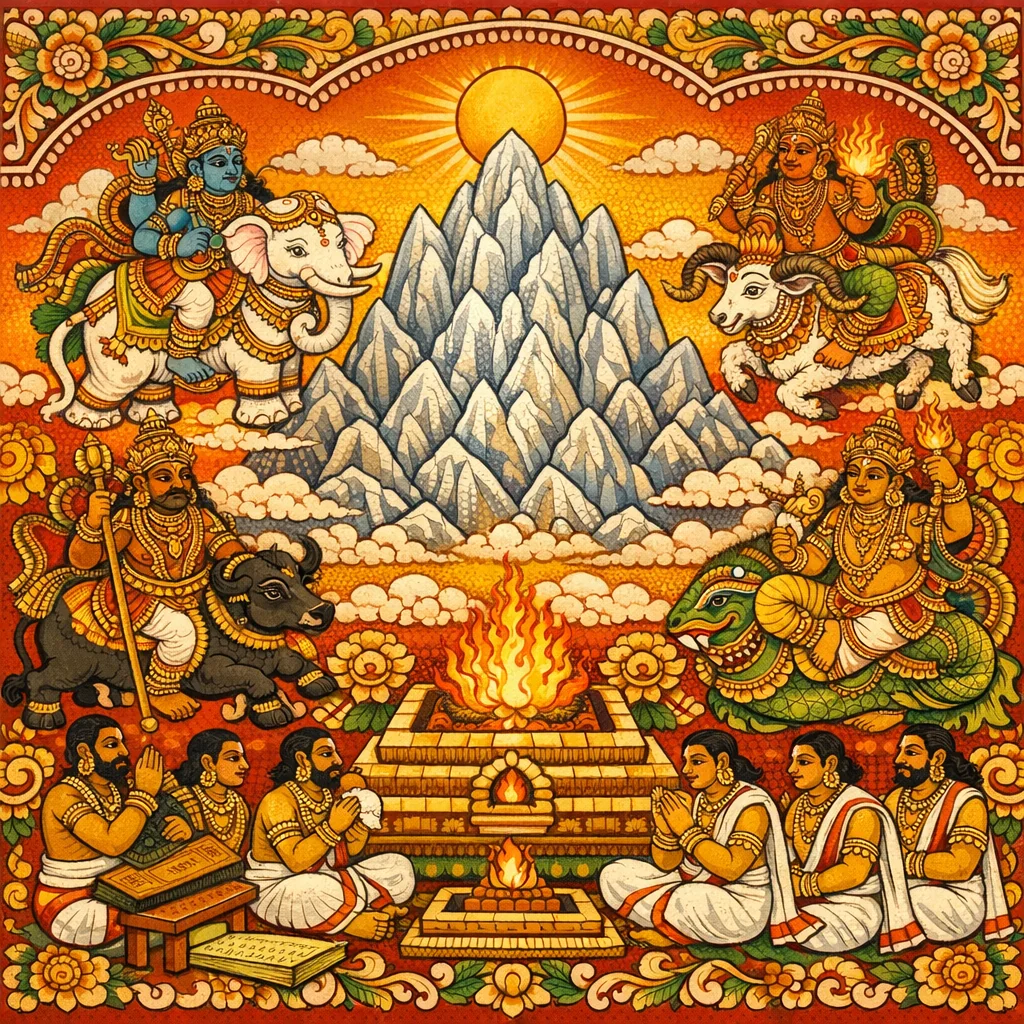
Adhyaya 91: The Rite of Gifting the ‘Silver Mountain’ (Raupyācala/Rajatācala Dāna)
रौप्याचलदानविधिः
Speaker: Īśvara (the Lord, as teacher in the dāna section)
Continuing the teachings on dāna-dharma, the Lord declares he will teach the gift of the “Silver Mountain” (Raupyācala/Rajatācala), which grants Somaloka. He prescribes graded weights for the silver mountain and allows proportional reduction for those unable to meet the higher measures. He then explains how to fashion the required forms (Mandara and related elements) in silver, while worshipping the Lokapālas with refined-gold images, with a special rule that Brahmā, Viṣṇu, and Arka receive golden hips and other silver-prescriptions in this scheme become gold. The donor completes the remaining observances as before—homa, keeping vigil, and allied rites—and at dawn gives the silver mountain to the guru. Thereafter gifts of garments and ornaments are offered to priests while reciting a mantra to “Rājata,” seeking protection from the sorrowful ocean of saṃsāra. The Lord concludes that the merit equals gifting ten thousand cows and that one dwells honored in Somaloka until the great dissolution.
Key Concepts
Shlokas in Adhyaya 91
Verse 1
*ईश्वर उवाच अतः परं प्रवक्ष्यामि रौप्याचलमनुत्तमम् यत्प्रदानान्नरो याति सोमलोकमनुत्तमम् //
The Lord said: “Now I shall explain the unsurpassed Raupyācala (the ‘silver mountain’ offering); by making that gift, a man attains the unsurpassed world of Soma (the Moon).”
Verse 2
दशभिः पलसाहस्रैर् उत्तमो रजताचलः पञ्चभिर्मध्यमः प्रोक्तस् तदर्धेनाधमः स्मृतः //
A “silver mountain” (rajatācala) is held to be of the highest grade when it weighs ten thousand palas; of the middle grade when it is five thousand; and of the lowest grade when it is half of that.
Verse 3
अशक्तो विंशतेरूर्ध्वं कारयेच्छक्तितस्तदा विष्कम्भपर्वतांस्तद्वत् तुरीयांशेन कल्पयेत् //
If one is unable to carry out (the prescribed work) beyond twenty (units), then it should be done according to one’s capacity. Likewise, the transverse measures (viṣkambha) and the raised portions (parvata) should be set in proportion by taking a quarter-share (turīyāṁśa).
Verse 4
पूर्ववद्राजतान्कुर्वन् मन्दरादीन्विधानतः कलधौतमयांस्तद्वल् लोकेशानर्चयेद्बुधः //
As described earlier, the wise man should fashion the required images in silver—such as Mandara and the rest—according to the prescribed rules; likewise, he should worship the Lokapālas (world-guardians) with images made of kaladhauta (refined gold).
Verse 5
ब्रह्मविष्ण्वर्कवान्कार्यो नितम्बो ऽत्र हिरण्मयः राजतं स्याद्यदन्येषां सर्वं तदिह काञ्चनम् //
In this iconographic scheme, the images of Brahmā, Viṣṇu, and Arka (the Sun) should be fashioned with golden hips; for the other deities, whatever is prescribed elsewhere as silver is here to be made entirely in gold.
Verse 6
शेषं तु पूर्ववत्कुर्याद् धोमजागरणादिकम् दद्यात्ततः प्रभाते तु गुरवे रौप्यपर्वतम् //
As for the remainder, it should be performed as previously prescribed—such as the fire-offering (homa), keeping vigil, and related observances. Then, at dawn, one should present to the guru a “mountain of silver,” that is, a substantial gift of silver.
Verse 7
विष्कम्भशैलानृत्विग्भ्यः पूज्यवस्त्रविभूषणैः इमं मन्त्रं पठन्दद्याद् दर्भपाणिर्विमत्सरः //
With reverence, he should present (these offerings) to the officiating priests, together with worthy garments and ornaments, reciting this mantra, holding darbha-grass in his hand and free from envy.
Verse 8
पितॄणां वल्लभो यस्माद् धरीन्द्राणां शिवस्य च पाहि राजत तस्मात्त्वं शोकसंसारसागरात् //
Since you are dear to the Pitṛs, to the lords of the gods, and to Śiva as well, therefore, O Rājata, protect (me/us) from the ocean of worldly existence filled with sorrow.
Verse 9
इत्थं निवेद्य यो दद्याद् रजताचलमुत्तमम् गवामयुतदानस्य फलं प्राप्नोति मानवः //
Having thus duly offered and dedicated it with the proper statement, whoever donates an excellent “silver mountain” attains the very merit that arises from gifting ten thousand cows.
Verse 10
सोमलोके स गन्धर्वैः किंनराप्सरसां गणैः पूज्यमानो वसेद्विद्वान् यावदाभूतसंप्लवम् //
That learned man dwells in the world of Soma, honored by the Gandharvas and by hosts of Kinnaras and Apsarases, until the cosmic deluge that dissolves all beings.
Frequently Asked Questions
It teaches the Raupyācala (Rajatācala) dāna: constructing and dedicating a symbolic “silver mountain,” completing homa and night-vigil, offering it to the guru at dawn, and giving associated gifts to priests with a specific mantra—promising Somaloka as the chief fruit.
By weight: the highest grade is 10,000 palas, the middle is 5,000 palas, and the lowest is half of the middle (i.e., 2,500 palas). The text also allows proportional scaling according to the donor’s capacity.
This chapter is primarily Dāna-Dharma (ritual gifting) with iconographic/material prescriptions; it does not focus on Vastu temple-planning, Rajadharma statecraft, creation narratives, or genealogies.
Brahmā, Viṣṇu, and Arka (the Sun) are prescribed with golden hips, and for other deities, whatever is elsewhere prescribed as silver is to be made in gold here; Lokapālas are worshipped with kaladhauta (refined gold) images.
While giving with darbha in hand and without envy, the donor invokes “Rājata” as dear to the Pitṛs, the lords of the gods, and Śiva, asking protection from the sorrow-filled ocean of worldly existence (saṃsāra).