Adhyaya 65: Description of the Akṣaya Tṛtīyā Observance (Imperishable Merit on Vaiśākha Śukla Tṛtīyā)
अक्षयतृतीया-व्रतवर्णनम्
Speaker: Īśvara (the Lord, instructing teacher-voice)
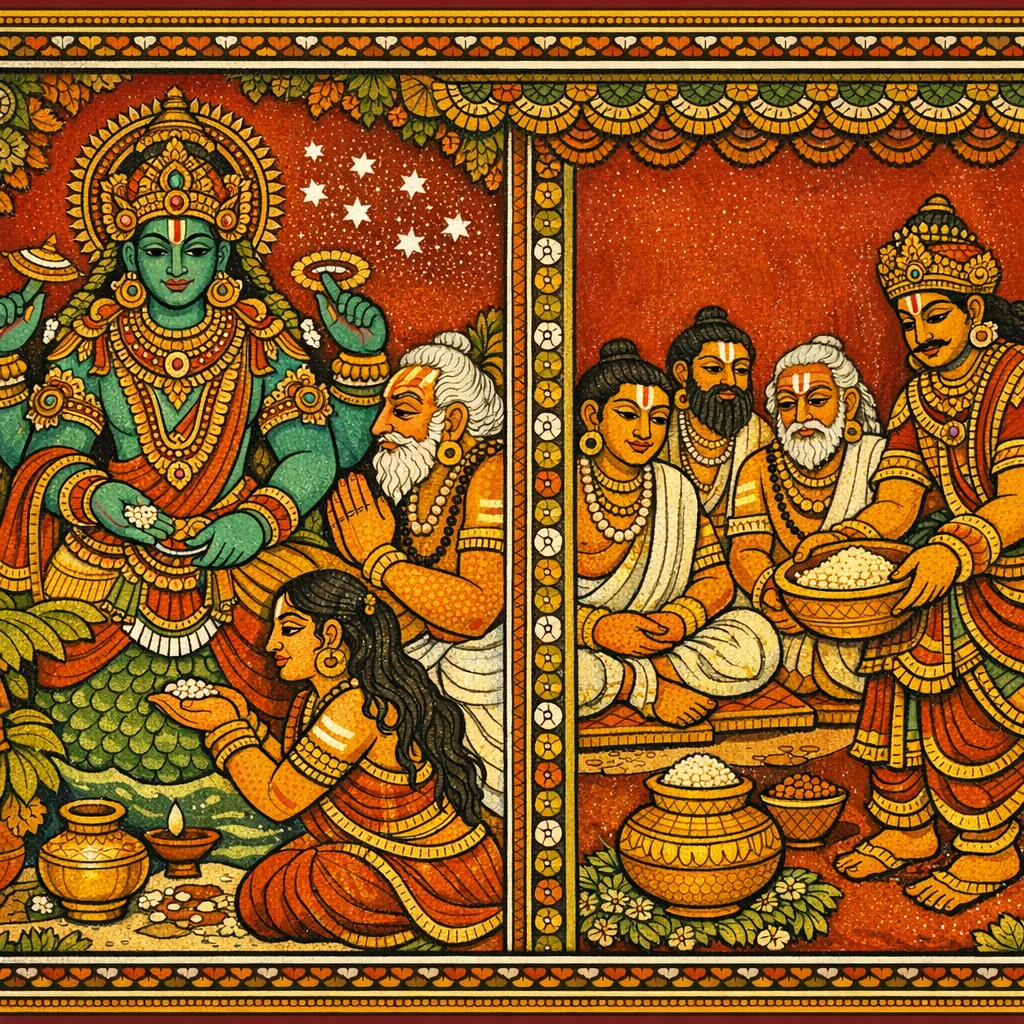
Continuing his instruction, the Lord proclaims another observance, Tṛtīyā, praised as sarva-kāma-dā, the fulfiller of all desires. He lays down the governing rule that dāna (charitable giving), homa (fire-offering), and japa (mantra-recitation) performed on this tithi become akṣaya, yielding imperishable merit. He then specifies the bright-fortnight (śukla pakṣa) Tṛtīyā of Vaiśākha as granting unfailing fruit of righteousness, further magnified when it coincides with the Kṛttikā nakṣatra and is worshipped with special reverence. Explaining the epithet “Akṣayā,” he connects it with Viṣṇu-worship using akṣata, prescribing ritual bathing and the offering of akṣata to Viṣṇu. He also enjoins feeding Brāhmaṇas with well-prepared saktu before the observer eats. The Lord concludes that even one correctly performed Tṛtīyā observance bestows the comprehensive merit of these rites, and that fasting worship of Janārdana on Tṛtīyā grants the fruit of a Rājasūya and the highest spiritual goal.
Key Concepts
Shlokas in Adhyaya 65
Verse 1
*ईश्वर उवाच अथान्यामपि वक्ष्यामि तृतीयां सर्वकामदाम् यस्यां दत्तं हुतं जप्तं सर्वं भवति चाक्षयम् //
The Lord said: “Now I shall also describe another observance—the Third (Tṛtīyā), the fulfiller of all desires—on which whatever is given in charity, offered into the sacred fire, or repeated as mantra becomes imperishable.”
Verse 2
वैशाखशुक्लपक्षे तु तृतीया यैरुपोषिता अक्षयं फलमाप्नोति सर्वस्य सुकृतस्य च //
Whoever observes a fast on Tṛtīyā, the third lunar day, in the bright fortnight of Vaiśākha attains an imperishable reward—the unfailing fruit of all meritorious deeds.
Verse 3
सा तथा कृत्तिकोपेता विशेषेण सुपूजिता तत्र दत्तं हुतं जप्तं सर्वमक्षयमुच्यते //
Likewise, when (the sacred observance/time) is joined with the Kṛttikā constellation and is worshipped with special reverence, then whatever is given in charity, offered into the fire, or repeated as japa there is said to become imperishable (yielding inexhaustible merit).
Verse 4
अक्षया संततिस्तस्यास् तस्यां सुकृतमक्षयम् अक्षतैः पूज्यते विष्णुस् तेन साप्यक्षया स्मृता अक्षतैस्तु नराः स्नाता विष्णोर्दत्त्वा तथाक्षतान् //
On that tithi one gains an unbroken line of descendants, and on it merit becomes imperishable. Viṣṇu is worshipped with akṣata (unbroken rice grains); therefore it is remembered as “Akṣayā” (the Imperishable). After bathing, people should also offer those akṣata grains to Viṣṇu.
Verse 5
विप्रेषु दत्त्वा तानेव तथा सक्तून् सुसंकृतान् यथान्नभुङ्महाभागः फलमक्षय्यमश्नुते //
Having given to the Brāhmaṇas that same well-prepared saktu (roasted barley-flour), the noble man then partakes of food himself; thus, O fortunate one, he obtains an imperishable reward.
Verse 6
एकामप्युक्तवत्कृत्वा तृतीयां विधिवन्नरः एतासामपि सर्वासां तृतीयानां फलं भवेत् //
If a person performs even a single Tṛtīyā observance exactly as stated and in due ritual order, he obtains the full merit that is said to arise from all such Tṛtīyā rites.
Verse 7
तृतीयायां समभ्यर्च्य सोपवासो जनार्दनम् राजसूयफलं प्राप्य गतिमग्र्यां च विन्दति //
On the third lunar day (Tṛtīyā), one who worships Lord Janārdana while observing a fast (upavāsa) attains the merit of the Rājasūya sacrifice and also obtains the highest state (supreme liberation).
Frequently Asked Questions
Adhyāya 65 teaches that observing Tṛtīyā—especially Vaiśākha Śukla Tṛtīyā—makes religious acts akṣaya (imperishable). The Lord instructs fasting and worship of Janārdana (Viṣṇu), offering akṣata after bathing, and giving saktu in charity to Brāhmaṇas. It emphasizes that dāna, homa, and japa done on this day yield inexhaustible merit, and that proper observance can grant Rājasūya-level fruit and the highest spiritual state.
This chapter is primarily Dharma in the form of vrata-dharma (ritual observance and sacred calendrics). It also touches a genealogy-related aspiration indirectly through the promise of an unbroken line of descendants (akṣayā santati). Vāstu and architectural prescriptions are not discussed in Adhyāya 65.
It is remembered as ‘Akṣayā’ because merit becomes imperishable on this tithi, and because Viṣṇu is worshipped with akṣata (unbroken rice grains). The text links the symbolism of “unbroken” offerings with the doctrine of “unbroken/inexhaustible” spiritual fruit.
The chapter recommends fasting, bathing, worshipping Viṣṇu/Janārdana with akṣata, performing dāna (especially giving well-prepared saktu to Brāhmaṇas), and undertaking homa and japa—stating that these acts become akṣaya when done on this day.