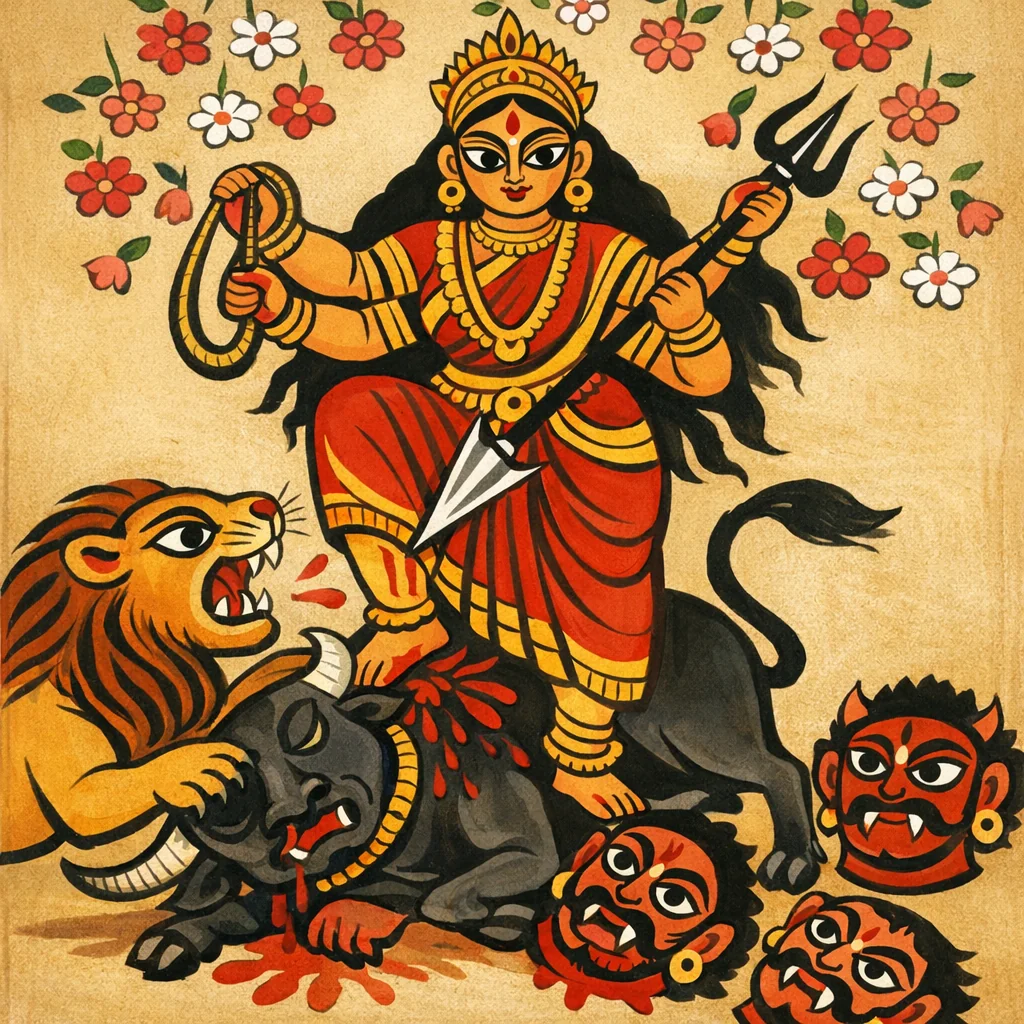
Adhyaya 83: The Slaying of Mahishasura’s Armies and the Final Death of Mahishasura
महिषासुरसैन्यवधः (Mahiṣāsurasainyavadhaḥ)
Narayani Stuti
Goddess Caṇḍikā leads the gods in crushing Mahishasura’s armies with sacred weapons and divine might. After a fierce battle, Mahishasura repeatedly shifts forms to resist, yet the Goddess finally subdues and slays him, ending adharma and restoring Dharma.
Divine Beings
Celestial Realms
Key Content Points
Focus Keywords
Shlokas in Adhyaya 83
Verse 1
इति श्रीमार्कण्डेयमहापुराणे सावर्णिके मन्वन्तरे देवीमाहात्म्ये महिषासुरसैन्यवधो नाम द्व्यशीतितमोऽध्यायः । ऋषिरुवाच— निहन्यमानं तत्सैन्यमवलोक्य महासुरः । सेनानीश्चिक्षुरः कोपाद्ययौ योद्धुमथाम्बिकाम् ॥
Thus, in the Śrī Mārkaṇḍeya Mahāpurāṇa, in the Sāvarṇi Manvantara, in the Devī Māhātmya, ends the chapter called “The Slaying of Mahīṣāsura’s Army” (Chapter 82). The Ṛṣi said: Seeing his army being slain, the great asura—his commander Cikṣura—went forth in anger to fight Ambikā.
Verse 2
स देवीं शरवर्षेण ववर्ष समरेऽसुरः । यथा मेरुगिरेः शृङ्गं तोयवर्षेण तोयदः ॥
In battle that asura showered the Goddess with a rain of arrows—like a rain-cloud pouring down rain upon the peak of Mount Meru.
Verse 3
तस्य छित्त्वा ततो देवी लीलयैव शरोत्करान् । जघान तुरगान् बाणैर्यन्तारं चैव वाजिनाम् ॥
Then the Goddess, having cut down his volleys of arrows as if in mere play, struck down the horses with her arrows—and also the charioteer of the steeds.
Verse 4
चिच्छेद च धनुः सद्यो ध्वजं चातिसमुच्छ्रितम् । विव्याध चैव गात्रेषु छिन्नधन्वानमाशुगैः ॥
She immediately cut his bow, and also his banner raised high; and with swift arrows she pierced his limbs—him whose bow had been severed.
Verse 5
स छिन्नधन्वा विरथो हताश्वो हतसारथिः । अभ्यधावत तां देवीं खड्गचर्मधरोऽसुरः ॥
With his bow shattered, his chariot broken, his horses slain and his charioteer killed, that asura rushed straight at the Goddess, bearing sword and shield.
Verse 6
सिंहमाहत्य खड्गेन तीक्ष्णधारेण मूर्धनि । आजघान भुजे सव्ये देवीमप्यतिवेगवान् ॥
Striking the lion on the head with his sharp-edged sword, the exceedingly swift one also smote the Goddess on her left arm.
Verse 7
तस्याः खड्गो भुजं प्राप्य पफाल नृपनन्दन । ततो जग्राह शूलं स कोपादरुणलोचनः ॥
O delight of kings, her sword, reaching his arm, split it. Then he, red-eyed with rage, seized a trident.
Verse 8
चिक्षेप च ततस्तत्तु भद्रकाल्यां महासुरः । जाज्वल्यमानं तेजोभी रविबिम्बमिवाम्बरात् ॥
Then that great asura hurled it at Bhadrakali—blazing with radiance—like the orb of the sun falling from the sky.
Verse 9
दृष्ट्वा तदापतच्छूलं देवी शूलममुंचत । तच्छूलं शतधा तेन नीतं स च महासुरः ॥
Seeing that trident rushing toward her, the Goddess released her own trident. By it, that trident was shattered into a hundred pieces—and that great asura as well was struck down.
Verse 10
हते तस्मिन्महावीर्ये महिषस्य चमूपतौ । आजगाम गजारूढश्चामरस्त्रिदशार्दनः ॥
When that mighty hero, the commander of Mahisha’s army, was slain, Chamara—the crusher of the gods—arrived mounted on an elephant.
Verse 11
सोऽपि शक्तिं मुमोचाथ देव्यास्तामम्बिका द्रुतम् । हुङ्काराभिहतां भूमौ पातयामास निष्प्रभाम् ॥
He too released a javelin (śakti) at the Goddess; but Ambikā swiftly struck it down with her huṃkāra, casting it to the ground, lusterless.
Verse 12
भग्नां शक्तिं निपतितां दृष्ट्वा क्रोधसमन्वितः । चिक्षेप चामरः शूलं बाणैस्तदपि साच्छिनत् ॥
Seeing his javelin broken and fallen, Chamara, filled with anger, hurled a trident; that too she cut apart with arrows.
Verse 13
ततः सिंहः समुत्पत्य गजकुम्भान्तरे स्थितः । बाहुयुद्धेन युयुधे तेनोच्चैस्त्रिदशारिणा ॥
Then the lion leapt up and took position between the elephant’s temples, and fought him—Chamara, the lofty enemy of the gods—in hand-to-hand combat.
Verse 14
युधायमानौ ततस्तौ तु तस्मान्नागान्महीं गतौ । युयुधातेऽतिसंरब्धौ प्रहारैरतिदारुणैः ॥
As they fought, the two of them then came down from that elephant to the ground, and battled in extreme fury with blows most dreadful.
Verse 15
ततो वेगात्खमुत्पत्य निपत्य च मृगारिणा । करप्रहारेण शिरश्चामरस्य पृथक्कृतम् ॥
Then the enemy of the deer—the Lion—sprang swiftly into the sky and swooped down; striking with his paw, he severed Cāmara’s head.
Verse 16
उदग्रश्च रणे देव्याः शिलावृक्षादिभिर्हतः । दन्तमुष्टितलैश्चैव करालश्च निपातितः ॥
And Udagra was slain in battle by the Goddess’s forces with rocks, trees, and the like; and Karāla too was struck down by teeth, fists, and palms.
Verse 17
देवी क्रुद्धा गदापातैश्चूर्णयामास चोद्धतम् । वाष्कलं भिन्दिपालेन बाणैस्ताम्रं तथान्धकम् ॥
The Goddess, enraged, crushed the insolent one with blows of her mace. Vāṣkala she split with a bhindipāla (javelin), and Tāmra and Andhaka she struck down with arrows.
Verse 18
उग्रास्यमुग्रवीर्यञ्च तथैव च महाहनुम् । त्रिनेत्रा च त्रिशूलेन जघान परमेश्वरी ॥
Parameśvarī, the three-eyed Goddess, slew Ugrāsya, Ugravīrya, and Mahāhanu with her trident.
Verse 19
बिडालस्यासिना कायात् पातयामास वै शिरः । दुर्धरं दुर्मुखं चोभौ शरैर्निन्ये यमक्षयम् । कालं च कालदण्डेन कालरात्रिरपातयत् ॥
With a sword she cut Biḍāla’s head from his body. Both Durdhara and Durmukha she dispatched to Yama’s abode with arrows. And Kāla too Kālarātri struck down with the staff of Time.
Verse 20
अग्रदर्शनमत्युग्रैः खड्गपातैरताडयत् । असिनैवासिलोमानमच्छिदत् सा रणोत्सवे । गणैः सिंहॆन देव्याः च जयक्ष्वेडाकृतोत्सवैः ॥
She struck down Agradarśana with exceedingly fierce sword-strokes, and with her sword she also cut down Asilomā in that festival of battle—while the Goddess’s gaṇas and her lion raised victory-shouts in celebration.
Verse 21
एवं संक्षीयमाणे तु स्वसैन्ये महिषासुरः । माहिषेण स्वरूपेण त्रासयामास तान् गणान् ॥
When his own army was thus being destroyed, Mahīṣāsura, assuming his buffalo-form, began to terrify those gaṇas.
Verse 22
कांश्चित्तुण्डप्रिहारेण खुरक्षेपैस्तथापरान् । लाङ्गूलताडितांश्चान्यान् शृङ्गाभ्याञ्च विदारितान् ॥
Some he struck with blows of his snout; others he hurled with kicks of his hooves; some he battered with his tail, and others he ripped apart with his horns.
Verse 23
वेगेन कांश्चिदपरान् नादेन भ्रमणेन च । निश्वासपवनेनान्यान् पातयामास भूतले ॥
Some others he felled by sheer speed; others by his roar and his whirling movements; and still others he cast down to the ground by the wind of his breath.
Verse 24
निपात्य प्रमथानीकमभ्यधावत सोऽसुरः । सिंहं हन्तुं महादेव्याः कोपं चक्रे ततोऽम्बिका ॥
Having felled the host of pramathas, that demon rushed forward to kill the Great Goddess’s lion; then Ambikā became wrathful.
Verse 25
सोऽपि कोपान्महावीऱ्यः खुरक्षुण्णमहीतलः । शृङ्गाभ्यां पर्वतानुच्चैश्चिक्षेप च ननाद च ॥
He too, mighty in valor and inflamed with wrath, churned up the earth with his hooves; with his horns he hurled lofty mountains aloft, and he roared.
Verse 26
वेगभ्रमणविक्षुण्णा मही तस्य व्यशीर्यत । लाङ्गूलेनाहतश्चाब्धिः प्लावयामास सर्वतः ॥
By his swift whirling movements the earth was shattered; and the ocean, struck by his tail, surged and flooded everywhere.
Verse 27
धुतशृङ्गविभिन्नाश्च खण्डं खण्डं ययुर्घनाः । श्वासानिलास्ताः शतशो निपेतुर्नभसोऽचलाः ॥
And clouds, shattered by the shaking of his horns, went into fragments; driven by the wind of his breath, hundreds of mountains fell from the sky.
Verse 28
इति क्रोधसमाध्मातमापतान्तं महासुरम् । दृष्ट्वा सा चण्डिका कोपं तद्वधाय तदाकरोत् ॥
Seeing that great asura rushing in, swollen with rage, Caṇḍikā then assumed wrath in order to slay him.
Verse 29
सा क्षिप्त्वा तस्य वै पाशं तं बबन्ध महासुरम् । तत्याज माहिषं रूपं सोऽपि बद्धो महामृधे ॥
Casting her noose upon him, she bound that great asura. Though bound in the great battle, he abandoned his buffalo-form.
Verse 30
ततः सिंहोऽभवत् सद्यो यावत्तस्याम्बिका शिरः । छिनत्ति तावत्पुरुषः खड्गपाणिरदृश्यत ॥
Then he instantly became a lion; and just as Ambikā was about to cut off his head, a man appeared, sword in hand.
Verse 31
तत एवाशु पुरुषं देवी चिच्छेद सायकैः । तं खड्गचर्मणा सार्धं ततः सोऽभून्महागजः ॥
Right then, the Goddess swiftly cut down that man with her arrows—together with his sword and shield; then he became a great elephant.
Verse 32
करेण च महासींहं तं चकर्ष जगर्ज च । कर्षतस्तु करं देवी खड्गेन निरकृन्तत ॥
With his trunk he dragged the great lion and roared; but as he dragged, the Goddess cut off his trunk with her sword.
Verse 33
ततो महासुरो भूयो माहिषं वपुरास्थितः । तथैव क्षोभयामास त्रैलोक्यं सचराचरम् ॥
Then that great asura again assumed the body of a buffalo; and just so he continued to shake the three worlds, with all that moves and does not move.
Verse 34
ततः क्रुद्धा जगन्माता चण्डिका पानमुत्तमम् । पपौ पुनः पुनश्चैव जहासारुणलोचना ॥
Then the Mother of the world, Caṇḍikā, enraged, drank the finest drink again and again; and she laughed, her eyes reddened.
Verse 35
ननर्द चासुरः सोऽपि बलवीर्यमदोद्धतः । विषाणाभ्यां चिक्षेप चण्डिकां प्रति भूधरान् ॥
That asura too roared aloud, intoxicated with his strength and valor, and with his horns he hurled mountains toward Caṇḍikā.
Verse 36
सा च तान् प्रहितांस्तेन चूर्णयन्ती शरोत्करैः । उवाच तं मदोद्धूतमुखरागाकुलाक्षरम् ॥
And she, pulverizing those mountains hurled by him with volleys of arrows, spoke to him—whose speech was boisterous from intoxication and whose words were confused.
Verse 37
देव्युवाच गरज गरज क्षणं मूढ मधु यावत्पिबाम्यहम् । मया त्वयि हतेऽत्रैव गर्जिष्यन्त्याशु देवताः ॥
The Goddess said: “Roar, roar for a moment, fool—until I drink this honey. When you are slain by me, right here, the gods will soon roar in triumph.”
Verse 38
ऋषिरुवाच एवमुक्त्वा समुत्पत्य सारूढा तं महासुरम् । पादेनाक्रम्य कण्ठे च शूलेनैनमताडयत् ॥
The seer said: Having spoken thus, she sprang up, mounted upon that great asura, pressed him down with her foot, and struck him in the neck with her spear.
Verse 39
ततः सोऽपि पदाक्रान्तस्तया निजमुखात्ततः । अर्धनिष्क्रान्त एवासीद् देव्याः वीर्येण संवृतः ॥
Then, though pressed down by her foot, he began to emerge from his own mouth; yet he remained only half-emerged, checked and constrained by the Goddess’s power.
Verse 40
अर्धनिष्क्रान्त एवासौ युध्यमानो महासुरः । तया महासिना देव्याः शिरश्छित्त्वा निपातितः ॥
While that great asura was still only half-emerged and fighting on, the Goddess felled him, cutting off his head with her great sword.
Verse 41
एवं स महिषो नाम ससैन्यः ससुहृद्गणः । त्रैलोक्यं मोहयित्वा तु तया देव्याः विनाशितः ॥
Thus was the one named Mahiṣa destroyed by the Goddess—together with his army and his host of allies—after having deluded the three worlds.
Verse 42
त्रैलोक्यस्थैस्तदा भूतैर्महिषे विनिपातिते । जयेत्युक्तं ततः सर्वैः सदेवासुरमानवैः ॥
Then, when Mahiṣa had fallen, all beings in the three worlds proclaimed “Victory!”—including gods, asuras, and humans.
Verse 43
ततो हाहाकृतं सर्वं दैत्यसैन्यं ननाश तत् । प्रहर्षं च परं जग्मुः सकला देवतागणाः ॥
Then the entire army of the daityas, crying “Alas!”, was routed and perished; and all the hosts of gods attained supreme joy.
Verse 44
तुष्टुवुस्तां सुरा देवीṃ सह दिव्यैर्महर्षिभिः । जगुर्गन्धर्वपतयो ननृतुश्चाप्सरोगणाः ॥
The gods praised that Goddess together with the divine great seers; the lords of the Gandharvas sang, and the hosts of Apsarases danced.
Frequently Asked Questions
The chapter frames dharma as cosmic stability and adharma as violent, shape-shifting disruption: Mahiṣāsura’s protean forms symbolize evasive, escalating disorder, while the Devī’s measured yet absolute force represents sovereign restoration of moral and cosmological balance.
As part of the Devīmāhātmya embedded in the Sāvarṇika Manvantara setting, this Adhyāya anchors Manvantara history in shaktic intervention: the Devī’s victory functions as a paradigmatic event ensuring the continuity of divine governance across the three worlds within that Manvantara frame.
It delivers the climactic iconography and theology of the Mahiṣāsuramardinī episode: Caṇḍikā binds the asura with a pāśa, pins him underfoot, pierces him with the śūla, and beheads him—followed by universal acclamation and praise—establishing the Devī as the decisive salvific power over cosmic crisis.