Adhyaya 78: Hymn to Surya and the Distribution of Solar Splendour; Genealogy of Vaivasvata and Chaya’s Line
सूर्यस्तुति-तेजोविभाग-विवस्वत्सन्तानवर्णन (Sūryastuti–Tejovibhāga–Vivasvat-santāna-varṇana)
Dhumralochana
This chapter offers a sacred hymn praising Surya, the Sun-god, extolling his tejas—his radiant, life-sustaining splendour. It describes how the Sun apportions light and heat among the devas and the worlds, upholding dharma and the cosmic order. It then recounts the genealogy of Vaivasvata and the lineage born of Chaya, naming descendants and the continuation of their sacred line.
Divine Beings
Celestial Realms
Key Content Points
Focus Keywords
Shlokas in Adhyaya 78
Verse 1
इति श्रीमार्कण्डेयपुराणे वैवस्वतमन्वन्तरे साप्तसप्ततितमोऽध्यायः । अष्टसप्ततितमोऽध्यायः— ७८ मार्कण्डेय उवाच । ततस्तं तुष्टुवुर्देवास्तथा देवर्षयो रविम् । वाग्भिरोड्यमशेषस्य त्रैलोक्यस्य समागताः ॥
Thus ends the seventy-seventh chapter of the Śrī Mārkaṇḍeya Purāṇa, in the Vaivasvata Manvantara. Chapter 78 begins. Mārkaṇḍeya said: Then the gods, and likewise the divine seers, assembled from the whole threefold world, bearing offerings of speech (hymns), praised Ravi (the Sun).
Verse 2
देवा ऊचुः नमस्ते ऋक्स्वरूपाय सामरूपाय ते नमः । यजुः स्वरूपरूपाय साम्नान्धामवते नमः ॥
The gods said: Salutations to you who are of the form of the Ṛgveda; salutations to you who are of the form of the Sāmaveda. Salutations to you who are of the form of the Yajurveda; salutations to you, the radiant abode of the Sāman chants.
Verse 3
ज्ञानैकधामभूताय निर्धूततमसे नमः । शुद्धज्योतिः स्वरूपाय विशुद्धायामलात्मने ॥
Salutations to you who have become the sole abode of knowledge, who have shaken off all darkness; to you whose very form is pure light—utterly pure, of stainless essence.
Verse 4
वरिष्ठाय वरेण्याय परस्मै परमात्मने । नमोऽखिलजगद्व्यापिस्वरूपायात्ममूर्तये ॥
Salutations to the most excellent, the most worthy of choice; to the transcendent Supreme Self. Salutations to you whose very nature pervades the entire universe, whose embodiment is the Self of all.
Verse 5
इदं स्तोत्रवरं रम्यं श्रोतव्यं श्रद्धया नरैः । शिष्यॊ भूत्वा समाधिस्थो दत्त्वा देयं गुरोरपि ॥
This excellent and delightful hymn should be listened to by people with faith. Becoming a disciple, established in collectedness (samādhi), and having offered what is to be offered to the teacher—then it should be received (and transmitted).
Verse 6
न शून्यभूतैः श्रोतव्यमेतत्तु सफलं भवेत् । सर्वकारणभूताय निष्ठायै ज्ञानचेतसाम् ॥
This should not be listened to by those who are empty (without earnestness); then it becomes fruitful. It is meant for the steadfastness of those whose minds are set on knowledge, and for realizing the One who is the cause of all.
Verse 7
नमः सूर्यस्वरूपाय प्रकाशात्मस्वरूपिणे । भास्कराय नमस्तुभ्यं तथा दिनकृते नमः ॥
Salutations to you whose form is the Sun, whose very essence is illumination. Salutations to you as Bhāskara; salutations also to you, the maker of the day.
Verse 8
शर्वरीहेतवे चैव सन्ध्याज्योत्स्नाकृते नमः । त्वं सर्वमेतद् भगवन् जगदुद्भ्रमता त्वया ॥
Salutations to you who are the cause of the night, and to you who bring forth twilight and moonlight. O Lord, you are all this; by you, as the universe whirls onward, it is sustained in its course.
Verse 9
भ्रमत्याविद्धमखिलं ब्रह्माण्डं सचराचरम् । त्वदंशुभिरिदं स्पृष्टं सर्वं सञ्जायते शुचि ॥
The entire cosmic egg—everything moving and unmoving—is set in motion and pervaded as it revolves. When touched by your rays, all of this becomes pure.
Verse 10
क्रियते त्वत्करैः स्पर्शाज्जलादीनां पवित्रता । होमदानादिको धर्मो नोपकाराय जायते ॥
By the touch of your hands, the purity of water and the other elements is brought about. Ritual duty such as oblations and gifts, by itself, does not become beneficial (without you).
Verse 11
तावद्यावन्न संयोगि जगदेतत् त्वदंशुभिः । ऋचस्ते सकला ह्येता यजूṃष्येतानि चान्यतः ॥
So long as this world is not conjoined with your rays, it does not attain its proper efficacy. All these Ṛk-verses are yours indeed, and these Yajus-formulas as well, likewise.
Verse 12
सकलानि च सामानि निपतन्ति त्वदङ्गतः । ऋङ्मयस्त्वं जगन्नाथ ! त्वमेव च यजुर्मयः ॥
All the Sāman chants issue forth from your very limbs. O Lord of the world, you are of the nature of the Ṛgveda; and you alone are also of the nature of the Yajurveda.
Verse 13
यतः साममयश्चैव ततो नाथ ! त्रयीमयः । त्वमेव ब्रह्मणो रूपं परञ्चापरमेव च ॥
Since you are of the nature of the Sāman as well, therefore, O Lord, you are the very embodiment of the Triad (the three Vedas). You alone are the form of Brahman—both the supreme (transcendent) and the non-supreme (immanent).
Verse 14
मूर्तामूर्तस्तथा सूक्ष्मः स्थूलरूपस्तथा स्थितः । निमेषकाष्ठादिमयः कालरूपः क्षयात्मकः । प्रसीद स्वेच्छया रूपं स्वतेजः शमनं कुरु ॥
You abide as both formed and formless; as subtle and also as gross. You are made of time-units beginning with the blink (nimeṣa) and the kāṣṭhā; you are time itself, whose nature is dissolution. Be gracious—by your own will, assume a form and pacify your own radiance.
Verse 15
मार्कण्डेय उवाच एवṃ संस्तूयमानस्तु देवैर्देवर्षिभिस्तथा । मुमोच स्वं तदा तेजस्तेजसां राशिरव्ययः ॥
Mārkaṇḍeya said: Thus praised by the gods and the divine seers, the imperishable mass of splendor then released its own radiance.
Verse 16
यत्तस्य ऋङ्मयṃ तेजो भविता तेन मेदिनी । यजुर्मयेनापि दिवं स्वर्गः साममयṃ रवॆः ॥
That radiance of his/hers which was of the nature of the Ṛg became the Earth. By that which was of the nature of the Yajur, the heaven (div) became; and the sun became of the nature of the Sāman.
Verse 17
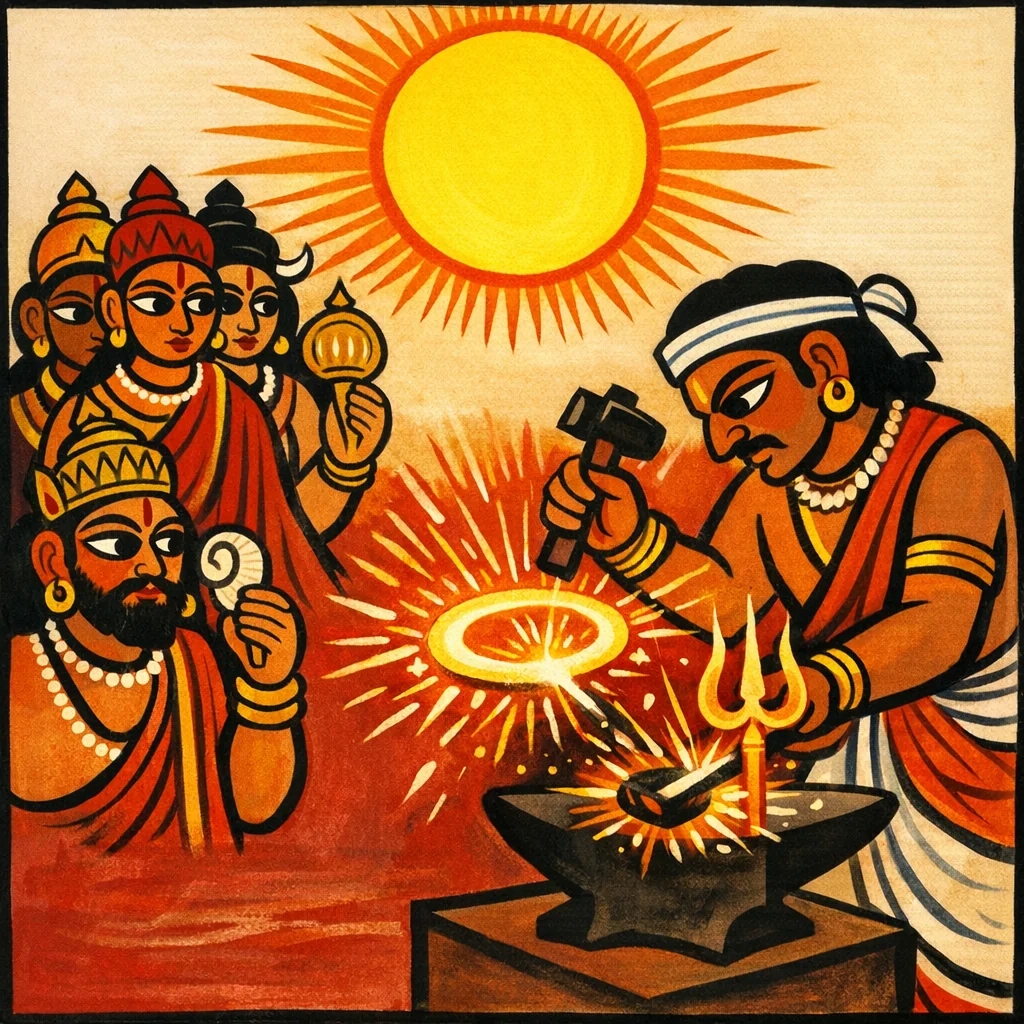
शातितास्तेजसो भागा ये त्वष्ट्रा दश पञ्च च । त्वष्ट्रैव तेन शर्वस्य कृतं शूलं महात्मना ॥
The portions of that radiance were divided—fifteen parts by Tvaṣṭṛ. With that, the great-souled Tvaṣṭṛ fashioned the trident (śūla) for Śarva (Śiva).
Verse 18
चक्रं विष्णोर्वसूनाञ्च शङ्कवो 'थ सुदारुणाः । पावकस्य तथा शक्तिः शिबिका धनदस्य च ॥
The discus for Viṣṇu, and fierce spears for the Vasus; likewise a spear-weapon for Pāvaka (Agni), and a palanquin for Dhanada (Kubera) as well.
Verse 19
अन्येषामसुरारीणामस्त्राण्युग्राणि यानि वै । यक्षविद्याधराणाञ्च तानि चक्रे स विश्वकृत् ॥
And the other fierce weapons belonging to the enemies of the Asuras (the gods), and also those of the Yakṣas and Vidyādharas—those the universal maker fashioned.
Verse 20
ततश्च षोडशं भागं बिभर्ति भगवान् विभुः । तत्तेजः पञ्चदशधा शातितं विश्वकर्मणा ॥
Then the Lord, the all-pervading one, retains the sixteenth portion. That radiance was divided fifteenfold by Viśvakarman.
Verse 21
ततोऽश्व रूपधृग्भानुरुत्तरानगमत्कुरून् । तदृशे तत्र संज्ञाञ्च वडवारूपधारिणीम् ॥
Then Bhānu (the Sun), assuming the form of a horse, went northward to the Kuru country. There he saw Saṃjñā as well, who was bearing the form of a mare.
Verse 22
सा च दृष्ट्वा तमायान्तं परपुंसो विशङ्कया । जगाम संमुखं तस्य पृष्ठरक्षणतत्परा ॥
And she, seeing him draw near and suspecting him to be another man, went forth to confront him—remaining wary, intent on guarding her back.
Verse 23
ततश्च नासिकायोगं तयोस्तत्र समेतयोः । नासत्यदस्त्रौ तनयावश्वीवक्त्रविनिर्गतौ ॥
Then, when the two met there, a union occurred through the nose; and the two sons—Nāsatya and Dasra—came forth, emerging with horse-like faces.
Verse 24
रेतसोऽन्ते च रेवन्तः खड्गी चर्मो तनुत्रधृक् । अश्वारूढः समुद्भूतो बाणतूणसमन्वितः ॥
And at the end of the emission of seed, Revanta arose—bearing a sword, shield, and armor—mounted on a horse and equipped with arrows and a quiver.
Verse 25
ततः स्वरूपमतुलं दर्शयामास भानुमान् । तस्यैषा च समालोक्य स्वरूपं मुदमाददे ॥
Then Bhānumān (the Sun) revealed his incomparable true form; and she, beholding that true form, was filled with joy.
Verse 26
स्वरूपधारिणीं चैमामानिनाय निजाश्रयम् । संज्ञां भार्यां प्रीतिमतीं भास्करो वारितस्करः ॥
And Bhāskara (the Sun), the restrainer of thieves (that is, the dispeller of darkness), brought this Saṃjñā—now bearing her own true form—back to his own abode, as his beloved wife.
Verse 27
ततः पूर्वसुतो योऽस्याः सोऽभूद्वैवस्वतो मनुः । द्वितीयश्च यमः शापाद्धर्मदृष्टिरभूत् सुतः ॥
Then her earlier-born son became Vaivasvata Manu, and the second was Yama. But through a curse, another son became Dharma-dṛṣṭi, “one who beholds dharma.”
Verse 28
कृमयो मांसमादाय पादतोऽस्य महीतले । पतिष्यन्तीति शापान्तं तस्य चक्रे पिता स्वयम् ॥
“Worms will take the flesh from his feet and fall to the ground”—thus the father himself set a limit and an end to that curse.
Verse 29
धर्मदृष्टिर्यतश्चासौ समो मित्रे तथाहिते । ततो नियोगं तं याम्ये चकार तिमिरापहः ॥
And because that Dharma-dṛṣṭi was impartial alike to friend and foe, the Dispeller of darkness—the Sun—appointed him to an office and commission connected with Yama.
Verse 30
यमुना च नदी जज्ञे कलिन्दान्तरवाहिनी । अश्विनौ देवभिषजौ कृतौ पित्रा महात्मना ॥
And the river Yamunā was born, flowing through and along the Kalinda mountain region; and the two Aśvins were constituted as the divine physicians by their great-souled father.
Verse 31
गुह्यकाधिपतित्वे च रेवन्तोऽपि नियोजितः । च्छायासंज्ञासुतानाञ्च नियोगः श्रूयतां मम ॥
And Revanta too was appointed to lordship over the guhyakas. Now hear from me the appointments (niyoga) of the sons of Chāyā and Saṃjñā.
Verse 32
पूर्वजस्य मनोस्तुल्यश्छायासंज्ञासुतोऽग्रजः । ततः सावर्णिकीं संज्ञामवाप तनयो रवेः ॥
The elder son born of Chāyā and Saṃjñā was, in mind, like the earlier Manu. Therefore that son of Ravi (the Sun) obtained the designation “Sāvarṇi.”
Verse 33
भविष्यति मनुः सोऽपि बलिरिन्द्रो यदा तदा । शनैश्चरो ग्रहाणाञ्च मध्ये पित्रा नियोजितः ॥
He too will become a Manu; and at that time Bali will be Indra. Śanaiścara (Saturn) will be appointed by his father among the planets.
Verse 34
तयोस्तृतीया या कन्या तपती नाम सा कुरुम् । नृपात्संवरणात्पुत्रमवाप मनुजेश्वरम् ॥
The third daughter of those two, named Tapatī, bore a son—Kuru—by King Saṃvaraṇa, a lord among men.
Verse 35
तस्य वैवस्वतस्याहं मनोः सप्तममन्तरम् । कथयामि सुतान्भूपानृषीन्देवान्सुराधिपम् ॥
Now I shall recount the seventh Manvantara of that Vaivasvata Manu—his sons, the kings, the sages, the gods, and the lord of the gods (Indra).
Frequently Asked Questions
It examines how an overwhelming divine potency (Sūrya’s tejas) can be both transcendent and yet rendered immanent, measurable, and beneficial—purifying ritual action, sustaining the cosmos, and becoming intelligible through Vedic identification (trayīmaya) and controlled distribution.
It anchors the Vaivasvata Manvantara in solar lineage: Vaivasvata Manu is presented as Sūrya’s earlier son, while related figures (Yama/Dharmadṛṣṭi, the Aśvins, Revanta, Śanaiścara, and Tapatī) receive origins and cosmic appointments that support Manvantara governance and dharma-administration.
The chapter links Sūrya with Saṃjñā and Chāyā and enumerates their offspring and roles: Vaivasvata Manu (Manu of the seventh Manvantara), Yama as Dharmadṛṣṭi, the Aśvins as divine physicians, Revanta’s placement in guhyaka leadership, Śanaiścara’s graha-station, and Tapatī’s integration into the Kuru royal line through Saṃvaraṇa.