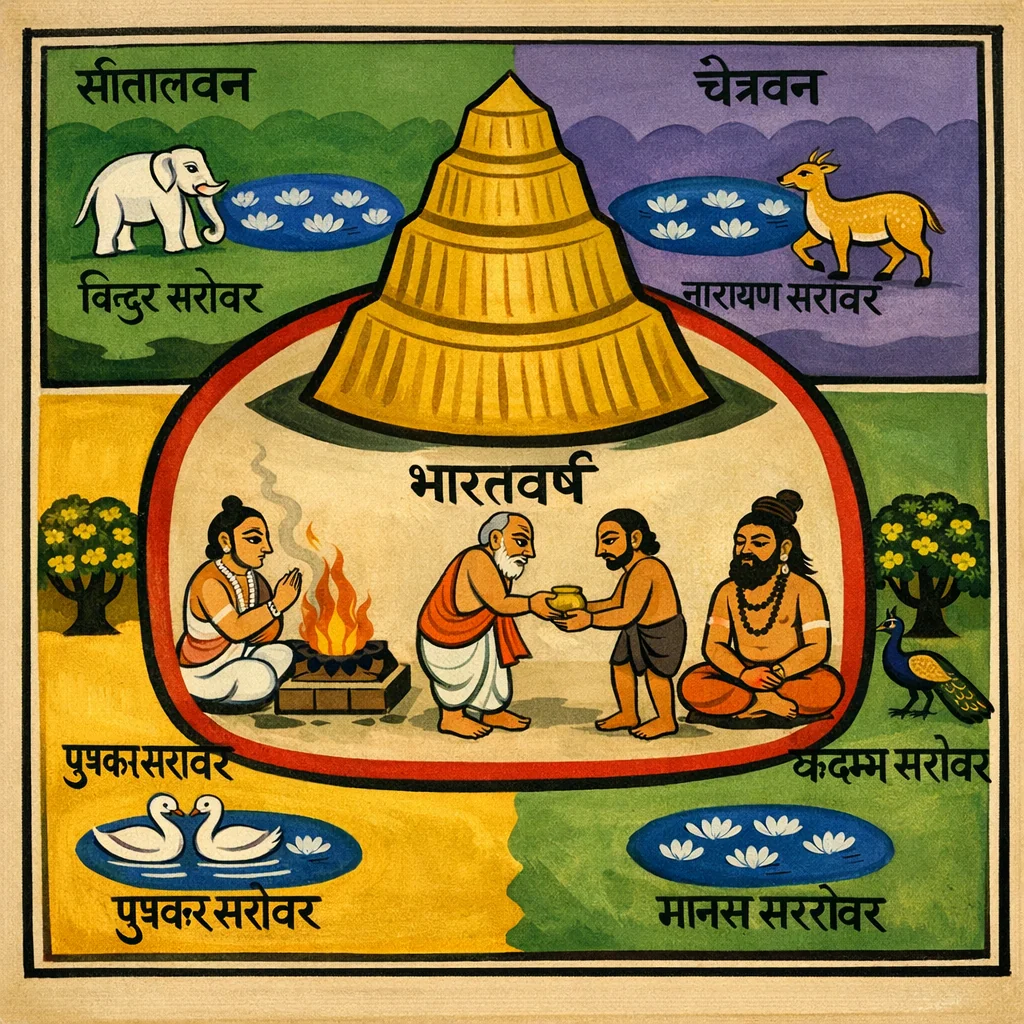
Adhyaya 55: Description of Jambudvipa: The Four Forests, Lakes, and Mountain Ranges Around Mount Meru; Bharata as the Karma-Bhumi
भुवनकोशे जम्बूद्वीपवर्णनम् (Bhuvanakośe Jambūdvīpavarṇanam)
Surya's Chariot
This adhyaya describes Jambudvīpa in the Bhuvanakośa, with Mount Meru as the world’s central axis. It recounts the four forests in the four directions around Meru, the sacred lakes and waters, and the surrounding mountain ranges that encircle and divide the regions. It concludes by declaring Bhārata-varṣa to be the Karma-bhūmi, the land where beings perform actions, reap their results, and practice Dharma for spiritual attainment.
Divine Beings
Celestial Realms
Key Content Points
Focus Keywords
Shlokas in Adhyaya 55
Verse 1
इति श्रीमार्कण्डेयपुराणे भुवनकोशस्थजम्बूद्वीपवर्णनं नाम चतुःपञ्चाशोऽध्यायः । पञ्चपञ्चाशोऽध्यायः । मार्कण्डेय उवाच । शैलेषु मन्दाराद्येषु चतुष्वपि द्विजोत्तम । वानानि यानि चत्वारि सरांसि च निबोध मे ॥
Thus ends, in the Śrī Mārkaṇḍeya Purāṇa, the fifty-fourth chapter called “Description of Jambūdvīpa in the Bhuvanakośa.” Now begins the fifty-fifth chapter. Mārkaṇḍeya said: O best of the twice-born, learn from me the four forests and the lakes found on the four mountains beginning with Mandara.
Verse 2
पूर्वं चैत्ररथं नाम दक्षिणे नन्दनं वनम् । वैभ्राजं पश्चिमे शैले सावित्रं चोत्तराचले ॥
To the east is the forest named Caitraratha; to the south, the Nandana grove; on the western mountain is Vaibhrāja; and on the northern mountain, Sāvitra.
Verse 3
अरुणोदं सरः पूर्वं मानसं दक्षिणे तथा । शीतोदं पश्चिमे मेरोर् महाभद्रं तथोत्तरे ॥
To the east is the lake Aruṇoda; to the south likewise is Mānasā; to the west of Meru is Śītoda; and to the north likewise is Mahābhadra.
Verse 4
शीतार्तश्चक्रमुञ्जश्च कुलीरोऽथ सुकङ्कवान् । मणिशैलोऽथ वृषवान् महानीलो भवाचलः ॥
Śītārta, Cakramuñja, Kulīra, and Sukaṅkavān; Maṇiśaila, Vṛṣavān, Mahānīla, and Bhavācala—these are counted among the great mountains being enumerated.
Verse 5
सूबिन्दुर्मन्दरो वेणुस्तामसो निषधस्तथा । देवशैलश्च पूर्वेण मन्दरस्य महाचलः ॥
Sūbindu, Mandara, Veṇu, Tāmasa, and Niṣadha; and to the east of Mandara stands the great mountain Devaśaila.
Verse 6
त्रिकटशिखराद्रिश्च कलिङ्गोऽथ पतङ्गकः । रुचकः सानुमांश्चाद्रिस्ताम्रकोऽथ विशाखवान् ॥
Trikaṭaśikhara (the three-peaked mountain), Kaliṅga, Pataṅgaka, Rucaka, Sānumān, Tāmraka, and Viśākhavān—these too are counted among the mountains being described.
Verse 7
श्वेतोदरः समूलश्च वसुधारश्च रत्नवान् । एकशृङ्गो महाशैलो राजशालः पिपाठकः ॥
Śvetodara, Samūla, Vasudhāra, and Ratnavān; Ekaśṛṅga (the single-peaked), Mahāśaila, Rājaśāla, and Pipāṭhaka—these too are mountains in the enumeration.
Verse 8
पञ्चशैलोऽथ कैलासो हिमवांश्चाचलोत्तमः । इत्येते दक्षिणे पार्श्वे मेरोः प्रोक्ता महाचलाः ॥
Pañcaśaila, Kailāsa, and Himavān—the best of mountains. Thus, these great mountains are declared to lie on the southern side of Meru.
Verse 9
सुरक्षः शिशिराक्षश्च वैदूर्यः कपिलस्तथा । पिञ्जरोऽथ महाभद्रः सुरसः पिङ्गलो मधुः ॥
Surakṣa, Śiśirākṣa, Vaidūrya, and Kapila; Piñjara, Mahābhadra, Surasa, Piṅgala, and Madhu—these (among the mountains) are being enumerated.
Verse 10
अञ्जनः कुक्कुटः कृष्णः पाण्डरश्चालोत्तमः । सहस्रशिखरश्चाद्रिः पारियात्रः सशृङ्गवान् ॥
Añjana, Kukkuṭa, Kṛṣṇa, and Pāṇḍara, and also Acalottama; the mountain Sahasraśikhara; and Pāriyātra, possessing peaks—these are listed among the ranges.
Verse 11
पश्चिमेन तथा मेरोर् विस्कम्भात् पश्चिमाद्वहिः । एतेऽचलाः समाख्याताḥ शृणुष्वन्यांस्तथोत्तरान् ॥
Thus, to the west of Meru—outside, beyond its extent—these mountains have been named. Now hear of the others, those to the north as well.
Verse 12
शङ्खकूटोऽथ वृषभो हंसनाभस्तथाचलः । कपिलेन्द्रस्तथा शैलः सानुमान् नील एव च ॥
Śaṅkhakūṭa, Vṛṣabha, and Haṃsanābha; likewise another mountain; also Kapilendra; and Śaila; and Sānumān; and Nīla as well—these are the northern mountains, in this sequence.
Verse 13
स्वर्णशृङ्गी शातशृङ्गी पुष्पको मेघपर्वतः । विरजाक्षो वराहाद्रिर्मयूरो जारुधिस्तथा ॥
Svarṇaśṛṅgī, Śātaśṛṅgī, Puṣpaka, and Meghaparvata; Virajākṣa, Varāhādri, Mayūra, and Jārudhi likewise—these are the mountains being enumerated to the north.
Verse 14
इत्येते कथिता ब्रह्मन् । मेरोरुत्तरतो नगाः । एतेषां पर्वतानान्तु द्रौण्योऽतीव मनोहराः ॥
Thus, O Brāhmaṇa, these mountains to the north of Meru have been described. And the valleys (basins) of these mountains are exceedingly delightful.
Verse 15
वनैरमलपानीयैः सरोभिरुपशोभिताः । तासु पुण्यकृतां जन्म मनुष्याणां द्विजोत्तम ॥
They are adorned with forests and with lakes of pure water. In those regions, O best of the twice-born, humans are born who have performed meritorious deeds.
Verse 16
एते भौमा द्विजश्रेष्ठ । स्वर्गाः स्वर्गगुणाधिकाः । न तासु पुण्यपापानामपूर्वाणामुपार्जनम् ॥
These are earthly heavens, O best of brāhmaṇas—abounding in heavenly qualities. In them there is no acquisition of new merit or sin.
Verse 17
पुण्योपभोगा एवोक्ता देवानामपि तास्वपि । शीतान्ताद्येषु चैतषु शैलेषु द्विजसत्तम ॥
Even for the gods, those regions are said to be places for the enjoyment of merit. And so too in these mountains beginning with Śītānta, O best among the twice-born.
Verse 18
विद्याधराणां यक्षाणां किन्नरोगररक्षसाम् । देवानाञ्च महावासा गन्धर्वाणां च शोभनाः ॥
They are great abodes for Vidyādharas, Yakṣas, Kinnaras, Nāgas (serpent-beings), and Rākṣasas; and also splendid dwellings for the gods and for Gandharvas.
Verse 19
महापुण्या मनोज्ञैश्च सदैवोपवनैर्युताः । सरांसि च मनोज्ञानि सर्वर्तुसुखदोऽनिलः ॥
Those regions are exceedingly holy and are ever adorned with delightful groves. Their lakes are charming, and the breeze there brings comfort in every season.
Verse 20
न चैतषु मनुष्याणां वैमनस्यानि कुत्रचित् । तदेवं पार्थिवं पद्मं चतुष्पत्रं मयोदितम् ॥
And among these regions there is nowhere any dejection of mind for humans. Thus have I described this earthly lotus with four petals.
Verse 21
भद्राश्चभारताद्यानि पत्राण्यस्य चतुर्दिशम् । भारतं नाम यद्वर्षं दक्षिणेन मयोदितम् ॥
Its petals in the four directions are Bhadrā and those beginning with Bhārata. That region called Bhārata, I have described as lying to the south.
Verse 22
तत् कर्मभूमिर्नान्यत्र संप्राप्तिः पुण्यपापयोः । एतत् प्रधानं विज्ञेयं यत्र सर्वं प्रतिष्ठितम् ॥
That Bhārata is the land of action (karma); nowhere else is there the fresh acquisition of merit and sin. This should be understood as the principal region, upon which everything is established.
Verse 23
तस्मात् स्वर्गापवर्गौ च मानुष्यानारकावपि । तिर्यक्त्वमथवाप्यन्यत् नरः प्राप्नोति वै द्विज ॥
Therefore, O twice-born, a person attains heaven and also liberation; and also human rebirth and hellish states; or animality, or some other condition.
Frequently Asked Questions
The chapter’s ethical thesis is the distinction between realms of enjoyment and realms of moral agency: it identifies Bharata-varsha as karmabhūmi, the principal human domain where new puṇya and pāpa are generated, determining trajectories such as svarga, apavarga, or lower rebirths.
This Adhyaya is not primarily a Manvantara-transition unit; instead, it supports the Purāṇic historiographical frame by supplying the cosmographical stage (bhuvanakośa) on which Manvantara genealogies and dharma histories are situated, especially by privileging Bharata-varsha as the arena of karmic causality.
This chapter does not belong to the Devī Māhātmya sequence (Adhyayas 81–93) and contains no explicit Śākta stuti or battle narrative; its contribution is instead cosmographical and soteriological, clarifying Bharata-varsha’s role as karmabhūmi within the broader Purāṇic worldview.