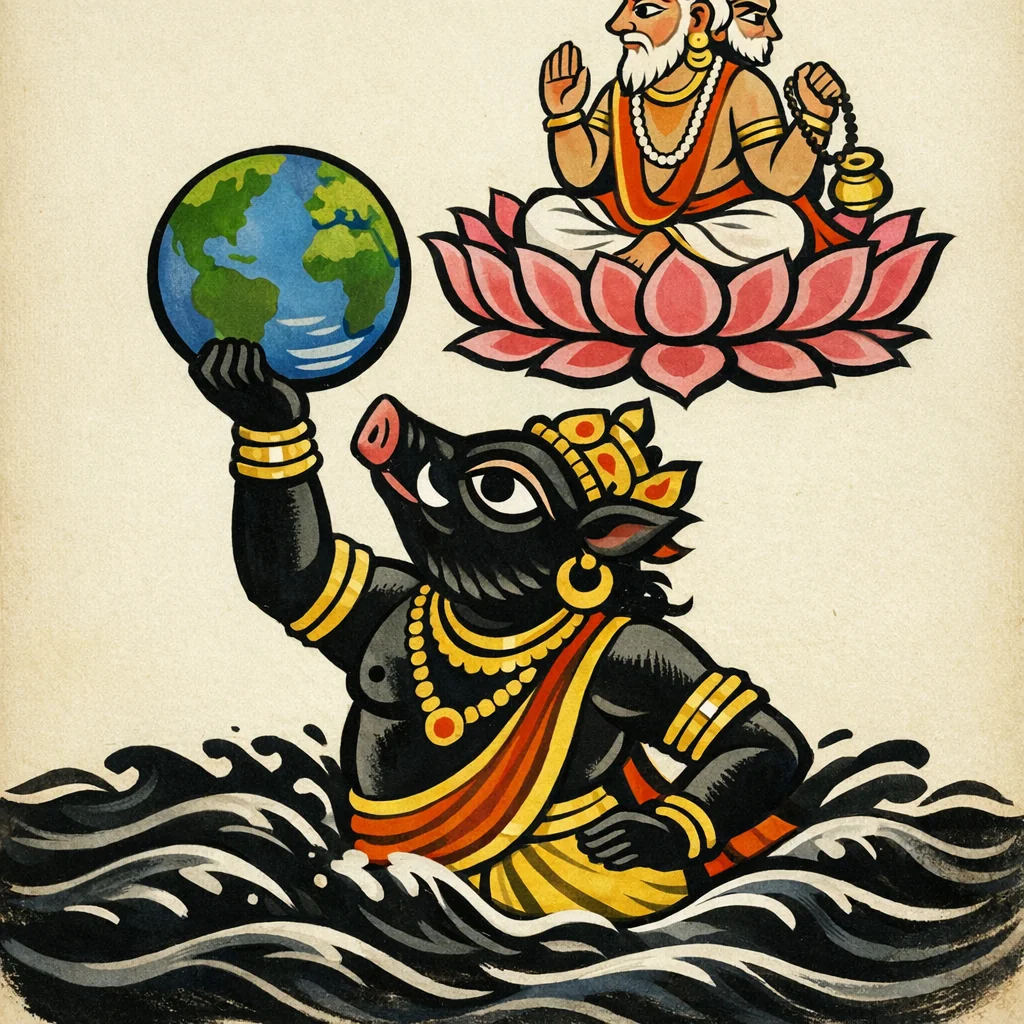
Adhyaya 47: Brahma’s Awakening and the Ninefold Scheme of Creation
सर्गनवकवर्णनम् (Sarga-navaka-varṇanam)
Bharata-varsha
This adhyaya recounts Brahmā’s awakening from yoga-nidrā and his commencement of creation according to the ninefold scheme (sarga-navaka). It sets forth the ordered unfolding from the subtle, unmanifest state into elements, living beings, and the world’s arrangement, honoring divine sovereignty and the laws of cosmic time.
Divine Beings
Celestial Realms
Key Content Points
Focus Keywords
Shlokas in Adhyaya 47
Verse 1
इति श्रीमार्कण्डेयपुराणे ब्रह्मायु-प्रमाणो नाम षट्चत्वारिंशोऽध्यायः । सप्तचत्वारिंशोऽध्यायः । क्रौष्टुकिरुवाच— यथा ससर्ज वै ब्रह्मा भगवानादिकृत् प्रजाः । प्रजापतिः पतिर्देवस् तन्मे विस्तरतो वद ॥
Thus ends the forty-sixth chapter in the Śrī Mārkaṇḍeya Purāṇa, called “The Measure of Brahmā’s Lifespan”. Now begins chapter forty-seven. Krauṣṭuki said: “How did Brahmā—the Blessed One, the primal maker—create the creatures? O lord Prajāpati, deity of beings, tell me in detail.”
Verse 2
मार्कण्डेय उवाच— कथयाम्येष ते ब्रह्मन् ससर्ज भगवान् यथा । लोककृत् शाश्वतः कृत्स्नं जगत् स्थावरजङ्गमम् ॥
Mārkaṇḍeya said: “I shall tell you, O Brahmin, how the Blessed Lord—the eternal maker of the worlds—created the entire universe, both the immovable and the moving.”
Verse 3
पद्मावसाने प्रलये निशासुत्पोत्थितः प्रभुः । सत्त्वोद्रिक्तस्तदा ब्रह्मा शून्यं लोकमवैक्षत ॥
At the dissolution at the end of the Pādma cycle, the Lord Brahmā, rising at dawn after the cosmic night, then—abounding in sattva—beheld the world as empty.
Verse 4
इमञ्चोदाहरन्त्यत्र श्लोकं नारायणं प्रति । ब्रह्मस्वरूपिणं देवं जगतः प्रभवाप्ययम् ॥
Here they recite this verse addressed to Nārāyaṇa: “the deity whose form is Brahman, who is the origin and dissolution of the world.”
Verse 5
आपो नारा वै तनव इत्यपां नाम शुश्रुम । तासु शेते स यस्माच्च तेन नारायणः स्मृतः ॥
“The waters are indeed called nārā”—so we have heard, as a name of the waters. And because he lies upon them, he is remembered as Nārāyaṇa.
Verse 6
विबुद्धः सलिले तस्मिन् विज्ञायान्तर्गतां महीम् । अनुमानात् समुद्धारं कर्तुकामस्तदा क्षिते ॥
Awakened in those waters, and realizing that the earth lay submerged within them, he then—by inference—desired to raise up the earth.
Verse 7
अकरोत् स तनूरन्याः कल्पादिषु यथा पुरा । मत्स्यकूर्मादिकास्तद्वद्वाराहं वपुरास्थितः ॥
He assumed another body, as formerly in other Kalpas; and just as he took forms such as Fish and Tortoise, so too he took on the body of the Boar (Varāha).
Verse 8
वेदयज्ञमयं दिव्यं वेदयज्ञमयो विभुः । रूपं कृत्वा विवेशाप्सु सर्वगः सर्वसम्भवः ॥
The all-pervading Lord, source of all beings, assuming a divine form constituted of the Vedas and sacrifice, entered into the waters.
Verse 9
समुद्धृत्य च पातालान्मुमोच सलिले भुवम् । जनलोकस्थितैः सिद्धैश्चिन्त्यमानो जगत्पतिः ॥
Having lifted the Earth up from the nether regions, the Lord of the world released her upon the waters, while the Siddhas abiding in Janaloka contemplated Him.
Verse 10
तस्योपरि जलौघस्य महती नैरिव स्थिताः । विततत्वात्तु देहस्य न मही याति सम्प्लवम् ॥
Above that mass of waters the great Earth stood as if on a support; because His body was spread vast, the Earth did not sink into inundation.
Verse 11
ततः क्षितिं समीक्ष्य पृथिव्यां सोऽसृजद् गिरिन् । प्राक् सर्गे दह्यमाने तु तदा संवर्तकाग्निना ॥
Then, having made the ground even, he created mountains upon the earth—whereas in the former creation they were burned at that time by the fire of dissolution.
Verse 12
तेनाग्निना विशीर्णास्ते पर्वता भुवि सर्वशः । शैला एकार्णवे मग्ना वायुनापस्तु संहताः ॥
By that fire the mountains everywhere on earth were shattered; the rocky masses sank into the single ocean, and the waters were driven together by the wind.
Verse 13
निषक्ता यत्र यत्रासंस्तत्र तत्राचलाभवन् । भूविभागं ततः कृत्वा सप्तद्वीपोपशोभितम् ॥
Wherever those masses came to rest, there and there they became mountains; then, dividing the earth, he made it adorned with seven continents.
Verse 14
भूराद्यांश्चतुरो लोकान् पूर्वंवत् समकल्पयत् । सृष्टिंचिन्तयतस्तस्य कल्पादिषु यथा पुरा ॥
He arranged the four worlds beginning with Bhū (Earth) just as before; as he contemplated creation, so it was in the beginnings of the kalpas, as formerly.
Verse 15
अबुद्धिपूर्वकस्तस्मात् प्रादुर्भूतस्तमोमयः । तमो मोहो महामोहस्तामिस्त्रो ह्यन्धसंज्ञितः ॥
From him there arose, without deliberate intent, a product made of darkness: (known as) Tamas, Moha, Mahāmoha, Tāmisra, and Andha (blindness).
Verse 16
अविद्या पञ्चपर्वैषा प्रादुर्भूता महात्मनः । पञ्चधावस्थितः सर्गो ध्यायतोऽप्रतिबोधवान् ॥
This ignorance, having five ‘nodes’ (or divisions), manifested from that Great Being; and as he contemplated—being as yet unawakened—creation became established in fivefold form.
Verse 17
बहिरन्तश्चाप्रकाशः संवृतात्मा नगात्मकः । मुख्या नगा यतश्चोक्ता मुख्यसर्गस्ततस्त्वयम् ॥
Without illumination outwardly and inwardly, with the self veiled, this creation was of the nature of ‘naga’ (immobile/vegetative beings). Since these ‘nagas’ are called primary, this is therefore termed the primary creation (mukhya-sarga).
Verse 18
तं दृष्ट्वासाधकं सर्गममन्यदपरं पुनः । तस्याभिध्यायतः सर्गं तिर्यक्स्रोतो ह्यवर्तत ॥
Seeing that creation to be ineffective (not conducive to the intended purpose), he again conceived another. As he contemplated, the creation called ‘tiryak-srotas’ (moving sideways) came into being.
Verse 19
यस्मात्तिर्यक्प्रवृत्तिः सा तिर्यक्स्रोतस्ततः स्मृतः । पश्वादयस्ते विख्यातास्तमः प्रायो ह्यवेदिनः ॥
Because their activity proceeds sideways (not upward toward discernment), they are therefore called ‘tiryak-srotas’. They are known as animals and the like, mostly dominated by tamas and lacking understanding.
Verse 20
अतपथग्राहिणश्चैव ते ’ज्ञाने ज्ञानमानिनः । अहङ्कृता अहंमाना अष्टाविंशद्विधात्मकाः ॥
They grasp what is not the path, and in ignorance they imagine themselves to be knowing. They are shaped by egoity and self-conceit, being of a twenty-eightfold constitution.
Verse 21
अन्तः प्रकाशास्ते सर्वे आवृतास्तु परस्परम् । तमप्यसाधकं मत्वा ध्यायतो ’न्यस्ततो ’भवत् ॥
All of them had inner luminosity, yet they were mutually veiled. Considering even that creation ineffective, as he contemplated, another (creation) then arose.
Verse 22
ऊर्ध्वस्रोतस्तृतीयस्तु सात्त्विकः समवर्तत । ते सुखप्रीतिबहुला बहिरन्तस्त्वनावृताः ॥
The third creation, called ‘ūrdhva-srotas’ (upward-flowing), arose as sāttvika. They were abundant in happiness and delight, and were unobscured both outwardly and inwardly.
Verse 23
प्रकाशा बहिरन्तश्च ऊर्ध्वस्रोतः समुद्भवाः । तुष्टात्मकस्तृतीयस्तु देवसर्गो हि स स्मृतः ॥
The beings born as ūrdhva-srotas were luminous both outwardly and inwardly. This third creation, of the nature of contentment, is remembered as the creation of the gods (devasarga).
Verse 24
तस्मिन् सर्गे ’भवत् प्रीतिर्निष्पन्ने ब्रह्मणस्तदा । ततो ’न्यं स तदा दध्यौ साधकं सर्गमुत्तमम् ॥
When that creation was completed, Brahmā then felt delight in it. Thereafter he conceived another—an excellent creation that would be truly effective (sādhaka).
Verse 25
तथाभिध्यायतस्तस्य सत्याभिध्यायिनस्ततः । प्रादुर्बभौ तदाव्यक्तादर्वाक्स्रोतस्तु साधकः ॥
As he thus contemplated—contemplating truly—then from the Unmanifest (avyakta) the ‘arvāk-srotas’ creation manifested, a creation that is effective (sādhaka).
Verse 26
यस्मादर्वाग् व्यवर्तन्त ततोऽर्वाक्स्रोतसस्तु ते । ते च प्रकाशबहुलास्तमोद्रिक्ता रजो ’धिकाः ॥
Because they proceeded downward, they are therefore called ‘arvāk-srotas’. They too are rich in luminosity, yet have increased tamas and a predominance of rajas.
Verse 27
तस्मात्ते दुःखबहुला भूयोभूयश्च कारिणः । प्रकाशा बहिरन्तश्च मनुष्याः साधकाश्च ते ॥
Therefore they are full of suffering and act again and again. Yet they are luminous both outwardly and inwardly; they are humans, and they are capable of accomplishment (sādhaka).
Verse 28
पञ्चमोऽनुग्रहः सर्गः स चतुर्धा व्यवस्थितः । विपर्ययेण सिद्ध्या च शान्त्या तुष्ट्या तथैव च ॥
The fifth is the ‘anugraha’ creation (the bestowal of grace), and it is arranged in four forms: by reversal (viparyaya), by accomplishment (siddhi), by peace (śānti), and likewise by contentment (tuṣṭi).
Verse 29
निर्वृत्तं वर्तमानञ्च तेर्’थं जानन्ति वै पुनः । भूतादिकानां भूतानां षष्ठः सर्ग स उच्यते ॥
They again know the meaning of what has passed and what is present. This is called the sixth creation of beings, beginning with the bhūtādi (the elemental principles).
Verse 30
ते परिग्राहिणः सर्वे संविभागरता तथा । चोदनाश्चाप्यशीलाś्च ज्ञेया भूतादिकाश्च ते ॥
All of them are acquisitive (grasping), and they also delight in apportioning (sharing/distributing). They are driven by impulses and lack fixed discipline; know them as belonging to the bhūtādi class.
Verse 31
प्रथमो महतः सर्गो विज्ञेयो ब्रह्मणस्तु सः । तन्मात्राणां द्वितीयस्तु भूतसर्गः स उच्यते ॥
The first creation is that of Mahat (the Great Principle), to be understood as belonging to Brahmā. The second is of the tanmātras; it is called the creation of the elements (bhūta-sarga).
Verse 32
वैकारिकस्तृतीयस्तु सर्गश्चैन्द्रियकः स्मृतः । इत्येष प्राकृतः सर्गः सम्भूतो बुद्धैपूर्वकः ॥
The third creation is called the vaikārika, also remembered as the creation of the senses (indriya). Thus this prākṛta creation arises with buddhi (intellect) as the prior factor.
Verse 33
मुख्यः सर्गश्चतुर्थस्तु मुख्याः वै स्थावराः स्मृताः । तिर्यक्स्रोतस्तु यः प्रोक्तस्तिर्यग्योन्यः स पञ्चमः ॥
The fourth is the ‘mukhya’ creation; the immovables (sthāvara) are indeed remembered as primary. The fifth, called ‘tiryak-srotas’, is the creation of those born in animal wombs (tiryag-yoni).
Verse 34
तथोर्ध्वस्रोतसां षष्ठो देवसर्गस्तु स स्मृतः । ततोऽर्वाक्स्रोतसां सर्गः सप्तमः स तु मानुषः ॥
So too, the sixth—of those with the upward current (ūrdhva-srotas)—is remembered as the creation of the gods. Then the creation of those with the downward current (arvāk-srotas) is the seventh, namely the human creation.
Verse 35
अष्टमोऽनुग्रहः सर्गः सात्त्विकस्तामसश्च सः । पञ्चैते वैकृताः सर्गाः प्राकृतास्तु त्रयः स्मृताः ॥
The eighth is the anugraha creation; it is both sāttvika and tāmasa. These five are the vaikṛta creations, while the prākṛta creations are remembered as three.
Verse 36
प्राकृतो वैकृतश्चैव कौमारो नवमः स्मृतः । इत्येते वै समाख्याता नव सर्गाः प्रजापतेः ॥
And the ninth, remembered as the kaumāra creation, is both prākṛta and vaikṛta. Thus these nine creations of Prajāpati have indeed been enumerated.
Frequently Asked Questions
It investigates how ordered creation proceeds from Brahmā’s contemplation after pralaya, moving from narrative cosmogony to an analytical classification of manifestation: the rise of fivefold avidyā and the graded emergence of life-streams, culminating in the ninefold schema of sarga.
Rather than detailing a specific Manu lineage, it supplies the cosmological precondition for any Manvantara: earth’s re-stabilization, the reconstitution of lokas, and the typology of beings (devas, humans, animals, immobiles) that populate subsequent Manvantara histories.
This Adhyaya is outside the Devi Mahatmyam (Adhyayas 81–93) and contains no Shakti battle narrative or stuti; its relevance is primarily cosmological and taxonomic, establishing creation categories later presupposed by Puranic theology.