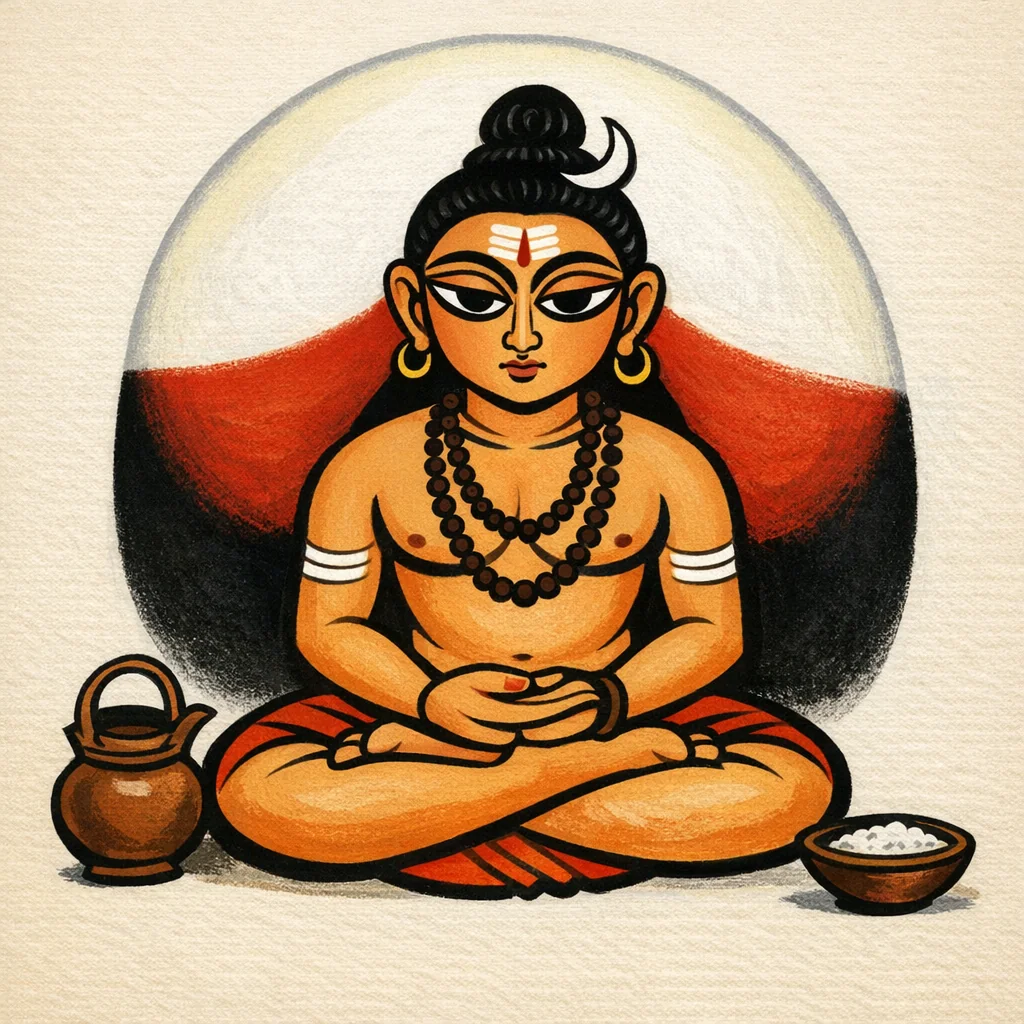
Adhyaya 39: Yoga Discipline: Posture, Breath Control, Sense Withdrawal, and Signs of Attainment
योगविधिः (Yogavidhiḥ)
Funeral Rites
This adhyaya teaches the discipline of Yoga—posture (āsana), breath control (prāṇāyāma), withdrawal of the senses (pratyāhāra), and the signs of attainment. It urges pure, calm, and steadfast practice to cleanse the mind and lead it toward samādhi.
Key Content Points
Focus Keywords
Shlokas in Adhyaya 39
Verse 27
इति श्रीमार्कण्डेयपुराणे पितापुत्रसंवादे प्रश्नाध्यायो नामाष्टत्रिंशोऽध्यायः । युञ्जतश्च सदा योगं यादृग्विहितमासनम् ॥
Thus, in the Śrī Mārkaṇḍeya Purāṇa, in the dialogue of father and son, ends the chapter called “The Chapter of Questions” (colophon). Now: for one who continually engages in yoga, what prescribed posture (āsana) should be adopted?
Verse 28
पद्ममर्धासनञ्चापि तथा स्वस्तिकमासनम् । आस्थाय योगं युञ्जीत कृत्वा च प्रणवं हृदि ॥
Having adopted the lotus posture, or the half-seat, and likewise the svastika posture, one should practice yoga, placing (fixing) the praṇava (Oṃ) within the heart.
Verse 29
समः समासनो भूत्वा संहृत्य चरणावुभौ । संवृतास्यस्तथैवोरू सम्यग्विष्टभ्य चाग्रतः ॥
Becoming even and steady in one’s seated posture, drawing in both feet; keeping the mouth closed, and likewise setting the thighs properly, supported and placed in front in correct alignment.
Verse 30
पार्ष्णिभ्यां लिङ्गवृषणावस्पृशन् प्रयतः स्थितः । किञ्चिदुन्नामितशिरा दन्तैर्दन्तान्न संस्पृशेत् ॥
Remaining composed and attentive (in the posture), without the heels touching the genitals and testicles; with the head slightly raised, one should not press the teeth against the teeth.
Verse 31
सम्पश्यन् नासिकाग्रं स्वं दिशश्चानवलोकयन् । रजसा तमसो वृत्तिं सत्त्वेन रजसस्तथा ॥
Gazing at the tip of one’s own nose, not looking toward the directions, one should overcome the activity of tamas by rajas, and likewise that of rajas by sattva.
Verse 32
सञ्चाद्य निर्मले सत्त्वे स्थितो युञ्जीत योगवित् । इन्द्रियाणीन्द्रियार्थेभ्यः प्राणादीन् मन एव च ॥
Having subdued the lower tendencies and abiding in purified sattva, the knower of yoga should apply himself to yoga—restraining the senses from their objects, and also the vital airs beginning with prāṇa, and the mind itself.
Verse 33
निगृह्य समवायेन प्रत्याहारमुपक्रमेत् । यस्तु प्रत्याहरेत्कामान् सर्वाङ्गानीव कच्छपः ॥
Having restrained them in a unified manner, one should begin pratyāhāra (withdrawal). He who withdraws desires—like a tortoise withdrawing all its limbs—practices pratyāhāra properly.
Verse 34
सदात्मरतिरैकस्थः वश्यत्यात्मानमात्मनि । स बाह्याभ्यन्तरं शौचं निष्पाद्याकण्ठनाभितः ॥
Always delighting in the Self and established in one-pointedness, he brings the self under control within the Self. He then accomplishes external and internal purity, from the navel up to the throat.
Verse 35
पूरयित्वा बुधो देहं प्रत्याहारमुपक्रमेत् । प्राणायामा दश द्वौ च धारणा साभिधीयते ॥
Having filled the body, the wise one should begin pratyāhāra. Ten and two (i.e., twelve) prāṇāyāmas are here called ‘dhāraṇā’.
Verse 36
द्वे धारणॆ स्मृते योगे योगिभिस्तत्त्वदृष्टिभिः । तथा वै योगयुक्तस्य योगिनो नियतात्मनः ॥
In yoga, yogins who see reality (tattva) remember two kinds of dhāraṇā. Likewise, for the yogin who is yoked to yoga and self-restrained… (the statement continues beyond this verse).
Verse 37
सर्वे दोषाः प्रणश्यन्ति स्वस्थश्चैवोपजायते । वीक्षते च परं ब्रह्म प्राकृतांश्च गुणान् पृथक् ॥
All faults are destroyed, and one becomes established in health; one beholds the Supreme Brahman and discerns the natural guṇas as distinct from the Self.
Verse 38
व्योमादिपरमाणूंश्च तथात्मानमकल्मषम् । इत्थं योगी यताहारः प्राणायामपरायणः ॥
Thus the yogin—restrained in diet and devoted to prāṇāyāma—contemplates even the atoms of space and the other elements, and likewise the Self that is stainless.
Verse 39
जितां जितां शनैर्भूमिमारोहेत यथा गृहम् । दोषान् व्याधींस्तथा मोहमाक्रान्ता भूरनिर्जिता ॥
One should ascend, step by step, each level as it is mastered—like climbing to a house. But an unconquered stage becomes overrun by faults, diseases, and delusion.
Verse 40
विवर्धयति नारोहेत्तस्माद् भूमिमनिर्जिताम् । प्राणानामुपसंरोधात् प्राणायाम इति स्मृतः ॥
That practice increases those troubles; therefore one should not ascend an unconquered stage. Because it is the restraint of the vital breaths, it is remembered as prāṇāyāma.
Verse 41
धारणेत्युच्यते चेयं धार्यते यन्मनो यथा । शब्दादिभ्यः प्रवृत्तानि यदक्षाणि यतात्मभिः ॥
This is called dhāraṇā—how the mind is held steady. The senses, which run toward sound and other objects, are to be restrained by the self-controlled.
Verse 42
प्रत्याह्रियन्ते योगेन प्रत्याहारस्ततः स्मृतः । उपायश्चात्र कथितो योगिभिः परमर्षिभिः ॥
The senses are drawn back by yoga; therefore it is known as pratyāhāra. Here this method has been taught by yogins—the supreme seers.
Verse 43
येन व्याध्यादयो दोषा न जायन्ते हि योगिनः । यथा तोयार्थिनस्तोयं यन्त्रनालादिभिः शनैः ॥
By this, faults such as diseases do not arise in a yogin; as one seeking water draws it up gradually by devices, pipes, and the like.
Verse 44
आपिबेयुस्तथा वायुं पिबेद्योगी जितश्रमः । प्राङ्नाभ्यां हृदये चात्र तृतीये च तथोरसि ॥
So too the yogin, having conquered fatigue, should ‘drink’ the breath. (He should fix it) at the fore-navel region, in the heart, and here at the third place, likewise in the chest.
Verse 45
कण्ठे मुखे नासिकाग्रे नेत्रभ्रूमध्यमूर्धसु । किञ्च तस्मात्परस्मिंश्च धारणाऽऽ परमा स्मृता ॥
(Fixation may be) in the throat, the mouth, the tip of the nose, the eyes, the space between the eyebrows, and the crown of the head; and further, beyond that (in the transcendent), dhāraṇā is remembered as supreme.
Verse 46
दशैताः धारणाः प्राप्य प्राप्रोत्यक्शरसाम्यताम् । नाध्मातः क्षुधितः श्रान्तो न च व्याकुलचेतनः ॥
Having attained these ten dhāraṇās, one attains equality with the imperishable (akṣara). One is not bloated, not hungry, not fatigued, and the mind is not agitated.
Verse 47
युञ्जीत योगं राजेन्द्र ! योगी सिद्ध्यर्थमादृतः । नातिशीते न चोष्णे वै न द्वन्द्वे नानिलात्मके ॥
O best of kings, the yogin intent on attainment should apply himself to yoga—but not in excessive cold, not in excessive heat, not amid disturbing conditions of paired opposites, and not when the body or environment is dominated by wind (vāta).
Verse 48
कालेष्वेतेषु युञ्जीत न योगं ध्यानतत्परः । सशब्दाग्निजालभ्यासे जीर्णगोष्ठे चतुष्पथे ॥
Devoted to meditation, one should not practice yoga at such times/conditions: where there is noise, near fire and blazing flames, in a dilapidated cow-shed or enclosure, or at a four-way crossroads.
Verse 49
शुष्कपर्णचये नद्यां श्मशाने ससरीसृपे । सभये कूपतीरे वा चैत्यवल्मीकसञ्चये ॥
Likewise, one should not (practice) on heaps of dry leaves, in or by a river, in a cremation ground, in places with reptiles, in fearful places, on the edge of a well, or amid shrines (caitya) and anthills.
Verse 50
देशेष्वेतेषु तत्त्वज्ञो योगाभ्यासं विवर्जयेत् । सत्त्वस्यानुपपत्तौ च देशकालं विवर्जयेत् ॥
In such places, the knower of reality should avoid the practice of yoga; and whenever sattva (clarity and balance) is not attainable, he should avoid that place and time.
Verse 51
नासतो दर्शनं योगे तस्मात्तत्परिवर्जयेत् । देशानेताननादृत्य मूढत्वाद्यो युनक्ति वै ॥
In yoga, no true realization or vision arises from what is improper; therefore one should avoid it. He who, out of foolishness, disregards these places and still practices—errs.
Verse 52
विघ्राय तस्य वै दोषा जायन्ते तन्निबोध मे । बाधिर्यं जडता लोपः स्मृतेर्मूकत्वमन्धता ॥
From such disturbance and derangement, faults indeed arise—understand this from me: deafness, dullness, loss of memory, muteness, and blindness.
Verse 53
ज्वरश्च जायते सद्यस्तत्तदज्ञानयोगिनः । प्रमादाद्योगिनो दोषा यद्येते स्युश्चिकित्सितम् ॥
Fever also arises quickly in that ignorant practitioner of yoga. These faults of a yogin, born of negligence, if they occur, are to be treated (remedied).
Verse 54
तेषां नाशाय कर्तव्यं योगिनां तन्निबोध मे । स्निग्धां यवागूमत्युष्णां भुक्त्वा तत्रैव धारयेत् ॥
To destroy those faults, what should be done by yogins—learn this from me: having eaten very warm, unctuous gruel (yavāgū), one should retain it within (let it settle; do not expel it).
Verse 55
वात-गुल्मप्रशान्त्यर्थमुदावर्ते तथोदरे । यवागूं वापि पवनं वायुग्रन्थिं प्रतिक्षिपेत् ॥
For the pacification of vāta disorders and gulma, and likewise for udāvarta and abdominal afflictions, one should administer gruel; it counteracts the wind (pavana) and relieves a ‘knot’ of vāyu.
Verse 56
तद्वत्कम्पे महाशैलं स्थिरं मनसि धारयेत् । विघाते वचसो वाचं बाधिर्ये श्रवणेन्द्रियम् ॥
Similarly, in trembling one should hold in the mind the steady image of a great mountain. In impairment of speech, one should steady and restore speech; in deafness, one should restore the faculty of hearing.
Verse 57
यथैवाम्रफलं ध्यायेत् तृष्णार्तो रसनेंद्रिये । यस्मिन् यस्मिन् रुजा देहे तस्मिंस्तदुपकारिणी ॥
Just as a man afflicted by thirst contemplates a mango-fruit through the faculty of taste, so too—wherever there is pain in the body—one should hold in meditation that specific aid which is beneficial to that very spot.
Verse 58
धारयेद्धारणामुष्णे शीतां शीते च दाहिनीम् । कीलं शिरसि संस्थाप्य काष्ठं काष्ठेन ताडयेत् ॥
In heat, one should maintain a cooling concentration; and in cold, a heating (burning) one. It is like setting a peg upon the head and striking wood with wood to drive it out or into place.
Verse 59
लुप्तस्मृतेः स्मृतिः सद्यो योगिनस्तेन जायते । द्यावापृथिव्यौ वाय्वग्री व्यापिनावपि धारयेत् ॥
For one whose memory has been lost, memory arises at once by that practice. One may also hold in concentration ‘Dyāvā-Pṛthivī’ (Heaven-and-Earth) and ‘Vāyvagrī’ as all-pervading principles.
Verse 60
अमानुषात् सत्त्वजाद्वा बाधास्त्वेताश्चिकित्सिताः । अमानुषं सत्त्वमन्तर्योगिनं प्रविशेद्यदि ॥
These afflictions are to be treated, whether they arise from a non-human being or from a creature-born cause. If a non-human entity should enter within a yogin, then—
Verse 61
वाय्वग्रीधारणेनैनं देहसंस्थं विनिर्दहेत् । एवं सर्वात्मना रक्षा कार्या योगविदा नृप ॥
By the vāyvagrī concentration one should burn it out, even when it is lodged in the body. Thus, O king, complete protection should be carried out by one who knows yoga.
Verse 62
धर्मार्थकाममोक्षाणां शरीरं साधनं यतः । प्रवृत्तिलक्षणाख्यानाद्योगिनो विस्मयात्तथा । विज्ञानं विलयं याति तस्माद्गोप्याः प्रवृत्तयः ॥
Since the body is the means for dharma, artha, kāma, and mokṣa—if the signs of one’s practice are described openly, then through people’s amazement and attention the yogin’s insight/knowledge comes to dissolution. Therefore, one’s practices should be kept concealed.
Verse 63
आलोल्यमारोग्यमनिष्ठुरत्वं गन्धः शुभो मूत्रपुरीषमल्पम् । कान्तिः प्रसादः स्वरसोम्यतां च योगप्रवृत्तेः प्रथमं हि चिह्नम् ॥
Lightness (nimble ease), health, absence of harshness, a pleasant bodily odor, scant urine and feces, radiance, clarity/serenity, and gentleness of voice—these are indeed the first signs of engagement in yoga.
Verse 64
अनुरागी जनो याति परोक्षे गुणकीर्तनम् । न बभ्यति च सत्त्वानि सिद्धेर्लक्षणमुत्तमम् ॥
People become affectionate and, even in one’s absence, speak praise of one’s virtues. And beings do not fear him. This is an excellent sign of attainment (siddhi).
Verse 65
शीतोष्णादिभिरत्युग्रैर्यस्य बाधा न विद्यते । न भीतिमेति चान्येभ्यस्तस्य सिद्धिरुपस्थिताः ॥
He who is not afflicted even by extremely intense cold, heat, and the like, and who does not fall into fear of others—for him attainment (siddhi) has drawn near/is present.
Frequently Asked Questions
It investigates how disciplined technique (āsana, sense-withdrawal, breath-restraint, and concentration) transforms the mind through a guṇa-based purification—tamas and rajas are progressively subdued until the practitioner stabilizes in clarified sattva, enabling brahma-darśana and freedom from defects.
This chapter is not structured as a Manvantara chronicle; instead, it functions as a doctrinal-technical interlude within the Purāṇic discourse, supplying a practical yoga methodology and its safeguards rather than genealogies, Manus, or cosmic durations.
It does not belong to the Devī Māhātmya unit (Adhyāyas 81–93) and contains no direct Śākta stuti, epithet, or battle narrative; its relevance is yogic and therapeutic, focusing on practice conditions, obstacles, and observable signs of attainment.