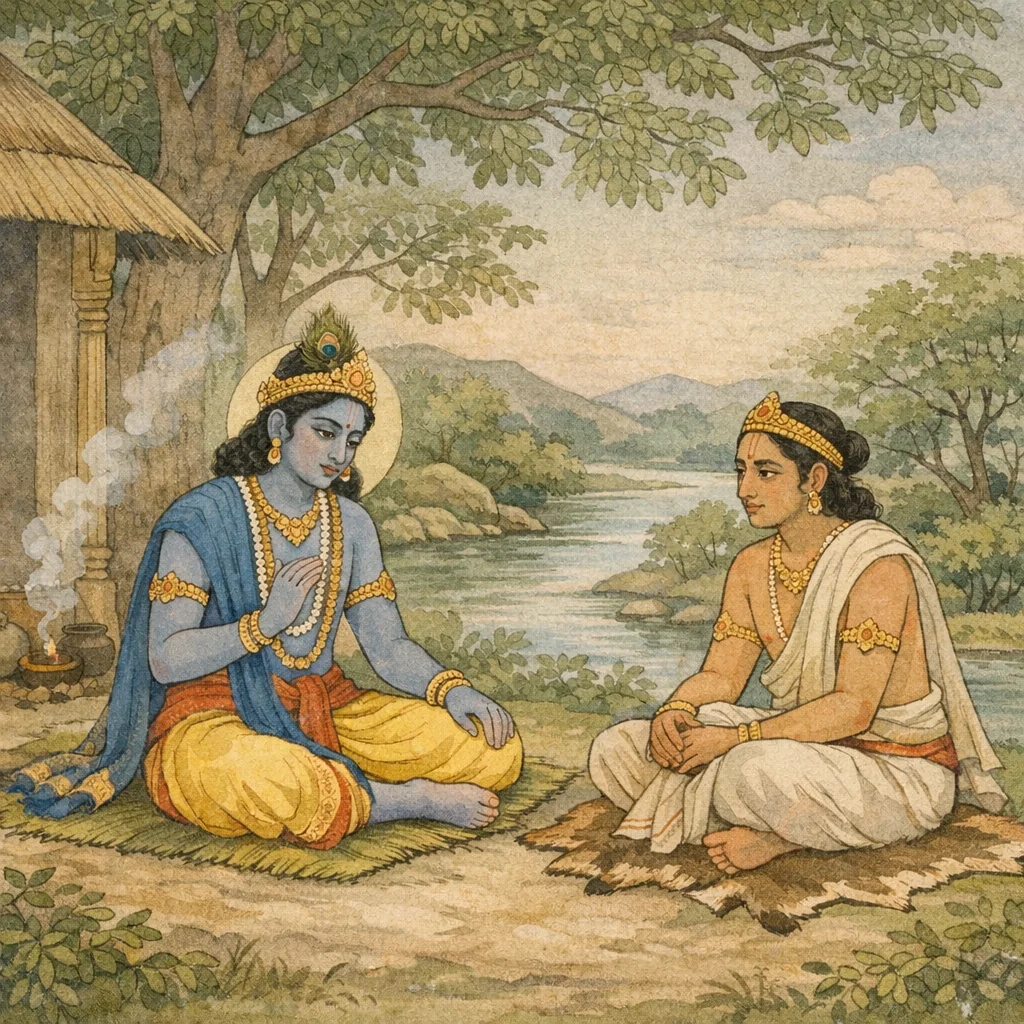
Adhyaya 13
Book 3 (Āraṇyaka-parva), Adhyāya 13 — Alliance Gathering; Arjuna’s Praise of Keśava; Draupadī’s Duḥkha-nivedana; Assurances and Vows
Upa-parva: Kṛṣṇa–Pāṇḍava-saṅgama (Allies in the Forest) — Episode of Consolation, Praise, and Vows
Vaiśaṃpāyana describes allied kṣatriya groups (Vṛṣṇis, Andhakas, Bhojas, and others) approaching the Pandavas in the great forest, distressed by their exile and condemning the Dhārtarāṣṭras. Krishna (Vāsudeva) expresses a firm assurance that principal aggressors will face consequences, and proposes the restoration of Yudhiṣṭhira’s sovereignty in principle. Arjuna then pacifies Krishna’s heightened anger by reciting an extended theological encomium, identifying Krishna with Nārāyaṇa/Vishnu and recalling ascetic, cosmic, and heroic motifs. Krishna reciprocates with a metaphysical identification of Arjuna and himself as the paired sages Nara–Nārāyaṇa, emphasizing inseparability of purpose. Draupadī (Pāñcālī) approaches Krishna as refuge and delivers a structured grievance: she recounts her humiliation in the Kuru assembly, critiques the perceived inaction of her protectors, and recalls earlier attempts on the Pandavas’ lives. She argues from social-dharmic norms of spousal protection and lineage dignity, naming her sons and the injustice of their dispossession. Krishna responds with assurance of future reversal of fortunes and confirms that her anger will culminate in the lamentation of the adversaries’ households. Allied leaders then articulate explicit role-claims regarding future engagements, reinforcing coalition resolve.
Chapter Arc: वनवास की धूल में पाण्डवों के पास एक ऐसा अतिथि आता है जिसकी वाणी में द्वारका का तेज और नीति का भार है—कृष्ण, जो दूर रहकर भी द्यूत-विपत्ति की ज्वाला को अपने भीतर लिये चला आया है। → कृष्ण स्वीकार करता है कि आनर्तदेश में असांनिध्य के कारण वह समय पर हस्तिनापुर न पहुँच सका; फिर वह बताता है कि यदि बुलाया भी न जाता, तो भी वह कौरवों के द्यूत में स्वयं पहुँचकर दुर्योधन और धृतराष्ट्र के सामने दोष गिनाकर उसे रोकने का यत्न करता। वह स्मरण कराता है कि जुए ने पहले भी नल जैसे राजाओं को अनपेक्षित विनाश तक पहुँचाया, और यह व्यसन ‘सातत्य’—लगातार खेलने की लत—बनकर कुलों को खा जाता है। → कृष्ण का नैतिक प्रहार तीखा हो उठता है: वह भीष्म, द्रोण, कृप, बाह्लीक और धृतराष्ट्र जैसे वृद्ध-आधार स्तम्भों को साक्षी बनाकर द्यूत के विरुद्ध खड़े होने की कल्पना करता—और उसी कल्पना के बरक्स वर्तमान सत्य चमकता है कि वे सब मौन रहे, और पाण्डव ‘व्यसने मग्न’ होकर वन में पड़े हैं। → कृष्ण पाण्डवों के दुःख को अपना दुःख मानकर उन्हें धैर्य देता है, यह स्पष्ट करता है कि यह विपत्ति केवल भाग्य नहीं—द्यूत के दोषों और राजधर्म की विफलता का फल है; साथ ही वह संकेत देता है कि नीति, संयम और समय आने पर पुरुषार्थ से ही इसका प्रत्युत्तर दिया जा सकता है। → कृष्ण की उपस्थिति एक प्रश्न छोड़ जाती है—क्या पाण्डव इस अन्याय को केवल सहेंगे, या उचित समय पर धर्म-सम्मत प्रतिकार का मार्ग चुनेंगे?
Shlokas
Verse 1
#:73..8 #::3...7 () असम आता - यत्रसायंगृह मुनि वे होते हैं, जो जहाँ सायंकाल हो जाता है वहीं घरकी तरह रातभर निवास करते हैं। + आदिपर्वके १४७वें अध्यायके लाक्षागृहदाहप्रसंगमें बतलाया है कि 'भीमसेनने माताको तो कंधेपर चढ़ा लिया और नकुल-सहदेवको गोदमें उठा लिया तथा शेष दोनों भाइयोंको दोनों हाथोंसे पकड़कर उन्हें सहारा देते हुए चलने लगे।” इस कथनसे द्रौपदीके वचन भिन्न हैं; क्योंकि द्रौपदीका उस समय विवाह नहीं हुआ था, अतः द्रौपदी इस बातको ठीक-ठीक नहीं जानती थी, इसीसे वह लोगोंके मुखसे सुनी-सुनायी बात अनुमानसे कह रही है; अत: लाक्षागृहदाहके प्रसंगकी बात ही ठीक है। त्रयोदशो< ध्याय: श्रीकृष्णका जूएके अनुपस्थिलिको बताते हु पाण्डवोंपर आयी हुई विपत्तिमें अपनी कारण मानना वायुदेव उवाच नैतत् कृच्छुमनुप्राप्तो भवान् स्याद् वसुधाधिप । यद्य॒हं द्वारकायां स्यां राजन् संनिहित: पुरा,भगवान् श्रीकृष्ण बोले--राजन्! यदि मैं पहले द्वारकामें या उसके निकट होता तो आप इस भारी संकटमें नहीं पड़ते
Vāyudeva said: “O lord of the earth, you would not have fallen into this grievous calamity, had I been earlier in Dvārakā—or close at hand there, O king.”
Verse 2
आगच्छेयमहं द्यूतमनाहूतो 5पि कौरवै: । आम्बिकेयेन दुर्धर्ष राज्ञा दुर्योधनेन च । वारयेयमहं द्यूतं बहून् दोषान् प्रदर्शयन्,दुर्जय वीर! अम्बिकानन्दन धृतराष्ट्र, राजा दुर्योधन तथा अन्य कौरवोंके बिना बुलाये भी मैं उस द्यूतसभामें आता और जूएके अनेक दोष दिखाकर उसे रोकनेकी चेष्टा करता
Vāyu said: “Even if the Kauravas had not summoned me, I would have gone to that gambling hall—where the unconquerable king Duryodhana, son of Ambikā, presided—and I would have tried to stop the dice-play by pointing out its many faults.”
Verse 3
भीष्मद्रोणी समानाय्य कृपं बाह्लीकमेव च । वैचित्रवीर्य राजानमलं द्यूतेन कौरव,प्रभो! मैं आपके लिये भीष्म, द्रोण, कृप, बाह्नीक तथा राजा धृतराष्ट्रको बुलाकर कहता--“कुरुवंशके महाराज! आपके पुत्रोंकोी जूआ नहीं खेलना चाहिये।” राजन! मैं द्यूतसभामें जूएके उन दोषोंको स्पष्टरूपसे बताता, जिनके कारण आपको अपने राज्यसे वंचित होना पड़ा है
Vāyu said: “Having summoned Bhīṣma and Droṇa, and also Kṛpa and Bāhlīka, and King Dhṛtarāṣṭra—the heir of Vicitravīrya—I would declare: ‘O Kaurava lord, enough of gambling. Your sons should not play at dice.’ In the dice-hall I would plainly set forth the faults of gambling—those very causes by which you were deprived of your kingdom.”
Verse 4
पुत्राणां तव राजेन्द्र त्वन्निमित्तमिति प्रभो । तत्राचक्षमहं दोषान् यैर्भवान् व्यतिरोपित:,प्रभो! मैं आपके लिये भीष्म, द्रोण, कृप, बाह्नीक तथा राजा धृतराष्ट्रको बुलाकर कहता--“कुरुवंशके महाराज! आपके पुत्रोंकोी जूआ नहीं खेलना चाहिये।” राजन! मैं द्यूतसभामें जूएके उन दोषोंको स्पष्टरूपसे बताता, जिनके कारण आपको अपने राज्यसे वंचित होना पड़ा है
Vāyu said: “O king of kings, O lord—(I declared) that the fault lay with your sons, and that it was on your account. There, in that very assembly, I pointed out the evils (of gambling), by which you were deprived and cast out (from your rightful kingdom).”
Verse 5
वीरसेनसुतो यैस्तु राज्यात् प्रभ्रंशित: पुरा । अतर्कितविनाशश्ष् देवनेन विशाम्पते,तथा जिन दोषोंने पूर्वकालमें वीरसेनपुत्र महाराज नलको राजसिंहासनसे च्युत किया। नरेश्वर! जूआ खेलनेसे सहसा ऐसा सर्वनाश उपस्थित हो जाता है, जो कल्पनामें भी नहीं आ सकता
O lord of the people, it was by gambling that Nala, the son of Vīrasena, was formerly cast down from his kingdom. From play at dice there arises a sudden and unforeseen ruin—destruction that the mind cannot even anticipate.
Verse 6
सातत्यं च प्रसड्गस्य वर्णयेयं यथातथम्,इसके सिवा उससे सदा जूआ खेलनेकी आदत बन जाती है। यह सब बातें मैं ठीक- ठीक बता रहा हूँ
Vāyu said: “I shall describe, exactly as it is, how constant indulgence becomes an attachment—how, apart from this, a person develops a habitual addiction to gambling. I am stating these matters truthfully and in proper order.”
Verse 7
स्त्रियो$क्षा मृगया पानमेतत् कामसमुत्थितम् । दुःखं चतुष्टयं प्रोक्त यैर्नरो भ्रश्यते श्रिय:,स्त्रियोंके प्रति आसक्ति, जूआ खेलना, शिकार खेलनेका शौक और मद्यपान--ये चार प्रकारके भोग कामनाजनित दुःख बताये गये हैं, जिनके कारण मनुष्य अपने धन-ऐश्वर्यसे भ्रष्ट हो जाता है। शास्त्रोंके निपुण विद्वान् सभी परिस्थितियोंमें इन चारोंको निन्दनीय मानते हैं; परंतु द्यूतक्रीडाको तो जूएके दोष जाननेवाले लोग विशेषरूपसे निन्दनीय समझते हैं
Vāyu said: “Women (i.e., obsessive attachment to women), gambling with dice, hunting, and drinking—these arise from desire. They are declared to be a fourfold source of misery, by which a man falls away from prosperity and good fortune.”
Verse 8
तत्र सर्वत्र वक्तव्यं मन्यन्ते शास्त्रकोविदा: । विशेषतश्च वक्तव्यं ्यूते पश्यन्ति तद्विद:,स्त्रियोंके प्रति आसक्ति, जूआ खेलना, शिकार खेलनेका शौक और मद्यपान--ये चार प्रकारके भोग कामनाजनित दुःख बताये गये हैं, जिनके कारण मनुष्य अपने धन-ऐश्वर्यसे भ्रष्ट हो जाता है। शास्त्रोंके निपुण विद्वान् सभी परिस्थितियोंमें इन चारोंको निन्दनीय मानते हैं; परंतु द्यूतक्रीडाको तो जूएके दोष जाननेवाले लोग विशेषरूपसे निन्दनीय समझते हैं
There, the learned authorities in the śāstras hold that in every circumstance one must speak out against these faults; and those who truly understand the matter deem it especially necessary to denounce gambling. For attachment to women, gambling, the passion for hunting, and drinking liquor—these four enjoyments are said to bring sorrow born of desire, and by them a person falls away from wealth and sovereignty.
Verse 9
एकाहादू द्रव्यनाशोअत्र ध्रुवं व्यसनमेव च । अभुक्तनाशश्चार्थानां वाक््पारुष्यं च केवलम्,जूएसे एक ही दिनमें सारे धनका नाश हो जाता है। साथ ही जूआ खेलनेसे उसके प्रति आसक्ति होनी निश्चित है। समस्त भोग-पदार्थोंका बिना भोगे ही नाश हो जाता है और बदलेमें केवल कटुवचन सुननेको मिलते हैं। कुरुनन्दन! ये तथा और भी बहुत-से दोष हैं, जो जूएके प्रसंगसे कटु परिणाम उत्पन्न करनेवाले हैं। महाबाहो! मैं धृतराष्ट्रसे मिलकर जूएके ये सभी दोष बतलाता
Vāyu said: “In gambling, within a single day one’s wealth is surely ruined, and calamity alone becomes certain. Even the goods meant for enjoyment perish without being enjoyed, and in return one gains nothing but harsh, bitter speech. These and many other faults arise from the gambling episode, bringing painful consequences.”
Verse 10
एतच्चान्यच्च कौरव्य प्रसज्िकटुकोदयम् | द्यूते ब्रूयां महाबाहो समासाद्याम्बिकासुतम्,जूएसे एक ही दिनमें सारे धनका नाश हो जाता है। साथ ही जूआ खेलनेसे उसके प्रति आसक्ति होनी निश्चित है। समस्त भोग-पदार्थोंका बिना भोगे ही नाश हो जाता है और बदलेमें केवल कटुवचन सुननेको मिलते हैं। कुरुनन्दन! ये तथा और भी बहुत-से दोष हैं, जो जूएके प्रसंगसे कटु परिणाम उत्पन्न करनेवाले हैं। महाबाहो! मैं धृतराष्ट्रसे मिलकर जूएके ये सभी दोष बतलाता
O scion of the Kurus, gambling brings on attachment and yields bitter consequences. In a single day one’s wealth can be ruined; pleasures and possessions perish without ever being truly enjoyed, and in return one gains only harsh words and humiliation. These and many other faults arise from the very occasion of dice. Mighty-armed one, having approached the son of Ambikā (Dhṛtarāṣṭra), I will tell him all these defects of gambling.
Verse 11
एवमुक्तो यदि मया गृह्नीयाद् वचनं मम । अनामयं स्याद् धर्मश्न॒ कुरूणां कुरुवर्धन,कुरुवर्धन! मेरे इस प्रकार समझाने-बुझानेपर यदि वे मेरी बात मान लेते तो कौरवोंमें शान्ति बनी रहती और धर्मका भी पालन होता
Vāyu said: “If, after being addressed by me in this way, he had accepted my counsel, then among the Kurus there would have been well-being and freedom from calamity; and you—knower of dharma, increaser of the Kuru line—would have seen dharma upheld.”
Verse 12
न चेत् स मम राजेन्द्र गृह्लीयान्मधुंर वच: । पथ्यं च भरतश्रेष्ठ निगृह्नीयां बलेन तम्,राजेन्द्र! भरतश्रेष्ठ! यदि वे मेरे मधुर एवं हितकर वचनको सुनकर उसे न मानते तो मैं उन्हें बलपूर्वक रोक देता
Vāyu said: “O king, best of the Bharatas—if he would not accept my gentle words, words that are sweet yet salutary, then, for his own good, I would restrain him by force. When counsel that protects dharma is refused, I am prepared to enforce restraint so that harm does not arise from unchecked impulse.”
Verse 13
अथैनमपनीतेन सुहृदो नाम दुर्हवद: । सभासदोशनुवर्तेरंस्तांश्व हन्यां दुरोदरान्,यदि वहाँ सुहृदनामधारी शत्रु अन्यायका आश्रय ले इस धृतराष्ट्रका साथ देते तो मैं उन सभासद जुआरियोंको मार डालता इति श्रीमहाभारते वनपर्वणि अर्जुनाभिगमनपर्वणि वासुदेववाक्ये त्रयोदशो<5 ध्याय: इस प्रकार श्रीमह्याभारत वनपर्वके अन्तर्गत अजुनाभिगमनपर्वमें वायुदेववाक्यविषयक तेरहवाँ अध्याय पूरा हुआ
Vāyu said: “If those assembly-men—gamblers of wicked intent—were to side with this Dhṛtarāṣṭra by taking refuge in injustice, even while bearing the name of ‘friends’, I would strike down those evil-hearted men.” The statement underscores that mere labels like ‘friend’ do not sanctify wrongdoing; support given to adharma, especially in a public council, becomes culpable and invites righteous retribution.
Verse 14
असांनिध्यं तु कौरव्य ममानर्तेष्वभूत् तदा | येनेदं व्यसन प्राप्ता भवन्तो द्यूतकारितम्,कुरुश्रेष्ठ! मैं उन दिनों आनर्तदेशमें ही नहीं था, इसीलिये आपलोगोंपर यह द्यूतजनित संकट आ गया
Vāyu said: “O scion of the Kurus, at that time I was not present in the land of Ānarta. Because of that absence, O best of the Kurus, you all fell into this calamity—this disaster brought about by the gambling match.”
Verse 15
सो>हमेत्य कुरुश्रेष्ठ द्वारकां पाण्डुनन्दन । अश्रौषं त्वां व्यसनिनं युयुधानादू यथातथम्,कुरुप्रवर पाण्डुनन्दन! जब मैं द्वारकामें आया, तब सात्यकिसे आपके संकटमें पड़नेका यथावत् समाचार सुना
“So I came (saying, ‘Here I am’), O best of the Kurus, O joy of the Pāṇḍus, to Dvārakā. There I heard from Yuyudhāna the full and accurate account of your distress.”
Verse 16
श्र॒ुत्वैव चाहं राजेन्द्र परमोद्धिग्नमानस: । तूर्णमभ्यागतो$स्मि त्वां द्रष्टकामो विशाम्पते,राजेन्द्र! वह सुनते ही मेरा मन अत्यन्त उद्विग्न हो उठा और प्रजेश्वर! मैं तुरंत ही आपसे मिलनेके लिये चला आया
Vāyu said: “O best of kings, the moment I heard of it my mind was shaken with deepest anxiety. Therefore, O lord of the people, I have come here at once, eager to see you.”
Verse 17
अहो कृच्छ्मनुप्राप्ता: सर्वे सम भरतर्षभ | सोऊहं त्वां व्यसने मग्नं पश्यामि सह सोदरै:,भरतकुलभूषण! अहो! आप सब लोग बड़ी कठिनाईमें पड़ गये हैं। मैं तो आपको सब भाइयोंसहित विपत्तिके समुद्रमें डूबा हुआ देख रहा हूँ
Vāyu said: “Alas, O bull among the Bharatas, you have all fallen into grievous hardship. I see you—together with your brothers—sunk in the depths of calamity. O ornament of the Bharata lineage, this distress has overtaken you all.”
Frequently Asked Questions
The chapter stages the tension between justified indignation at injustice and the disciplined restraint required for legitimate, collective action—especially when protection obligations toward a spouse and polity appear to have failed publicly.
Arjuna’s praise and Krishna’s reply frame righteous action as grounded in controlled agency and metaphysical alignment: Krishna is presented as cosmic order, and Arjuna as inseparable partner (Nara–Nārāyaṇa), implying duty coordinated with higher purpose.
No formal phalaśruti formula is stated; the meta-function is narrative-ethical: public assurance, identity teaching (Nara–Nārāyaṇa), and vow-like commitments serve as the chapter’s legitimizing commentary within the exile arc.