Adhyaya 101
Udyoga Parva, Adhyāya 101: Bhogavatī-varṇana, Nāga-vaṃśa-kathana, and Sumukha-vivāha-prastāva
Upa-parva: Mātali–Nāgaloka Saṃvāda (Episode on Bhogavatī and the Nāga genealogy)
Nārada opens by describing Bhogavatī, the illustrious Nāga city governed by Vāsuki, likened to Amarāvatī in splendor. He identifies Śeṣa as the great serpent whose ascetic power and immense radiance uphold the earth, portraying cosmic stability as grounded in tapas and dhāraṇa (support). The narrative then surveys the inhabitants—Surasā’s Nāga offspring—marked by varied forms, ornaments, and symbolic insignia, including multi-headed serpents of diverse magnitudes. A long onomastic catalog follows, listing eminent Nāgas (e.g., Vāsuki, Takṣaka, Karkoṭaka, Dhanaṃjaya, Kāliya, Nahūṣa, Kambala, Aśvatara, and others), functioning as a genealogical index. The speaker frame shifts: Kaṇva reports that Mātali attentively observes the assembly and questions Nārada about a particularly radiant Nāga before him—asking his parentage, maternal line, and the clan for which he stands as a banner-like figure. Mātali further states that the Nāga’s composure, courage, beauty, and youth have drawn his mind, identifying him as a desirable husband for his daughter Guṇakeśī. Nārada then provides credentials: the Nāga prince is Sumukha, born in the Airāvata lineage, recognized as Āryaka’s grandson and Vāmana’s descendant; his father Cikura was killed by Vainateya (Garuḍa). Concluding, Mātali declares Sumukha his chosen son-in-law and requests Nārada’s assistance to formalize the marriage proposal—an episode that fuses cosmology, lineage authentication, and alliance-making.
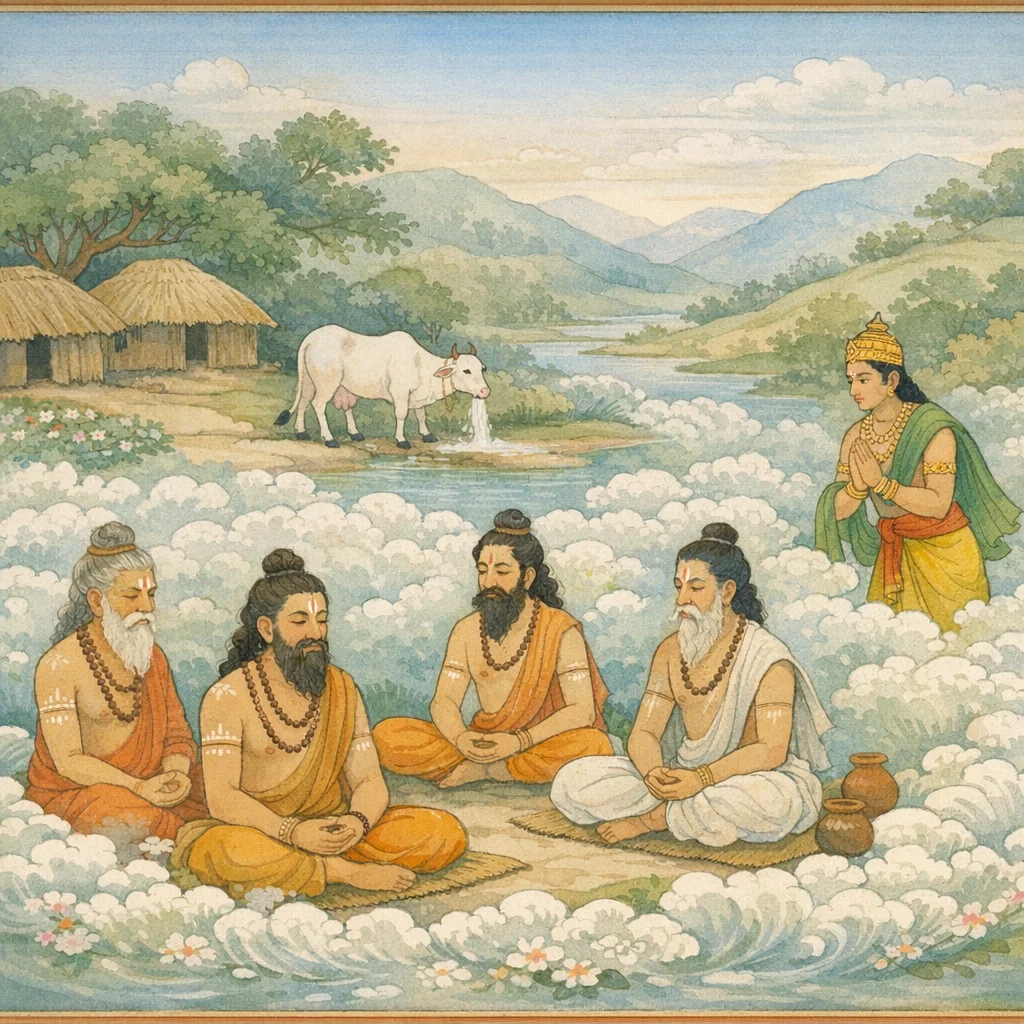
Chapter Arc: देवताओं के सारथि मातलि वर की खोज में अद्भुत लोकों की ओर बढ़ते हैं—जहाँ पृथ्वी-सार से प्रकट सुरभि का क्षीर अनिर्वचनीय ‘एकरस’ होकर निरन्तर बहता है। → यात्रा साधारण नहीं रहती: क्षीरसागर के फेन से घिरे आश्रमों में ‘फेनप’ महर्षि उग्र तप में स्थित हैं, जिनसे देवता भी भय खाते हैं; साथ ही दिशाओं को धारण करने वाली सुरभि-पुत्री धेनुओं का रहस्य खुलता है—मानो सृष्टि का संतुलन स्वयं गौ-तत्त्व पर टिका हो। → सुरभि के क्षीर का त्रिविध रूप उद्घाटित होता है—सुधाभोजियों के लिए सुधा, पितरों के लिए स्वधा, और देवताओं के लिए अमृत; उसी के साथ गाथा का उच्चारण होता है कि रसातल-तल में जैसा सुख-निवास है वैसा नागलोक, स्वर्ग या त्रिविष्टप-विमानों में भी नहीं। → मातलि को उस लोक-व्यवस्था का स्वरूप स्पष्ट हो जाता है: तपस्वियों का आहार-व्रत, दिशाओं का धारण, और क्षीर का दिव्य-परिवर्तन—ये सब वर-खोज के पथ पर संकेत-स्तम्भ बनते हैं, जिससे आगे की खोज के लिए दिशा निश्चित होती है। → वरान्वेषण की यात्रा अगले चरण में किस लोक/कुल/वीर तक पहुँचेगी—और कौन-सा गुण ‘योग्य वर’ का निर्णायक बनेगा—यह प्रश्न खुला रह जाता है।
Shlokas
Verse 1
इस प्रकार श्रीमहाभारत उद्योगपर्वके अन्तर्गत भगवद्यानपर्वमें मातलिके द्वारा वरका खोजविषयक एक सौ एकवाँ अध्याय पूरा हुआ ॥/ १०९ ॥/ अपना बछ। 2 द्र्याधेकशततमो< ध्याय: सुरभि और उसकी 80005 कक रसातलके सुखका व नारद उवाच इदं रसातलं नाम सप्तमं पृथिवीतलम् । यत्रास्ते सुरभिर्माता गवाममृतसम्भवा,नारदजी बोले--मातले! यह पृथ्वीका सातवाँ तल है, जिसका नाम रसातल है। यहाँ अमृतसे उत्पन्न हुई गोमाता सुरभि निवास करती हैं
Narada said: “This is the seventh stratum of the earth, called Rasātala. Here dwells Surabhī, the Mother of cows, born from nectar (amṛta).”
Verse 2
क्षरन्ती सततं क्षीरं पृथिवीसारसम्भवम् । षण्णां रसानां सारेण रसमेकमनुत्तमम्
Nārada said: “It continually exudes milk—born of the very essence of the earth—an unsurpassed single sap distilled from the quintessence of the six tastes.”
Verse 3
ये सुरभि पृथ्वीके सारतत्त्वसे प्रकट, छः रसोंके सारभागसे संयुक्त एवं सर्वोत्तम, अनिर्वचनीय एकरसरूप क्षीरको सदा अपने स्तनोंसे प्रवाहित करती रहती हैं ।। अमृतेनाभितृप्तस्य सारमुद्गिरत: पुरा । पितामहस्य वदनादुदतिष्ठ दनिन्दिता
Nārada said: “Long ago, when the Grandsire (Brahmā), fully satisfied with nectar, was uttering the very essence (of creation), there arose from his mouth, O blameless one, that wondrous, incomparable milk—single in taste yet supreme—ever flowing from the teats of Surabhi, the divine cow. This recalls how the world’s sustenance is grounded in a pure, life-giving essence that supports dharma and wellbeing.”
Verse 4
पूर्वकालमें जब ब्रह्मा अमृतपान करके तृप्त हो उसका सारभाग अपने मुखसे निकाल रहे थे, उसी समय उनके मुखसे अनिन्दिता सुरभिका प्रादुर्भाव हुआ था ।। यस्या: क्षीरस्य धाराया निपतन्त्या महीतले । हृदः कृत: क्षीरनिधि: पवित्र परमुच्यते,पृथ्वीपर निरन्तर गिरती हुई उस सुरभिके क्षीरकी धारासे एक अनन्त हृद बन गया, जिसे 'क्षीरसागर” कहते हैं। वह परम पवित्र है
Nārada said: In ancient times, when Brahmā, having drunk the nectar and become satisfied, was expelling its concentrated essence from his mouth, at that very moment the blameless Surabhī manifested from his mouth. From the stream of her milk that fell unceasingly upon the earth, an immeasurable basin was formed—a vast reservoir of milk, spoken of as the “Ocean of Milk” (Kṣīra-sāgara); it is declared supremely pure.
Verse 5
पुष्पितस्येव फेनेन पर्यन्तमनुवेष्टितम् पिबन्तो निवसन्त्यत्र फेनपा मुनिसत्तमा:,क्षीरसागरसे जो फेन उत्पन्न होता है, वह पुष्पके समान जान पड़ता है। वह फेन क्षीरसमुद्रके तटपर फैला रहता है, जिसे पीते हुए फेनपसंज्ञक बहुत-से मुनिश्रेष्ठ इस रसातलमें निवास करते हैं
The foam that arises from the Ocean of Milk appears like blossoming flowers. That foam lies spread along the shores of the milk-sea; and many foremost sages, known as the Phenapā, dwell in this Rasātala, drinking that foam as their sustenance.
Verse 6
फेनपा नाम ते ख्याता: फेनाहाराश्न मातले । उग्रे तपसि वर्तन्ते येषां बिभ्यति देवता:,मातले! फेनका आहार करनेके कारण वे महर्षिगण “फेनप” नामसे विख्यात हैं। वे बड़ी कठोर तपस्यामें संलग्न रहते हैं। उनसे देवतालोग भी डरते हैं
O Mātali, those sages are renowned by the name Phenapā, for they subsist on foam as their food. They abide in exceedingly austere tapas; such is the intensity of their discipline that even the gods stand in awe of them.
Verse 7
अस्याश्षतस्रो धेन्वो<न्या दिक्षु सर्वासु मातले । निवसन्ति दिशां पालयो धारयन्त्यो दिश: सम ता:,मातले! सुरभिकी पुत्रीस्वरूपा चार अन्य धेनुएँ हैं, जो सब दिशाओंमें निवास करती हैं। वे दिशाओंका धारण-पोषण करनेवाली हैं
Nārada said: “O Mātali, besides her there are a hundred other cows, present in every direction. Dwelling throughout the quarters, they sustain and protect the directions themselves, upholding the balance and order of the world.”
Verse 8
पूर्वां दिशं धारयते सुरूपा नाम सौरभी । दक्षिणां हंसिका नाम धारयत्यपरां दिशम्,सुरूपा नामवाली धेनु पूर्वदिशाको धारण करती है तथा उससे भिन्न दक्षिणदिशाका हंसिका नामवाली धेनु धारण-पोषण करती है
Narada said: “A cow of the Saurabhī lineage named Surūpā sustains the eastern quarter; and another cow, named Haṁsikā, sustains the southern quarter.”
Verse 9
पश्चिमा वारुणी दिक् च धार्यते वै सुभद्रया । महानुभावया नित्यं मातले विश्वरूपया,मातले! महाप्रभावशालिनी विश्वरूपा सुभद्रा नामवाली सुरभिकन्याके द्वारा वरुणदेवकी पश्चिमदिशा धारण की जाती है
Nārada said: “O Mātali! The western quarter—belonging to Varuṇa—is ever upheld by Subhadrā, a woman of great spiritual stature and manifold forms. Endowed with mighty power, the Surabhi-born maiden named Subhadrā bears the guardianship of Varuṇa’s western direction.”
Verse 10
सर्वकामदुघा नाम धेनुर्धारयते दिशम् । उत्तरां मातले धर्म्या तथैलविलसंज्ञिताम्,चौथी धेनुका नाम सर्वकामदुघा है। मातले! वह धर्मयुक्त कुबेरसम्बन्धिनी उत्तरदिशाका धारण-पोषण करती है
Nārada said: “A wish-fulfilling cow named Sarvakāmadughā sustains the northern quarter. O Mātali, that northern direction is righteous in character and is also known as ‘Ailavila’, being associated with Kubera.”
Verse 11
आसां तु पयसा मिश्र पयो निर्मथ्य सागरे | मन्थानं मन्दरं कृत्वा देवैरसुरसंहितै:,देवसारथे! देवताओंने असुरोंसे मिलकर मन्दराचलको मथानी बनाकर इन्हीं धेनुओंके दूधसे मिश्रित क्षीरसागरकी दुग्धराशिका मन्थन किया और उससे वारुणी, लक्ष्मी एवं अमृतको प्रकट किया। तत्पश्चात् उस समुद्रामन्थनसे अश्वराज उच्चै:श्रवा तथा मणिरत्न कौस्तुभका भी प्रादुर्भाव हुआ था
Nārada said: “Then, using the milk of those cows, the gods—joined together with the asuras—churned the Ocean, whose waters had become mingled with milk, making Mandara Mountain the churning-rod. From that churning arose Vāruṇī, Śrī (Lakṣmī), and amṛta; and thereafter there also appeared the king of horses, Uccaiḥśravā, and the jewel Kaustubha.”
Verse 12
उद्धृता वारुणी लक्ष्मीरमृतं चापि मातले । उच्चै:श्रवाश्ना श्वराजो मणिरत्नं च कौस्तुभम्,देवसारथे! देवताओंने असुरोंसे मिलकर मन्दराचलको मथानी बनाकर इन्हीं धेनुओंके दूधसे मिश्रित क्षीरसागरकी दुग्धराशिका मन्थन किया और उससे वारुणी, लक्ष्मी एवं अमृतको प्रकट किया। तत्पश्चात् उस समुद्रामन्थनसे अश्वराज उच्चै:श्रवा तथा मणिरत्न कौस्तुभका भी प्रादुर्भाव हुआ था
Nārada said: “O Mātali, charioteer of the gods, from the churning of the ocean there arose Vāruṇī, Lakṣmī, and also amṛta (the nectar of immortality). From that same churning also appeared the king of horses, Uccaiḥśravā, and the jewel Kaustubha.”
Verse 13
सुधाहारेषु च सुधां स्वधाभोजिषु च स्वधाम् । अमृतं चामृताशेषु सुरभी क्षरते पय:
Nārada said: “Among those who live on nectar, nectar itself is found; among those who partake of the ancestral offering (svadhā), svadhā is present. And for those who are wholly sustained by immortality, immortality is their portion. The divine cow Surabhī yields milk accordingly.”
Verse 14
सुरभि अपने स्तनोंसे जो दूध बहाती है, वह सुधाभोजी लोगोंके लिये सुधा, स्वधाभोजी पितरोंके लिये स्वधा तथा अमृतभोजी देवताओंके लिये अमृतरूप है ।। अत्र गाथा पुरा गीता रसातलनिवासिभि: । पौराणी श्रूयते लोके गीयते या मनीषिभि:,यहाँ रसातलनिवासियोंने पूर्वकालमें जो पुरातन गाथा गायी थी, वह अब भी लोकमें सुनी जाती है और मनीषी पुरुष उसका गान करते हैं
Nārada said: “The milk that Surabhī lets flow from her udders becomes, for those who partake of sudhā, sudhā itself; for the Pitṛs who partake of svadhā, it becomes svadhā; and for the gods who partake of amṛta, it becomes amṛta. In this connection, an ancient gāthā once sung long ago by the dwellers of Rasātala is still heard in the world, and discerning sages continue to chant it.”
Verse 15
न नागलोके न स्वर्गे न विमाने त्रिविष्टपे । परिवास: सुखस्तादृगू रसातलतले यथा,वह गाथा इस प्रकार है--“नागलोक, स्वर्गलोक तथा स्वर्गलोकके विमानमें निवास करना भी वैसा सुखदायक नहीं होता, जैसा रसातलमें रहनेसे सुख प्राप्त होता है”
Nārada said: “Neither in the realm of the Nāgas, nor in heaven, nor even in the celestial aerial mansions of the threefold heaven is residence as truly pleasant as it is in Rasātala.”
Verse 102
इति श्रीमहाभारते उद्योगपर्वणि भगवद्यानपर्वणि मातलिवरान्वेषणे दयथधिकशततमो<्थध्याय:
Thus ends the one-hundred-and-second chapter in the Udyoga Parva of the Śrī Mahābhārata, within the section concerning the divine mission/embassy, in the episode titled “The Search for the Excellent Mātali.”
Frequently Asked Questions
The ethical choice concerns criteria for alliance through marriage: Mātali weighs visible virtues (discipline, courage, demeanor) against genealogical legitimacy, seeking an option that is socially sanctioned and strategically stable.
The chapter teaches that order—cosmic and social—depends on sustaining forces: Śeṣa embodies dhāraṇa through tapas, while human-like institutions rely on verified lineage, credible testimony, and prudent alliance-making rather than impulse.
No explicit phalaśruti appears in this excerpt; its meta-function is archival and legitimizing—preserving cosmological claims (Śeṣa’s support) and genealogical data to ground subsequent relational decisions in recognized authority.