Adhyaya 44
Āstīka-janma: Vāsuki’s Consolation and the Birth/Naming of Āstīka (अस्तीकोत्पत्तिः)
Upa-parva: Āstīkopākhyāna (Episode of Āstīka) — within Ādi Parva
Sauti narrates that Jaratkāru (the wife) informs her brother Vāsuki that her husband, the sage Jaratkāru, has departed for the forest hermitage after indicating the presence of a pregnancy (“astī” while pointing to her abdomen). Vāsuki, distressed by the apparent abandonment and anxious about the community’s promised relief from the sarpa-satra, questions her about the sage’s conduct and seeks emotional resolution. Jaratkāru reassures him that the sage’s statement is reliable and that a radiant son will be born who will serve the serpents’ welfare. Vāsuki accepts the assurance, honors his sister with appropriate consolations and gifts, and the embryo is described as growing with great brilliance. In due time, she gives birth to a child compared to divine splendor; he is raised in the Nāga king’s residence, studies the Vedas with their auxiliaries under a Bhārgava teacher, and becomes known as Āstīka—named from the father’s utterance “astī” before departing while the child was still in the womb.
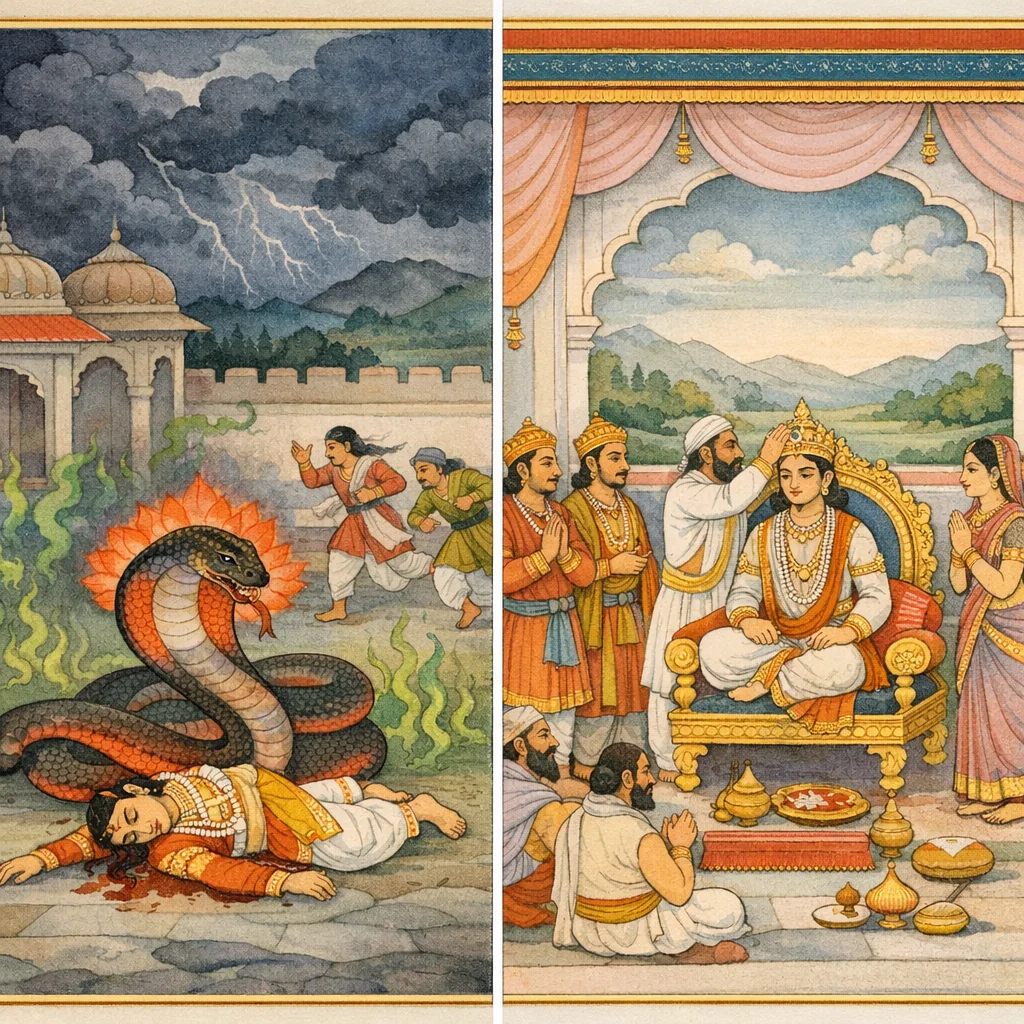
Chapter Arc: सूत उग्रश्रवा जनमेजय के राज्याभिषेक-विवाह की कथा के बीच अचानक राजसभा में शोक का तूफ़ान उठा देते हैं—मंत्रियों को भोग-विलास से घिरा राजमहल नहीं, अपशकुन और भय से भरा दृश्य दिखता है। → तक्षक की फुंकार-भरी गर्जना आकाश में गूँजती है; मंत्री घबराकर दौड़ते हैं और पद्मवर्चस् (लाल कमल-सा तेज) नागश्रेष्ठ तक्षक को देखते हैं। भय फैलता है, दिशाएँ छूटती हैं, और राजमहल विषजनित अग्नि से घिरकर प्रदीप्त हो उठता है। → तक्षक-तेज से राजा परीक्षित वज्राघात-सा गिर पड़ते हैं—राजा का पतन एक क्षण में, जैसे शनि/अशनिताडित वृक्ष। → राजपुरोहित और मंत्रीगण शुद्धि सहित परलोक-संस्कार संपन्न करते हैं। तत्पश्चात बालक जनमेजय, पुरोहितों-मंत्रियों के सहारे, कुरुवंश के अग्रज की भाँति राज्य संभालते हैं; धर्म की परीक्षा कर काशिराज की कन्या वपुष्टमा का पाणिग्रहण होता है और दाम्पत्य में अनुराग-स्थैर्य स्थापित होता है। → तक्षक द्वारा परीक्षित-वध की स्मृति भविष्य में प्रतिशोध की चिंगारी बनकर रह जाती है—यह बीज आगे ‘सर्पसत्र’ की ओर कथा को ढकेलेगा।
Shlokas
Verse 1
अफड-ए क्र चतुश्नत्वारिशो< ध्याय: जनमेजयका राज्याभिषेक और विवाह सौतिरुवाच ते तथा मन्त्रिणो दृष्टवा भोगेन परिवेष्टितम् । विषण्णवदना: सर्वे रुरुदुर्भशदु:खिता:,उग्रश्रवाजी कहते हैं--शौनकजी! मन्त्रीगण राजा परीक्षित्को तक्षक नागसे जकड़ा हुआ देख अत्यन्त दुःखी हो गये। उनके मुखपर विषाद छा गया और वे सब-के-सब रोने लगे
Sauti said: Seeing the king thus tightly coiled and bound by the serpent’s body, the ministers were overwhelmed with grief. Their faces fell into deep dejection, and all of them wept, stricken with intense sorrow.
Verse 2
तं तु नादं ततः श्रुत्वा मन्त्रिणस्ते प्रदुद्र॒व॒ुः । अपश्यन्त तथा यान्तमाकाशे नागमद्भुतम्,तक्षककी फुंकारभरी गर्जना सुनकर मन्त्रीलोग भाग चले। उन्होंने देखा लाल कमलकी-सी कान्ति-वाला वह अद्भुत नाग आकाशकमें सिन्दूरकी रेखा-सी खींचता हुआ चला जा रहा है। नागोंमें श्रेष्ठ तक्षकको इस प्रकार जाते देख वे राजमन्त्री अत्यन्त शोकमें डूब गये
Hearing that roar, the king’s ministers at once fled in alarm. Yet they beheld that wondrous serpent moving through the sky. Seeing Takṣaka—foremost among nāgas—depart in this manner, the royal counselors were overwhelmed with grief, sensing the ominous force of his intent and the peril it portended for the realm.
Verse 3
सीमन्तमिव कुर्वाणं नभस: पद्मवर्चसम् | तक्षकं पन्नगश्रेष्ठ भूशं शोकपरायणा:,तक्षककी फुंकारभरी गर्जना सुनकर मन्त्रीलोग भाग चले। उन्होंने देखा लाल कमलकी-सी कान्ति-वाला वह अद्भुत नाग आकाशकमें सिन्दूरकी रेखा-सी खींचता हुआ चला जा रहा है। नागोंमें श्रेष्ठ तक्षकको इस प्रकार जाते देख वे राजमन्त्री अत्यन्त शोकमें डूब गये
They beheld Takṣaka, the foremost of serpents, radiant like a red lotus, moving through the sky as though drawing a vermilion parting-line across it. Hearing the thunderous, hiss-laden roar of Takṣaka, the king’s ministers fled in fear; and seeing him depart in this manner, they were overwhelmed with grief.
Verse 4
ततस्तु ते तद् गृहमग्निना<5<वृतं प्रदीप्यमानं विषजेन भोगिन: । भयात् परित्यज्य दिश: प्रपेदिरे पपात राजाशनिताडितो यथा,वह राजमहल सर्पके विषजनित अग्निसे आवृत हो धू-धू करके जलने लगा। यह देख उन सब मन्त्रियोंने भयसे उस स्थानको छोड़कर भिन्न-भिन्न दिशाओंकी शरण ली तथा राजा परीक्षित् वज्जके मारे हुएकी भाँति धरतीपर गिर पड़े
Then that palace was engulfed in fire, blazing fiercely—kindled by the serpent’s venom. Seeing this, the ministers, terrified, abandoned the place and fled in different directions; and King Parīkṣit fell to the earth like one struck down by a thunderbolt.
Verse 5
ततो नृपे तक्षकतेजसा हते प्रयुज्य सर्वा: परलोकसत्क्रिया: । शुचिर्द्धिजो राजपुरोहितस्तदा तथैव ते तस्य नृपस्य मन्त्रिण:,तक्षककी विषानि्निद्वारा राजा परीक्षित्के दग्ध हो जानेपर उनकी समस्त पारलौकिक क्रियाएँ करके पवित्र ब्राह्मण राजपुरोहित, उन महाराजके मन्त्री तथा समस्त पुरवासी मनुष्योंने मिलकर उन्हींके पुत्रको, जिसकी अवस्था अभी बहुत छोटी थी, राजा बना दिया। कुरुकुलका वह श्रेष्ठ वीर अपने शत्रुओंका विनाश करनेवाला था। लोग उसे राजा जनमेजय कहते थे
Then, when the king had been slain by the fiery potency of Takṣaka, all the rites due for the departed were duly performed. At that time the purified Brahmin royal priest, along with the king’s ministers, proceeded in accordance with custom—ensuring the continuity of righteous order by completing the funerary obligations and arranging the succession.
Verse 6
नृपं शिशुं तस्य सुतं प्रचक्रिरे समेत्य सर्वे पुरवासिनो जना: । नृपं यमाहुस्तममित्रघातिनं कुरुप्रवीरं जनमेजयं जना:,तक्षककी विषानि्निद्वारा राजा परीक्षित्के दग्ध हो जानेपर उनकी समस्त पारलौकिक क्रियाएँ करके पवित्र ब्राह्मण राजपुरोहित, उन महाराजके मन्त्री तथा समस्त पुरवासी मनुष्योंने मिलकर उन्हींके पुत्रको, जिसकी अवस्था अभी बहुत छोटी थी, राजा बना दिया। कुरुकुलका वह श्रेष्ठ वीर अपने शत्रुओंका विनाश करनेवाला था। लोग उसे राजा जनमेजय कहते थे
After the king had perished, all the citizens of the city assembled and installed his son—still a mere child—as king. That prince of the Kuru line, famed as a slayer of enemies, was known among the people as King Janamejaya.
Verse 7
स बाल एवार्यमतिर्नपोत्तम: सहैव तैर्मन्त्रिपुरोहितैस्तदा । शशास राज्यं कुरुपुज्गभवाग्रजो यथास्य वीर: प्रपितामहस्तथा,बचपनमें ही नृपश्रेष्ठ जनमेजयकी बुद्धि श्रेष्ठ पुरुषोंके समान थी। अपने वीर प्रपितामह महाराज युधिष्ठिरकी भाँति कुरुश्रेष्ठ वीरोंके अग्रगण्य जनमेजय भी उस समय मन्त्री और पुरोहितोंके साथ धर्मपूर्वक राज्यका पालन करने लगे
Even while still a boy, the best of kings possessed a noble and discerning mind. At that time, together with his ministers and the family priest, he governed the kingdom in accordance with dharma—just as his heroic great-grandfather had done. Thus Janamejaya, foremost among the Kurus, began to uphold righteous rule under proper counsel and sacred guidance.
Verse 8
ततस्तु राजानममित्रतापनं समीक्ष्य ते तस्य नृपस्य मन्त्रिण: । सुवर्णवर्माणमुपेत्य काशिपं वपुष्टमार्थ वरयाम्प्रचक्रमु:,राजमन्त्रियोंने देखा, राजा जनमेजय शत्रुओंको दबानेमें समर्थ हो गये हैं, तब उन्होंने काशिराज सुवर्णवर्माके पास जाकर उनकी पुत्री वपुष्टमाके लिये याचना की
Then, observing that King Janamejaya had become a formidable subduer of enemies, his ministers approached Suvarṇavarman, the king of Kāśī, and began to seek in marriage his daughter Vapuṣṭamā for their king.
Verse 9
ततः स राजा प्रददौ वपुष्टमां कुरुप्रवीराय परीक्ष्य धर्मत: । स चापि तां प्राप्प मुदायुतो5भव- न्न चान्यनारीषु मनोदथे क्वचित्,काशिराजने धर्मकी दृष्टिसे भलीभाँति जाँच-पड़ताल करके अपनी कन्या वपुष्टमाका विवाह कुरुकुलके श्रेष्ठ वीर जनमेजयके साथ कर दिया। जनमेजयने भी वपुष्टमाको पाकर बड़ी प्रसन्नताका अनुभव किया और दूसरी स्त्रियोंकी ओर कभी अपने मनको नहीं जाने दिया
Then that king, having examined the matter in accordance with dharma, gave his daughter Vapuṣṭamā in marriage to Janamejaya, the foremost hero of the Kuru line. Janamejaya too, on obtaining her, became filled with joy, and he never at any time set his mind upon other women.
Verse 10
सर:सु फुल्लेषु वनेषु चैव हि प्रसन्नचेता विजहार वीर्यवान् । तथा स राजन्यवरो विजद्ठिवान् यथोर्वशीं प्राप्य पुरा पुरूरवा:,राजाओंमें श्रेष्ठ महापराक्रमी जनमेजयने प्रसन्न-चित्त होकर सरोवरों तथा पुष्पशोभित उपवनोंमें रानी वपुष्टमाके साथ उसी प्रकार विहार किया, जैसे पूर्वकालमें उर्वशीको पाकर महाराज पुरूरवाने किया था
With a tranquil mind, the mighty king—foremost among rulers—sportively wandered in lotus-blooming lakes and flower-adorned groves together with Queen Vapuṣṭamā, just as in ancient times King Purūravas delighted after attaining Urvaśī.
Verse 11
वपुष्टमा चापि वरं पतिव्रता प्रतीतरूपा समवाप्य भूपतिम् । भावेन रामा रमयाम्बभूव सा विहारकालेष्ववरोधसुन्दरी,वषुष्टमा पतिव्रता थी। उसका रूपसौन्दर्य सर्वत्र विख्यात था। वह राजाके अन्तःपुरमें सबसे सुन्दरी रमणी थी। राजा जनमेजयको पतिरूपमें प्राप्त करके वह विहारकालमें बड़े अनुरागके साथ उन्हें आनन्द प्रदान करती थी
She was of the finest beauty and an exemplary devoted wife, renowned for her pleasing form. Having obtained the king as her husband, she—an incomparable beauty of the inner palace—delighted him with affectionate love during times of recreation, bringing him joy and contentment.
Verse 44
इति श्रीमहाभारते आदिपर्वणि आस्तीकपर्वणि जनमेजयराज्याभिषेके चतुश्नत्वारिंशोध्याय:
Thus, in the Śrī Mahābhārata, within the Ādi Parva—specifically the Āstīka Parva—this is the forty-fourth chapter, connected with the royal consecration (rājyābhiṣeka) of King Janamejaya. This line serves as a colophon, formally marking the close of the chapter and situating the narrative within its wider textual and ritual frame.
Frequently Asked Questions
The tension between ascetic autonomy (the sage’s departure and fear of anger/curse) and communal obligation (the serpents’ dependence on a promised son for relief) frames a dharma-conflict about duty, consent, and consequence.
Speech and intention function as ethical instruments: a concise truthful utterance (“astī”) becomes a stabilizing assurance that regulates fear, enables patience, and preserves social order amid uncertainty.
No explicit phalaśruti is stated here; instead, the chapter’s meta-function is etiological—explaining Āstīka’s name, legitimacy, education, and narrative role as a necessary condition for later ritual de-escalation.