Adhyaya 94
अन्धक-हिरण्याक्ष-प्रसङ्गः, वराहावतारः, दंष्ट्राभूषणं च
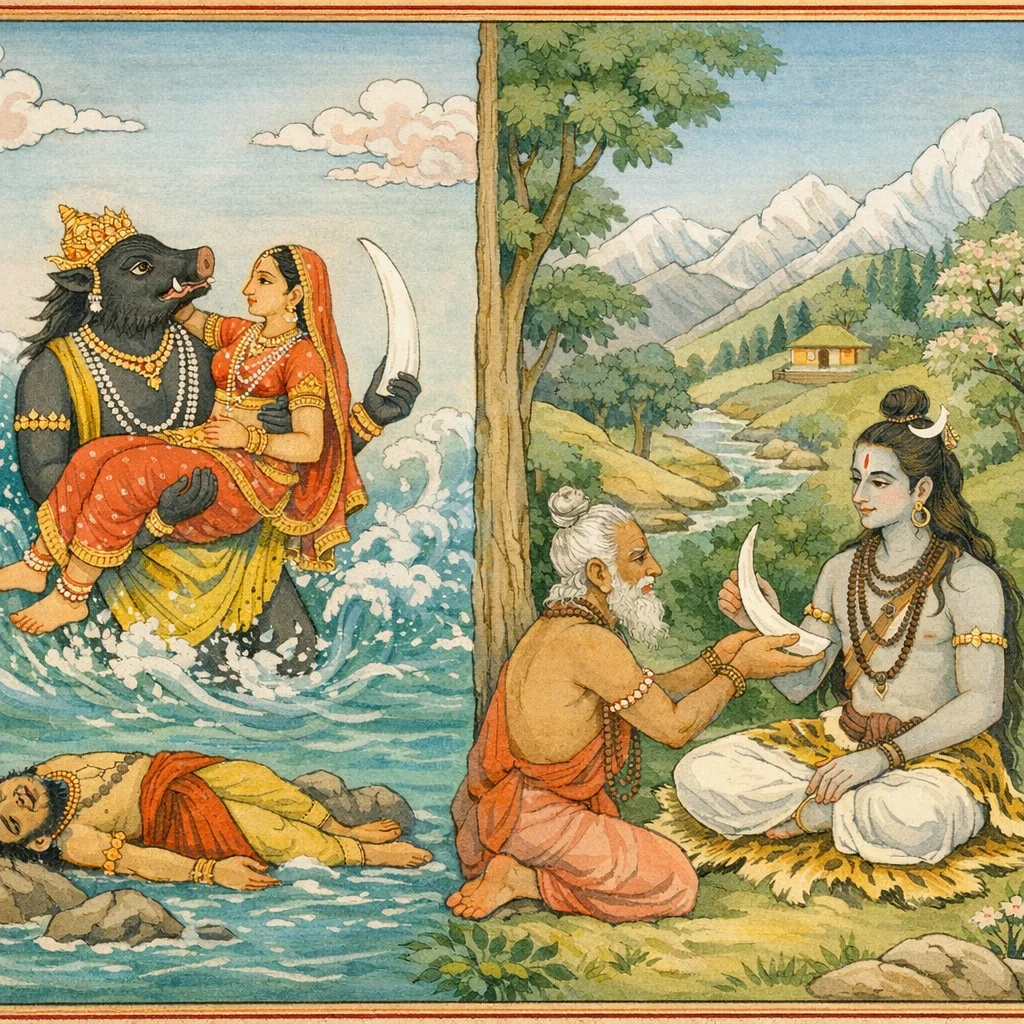
The ṛṣis ask three connected questions: how Hiraṇyākṣa is Andhaka’s father, how he was slain by Viṣṇu, and why Varāha’s tusk became an ornament of Mahādeva. Sūta explains that Hiraṇyākṣa, brother of Hiraṇyakaśipu, conquers the devas, binds the Earth, and drags Bhū-devī down to Rasātala. The afflicted gods petition Viṣṇu, who manifests as Yajña-Varāha (echoing the pattern of divine epiphany seen in liṅgodbhava), kills the daitya with the tip of his tusk, lifts up Bhū-devī, and restores cosmic order. Brahmā and the devas offer extended stuti, praising Varāha as the world’s sustainer and support. After Viṣṇu departs, the Earth—pressed by the tusk’s weight—leaves it behind; Śiva (Bhava) happens upon it, takes it, and wears it on his chest as a bhūṣaṇa. The chapter implies that such “aṅga-vibhāga” and divine ornamentation are liberating līlā, preparing the next teaching on the importance of Śiva’s signs for vipra-mukti and devotion.
Shlokas
Verse 1
इति श्रीलिङ्गमहापुराणे पूर्वभागे अन्धकगाणपत्यात्मको नाम त्रिनवतितमो ऽध्यायः ऋषय ऊचुः कथमस्य पिता दैत्यो हिरण्याक्षः सुदारुणः विष्णुना सूदितो विष्णुर् वाराहत्वं कथं गतः
Thus, in the Śrī Liṅga Mahāpurāṇa, in the Pūrva-bhāga, begins the ninety-fourth chapter called “The Account of Andhaka as the Lord of the Gaṇas.” The sages said: “How was his father—the exceedingly fierce Daitya Hiraṇyākṣa—slain by Viṣṇu, and how did Viṣṇu assume the form of the Boar (Varāha)?”
Verse 2
तस्य शृङ्गं महेशस्य भूषणत्वं कथं गतम् एतत्सर्वं विशेषेण सूत वक्तुमिहार्हसि
How did that horn come to be an ornament of Mahādeva? O Sūta, you are fit to explain all of this to us in particular and in full detail.
Verse 3
सूत उवाच हिरण्यकशिपोर्भ्राता हिरण्याक्ष इति स्मृतः पुरान्धकासुरेशस्य पिता कालान्तकोपमः
Sūta said: Hiraṇyākṣa—so he is remembered—was the brother of Hiraṇyakaśipu. In former times he became the father of Andhaka, lord of the Asuras, terrifying like the End-Time itself.
Verse 4
देवाञ्जित्वाथ दैत्येन्द्रो बद्ध्वा च धरणीमिमाम् नीत्वा रसातलं चक्रे वन्दीम् इन्दीवरप्रभाम्
Having conquered the Devas, the lord of the Daityas bound this very Earth and, taking her down to Rasātala, made her a captive—dark-lustrous like a blue lotus.
Verse 5
ततः सब्रह्मका देवाः परिम्लानमुखश्रियः बाधितास्ताडिता बद्ध्वा हिरण्याक्षेण तेन वै
Then the Devas—Brahmā included—had the radiance of their faces withered. Tormented and struck, they were bound by that Hiraṇyākṣa. Thus, even the gods, when caught in the net of pāśa (bondage), are humbled until the supreme Pati, Śiva, restores cosmic order.
Verse 6
बलिना दैत्यमुख्येन क्रूरेण सुदुरात्मना प्रणम्य शिरसा विष्णुं दैत्यकोटिविमर्दनम्
Then Bali—the foremost among the Daityas, cruel and hard of heart—bowed his head in obeisance to Viṣṇu, the crusher of millions of demons. In the Śaiva understanding, even such might is ultimately under the Supreme Pati; Śiva alone dissolves the bonds of pāśa that bind the paśus.
Verse 7
सर्वे विज्ञापयामासुर् धरणीबन्धनं हरेः श्रुत्वैतद्भगवान् विष्णुर् धरणीबन्धनं हरिः
Then all of them submitted their petition concerning Hari’s act of “binding and steadying the Earth.” Hearing this, the Blessed Lord Viṣṇu—Hari himself—proceeded to undertake the binding/establishing of the Earth.
Verse 8
भूत्वा यज्ञवराहो ऽसौ यथा लिङ्गोद्भवे तथा दैत्यैश् च सार्धं दैत्येन्द्रं हिरण्याक्षं महाबलम्
Assuming the form of Yajña-Varāha, the sacrificial Boar—just as in the episode of the Liṅga’s manifestation—he confronted, together with the other Daityas, the mighty Daitya-king Hiraṇyākṣa, endowed with great strength.
Verse 9
दंष्ट्राग्रकोट्या हत्वैनं रेजे दैत्यान्तकृत्प्रभुः कल्पादिषु यथापूर्वं प्रविश्य च रसातलम्
Having slain him with the sharp tip of his tusk, the Lord—destroyer of the Daityas—shone forth in glory; and then, as in the beginnings of former kalpas, he entered Rasātala once again.
Verse 10
आनीय वसुधां देवीम् अङ्कस्थामकरोद्बहिः ततस् तुष्टाव देवेशं देवदेवः पितामहः
Having brought forth the goddess Vasudhā (the Earth), he placed her upon his lap; then Pitāmaha Brahmā—god of the gods—sang praises to the Lord of the Devas, Śiva, the supreme Pati who releases the bound souls (paśus) from their pāśas.
Verse 11
शक्राद्यैः सहितो भूत्वा हर्षगद्गदया गिरा शाश्वताय वराहाय दंष्ट्रिणे दण्डिने नमः
United with Indra and the other Devas, and speaking with a voice trembling in joy, I offer salutations to the Eternal Varāha—the mighty-tusked One—who bears the daṇḍa, the staff of sovereign discipline: the Pati who restrains bondage and upholds dharma.
Verse 12
नारायणाय सर्वाय ब्रह्मणे परमात्मने कर्त्रे धर्त्रे धरायास्तु हर्त्रे देवारिणां स्वयम् कर्त्रे नेत्रे सुरेन्द्राणां शास्त्रे च सकलस्य च
Salutations to Nārāyaṇa—the all-pervading One—who is Brahman, the Supreme Self: the Creator and Sustainer, the very support of the Earth; Himself the destroyer of the foes of the gods; the maker and guiding ‘eye’ of the lords of the Devas; and the very Śāstra, the governing revelation and rule of all that exists.
Verse 13
त्वमष्टमूर्तिस्त्वमनन्तमूर्तिस् त्वमादिदेवस्त्वमनन्तवेदितः त्वया कृतं सर्वमिदं प्रसीद सुरेश लोकेश वराह विष्णो
You are the Lord of the eightfold manifestations, and you are of infinite forms. You are the Primordial Deva, known without end through the Veda. All this universe has been fashioned by you—be gracious, O Lord of the gods, Ruler of the worlds, O Varāha, O Viṣṇu.
Verse 14
तथैकदंष्ट्राग्रमुखाग्रकोटिभागैकभागार्धतमेन विष्णो हताः क्षणात् कामद दैत्यमुख्याः स्वदंष्ट्रकोट्या सह पुत्रभृत्यैः
Thus, by Viṣṇu—using but the tiniest fraction of the tip of a single tusk—Kāmada and the foremost Daitya chiefs were slain in an instant, together with their sons and attendants.
Verse 15
त्वयोद्धृता देव धरा धरेश धराधराकार धृताग्रदंष्ट्रे धराधरैः सर्वजनैः समुद्रैः सुरासुरैः सेवितचन्द्रवक्त्र
O Deva, O Lord who upholds the Earth! By you the Earth has been lifted up—you who assumed the form of a mighty bearer of mountains, with the Earth raised upon the tip of your tusk. You are worshipped by the lords of mountains, by all beings, by the oceans, and by both Devas and Asuras—O Śiva, whose face is radiant like the moon.
Verse 16
त्वयैव देवेश विभो कृतश् च जयः सुराणामसुरेश्वराणाम् अहो प्रदत्तस्तु वरः प्रसीद वाग्देवता वारिजसंभवाय
O Lord of the Devas, all-pervading Master—by You alone was the victory of the gods over the lords of the Asuras accomplished. Truly, the boon has been granted; be gracious. May the Goddess of Speech (Vāc-devī) bestow her favor upon Brahmā, the Lotus-born.
Verse 17
तव रोम्णि सकलामरेश्वरानयनद्वये शशिरवी पदद्वये /* निहिता रसातलगता वसुंधरा तव पृष्ठतः सकलतारकादयः
O Mahādeva—within the hairs of Your body abide all the lords of the Devas; in Your two eyes dwell the Sun and the Moon; at Your two feet rests the Earth, set upon the depths of Rasātala; and behind Your back stand all the stars and the celestial hosts. Thus the whole cosmos is upheld in You, the Pati beyond all pāśas.
Verse 18
जगतां हिताय भवता वसुंधरा भगवन् रसातलपुटं गता तदा अबलोद्धृता च भगवंस्तवैव सकलं त्वयैव हि धृतं जगद्गुरो
O Bhagavān, for the welfare of all worlds You lifted up the Earth when she had sunk into the hollow of Rasātala. Truly, O Lord, the entire cosmos is Yours alone—by You alone it is borne and sustained, O Guru of the universe.
Verse 19
इति वाक्पतिर्बहुविधैस्तवार्चनैः प्रणिपत्य विष्णुममरैः प्रजापतिः विविधान्वरान् हरिमुखात्तु लब्धवान् हरिनाभिवारिजदेहभृत् स्वयम्
Thus Vākpati (Brahmā), the Prajāpati, together with the Devas, bowed down to Viṣṇu and worshipped Him in many ways; and from Hari’s own mouth he obtained diverse boons—he who himself bears the lotus-born body sprung from Hari’s navel.
Verse 20
अथ तामुद्धृतां तेन धरां देवा मुनीश्वराः मूर्ध्न्यारोप्य नमश्चक्रुश् चक्रिणः संनिधौ तदा
Then the Devas and the lordly sages, taking that Earth which had been lifted up by him and placing her upon their heads, bowed in reverence in the very presence of the Cakrin, the divine wielder of the discus.
Verse 21
अनेनैव वराहेण चोद्धृतासि वरप्रदे कृष्णेनाक्लिष्टकार्येण शतहस्तेन विष्णुना
O bestower of boons! By this very Varāha you were lifted up; by Kṛṣṇa—Viṣṇu of effortless action, the “hundred‑handed” Lord—you were raised from the depths.
Verse 22
धरणि त्वं महाभोगे भूमिस्त्वं धेनुरव्यये लोकानां धारिणी त्वं हि मृत्तिके हर पातकम्
O Earth, abundant in blessings! You are the sustaining ground; you are the imperishable cow that yields all that is needed. Indeed, you uphold the worlds. O sacred clay, remove sin.
Verse 23
मनसा कर्मणा वाचा वरदे वारिजेक्षणे त्वया हतेन पापेन जीवामस्त्वत्प्रसादतः
O boon-giver, lotus-eyed one—by your act sin has been destroyed. By your grace alone we continue to live, purified in mind, deed, and speech.
Verse 24
इत्युक्ता सा तदा देवी धरा देवैर् अथाब्रवीत् वराहदंष्ट्राभिन्नायां धरायां मृत्तिकां द्विजाः
Thus addressed by the gods, the Goddess Earth, Dharā, then spoke: “O twice-born ones, take the sacred clay from that very ground which was split by the tusk of Varāha.”
Verse 25
मन्त्रेणानेन यो बिभ्रत् मूर्ध्नि पापात्प्रमुच्यते आयुष्मान् बलवान् धन्यः पुत्रपौत्रसमन्वितः
Whoever bears this mantra upon the head is released from sin. Endowed with long life and strength, he becomes blessed and prospers, accompanied by sons and grandsons—by the grace of Pati (Śiva), who cuts the pāśa, the bond of impurity.
Verse 26
क्रमाद्भुवि दिवं प्राप्य कर्मान्ते मोदते सुरैः अथ देवे गते त्यक्त्वा वराहे क्षीरसागरम्
In due course, leaving the earth, he attains heaven; and when the fruits of his karma are spent, he rejoices among the Devas. Thereafter, when that Deva had departed, Varāha left the Ocean of Milk behind.
Verse 27
वाराहरूपमनघं चचाल च धरा पुनः तस्य दंष्ट्राभराक्रान्ता देवदेवस्य धीमतः
Assuming the stainless form of the Boar, the wise Lord of Lords lifted the Earth again; borne and pressed upon the weight of His tusk, the Earth was set in motion and raised up.
Verse 28
यदृच्छया भवः पश्यन् जगाम जगदीश्वरः दंष्ट्रां जग्राह दृष्ट्वा तां भूषणार्थमथात्मनः
By mere happenstance, Bhava—the Lord of the worlds—went on; and seeing a tusk, He took it up, intending it as an ornament for Himself.
Verse 29
दधार च महादेवः कूर्चान्ते वै महोरसि देवाश् च तुष्टुवुः सेन्द्रा देवदेवस्य वैभवम्
Mahādeva bore it upon the upper region near the collarbone on His vast chest; and the Devas, together with Indra, sang praises of the majesty of the God of gods. Thus Pati reveals His sovereign power, and the Paśus (souls), aided by the Devas, recognize His unsurpassed lordship.
Verse 30
धरा प्रतिष्ठिता ह्येवं देवदेवेन लीलया भूतानां संप्लवे चापि विष्णोश्चैव कलेवरम्
Thus the Earth was set firm by the Lord of Lords, merely as His divine līlā. And at the time of the deluge of beings, even the embodiment of Viṣṇu is drawn into that dissolution—showing that all forms remain under the sovereignty of Pati, the supreme Śiva.
Verse 31
ब्रह्मणश् च तथान्येषां देवानामपि लीलया विभुरङ्गविभागेन भूषितो न यदि प्रभुः
If the Sovereign Lord—the all-pervading One—were not, in His divine play, adorned through the differentiated functions and offices of Brahmā and the other gods, then those very deities would have no power to act at all; for their capacities arise only from Pati, the Lord who apportions cosmic roles.
Verse 32
कथं विमुक्तिर्विप्राणां तस्माद्दंष्ट्री महेश्वरः
How, indeed, does liberation (vimukti) come to the brahmin seers from Him—Maheshvara, Mahādeva, the Great Lord—who manifests as the fanged One (protector-destroyer), removing the pāśa, the bonds that bind the paśu, the individual soul?
Frequently Asked Questions
Viṣṇu becomes Yajña-Varāha and kills the daitya by the sharp tip of his tusk (dāṃṣṭrāgra-koṭi), then enters Rasātala to retrieve Bhū-devī.
The text presents it as Śiva’s līlā and as a theological sign: the instrument of cosmic rescue becomes a Śaiva emblem (bhūṣaṇa), indicating Śiva’s overarching lordship and the salvific meaning encoded in divine symbols.
Bhū-devī states that bearing the mṛttikā from the Earth ‘split by Varāha’s tusk’ with a mantra grants release from pāpa and leads to prosperity and heavenly enjoyment—functioning as a purificatory vrata-like practice aligned with dharma.