Adhyaya 9
योगान्तरायाः, औपसर्गिकसिद्धयः, परवैराग्येन शैवप्रसादः
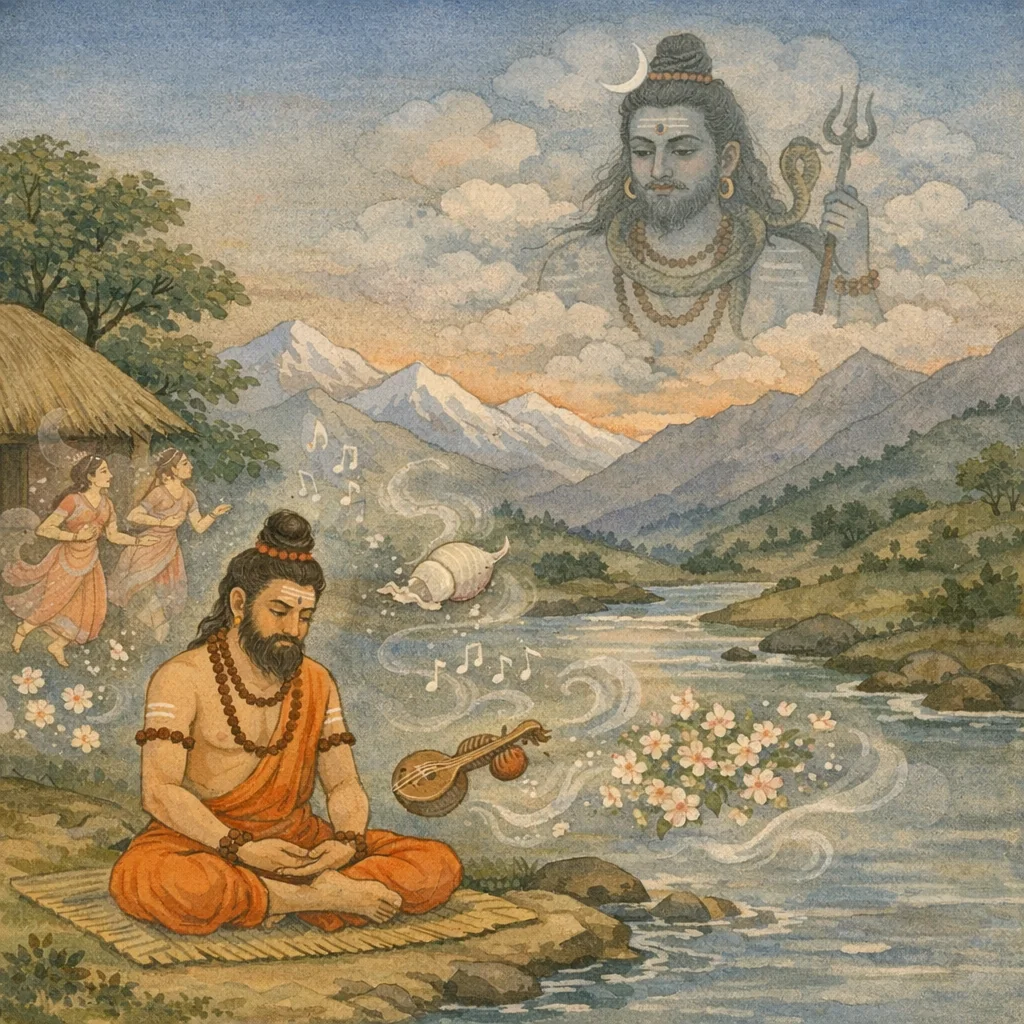
Sūta enumerates ten yoga-antarāyas that throw the yogin off course—from laziness to craving for sense-objects—and explains their inner workings: doubt about knowledge, mental unsteadiness, loss of faith in sādhana, deluded cognition, and the innate threefold suffering (ādhyātmika, ādhibhautika, ādhidaivika). He then describes the upasargas that arise once obstacles subside: graded siddhi-experiences such as pratibhā (intuitive insight), śravaṇa (supernormal hearing), darśana (visions), āsvāda/vedanā (subtle taste and tactile cognition), and awareness of divine fragrances, expanding into elemental aiśvarya across realms (pārthiva, āpya, taijasa, vāyavya, ākāśa, mānasa, ahaṅkāra, and brahmic cognition). These attainments are declared non-final and to be renounced—even up to Brahmā’s world—through restraint and supreme vairāgya. When the yogin abandons fascination with power and stills the mind, Mahādeva’s prasāda arises, granting dharma, jñāna, aiśvarya, vairāgya, and apavarga, preparing steadfastness in Pāśupata-yoga beyond this chapter.
Shlokas
Verse 1
सूत उवाच आलस्यं प्रथमं पश्चाद् व्याधिपीडा प्रजायते प्रमादः संशयस्थाने चित्तस्येहानवस्थितिः
Sūta said: First arises laziness; thereafter affliction by disease is born. Then comes heedlessness; and when doubt takes hold, the mind no longer remains steady in its pursuit here—of dharma and the path to Śiva.
Verse 2
अश्रद्धादर्शनं भ्रान्तिर् दुःखं च त्रिविधं ततः दौर्मनस्यमयोग्येषु विषयेषु च योग्यता
From that inner fall arise threefold afflictions—loss of faith in right vision, delusion, and suffering; thereafter come dejection and a mistaken sense of fitness toward unworthy sense-objects.
Verse 3
दशधाभिप्रजायन्ते मुनेर्योगान्तरायकाः आलस्यं चाप्रवृत्तिश् च गुरुत्वात्कायचित्तयोः
For the sage engaged in Yoga, the hindrances to Yoga arise in ten forms. Among them are laziness and non-engagement, born from the heaviness (inertia) of body and mind—bondages that keep the paśu from turning toward the Pati, Śiva.
Verse 4
व्याधयो धातुवैषम्यात् कर्मजा दोषजास् तथा प्रमादस्तु समाधेस्तु साधनानाम् अभावनम्
Diseases arise from an imbalance of the bodily constituents; others are born of past actions (karma) and of inner defects (doṣas). Negligence, however, is the failure to cultivate the means of samādhi—thus obstructing the yogin’s absorption in the Lord (Pati).
Verse 5
इदं वेत्युभयस्पृक्तं विज्ञानं स्थानसंशयः अनवस्थितचित्तत्वम् अप्रतिष्ठा हि योगिनः
This so-called ‘knowing’ is mixed with duality; it becomes mere cognition entangled in opposites. From that arises doubt about one’s true station, an unsteady mind, and—indeed—for the yogin, a lack of firm establishment. Only when the paśu rests in the Pati (Śiva) does steadiness become possible.
Verse 6
लब्धायामपि भूमौ च चित्तस्य भवबन्धनात् अश्रद्धाभावरहिता वृत्तिर्वै साधनेषु च
Even after one has attained the spiritual ground or stage, since the mind remains bound by bhava—worldly becoming—one’s engagement in all sādhanas must be kept free from aśraddhā, the absence of faith. Truly, in every discipline the right disposition is that which is devoid of faithlessness.
Verse 7
साध्ये चित्तस्य हि गुरौ ज्ञानाचारशिवादिषु विपर्ययज्ञानमिति भ्रान्तिदर्शनम् उच्यते
When the mind’s true aim is to be fulfilled, yet with regard to the Guru and the Shaiva standards—right knowledge (jñāna), right conduct (ācāra), and Shiva and the like—inverted cognition arises; this is called the “perception of delusion” (bhrānti-darśana).
Verse 8
अनात्मन्यात्मविज्ञानम् अज्ञानात्तस्य संनिधौ दुःखमाध्यात्मिकं प्रोक्तं तथा चैवाधिभौतिकम्
Through ignorance, one superimposes knowledge of the Self upon what is not the Self; in the very presence of that delusion, suffering is said to arise—both the inner (ādhyātmika) and the outer, creature-born (ādhibhautika).
Verse 9
आधिदैविकमित्युक्तं त्रिविधं सहजं पुनः इच्छाविघातात्संक्षोभश् चेतसस्तदुदाहृतम्
That which is called “ādhidaivika” is again said to be threefold and innate. It is explained as the agitation of the mind arising from the obstruction of one’s intended will—an affliction rooted in the presiding divine forces of the world.
Verse 10
दौर्मनस्यं निरोद्धव्यं वैराग्येण परेण तु तमसा रजसा चैव संस्पृष्टं दुर्मनः स्मृतम्
Despondency of mind should be restrained by the highest dispassion (para-vairāgya). That mind which is tainted by tamas and rajas is remembered as durmanas/durbuddhi—the troubled, impure mind.
Verse 11
तदा मनसि संजातं दौर्मनस्यमिति स्मृतम् हठात्स्वीकरणं कृत्वा योग्यायोग्यविवेकतः
Then, what arises in the mind is known as daurmanasya—despondency. It is born when one abandons discernment between what is fit and unfit and makes a forced acceptance of a course of action.
Verse 12
विषयेषु विचित्रेषु जन्तोर्विषयलोलता अन्तराया इति ख्याता योगस्यैते हि योगिनाम्
For the embodied being (paśu), fickle craving toward the many-varied sense-objects is known as antarāya—an obstacle to Yoga; indeed, these are the impediments that confront yogins.
Verse 13
अत्यन्तोत्साहयुक्तस्य नश्यन्ति न च संशयः प्रनष्टेष्वन्तरायेषु द्विजाः पश्चाद्धि योगिनः
For one endowed with unwavering ardour, the impediments are destroyed—of this there is no doubt. When the obstacles have perished, O twice-born ones, such a person thereafter truly becomes a yogin.
Verse 14
उपसर्गाः प्रवर्तन्ते सर्वे ते ऽसिद्धिसूचकाः प्रतिभा प्रथमा सिद्धिर् द्वितीया श्रवणा स्मृता
When obstacles (upasargas) arise, all of them are indicators of asiddhi—non-attainment. Of the siddhis, the first is pratibhā, inner illumination, and the second is said to be śravaṇa, sacred audition—true hearing.
Verse 15
वार्त्ता तृतीया विप्रेन्द्रास् तुरीया चेह दर्शना आस्वादा पञ्चमी प्रोक्ता वेदना षष्ठिका स्मृता
O best of Brahmins, the third is called vārttā—articulated speech; the fourth here is said to be seeing; the fifth is declared to be tasting; and the sixth is remembered as vedanā—sensation (feeling).
Verse 16
स्वल्पषट्सिद्धिसंत्यागात् सिद्धिदाः सिद्धयो मुनेः प्रतिभा प्रतिभावृतिः प्रतिभाव इति स्थितिः
By abandoning attachment to the lesser set of six siddhis, the muni attains the siddhis that truly bestow perfection: intuitive illumination (pratibhā), the protective veiling that contains that radiance (pratibhā-vṛti), and the mature state of realized being (pratibhāva)—thus is the established condition.
Verse 17
बुद्धिर्विवेचना वेद्यं बुध्यते बुद्धिरुच्यते सूक्ष्मे व्यवहिते ऽतीते विप्रकृष्टे त्वनागते
That discerning faculty by which the knowable is understood is called buddhi (intellect). It apprehends what is subtle, what is concealed or intervened, what is past, what is far away, and even what is yet to come.
Verse 18
सर्वत्र सर्वदा ज्ञानं प्रतिभानुक्रमेण तु श्रवणात्सर्वशब्दानाम् अप्रयत्नेन योगिनः
For the yogin, knowledge arises everywhere and at all times through the successive unfolding of intuitive insight (pratibhā); and merely by hearing, the meanings of all words are grasped effortlessly. Such is the siddhi born of Śaiva yoga, loosening the bonds (pāśa) that bind the paśu to saṃsāra and turning the mind toward the Lord (Pati).
Verse 19
ह्रस्वदीर्घप्लुतादीनां गुह्यानां श्रवणादपि स्पर्शस्याधिगमो यस् तु वेदना तूपपादिता
By merely hearing the secret distinctions of sound—short, long, and prolated (pluta)—there arises even the cognition of touch; thus the process of sensory apprehension (vedanā) is established. Here the bound soul (paśu) is shown to move under the bonds (pāśa) of the tanmātras, until it turns toward the Lord (Pati), Śiva, who transcends them.
Verse 20
दर्शनाद्दिव्यरूपाणां दर्शनं चाप्रयत्नतः संविद्दिव्यरसे तस्मिन्न् आस्वादो ह्यप्रयत्नतः
By the very beholding of the Divine Forms, their vision arises without strain; and when awareness rests in that divine Rasa, its savoring too occurs effortlessly.
Verse 21
वार्त्ता च दिव्यगन्धानां तन्मात्रा बुद्धिसंविदा विन्दन्ते योगिनस्तस्माद् आब्रह्मभुवनं द्विजाः
Even the subtle report (vārttā) of the divine fragrances—namely the tanmātras—yogins apprehend through the awakened cognition of buddhi. Therefore, O twice-born ones, they can perceive and range through the worlds up to Brahmā’s realm.
Verse 22
जगत्यस्मिन् हि देहस्थं चतुःषष्टिगुणं समम् औपसर्गिकम् एतेषु गुणेषु गुणितं द्विजाः
Indeed, in this world, what abides within the body is an equal set of sixty-four innate attributes; and, O twice-born ones, the embodied being is reckoned and classified according to these very qualities.
Verse 23
संत्याज्यं सर्वथा सर्वम् औपसर्गिकमात्मनः पैशाचे पार्थिवं चाप्यं राक्षसानां पुरे द्विजाः
Therefore, O twice-born ones, one must utterly abandon every defiling influence that befalls the self—whether arising from contagion and obstructive forces (upasarga), from piśāca-like impurity, or from the grossly earthly taint found in the abodes of rākṣasas—so that the paśu (bound soul) may remain fit for Śiva’s worship and the path of Pāśupata discipline.
Verse 24
याक्षे तु तैजसं प्रोक्तं गान्धर्वे श्वसनात्मकम् ऐन्द्रे व्योमात्मकं सर्वं सौम्ये चैव तु मानसम्
In the Yakṣa-order it is declared to be of the fiery (tejas) nature; in the Gandharva-order it is of the nature of breath and wind. In the Aindra (Indra-related) order everything is of the nature of space (ākāśa); and in the Saumya (Soma-related) order it is indeed mental in character. Thus the embodied paśu is seen as structured by elemental and subtle powers, while the Pati—Śiva—remains the transcendent Lord beyond these constituents.
Verse 25
प्राजापत्ये त्वहङ्कारं ब्राह्मे बोधमनुत्तमम् आद्ये चाष्टौ द्वितीये च तथा षोडशरूपकम्
In the Prajāpatya (creative) order arises egoity (ahaṅkāra); in the Brahmic order, the unsurpassed awakening (buddhi). In the first set there are eight forms, and in the second as well; likewise, there is a sixteenfold configuration—thus the structure of manifestation is taught.
Verse 26
चतुर्विंशत्तृतीये तु द्वात्रिंशच्च चतुर्थके चत्वारिंशत् पञ्चमे तु भूतमात्रात्मकं स्मृतम्
In the third set there are twenty-four; in the fourth, thirty-two; and in the fifth, forty. This fifth is remembered as consisting of the subtle elements alone (bhūta-mātras).
Verse 27
गन्धो रसस् तथा रूपं शब्दः स्पर्शस्तथैव च प्रत्येकमष्टधा सिद्धं पञ्चमे तच्छतक्रतोः
Smell, taste, form, sound, and touch—each is established in an eightfold manner within the fifth principle. Thus it is taught, O Śatakratu (Indra), in the discernment of tattvas, so that the paśu (bound soul) may distinguish the field of experience from Pati, the Lord.
Verse 28
तथाष्टचत्वारिंशच् च षट्पञ्चाशत्तथैव च चतुःषष्टिगुणं ब्राह्मं लभते द्विजसत्तमाः
Thus the best of the twice-born attains Brahmanical merit multiplied forty-eightfold, fifty-sixfold, and likewise sixty-fourfold.
Verse 29
औपसर्गिकम् आ ब्रह्म भुवनेषु परित्यजेत् लोकेष्वालोक्य योगेन योगवित्परमं सुखम्
Having discerned the worlds, the knower of Yoga should abandon all contingent afflictions—up to the level of Brahmā’s realm—and through Yoga attain the supreme bliss. In Śaiva Siddhānta, the paśu (bound soul) loosens pāśa (bondage) by yogic discernment and turns toward Pati, the Supreme Lord Śiva, as the ground of true sukha.
Verse 30
स्थूलता ह्रस्वता बाल्यं वार्धक्यं यौवनं तथा नानाजातिस्वरूपं च चतुर्भिर् देहधारणम्
Corpulence and smallness, childhood, old age, and youth—as well as forms belonging to many species—these constitute the soul’s taking up of embodiment in fourfold ways, under the governance of Pati (Śiva) and according to the bonds (pāśa) of karma.
Verse 31
पार्थिवांशं विना नित्यं सुरभिर् गन्धसंयुतः एतदष्टगुणं प्रोक्तम् ऐश्वर्यं पार्थिवं महत्
Apart from the earthy portion, it is ever fragrant, endowed with scent. This is declared to be the great earthly sovereignty, described as possessing eight qualities.
Verse 32
जले निवसनं यद्वद् भूम्यामिव विनिर्गमः इच्छेच्छक्तः स्वयं पातुं समुद्रमपि नातुरः
Just as one may dwell within water and yet emerge onto dry land, so too the Lord—whose very nature is sovereign Will (icchā-śakti)—is never constrained; if He so wishes, He can even drink up the ocean by Himself, without strain.
Verse 33
यत्रेच्छति जगत्यस्मिंस् तत्रास्य जलदर्शनम् यद्यद्वस्तु समादाय भोक्तुमिच्छति कामतः
Wherever he wills in this world, there water appears before him. Whatever object he takes up, he is able to enjoy it according to his desire—by the Lord (Pati’s) granting of siddhi.
Verse 34
तत्तद्रसान्वितं तस्य त्रयाणां देहधारणम् भाण्डं विनाथ हस्तेन जलपिण्डस्य धारणम्
Endowed with their respective essences (rasas), he becomes the support that bears the bodies of the three (worlds/conditions). And, without any vessel, by his own hand he holds together the mass of water—so too does the Lord (Pati) uphold embodied existence by his sovereign power.
Verse 35
अव्रणत्वं शरीरस्य पार्थिवेन समन्वितम् एतत् षोडशकं प्रोक्तम् आप्यमैश्वर्यमुत्तमम्
The body’s being free from wounds—together with the earthly (pārthiva) endowment—this set of sixteen has been declared as the supreme sovereignty belonging to the Water-principle (āpya-aiśvarya).
Verse 36
देहादग्निविनिर्माणं तत्तापभयवर्जितम् लोकं दग्धमपीहान्यद् अदग्धं स्वविधानतः
From the body there arises a fire—yet it is free from the fear and torment of heat. Though it scorches the world, that other Reality remains unburnt by its own intrinsic law—standing apart as the Pati beyond all dissolution.
Verse 37
जलमध्ये हुतवहं चाधाय परिरक्षणम् अग्निनिग्रहणं हस्ते स्मृतिमात्रेण चागमः
Placing the sacred fire even within water, there is protection; the fire can be restrained in the hand—such is the efficacy of the Āgama, accomplished by mere recollection (smṛti).
Verse 38
भस्मीभूतविनिर्माणं यथापूर्वं सकामतः द्वाभ्यां रूपविनिष्पत्तिर् विना तैस्त्रिभिर् आत्मनः
By His own will, He brings forth again—just as before—the manifestation from what has been reduced to ash; yet the soul’s form is not accomplished by merely two factors, for it is impossible without those three intrinsic principles of the Self.
Verse 39
चतुर्विंशात्मकं ह्येतत् तैजसं मुनिपुङ्गवाः मनोगतित्वं भूतानाम् अन्तर्निवसनं तथा
O best of sages, this Taijasa principle is said to be twenty-fourfold; it grants beings the capacity to move by mind alone, and it abides within them as the indwelling inner presence.
Verse 40
पर्वतादिमहाभारस्कन्धेनोद्वहनं पुनः लघुत्वं च गुरुत्वं च पाणिभ्यां वायुधारणम्
Again, there is the lifting of immense burdens—such as mountains—upon the shoulders; the attainment of lightness and heaviness at will; and the holding or restraining of the wind by one’s hands. These are but powers that arise in yoga, while the true Pati, Śiva, remains the sovereign beyond all siddhis.
Verse 41
अङ्गुल्यग्रनिघातेन भूमेः सर्वत्र कंपनम् एकेन देहनिष्पत्तिर् वातैश्वर्यं स्मृतं बुधैः
By striking with the tip of a finger, the earth trembles everywhere; and by a single act of will one may fashion a body. The wise remember this as vāyu-aiśvarya—mastery born of the wind-principle.
Verse 42
छायाविहीननिष्पत्तिर् इन्द्रियाणां च दर्शनम् आकाशगमनं नित्यम् इन्द्रियार्थैः समन्वितम्
He manifests without casting a shadow; the inner faculties become directly perceptible; he moves constantly through the sky—yet remains fully capable with respect to the objects of the senses. These are the signs of yogic accomplishment granted through devotion to Pati (Śiva) and the discipline of Pāśupata-yoga.
Verse 43
दूरे च शब्दग्रहणं सर्वशब्दावगाहनम् तन्मात्रलिङ्गग्रहणं सर्वप्राणिनिदर्शनम्
It apprehends sound even from afar and pervades the comprehension of all sounds. It grasps the subtle mark (liṅga) that is only the tanmātra, and thereby reveals itself as the inner Witness present in all living beings.
Verse 44
ऐन्द्रम् ऐश्वर्यम् इत्युक्तम् एतैरुक्तः पुरातनः यथाकामोपलब्धिश् च यथाकामविनिर्गमः
This is called Indra-like aiśvarya. By these powers the Primordial Lord is described: the attainment of whatever is willed, and the departure or withdrawal from the world whenever it is willed.
Verse 45
सर्वत्राभिभवश्चैव सर्वगुह्यनिदर्शनम् कामानुरूपनिर्माणं वशित्वं प्रियदर्शनम्
He is the Unconquerable One everywhere; He reveals even what is most hidden. He fashions manifestations in accordance with the devotee’s intention, grants vaśitva—mastery and irresistible influence—and bestows the blessed vision that is dear to the heart.
Verse 46
संसारदर्शनं चैव मानसं गुणलक्षणम् छेदनं ताडनं बन्धं संसारपरिवर्तनम्
This is the very perception of saṃsāra—an inner (mental) state marked by the guṇas—appearing as “cutting,” “beating,” and “binding,” and thus as the soul’s repeated turning through worldly existence.
Verse 47
सर्वभूतप्रसादश् च मृत्युकालजयस् तथा प्राजापत्यमिदं प्रोक्तम् आहङ्कारिकमुत्तमम्
It bestows grace upon all beings and also conquers the appointed time of death. This is declared to be the Prajāpatya principle—the creative, progenitive power—supreme among the forces arising from ahaṅkāra, the individuating “I”-sense.
Verse 48
अकारणजगत्सृष्टिस् तथानुग्रह एव च प्रलयश्चाधिकारश् च लोकवृत्तप्रवर्तनम्
The causeless emanation of the universe, and likewise grace itself; dissolution (pralaya), sovereign authority, and the setting in motion of the world’s order of conduct—these are His functions.
Verse 49
असादृश्यमिदं व्यक्तं निर्माणं च पृथक्पृथक् संसारस्य च कर्तृत्वं ब्राह्मम् एतद् अनुत्तमम्
This manifested world is marked by dissimilarity—its formations arise distinct and separate. And the agency that drives the revolving cycle of saṃsāra is called “Brahmic” (brāhma), a supreme principle of cosmic ordering; yet in Shaiva understanding it ultimately operates only under Pati, Lord Śiva, who alone stands beyond all becoming.
Verse 50
एतावत्तत्त्वमित्युक्तं प्राधान्यं वैष्णवं पदम् ब्रह्मणा तद्गुणं शक्यं वेत्तुमन्यैर्न शक्यते
Thus far the principle has been declared: the primordial Pradhāna is spoken of as the “Vaiṣṇava station.” Even Brahmā can comprehend its qualities; others are not capable of knowing it.
Verse 51
विद्यते तत्परं शैवं विष्णुना नावगम्यते असंख्येयगुणं शुद्धं को जानीयाच्छिवात्मकम्
That supreme Shaiva Reality truly exists—yet even Vishnu cannot fully comprehend it. Pure and endowed with immeasurable qualities, who indeed can know the Shiva-nature (Śivātman) as it is?
Verse 52
व्युत्थाने सिद्धयश्चैता ह्य् उपसर्गाश् च कीर्तिताः निरोद्धव्याः प्रयत्नेन वैराग्येण परेण तु
In the state of distraction from Yoga (vyutthāna), these very powers (siddhis) are declared to be impediments (upasargas). Therefore they must be restrained with steady effort, by supreme dispassion (para-vairāgya), so that the paśu is not ensnared again by the subtle bond (pāśa) and may move toward the Lord (Pati), Śiva.
Verse 53
नाशातिशयतां ज्ञात्वा विषयेषु भयेषु च अश्रद्धया त्यजेत्सर्वं विरक्त इति कीर्तितः
Knowing the overwhelming certainty of destruction in sense-objects, and the fear bound up with them, one should abandon everything without clinging faith in them; such a one is declared to be truly dispassionate (virakta).
Verse 54
वैतृष्ण्यं पुरुषे ख्यातं गुणवैतृष्ण्यमुच्यते वैराग्येणैव संत्याज्याः सिद्धयश्चौपसर्गिकाः
Dispassion in the embodied being (puruṣa) is well renowned; it is called freedom from thirst for the guṇas (guṇa-vaitṛṣṇya). And by true renunciation alone, even the incidental siddhis that arise as obstacles (aupāsargika) are to be abandoned.
Verse 55
औपसर्गिकम् आ ब्रह्मभुवनेषु परित्यजेत् निरुध्यैव त्यजेत्सर्वं प्रसीदति महेश्वरः
One should abandon all incidental, obstructing attachments—even those reaching up to the worlds of Brahmā. By restraining the senses and mind and thus relinquishing everything, Mahādeva, the Great Lord, becomes gracious.
Verse 56
प्रसन्ने विमला मुक्तिर् वैराग्येण परेण वै अथवानुग्रहार्थं च लीलार्थं वा तदा मुनिः
When the Lord Pati (Śiva) is pleased, liberation becomes stainless and pure—indeed through supreme dispassion (para‑vairāgya). Or else, O sage, it arises then for the sake of divine grace (anugraha) and also as the Lord’s līlā, His sportive freedom.
Verse 57
अनिरुध्य विचेष्टेद्यः सो ऽप्येवं हि सुखी भवेत् क्वचिद्भूमिं परित्यज्य ह्य् आकाशे क्रीडते श्रिया
Even one who acts without restraint will, in this manner, come to be happy; and at times—abandoning the ground—he sports in the sky, endowed with splendor.
Verse 58
उद्गिरेच्च क्वचिद्वेदान् सूक्ष्मानर्थान् समासतः क्वचिच्छ्रुते तदर्थेन श्लोकबन्धं करोति सः
At times he recites the Vedas; at times he conveys their subtle meanings in concise form. And at other times, having heard the Śruti, he composes verses that faithfully bind together its intended sense.
Verse 59
क्वचिद्दण्डकबन्धं तु कुर्याद्बन्धं सहस्रशः मृगपक्षिसमूहस्य रुतज्ञानं च विन्दति
At times, if one repeatedly performs the binding rite called daṇḍaka‑bandha—again and again, even a thousandfold—one attains knowledge of the cries and calls of gatherings of beasts and birds.
Verse 60
ब्रह्माद्यं स्थावरान्तं च हस्तामलकवद्भवेत् बहुनात्र किमुक्तेन विज्ञानानि सहस्रशः
From Brahmā onward, up to the immobile beings, all becomes as clear as a fruit held in one’s palm. What need is there to say more?—one gains thousands of discriminative knowledges.
Verse 61
उत्पद्यन्ते मुनिश्रेष्ठा मुनेस्तस्य महात्मनः अभ्यासेनैव विज्ञानं विशुद्धं च स्थिरं भवेत्
O best of sages, from that great-souled seer true realizations arise; by sustained practice alone, discriminative spiritual knowledge becomes purified and steady.
Verse 62
तेजोरूपाणि सर्वाणि सर्वं पश्यति योगवित् देवबिम्बान्यनेकानि विमानानि सहस्रशः
The knower of Yoga beholds all things as forms of radiance; he sees the whole—countless divine reflections and thousands upon thousands of celestial vimānas.
Verse 63
पश्यति ब्रह्मविष्ण्विन्द्रयमाग्निवरुणादिकान् ग्रहनक्षत्रताराश् च भुवनानि सहस्रशः
He beholds Brahmā, Viṣṇu, Indra, Yama, Agni, Varuṇa and the other deities; and he also sees the planets, lunar mansions, and stars—indeed, the worlds in their thousands. (Such vision arises when the paśu is lifted beyond pāśa by the grace of Pati, Śiva.)
Verse 64
पातालतलसंस्थाश् च समाधिस्थः स पश्यति आत्मविद्याप्रदीपेन स्वस्थेनाचलनेन तु
Established in samādhi, he beholds even the realms situated in the pātālas (netherworlds), by the lamp of Self-knowledge (ātma-vidyā)—steady, self-abiding, and unmoving. Thus the paśu, through yogic stillness, gains luminous insight by the grace of the Lord (Pati).
Verse 65
प्रसादामृतपूर्णेन सत्त्वपात्रस्थितेन तु तमो निहत्य पुरुषः पश्यति ह्यात्मनीश्वरम्
When the vessel of the mind abides in sattva and is filled with the nectar of divine grace, the paśu destroys tamas; then, indeed, the person beholds within the Self the Lord (Pati), the Inner Ruler.
Verse 66
तस्य प्रसादाद्धर्मश् च ऐश्वर्यं ज्ञानमेव च वैराग्यमपवर्गश् च नात्र कार्या विचारणा
By His grace arise dharma, sovereign power (aiśvarya), true knowledge, dispassion (vairāgya), and even apavarga—the final liberation. Of this there is no need for doubt or further deliberation.
Verse 67
न शक्यो विस्तरो वक्तुं वर्षाणामयुतैरपि योगे पाशुपते निष्ठा स्थातव्यं च मुनीश्वराः
Even in tens of thousands of years, its full extent cannot be spoken. Therefore, O lordly sages, remain steadfast in Pāśupata-yoga—firmly established in that discipline.
Frequently Asked Questions
Ālasya, vyādhi, pramāda, saṃśaya, anavasthita-citta, aśraddhā, bhrānti-darśana, duḥkha (threefold), daurmanasya, and viṣaya-lolatā—presented as a complete diagnostic of why meditation and samādhi fail to stabilize.
Pratibhā (intuitive cognition), śravaṇa (unforced hearing of all sounds), darśana (vision of divine forms), āsvāda (subtle taste), vedanā (subtle touch/skin-cognition), and awareness of divine fragrances—followed by broader elemental aiśvarya classifications across realms.
They should be restrained and renounced through para-vairāgya; the yogin is advised to abandon attachment to aupasargika attainments even up to Brahmā-world, so that the mind rests and Śiva’s prasāda yields purity and liberation.
Vairāgya is portrayed as the decisive discipline that neutralizes obstacles and siddhi-attachments; when renunciation and restraint mature, Mahēśvara becomes pleased, and from that prasāda arise dharma, jñāna, aiśvarya, vairāgya itself, and apavarga (moksha).