Adhyaya 73
Adhyaya 73 — त्रिपुरदाहे ब्रह्मस्तवः (Brahmā’s Hymn in the Context of Tripura’s Burning)
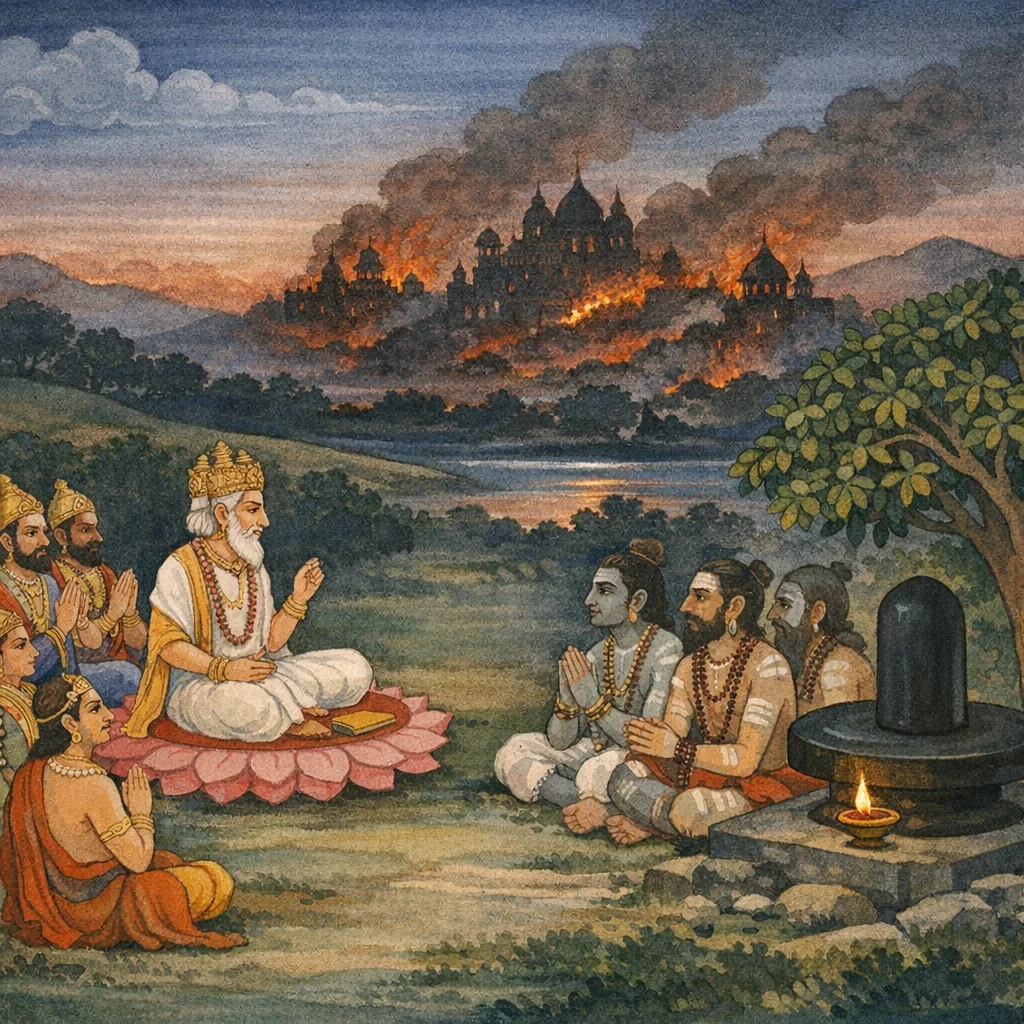
Sūta relates that after Mahādeva burns Tripura in an instant, Brahmā addresses Indra and the assembled devas: the daityas—Tārakākṣa, Kamalākṣa, Vidyunmālī and others—perished because they abandoned devotion to Śiva as the Liṅga-mūrti and relied on māyā. Brahmā proclaims Liṅga-pūjā to be a perpetual obligation; the world is pervaded by the Liṅga and all things are established in it. He names beings across realms—devas, asuras, yakṣas, siddhas, pitṛs, munis, rākṣasas—who attain success through Liṅgārcana. The teaching then turns to sādhana: the state of being ‘paśu’ and its transcendence through the Pāśupata discipline, purification by praṇava-based prāṇāyāma, tattva-śuddhi (guṇas, ahaṅkāra, tanmātras, bhūtas, indriyas), and bhasma-dhāraṇa. Brahmā concludes that constant remembrance and worship of Śiva protects from pāpa and grants both worldly enjoyments and divine status; thereafter Śakra and the devas worship Śiva as Pāśupatas, their bodies smeared with ash.
Shlokas
Verse 1
इति श्रीलिङ्गमहापुराणे पूर्वभागे त्रिपुरदाहे ब्रह्मस्तवो नाम द्विसप्तितमो ऽध्यायः सूत उवाच गते महेश्वरे देवे दग्ध्वा च त्रिपुरं क्षणात् सदस्याह सुरेन्द्राणां भगवान्पद्मसंभवः
Thus, in the Śrī Liṅga Mahāpurāṇa, in the Pūrva-bhāga, in the account of the Burning of Tripura, begins the seventy-second chapter called “Brahmā’s Hymn of Praise.” Sūta said: When Lord Maheśvara had departed—having in an instant burned Tripura—the Blessed Lotus-born (Brahmā) addressed the assembled Indras, the lords of the gods.
Verse 2
पितामह उवाच संत्यज्य देवदेवेशं लिङ्गमूर्तिमहेश्वरम् तारपौत्रो महातेजास् तारकस्य सुतो बली
Pitāmaha (Brahmā) said: Having forsaken the God of gods—Maheśvara, whose very form is the Liṅga—there arose the mighty and radiant one, the grandson of Tārā, the powerful son of Tāraka.
Verse 3
तारकाक्षो ऽपि दितिजः कमलाक्षश् च वीर्यवान् विद्युन्माली च दैत्येशः अन्ये चापि सबान्धवाः
Tārakākṣa too—an asura born of Diti—along with the mighty Kamalākṣa, and Vidyunmālī, lord of the Dānavas, and many others besides, assembled together with their kinsmen (as a confederation of the asuric hosts).
Verse 4
त्यक्त्वा देवं महादेवं मायया च हरेः प्रभोः सर्वे विनष्टाः प्रध्वस्ताः स्वपुरैः पुरसंभवैः
Having abandoned the God Mahādeva, and being deluded by the māyā of Lord Hari, they all were ruined and utterly shattered—by their own cities, born of those very strongholds.
Verse 5
तस्मात्सदा पूजनीयो लिङ्गमूर्तिः सदाशिवः यावत्पूजा सुरेशानां तावदेव स्थितिर्यतः
Therefore, Sadāśiva—manifest as the Liṅga-form—should always be worshipped; for as long as the Lords of the Devas continue their worship, so long does their stability and sovereign order endure.
Verse 6
पूजनीयः शिवो नित्यं श्रद्धया देवपुङ्गवैः सर्वलिङ्गमयो लोकः सर्वं लिङ्गे प्रतिष्ठितम्
Śiva is ever to be worshipped with faith by the foremost among the gods; for this whole world is pervaded by the Liṅga, and all things stand established in the Liṅga.
Verse 7
तस्मात् सम्पूजयेल्लिङ्गं य इच्छेत्सिद्धिमात्मनः सर्वे लिङ्गार्चनादेव देवा दैत्याश् च दानवाः
Therefore, whoever seeks the true siddhi of the Self should worship the Liṅga with full reverence; for through Liṅga-adoration alone do all—Devas, Daityas, and Dānavas—attain their respective powers and fulfillments.
Verse 8
यक्षा विद्याधराः सिद्धा राक्षसाः पिशिताशनाः पितरो मुनयश्चापि पिशाचाः किन्नरादयः
Yakṣas, Vidyādharas, Siddhas, Rākṣasas, flesh-eating beings; the Pitṛs (ancestral fathers) and the sages; Piśācas, Kinnaras, and the like—all these orders of beings are spoken of as present within the vast retinue that gathers around the Lord (Pati), drawn by His all-pervading Śaiva power.
Verse 9
अर्चयित्वा लिङ्गमूर्ति संसिद्धा नात्र संशयः तस्माल्लिङ्गं यजेन्नित्यं येन केनापि वा सुराः
Having worshipped the Liṅga-form, the gods attain complete accomplishment—of this there is no doubt. Therefore, O Devas, one should worship the Liṅga daily, by whatever means are available.
Verse 10
पशवश् च वयं तस्य देवदेवस्य धीमतः पशुत्वं च परित्यज्य कृत्वा पाशुपतं ततः
We too are but paśus (bound souls) of that wise Lord of Lords, God of gods. Therefore, casting off paśutva (the state of bondage), we shall then undertake the Pāśupata path, the discipline belonging to Paśupati.
Verse 11
पूजनीयो महादेवो लिङ्गमूर्तिः सनातनः विशोध्य चैव भूतानि पञ्चभिः प्रणवैः समम्
Mahādeva—eternal, established as the very form of the Liṅga—is to be worshipped. Before the rite, one should purify the five bhūtas (elements) with the fivefold Praṇava, aligning oneself with the sacred vibration.
Verse 12
प्राणायामैः समायुक्तैः पञ्चभिः सुरपुङ्गवाः चतुर्भिः प्रणवैश्चैव प्राणायामपरायणैः
O foremost among the gods, one should properly engage in five regulated prāṇāyāmas, and likewise in four recitations of the Praṇava (Oṁ), remaining wholly devoted to prāṇāyāma. By such yogic restraint the paśu (bound soul) is refined, the pāśa (bondage) is weakened, and fitness for the grace of Pati (Śiva) is cultivated.
Verse 13
त्रिभिश् च प्रणवैर्देवाः प्राणायामैस्तथाविधैः द्विधा न्यस्य तथौंकारं प्राणायामपरायणः
And the Devas, employing the threefold Praṇava and the prescribed disciplines of prāṇāyāma, duly performed the twofold nyāsa of the sacred Oṁ—being wholly devoted to prāṇāyāma as inner purification in Śiva-worship.
Verse 14
ततश्चौंकारम् उच्चार्य प्राणापानौ नियम्य च ज्ञानामृतेन सर्वाङ्गान्य् आपूर्य प्रणवेन च
Then, uttering the sacred syllable Oṁ and restraining the in-breath and out-breath, one should fill all the limbs with the nectar of liberating knowledge through the Praṇava, so that the paśu becomes fit for the grace of Pati (Śiva).
Verse 15
गुणत्रयं चतुर्धाख्यम् अहङ्कारं च सुव्रताः तन्मात्राणि च भूतानि तथा बुद्धीन्द्रियाणि च
O you of noble vows, from Prakṛti arise the three guṇas; the fourfold ego-principle (ahaṅkāra); the subtle elements (tanmātras) and the gross elements (bhūtas); and also the organs of knowledge and action. Thus the manifested order is enumerated as the field of pāśa in which the paśu moves, until released by the Lord, Pati—Śiva.
Verse 16
कर्मेन्द्रियाणि संशोध्य पुरुषं युगलं तथा चिदात्मानं तनुं कृत्वा चाग्निर्भस्मेति संस्पृशेत्
Having purified the organs of action, and likewise the pair of principles that constitute the embodied person, one should render the conscious Self subtle; then, with the awareness that “Agni is ash,” one should touch and apply the sacred ash.
Verse 17
वायुर्भस्मेति च व्योम तथाम्भः पृथिवी तथा त्रियायुषं त्रिसंध्यं च धूलयेद् भसितेन यः
He who smears himself with sacred ash—contemplating it as Vāyu (wind), as Vyoma (space), as Ambhas (water), and as Pṛthivī (earth)—and who performs this ash-application at the three sandhyās, attains a life-span of three measures and is purified through the Pāśupata observance.
Verse 18
स योगी सर्वतत्त्वज्ञो व्रतं पाशुपतं त्विदम् भवेन पाशमोक्षार्थं कथितं देवसत्तमाः
That Yogin, the knower of all tattvas, taught this very Pāśupata observance—declared by Bhava (Śiva) for the sake of release from the pāśa (bondage), O best among the Devas.
Verse 19
एवं पाशुपतं कृत्वा सम्पूज्य परमेश्वरम् लिङ्गे पुरा मया दृष्टे विष्णुना च महात्मना
Thus, having undertaken the Pāśupata observance and having fully worshipped Parameśvara, I formerly beheld the Lord in the Liṅga—seen likewise by the great-souled Viṣṇu.
Verse 20
पशवो नैव जायन्ते वर्षमात्रेण देवताः अस्माभिः सर्वकार्याणां देवमभ्यर्च्य यत्नतः
O Devas, beings (pashus) do not come into manifestation merely by the passage of a single year. Therefore, for the accomplishment of every undertaking, we must diligently worship the Lord (Pati), making Him the foremost refuge of all action.
Verse 21
बाह्ये चाभ्यन्तरे चैव मन्ये कर्तव्यमीश्वरम् प्रतिज्ञा मम विष्णोश् च दिव्यैषा सुरसत्तमाः
O best of the Devas, I hold that Īśvara must be worshipped both outwardly and inwardly; this divine vow is mine—and also Vishnu’s.
Verse 22
मुनीनां च न संदेहस् तस्मात् सम्पूजयेच्छिवम् सा हानिस्तन्महच्छिद्रं स मोहः सा च मूकता
Among the sages there is no doubt about this; therefore one should worship Śiva with full reverence. Neglect of that worship is loss indeed—it is a great breach; it is delusion, and it is spiritual dumbness.
Verse 23
यत्क्षणं वा मुहूर्तं वा शिवमेकं न चिन्तयेत् भवभक्तिपरा ये च भवप्रणतचेतसः
Even for a moment or a single muhūrta, one should not fail to contemplate the One Shiva—especially those devotees devoted to Bhava, whose hearts are bowed in reverence to Bhava.
Verse 24
भवसंस्मरणोद्युक्ता न ते दुःखस्य भाजनम् भवनानि मनोज्ञानि दिव्यमाभरणं स्त्रियः
O woman devoted to the remembrance of Bhava (Śiva), you are not a vessel for sorrow. You shall obtain delightful dwellings, divine ornaments, and noble women as attendants/companions—all as the auspicious fruit of Śiva’s grace.
Verse 25
धनं वा तुष्टिपर्यन्तं शिवपूजाविधेः फलम् ये वाञ्छन्ति महाभोगान् राज्यं च त्रिदशालये ते ऽर्चयन्तु सदा कालं लिङ्गमूर्तिं महेश्वरम्
Wealth—even up to complete contentment—is the fruit of the prescribed rite of Śiva-worship. Those who desire great enjoyments and sovereign rule in the abode of the Thirty (the Devas) should, at all times, worship Maheśvara in the form of the Liṅga—Pati, the Lord who grants both bhoga (experience) and higher attainment.
Verse 26
हत्वा भित्त्वा च भूतानि दग्ध्वा सर्वमिदं जगत्
Having slain and shattered the beings, and having burned up this entire world, the Lord brings all manifested forms to dissolution; He withdraws the paśus from their bonds (pāśas) and returns them to the unmanifest under the sovereignty of Pati, Śiva.
Verse 27
यजेदेकं विरूपाक्षं न पापैः स प्रलिप्यते शैलं लिङ्गं मदीयं हि सर्वदेवनमस्कृतम्
Whoever worships the One Virūpākṣa—the Three-Eyed Lord—is not tainted by sins. For this stone Liṅga is truly Mine, revered and bowed to by all the gods.
Verse 28
इत्युक्त्वा पूर्वमभ्यर्च्य रुद्रं त्रिभुवनेश्वरम् तुष्टाव वाग्भिर् इष्टाभिर् देवदेवं त्रियंबकम्
Having thus spoken, he first worshipped Rudra, the Lord of the three worlds; then, with cherished and fitting words, he praised Triyambaka—the God of gods—who alone is Pati, the liberator of the paśus from the fetters (pāśa).
Verse 29
तदाप्रभृति शक्राद्याः पूजयामासुरीश्वरम् साक्षात्पाशुपतं कृत्वा भस्मोद्धूलितविग्रहाः
From that time onward, Indra (Śakra) and the other gods began to worship Lord Īśvara. Directly undertaking the Pāśupata observance, they smeared their bodies with sacred ash (bhasma) and offered Him adoration.
Frequently Asked Questions
Brahmā states that Sadāśiva as Liṅga-mūrti is perpetually worthy of worship; the entire world is ‘liṅga-made’ and all realities are established in the Liṅga, making Liṅgārcana the sustaining dharma of devas and beings.
The chapter outlines praṇava (Oṃ) centered prāṇāyāma and internal purification (tattva-śuddhi of guṇas, ahaṅkāra, tanmātras, bhūtas, and indriyas), followed by bhasma application (ash rite) and constant worship/remembrance of Śiva as Liṅga for pāśa-mokṣa.
Tripuradāha becomes a didactic proof that abandoning Śiva-Liṅga devotion leads to ruin, while sustained Liṅga-pūjā preserves divine order; thus Brahmā urges nitya-yajana (daily worship) and unbroken contemplation of Śiva.