Adhyaya 70
Adhyaya 70: आदिसर्गः—महत्-अहङ्कार-तन्मात्रा-भूतसृष्टिः, ब्रह्माण्डावरणम्, प्रजासर्गः, त्रिमूर्ति-शैवाधिष्ठानम्
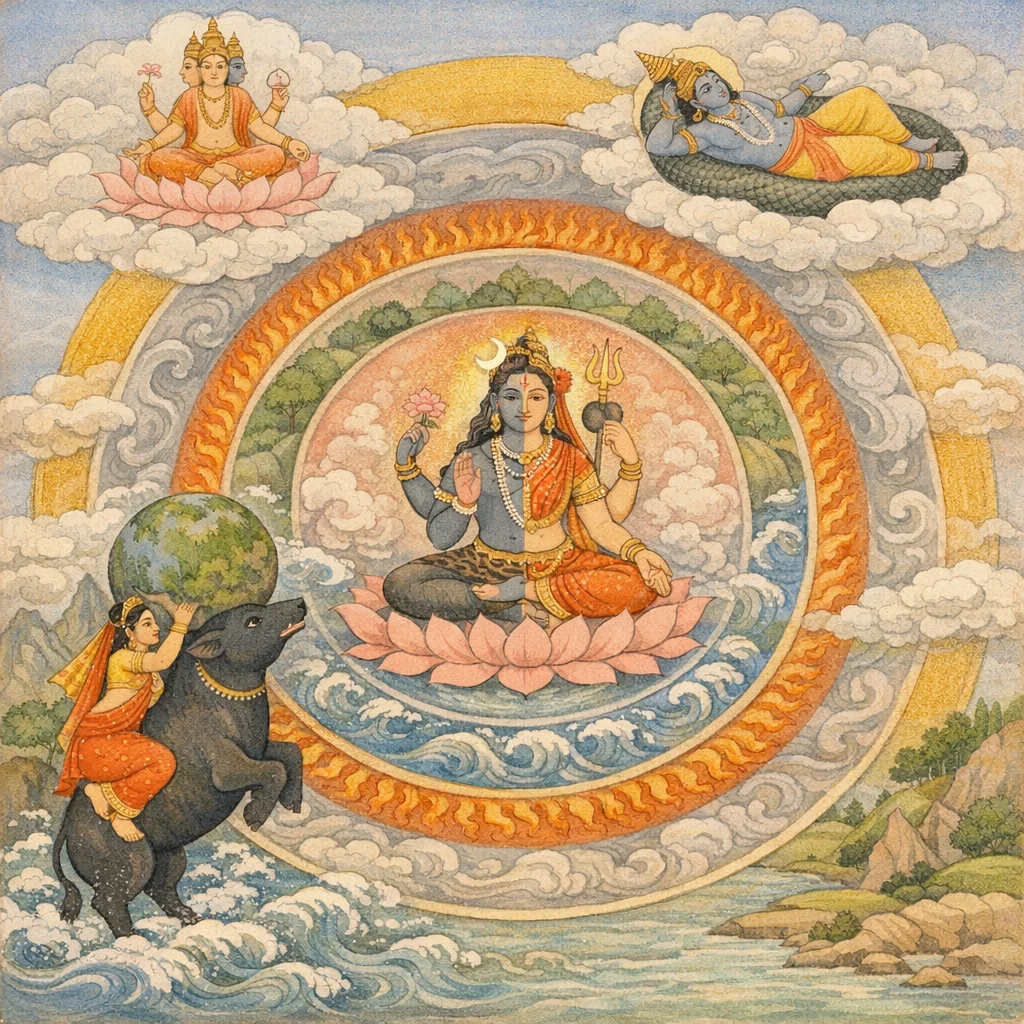
Urged by the Ṛṣis, Sūta fully unfolds the previously “not fully revealed” account of ādi-sarga. He first establishes Mahādeva (Śiva) as transcendent over Prakṛti and Puruṣa, then traces manifestation from Avyakta into Mahat (also called Manas/Mati/Buddhi/Saṃvid, etc.), explaining its functions and name-derivations. From rajas-touched Ahaṅkāra arises a threefold creative stream: the tāmasa line produces the Tanmātras and the Mahābhūtas in order—ākāśa→vāyu→tejas→āpas→pṛthivī—while the sāttvika (vaikārika) line produces the indriyas and mind. The chapter describes the elements’ mutual interpenetration, the formation of the cosmic egg (brahmāṇḍa) with its layered coverings, and Śiva’s forms established across these levels. It integrates the Trimūrti as emanating from Mahādeva, moves through kalpa/manvantara time, Varāha’s uplifting of Earth, and Brahmā’s prajā-sarga of devas, asuras, pitṛs, humans, yakṣa-rākṣasas, nāgas/serpents, gandharvas, animals, and ritual structures. It culminates in Rudra-creation, Śiva’s steadfastness as Sthāṇu, Ardhanārīśvara, and a protective, merit-bestowing recitation of Devī’s names—closing the cosmological arc with Śaiva devotional purpose and a promise of liberation.
Shlokas
Verse 1
इति श्रीलिङ्गमहापुराणे पूर्वभागे सोमवंशानुकीर्तनं नामैकोनसप्ततितमो ऽध्यायः ऋषय ऊचुः आदिसर्गस्त्वया सूत सूचितो न प्रकाशितः सांप्रतं विस्तरेणैव वक्तुमर्हसि सुव्रत
Thus, in the Śrī Liṅga Mahāpurāṇa, in the Pūrvabhāga, begins the sixty-ninth chapter entitled “The Recounting of the Lunar Dynasty.” The sages said: “O Sūta, you have only indicated the primordial creation, but you have not made it clear. Now, O keeper of an excellent vow, you should describe it in detail.”
Verse 2
सूत उवाच महेश्वरो महादेवः प्रकृतेः पुरुषस्य च परत्वे संस्थितो देवः परमात्मा मुनीश्वराः
Sūta said: O lordly sages, Mahēśvara—Mahādeva—is the supreme Deity, established beyond both Prakṛti and Puruṣa. He is the Paramātman, the transcendent Pati (Lord) over all.
Verse 3
च्रेअतिओन् फ़्रोम् अव्यक्त अव्यक्तं चेश्वरात्तस्माद् अभवत्कारणं परम् प्रधानं प्रकृतिश्चेति यदाहुस्तत्त्वचिन्तकाः
Creation proceeds from the Unmanifest (Avyakta); and that Unmanifest arises from the Lord. Therefore the supreme causal principle—called Pradhāna, also known as Prakṛti—is what the contemplators of reality (tattva) declare.
Verse 4
गन्धवर्णरसैर् हीनं शब्दस्पर्शविवर्जितम् अजरं ध्रुवमक्षय्यं नित्यं स्वात्मन्यवस्थितम्
He is devoid of smell, colour, and taste, and is free from sound and touch. Unaging, steadfast, undecaying, and eternal, he abides established in his own Self—Śiva, the Pati—beyond the grasp of the senses and the pāśa that bind the paśu.
Verse 5
जगद्योनिं महाभूतं परं ब्रह्म सनातनम् विग्रहः सर्वभूतानाम् ईश्वराज्ञाप्रचोदितम्
He is the womb of the universe—the Great Being, the supreme and eternal Brahman. By the command of the Lord (Pati), he becomes the manifested form within all beings, impelling their embodied existence.
Verse 6
अनाद्यन्तमजं सूक्ष्मं त्रिगुणं प्रभवाव्ययम् अप्रकाशमविज्ञेयं ब्रह्माग्रे समवर्तत
Before Brahmā and the act of creation, That Reality existed—beginningless and endless, unborn and subtle; the source of the three guṇas yet itself imperishable; unmanifest (beyond sensory illumination) and unknowable to ordinary cognition—abiding as the primordial Supreme, Śiva as Pati.
Verse 7
अस्यात्मना सर्वमिदं व्याप्तं त्वासीच्छिवेच्छया गुणसाम्ये तदा तस्मिन्न् अविभागे तमोमये
By His very Self, all this was pervaded; and by Śiva’s will, at that time—when the three guṇas were in perfect equilibrium—it existed in that undivided, darkness-laden, unmanifest state.
Verse 8
महन्त् सर्गकाले प्रधानस्य क्षेत्रज्ञाधिष्ठितस्य वै गुणभावाद्व्यज्यमानो महान् प्रादुर्बभूव ह
At the time of creation, when Pradhāna (primordial Nature) is presided over by the Kṣetrajña (the indwelling Lord of consciousness), the Great Principle—Mahat—manifested through the stirring of the guṇas.
Verse 9
सूक्ष्मेण महता चाथ अव्यक्तेन समावृतम् सत्त्वोद्रिक्तो महानग्रे सत्तामात्रप्रकाशकः
Then, enveloped by the subtle principle, by Mahat, and by the Unmanifest (Avyakta), the Mahat—predominant in sattva—arose first, shining as the mere illumination of pure being.
Verse 10
मनो महांस्तु विज्ञेयम् एकं तत्कारणं स्मृतम् समुत्पन्नं लिङ्गमात्रं क्षेत्रज्ञाधिष्ठितं हि तत्
Mind (manas) together with Mahat is to be understood as one; it is remembered as a single causal principle. From it arises only the subtle “liṅga,” the mark; and that subtle principle is indeed presided over by the Kṣetrajña—the Knower of the Field, Pati, Śiva.
Verse 11
धर्मादीनि च रूपाणि लोकतत्त्वार्थहेतवः महान् सृष्टिं विकुरुते चोद्यमानः सिसृक्षया
Assuming forms such as Dharma and the rest—becoming the causes of the world’s principles (tattvas) and their purposes—the Great One, impelled by the will to manifest, unfolds creation into its differentiated state.
Verse 12
मनो महान्मतिर्ब्रह्म पूर्बुद्धिः ख्यातिरीश्वरः प्रज्ञा चितिः स्मृतिः संविद् विश्वेशश्चेति स स्मृतः
He is remembered as Mind (manas), the Great Principle (Mahān), Intelligence (mati), the Creative Absolute (Brahma), Primordial Understanding (pūrva-buddhi), Renown (khyāti), the Supreme Lord (Īśvara), Higher Wisdom (prajñā), Consciousness (citti), Memory (smṛti), Pure Awareness (saṃvid), and the Lord of the Universe (Viśveśa).
Verse 13
मनुते सर्वभूतानां यस्माच्चेष्टा फलं ततः सौक्ष्म्यात्तेन विभक्तं तु येन तन्मन उच्यते
That by which the fruits of the actions of all beings are cognized—by virtue of its subtlety and its power to differentiate—is therefore called manas, the mind.
Verse 14
तत्त्वानाम् अग्रजो यस्मान् महांश् च परिमाणतः विशेषेभ्यो गुणेभ्यो ऽपि महानिति ततः स्मृतः
Because it is the first-born among the tattvas and vast in its measure, surpassing even the particulars and the guṇas, it is therefore remembered as Mahān, the Great Principle.
Verse 15
बिभर्ति मानं मनुते विभागं मन्यते ऽपि च पुरुषो भोगसंबन्धात् तेन चासौ मतिः स्मृतः
Through association with bhoga (enjoyment), the bound puruṣa upholds the sense of self, conceives divisions, and clings to opinions; therefore that conditioning is termed “mati,” mind/intellect.
Verse 16
बृहत्त्वाद् बृंहणत्वाच्च भावानां सकलाश्रयात् यस्माद्धारयते भावान् ब्रह्म तेन निरुच्यते
Because It is vast, because It brings about expansion, and because It is the universal refuge of all existents—since It upholds all beings, It is therefore designated as Brahman.
Verse 17
यः पूरयति यस्माच्च कृत्स्नान्देवाननुग्रहैः नयते तत्त्वभावं च तेन पूरिति चोच्यते
He is called “Pūri” because, through His gracious favors, He fulfills all the gods, and because He also leads them into the state of true Reality (tattva-bhāva).
Verse 18
बुध्यते पुरुषश्चात्र सर्वान् भावान् हितं तथा यस्माद्बोधयते चैव बुद्धिस्तेन निरुच्यते
Here the Puruṣa becomes aware of all states of being and of what is truly beneficial; and because it causes (him) to know and awaken, it is therefore designated as Buddhi (the intellect).
Verse 19
ख्यातिः प्रत्युपभोगश् च यस्मात्संवर्तते ततः भोगस्य ज्ञाननिष्ठत्वात् तेन ख्यातिरिति स्मृतः
That from which both ‘manifest cognition’ (khyāti) and immediate re-experience (pratyupabhoga) proceed is, for this reason, remembered as Khyāti; for enjoyment/experience (bhoga) is grounded in knowledge (jñāna), resting upon it as its basis.
Verse 20
ख्यायते तद्गुणैर् वापि ज्ञानादिभिर् अनेकशः तस्माच्च महतः संज्ञा ख्यातिरित्यभिधीयते
Because it becomes manifest and is widely known through its own qualities—such as knowledge and the rest—therefore the Great Principle (Mahat) is designated by the name ‘Khyāti’, meaning ‘manifest renown’ or ‘that which is made known’.
Verse 21
साक्षात्सर्वं विजानाति महात्मा तेन चेश्वरः यस्माज्ज्ञानानुगश्चैव प्रज्ञा तेन स उच्यते
The great-souled one who directly knows all realities is, for that very reason, called “Īśvara”; and because his discernment (prajñā) follows true knowledge (jñāna), he is spoken of as endowed with prajñā.
Verse 22
ज्ञानादीनि च रूपाणि बहुकर्मफलानि च चिनोति यस्माद्भोगार्थं तेनासौ चितिरुच्यते
Because it gathers the forms beginning with knowledge (jñāna), and also the many fruits of actions for the sake of experience (bhoga), therefore it is called “Citi” (the cognizing consciousness that collects and enjoys).
Verse 23
वर्तमानव्यतीतानि तथैवानागतान्यपि स्मरते सर्वकार्याणि तेनासौ स्मृतिरुच्यते
That by which one recollects all matters—those of the present, the past, and likewise even the future—is therefore called smṛti (remembrance).
Verse 24
कृत्स्नं च विन्दते ज्ञानं यस्मान्माहात्म्यमुत्तमम् तस्माद् विन्देर् विदेश्चैव संविदित्यभिधीयते
Because, through it, one attains complete knowledge and the supreme greatness, it is therefore called Saṃvid—being derived from the roots vind (“to find/attain”) and vid (“to know”).
Verse 25
विद्यते ऽपि च सर्वत्र तस्मिन्सर्वं च विन्दति तस्मात्संविदिति प्रोक्तो महद्भिर् मुनिसत्तमाः
He exists everywhere; and in Him, indeed, all things are found and attained. Therefore the great sages have declared Him to be Saṃvid—Supreme Consciousness.
Verse 26
जानातेर् ज्ञानम् इत्याहुर् भगवान् ज्ञानसंनिधिः बन्धनादिपरीभावाद् ईश्वरः प्रोच्यते बुधैः
The wise declare that “knowledge” is that by which one truly knows; the Blessed Lord is the abiding presence of Knowledge itself. Since He transcends and overmasters bondage and every limiting condition, the learned proclaim Him as Īśvara—the sovereign Pati.
Verse 27
पर्यायवाचकैः शब्दैस् तत्त्वम् आद्यम् अनुत्तमम् व्याख्यातं तत्त्वभावज्ञैर् देवसद्भावचेतकैः
Using synonymous expressions, those who know the true nature of tattva have expounded the primordial, unsurpassed Principle. Their minds, attuned to divine truth, speak so that Śiva, the Pati, may be understood beyond mere names.
Verse 28
महान्सृष्टिं विकुरुते चोद्यमानः सिसृक्षया संकल्पो ऽध्यवसायश् च तस्य वृत्तिद्वयं स्मृतम्
Urged by the will to manifest, he unfolds the vast creation. His operation is remembered as twofold: saṅkalpa, sacred intention, and adhyavasāya, decisive determination.
Verse 29
त्रिगुणाद् रजसोद्रिक्ताद् अहङ्कारस्ततो ऽभवत् महता च वृतः सर्गो भूतादिर् बाह्यतस्तु सः
From Prakṛti constituted of the three guṇas—when rajas becomes predominant—ahaṅkāra, the I-principle, arises. Enveloped by Mahat, cosmic intelligence, that outward-moving creation begins as bhūtādi, the origin of the elements.
Verse 30
तस्मादेव तमोद्रिक्ताद् अहङ्कारादजायत भूततन्मात्रसर्गस्तु भूतादिस्तामसस्तु सः
From that ahaṅkāra dominated by tamas arose the creation of the tanmātras, the subtle elements, and the bhūtas, the gross elements. That source is called Bhūtādi—the tamasic form of ahaṅkāra.
Verse 31
च्रेअतिओन् ओफ़् महाभूतस् भूतादिस्तु विकुर्वाणः शब्दमात्रं ससर्ज ह आकाशं सुषिरं तस्माद् उत्पन्नं शब्दलक्षणम्
When Bhūtādi (the tamasic principle of ahaṅkāra) underwent transformation, it brought forth only the subtle potential of sound (śabda-mātra). From that arose ākāśa, the all-pervading ether—hollow and accommodating—whose defining mark is sound. In the Śaiva understanding, this unfolding of tattvas proceeds under Pati (Śiva), the sovereign regulator, while the bound soul (paśu) experiences these evolutes through the bonds (pāśa) of limitation.
Verse 32
आकाशं शब्दमात्रं तु स्पर्शमात्रं समावृणोत् वायुश्चापि विकुर्वाणो रूपमात्रं ससर्ज ह
From ākāśa, marked by the mere potential of sound (śabda-mātra), arose the mere potential of touch (sparśa-mātra). And Vāyu, as it transformed, then brought forth the mere potential of form (rūpa-mātra).
Verse 33
ज्योतिरुत्पद्यते वायोस् तद्रूपगुणम् उच्यते स्पर्शमात्रस्तु वै वायू रूपमात्रं समावृणोत्
From Vāyu (the principle of air) arises Jyotis (fire/light); therefore form (rūpa) is declared its specific quality. Air, whose own defining mark is only touch, enveloped and carried this mere principle of form (rūpa-mātra) into manifestation.
Verse 34
ज्योतिश्चापि विकुर्वाणं रसमात्रं ससर्ज ह सम्भवन्ति ततो ह्यापस् ता वै सर्वरसात्मिकाः
That primordial Light (jyotis), by transforming itself, brought forth the mere principle of taste and essence (rasa-mātra). From that indeed the Waters (āpas) came into being—those Waters are verily of the very nature of all tastes and all essences.
Verse 35
रसमात्रास्तु ता ह्यापो रूपमात्रो ऽग्निर् आवृणोत् आपश्चापि विकुर्वत्यो गन्धमात्रं ससर्जिरे
Those Waters were constituted of taste alone; Fire, constituted of form alone, enveloped them. And the Waters too, undergoing transformation, brought forth the subtle principle of fragrance alone (gandha-mātra)—thus the further unfolding of the elements proceeded under the Lord, Pati (Śiva), who presides over creation.
Verse 36
संघातो जायते तस्मात् तस्य गन्धो गुणो मतः तस्मिंस्तस्मिंश् च तन्मात्रं तेन तन्मात्रता स्मृता
From that subtle principle a composite gross element is produced; its specific quality is held to be smell. In each such element abides its corresponding subtle essence (tanmātra); therefore it is remembered as possessing the state of a tanmātra.
Verse 37
अविशेषवाचकत्वाद् अविशेषास् ततस् तु ते प्रशान्तघोरमूढत्वाद् अविशेषास्ततः पुनः
Because they are spoken of only in non-differentiating terms, they are therefore called “aviśeṣa,” undifferentiated. And again, since they bear the triad of qualities—tranquil (praśānta), fierce (ghora), and deluded (mūḍha)—they are once more said to be undifferentiated.
Verse 38
भूततन्मात्रसर्गो ऽयं विज्ञेयस्तु परस्परम् वैकारिकादहङ्कारात् सत्त्वोद्रिक्तात्तु सात्त्विकात्
This is the creation of the tanmātras (subtle elements) and the bhūtas (gross elements), to be understood as mutually connected in due sequence. It arises from the vaikārika (sāttvika) ahaṅkāra—egoity in which sattva predominates.
Verse 39
वैकारिकः स सर्गस्तु युगपत् सम्प्रवर्तते इन्द्रियस् बुद्धीन्द्रियाणि पञ्चैव पञ्च कर्मेन्द्रियाणि च
From the vaikārika (sāttvika) principle, that creation proceeds all at once: the faculties arise—five organs of knowledge (buddhīndriyas) and five organs of action (karmendriyas).
Verse 40
साधकानीन्द्रियाणि स्युर् देवा वैकारिका दश एकादशं मनस्तत्र स्वगुणेनोभयात्मकम्
The ten sense-faculties are instruments of accomplishment (sādhaka), arising from the sāttvika (vaikārika) principle. Among them the mind (manas) is the eleventh; by its own inherent quality it partakes of both—cognitive and active—and thus becomes dual-natured.
Verse 41
श्रोत्रं त्वक् चक्षुषी जिह्वा नासिका चैव पञ्चमी शब्दादीनामवाप्त्यर्थं बुद्धियुक्तानि तानि वै
The ear, the skin, the two eyes, the tongue, and the nose as the fifth—these are the five sense-faculties. Endowed with the guiding power of buddhi, they are meant to apprehend sound and the rest of the sense-objects.
Verse 42
पादौ पायुरुपस्थश् च हस्तौ वाग्दशमी भवेत् गतिर्विसर्गो ह्यानन्दः शिल्पं वाक्यं च कर्म तत्
The feet, the anus, the generative organ, the hands, and speech—speech becomes the tenth. Their functions are movement, excretion, delight, craftsmanship, and articulation; thus these are the karmas of the organs of action.
Verse 43
आकाशं शब्दमात्रं च स्पर्शमात्रं समाविशत् द्विगुणस्तु ततो वायुः शब्दस्पर्शात्मको ऽभवत्
From subtle sound alone arose ākāśa (ether); and when the subtle principle of touch entered into it, then vāyu (air) manifested as twofold in quality—possessing both sound and touch.
Verse 44
रूपं तथैव विशतः शब्दस्पर्शगुणावुभौ त्रिगुणस्तु ततस्त्वग्निः सशब्दस्पर्शरूपवान्
Likewise, form (rūpa) entered, and the two qualities—sound and touch—also entered. Then fire (agni) arose as that which bears three qualities: sound, touch, and form.
Verse 45
सशब्दस्पर्शरूपं च रसमात्रं समाविशत् तस्माच्चतुर्गुणा आपो विज्ञेयास्तु रसात्मिकाः
Endowed with sound, touch, and form, it then entered into the subtle principle of taste (rasa) alone. Therefore the Waters (āpas) are to be understood as fourfold in qualities, having taste as their very essence.
Verse 46
शब्दस्पर्शं च रूपं च रसो वै गन्धमाविशत् संगता गन्धमात्रेण आविशन्तो महीमिमाम्
Sound, touch, and form—indeed taste as well—entered into fragrance. United with the mere principle of smell, the gandha-tanmātra, they pervaded and became this Earth-element (mahī), the gross support for embodied souls (paśu) within the bonds (pāśa) of the manifest creation.
Verse 47
तस्मात्पञ्चगुणा भूमिः स्थूला भूतेषु शस्यते शान्ता घोराश् च मूढाश् च विशेषास्तेन ते स्मृताः
Therefore Earth (bhūmi), endowed with five qualities, is praised among the elements as the grossest. Its particular modes are remembered as peaceful (śānta), terrible (ghora), and deluding or inert (mūḍha)—distinct conditions arising within embodied existence.
Verse 48
परस्परानुप्रवेशाद् धारयन्ति परस्परम् भूमेरन्तस्त्विदं सर्वं लोकालोकाचलावृतम्
By mutually interpenetrating one another, these cosmic supports uphold each other. And all this lies within the Earth’s inner expanse, enclosed by the Lokāloka mountain—marking the boundary between the manifest worlds and the unmanifest darkness beyond.
Verse 49
विशेषाश्चेन्द्रियग्राह्या नियतत्वाच्च ते स्मृताः गुणं पूर्वस्य सर्गस्य प्राप्नुवन्त्युत्तरोत्तराः
These particularities (viśeṣas) are apprehended by the senses and are therefore remembered as determinate. In the successive stages of creation, each later creation comes to possess the quality of the preceding creation—step by step—according to the ordered unfolding governed by Pati (Śiva).
Verse 50
तेषां यावच्च तद् यच्च यच्च तावद्गुणं स्मृतम् उपलभ्याप्सु वै गन्धं केचिद् ब्रूयुर् अपां गुणम्
Among these elements, whatever extent and whatever kind of property is remembered as their measure of qualities—some, on perceiving fragrance even in water, declare that “smell” too is a quality of the waters.
Verse 51
पृथिव्यामेव तं विद्याद् अपां वायोश् च संश्रयात् एते सप्त महात्मानो ह्य् अन्योन्यस्य समाश्रयात्
Know that principle as grounded in Earth, sustained by Water and by Wind. These seven great realities are mutually dependent, each resting upon the other—thus the manifested order stands through reciprocal support.
Verse 52
पुरुषाधिष्ठितत्वाच्च अव्यक्तानुग्रहेण च अण्ड महादयो विशेषान्ता ह्य् अण्डमुत्पादयन्ति ते
Because they are presided over by the Puruṣa (the Supreme Lord as Pati) and through the gracious impulse of the Unmanifest (Avyakta), those principles beginning with Mahat and ending in the particularized elements bring forth the Cosmic Egg (Brahmāṇḍa).
Verse 53
एककालसमुत्पन्नं जलबुद्बुदवच्च तत् विशेषेभ्यो ऽण्डम् अभवन् महत् तद् उदकेशयम्
Arising all at once—like a bubble upon water—there emerged from the differentiated principles a vast cosmic egg, resting upon the primal waters.
Verse 54
अद्भिर् दशगुणाभिस्तु बाह्यतो ऽण्डं समावृतम् आपो दशगुणेनैतास् तेजसा बाह्यतो वृताः
The cosmic Egg (brahmāṇḍa) is enclosed on the outside by waters tenfold in measure; and those waters, again tenfold, are outwardly encircled by fire (tejas).
Verse 55
तेजो दशगुणेनैव वायुना बाह्यतो वृतम् वायुर्दशगुणेनैव बाह्यतो नभसा वृतः
Fire is outwardly enclosed by Air, tenfold greater than it; and Air, in turn, is outwardly enclosed by Ether, tenfold greater than Air. Thus the gross elements are successively enveloped by subtler, more expansive principles—revealing the ordered veiling (āvaraṇa) within creation under the Lord (Pati).
Verse 56
आकाशेनावृतो वायुः खं तु भूतादिनावृतम् भूतादिर्महता चापि अव्यक्तेनावृतो महान्
Air is enveloped by ether (ākāśa); and ether is enveloped by bhūtādi, the primal elemental principle. Bhūtādi is enveloped by Mahat; and Mahat is enveloped by Avyakta, the Unmanifest—the subtle causal ground from which the manifest cosmos arises and into which it withdraws, under the sovereignty of Pati (Śiva).
Verse 57
शर्वश्चाण्डकपालस्थो भवश्चांभसि सुव्रताः रुद्रो ऽग्निमध्ये भगवान् उग्रो वायौ पुनः स्मृतः
Śarva abides in the skull-bowl (kapāla) of the fierce ascetic; Bhava is established in the waters, O you of disciplined vows. Rudra—the Blessed Lord—is present in the midst of fire, and Ugra again is remembered as dwelling in the wind.
Verse 58
भीमश्चावनिमध्यस्थो ह्य् अहङ्कारे महेश्वरः बुद्धौ च भगवानीशः सर्वतः परमेश्वरः
He is Bhīma, stationed at the very center of the earth; in the principle of ego (ahaṅkāra) he is Maheśvara; and within the intellect (buddhi) he is the Blessed Lord, Īśa. In every way and everywhere, he alone is Parameśvara, the Supreme Lord.
Verse 59
एतैरावरणैरण्डं सप्तभिः प्राकृतैर् वृतम् एता आवृत्य चान्योन्यम् अष्टौ प्रकृतयः स्थिताः
By these seven primordial (prākṛta) enclosures the cosmic egg (aṇḍa) is surrounded. Each of them, mutually covering the others in succession, stands established as the eightfold Prakṛti.
Verse 60
प्रसर्गकाले स्थित्वा तु ग्रसन्त्येताः परस्परम् एवं परस्परोत्पन्ना धारयन्ति परस्परम्
But at the time of dissolution (pralaya), these principles remain for a while and then devour one another. Thus, having arisen from one another, they also mutually sustain one another—until they are reabsorbed into the higher order, under the governance of Pati (Śiva).
Verse 61
फ़िर्स्त् पुरुष आधाराधेयभावेन विकारास्ते विकारिषु महेश्वरः परो ऽव्यक्ताद् अण्डम् अव्यक्तसंभवम्
The First Person, Puruṣa, as the relation of support and supported (ādhāra–ādheya), becomes the transformations within the transformed principles; yet Mahādeva remains the Supreme, beyond even the Unmanifest (Avyakta), from whom the cosmic Egg (Aṇḍa) arises, born of the Unmanifest.
Verse 62
अण्डाज्जज्ञे स एवेशः पुरुषो ऽर्कसमप्रभः तस्मिन्कार्यस्य करणं संसिद्धं स्वेच्छयैव तु
From the cosmic Egg (Aṇḍa) was born that very Lord—Īśa, the Puruṣa, radiant like the sun. In Him, the power to accomplish all effects and operations of creation stood already perfected, solely by His own free will.
Verse 63
स वै शरीरी प्रथमः स वै पुरुष उच्यते तस्य वामाङ्गजो विष्णुः सर्वदेवनमस्कृतः
He indeed is the first embodied One; He is called the Puruṣa. From His left side was born Viṣṇu, revered and saluted by all the gods.
Verse 64
लक्ष्म्या देव्या ह्यभूद्देव इच्छया परमेष्ठिनः दक्षिणाङ्गभवो ब्रह्मा सरस्वत्या जगद्गुरुः
By the will-power (icchā-śakti) of the Supreme Lord, the Goddess Lakṣmī became the divine potency; and from the right side of the Grand-Sire (Parameṣṭhin) arose Brahmā, who through Sarasvatī became the world-teacher. Thus creation proceeds under Śiva’s sovereignty as Pati, through Śakti.
Verse 65
तस्मिन्नण्डे इमे लोका अन्तर्विश्वमिदं जगत् चन्द्रादित्यौ सनक्षत्रौ सग्रहौ सह वायुना
Within that cosmic Egg (Aṇḍa) are these worlds—this entire inner universe. There too are the Moon and the Sun, along with the constellations and the planets, and with them Vāyu, the moving principle of the vital wind.
Verse 66
लोकालोकद्वयं किंचिद् अण्डे ह्यस्मिन्समर्पितम् हुमन् <-> दिविने तिमे यत्तु सृष्टौ प्रसंख्यातं मया कालान्तरं द्विजाः
Within this cosmic egg (brahmāṇḍa), a portion of the two realms—Loka and Aloka—has been set in place. And the divisions of time, human and divine, which I have enumerated in the account of creation—those very intervals of time, O twice-born ones, are to be understood here.
Verse 67
एतत्कालान्तरं ज्ञेयम् अहर्वै पारमेश्वरम् रात्रिश्चैतावती ज्ञेया परमेशस्य कृत्स्नशः
This interval of time should be understood as the day of Parameśvara; and a night of the same measure should also be understood—thus, in full, is the complete day-and-night of the Supreme Lord.
Verse 68
अहस्तस्य तु या सृष्टिः रात्रिश् च प्रलयः स्मृतः नाहस्तु विद्यते तस्य न रात्रिरिति धारयेत्
For the one who is ‘with hands’ (i.e., embodied and limited), creation is spoken of as the day and dissolution as the night. But for the One who is ‘handless’—the transcendent Pati, Śiva—there is neither day nor night; hold this as the settled understanding.
Verse 69
उपचारस्तु क्रियते लोकानां हितकाम्यया इन्द्रियाणीन्द्रियार्थाश् च महाभूतानि पञ्च च
Ritual service (upacāra) is performed with the intention of the welfare of beings; it encompasses the sense-faculties and their objects, and also the five great elements. Thus, the entire field of embodied experience is offered and harmonized in devotion to Pati, Lord Śiva.
Verse 70
तस्मात् सर्वाणि भूतानि बुद्धिश् च सह दैवतैः अहस्तिष्ठन्ति सर्वाणि परमेशस्य धीमतः
Therefore, all beings—and even the faculty of intellect (buddhi) together with the gods—remain upheld and sustained by the wise Supreme Lord (Parameśvara).
Verse 71
अहरन्ते प्रलीयन्ते रात्र्यन्ते विश्वसंभवः स्वात्मन्यवस्थिते व्यक्ते विकारे प्रतिसंहृते
At the end of the day all things dissolve; at the end of the night, the Source of the universe remains established in His own Self. When the manifest principle abides in Him, the evolutes (vikāras) are withdrawn back into their cause.
Verse 72
प्रकृति अन्द् पुरुष साधर्म्येणावतिष्ठेते प्रधानपुरुषावुभौ तमःसत्त्वरजोपेतौ समत्वेन व्यवस्थितौ
Prakṛti and Puruṣa abide in mutual similarity; both—Pradhāna (primordial Nature) and Puruṣa—are associated with tamas, sattva, and rajas, and remain poised in equilibrium. In the Shaiva understanding, this depicts the pre-manifest balance of the guṇas within the field of bondage (pāśa), prior to their disturbance that drives creation under the Lord (Pati).
Verse 73
अनुपृक्तावभूतां ताव् ओतप्रोतौ परस्परम् गुणसाम्ये लयो ज्ञेयो वैषम्ये सृष्टिरुच्यते
Those two—Prakṛti (the field of the guṇas) and Puruṣa (the indwelling conscious principle)—remain mutually interwoven, as warp and woof. When the guṇas are in equilibrium, dissolution (laya) is to be understood; when they become unequal, creation (sṛṣṭi) is declared to arise.
Verse 74
तिले यथा भवेत्तैलं घृतं पयसि वा स्थितम् तथा तमसि सत्त्वे च रजस्यनुसृतं जगत्
Just as oil is present within sesame seeds, and ghee abides within milk, so too does this entire world remain pervaded and carried along within tamas, sattva, and rajas—the three guṇas—under the Lord’s ordering power.
Verse 75
उपास्य रजनीं कृत्स्नां परां माहेश्वरीं तथा अर्हमुखे प्रवृत्तश् च परः प्रकृतिसंभवः
Having worshipped throughout the entire night that supreme Māheśvarī—the holy night of Śiva—the Supreme One, born of Prakṛti, then became active at the auspicious forefront, initiating the onward flow of manifestation.
Verse 76
क्षोभयामास योगेन परेण परमेश्वरः प्रधानं पुरुषं चैव प्रविश्य स महेश्वरः
By His supreme Yoga, Parameśvara stirred Pradhāna (primordial Nature) and Puruṣa (the conscious principle) into activity; entering into them, that Maheśvara set the process of creation in motion.
Verse 77
त्रिमूर्ति महेश्वरात्त्रयो देवा जज्ञिरे जगदीश्वरात् शाश्वताः परमा गुह्यः सर्वात्मानः शरीरिणः
From Maheśvara—the Lord who is the very Trimūrti, the Sovereign of the universe—were born the three gods. Eternal, supreme, and profoundly hidden, they abide as the indwelling Self of all embodied beings.
Verse 78
एत एव त्रयो देवा एत एव त्रयो गुणाः एत एव त्रयो लोका एत एव त्रयो ऽग्नयः
These alone are the three Gods; these alone are the three guṇas. These alone are the three worlds; these alone are the three sacred fires—(all) resting in the one Supreme Lord as Pati, the source and support of every triad.
Verse 79
परस्पराश्रिता ह्येते परस्परमनुव्रताः परस्परेण वर्तन्ते धारयन्ति परस्परम्
Indeed, these are mutually dependent and mutually devoted to one another’s ordained duties. They live by one another and uphold one another—sustaining the cosmic order that ultimately rests in Pati, Lord Śiva, the inner support of all.
Verse 80
अन्योन्यमिथुना ह्येते अन्योन्यमुपजीविनः क्षणं वियोगो न ह्येषां न त्यजन्ति परस्परम्
Indeed, these exist as mutually paired and mutually dependent; even for a moment there is no separation among them—they do not abandon one another. Thus does the paśu (bound soul) remain entwined in saṅga, sustained by reciprocal attachment, until the grace of Pati (Śiva) cuts the pāśa (bondage).
Verse 81
ईश्वरस्तु परो देवो विष्णुश् च महतः परः ब्रह्मा च रजसा युक्तः सर्गादौ हि प्रवर्तते
Īśvara is the supreme Deva; and Viṣṇu is beyond the Mahat (cosmic intellect). Brahmā, united with rajas, indeed proceeds at the very beginning of creation to set forth the process of emanation.
Verse 82
परः स पुरुषो ज्ञेयः प्रकृतिः सा परा स्मृता
He is to be known as the Supreme Puruṣa (the Transcendent Lord, Pati); and She is remembered as the Supreme Prakṛti (the highest Śakti), the source of manifestation.
Verse 83
अधिष्ठिता सा हि महेश्वरेण प्रवर्तते चोद्यमने समन्तात् अनुप्रवृत्तस्तु महांस्तदेनां चिरस्थिरत्वाद् विषयं श्रियः स्वयम्
For she—Śrī (prosperity)—is truly governed by Mahādeva; when impelled by Him, she moves everywhere in every direction. And the great one, acting in accordance with Him, becomes by that long-enduring stability itself the proper abode of Śrī.
Verse 84
प्रधानगुणवैषम्यात् सर्गकालः प्रवर्तते ईश्वराधिष्ठितात्पूर्वं तस्मात्सदसदात्मकात्
When the equilibrium of the guṇas in Pradhāna becomes disturbed, the time of creation begins to operate—arising first from that Pradhāna which is presided over by Īśvara, and which is of the nature of both the manifest and the unmanifest (sat and asat).
Verse 85
संसिद्धः कार्यकरणे रुद्रश्चाग्रे ह्यवर्तत तेजसाप्रतिमो धीमान् अव्यक्तः सम्प्रकाशकः
Rudra existed in the beginning—perfectly accomplished in the power to effect all works. In splendor he was without equal, wise and inwardly unmanifest, yet the One who makes all things shine forth.
Verse 86
स वै शरीरी प्रथमः स वै पुरुष उच्यते ब्रह्मा च भगवांस्तस्माच् चतुर्वक्त्रः प्रजापतिः
He indeed became the first embodied one; therefore he is called the Puruṣa. That blessed Brahmā, from that very emergence, became the four-faced Prajāpati, the progenitor who sets creation in motion.
Verse 87
संसिद्धः कार्यकारणे तथा वै समवर्तत एक एव महादेवस् त्रिधैवं स व्यवस्थितः
Fully accomplished in both effect and cause, He indeed became manifest. That Mahādeva is truly One alone, yet He is established in a threefold mode—presiding over creation, maintenance, and dissolution.
Verse 88
अप्रतीपेन ज्ञानेन ऐश्वर्येण समन्वितः धर्मेण चाप्रतीपेन वैराग्येण च ते ऽन्विताः
Endowed with unobstructed knowledge and divine lordly power, they are likewise possessed of unobstructed dharma and of dispassion (vairāgya). Thus are they perfected in the qualities that lead the bound soul (paśu) toward the Lord (Pati).
Verse 89
अव्यक्ताज्जायते तेषां मनसा यद्यदीहितम् वशीकृतत्वात्त्रैगुण्यं सापेक्षत्वात्स्वभावतः
From the Unmanifest (avyakta) arises, for embodied beings, whatever the mind intends. Because it is brought under control, the triad of guṇas operates; and by its very nature it functions dependently—ever relative to causes and conditions.
Verse 90
चतुर्मुखस्तु ब्रह्मत्वे कालत्वे चान्तकः स्मृतः सहस्रमूर्धा पुरुषस् तिस्रो ऽवस्थाः स्वयंभुवः
In His function as Brahmā, He is the Four-faced; and in His function as Time, He is remembered as Antaka, the Ender. As the thousand-headed Puruṣa, the Self-born abides in the three states of being.
Verse 91
ब्रह्मत्वे सृजते लोकान् कालत्वे संक्षिपत्यपि पुरुषत्वे ह्युदासीनस् तिस्रो ऽवस्थाः प्रजापतेः
As Brahmatva he brings forth the worlds; as Kālatva he gathers them back again; and as the transcendent Puruṣa he remains unattached. These are the three states of Prajāpati—ultimately under the lordship of Pati (Śiva), beyond pāśa and the becoming of the paśu.
Verse 92
ब्रह्मा कमलगर्भाभो रुद्रः कालाग्निसन्निभः पुरुषः पुण्डरीकाक्षो रूपं तत्परमात्मनः
Brahmā, radiant like one born from the lotus; Rudra, resembling the fire of Time at dissolution; and the Puruṣa, the lotus‑eyed Lord—these are the manifest forms of that Supreme Self (Paramātman).
Verse 93
एकधा स द्विधा चैव त्रिधा च बहुधा पुनः महेश्वरः शरीराणि करोति विकरोति च
He is one, and yet becomes two, indeed three, and again manifold. Mahēśvara fashions bodies and also transforms them—by his lordship as Pati, while the bound souls (paśu) experience those forms under the force of pāśa.
Verse 94
नानाकृतिक्रियारूपनामवन्ति स्वलीलया महेश्वरः शरीराणि करोति विकरोति च
By his own free divine play (līlā), Mahēśvara fashions embodied forms endowed with countless shapes, actions, appearances, and names—and he also alters and transforms those bodies again and again.
Verse 95
त्रिधा यद्वर्तते लोके तस्मात्त्रिगुण उच्यते चतुर्धा प्रविभक्तत्वाच् चतुर्व्यूहः प्रकीर्तितः
Because it functions in the world in three modes, it is therefore called “endowed with the three guṇas” (triguṇa). And because it is differentiated fourfold, it is proclaimed as the “fourfold manifestation” (caturvyūha).
Verse 96
यदाप्नोति यदादत्ते यच्चात्ति विषयानयम् यच्चास्य सततं भावस् तस्मादात्मा निरुच्यते
That which attains (experiences), that which appropriates, that which enjoys these sense‑objects, and that which is its ever‑continuing inner disposition—therefore it is designated as the Ātman, the Self.
Verse 97
ऋषिः सर्वगतत्वाच्च शरीरी सो ऽस्य यत्प्रभुः स्वामित्वमस्य यत्सर्वं विष्णुः सर्वप्रवेशनात्
He is called Ṛṣi because He is all‑pervading; He is called Śarīrī because He indwells all bodies. He is Prabhu because He is Lord over all, and Svāmin because all things belong to Him. He is called Viṣṇu because He enters into everything—pervading all from within.
Verse 98
भगवान् भगवद्भावान् निर्मलत्वाच्छिवः स्मृतः परमः सम्प्रकृष्टत्वाद् अवनाद् ओमिति स्मृतः
He is called Bhagavān because He possesses divine lordliness and the fullness of auspicious powers. Because of His stainless purity He is remembered as Śiva. As the Supreme—utterly transcendent and pre‑eminent—He is also remembered as Oṁ, the primal sound (praṇava) whose subtle resonance abides within all manifestation.
Verse 99
सर्वज्ञः सर्वविज्ञानात् सर्वः सर्वमयो यतः त्रिधा विभज्य चात्मानं त्रैलोक्यं सम्प्रवर्तते
Because He is omniscient through all knowledge, and because He is the All—pervading and formed of everything—He divides His own Self into three and thereby sets the three worlds into orderly motion and function.
Verse 100
सृजते ग्रसते चैव रक्षते च त्रिभिः स्वयम् आदित्वाद् आदिदेवो ऽसाव् अजातत्वाद् अजः स्मृतः
By His own three powers He creates, withdraws (reabsorbs), and protects. Because He is the Primordial Source, He is remembered as Ādi-deva, the First God; and because He is unborn, He is known as Aja, the Unborn.
Verse 101
पाति यस्मात्प्रजाः सर्वाः प्रजापतिर् इति स्मृतः देवेषु च महान्देवो महादेवस्ततः स्मृतः
Because He protects all beings (prajā), He is remembered as Prajāpati; and because among the gods He is the Great God, therefore He is remembered as Mahādeva.
Verse 102
सर्वगत्वाच्च देवानाम् अवश्यत्वाच्च ईश्वरः बृहत्त्वाच्च स्मृतो ब्रह्मा भूतत्वाद्भूत उच्यते
Because He pervades even the gods, He is called the All-pervading; because He is the inescapable Necessity that none can override, He is called Īśvara. Because of His vastness and greatness He is remembered as Brahman; and because He is the very ground of all beings, He is called Bhūta, the Being of beings.
Verse 103
क्षेत्रज्ञः क्षेत्रविज्ञानाद् एकत्वात्केवलः स्मृतः यस्मात्पुर्यां स शेते च तस्मात्पूरुष उच्यते
Because He knows the Kṣetra (the Field) in truth, He is remembered as Kṣetrajña, the Knower of the Field; and because He is one, He is remembered as Kevala—pure and unalloyed. And since He ‘dwells’ within the city (purī) of the body, therefore He is called Puruṣa. In Shaiva understanding, this points to the pashu (individual self) as the inner witness, whose true oneness is realized through the grace of Pati (Shiva) when pāśa (bondage) is removed.
Verse 104
अनादित्वाच्च पूर्वत्वात् स्वयंभूरिति संस्मृतः याज्यत्वादुच्यते यज्ञः कविर् विक्रान्तदर्शनात्
Because He is without beginning and prior to all, He is remembered as Svayambhū, the Self-born. Because He alone is worthy to be worshipped and invoked, He is called Yajña. And because His vision pervades and surpasses all, He is called Kavi, the all-seeing sage.
Verse 105
क्रमणः क्रमणीयत्वात् पालकश्चापि पालनात् आदित्यसंज्ञः कपिलो ह्य् अग्रजो ऽग्निरिति स्मृतः
He is called Kramaṇa because He moves everywhere and is the One to be approached by all. He is Pālaka because He protects through His sustaining power. He is known as Āditya, radiant like the Sun; as Kapila, tawny-hued and subtle in essence; and He is remembered as Agni, the First-born—because He is the primal fire that leads all rites and inner awakening.
Verse 106
हिरण्यमस्य गर्भो ऽभूद् धिरण्यस्यापि गर्भजः तस्माद्धिरण्यगर्भत्वं पुराणे ऽस्मिन्निरुच्यते
From Him arose Hiraṇyagarbha, the “golden womb” (the cosmic embryo); and from that very golden principle, too, offspring was born. Therefore, in this Purāṇa it is explained why the state called “Hiraṇyagarbha” is so designated—pointing to the manifested origin of creation under the Lord Pati (Śiva).
Verse 107
स्वयंभुवो ऽपि वृत्तस्य कालो विश्वात्मनस्तु यः न शक्यः परिसंख्यातुम् अपि वर्षशतैरपि
Even the time-span of Svayambhū (Brahmā) in his cyclic activity—indeed, that Time (Kāla) belonging to the Universal Self—cannot be calculated, even if one spent hundreds of years merely counting it.
Verse 108
कालसंख्याविवृत्तस्य परार्धो ब्रह्मणः स्मृतः तावच्छेषो ऽस्य कालो ऽन्यस् तस्यान्ते प्रतिसृज्यते
In the unfolding of the reckoning of Time, a parārdha is remembered as half of Brahmā’s lifespan. When that measure is completed, another span of time still remains; at its end, creation is brought forth again, according to the Lord Pati (Śiva), who governs dissolution and re-manifestation.
Verse 109
कोटिकोटिसहस्राणि अहर्भूतानि यानि वै वाराहकल्प समतीतानि कल्पानां तावच्छेषाः परे तु ये यस्त्वयं वर्तते कल्पो वाराहस्तं निबोधत
Countless—by crores upon crores—are the day-cycles that have passed as the Varāha-kalpa; and among the kalpas, as many still remain beyond, yet to come. Know, then, that the kalpa presently in progress is itself the Varāha-kalpa.
Verse 110
प्रथमः सांप्रतस्तेषां कल्पो ऽयं वर्तते द्विजाः यस्मिन्स्वायंभुवाद्यास्तु मनवस्ते चतुर्दश
O twice-born sages, this present kalpa is the first among those cycles; in it the fourteen Manus—beginning with Svāyambhuva—preside, establishing the ordered flow of creation and governance under the Lord Pati (Śiva).
Verse 111
अतीता वर्तमानाश् च भविष्या ये च वै पुनः तैरियं पृथिवी सर्वा सप्तद्वीपा सपर्वता
By those (kings/ages) who are past, those who are present, and those who will again arise in the future, this entire Earth—together with its seven continents and its mountains—has been successively protected and governed.
Verse 112
पूर्णं युगसहस्रं वै परिपाल्या महेश्वरैः प्रजाभिस्तपसा चैव तेषां शृणुत विस्तरम्
For a full thousand yugas indeed, the Maheshvaras safeguarded the cosmic order; and through tapas the progeny were sustained and increased. Hear now, in detail, the full account of them.
Verse 113
मन्वन्तरेण चैकेन सर्वाण्येवान्तराणि च कथितानि भविष्यन्ति कल्पः कल्पेन चैव हि
By describing even a single Manvantara, all the intermediate cycles are implicitly explained; likewise, by speaking of one Kalpa, the nature of the Kalpas is explained—thus is the Purāṇic vision of time’s repeating order upheld by Pati (Śiva), the Lord of cosmic rhythm.
Verse 114
अतीतानि च कल्पानि सोदर्काणि सहान्वयैः अनागतेषु तद्वच्च तर्कः कार्यो विजानता
The knower should reflect with discernment upon the kalpas that have passed—together with their sequences, outcomes, and lineages—and likewise apply the same reasoning to the kalpas yet to come.
Verse 115
स्ंन्द्फ़्लुत् आपो ह्यग्रे समभवन् नष्टे च पृथिवीतले शान्ततारैकनीरे ऽस्मिन् न प्राज्ञायत किंचन
At the beginning, when the surface of the earth had perished, only the waters remained, flooding all. In that single, tranquil expanse of water, nothing whatsoever could be discerned.
Verse 116
एकार्णवे तदा तस्मिन् नष्टे स्थावरजङ्गमे तदा भवति वै ब्रह्मा सहस्राक्षः सहस्रपात्
When only the single ocean remains—when all that is immobile and mobile has perished—then Brahmā manifests, endowed with a thousand eyes and a thousand feet.
Verse 117
सहस्रशीर्षा पुरुषो रुक्मवर्णस् त्वतीन्द्रियः ब्रह्मा नारायणाख्यस्तु सुष्वाप सलिले तदा
Then that thousand-headed Cosmic Person—golden-hued and beyond the reach of the senses—Brahmā, also known as Nārāyaṇa, lay in yogic slumber upon the primordial waters. In Shaiva understanding, this points to the veiling power (pāśa) within prakṛti, while the supreme Pati, Śiva, remains the transcendent ground of all emergence.
Verse 118
सत्त्वोद्रेकात्प्रबुद्धस्तु शून्यं लोकमुदैक्षत इमं चोदाहरन्त्यत्र श्लोकं नारायणं प्रति
But, awakened by a surge of sattva (luminous clarity), he beheld the world as empty; and here they recite this very verse, addressed to Nārāyaṇa.
Verse 119
आपो नाराश् च सूनव इत्यपां नाम शुश्रुमः आपूर्य ताभिर् अयनं कृतवानात्मनो यतः
We have heard that the Waters are called ‘the sons of Nara.’ Having filled the cosmic expanse with those waters, the Lord made them His own resting-place (ayana); therefore He is known as Nārāyaṇa.
Verse 120
अप्सु शेते यतस्तस्मात् ततो नारायणः स्मृतः चतुर्युगसहस्रस्य नैशं कालम् उपास्यतः
Because he lies upon the waters, he is therefore remembered as Nārāyaṇa. He remains in contemplation through the night-time span that equals a thousand cycles of the four yugas.
Verse 121
शर्वर्यन्ते प्रकुरुते ब्रह्मत्वं सर्गकारणात् ब्रह्मा तु सलिले तस्मिन् वायुर्भूत्वा समाचरत्
At the end of the cosmic night, since creation had to be set in motion, Prakṛti brought forth the state of Brahmāhood. Then Brahmā, within those primeval waters, moved about—having become Vāyu, the Wind—to stir the process of manifestation.
Verse 122
निशायामिव खद्योतः प्रावृट्काले ततस्तु सः एअर्थ् रिसेद् फ़्रोम् थे wअतेर् ततस् तु सलिले तस्मिन् विज्ञायान्तर्गतां महीम्
Then, like a firefly shining in the night during the rainy season, he perceived that the Earth lay hidden within those waters; and from that very water the Earth rose forth and became manifest.
Verse 123
अनुमानाद् असंमूढो भूमेरुद्धरणं पुनः अकरोत्स तनूमन्यां कल्पादिषु यथापुरा
By discerning through right inference and remaining unbewildered, he once again carried out the raising up of the Earth—assuming another embodied form—just as he had done before at the beginnings of former kalpas.
Verse 124
ततो महात्मा भगवान् दिव्यरूपम् अचिन्तयत् सलिलेनाप्लुतां भूमिं दृष्ट्वा स तु समन्ततः
Then the Great-Souled Lord, seeing the earth flooded on every side with water, contemplated a divine form—so that, as Pati, He might guide the bound souls (paśu) through the dissolution-like deluge and re-establish the cosmic order.
Verse 125
किंनु रूपमहं कृत्वा उद्धरेयं महीमिमाम् जलक्रीडानुसदृशं वाराहं रूपमाविशत्
“In what form shall I assume to lift up this Earth?”—thus contemplating, he entered a Varāha, the boar-form suited for sport in the waters, in order to raise her up.
Verse 126
अधृष्यं सर्वभूतानां वाङ्मयं ब्रह्मसंज्ञितम् पृथिव्युद्धरणार्थाय प्रविवेश रसातलम्
Invulnerable to all beings, that power formed of the sacred Word (Vāc), called Brahman, entered Rasātala to raise up the Earth.
Verse 127
अद्भिः संछादितां भूमिं स तामाशु प्रजापतिः उपगम्योज्जहारैनाम् आपश्चापि समाविशत्
When the Earth was covered by the waters, Prajāpati swiftly approached and lifted her up; and the waters, too, returned into their proper place.
Verse 128
सामुद्रा वै समुद्रेषु नादेयाश् च नदीषु च रसातलतले मग्नां रसातलपुटे गताम्
The ocean-born waters returned into the oceans, and the river-born waters into the rivers; and the earth, sunk to the level of Rasātala, passed into Rasātala’s hollow—swallowed by the depths at dissolution.
Verse 129
प्रभुर्लोकहितार्थाय दंष्ट्रयाभ्युज्जहार गाम् ततः स्वस्थानमानीय पृथिवीं पृथिवीधरः
For the welfare of the worlds, the Supreme Lord lifted up the Earth with His tusk; then, as the Bearer of the Earth, He brought Pṛthivī back and established her again in her proper place.
Verse 130
मुमोच पूर्ववद् असौ धारयित्वा धराधरः तस्योपरि जलौघस्य महती नौरिव स्थिता
Having upheld the burden as before, that mighty Bearer of the Earth released it; and above that rushing mass of waters, the great Earth stood steady—like a vast boat afloat.
Verse 131
तत्समा ह्युरुदेहत्वान् न मही याति संप्लवम् तत उत्क्षिप्य तां देवो जगतः स्थापनेच्छया
By the vast expanse of His mighty body, the Earth did not sink into the cosmic flood. Then the Lord, wishing to re-establish the worlds in their rightful order, lifted her up.
Verse 132
पृथिव्याः प्रविभागाय मनश्चक्रे ऽम्बुजेक्षणः पृथिवीं च समां कृत्वा पृथिव्यां सो ऽचिनोद् गिरीन्
For the proper division and ordering of the earth, the lotus-eyed Lord set His mind to the task. Having made the earth even and well-balanced, He then arranged mountains upon it.
Verse 133
प्राक्सर्गे दह्यमाने तु तदा संवर्तकाग्निना तेनाग्निना विशीर्णास्ते पर्वता भूरिविस्तराः
When, before the next creation, the universe was being consumed by the Saṃvartaka fire of dissolution, those mountains—spread vast across the earth—were shattered and reduced by that very blaze.
Verse 134
शैत्यादेकार्णवे तस्मिन् वायुना तेन संहताः निषिक्ता यत्र यत्रासंस् तत्र तत्राचलाभवन्
In that single, undivided cosmic ocean, through coldness the masses were compacted by that Wind. Wherever they were deposited and settled, there and there they became immovable mountains—forms arising within creation under Pati, the Lord who orders the elements.
Verse 135
तदाचलत्वाद् अचलाः पर्वभिः पर्वताः स्मृताः गिरयो हि निगीर्णत्वाच् छयानत्वाच्छिलोच्चयाः
Because of their unmoving nature they are called ‘acala’ (the immobile). Owing to their ridges and joints they are remembered as ‘parvata’ (mountains). Indeed they are termed ‘giri’ as though swallowed up by their massiveness, and ‘śiloccaya’ because they lie spread out as great heaps of rock.
Verse 136
ततस्तेषु विकीर्णेषु कोटिशो हि गिरिष्वथ विश्वकर्मा विभजते कल्पादिषु पुनः पुनः
Then, when they have been scattered in countless millions among the mountains, Viśvakarmā apportions and arranges them again and again at the beginnings of successive kalpas.
Verse 137
ससमुद्रामिमां पृथ्वीं सप्तद्वीपां सपर्वताम् भूराद्यांश् चतुरो लोकान् पुनः सो ऽथ व्यकल्पयत्
Then he re-ordered creation once again—this earth encircled by oceans, with its seven continents and mountains—and he reconstituted the four worlds beginning with Bhūḥ. Thus the cosmic arrangement was set anew under the Lord’s sovereign will.
Verse 138
ब्रह्मा च्रेअतेस् अनिमल्स् एत्च्। लोकान् प्रकल्पयित्वाथ प्रजासर्गं ससर्ज ह ब्रह्मा स्वयंभूर्भगवान् सिसृक्षुर्विविधाः प्रजाः
Then Brahmā created the animals and the rest. Having first arranged the worlds, the self-born, venerable Brahmā—desiring to bring forth manifold beings—set in motion the creation of progeny (prajā-sarga).
Verse 139
ससर्ज सृष्टिं तद्रूपां कल्पादिषु यथापुरा तस्याभिध्यायतः सर्गं तथा वै बुद्धिपूर्वकम्
He projected creation in that very form—just as before in the beginnings of the kalpas. And as he contemplated, the emanation unfolded accordingly, preceded by Intelligence (buddhi): the ordered manifestation arising from deliberate, inward intention under the Lord (Pati).
Verse 140
बुद्ध्याश् च समकाले वै प्रादुर्भूतस् तमोमयः तमोमोहो महामोहस् तामिस्रश्चान्धसंज्ञितः
And simultaneously with the arising of intellect (buddhi), there manifested the tamasic principle; it is called Delusion born of darkness (tamo-moha), Great Delusion (mahā-moha), Blinding Darkness (tāmisra), and the state known as Andha—spiritual blindness.
Verse 141
अविद्या पञ्चपर्वैषा प्रादुर्भूता महात्मनः पञ्चधावस्थितः सर्गो ध्यायतः सो ऽभिमानिनः
From that Great Being, as he contemplated while identified with the sense of “I” (abhimāna), five-jointed Ignorance (avidyā) manifested; and creation became established in a fivefold manner.
Verse 142
संवृतस्तमसा चैव बीजाङ्कुरवदावृतः बहिरन्तश्चाप्रकाशस् तब्धो निःसंज्ञ एव च
Enshrouded by tamas indeed, covered over like a sprout within a seed, he is without illumination both outwardly and inwardly—stupefied, and as though devoid of awareness.
Verse 143
यस्मात्तेषां वृता बुद्धिर् दुःखानि करणानि च तस्मात्ते संवृतात्मानो नगा मुख्याः प्रकीर्तिताः
Because their intellect is veiled, and their faculties are bound up with suffering, therefore they are called the foremost Nāgas—beings whose inner self remains enclosed and constrained.
Verse 144
मुख्यसर्गं तथाभूतं दृष्ट्वा ब्रह्मा ह्यसाधकम् अप्रसन्नमनाः सो ऽथ ततो ऽन्यं सो ह्यमन्यत
Seeing that primary creation had thus come about yet was not accomplishing its intended purpose, Brahmā became inwardly displeased; therefore he turned his mind to another course of creation.
Verse 145
तस्याभिध्यायतश्चैव तिर्यक्स्रोता ह्यवर्तत तस्मात् तिर्यक्प्रवृत्तः स तिर्यक्स्रोतास् ततः स्मृतः
As he contemplated, the current called the “tiryak-srotas” (the sideways-flowing stream of embodiment) came forth. Therefore, because it proceeds in a lateral course, it is remembered as the Tiryak-srotas—beings whose life-movement turns outward into sense-bound existence under the pressure of pāśa (bondage), until turned back toward Pati, Śiva.
Verse 146
पश्वादयस्ते विख्याता उत्पथग्राहिणो द्विजाः तस्याभिध्यायतो ऽन्यं वै सात्त्विकः समवर्तत
O twice-born ones, the beings beginning with the paśu-class became known as followers of a wayward path. As He contemplated, another creation—sāttvika in nature—came forth, aligned with purity and the right order, to lead the bound soul (paśu) toward the Lord, Pati.
Verse 147
ऊर्ध्वस्रोतास्तृतीयस्तु स वै चोर्ध्वं व्यवस्थितः यस्मात्प्रवर्तते चोर्ध्वम् ऊर्ध्वस्रोतास्ततः स्मृतः
The third class is called Ūrdhvasrotas, the “upward-flowing.” It is established in an upward orientation; because its current moves upward, it is therefore remembered as Ūrdhvasrotas.
Verse 148
ते सुखप्रीतिबहुला बहिरन्तश् च संवृताः प्रकाशा बहिरन्तश् च ऊर्ध्वस्रोतोभवाः स्मृताः
They abound in happiness and delight; inwardly and outwardly they are self-contained and veiled, yet inwardly and outwardly radiant. They are remembered as beings of the upward-flowing current (ūrdhva-srotas), tending toward ascent—toward Pati and liberation from the bonds of pāśa.
Verse 149
ते सत्त्वस्य च योगेन सृष्टाः सत्त्वोद्भवाः स्मृताः ऊर्ध्वस्रोतास्तृतीयो वै देवसर्गस्तु स स्मृतः
By the conjunction (yoga) of sattva they were created; they are remembered as born of sattva. They are the Ūrdhvasrotas; this indeed is known as the third creation—the creation of the Devas.
Verse 150
प्रकाशाद् बहिरन्तश् च ऊर्ध्वस्रोतोद्भवाः स्मृताः ते ऊर्ध्वस्रोतसो ज्ञेयास् तुष्टात्मानो बुधैः स्मृताः
Born from the luminous principle, outwardly and inwardly, they are said to arise as the Ūrdhvasrotas (upward-flowing). Know them as the Ūrdhvasrotas—souls whose inner being is content and purified—so declare the wise.
Verse 151
ऊर्ध्वस्रोतःसु सृष्टेषु देवेषु वरदः प्रभुः प्रीतिमानभवद्ब्रह्मा ततो ऽन्यं सो ऽभ्यमन्यत
When the upward-streaming gods (ūrdhvasrotas) had been created, the boon-bestowing Lord, Brahmā, was filled with joy; then he conceived of bringing forth yet another order of beings.
Verse 152
ससर्ज सर्गमन्यं हि साधकं प्रभुरीश्वरः ततो ऽभिध्यायतस्तस्य सत्याभिध्यायिनस्तदा
Then the Lord, Īśvara—the Supreme Pati—brought forth another phase of creation, a means toward accomplishment. Thereafter, as he contemplated, the beings who contemplate in truth, with unfailing intent, arose in accordance with that very meditation.
Verse 153
प्रादुरासीत्तदा व्यक्ताद् अर्वाक्स्रोतास्तु साधकः यस्माद् अर्वाङ्न्यवर्तन्त ततो ऽर्वाक्स्रोतसस् तु ते
Then, from the manifest principle (vyakta), there appeared the ‘downward-flowing’ creation (arvāk-srotas)—the striving beings, the sādhakas. Since they turned their course downward, they are therefore called the Arvāk-srotasas.
Verse 154
ते च प्रकाशबहुलास् तमःपृक्ता रजो ऽधिकाः तस्मात्ते दुःखबहुला भूयोभूयश् च कारिणः
Though they contain much light (sattva), they are mixed with darkness (tamas) and are predominantly driven by passion (rajas). Therefore they abound in suffering, repeatedly engaging in action again and again, revolving in bondage.
Verse 155
संवृता बहिरन्तश् च मनुष्याः साधकाश् च ते
Those human beings who are disciplined and self-contained—outwardly and inwardly—are indeed the sādhakas, the true spiritual practitioners.
Verse 156
लक्षणैस्तारकाद्यैस्ते ह्य् अष्टधा तु व्यवस्थिताः
By their distinguishing marks—beginning with the “Tāraka” type—they are indeed arranged in eight categories.
Verse 157
सिद्धात्मानो मनुष्यास्ते गन्धर्वसहधर्मिणः इत्येष तैजसः सर्गो ह्य् अर्वाक्स्रोतःप्रकीर्तितः
Those human beings are called “siddhātmānaḥ” (perfected in spirit), sharing the same dharma as the Gandharvas. This is proclaimed as the Taijasa creation (luminous, mind-born), known as Arvāk-srotas—beings whose current flows downward into embodied existence.
Verse 158
पञ्चमो ऽनुग्रहः सर्गश् चतुर्धा तु व्यवस्थितः विपर्ययेण शक्त्या च सिद्ध्या तुष्ट्या तथैव च
The fifth creation is called Anugraha-sarga (creation through divine grace). It is arranged fourfold: through viparyaya (reversal), through śakti (power), through siddhi (attainment), and likewise through tuṣṭi (contentment).
Verse 159
स्थावरेषु विपर्यासस् तिर्यग्योनिषु शक्तितः सिद्धात्मानो मनुष्यास्तु ऋषिदेवेषु कृत्स्नशः
Among immobile beings (sthāvara), consciousness is inverted and veiled; among animals (tiryagyoni), it functions only by limited power. But in humans the Self may become perfected, and in sages and gods it manifests in full—thus revealing the graded unveiling of the paśu’s awareness under the Lord, Pati.
Verse 160
इत्येष प्राकृतः सर्गो वैकृतो नवमः स्मृतः भूतादिकानां भूतानां षष्ठः सर्गः स उच्यते
Thus this is declared to be the prākṛta creation (primordial, born of prakṛti), remembered as the ninth, the vaikṛta (evolved) creation. It is called the sixth creation of the bhūtas—beginning with bhūtādi (the source of the subtle elements) and culminating in manifested beings.
Verse 161
निवृत्तं वर्तमानं च तेषां जानन्ति वै पुनः भूतादिकानां भूतानां सप्तमः सर्ग एव च
They again know both what has withdrawn (the state of nivṛtti) and what is presently manifest. This indeed is the seventh creation—the emanation of beings beginning from the elements and the elemental categories.
Verse 162
ते परिग्राहिणः सर्वे संविभागरताः पुनः स्वादनाश् चाप्यशीलाश् च ज्ञेया भूतादिकाश् च ते
All of them are graspers after possessions; again, they are intent on apportioning and dividing for their own ends. They are addicted to sensual tastes and are without right conduct—know them to be of the bhūta-type and the like, of lower tamasic classes of beings.
Verse 163
विपर्ययेण भूतादिर् अशक्त्या च व्यवस्थितः प्रथमो महतः सर्गो विज्ञेयो ब्रह्मणः स्मृतः
Through inversion (viparyaya) and through incapacity (aśakti), the primordial source of beings becomes fixed in that condition. This is remembered as Brahmā’s first great emanation—the initial creation proceeding from Mahat, the cosmic intellect.
Verse 164
तन्मात्राणां द्वितीयस्तु भूतसर्गः स उच्यते वैकारिकस्तृतीयस्तु सर्ग ऐन्द्रियकः स्मृतः
The second creation is said to be the emanation of the tanmātras, the subtle elements, and is called bhūta-sarga. The third is remembered as the vaikārika creation—namely the aindriyaka, in which the organs of perception and action arise.
Verse 165
इत्येष प्राकृतः सर्गः सम्भूतो बुद्धिपूर्वकः मुख्यसर्गश्चतुर्थश् च मुख्या वै स्थावराः स्मृताः
Thus arises this Prākṛta, material creation, unfolding in due order beginning with Buddhi, the cosmic intellect. This is called the fourth mukhya-sarga, the primary creation; and in it, the foremost beings are said to be the sthāvara, the immobile life-forms.
Verse 166
ततो ऽर्वाक्स्रोतसां सर्गः सप्तमः स तु मानुषः अष्टमो ऽनुग्रहः सर्गः सात्त्विकस्तामसश् च सः
Thereafter comes the seventh creation, called the “arvāk-srotas” (downward-flowing) creation—indeed, this is the human order. The eighth is the “anugraha-sarga,” creation by divine grace, manifesting in both sāttvika and tāmasa modes.
Verse 167
पञ्चैते वैकृताः सर्गाः प्राकृतास्तु त्रयः स्मृताः प्राकृतो वैकृतश्चैव कौमारो नवमः स्मृतः
Five of these are known as the vaikṛta (evolute) creations, while three are remembered as prākṛta (primordial). The ninth creation is also remembered as the Kaumāra, having a nature that is both primordial and evolute.
Verse 168
अबुद्धिपूर्वकाः सर्गाः प्राकृतास्तु त्रयः स्मृताः बुद्धिपूर्वं प्रवर्तन्ते षट् पुनर्ब्रह्मणस्तु ते
Three creations are remembered as prākṛta, arising without the prior manifestation of buddhi (intellect). But six further creations proceed with intellect as their precedent—these are indeed the creations of Brahmā, the cosmic demiurge, functioning under the Lord (Pati) who empowers manifestation.
Verse 169
विस्तरानुग्रहः सर्गः कीर्त्यमानो निबोधत चतुर्धावस्थितः सो ऽथ सर्वभूतेषु कृत्स्नशः
Understand as it is being proclaimed: this creation—an expanded manifestation of divine grace—then abides in a fourfold manner, pervading all beings entirely.
Verse 170
इत्येते प्राकृताश्चैव वैकृताश् च नव स्मृताः परस्परानुरक्ताश् च कारणैश् च बुधैः स्मृताः
Thus these nine are remembered as both prākṛta (primordial) and vaikṛta (evolute). They are mutually connected and interdependent; and the wise also recognize them as causal factors within the chain of manifestation.
Verse 171
ब्रह्माऽस् सोन्स् अग्रे ससर्ज वै ब्रह्मा मानसानात्मनः समान् ऋभुः सनत्कुमारश् च द्वावेतावूर्ध्वरेतसौ
In the beginning, Brahmā indeed brought forth his sons—mind-born emanations equal to his own intent: Ṛbhu and Sanatkumāra. Those two were ūrdhva-retas, conserving their generative power and abiding in upward-moving brahmacarya.
Verse 172
पूर्वोत्पन्नौ पुरा तेभ्यः सर्वेषामपि पूर्वजौ व्यतीते त्वष्टमे कल्पे पुराणौ लोकसाक्षिणौ
Born before all others in ancient time, those two were the eldest of all. Having endured beyond the eighth kalpa, they stand as the ancient ones—witnesses of the worlds—abiding through the cycles of creation and dissolution under the Lord (Pati).
Verse 173
तौ वाराहे तु भूर्लोके तेजः संक्षिप्य धिष्ठितौ तावुभौ मोक्षकर्माणाव् आरोप्यात्मानमात्मनि
Then, in the Varāha-form world upon Bhūrloka, the two withdrew and gathered their radiance and became firmly established. Both, intent on the act that leads to liberation, they placed the self in the Self—merging individual consciousness into the inner Ātman—under the Lord (Pati) who grants mokṣa.
Verse 174
प्रजां धर्मं च कामं च त्यक्त्वा वैराग्यमास्थितौ यथोत्पन्नस्तथैवेह कुमारः स इहोच्यते
He who abandons progeny, worldly duty, and desire, and abides in dispassion—remaining here just as he was at birth (unentangled and unclaimed)—is called a Kumāra.
Verse 175
तस्मात् सनत्कुमारेति नामास्येह प्रकीर्तितम् सनन्दं सनकं चैव विद्वांसं च सनातनम्
Therefore, in this account he is celebrated by the name “Sanatkumāra”; and (along with him) Sananda, Sanaka, and the wise Sanātana are also proclaimed—those eternally youthful sages renowned for steadfast knowledge of the Pati (Śiva) and the release of the paśu from pāśa.
Verse 176
विज्ञानेन निवृत्तास्ते व्यवर्तन्त महौजसः संबुद्धाश्चैव नानात्वे अप्रवृत्ताश् च योगिनः
Through vijñāna, discriminative knowledge, those mighty ones withdrew and turned back from worldly involvement. Awakened to the truth beyond multiplicity, those yogins did not proceed into the realm of differentiated experience, but remained established on the path that leads the paśu (bound soul) toward the Pati, Lord Śiva.
Verse 177
असृष्ट्वैव प्रजासर्गं प्रतिसर्गं गताः पुनः ततस्तेषु व्यतीतेषु ततो ऽन्यान् साधकान् सुतान्
Without even bringing forth the creation of beings, they again entered the cycle of dissolution and re-creation. When those cycles had passed, then he brought forth other sons—accomplished sādhakas—fit for the work of manifestation.
Verse 178
मानसानसृजद्ब्रह्मा पुनः स्थानाभिमानिनः आ भूतसम्प्लवावस्था यैरियं विधृता मही
Then Brahmā again brought forth—by mind-born creation—the presiding powers who identify with their cosmic stations; by them this Earth is upheld, right up to the condition of dissolution when all beings are submerged.
Verse 179
आपो ऽग्निं पृथिवीं वायुम् अन्तरिक्षं दिवं तथा समुद्रांश् च नदीश्चैव तथा शैलवनस्पतीन्
The waters, fire, the earth, the wind, the mid-space and the heavenly realm; likewise the oceans and the rivers, and also the mountains and the lordly trees—all these are encompassed within the manifest field of the Pati, Lord Śiva.
Verse 180
ओषधीनां तथात्मानो वल्लीनां वृक्षवीरुधाम् लताः काष्ठाः कलाश्चैव मुहूर्ताः संधिरात्र्यहान्
Likewise, there are presiding inner principles for medicinal herbs, for creepers, for trees and plants; for climbers and for timber; and also for the kalās (divisions of time), the muhūrtas, and the junctions of nights and days.
Verse 181
अर्धमासांश् च मासांश् च अयनाब्दयुगानि च स्थानाभिमानिनः सर्वे स्थानाख्याश्चैव ते स्मृताः
The half-months, the months, the courses of ayana, the years, and the yugas—all have presiding intelligences who identify with those stations; therefore they are remembered as deities known by the very names of those cosmic stations.
Verse 182
ब्रह्मऽस् एलेवेन् सोन्स् देवानृषींश् च महतो गदतस्तान् निबोधत मरीचिभृग्वङ्गिरसं पुलस्त्यं पुलहं क्रतुम्
Hear and understand as the Great One, Brahmā, declares: his eleven mind-born progeny—devas and seer-progenitors—Marīci, Bhṛgu, Aṅgiras, Pulastya, Pulaha, Kratu (and the rest); through them the currents of creation proceed under the Lord, Pati.
Verse 183
दक्षमत्रिं वसिष्ठं च सो ऽसृजन्मानसान् नव नव ब्रह्माण इत्येते पुराणे निश्चयं गताः
He then brought forth, by mere thought, Dakṣa, Atri, and Vasiṣṭha—indeed the nine mind-born progenitors. These are affirmed in the Purāṇa as the “nine Brahmās,” the primal agents of creation.
Verse 184
तेषां ब्रह्मात्मकानां वै सर्वेषां ब्रह्मवादिनाम् स्थानानि कल्पयामास पूर्ववत्पद्मसंभवः
For all those Brahmavādins—whose very nature was rooted in Brahman—Padma-sambhava (Brahmā), as before, duly arranged and assigned their proper seats and abodes, establishing them in accordance with their realized station.
Verse 185
ततो ऽसृजच्च संकल्पं धर्मं चैव सुखावहम् सो ऽसृजद् व्यवसायात्तु धर्मं देवो महेश्वरः
Then Maheśvara, the Mahādeva, brought forth saṅkalpa—the power of sacred intention—and also Dharma, the bearer of true well-being. Indeed, from His resolute will (vyavasāya), that very Dharma was manifested by the God Maheśvara.
Verse 186
संकल्पं चैव संकल्पात् सर्वलोकपितामहः मानसश् च रुचिर्नाम विजज्ञे ब्रह्मणः प्रभोः
From the very act of sacred resolve (saṅkalpa), the Grandfather of all worlds, Brahmā, brought forth Saṅkalpa; and from that same projection of mind, Lord Brahmā also generated the mind-born being named Ruci.
Verse 187
प्राणाद्ब्रह्मासृजद्दक्षं चक्षुर्भ्यां च मरीचिनम् भृगुस्तु हृदयाज्जज्ञे ऋषिः सलिलजन्मनः
From his vital breath (prāṇa) Brahmā brought forth Dakṣa; from his eyes he manifested Marīci. From his heart was born the Ṛṣi Bhṛgu—sprung from the primal waters—thus initiating the ordered unfolding of creation.
Verse 188
शिरसो ऽङ्गिरसश्चैव श्रोत्रादत्रिं तथासृजत् पुलस्त्यं च तथोदानाद् व्यानाच्च पुलहं पुनः
From the head he brought forth Aṅgiras; from the ear he likewise emanated Atri. From the upward-breath (udāna) he manifested Pulastya, and again from the pervading-breath (vyāna) he brought forth Pulaha.
Verse 189
समानजो वसिष्ठश् च अपानान्निर्ममे क्रतुम् इत्येते ब्रह्मणः पुत्रा दिव्या एकादशा स्मृताः
From Samānaja he brought forth Vasiṣṭha, and from the downward-breath (apāna) he fashioned Kratu—thus these are remembered as the eleven divine sons of Brahmā. In the Śaiva vision, such creators act only as empowered agents within Pati’s (Śiva’s) cosmic order, while the bound souls (paśu) remain under pāśa until grace arises.
Verse 190
धर्मादयः प्रथमजाः सर्वे ते ब्रह्मणः सुताः भृग्वादयस्तु ते सृष्टा नवैते ब्रह्मवादिनः
Dharma and the others were the first-born; all of them were sons of Brahmā. Then were created Bhṛgu and the rest—these nine were the expounders of Brahman (brahmavādins).
Verse 191
गृहमेधिनः पुराणास् ते धर्मस् तैः सम्प्रवर्तितः तेषां द्वादश ते वंशा दिव्या देवगुणान्विताः
Those ancient householders (gṛhamedhins), by the traditions they established, set the current of Dharma in motion; from them arose twelve lineages—divine families endowed with the qualities of the gods.
Verse 192
क्रियावन्तः प्रजावन्तो महर्षिभिर् अलंकृताः ऋभु, सनत्कुमार ऋभुः सनत्कुमारश् च द्वावेतावूर्ध्वरेतसौ
Endowed with sacred discipline and spiritual potency, and graced by the presence of great seers, the venerable ones are Ṛbhu and Sanatkumāra. These two are famed as ūrdhvaretas—those who, through yogic restraint, have turned their generative power upward, fit vessels for Pati, the Lord, and for Shaiva knowledge.
Verse 193
पूर्वोत्पन्नौ परं तेभ्यः सर्वेषामपि पूर्वजौ व्यतीते त्वष्टमे कल्पे पुराणौ लोकसाक्षिणौ
Born before all others and transcending them, the two were the most ancient progenitors of all. When the eighth kalpa had passed, those two ancients stood as witnesses of the worlds.
Verse 194
विराजेतामुभौ लोके तेजः संक्षिप्य धिष्ठितौ तावुभौ योगकर्माणाव् आरोप्यात्मानम् आत्मनि
In both worlds they shone forth, having gathered their radiance inward and become firmly established. Then, performing the disciplines of Yoga, those two caused the self to be reposed in the Self—merging inwardly in contemplative absorption.
Verse 195
प्रजां धर्मं च कामं च त्यक्त्वा वैराग्यमास्थितौ यथोत्पन्नः स एवेह कुमारः स इहोच्यते
Abandoning progeny, worldly duty, and desire, he abides in dispassion (vairāgya); remaining just as he was at birth, he is here called a “Kumāra.”
Verse 196
तस्मात्सनत्कुमारेति नामास्येह प्रतिष्ठितम् ततो ऽभिध्यायतस्तस्य जज्ञिरे मानसाः प्रजाः
Therefore, in this world his name became established as “Sanatkumāra.” Thereafter, as he contemplated within, mind-born progeny arose from him.
Verse 197
तच्छरीरसमुत्पन्नैः कार्यैस्तैः कारणैः सह क्षेत्रज्ञाः समवर्तन्त गात्रेभ्यस्तस्य धीमतः
From the limbs of that wise One, the knowers of the field (kṣetrajñas)—the bound souls (paśus)—came forth together with those effects and their corresponding causes that arise from the body.
Verse 198
ततो देवासुरपितॄन् मानुषांश् च चतुष्टयम् सिसृक्षुर् अम्भांस्येतानि स्वम् आत्मानम् अयूयुजत्
Then, desiring to bring forth the fourfold orders—gods, asuras, pitṛs, and humans—he yoked his own Self with these primordial waters, setting creation in motion.
Verse 199
ततस्तु युञ्जतस्तस्य तमोमात्रसमुद्भवम् समभिध्यायतः सर्गं प्रयत्नेन प्रजापतेः
Then, as that Prajāpati strove in concentrated yoga and contemplated creation with effort, there arose—out of the mere principle of tamas—the dark, inertia-born phase of manifestation.
Verse 200
ततो ऽस्य जघनात्पूर्वम् असुरा जज्ञिरे सुताः असुर:: निरुक्ति असुः प्राणः स्मृतो विप्रास् तज्जन्मानस् ततो ऽसुराः
Then, from his hinder-part first, sons were born as the Asuras. O brahmins, the etymology of “Asura” is this: asu means the vital breath; since they are born from that (asu), therefore they are called Asuras.
Frequently Asked Questions
It presents Avyakta/Pradhāna as the causal ground, then describes Mahat arising at creation-time when guṇa-equilibrium shifts under the kṣetrajña’s (conscious principle’s) governance—explicitly under Śiva’s will. From Mahat, rajas-dominant transformation yields Ahaṅkāra, which becomes the pivot for further emanations.
From tāmasa Ahaṅkāra arise Tanmātras and then the Mahābhūtas in order: ākāśa (sound), vāyu (sound+touch), tejas/agni (sound+touch+form), āpas (adds taste), and pṛthivī (adds smell), with each later element inheriting prior guṇas.
The chapter uses cosmology as a devotional instrument: naming Devī (Śiva’s śakti) functions as rakṣā (protective recitation) and as upāsanā that aligns the practitioner with Śiva-Śakti governance of the tattvas, thereby linking metaphysical knowledge with lived spiritual benefit.