Adhyaya 7
प्रसाद-ज्ञान-योग-मोक्षक्रमः तथा व्यास-रुद्रावतार-मन्वन्तर-परम्परा
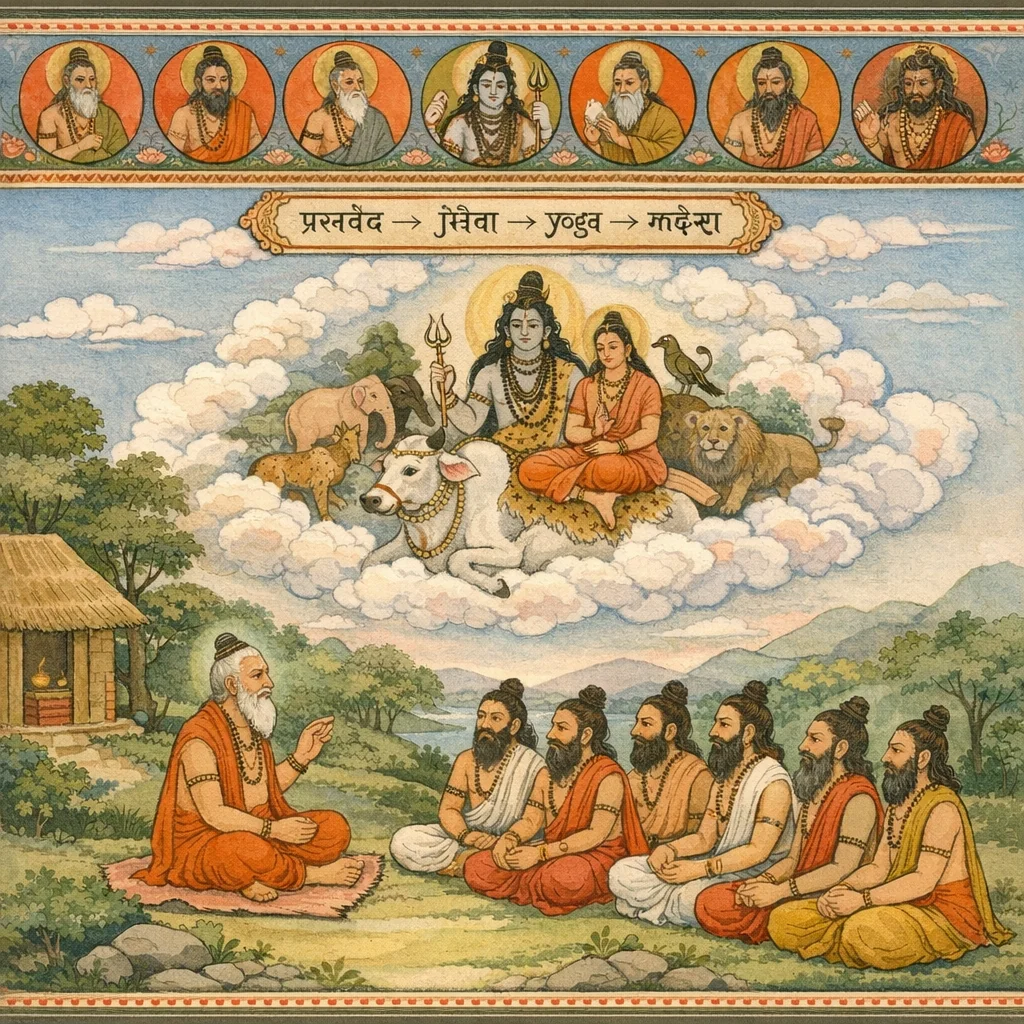
Sūta discloses a “rahasya” of Śaṅkara’s primordial greatness: even when yogins possess aṣṭa-sādhana (prāṇāyāma and the like) and virtues such as compassion, karmic action still yields svarga or naraka. The decisive teaching is the sequence “prasāda → jñāna → yoga → mokṣa,” declaring Śiva’s grace to be the true engine of liberation. The ṛṣis ask how the thought-free (cintā-rahita) Śiva bestows prasāda and at what point it arises on the yogic path. Romaharṣaṇa answers through lineage and cosmic time, listing Vyāsa avatāras across successive Dvāpara cycles and Rudra’s yogācārya avatāras in Kali, along with their disciples in “all cycles” (sarvāvarteṣu). The chapter also enumerates the manvantaras within the Varāha Kalpa and concludes by defining all beings as paśu and Śiva as Paśupati, establishing Pāśupata Yoga as Rudra’s revealed means to attain higher and lower powers and, ultimately, mokṣa—preparing the ground for later teaching on grace, initiation, and Śaiva yogic discipline.
Shlokas
Verse 1
सूत उवाच रहस्यं वः प्रवक्ष्यामि भवस्यामिततेजसः प्रभावं शंकरस्याद्यं संक्षेपात्सर्वदर्शिनः
Sūta said: I shall reveal to you the secret—briefly—the primordial majesty of Śaṅkara, the all-seeing Lord Bhava of immeasurable splendor.
Verse 2
योगिनः सर्वतत्त्वज्ञाः परं वैराग्यमास्थिताः
The yogins—knowers of all tattvas—abide in supreme dispassion, having turned away from pāśa (bondage) and resting in orientation toward Pati, the Supreme Lord.
Verse 3
प्राणायामादिभिश्चाष्टसाधनैः सहचारिणः
Accompanied by the eight disciplines—beginning with prāṇāyāma—they proceed as steadfast companions on the Pāśupata path toward Pati (Śiva), the liberator who frees the bound soul (paśu) from the fetter (pāśa).
Verse 4
करुणादिगुणोपेताः कृत्वापि विविधानि ते कर्माणि नरकं स्वर्गं गच्छन्त्येव स्वकर्मणा
Even those endowed with compassion and other virtues, after performing many kinds of deeds, still go to hell or to heaven—driven indeed by their own karma. Thus the bound soul (paśu), under the force of pāśa as karmic bondage, revolves in its results until it turns toward Pati, Śiva, the liberator.
Verse 5
प्रसादाज्जायते ज्ञानं ज्ञानाद्योगः प्रवर्तते योगेन जायते मुक्तिः प्रसादादखिलं ततः
From Śiva’s grace (prasāda) arises true knowledge; from knowledge, Yoga is set in motion. Through Yoga liberation is born; thus, in the end, everything proceeds from grace alone.
Verse 6
ऋषय ऊचुः प्रसादाद् यदि विज्ञानं स्वरूपं वक्तुमर्हसि दिव्यं माहेश्वरं चैव योगं योगविदां वर
The sages said: “Out of grace, if you deem it fit to speak, please explain the true nature of divine knowledge—the essential reality of Mahēśvara—and also that Māheśvara Yoga, O best among the knowers of Yoga.”
Verse 7
कथं करोति भगवान् चिन्तया रहितः शिवः प्रसादं योगमार्गेण कस्मिन्काले नृणां विभुः
How does the Blessed Lord Śiva—free from all mental constructions—bestow His grace upon human beings through the path of Yoga, and at what time does that all-pervading Master grant it?
Verse 8
रोमहर्षण उवाच देवानां च ऋषीणां च पितॄणां संनिधौ पुरा शैलादिना तु कथितं शृण्वन्तु ब्रह्मसूनवे
Romaharṣaṇa said: Formerly, in the presence of the Devas, the Ṛṣis, and the Pitṛs, this was proclaimed by Śailādi. Now let it be heard for the sake of Brahmā’s son.
Verse 9
व्यासावताराणि तथा द्वापरान्ते च सुव्रताः योगाचार्यावताराणि तथा तिष्ये तु शूलिनः
At the close of the Dvāpara age, O noble-vowed ones, he manifests as the Vyāsa-incarnations; and in the period of Tiṣya as well, the Trident-bearing Lord (Śiva) appears as incarnations of the Yoga-teachers, guiding bound souls (paśus) through discipline toward the Lord (Pati).
Verse 10
तत्रतत्र विभोः शिष्याश् चत्वारः शमभाजनाः प्रशिष्या बहवस्तेषां प्रसीदत्येवमीश्वरः
Here and there, the all-pervading Lord has four disciples—fit vessels of śama (inner restraint). From them arise many sub-disciples; in this very way the Lord (Pati), Īśvara, becomes gracious.
Verse 11
एवं क्रमागतं ज्ञानं मुखादेव नृणां विभोः वैश्यान्तं ब्राह्मणाद्यं हि घृणया चानुरूपतः
Thus, the sacred knowledge—handed down in due succession—issued from the very mouth of the Lord, the Sovereign of beings. Beginning with the Brāhmaṇa and extending down to the Vaiśya, it was imparted in a manner suited to each, according to the measure of restraint and compassion that governs right instruction.
Verse 12
ऋषय ऊचुः द्वापरे द्वापरे व्यासाः के वै कुत्रान्तरेषु वै कल्पेषु कस्मिन्कल्पे नो वक्तुमर्हसि चात्र तान्
The sages said: “In each Dvāpara age, who indeed are the Vyāsas? And in which Manvantaras, in which Kalpas, and in what specific Kalpa do they appear? You are worthy to tell us of them here—please describe them.”
Verse 13
सूत उवाच शृण्वन्तु कल्पे वाराहे द्विजा वैवस्वतान्तरे व्यासांश् च साम्प्रतं रुद्रांस् तथा सर्वान्तरेषु वै
Sūta said: “O twice-born sages, listen—within the Varāha Kalpa, in the present Vaivasvata Manvantara, I shall now recount the Vyasas and the Rudras, and likewise those in all the other Manvantaras as well.”
Verse 14
वेदानां च पुराणानां तथा ज्ञानप्रदर्शकान् यथाक्रमं प्रवक्ष्यामि सर्वावर्तेषु साम्प्रतम्
Now I shall explain, in due order, the Vedas and the Purāṇas as well—those scriptures that illuminate true knowledge—according to the proper sequence, as it is presently taught in all traditions.
Verse 15
क्रतुः सत्यो भार्गवश् च अङ्गिराः सविता द्विजाः मृत्युः शतक्रतुर्धीमान् वसिष्ठो मुनिपुंगवः
He is Kratu (the power of sacrificial rite), Satya (Truth itself), Bhārgava, and Aṅgiras; He is Savitṛ (the impeller of all beings) and the Dvija (the twice-born, the inner awakening). He is Mṛtyu (Death that ends all), Śatakratu (the lord of a hundred sacrifices), Dhīmān (the supremely intelligent), Vasiṣṭha, and the foremost among sages.
Verse 16
सारस्वतस्त्रिधामा च त्रिवृतो मुनिपुंगवः शततेजाः स्वयंधर्मो नारायण इति श्रुतः
He is known as Sārasvata (lord of sacred wisdom), as Tridhāman (whose radiance abides in the three realms), and as Trivṛta (present as the threefold principle). He is the foremost among sages, blazing with a hundredfold splendor; He is Dharma itself, self-arisen. He is also heard of as Nārāyaṇa—showing the one Pati (Śiva) who appears through many divine names.
Verse 17
तरक्षुश्चारुणिर्धीमांस् तथा देवः कृतंजयः ऋतंजयो भरद्वाजो गौतमः कविसत्तमः
Also (there were) Tarakṣu, Cāruṇi the wise, Deva, Kṛtaṃjaya, Ṛtaṃjaya, Bharadvāja, Gautama, and Kavisattama—the foremost of seers. All were eminent knowers aligned to the path where Pati (Śiva) is realized and the Pāśa of bondage is cut for the sake of the Pāśu (the soul).
Verse 18
वाचश्रवा मुनिः साक्षात् तथा शुष्मायणिः शुचिः तृणबिन्दुर् मुनी रूक्षः शक्तिः शाक्तेय उत्तरः
There were the sage Vācaśravā, manifest in his very presence; likewise the pure Śuṣmāyaṇi; the austere sage Tṛṇabindu; and Śakti—known as Śākteya—who was eminent among the later teachers in this lineage.
Verse 19
जातूकर्ण्यो हरिः साक्षात् कृष्णद्वैपायनो मुनिः व्यासास्त्वेते च शृण्वन्तु कलौ योगेश्वरान् क्रमात्
Jātūkarṇya—Hari himself in visible form—and the sage Kṛṣṇadvaipāyana, the Vyāsa: let these too be heard of, in due order, in the Kali age as Yogic Lords (yogeśvaras).
Verse 20
असंख्याता हि कल्पेषु विभोः सर्वान्तरेषु च कलौ रुद्रावताराणां व्यासानां किल गौरवात्
Indeed, across countless kalpas—and in every manvantara of the all-pervading Lord—there are innumerable descents of Rudra and innumerable Vyasas as well, for their greatness is beyond measure.
Verse 21
वैवस्वतान्तरे कल्पे वाराहे ये च तान् पुनः अवतारान् प्रवक्ष्यामि तथा सर्वान्तरेषु वै
In the Vaivasvata Manvantara, within the Varāha Kalpa, I shall again set forth those manifestations (avatāras); and likewise, indeed, in all the other Manvantaras as well.
Verse 22
ऋषय ऊचुः मन्वन्तराणि वाराहे वक्तुमर्हसि साम्प्रतम् तथैव चोर्ध्वकल्पेषु सिद्धान्वैवस्वतान्तरे
The sages said: “O Varāha, you should now describe the Manvantaras to us—likewise the accomplished orders of Siddhas in the higher kalpas, and those that arise within the Vaivasvata Manvantara.”
Verse 23
रोमहर्षण उवाच मनुः स्वायम्भुवस्त्वाद्यस् ततः स्वारोचिषो द्विजाः उत्तमस्तामसश्चैव रैवताश्चाक्षुषस् तथा
Romaharṣaṇa said: “The first Manu is Svāyambhuva; after him, O twice-born sages, comes Svārociṣa. Then follow Uttama, Tāmasa, also Raivata, and likewise Cākṣuṣa.”
Verse 24
वैवस्वतश् च सावर्णिर् धर्मः सावर्णिकः पुनः पिशङ्गश्चापिशङ्गाभः शबलो वर्णकस् तथा
And (there are) Vaivasvata and Sāvarṇi; also Dharma and again Sāvarṇika; Piśaṅga and Piśaṅgābha; Śabala and likewise Varṇaka.
Verse 25
औकारान्ता अकाराद्या मनवः परिकीर्तिताः श्वेतः पाण्डुस् तथा रक्तस् ताम्रः पीतश्च कापिलः
The Manus are declared to be arranged in order, from those beginning with ‘a’ up to those ending in ‘o’. They are described as: the White, the Pale, the Red, the Copper-hued, the Yellow, and the Tawny-brown (Kapila).
Verse 26
कृष्णः श्यामस् तथा धूम्रः सुधूम्रश् च द्विजोत्तमाः अपिशङ्गः पिशङ्गश् च त्रिवर्णः शबलस् तथा
O best of the twice-born, (the Lord) is praised as Kṛṣṇa, Śyāma, Dhūmra and Sudhūmra; as Apiśaṅga and Piśaṅga; and also as Trivarṇa and Śabala—names that indicate the Lord (Pati) manifesting diverse hues and forms, while remaining the one transcendent Śiva beyond all qualities.
Verse 27
कालंधुरस्तु कथिता वर्णतो मनवः शुभाः नामतो वर्णतश्चैव वर्णतः पुनरेव च
Thus Kālaṃdhura has been described. The auspicious Manus are also set forth—by their class and by their names, and again by their classification.
Verse 28
स्वरात्मानः समाख्याताश् चान्तरेशाः समासतः वैवस्वत ऋकारस्तु मनुः कृष्णः सुरेश्वरः
Thus, in brief, the self-luminous inner governors (antareśas) have been declared. Among them, Vaivasvata—whose very essence is the Ṛk (Vedic hymn)—is Manu, Kṛṣṇa, and the Lord of the Devas; as the indwelling ruler he upholds order within beings.
Verse 29
सप्तमस्तस्य वक्ष्यामि युगावर्तेषु योगिनः समतीतेषु कल्पेषु तथा चानागतेषु वै
Now I shall declare the seventh of his Yogic manifestations—how that Yogi (Śiva, the Pati) appears at the turning of the Yugas, in kalpas that have already passed and likewise in those yet to come.
Verse 30
वाराहः साम्प्रतं ज्ञेयः सप्तमान्तरतः क्रमात् योगावतारांश् च विभोः शिष्याणां संततिस् तथा
Know that, in the present sequence, the Lord’s manifestation is to be understood as Varāha (the boar-form), in due order within the seventh cycle (of Manvantaras). Likewise, one should understand the Yogic descents of the all-pervading Lord (Śiva) and also the successive lineages of His disciples.
Verse 31
सम्प्रेक्ष्य सर्वकालेषु तथावर्तेषु योगिनाम् आद्ये श्वेतः कलौ रुद्रः सुतारो मदनस् तथा
Observing the course of all times and the recurring cycles of the yogins, the Lord manifests in distinct forms: in the first age as Śveta; in the Kali age as Rudra; and likewise as Sutāra and Madana.
Verse 32
सुहोत्रः कङ्कणश्चैव लोकाक्षिर् मुनिसत्तमाः जैगीषव्यो महातेजा भगवान् दधिवाहनः
“(There were) Suhotra and Kaṅkaṇa; Lokākṣi—those foremost among sages; and Jaigīṣavya of great splendor; and the venerable Dadhivāhana.”
Verse 33
ऋषभश् च मुनिर्धीमान् उग्रश्चात्रिः सुबालकः गौतमश्चाथ भगवान् सर्वदेवनमस्कृतः
Also there were Ṛṣabha, the wise sage; Ugra; Atri; Subālaka; and Gautama—the venerable one whom all the gods bow to in reverent salutation.
Verse 34
वेदशीर्षश् च गोकर्णो गुहावासी शिखण्डभृत् जटामाल्यट्टहासश् च दारुको लाङ्गली तथा
He is the One whose crown is the Veda itself; the Lord called Gokarṇa; the Cave-dweller; the Bearer of the peacock-plume; the One adorned with a garland of matted locks; the Lord of resounding, liberating laughter; also named Dāruka; and the Wielder of the plough—thus is Pati, Śiva, praised by these names.
Verse 35
महाकायमुनिः शूली दण्डी मुण्डीश्वरः स्वयम् सहिष्णुः सोमशर्मा च नकुलीशो जगद्गुरुः
He is Mahākāyamuni, the great-bodied sage; Śūlī, bearer of the trident; Daṇḍī, the staff-bearing ascetic; Muṇḍīśvara, the Lord in the guise of the shaven-headed renunciant; Svayam, the Self-existent. He is Sahiṣṇu, ever-forbearing; Somaśarmā, the auspicious one linked with Soma; and Nakulīśa, the World-Teacher—Pati who leads the paśu beyond the pāśa, past all bondage.
Verse 36
वैवस्वते ऽन्तरे सम्यक् प्रोक्ता हि परमात्मनः योगाचार्यावतारा ये सर्वावर्तेषु सुव्रताः
In the Vaivasvata Manvantara, the incarnations of the Supreme Self as Yoga-teachers have indeed been rightly declared—disciplined masters of pure vows who appear in every cycle, upholding sacred conduct.
Verse 37
व्यासाश्चैवं मुनिश्रेष्ठा द्वापरे द्वापरे त्विमे योगेश्वराणां चत्वारः शिष्याः प्रत्येकमव्ययाः
Thus, O best of sages, in each Dvāpara age these Vyāsas appear; and for the Yogīśvaras there are four disciples—each, in his own lineage, an unfailing bearer of that imperishable Śaiva transmission.
Verse 38
श्वेतः श्वेतशिखण्डी च श्वेताश्वः श्वेतलोहितः दुन्दुभिः शतरूपश् च ऋचीकः केतुमांस् तथा
The Lord (Pati) is remembered by these names: the White One—pure and stainless; He of the white crest; He whose steed is white; He who is white with a ruddy sheen; He who resounds like the sacred drum; He of a hundred forms; He who is praised through Ṛk-mantras; and He who bears the radiant banner.
Verse 39
विशोकश्च विकेशश् च विपाशः पापनाशनः सुमुखो दुर्मुखश्चैव दुर्दमो दुरतिक्रमः
He is Viśoka, the Sorrowless, and Vikeśa, the Unshorn; He is Vipāśa, beyond bonds, the Destroyer of sin (Pāpanāśana). He is Sumukha, fair-faced, and also Durmukha, terrible-faced; He is Durdama, unsubduable, and Duratikrama, whom none can overstep.
Verse 40
सनकश् च सनन्दश् च प्रभुर्यश् च सनातनः ऋभुः सनत्कुमारश् च सुधामा विरजास् तथा
Sanaka and Sanandana, Prabhu and Sanātana; Ṛbhu and Sanatkumāra, as well as Sudhāmā and Virajā—these revered sages are counted as bearers of the Śaiva stream of knowledge, inclined to the path that leads the paśu (individual soul) beyond pāśa (bondage) to the realization of Pati (Lord Śiva).
Verse 41
शङ्खपाद् वैरजश्चैव मेघः सारस्वतस् तथा सुवाहनो मुनिश्रेष्ठो मेघवाहो महाद्युतिः
Śaṅkhapāda, Vairaja, Megha, and Sārasvata; likewise Suvāhana—the foremost among sages—together with Meghavāha of great splendor: these are named as eminent beings within the auspicious retinue and sacred order connected to the Lord (Pati), whose presence supports the unfolding of Śiva’s cosmic work.
Verse 42
कपिलश्चासुरिश्चैव तथा पञ्चशिखो मुनिः वाल्कलश् च महायोगी धर्मात्मानो महौजसः
Kapila and Āsuri, and likewise the sage Pañcaśikha; and Vālkala too—the great yogin—were all righteous-souled and of mighty spiritual brilliance, standing in the Śaiva current that leads the bound soul (paśu) toward the Lord (Pati).
Verse 43
पराशरश् च गर्गश् च भार्गवश्चाङ्गिरास् तथा बलबन्धुर् निरामित्रः केतुशृङ्गस्तपोधनः
And (there were) Parāśara, Garga, Bhārgava, and likewise Āṅgiras; also Balabandhu, Nirāmitra, and Ketuśṛṅga—these are the tapodhanas, ascetics rich in the treasure of austerity, who uphold the Śaiva path and its liberating discipline.
Verse 44
लम्बोदरश् च लम्बश्च लम्बाक्षो लम्बकेशकः सर्वज्ञः समबुद्धिश् च साध्यः सर्वस्तथैव च
He is Lambodara, the Pot-bellied One; Lamba, the Vast and Lofty One; Lambākṣa, the Long‑eyed Lord; and Lambakeśaka, He whose hair flows long. He is Sarvajña, the All‑knowing; Samabuddhi, equal‑minded toward all beings; Sādhya, the One to be realized through disciplined practice; and Sarva, the All‑pervading Pati who is everything.
Verse 45
सुधामा काश्यपश्चैव वासिष्ठो विरजास् तथा अत्रिर् देवसदश्चैव श्रवणो ऽथ श्रविष्ठकः कुणिश् च कुणिबाहुश् च कुशरीरः कुनेत्रकः
Sūta said: “Also (among them were) Sudhāmā, Kāśyapa, Vāsiṣṭha, and Virajā; likewise Atri and Devasada; then Śravaṇa and Śraviṣṭhaka; Kuṇi and Kuṇibāhu; Kuśarīra and Kunetraka.” Thus the lineages are enumerated in the unfolding of creation under the Lord (Pati), as the paśu (bound soul) enters embodied existence through the ordered streams of progenitors.
Verse 46
कश्यपो ऽप्युशनाश्चैव च्यवनो ऽथ बृहस्पतिः उतथ्यो वामदेवश् च महायोगो महाबलः
Kāśyapa, Uśanas (Śukra), Cyavana, and Bṛhaspati; likewise Utathya and Vāmadeva—these great sages, mighty in strength, were exalted Mahāyogins, established in the supreme discipline that leads the bound soul (paśu) toward the Lord (Pati).
Verse 47
वाचश्रवाः सुधीकश्च श्यावाश्वश् च यतीश्वरः हिरण्यनाभः कौशल्यो लोगाक्षिः कुथुमिस् तथा
Vācaśravā, Sudhīka, Śyāvāśva, and Yatīśvara; Hiraṇyanābha, Kauśalya, Logākṣi, and likewise Kuthumi—these are revered seers in the Śaiva current, sustaining the transmission of Pati‑knowledge that frees the paśu (bound soul) from pāśa (bondage).
Verse 48
सुमन्तुर्बर्बरी विद्वान् कबन्धः कुशिकंधरः प्लक्षो दाल्भ्यायणिश्चैव केतुमान् गोपनस् तथा
Sumantu; Barbarī the learned; Kabandha; Kuśikandhara; Plakṣa; and also Dālbhyāyaṇi—together with Ketumān and Gopana—these are the revered transmitters in the sacred succession of knowledge.
Verse 49
भल्लावी मधुपिङ्गश्च श्वेतकेतुस्तपोनिधिः उशिको बृहदश्वश् च देवलः कविरेव च
Bhallāvī, Madhupiṅga, Śvetaketu—an ocean of austerity—Uśika, Bṛhadaśva, Devala, and Kavi as well: these revered seers are remembered here as part of the sacred succession that preserves the Shaiva vision, wherein the Pati (Lord Śiva) is realized through tapas, discipline, and transmitted wisdom.
Verse 50
शालिहोत्रो ऽग्निवेशश्च युवनाश्वः शरद्वसुः छगलः कुण्डकर्णश् च कुम्भश्चैव प्रवाहकः
Śālihotra, Agniveśa, Yuvanāśva, Śaradvasu, Chagala, Kuṇḍakarṇa, Kumbha, and Pravāhaka—these are (also) counted among the revered names in the lineage of Shiva’s yogic manifestations, by whose discipline the bound soul (paśu) is guided toward the Lord (Pati).
Verse 51
उलूको विद्युतश्चैव मण्डूको ह्याश्वलायनः अक्षपादः कुमारश् च उलूको वत्स एव च
Ulūka, Vidyuta, Maṇḍūka, and also Āśvalāyana; Akṣapāda and Kumāra—likewise Ulūka and Vatsa as well: these are the named transmitters in the sacred succession through which this Shaiva teaching is preserved.
Verse 52
कुशिकश्चैव गर्भश् च मित्रः कौरुष्य एव च शिष्यास्त्वेते महात्मानः सर्वावर्तेषु योगिनाम्
Kushika, Garbha, Mitra, and Kaurushya—these great-souled ones are the disciples (in the Shaiva current), established in every cycle among the yogins, preserving the stream of Pashupata-yoga across the ages.
Verse 53
विमला ब्रह्मभूयिष्ठा ज्ञानयोगपरायणाः एते पाशुपताः सिद्धा भस्मोद्धूलितविग्रहाः
Pure and stainless, established in Brahman, devoted to the Yoga of liberating knowledge—these are the accomplished Pāśupatas, their bodies dusted with sacred ash (bhasma).
Verse 54
शिष्याः प्रशिष्याश्चैतेषां शतशो ऽथ सहस्रशः प्राप्य पाशुपतं योगं रुद्रलोकाय संस्थिताः
Their disciples and grand-disciples—by the hundreds and even by the thousands—attained the Pāśupata Yoga; established in that realization, they became fit for Rudra’s world (Rudraloka).
Verse 55
देवादयः पिशाचान्ताः पशवः परिकीर्तिताः तेषां पतित्वात्सर्वेशो भवः पशुपतिः स्मृतः
From the gods onward, down to the piśācas, all embodied beings are taught to be paśus—souls under bondage. Because he is their Lord and Master, the all-ruling Bhava is remembered as Paśupati, the Lord of the bound souls.
Verse 56
तेन प्रणीतो रुद्रेण पशूनां पतिना द्विजाः योगः पाशुपतो ज्ञेयः परावरविभूतये
O twice-born ones, know that the Pāśupata Yoga—propounded by Rudra, the Pati, Lord of all paśus—should be understood for attaining both lower and higher powers, culminating in sovereignty over the worldly and the transcendent.
Frequently Asked Questions
It gives a direct causal ladder: from Śiva’s prasāda arises jñāna; from jñāna yoga becomes operative; through yoga mokṣa is attained—making grace the initiating principle of liberation.
Pāśupata Yoga is taught as Rudra’s revealed yogic path for the uplift of beings; since devas through piśācas and all creatures are termed ‘paśu’ (bound beings), Śiva is ‘Paśupati’ (Lord of paśus), and the yoga promulgated by him is therefore Pāśupata.
To authenticate Śaiva knowledge as an unbroken, cyclically renewed transmission: Vyāsa preserves revelation in Dvāpara, while Rudra manifests yogācāryas in Kali—together grounding practice in Purāṇic paramparā across yugas and kalpas.