Adhyaya 63
Adhyaya 63: Daksha’s Progeny, Kashyapa’s Offspring, and the Rishi-Vamshas that Sustain the Worlds
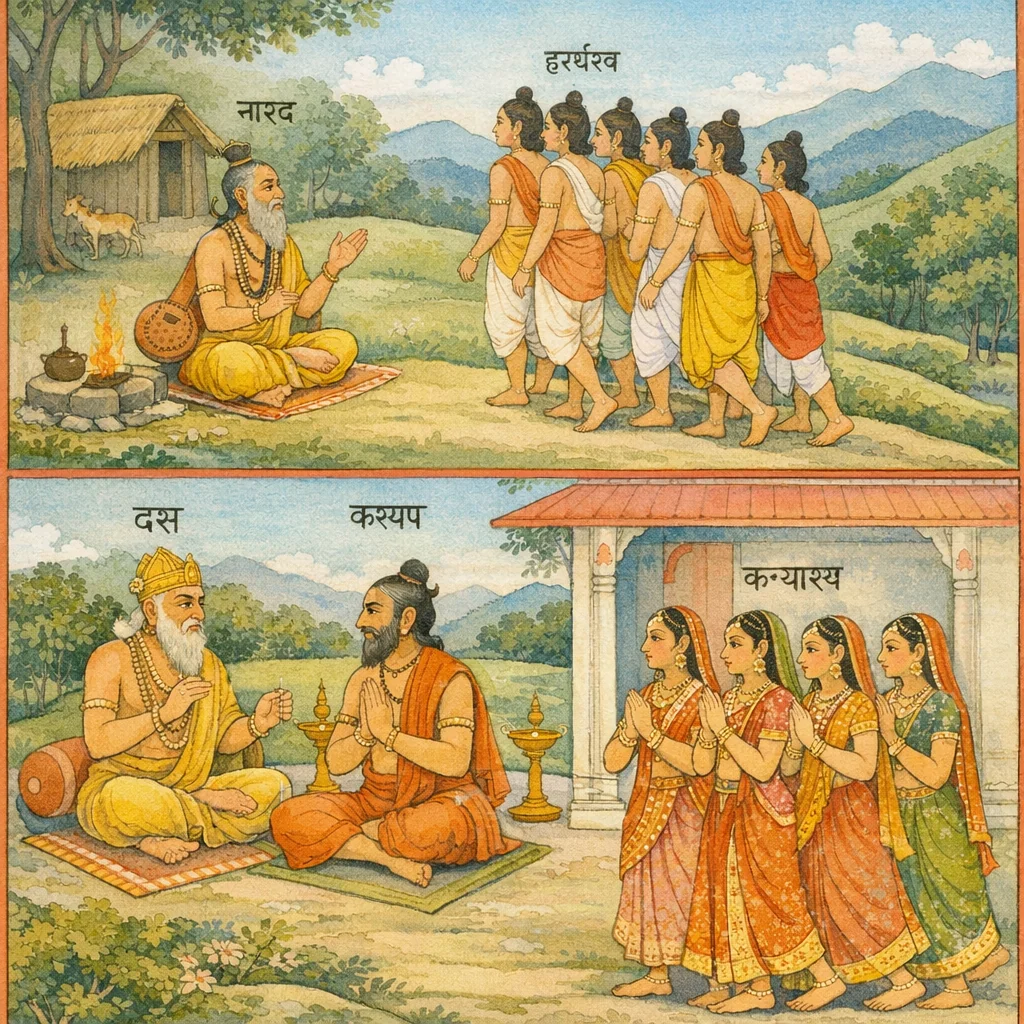
In response to the sages, Sūta describes the successive modes of creation, stressing that after Dakṣa the increase of beings becomes chiefly maithunī—through sexual union. Nārada’s counsel leads Dakṣa’s first two sets of sons (the Haryaśvas and the Śabalas) to disperse and never return, so Dakṣa produces sixty daughters and gives them in marriage to Dharma, Kaśyapa, Soma, Ariṣṭanemi, Bhṛgu’s son, Kṛśāśva, and Aṅgiras. From these unions arise the Viśvedevās, Sādhyas, Maruts, the eight Vasus (named), and the eleven Rudras (named). The account then turns to Kaśyapa’s wives and their progeny—Ādityas, Daityas (including Hiraṇyakaśipu and Hiraṇyākṣa), Dānavas, birds and beasts, Garuḍa and Aruṇa, nāgas with renowned chiefs, rākṣasas, yakṣas, gandharvas, apsarases, and vegetation. It proceeds to the great rishi lineages: Pulastya to Viśravas and the rākṣasa dynasties; Atri’s line with Soma, Dattātreya, and Durvāsā; and Vasiṣṭha’s line leading to Parāśara, Vyāsa, and Śuka. The chapter concludes that these vast families pervade the three worlds like the sun’s rays, preparing the continuity of later dharma teachings and Śiva-centered liberation.
Shlokas
Verse 1
इति श्रीलिङ्गमहापुराणे पूर्वभागे भुवनकोशे ध्रुवसंस्थानवर्णनं नाम द्विषष्टितमो ऽध्यायः ऋषय ऊचुः देवानां दानवानां च गन्धर्वोरगरक्षसाम् उत्पत्तिं ब्रूहि सूताद्य यथाक्रममनुत्तमम्
Thus, in the Śrī Liṅga Mahāpurāṇa, in the Pūrva-bhāga, within the section on the cosmic spheres (Bhuvanakośa), begins the sixty-third chapter entitled “Description of the Dhruva Abode.” The sages said: “O Sūta, now tell us—supremely and in proper sequence—the origin of the Devas, the Dānavas, the Gandharvas, the Nāgas, and the Rākṣasas.”
Verse 2
सूत उवाच संकल्पाद्दर्शनात्स्पर्शात् पूर्वेषां सृष्टिरुच्यते दक्षात्प्राचेतसादूर्ध्वं सृष्टिर्मैथुनसंभवा
Sūta said: The creation of the earliest beings is said to arise through mere intention (saṅkalpa), through sight, and through touch. But from Dakṣa, the son of Prācetasa, onward, creation proceeds through sexual union (maithuna).
Verse 3
यदा तु सृजतस्तस्य देवर्षिगणपन्नगान् न वृद्धिमगमल्लोकस् तदा मैथुनयोगतः
But when, even as he was creating the Devas, the divine seers, the hosts of beings, and the serpents, the worlds did not attain increase, then he resorted to the discipline of union (maithuna-yoga) for the sake of progeny-expansion.
Verse 4
दक्षः पुत्रसहस्राणि पञ्च सूत्यामजीजनत् तांस्तु दृष्ट्वा महाभागान् सिसृक्षुर्विविधाः प्रजाः
Dakṣa begot five thousand sons through Sūti. Seeing those highly fortunate sons, he desired to bring forth the many varieties of beings, thus setting the current of creation in motion under the Lord (Pati) who empowers all manifestation.
Verse 5
नारदः प्राह हर्यश्वान् दक्षपुत्रान् समागतान् भुवः प्रमाणं सर्वं तु ज्ञात्वोर्ध्वमध एव च
Nārada spoke to the assembled Haryaśvas, the sons of Dakṣa: “Know in full the measure of the worlds—what is above and what is below.”
Verse 6
ततः सृष्टिं विशेषेण कुरुध्वं मुनिसत्तमाः ते तु तद्वचनं श्रुत्वा प्रयाताः सर्वतोदिशम्
Then (the Lord) said: “O best of sages, proceed to manifest creation in its particular forms.” Having heard that command, they set forth in every direction to carry out the work of emanation.
Verse 7
अद्यापि न निवर्तन्ते समुद्रादिव सिन्धवः हर्यश्वेषु च नष्टेषु पुनर्दक्षः प्रजापतिः
Even today they do not return—like rivers that flow on into the ocean. And when the Haryaśvas had vanished, Dakṣa the Prajāpati once again set himself to the work of generating beings.
Verse 8
सूत्यामेव च पुत्राणां सहस्रमसृजत्प्रभुः शबला नाम ते विप्राः समेताः सृष्टिहेतवः
In that very act of bringing forth offspring, the Lord created a thousand sons. Those Brahmin seers, known as the Śabalas, united together, became instruments for the unfolding of creation.
Verse 9
नारदो ऽनुगतान्प्राह पुनस्तान्सूर्यवर्चसः भुवः प्रमाणं सर्वं तु ज्ञात्वा भ्रातॄन् पुनः पुनः
Nārada then spoke again to those radiant ones who followed him: “Having understood in full the measure and order of all the worlds, go repeatedly to your brothers and make it known to them.”
Verse 10
आगत्य वाथ सृष्टिं वै करिष्यथ विशेषतः ते ऽपि तेनैव मार्गेण जग्मुर्भ्रातृगतिं तथा
“Return, and then accomplish the work of creation in a special and orderly way.” Thus instructed, they too departed by that very path, attaining the same course as their brother.
Verse 11
ततस्तेष्वपि नष्टेषु षष्टिकन्याः प्रजापतिः वैरिण्यां जनयामास दक्षः प्राचेतसस्तदा
Then, even after those (daughters) had perished, the Prajāpati Dakṣa—son of the Pracetas—again begot sixty daughters through Vairiṇī, so that the stream of creation might continue.
Verse 12
प्रादात्स दशकं धर्मे कश्यपाय त्रयोदश विंशत्सप्त च सोमाय चतस्रो ऽरिष्टनेमये
He then bestowed ten (offerings) for Dharma, thirteen to Kaśyapa, twenty-seven to Soma, and four to Ariṣṭanemi—distributing these gifts as bhakti, loosening the pāśa-bonds of the pashu and turning the mind toward Pati, Śiva.
Verse 13
द्वे चैव भृगुपुत्राय द्वे कृशाश्वाय धीमते द्वे चैवाङ्गिरसे तद्वत् तासां नामानि विस्तरात्
Two (daughters) were given to the son of Bhṛgu, two to the wise Kṛśāśva, and likewise two to Aṅgiras. Now their names are to be set forth in detail.
Verse 14
शृणुध्वं देवमातॄणां प्रजाविस्तारमादितः मरुत्वती वसूर् यामिर् लम्बा भानुररुन्धती
“Listen, from the beginning, to the unfolding of the progeny of the Devamātṛs (divine mothers): Marutvatī, Vasū, Yāmī, Lambā, Bhānū, and Arundhatī.”
Verse 15
संकल्पा च मुहूर्ता च साध्या विश्वा च भामिनी धर्मपत्न्यः समाख्यातास् तासां पुत्रान्वदामि वः
Saṅkalpā, Muhūrtā, Sādhyā, Viśvā, and Bhāminī are proclaimed as the lawful wives of Dharma. Now I shall tell you of their sons.
Verse 16
विश्वेदेवास्तु विश्वायाः साध्या साध्यानजीजनत् मरुत्वत्यां मरुत्वन्तो वसोस्तु वसवस् तथा
From Viśvā arose the Viśvedevās; from Sādhyā were born the Sādhyas. From Marutvatī came the Maruts; and from Vasu, the Vasus likewise—thus the divine hosts were manifested in the course of creation, all functioning under the Lord (Pati) who ordains the cosmic order.
Verse 17
भानोस्तु भानवः प्रोक्ता मुहूर्ताया मुहूर्तकाः लम्बाया घोषनामानो नागवीथिस्तु यामिजः
For Bhānu, the attendants are declared to be the Bhānavas; for Muhūrtā, the Muhūrtakas. For Lambā, those named Ghoṣa; and for Nāgavīthī, the Yāmijas—deities born of, and presiding over, the divisions of time.
Verse 18
संकल्पायास्तु संकल्पो वसुसर्गं वदामि वः ज्योतिष्मन्तस्तु ये देवा व्यापकाः सर्वतोदिशम्
From Saṅkalpā there arose Saṅkalpa. I shall now declare to you the creation of the Vasus—those radiant Devas who pervade all directions on every side.
Verse 19
वसवस्ते समाख्याताः सर्वभूतहितैषिणः आपो ध्रुवश् च सोमश् च धरश्चैवानिलो ऽनलः
Thus the Vasus have been declared—those who ever seek the welfare of all beings: Āpa (Waters), Dhruva (the Steadfast/Polar), Soma (the Moon), Dhara (the Supporter/Earth), Anila (Wind), and Anala (Fire).
Verse 20
प्रत्यूषश् च प्रभासश् च वसवो ऽष्टौ प्रकीर्तिताः अजैकपाद् अहिर्बुध्न्यो विरूपाक्षः सभैरवः
Pratyūṣa and Prabhāsa are proclaimed among the eight Vasus. Likewise Ajaikapād, Ahirbudhnya, Virūpākṣa, and the awe-inspiring Bhairava are counted in the host of Rudras—divine powers that act under Pati (Śiva) within the cosmic order.
Verse 21
हरश् च बहुरूपश् च त्र्यंबकश् च सुरेश्वरः सावित्रश् च जयन्तश् च पिनाकी चापराजितः
He is Hara, the Remover of bondage; Bahurūpa, the One of countless forms; Tryambaka, the Three‑eyed Lord; and Sureśvara, the Sovereign of the gods. He is Sāvitra, the inner power of Sāvitrī (Gāyatrī) and the Vedic rite; Jayanta, the Ever‑Victorious; Pinākī, Bearer of the bow Pināka; and Aparājita, the Unconquered Pati whom no pasha can overcome.
Verse 22
एते रुद्राः समाख्याता एकादश गणेश्वराः कश्यपस्य प्रवक्ष्यामि पत्नीभ्यः पुत्रपौत्रकम्
Thus the Rudras have been declared—eleven lords of the gaṇas. Now I shall expound the lineage of Kaśyapa: the sons and grandsons born to him through his wives.
Verse 23
अदितिश् च दितिश्चैव अरिष्टा सुरसा मुनिः सुरभिर् विनता ताम्रा तद्वत् क्रोधवशा इला
Aditi and Diti indeed; likewise Ariṣṭā, Surasā, Muni, Surabhi, Vinatā, and Tāmrā; and in the same manner Krodhavaśā and Ilā—these are proclaimed among the progenitresses in the unfolding of creation.
Verse 24
कद्रूस्त्विषा दनुस्तद्वत् तासां पुत्रान्वदामि वः तुषिता नाम ये देवाश् चाक्षुषस्यान्तरे मनोः
Kadrū, Tviṣā, and likewise Danu—now I shall tell you of their offspring. The Devas known as the Tuṣitas manifested in the Manvantara of Cākṣuṣa Manu.
Verse 25
वैवस्वतान्तरे ते वै आदित्या द्वादश स्मृताः इन्द्रो धाता भगस्त्वष्ट मित्रो ऽथ वरुणो ऽर्यमा
In the Vaivasvata Manvantara, these are remembered as the Twelve Ādityas—Indra, Dhātṛ, Bhaga, Tvaṣṭṛ, Mitra, Varuṇa, and Aryaman.
Verse 26
विवस्वान्सविता पूषा अंशुमान् विष्णुरेव च एते सहस्रकिरणा आदित्या द्वादश स्मृताः
Vivasvān, Savitṛ, Pūṣan, Aṃśumān, and Viṣṇu as well—these thousand-rayed ones are remembered as the Twelve Ādityas. In the Śaiva vision, their radiance functions within the Lord’s cosmic order (Pati), while bound souls (paśu) experience that light through the limitations of bondage (pāśa).
Verse 27
दितिः पुत्रद्वयं लेभे कश्यपादिति नः श्रुतम् हिरण्यकशिपुं चैव हिरण्याक्षं तथैव च
We have heard that Diti bore two sons by Kaśyapa—namely Hiraṇyakaśipu and likewise Hiraṇyākṣa.
Verse 28
दनुः पुत्रशतं लेभे कश्यपाद् बलदर्पितम् विप्रचित्तिः प्रधानो ऽभूत् तेषां मध्ये द्विजोत्तमाः
O best of the twice-born, Danu bore a hundred sons by Kaśyapa—sons intoxicated with the pride of strength. Among them, Vipracitti became the foremost.
Verse 29
ताम्रा च जनयामास षट् कन्या द्विजपुङ्गवाः शुकीं श्येनीं च भासीं च सुग्रीवीं गृध्रिकां शुचिम्
O best of the twice-born, Tāmrā gave birth to six daughters—Śukī, Śyenī, Bhāsī, Sugrīvī, Gṛdhrikā, and Śuci.
Verse 30
शुकी शुकानुलूकांश् च जनयामास धर्मतः श्येनी श्येनांस् तथा भासी कुरङ्गांश् च व्यजीजनत्
In accord with dharma, the ordained cosmic order, Śukī gave birth to parrots and owls; likewise Śyenī bore hawks, and Bhāsī brought forth the kuraṅga-deer—thus did the species arise, proceeding by the law of Pati, the Lord.
Verse 31
गृध्री गृध्रान् कपोतांश् च पारावती विहंगमान् हंससारसकारण्डप्लवाञ्छुचिरजीजनत्
The pure progenitress Gṛdhrī gave birth to vultures; and Pārāvatī brought forth pigeons and other birds—swans, cranes, kāraṇḍas the waterfowl, and plavas—thus were the winged beings manifested in creation.
Verse 32
अजाश्वमेषोष्ट्रखरान् सुग्रीवी चाप्यजीजनत् विनता जनयामास गरुडं चारुणं शुभा
Sugrīvī gave birth to goats, horses, sheep, camels, and donkeys. The auspicious Vinatā, in her turn, gave birth to Garuḍa and Aruṇa.
Verse 33
सौदामिनीं तथा कन्यां सर्वलोकभयङ्करीम् सुरसायाः सहस्रं तु सर्पाणामभवत्पुरा
And (she bore) the maiden Saudāminī, terrifying to all the worlds; and of Surasā, in former times, a thousand serpents were born.
Verse 34
कद्रूः सहस्रशिरसां सहस्रं प्राप सुव्रता प्रधानास्तेषु विख्याताः षड्विंशतिरनुत्तमाः
The virtuous Kadrū gave birth to a thousand serpents—serpents of a thousand hoods. Among them, twenty-six were renowned as the foremost and unsurpassed.
Verse 35
शेषवासुकिकर्कोटशङ्खैरावतकम्बलाः धनञ्जयमहानीलपद्माश्वतरतक्षकाः
These are the serpent-lords: Śeṣa, Vāsuki, Karkoṭa, Śaṅkha, Airāvata, and Kambala; and also Dhanañjaya, Mahānīla, Padma, Aśvatara, and Takṣaka.
Verse 36
एलापत्रमहापद्मधृतराष्ट्रबलाहकाः शङ्खपालमहाशङ्खपुष्पदंष्ट्रशुभाननाः
Elāpatra, Mahāpadma, Dhṛtarāṣṭra, and Balāhaka; Śaṅkhapāla, Mahāśaṅkha, Puṣpadaṃṣṭra, and Śubhānana—these are the famed Nāgas, upheld within the Lord’s cosmic ordinance, serving the ordered creation that stands under Pati (Śiva).
Verse 37
शङ्खलोमा च नहुषो वामनः फणितस् तथा कपिलो दुर्मुखश्चापि पतञ्जलिरिति स्मृतः
In the tradition he is remembered by these names as well: Śaṅkhalomā, Nahuṣa, Vāmana, Phaṇita, Kapila, Durmukha, and also Patañjali.
Verse 38
रक्षोगणं क्रोधवशा महामायं व्यजीजनत् रुद्राणां च गणं तद्वद् गोमहिष्यौ वराङ्गना
Overpowered by wrath, the fair-limbed Mahāmāyā brought forth the hosts of Rākṣasas; and in the same manner she also generated the hosts of the Rudras—appearing as the cow and the she-buffalo, that excellent goddess.
Verse 39
सुरभिर् जनयामास कश्यपादिति नः श्रुतम् मुनिर्मुनीनां च गणं गणमप्सरसां तथा
We have heard that Surabhī bore offspring from Kaśyapa—namely, a sage (muni), a host of sages, and likewise a multitude of Apsarases.
Verse 40
तथा किंनरगन्धर्वान् अरिष्टाजनयद्बहून् तृणवृक्षलतागुल्मम् इला सर्वमजीजनत्
Likewise, Ariṣṭā brought forth many Kiṃnaras and Gandharvas; and Ilā generated all vegetation—grasses, trees, creepers, and shrubs—thus filling the world with embodied forms within the Lord’s cosmic order.
Verse 41
त्विषा तु यक्षरक्षांसि जनयामास कोटिशः एते तु काश्यपेयाश् च संक्षेपात्परिकीर्तिताः
From Tviṣā, he brought forth Yakṣas and Rākṣasas in countless millions. These, in brief, are declared to be the offspring of Kaśyapa.
Verse 42
एतेषां पुत्रपौत्रादिवंशाश् च बहवः स्मृताः एवं प्रजासु सृष्टासु कश्यपेन महात्मना
Many lineages of these beings—through sons, grandsons, and further descendants—are remembered. Thus, when the great-souled Kaśyapa had brought forth the manifold progeny, the stream of creation continued in ordered succession.
Verse 43
प्रतिष्ठितासु सर्वासु चरासु स्थावरासु च अभिषिच्याधिपत्येषु तेषां मुख्यान्प्रजापतिः
When all beings—mobile and immobile—had been duly established in their respective stations, Prajāpati then consecrated the foremost among them into positions of lordship, appointing them as rulers over their domains.
Verse 44
ततो मनुष्याधिपतिं चक्रे वैवस्वतं मनुम् स्वायंभुवे ऽन्तरे पूर्वं ब्रह्मणा ये ऽभिषेचिताः
Then Brahmā appointed Vaivasvata Manu as the sovereign lord of mankind—just as, in the earlier Svāyambhuva Manvantara, those rulers were formerly consecrated by Brahmā. Thus worldly governance proceeds by ordained succession under the cosmic order, while the Pati (Lord) remains the ultimate source of all authority.
Verse 45
तैरियं पृथिवी सर्वा सप्तद्वीपा सपर्वता यथोपदेशमद्यापि धर्मेण प्रतिपाल्यते
By them, this entire Earth—together with its seven continents and its mountains—is, even today, protected and governed through dharma, exactly as instructed; thus order is maintained according to the sacred teaching aligned with the Lord (Pati).
Verse 46
स्वायंभुवे ऽन्तरे पूर्वे ब्रह्मणा ये ऽभिषेचिताः ते ह्येते चाभिषिच्यन्ते मनवश् च भवन्ति ते
Those who were anointed by Brahmā in the earlier Svāyambhuva Manvantara—those very ones are again anointed here; and by that consecration they become Manus (rulers of a Manvantara).
Verse 47
मन्वन्तरेष्वतीतेषु गता ह्येतेषु पार्थिवाः एवमन्ये ऽभिषिच्यन्ते प्राप्ते मन्वन्तरे ततः
When the Manvantaras pass, these earthly kings too depart; and in the same way, when a new Manvantara arrives, other rulers are then consecrated in their place.
Verse 48
अतीतानागताः सर्वे नृपा मन्वन्तरे स्मृताः एतानुत्पाद्य पुत्रांस्तु प्रजासंतानकारणात्
All the kings—of the past and those yet to come—are remembered within each Manvantara. Having brought forth sons, they become causes for the continuity of progeny, sustaining the stream of beings in the world-order.
Verse 49
कश्यपो गोत्रकामस्तु चचार स पुनस्तपः पुत्रो गोत्रकरो मह्यं भवताद् इति चिन्तयन्
Desiring the establishment of a lineage (gotra), Kaśyapa again undertook austerities, contemplating: “May a son be born to me—one who will found and uphold my gotra.”
Verse 50
तस्यैवं ध्यायमानस्य कश्यपस्य महात्मनः ब्रह्मयोगात्सुतौ पश्चात् प्रादुर्भूतौ महौजसौ
As the great-souled Kaśyapa remained thus absorbed in contemplation, through the power of Brahma-yoga there later manifested to him two sons, radiant with immense spiritual splendor.
Verse 51
वत्सरश्चासितश्चैव तावुभौ ब्रह्मवादिनौ वत्सरान्नैध्रुवो जज्ञे रैभ्यश् च सुमहायशाः
Vatsara and Asita—both exponents of Brahman—were renowned sages. From Vatsara was born Naidhruva, and also Raibhya, a great one of illustrious fame.
Verse 52
रैभ्यस्य रैभ्या विज्ञेया नैध्रुवस्य वदामि वः च्यवनस्य तु कन्यायां सुमेधाः समपद्यत
Know that Raibhyā was the daughter of Raibhya. I shall tell you of Naidhruva as well: in the daughter of Cyavana, the sage Sumedhā was born, coming into manifestation.
Verse 53
नैध्रुवस्य तु सा पत्नी माता वै कुण्डपायिनाम् असितस्यैकपर्णायां ब्रह्मिष्ठः समपद्यत
She indeed was the wife of Naidhruva and became the mother of the Kuṇḍapāyins. From Asita, through (his wife) Ekaparṇā, there was born Brahmiṣṭha—one firmly established in Brahman.
Verse 54
शाण्डिल्यानां वरः श्रीमान् देवलः सुमहातपाः शाण्डिल्या नैध्रुवा रैभ्यास् त्रयः पक्षास्तु काश्यपाः
Among the Śāṇḍilyas, the illustrious Devala—of great austerities—was the foremost. The Śāṇḍilyas, the Naidhruvas, and the Raibhyas are said to be three branches (pakṣas), all belonging to the Kāśyapa lineage.
Verse 55
नव प्रकृतयो देवाः पुलस्त्यस्य वदामि वः चतुर्युगे ह्यतिक्रान्ते मनोरेकादशे प्रभोः
I shall tell you of Pulastya’s nine primal classes of deities. When the four yugas had passed, in the Lord Manu’s eleventh Manvantara, this account is to be understood.
Verse 56
अर्धावशिष्टे तस्मिंस्तु द्वापरे सम्प्रवर्तिते मानवस्य नरिष्यन्तः पुत्र आसीद् दमः किल
When the Dvāpara age had begun and was yet only half-spent, Manu’s son Nariṣyanta is said to have had a son named Dama. Thus the royal line continued in dharma, under the unseen governance of Pati (Śiva) who orders the cycles of time.
Verse 57
दमस्य तस्य दायादस् तृणबिन्दुरिति स्मृतः त्रेतायुगमुखे राजा तृतीये संबभूव ह
From him, Dama, there arose an heir remembered as Tṛṇabindu. At the very dawn of the Tretā-yuga, he indeed became a king—appearing as the third in that royal succession.
Verse 58
तस्य कन्या त्विलविला रूपेणाप्रतिमाभवत् पुलस्त्याय स राजर्षिस् तां कन्यां प्रत्यपादयत्
His daughter, named Ilavilā, was of incomparable beauty. That royal sage then duly gave that maiden to Pulastya.
Verse 59
ऋषिर् ऐरविलो यस्यां विश्रवाः समपद्यत तस्य पत्न्यश्चतस्रस्तु पौलस्त्यकुलवर्धनाः
From the ṛṣi Airavilā was born Viśravā; and he had four wives—women who became the increasers of Pulastya’s lineage.
Verse 60
बृहस्पतेः शुभा कन्या नाम्ना वै देववर्णिनी पुष्पोत्कटा बलाका च सुते माल्यवतः स्मृतेः
Bṛhaspati had an auspicious daughter named Devavarṇinī; and from Mālyavat and Smṛti were born two daughters, Puṣpotkaṭā and Balākā.
Verse 61
कैकसी मालिनः कन्या तासां वै शृणुत प्रजाः ज्येष्ठं वैश्रवणं तस्मात् सुषुवे देववर्णिनी
Kaikasī was the daughter of Mālin; O progeny, hear of her: Devavarṇinī, radiant with divine hue, first bore Vaiśravaṇa (Kubera), the eldest of her sons.
Verse 62
कैकसी चाप्यजनयद् रावणं राक्षसाधिपम् कुम्भकर्णं शूर्पणखां धीमन्तं च विभीषणम्
Kaikasī also gave birth to Rāvaṇa, the overlord of the Rākṣasas; to Kumbhakarṇa; to Śūrpaṇakhā; and to Vibhīṣaṇa, the wise. Thus was founded the famed Rākṣasa lineage, which later became an instrument for the restoration of dharma under the lordship of Pati (Śiva), who governs the destinies of bound souls (paśu) through their karmic bonds (pāśa).
Verse 63
पुष्पोत्कटा ह्यजनयत् पुत्रांस्तस्माद्द्विजोत्तमाः महोदरं प्रहस्तं च महापार्श्वं खरं तथा
O best of the twice-born, Puṣpotkaṭā bore sons from him—Mahodara, Prahasta, Mahāpārśva, and Khara. Thus, in the unfolding of creation, embodied beings (paśu) enter the web of lineage and karmic continuity under the governance of Pati, Śiva.
Verse 64
कुम्भीनसीं तथा कन्यां बलायाः शृणुत प्रजाः त्रिशिरा दूषणश्चैव विद्युज्जिह्वश् च राक्षसः
Hear, O beings, of Balā’s daughter named Kumbhīnasī; and also of the rākṣasas Triśiras, Dūṣaṇa, and Vidyujjihva.
Verse 65
कन्या वै मालिका चापि बलायाः प्रसवः स्मृतः इत्येते क्रूरकर्माणः पौलस्त्या राक्षसा नव
Kanyā and Mālikā too are remembered as the offspring of Balā. Thus are declared these nine Paulastya Rākṣasas—doers of cruel deeds.
Verse 66
विभीषणो ऽतिशुद्धात्मा धर्मज्ञः परिकीर्तितः पुलस्त्यस्य मृगाः पुत्राः सर्वे व्याघ्राश् च दंष्ट्रिणः
Vibhīṣaṇa is proclaimed as supremely pure in soul and a knower of dharma. The sons of Pulastya are said to be fierce like wild beasts—every one tiger-like and armed with fangs.
Verse 67
भूताः पिशाचाः सर्पाश् च सूकरा हस्तिनस् तथा वानराः किंनराश्चैव ये च किंपुरुषास् तथा
There were bhūtas and piśācas, serpents, boars and elephants; monkeys too, along with kiṃnaras and kiṃpuruṣas—diverse orders of beings gathered within Śiva’s all-encompassing host.
Verse 68
अनपत्यः क्रतुस्तस्मिन् स्मृतो वैवस्वते ऽन्तरे अत्रेः पत्न्यो दशैवासन् सुंदर्यश् च पतिव्रताः
In that Vaivasvata Manvantara, Kratu is remembered as without offspring. Sage Atri had ten wives, all famed as lovely and as pativratās, steadfast in wifely dharma.
Verse 69
भद्राश्वस्य घृताच्यां वै दशाप्सरसि सूनवः भद्राभद्रा च जलदा मन्दा नन्दा तथैव च
Indeed, from Bhadrāśva and the Apsaras Ghṛtācī were born ten offspring—Bhadrābhadrā, Jaladā, Mandā, Nandā, and others—thus is the celestial lineage enumerated within creation’s ordered unfolding.
Verse 70
बलाबला च विप्रेन्द्रा या च गोपाबला स्मृता तथा तामरसा चैव वरक्रीडा च वै दश
(These are) Balābalā and Viprendrā; and she who is remembered as Gopābalā; likewise Tāmarasā and Varakrīḍā—thus indeed, (in this set) there are ten designations.
Verse 71
आत्रेयवंशप्रभवास् तासां भर्ता प्रभाकरः स्वर्भानुपिहिते सूर्ये पतिते ऽस्मिन्दिवो महीम्
Born in the lineage of Ātreya, their husband was Prabhākara. When the Sun was veiled by Svarbhānu, the earth in this realm seemed to fall from the heavens—an ominous sign within the order of creation governed by the Lord, Pati (Śiva).
Verse 72
तमो ऽभिभूते लोके ऽस्मिन् प्रभा येन प्रवर्तिता स्वस्त्यस्तु हि तवेत्युक्ते पतन्निह दिवाकरः
When this world was overpowered by darkness, the radiance was set in motion by him. And when it was said, “May auspiciousness be yours,” the Sun (Divākara) then descended here—bowing, as it were, to that supreme dispeller of tamas.
Verse 73
ब्रह्मर्षेर्वचनात्तस्य पपात न विभुर्दिवः ततः प्रभाकरेत्युक्तः प्रभुरत्रिर्महर्षिभिः
By the command of the Brahmarṣi, the mighty one did not fall from heaven. Therefore, the lordly sage Atri was thereafter addressed by the great seers as “Prabhākara,” the bringer of radiance—one whose tapas protects the cosmic order upheld by Pati (Śiva).
Verse 74
भद्रायां जनयामास सोमं पुत्रं यशस्विनम् स तासु जनयामास पुनः पुत्रांस्तपोधनः
In Bhadrā he begot Soma, a glorious son. Thereafter, that treasure of austerity again sired sons through those (wives), further extending the lines of creation.
Verse 75
स्वस्त्यात्रेया इति ख्याता ऋषयो वेदपारगाः तेषां द्वौ ख्यातयशसौ ब्रह्मिष्ठौ च महौजसौ
They were renowned as the Svastyātreya sages, consummate masters of the Vedas. Among them, two were especially celebrated—illustrious in fame, firmly established in Brahman, and endowed with great spiritual potency.
Verse 76
दत्तो ह्यत्रिवरो ज्येष्ठो दुर्वासास्तस्य चानुजः यवीयसी स्वसा तेषाम् अमला ब्रह्मवादिनी
Of Atri’s excellent offspring, Dattātreya was the eldest; Durvāsā was his younger brother. Their youngest sister was Amalā, a pure woman devoted to brahma-vidyā—one who speaks and upholds the truth of the Absolute.
Verse 77
तस्य गोत्रद्वये जाताश् चत्वारः प्रथिता भुवि श्यावश् च प्रत्वसश्चैव ववल्गुश्चाथ गह्वरः
From his two gotras were born four sons renowned upon the earth—Śyāva, Pratvasa, Vavalgu, and Gahvara.
Verse 78
आत्रेयाणां च चत्वारः स्मृताः पक्षा महात्मनाम् काश्यपो नारदश्चैव पर्वतानुद्धतस् तथा
Among the descendants of Atri, four branches of those great-souled ones are remembered—namely Kaśyapa, Nārada, Parvata, and likewise Anuddhata.
Verse 79
जज्ञिरे मानसा ह्येते अरुन्धत्या निबोधत नारदस्तु वसिष्ठाया-रुन्धतीं प्रत्यपादयत्
Know this from Arundhatī: these (offspring) were mind-born. And Nārada, for his part, presented Arundhatī to Vasiṣṭha—thus establishing their sacred union that supports dharma within creation.
Verse 80
ऊर्ध्वरेता महातेजा दक्षशापात्तु नारदः पुरा देवासुरे युद्धे घोरे वै तारकामये
Nārada—whose vital energy was held upward in continence and who blazed with great splendor—had once become so through Dakṣa’s curse, at the time of the dreadful Deva–Asura war known as Tārakāmaya.
Verse 81
अनावृष्ट्या हते लोके ह्य् उग्रे लोकेश्वरैः सह वसिष्ठस्तपसा धीमान् धारयामास वै प्रजाः
When the world was struck by the fierce calamity of drought, the wise Vasiṣṭha—together with the guardians of the worlds—upheld and sustained living beings through the power of his tapas, preserving the order that ultimately rests in the Lord (Pati).
Verse 82
अन्नोदकं मूलफलम् ओषधीश् च प्रवर्तयन् तानेताञ्जीवयामास कारुण्यादौषधेन च
Setting in motion the provision of food and water, roots and fruits, and medicinal herbs, he restored those beings to life again—out of compassion—by means of healing remedies.
Verse 83
अरुन्धत्यां वसिष्ठस्तु सुतान् उत्पादयच्छतम् ज्यायसो ऽजनयच्छक्तेर् अदृश्यन्ती पराशरम्
From Arundhatī, Vasiṣṭha indeed brought forth a hundred sons. From the elder one was born Śakti, and from Śakti, Adṛśyantī gave birth to Parāśara—thus the sacred seer-lineage, upheld by the Lord (Pati), continues for the welfare of bound souls (paśu) through dharma and right knowledge.
Verse 84
रक्षसा भक्षिते शक्तौ रुधिरेण तु वै तदा काली पराशराज्जज्ञे कृष्णद्वैपायनं प्रभुम्
When Śakti was devoured by a rākṣasa, then indeed, from her blood Kālī was born; and from Parāśara she gave birth to the venerable Kṛṣṇa-Dvaipāyana (Vyāsa), the mighty lord among sages.
Verse 85
द्वैपायनो ह्यरण्यां वै शुकम् उत्पादयत्सुतम् उपमन्युं च पीवर्यां विद्धीमे शुकसूनवः
Indeed, Dvaipāyana (Vyāsa) begot in the forest his son Śuka; and in Pīvarī he begot Upamanyu. Know these as the sons born in Śuka’s lineage—an account preserving the sacred succession through which Śaiva knowledge is transmitted.
Verse 86
भूरिश्रवाः प्रभुः शंभुः कृष्णो गौरस्तु पञ्चमः कन्या कीर्तिमती चैव योगमाता धृतव्रता
He is called Bhūriśravā, the All‑Renowned; Prabhu, the Lord; and Śambhu, the Auspicious One. He is also named Kṛṣṇa, and as the fifth, Gaura, the Radiant. He is praised as Kanyā (the Maiden), Kīrtimatī (the Glorious), Yogamātā (Mother of Yoga), and Dhṛtavratā (Steadfast in Vows).
Verse 87
जननी ब्रह्मदत्तस्य पत्नी सा त्वनुहस्य च श्वेतः कृष्णश् च गौरश् च श्यामो धूम्रस्तथारुणः
She became the mother of Brahmadatta, and she was also the wife of Anuha. From that line the progeny are described by their hues: the White, the Black, the Fair, the Dark, the Smoky, and likewise the Reddish—thus indicating the manifold differentiations that arise within creation.
Verse 88
नीलो बादरिकश्चैव सर्वे चैते पराशराः पराशराणामष्टौ ते पक्षाः प्रोक्ता महात्मनाम्
Nīla and Bādarika—indeed all these are called Parāśaras. Thus, the eight ‘branches’ (pakṣas) of the great-souled Parāśaras have been declared.
Verse 89
अत ऊर्ध्वं निबोधध्वम् इन्द्रप्रमितिसंभवम् वसिष्ठस्य कपिञ्जल्यो घृताच्यामुदपद्यत
Now hear further: from Indrapramati’s line, in Vasiṣṭha’s sacred succession, there arose a birth through Kapīñjalī—Ghrtācī became the mother from whom that offspring manifested.
Verse 90
त्रिमूर्तिर्यः समाख्यात इन्द्रप्रमितिरुच्यते पृथोः सुतायां सम्भूतो भद्रस्तस्या भवद्वसुः
He who is renowned as the Trimūrti, the Threefold Form, is also spoken of as Indrāpramiti. From Pṛthu’s daughter was born Bhadra, and from her was born Bhavadvasu.
Verse 91
उपमन्युः सुतस्तस्य बहवो ह्यौपमन्यवः मित्रावरुणयोश्चैव कौण्डिन्या ये परिश्रुताः
From him was born Upamanyu; and from Upamanyu arose many descendants known as the Aupamanyavas. Likewise, the famed Kauṇḍinyas—remembered as belonging to the line of Mitra and Varuṇa—are also recalled here.
Verse 92
एकार्षेयास् तथा चान्ये वासिष्ठा नाम विश्रुताः एते पक्षा वसिष्ठानां स्मृता दश महात्मनाम्
So too there are others called the Ekārṣeyas, famed by the name “Vāsiṣṭhas.” These are remembered as the ten branches of the great-souled Vāsiṣṭhas.
Verse 93
इत्येते ब्रह्मणः पुत्रा मानसा विश्रुता भुवि भर्तारश् च महाभागा एषां वंशाः प्रकीर्तिताः
Thus these are the mind-born sons of Brahmā, renowned upon the earth—great and blessed sustainers of the worlds; and their lineages have now been duly proclaimed.
Verse 94
त्रिलोकधारणे शक्ता देवर्षिकुलसंभवाः तेषां पुत्राश् च पौत्राश् च शतशो ऽथ सहस्रशः
Born in the lineages of the divine seers (devarṣis), they were empowered to uphold the three worlds; and their sons and grandsons multiplied—by hundreds and then by thousands.
Verse 95
यैस्तु व्याप्तास्त्रयो लोकाः सूर्यस्येव गभस्तिभिः
By Him indeed the three worlds were pervaded—just as the Sun pervades them with its rays.
Frequently Asked Questions
The chapter names eight Vasus—Āpaḥ, Dhruva, Soma, Dhara, Anila, Anala, Pratyūṣa, and Prabhāsa—portraying them as beneficent cosmic sustainers; their enumeration functions as a cosmological index within the Bhuvanakośa framework.
The text enumerates eleven Rudras (including Ajāikapād, Ahirbudhnya, Virūpākṣa, and others), presenting them as gaṇeśvaras; in a Śaiva context, this underscores Śiva’s manifold governance through Rudra-forms while remaining the transcendent source of order.
By establishing dharmic administration of worlds—devas, rishis, kings, and lineages—the chapter explains the social-cosmic conditions that enable yajna, tapas, and sustained liṅga-upāsanā; ordered creation becomes the platform on which Śiva-bhakti and moksha-oriented disciplines can operate.