Adhyaya 60
सूर्यरश्मिस्वरूपकथनम् (Surya-Rashmi Svarupa Kathana)
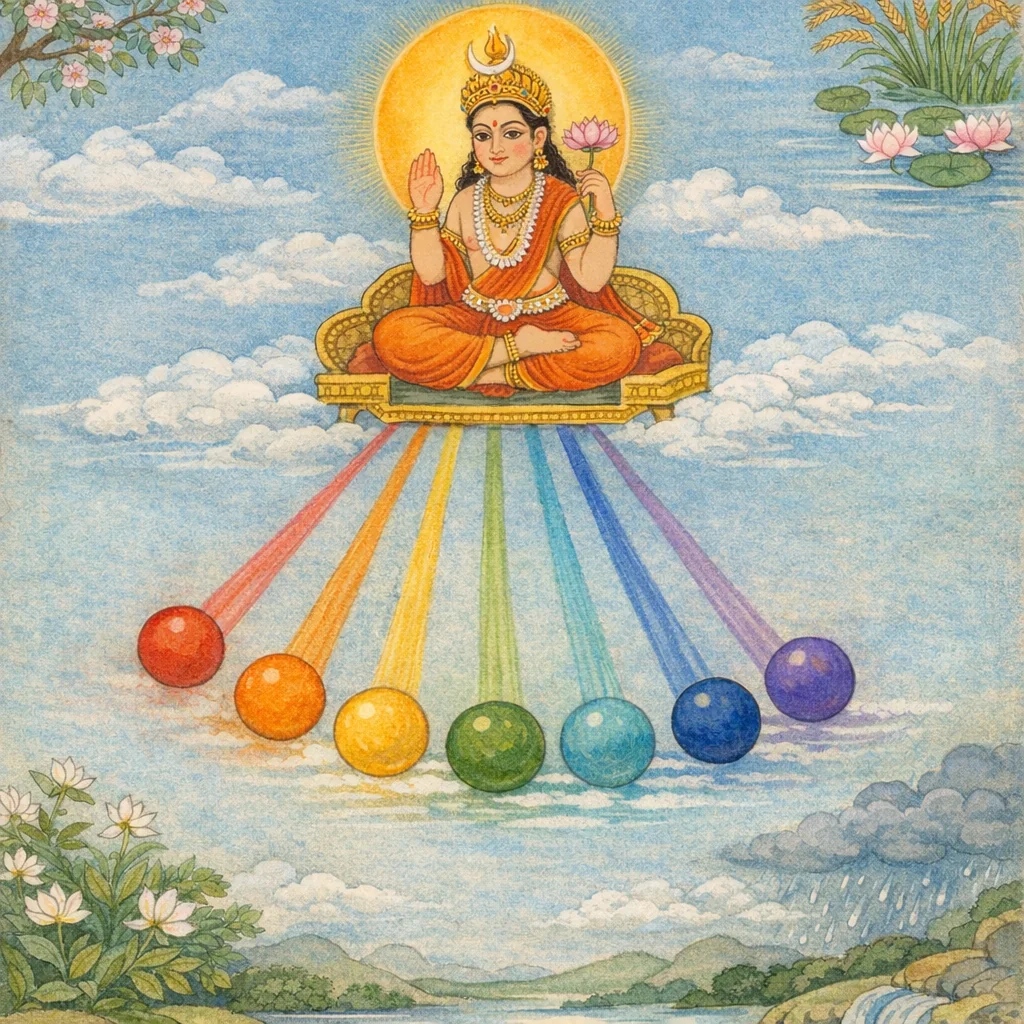
Sūta briefly identifies the divine forms presiding over five planets and points to the ādhidaivika (overruling divine) basis of the planetary and nakṣatra order—Agni with Āditya, Udaka with Candra, Skanda with Maṅgala, Nārāyaṇa with Budha, and so on. He then establishes Āditya (the Sun) as the root of all reckoning of time, from kṣaṇa and muhūrta through day, seasons, and yugas, declaring all to be dependent on the Sun. By philosophical and practical reasoning he affirms that without the Sun there would be no niyama, dīkṣā, daily rites, division of seasons, the arising of flowers, fruits, and grains, nor even worldly activity. The Sun is called “of Rudra’s form” and “Prajāpati of twelve selves,” thereby grounding Śiva’s lordship in the principle of light. In the latter half, the thousand-rayed Sun’s seven श्रेष्ठ rays—Suṣumnā, Harikeśa, Viśvakarmā, Viśvavyacā, Sannaddha, Sarvāvasu, Svarāṭ—are named as the wombs of the planets, by which Budha, Śukra, Maṅgala, Bṛhaspati, Śanaiścara and others are nourished and increased. Thus the chapter strengthens the earlier deity-based cosmic order through the Sun–Śiva light-principle and prepares the ground for fuller jyotiṣa and ādhidaivika exposition.
Shlokas
Verse 1
इति श्रीलिङ्गमहापुराणे पूर्वभागे सूर्यरश्मिस्वरूपकथनं नामैकोनषष्टितमो ऽध्यायः सूत उवाच शेषाः पञ्च ग्रहा ज्ञेया ईश्वराः कामचारिणः पठ्यते चाग्निरादित्य उदकं चन्द्रमाः स्मृतः
Thus, in the Śrī Liṅga Mahāpurāṇa (Pūrvabhāga) begins the fifty-ninth chapter called “The Account of the True Nature of the Sun’s Rays.” Sūta said: “The remaining five grahas are to be understood as sovereign powers, moving according to their own will. The Sun is spoken of as fire, and the Moon is remembered as water.”
Verse 2
शेषाणां प्रकृतिं सम्यग् वक्ष्यमाणां निबोधत सुरसेनापतिः स्कन्दः पठ्यते ऽङ्गारको ग्रहः
Understand well the true nature of the remaining powers that are about to be described. Skanda, commander of the army of the Devas, is recited as the graha Aṅgāraka (Mars).
Verse 3
नारायणं बुधं प्राहुर् देवं ज्ञानविदो जनाः सर्वलोकप्रभुः साक्षाद् यमो लोकप्रभुः स्वयम्
Those who know the truth of wisdom declare Nārāyaṇa to be the enlightened Deva. Yama, in truth, is the manifest Lord of all the worlds—himself the ruler who upholds the divine order.
Verse 4
महाग्रहो द्विजश्रेष्ठा मन्दगामी शनैश्चरः देवासुरगुरू द्वौ तु भानुमन्तौ महाग्रहौ
O best of the twice-born, Śanaiścara (Saturn), who moves slowly, is a great graha. And the two gurus—of the Devas and of the Asuras—are also radiant great grahas.
Verse 5
प्रजापतिसुतावुक्तौ ततः शुक्रबृहस्पती आदित्यमूलमखिलं त्रैलोक्यं नात्र संशयः
Thereafter, the two sons of Prajāpati—Śukra and Bṛhaspati—declared: “The entire threefold world has the Āditya (solar principle) as its root; of this there is no doubt.”
Verse 6
भवत्यस्माज्जगत्कृत्स्नं सदेवासुरमानुषम् रुद्रेन्द्रोपेन्द्रचन्द्राणां विप्रेन्द्राग्निदिवौकसाम्
From Him alone arises this entire universe—together with the Devas, Asuras, and human beings—along with Rudra, Indra, Upendra (Viṣṇu), and the Moon; and also the lordly sages, the Fire-god Agni, and the dwellers of heaven. Thus the Pati (Śiva) stands as the originating ground of all beings, while the paśus (souls) appear within His manifested order.
Verse 7
द्युतिर्द्युतिमतां कृत्स्नं यत्तेजः सर्वलौकिकम् सर्वात्मा सर्वलोकेशो महादेवः प्रजापतिः
He is the complete radiance of all that shines; the very brilliance behind every worldly splendor. He is the Self within all beings, the Lord of all worlds—Mahādeva, the supreme Progenitor (Prajāpati), the Pati who transcends and governs all paśus (souls).
Verse 8
सूर्य एव त्रिलोकेशो मूलं परमदैवतम् ततः संजायते सर्वं तत्रैव प्रविलीयते
The Sun alone is the Lord of the three worlds, the primal and supreme Divinity. From Him all things arise, and into Him alone they finally dissolve.
Verse 9
भावाभावौ हि लोकानाम् आदित्यान्निःसृतौ पुरा अविज्ञेयो ग्रहो विप्रा दीप्तिमान्सुप्रभो रविः
O Brahmins, in ancient times the becoming and non-becoming of the worlds issued forth from the Āditya. That radiant Sun (Ravi)—a celestial power difficult to comprehend—shines forth with surpassing brilliance.
Verse 10
अत्र गच्छन्ति निधनं जायन्ते च पुनः पुनः क्षणा मुहूर्ता दिवसा निशाः पक्षाश् च कृत्स्नशः
Here, in this world-process, moments and muhūrtas, days and nights, and entire fortnights repeatedly pass into dissolution and are born again—ever revolving in the wheel of time.
Verse 11
मासाः संवत्सरश्चैव ऋतवो ऽथ युगानि च तदादित्यादृते ह्येषा कालसंख्या न विद्यते
Months, the year, the seasons, and even the yugas—without that Āditya (the Sun), this reckoning of Time does not exist.
Verse 12
कालादृते न नियमो न दीक्षा नाह्निकक्रमः ऋतूनां च विभागश् च पुष्पं मूलं फलं कुतः
Without Time (Kāla), there can be no rule of observance, no initiation, and no daily ritual order. There would be no division of the seasons—so from where could flower, root, or fruit arise at all?
Verse 13
कुतः सस्यविनिष्पत्तिस् तृणौषधिगणो ऽपि च अभावो व्यवहाराणां जन्तूनां दिवि चेह च
How could there be the ripening of crops, or even the growth of grasses and medicinal herbs, when the very order of living beings’ dealings has collapsed—both in heaven and here on earth?
Verse 14
जगत्प्रतापनमृते भास्करं रुद्ररूपिणम् स एष कालश्चाग्निश् च द्वादशात्मा प्रजापतिः
Apart from Rudra in the form of the Sun—who scorches and illumines the worlds—this very One is also Time and Fire; as Prajāpati, He abides with a twelvefold nature.
Verse 15
तपत्येष द्विजश्रेष्ठास् त्रैलोक्यं सचराचरम् स एष तेजसां राशिः समस्तः सार्वलौकिकः
O best of the twice-born, this supreme Radiance scorches the three worlds, with all that moves and does not move. This indeed is the total mass of splendors—complete, transcending all worldly measure.
Verse 16
उत्तमं मार्गमास्थाय रात्र्यहोभिर् इदं जगत् पार्श्वत ऊर्ध्वम् अधश् चैव तापयत्येष सर्वशः
Taking to the highest course and moving through nights and days, this luminary heats the whole world—on the sides, above, and below—pervading every direction. In Shaiva understanding, this ordered “heat” is not mere burning, but the regulated tapas of cosmic law (ṛta), functioning under Pati (Śiva), who governs time and its powers.
Verse 17
यथा प्रभाकरो दीपो गृहमध्ये ऽवलम्बितः पार्श्वत ऊर्ध्वम् अधश्चैव तमो नाशयते समम्
Just as a radiant lamp, hung in the middle of a house, destroys darkness equally—on the sides, above, and below—so the light of Śiva-jñāna, established within, dispels in every direction the ignorance born of the soul’s bondage.
Verse 18
तद्वत्सहस्रकिरणो ग्रहराजो जगत्प्रभुः सूर्यो गोभिर् जगत् सर्वम् आदीपयति सर्वतः
Likewise, the Sun—thousand-rayed, king of the planets, lord over the world—illumines the entire universe on every side with his beams.
Verse 19
७ स्पेचिअल् सुन्रय्स् रवे रश्मिसहस्रं यत् प्राङ्मया समुदाहृतम् तेषां श्रेष्ठाः पुनः सप्त रश्मयो ग्रहयोनयः
Of the Sun’s thousand rays that I previously enumerated, seven are distinguished as supreme. Those seven foremost rays become the very wombs (sources) from which the planets arise.
Verse 20
सुषुम्नो हरिकेशश् च विश्वकर्मा तथैव च विश्वव्यचाः पुनश्चाद्यः संनद्धश् च ततः परः
He is Suṣumnā, the subtle inner channel; Hari-keśa, whose tresses shine with divine radiance; Viśvakarmā, the cosmic architect; and Viśvavyacā, the all-pervading Presence. Again, He is Ādya, the Primordial One; and Saṃnaddha, the perfectly arrayed Lord—ever ready to uphold the cosmic order beyond all else.
Verse 21
सर्वावसुः पुनश्चान्यः स्वराडन्यः प्रकीर्तितः सुषुम्नः सूर्यरश्मिस्तु दक्षिणां राशिम् ऐधयत्
Another solar ray is praised as Sarvāvasu, and another as Svarāṭ. Suṣumnā—this ray of the Sun—strengthened and set in order the southern course (rāśi), establishing its regulated movement.
Verse 22
न्यगूर्ध्वाधः प्रचारो ऽस्य सुषुम्नः परिकीर्तितः हरिकेशः पुरस्ताद् यो ऋक्षयोनिः प्रकीर्त्यते
Its movement is said to extend downward and upward; this is proclaimed to be Suṣumnā (the central channel). In the eastern direction is the one called Harikeśa, who is also renowned as Ṛkṣayoni.
Verse 23
दक्षिणे विश्वकर्मा च रश्मिर्वर्धयते बुधम् विश्वव्यचास्तु यः पश्चाच् छुक्रयोनिः स्मृतो बुधैः
To the south is Viśvakarmā; his radiance strengthens Budha (Mercury). And the deity called Viśvavyacās, established in the west, is remembered by the wise as the generative source (yoni) of Śukra (Venus).
Verse 24
संनद्धश् च तु यो रश्मिः स योनिर् लोहितस्य तु षष्ठः सर्वावसू रश्मिः स योनिस्तु बृहस्पतेः
The ray known as Saṃnaddha is the generative source (yoni) of Lohita (Mars). And the sixth ray—called Sarvāvasu—is the generative source (yoni) of Bṛhaspati (Jupiter).
Verse 25
शनैश्चरं पुनश् चापि रश्मिर् आप्यायते स्वराट् एवं सूर्यप्रभावेन नक्षत्रग्रहतारकाः
Again, Svarāṭ—the sovereign Sun—nourishes even Śanaiścara (Saturn) with his rays; thus, by the Sun’s potency, the constellations, planets, and stars are sustained. In Shaiva understanding, this sustaining power ultimately belongs to Pati—Śiva—who manifests as the cosmic order that upholds all luminous regulators of time and karma.
Verse 26
दृश्यन्ते दिवि ताः सर्वाः विश्वं चेदं पुनर्जगत् न क्षीयन्ते यतस्तानि तस्मान्नक्षत्रता स्मृता
All those luminaries are seen in the heavens, and this whole universe again appears as a moving world. Since they do not waste away, they are therefore remembered as “nakṣatras”—the imperishable stars.
Frequently Asked Questions
Sushumna (सुषुम्न), Harikesha (हरिकेश), Vishvakarma (विश्वकर्मा), Vishvavyacha (विश्वव्यचा), Sannaddha (संनद्ध), Sarvavasu (सर्वावसु), and Svarat (स्वराट्) are identified as the chief rays functioning as ‘graha-yonis’ (planetary sources/nourishers).
It explicitly calls the Sun ‘रुद्ररूपिणः’ and presents Surya as the universal heat/light that governs time, order, and life-processes—functions aligned with Shiva’s cosmic regulation, making solar radiance a visible expression of Shiva’s operative power.
The chapter states that without Aditya (the Sun), the enumeration and regulation of time—moments, days, nights, fortnights, months, years, seasons, and yugas—cannot be established, and with that collapse, ritual routine (ahnika), initiations (diksha), and worldly transactions also fail.