Adhyaya 57
सोमवर्णनम् (Graha–Ratha–Aśva Varṇana, Dhruva-Nibaddha Gati, Maṇḍala-Pramāṇa, Graha-Arcana)
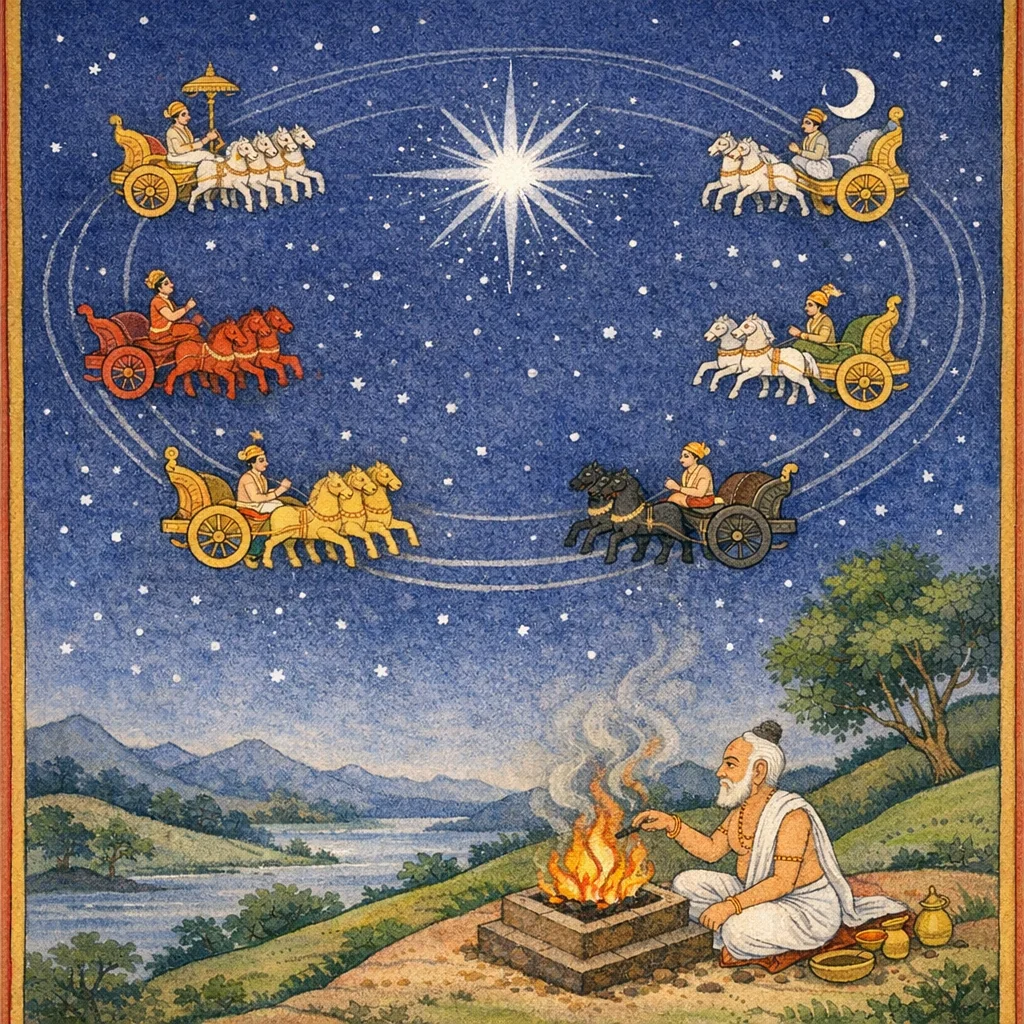
Sūta describes the chariots of the grahas and the number and colors of their horses—Soma (the Moon), Śukra, Bhauma, Jīva (Bṛhaspati), Manda (Śani), Svarbhānu (Rāhu), and others—highlighting the distinctive features of each vehicle. He then sets forth the cosmic order of motion: all planets and stars are bound to Dhruva and whirl on cords of wind like a wheel of fire. The measures of the solar and lunar discs, Rāhu’s dark abode, and the relative proportions among the grahas are stated. Uttarāyaṇa and Dakṣiṇāyaṇa, full moon and new moon, equinox times, and the visibility or darkening of the Sun and Moon are also explained. Finally, the hierarchy of worlds is indicated (Sun→Moon→constellations→Budha→Śukra→Maṅgala/retrograde/Bṛhaspati→Śanaiścara→Saptarṣi→Dhruva above), concluding with Brahmā’s initiation of planetary lordship and the injunction to worship the grahas in fire to pacify planetary afflictions, thereby strengthening discipline in Śaiva rites (Liṅga-pūjā/śānti).
Shlokas
Verse 1
इति श्रीलिङ्गमहापुराणे पूर्वभागे सोमवर्णनं नाम षट्पञ्चाशत्तमो ऽध्यायः सूत उवाच छरिओत्स् ओफ़् ओथेर् प्लनेत्स् अष्टभिश् च हयैर्युक्तः सोमपुत्रस्य वै रथः वारितेजोमयश्चाथ पिशङ्गैश्चैव शोभनैः
Thus, in the Śrī Liṅga-Mahāpurāṇa, in the Pūrvabhāga, in the chapter called “Description of Soma,” Sūta said: “The chariot of Soma’s son is indeed yoked with eight horses; it is fashioned of the cool, shining radiance of water and adorned with beautiful tawny steeds.”
Verse 2
दशभिश्चाकृशैरश्वैर् नानावर्णै रथः स्मृतः शुक्रस्य क्ष्मामयैर्युक्तो दैत्याचार्यस्य धीमतः
The chariot of the wise Śukra—the preceptor of the Daityas—is said to be drawn by ten unwearied horses of many hues, and to be furnished with components born of the earth.
Verse 3
अष्टाश्वश्चाथ भौमस्य रथो हैमः सुशोभनः जीवस्य हैमश्चाष्टाश्वो मन्दस्यायसनिर्मितः
Then Bhauma (Mars) has a splendid chariot of gold drawn by eight horses. Jīva (Jupiter) too has a golden chariot drawn by eight horses, while Manda (Saturn) has a chariot fashioned of iron.
Verse 4
रथ आपोमयैरश्वैर् दशभिस्तु सितेतरैः स्वर्भानोर्भास्करारेश् च तथा चाष्टहयः स्मृतः
The Sun’s chariot is said to be drawn by ten horses, white and non‑white, formed from the very essence of the waters. Likewise Svarbhānu, the Sun’s foe, is remembered as having a chariot drawn by eight horses.
Verse 5
सर्वे ध्रुवनिबद्धा वै ग्रहास्ते वातरश्मिभिः एतेन भ्राम्यमाणाश् च यथायोगं व्रजन्ति वै
All the grahas (planets) are indeed fastened to Dhruva by cords of wind‑like rays. Driven to revolve by that very force, they proceed along their respective paths in accordance with the ordained order.
Verse 6
यावन्त्यश्चैव ताराश् च तावन्तश्चैव रश्मयः सर्वे ध्रुवनिबद्धाश् च भ्रमन्तो भ्रामयन्ति तम्
As many as the stars are, so many indeed are their rays. All are bound to Dhruva; revolving, they make even him appear to revolve—thus is the cosmic order upheld.
Verse 7
अलातचक्रवद्यान्ति वातचक्रेरितानि तु यस्माद्वहति ज्योतींषि प्रवहस्तेन स स्मृतः
Like a whirling firebrand, the luminous forms move when driven by the wheel of wind. Because it bears and carries the lights onward, it is remembered as Pravaha—the force of onward-flowing motion.
Verse 8
नक्षत्रसूर्याश् च तथा ग्रहतारागणैः सह उन्मुखाभिमुखाः सर्वे चक्रभूताः श्रिता दिवि
The constellations and the Sun, together with the planets and the hosts of stars—each facing upward and toward one another—abide in the heavens as a single wheel-like order, upheld within the cosmic expanse governed by the Lord (Pati).
Verse 9
ध्रुवेणाधिष्ठिताश्चैव ध्रुवमेव प्रदक्षिणम् प्रयान्ति चेश्वरं द्रष्टुं मेढीभूतं ध्रुवं दिवि
Established upon Dhruva, all the luminaries move in circumambulation around Dhruva alone; and they proceed to behold the Lord—Dhruva in heaven, made as the fixed cosmic pivot (like a central post).
Verse 10
नवयोजनसाहस्रो विष्कम्भः सवितुः स्मृतः त्रिगुणस्तस्य विस्तारो मण्डलस्य प्रमाणतः
The diameter of the Sun (Savitar) is remembered to be nine thousand yojanas; and, according to the accepted measure of the solar orb, its expanse is three times that.
Verse 11
द्विगुणः सूर्यविस्ताराद् विस्तारः शशिनः स्मृतः तुल्यस्तयोस्तु स्वर्भानुर् भूत्वाधस्तात्प्रसर्पति
The Moon’s expanse is remembered to be twice the Sun’s. And Svarbhānu—equal in measure to them—moves below, creeping beneath; thus he becomes the cause of eclipse by veiling their light.
Verse 12
उद्धृत्य पृथिवीछायां निर्मितां मण्डलाकृतिम् स्वर्भानोस्तु बृहत्स्थानं तृतीयं यत् तमोमयम्
Having drawn forth the Earth’s shadow, fashioned as a circular disk (maṇḍala), there is indeed the vast third station of Svarbhānu, constituted of darkness. In this cosmic order, tamas works as a veiling power over the paśu (the bound soul), while Pati (Śiva) alone remains the unshadowed Illuminator beyond all eclipsing.
Verse 13
चन्द्रस्य षोडशो भागो भार्गवस्य विधीयते विष्कम्भान्मण्डलाच्चैव योजनाच्च प्रमाणतः
By authoritative measure (pramāṇa), the dimension assigned to Bhārgava (Śukra, Venus) is fixed as one-sixteenth of the Moon—computed in yojanas, on the basis of diameter and orbital circuit.
Verse 14
भार्गवात्पादहीनस्तु विज्ञेयो वै बृहस्पतिः पादहीनौ वक्रसौरी तथायामप्रमाणतः
Compared to Bhārgava (Śukra), Bṛhaspati (Jupiter) is to be understood as deficient by one pāda in measure; likewise Saurī (Śani/Saturn) is of crooked course (vakra) and deficient by two pādas—so it is stated according to proportional measure (yāma-pramāṇa).
Verse 15
विस्तारान्मण्डलाच्चैव पादहीनस्तयोर्बुधः तारानक्षत्ररूपाणि वपुष्मन्तीह यानि वै
From the expanse and from the celestial circle (maṇḍala) itself, Budha (Mercury) is described as deficient by a quarter (pāda) relative to those measures; and here, indeed, the embodied forms that appear as stars and constellations are also spoken of.
Verse 16
बुधेन तानि तुल्यानि विस्तारान्मण्डलादपि प्रायशश्चन्द्रयोगीनि विद्यादृक्षाणि तत्त्ववित्
A knower of tattva should understand that, by Budha’s (Mercury’s) measure, those lunar mansions are comparable—even in their expanse to the celestial circle (maṇḍala)—and that, for the most part, they are conjoined with the Moon, marked by lunar association.
Verse 17
तारानक्षत्ररूपाणि हीनानि तु परस्परम् शतानि पञ्च चत्वारि त्रीणि द्वे चैव योजने
The forms of the stars and the constellations are set apart from one another at intervals—five hundred, four hundred, three hundred, and two hundred yojanas.
Verse 18
सर्वोपरि निकृष्टानि तारकामण्डलानि तु योजनद्वयमात्राणि तेभ्यो ह्रस्वं न विद्यते
Above all, the lowest of the stellar spheres measures only two yojanas; and among them nothing is said to be smaller than that.
Verse 19
उपरिष्टात्त्रयस्तेषां ग्रहा ये दूरसर्पिणः सौरो ऽङ्गिराश् च वक्रश् च ज्ञेया मन्दविचारिणः
Above those are three planets that move far and slowly: Saurā (Saturn), Aṅgirā (Jupiter), and Vakra (Mars). They are to be understood as sluggish in their courses.
Verse 20
तेभ्यो ऽधस्तात्तु चत्वारः पुनरन्ये महाग्रहाः सूर्यः सोमो बुधश्चैव भार्गवश्चैव शीघ्रगाः
Below those are four other great planets that move swiftly: the Sun, the Moon, Budha (Mercury), and Bhārgava (Venus). Their ordered motion sustains the cosmic rhythm within Śiva’s ordinance, whereby bound souls (paśu) experience time and its fruits under the bonds (pāśa).
Verse 21
तावन्त्यस्तारकाः कोट्यो यावन्त्यृक्षाणि सर्वशः ध्रुवात् तु नियमाच्चैषाम् ऋक्षमार्गे व्यवस्थितिः
As many constellations (ṛkṣas) as there are in every direction, so many are the crores of stars. And by the regulating ordinance centered upon Dhruva, they remain orderly established in the path of the constellations, moving in a fixed, governed course.
Verse 22
सप्ताश्वस्यैव सूर्यस्य नीचोच्चत्वमनुक्रमात् उत्तरायणमार्गस्थो यदा पर्वसु चन्द्रमाः
In due succession the seven-horsed Sun attains his lower and higher courses; and when, at the sacred junctions (parvas), the Moon abides upon the path of the northern course (uttarāyaṇa), that time is held to be especially auspicious.
Verse 23
उच्चत्वाद्दृश्यते शीघ्रं नातिव्यक्तैर्गभस्तिभिः तदा दक्षिणमार्गस्थो नीचां वीथिमुपाश्रितः
Because he is at a higher elevation, he is seen to move swiftly, though his rays are not very distinct; then, situated on the southern course, he resorts to the lower track.
Verse 24
भूमिरेखावृतः सूर्यः पौर्णिमावास्ययोस् तदा ददृशे च यथाकालं शीघ्रमस्तमुपैति च
Then, on the days of the full moon and the new moon, the Sun was seen as though veiled by a line upon the earth; and, contrary to the proper order of time, he hastened to set. Such portents proclaim the disturbance of cosmic rhythm—when the Pāśa (bondage of disorder) rises, beings (Paśus) lose steadiness until the Lord (Pati), Śiva, restores dharma and balance.
Verse 25
तस्मादुत्तरमार्गस्थो ह्य् अमावास्यां निशाकरः ददृशे दक्षिणे मार्गे नियमाद्दृश्यते न च
Therefore, on the new-moon night the Moon—the night-maker—abiding in the northern course was beheld; but on the southern path it is, by cosmic ordinance, not seen.
Verse 26
ज्योतिषां गतियोगेन सूर्यस्य तमसा वृतः समानकालास्तमयौ विषुवत्सु समोदयौ
By the coordinated courses of the luminaries, the Sun becomes veiled by darkness; and at the equinoxes (viṣuvat), his setting and rising occur in equal measure and at equal times—showing the Lord’s orderly governance of time through the cosmic law that binds the paśu within measured cycles.
Verse 27
उत्तरासु च वीथीषु व्यन्तरास्तमनोदयौ पौर्णिमावास्ययोर् ज्ञेयौ ज्योतिश्चक्रानुवर्तिनौ
In the northern celestial tracks (vīthīs), the Vyantaras are to be known as presiding over sunset and sunrise on the full-moon and new-moon days; they move in accord with the revolving wheel of the luminaries.
Verse 28
दक्षिणायनमार्गस्थो यदा चरति रश्मिवान् ग्रहाणां चैव सर्वेषां सूर्यो ऽधस्तात् प्रसर्पति
When the radiant Sun moves along the southern course (dakṣiṇāyana), he proceeds beneath all the planets, in accordance with the ordained cosmic order. Thus the luminary’s descent marks the turning of time, while the Lord (Pati) remains the unseen regulator of all motion.
Verse 29
विस्तीर्णं मण्डलं कृत्वा तस्योर्ध्वं चरते शशी नक्षत्रमण्डलं कृत्स्नं सोमादूर्ध्वं प्रसर्पति
Having formed a broad circular sphere of its course, the Moon (Śaśī) moves above it; and the entire sphere of the constellations extends and spreads above Soma. Thus the ordered heavens proceed in measured layers—revealing the Lord (Pati) as the regulator of cosmic rhythm, while the bound souls (paśu) perceive His governance through time and celestial motion.
Verse 30
नक्षत्रेभ्यो बुधश्चोर्ध्वं बुधादूर्ध्वं तु भार्गवः वक्रस्तु भार्गवादूर्ध्वं वक्राद् ऊर्ध्वं बृहस्पतिः
Above the lunar mansions (Nakṣatras) is Mercury (Budha). Above Mercury is Venus (Bhārgava). Above Venus is the retrograde-moving one (Vakra, i.e., Mars). Above Vakra is Jupiter (Bṛhaspati).
Verse 31
तस्माच्छनैश्चरश्चोर्ध्वं तस्मात्सप्तर्षिमण्डलम् ऋषीणां चैव सप्तानां ध्रुवस्योर्ध्वं व्यवस्थितिः
Above that lies the sphere of Śanaiścara (Saturn); above that is the constellation-circle of the Seven Ṛṣis. And above those seven seers stands Dhruva, firmly established—fixed as the cosmic pivot in the ordered ascent of the worlds under the Lord (Pati).
Verse 32
तं विष्णुलोकं परमं ज्ञात्वा मुच्येत किल्बिषात् द्विगुणेषु सहस्रेषु योजनानां शतेषु च
By knowing that supreme realm called Viṣṇu’s world, the bound soul (paśu) is freed from sin and demerit. That realm is said to lie at a distance of two thousand and two hundred yojanas.
Verse 33
ग्रहनक्षत्रतारासु उपरिष्टाद्यथाक्रमम् ग्रहाश् च चन्द्रसूर्यौ च युतौ दिव्येन तेजसा
Above the planets, constellations, and stars—set in their proper order—are the Grahas, and the Moon and the Sun, joined together and shining with divine radiance. In this cosmic hierarchy their splendor mirrors the ordained rhythm of Śiva’s rule as Pati, while all moving beings (paśu) remain bound to the measured courses of time (pāśa).
Verse 34
नित्यमृक्षेषु युज्यन्ते गच्छन्तो ऽहर्निशं क्रमात् ग्रहनक्षत्रसूर्यास् ते नीचोच्चऋजुसंस्थिताः
Moving in due sequence day and night, the planets, the lunar mansions, and the Sun are ever yoked to the constellations. They abide in their ordained courses—at times descending, at times ascending, and at times proceeding straight—according to the cosmic law upheld by the Supreme Lord (Pati).
Verse 35
समागमे च भेदे च पश्यन्ति युगपत्प्रजाः ऋतवः षट् स्मृताः सर्वे समागच्छन्ति पञ्चधा
At the points of conjunction and separation of time-divisions, beings perceive overlapping transitions simultaneously. Though the seasons are remembered as six, they converge and operate in a fivefold manner within the ordered flow of Time—an expression of Mahādeva as Pati, the Lord who regulates kāla for the bound souls (paśu).
Verse 36
परस्परास्थिता ह्येते युज्यन्ते च परस्परम् असंकरेण विज्ञेयस् तेषां योगस्तु वै बुधैः
These principles truly abide in mutual dependence and are joined to one another; yet their union must be understood without confusion—such is their yoga, as the wise declare.
Verse 37
एवं संक्षिप्य कथितं ग्रहाणां गमनं द्विजाः भास्करप्रमुखानां च यथादृष्टं यथाश्रुतम्
Thus, O twice-born sages, the movements of the grahas—beginning with Bhāskara (the Sun)—have been stated in brief, exactly as they are seen and as they are heard in the sacred tradition.
Verse 38
ग्रहाधिपत्ये भगवान् ब्रह्मणा पद्मयोनिना अभिषिक्तः सहस्रांशू रुद्रेण तु यथा गुहः
For the lordship over the planets, the Blessed One—Sahasrāṃśu (the Sun)—was consecrated by Brahmā, the Lotus-born; and likewise Guha (Skanda) was consecrated by Rudra.
Verse 39
तस्माद्ग्रहार्चना कार्या अग्नौ चोद्यं यथाविधि आदित्यग्रहपीडायां सद्भिः कार्यार्थसिद्धये
Therefore, one should duly perform worship of the planetary powers, and also make the prescribed offering into the sacred fire according to rule. When there is affliction from the Sun (Āditya) as a graha, the good should do this for the successful accomplishment of their intended aims.
Frequently Asked Questions
They are said to be ‘dhruva-nibaddha’—fastened to Dhruva—and driven by ‘vāta-raśmi’ (wind-like cords/forces), moving like a rotating firebrand (alāta-cakra). This frames celestial motion as orderly, regulated, and non-random.
It prescribes graha-arcana (planetary propitiation) performed properly—also in Agni according to rule—especially during graha-pīḍā (affliction), for sādhus/householders seeking kārya-siddhi (successful outcomes) and remedial harmony.