Adhyaya 30
श्वेतमुनिना कालस्य निग्रहः (मृत्युञ्जय-भक्ति-प्रसादः)
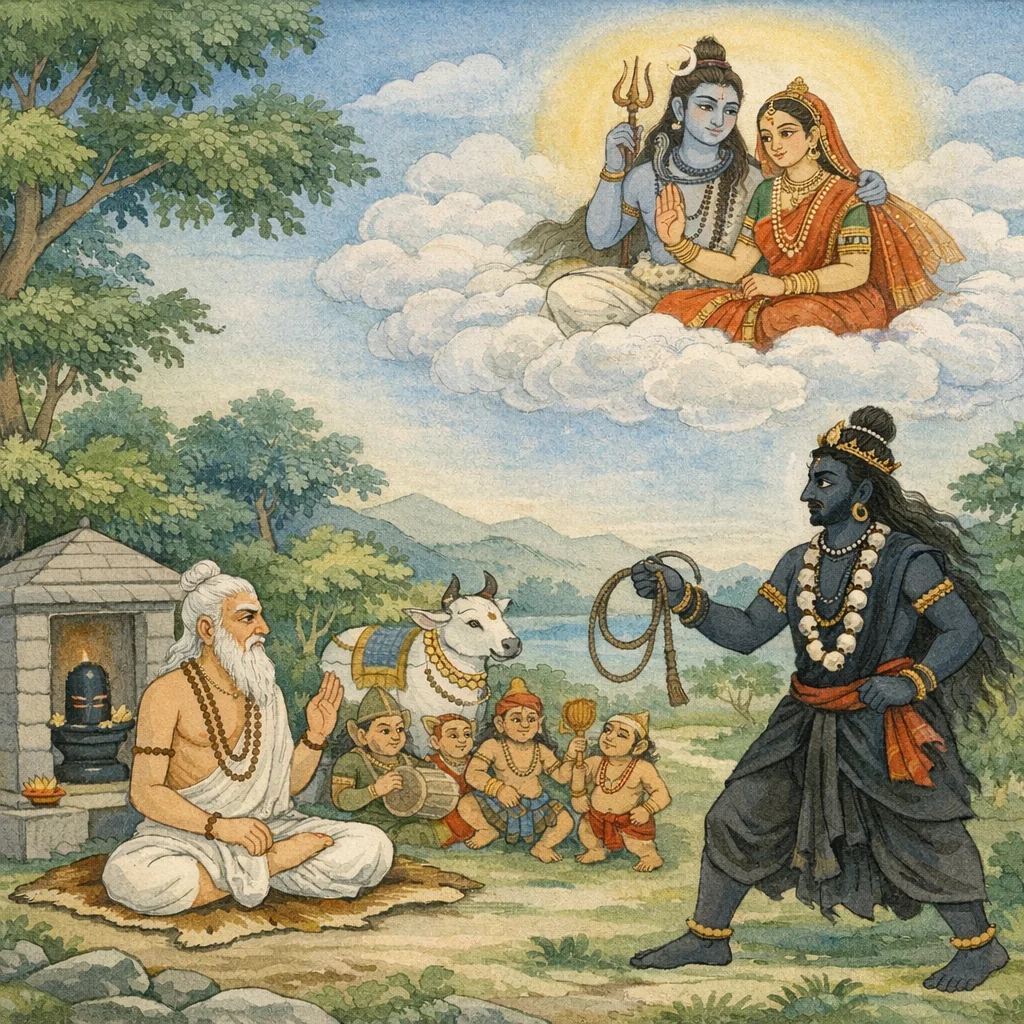
Śailādi recounts to the sages, as narrated by Brahmā, the holy tale of Śveta. The aged muni, absorbed in Liṅga-worship and Rudra-recitation, is confronted by Kāla, who doubts the power of “rauddra” rites and claims the right to drag him to Yamaloka. Śveta answers with unwavering Śaiva faith: Rudra abides in the Liṅga and is the source of the gods, so Kāla must depart. Enraged, Kāla binds him with his noose, mocking the deity’s seeming “inactivity” in the Liṅga. At once Sadāśiva appears with Ambikā, Nandin, and the gaṇas; with a mere glance he subdues and slays Antaka, protecting the devotee. The teaching then turns doctrinal: worship Mṛtyuñjaya Śaṅkara for bhukti and mukti; do not merely argue—surrender and adore Bhava with exclusive bhakti to become free from sorrow. Brahmā concludes that such Śiva-bhakti is not attained by dāna, tapas, yajña, Veda, or yogic restraints alone, but chiefly through Śiva’s prasāda; Pāśupata-bhakti grants the four aims and victory over death, as shown by Dadhīci, Brahmā, and Śveta, preparing the next chapters on the primacy of grace and Liṅga-upāsanā.
Shlokas
Verse 1
इति श्रीलिङ्गमहापुराणे पूर्वभागे एकोनत्रिंशो ऽध्यायः शैलादिरुवाच एवमुक्तास्तदा तेन ब्रह्मणा ब्राह्मणर्षभाः श्वेतस्य च कथां पुण्याम् अपृच्छन् परमर्षयः
Thus, in the Śrī Liṅga Mahāpurāṇa, in the Pūrvabhāga, the next chapter begins. Śailādi said: When Brahmā had spoken thus to those foremost brāhmaṇa-sages, the supreme seers asked about the holy narrative of Śveta.
Verse 2
पितामह उवाच श्वेतो नाम मुनिः श्रीमान् गतायुर्गिरिगह्वरे सक्तो ह्यभ्यर्च्य यद्भक्त्या तुष्टाव च महेश्वरम्
Pitāmaha (Brahmā) said: “There was a venerable sage named Śveta—illustrious and advanced in years—who dwelt absorbed in a mountain cave. Worshipping Śiva with deep devotion, he praised Mahēśvara, the Great Lord, and pleased Him.”},{
Verse 3
रुद्राध्यायेन पुण्येन नमस्तेत्यादिना द्विजाः ततः कालो महातेजाः कालप्राप्तं द्विजोत्तमम्
O twice-born sages, by the meritorious recitation of the Rudra-adhyāya—beginning with the words “namaḥ te” (“salutations to You”)—mighty, radiant Kāla (Time/Death) then approached the foremost of Brahmins, whose destined hour had arrived.
Verse 4
नेतुं संचिन्त्य विप्रेन्द्राः सान्निध्यमकरोन्मुनेः श्वेतो ऽपि दृष्ट्वा तं कालं कालप्राप्तो ऽपि शङ्करम्
O best of the brāhmaṇa-sages, having resolved to take him away, Kāla drew near and stood in the sage’s presence. Śveta too, seeing that Kāla—though his appointed hour had come—turned his whole intent toward Śaṅkara, fixing his mind upon the Lord.
Verse 5
पूजयामास पुण्यात्मा त्रियंबकमनुस्मरन् त्रियंबकं यजेदेवं सुगन्धिं पुष्टिवर्धनम्
That virtuous one performed worship, continually remembering Tryambaka. In this manner one should worship Tryambaka—the fragrant Lord who increases nourishment and well-being—so that the paśu (the bound soul) may align with the grace of Pati, the Supreme Lord.
Verse 6
किं करिष्यति मे मृत्युर् मृत्योर्मृत्युरहं यतः तं दृष्ट्वा सस्मितं प्राह श्वेतं लोकभयंकरः
“What can Death do to me? For I am the Death of Death itself.” Seeing him, Śveta—the one who terrifies the world—spoke with a gentle smile.
Verse 7
एह्येहि श्वेत चानेन विधिना किं फलं तव रुद्रो वा भगवान् विष्णुर् ब्रह्मा वा जगदीश्वरः
“Come, come, O Śveta. By performing this rite in the prescribed manner, what fruit do you seek? Is it Rudra (Śiva) as the Blessed Lord, or Viṣṇu, or Brahmā—the Lord of the worlds?”
Verse 8
कः समर्थः परित्रातुं मया ग्रस्तं द्विजोत्तम अनेन मम किं विप्र रौद्रेण विधिना प्रभोः
“O best of the twice-born, who is truly capable of saving one who has been seized by me? And what can I do, O brāhmaṇa, against this fierce ordinance of the Lord—Rudra’s decree?”
Verse 9
नेतुं यस्योत्थितश्चाहं यमलोकं क्षणेन वै यस्माद्गतायुस्त्वं तस्मान् मुने नेतुमिहोद्यतः
“I have risen to take you—indeed, in a moment—to Yama’s realm. Since your allotted lifespan has come to its end, therefore, O sage, I am here, prepared to lead you away.”
Verse 10
तस्य तद्वचनं श्रुत्वा भैरवं धर्ममिश्रितम् हा रुद्र रुद्र रुद्रेति ललाप मुनिपुङ्गवः
Hearing those words—Bhairava-like, yet blended with dharma—the foremost of sages began to cry out repeatedly, “Ha! Rudra, Rudra, O Rudra!”
Verse 11
तं प्राह च महादेवं कालं सम्प्रेक्ष्य वै दृशा नेत्रेण बाष्पमिश्रेण संभ्रान्तेन समाकुलः
Beholding Mahādeva, who stood forth as Kāla (Time), he addressed the Lord with his gaze fixed upon Him; his eyes were mingled with tears, and his whole being trembled—bewildered and overwhelmed.
Verse 12
श्वेत उवाच त्वया किं काल नो नाथश् चास्ति चेद्धि वृषध्वजः लिङ्गे ऽस्मिन् शङ्करो रुद्रः सर्वदेवभवोद्भवः
Śveta said: “What power has Kāla (Time) over you? If indeed we have a Lord—Vṛṣadhvaja—then in this very Liṅga abides Śaṅkara, Rudra, the source from whom the states and powers of all the gods arise.”
Verse 13
अतीव भवभक्तानां मद्विधानां महात्मनाम् विधिना किं महाबाहो गच्छ गच्छ यथागतम्
O mighty-armed one, for great-souled devotees of Bhava (Śiva) who are of My own nature, what need is there of formal procedure? Go—go back, just as you came.
Verse 14
ततो निशम्य कुपितस् तीक्ष्णदंष्ट्रो भयङ्करः श्रुत्वा श्वेतस्य तद्वाक्यं पाशहस्तो भयावहः
Hearing it, he became enraged—terrifying, with sharp fangs. And when he heard Śveta’s words, that dread one, holding a noose (pāśa) in his hand, grew even more fearsome.
Verse 15
सिंहनादं महत्कृत्वा चास्फाट्य च मुहुर्मुहुः बबन्ध च मुनिं कालः कालप्राप्तं तमाह च
Letting out a mighty lion-roar and snapping his fingers again and again, Kāla (Time) bound the sage; and to him—now reached by his destined hour—Kāla spoke.
Verse 16
मया बद्धो ऽसि विप्रर्षे श्वेतं नेतुं यमालयम् अद्य वै देवदेवेन तव रुद्रेण किं कृतम्
“O best of Brahmin sages, I have bound you to take Śveta to Yama’s abode. Yet today—what has your Rudra, the God of gods, done?”
Verse 17
क्व शर्वस्तव भक्तिश् च क्व पूजा पूजया फलम् क्व चाहं क्व च मे भीतिः श्वेत बद्धो ऽसि वै मया
“Where is your devotion to Śarva, and where is the worship—and the ‘fruit’ that comes from worship? Where am I, and where is fear of me? O Śveta, you are indeed bound by me.”
Verse 18
लिङ्गे ऽस्मिन् संस्थितः श्वेत तव रुद्रो महेश्वरः निश्चेष्टो ऽसौ महादेवः कथं पूज्यो महेश्वरः
“O Śveta, your Rudra—Mahādeva, Maheśvara—is established in this Liṅga. Yet He is actionless and unmoving; how, then, is that Mahādeva, Maheśvara to be worshipped?”
Verse 19
ततः सदाशिवः स्वयं द्विजं निहन्तुमागतम् निहन्तुमन्तकं स्मयन् स्मरारियज्ञहा हरः
Then Sadāśiva Himself—Hara, slayer of Kāma and destroyer of Dakṣa’s sacrifice—smilingly came forth to strike down that brāhmaṇa, and even to subdue Antaka (Death) who had come to kill.
Verse 20
त्वरन् विनिर्गतः परः शिवः स्वयं त्रिलोचनः त्रियंबको ऽम्बया समं सनन्दिना गणेश्वरैः
Then the Supreme Lord Śiva Himself—Three-eyed, Tryambaka—swiftly came forth, together with Ambā (the Mother), attended by Nandin and the lords of His gaṇas.
Verse 21
ससर्ज जीवितं क्षणाद् भवं निरीक्ष्य वै भयात् पपात चाशु वै बली मुनेस्तु संनिधौ द्विजाः
The mighty one, beholding Bhava (Śiva), at once let go his very life-breath; and out of fear he swiftly fell down, O twice-born sages, in the very presence of the muni.
Verse 22
ननाद चोर्ध्वमुच्चधीर् निरीक्ष्य चान्तकान्तकम् निरीक्षणेन वै मृतं भवस्य विप्रपुङ्गवाः
And he roared aloud, looking upward; and when Bhava beheld that foe—terrible as Death itself—he was indeed slain by the mere glance of Bhava, O best of Brahmins.
Verse 23
विनेदुरुच्चमीश्वराः सुरेश्वरा महेश्वरम् प्रणेमुरंबिकामुमां मुनीश्वरास्तु हर्षिताः
Then the exalted gods and their lordly chiefs resounded loudly in praise; the divine rulers bowed to Mahādeva, and the sage-lords—filled with joy—prostrated to Ambikā Umā, the very Śakti of the Supreme.
Verse 24
ससर्जुर् अस्य मूर्ध्नि वै मुनेर्भवस्य खेचराः सुशोभनं सुशीतलं सुपुष्पवर्षमंबरात्
Then the sky-moving celestials poured down from the heavens a splendid, cool shower of excellent flowers upon the head of Bhava the muni—Śiva, the Pati—honoring Him as the supreme Lord beyond all bonds (pāśa).
Verse 25
अहो निरीक्ष्य चान्तकं मृतं तदा सुविस्मितः शिलाशनात्मजो ऽव्ययं शिवं प्रणम्य शङ्करम्
“Ah!”—seeing Antaka (Death) lying slain, the son of Śilāśana stood utterly astonished; then, bowing down to Śaṅkara—Śiva, the imperishable (Pati)—he offered reverent homage.
Verse 26
उवाच बालधीर्मृतः प्रसीद चेति वै मुनेः महेश्वरं महेश्वर-स्य चानुगो गणेश्वरः
Then Gaṇeśvara, an attendant of Mahādeva, spoke to Mahēśvara: “Be gracious, O Lord,” and he addressed the sage as well, speaking with childlike innocence, as though overcome by fear of death.
Verse 27
ततो विवेश भगवान् अनुगृह्य द्विजोत्तमम् क्षणाद्गूढशरीरं हि ध्वस्तं दृष्ट्वान्तकं क्षणात्
Then the Blessed Lord, having shown grace to that best of the twice-born, entered into concealment; and in a moment, upon beholding Antaka, He utterly destroyed him, while His own form remained hidden.
Verse 28
तस्मान्मृत्युञ्जयं चैव भक्त्या सम्पूजये द्विजाः मुक्तिदं भुक्तिदं चैव सर्वेषामपि शङ्करम्
Therefore, O twice-born ones, worship Mṛtyuñjaya with devotion—Śaṅkara who grants all beings both bhukti (rightful worldly fruition) and mukti (liberation), the Pati who severs the pasha of death and bondage from the pashu, the bound soul.
Verse 29
बहुना किं प्रलापेन संन्यस्याभ्यर्च्य वै भवम् भक्त्या चापरया तस्मिन् विशोका वै भविष्यथ
What is the use of much talk? Renouncing all else, worship Bhava indeed; with single-pointed, unsurpassed devotion fixed in Him, you shall truly become free from sorrow.
Verse 30
शैलादिरुवाच एवमुक्तास्तदा तेन ब्रह्मणा ब्रह्मवादिनः प्रसीद भक्तिर्देवेशे भवेद्रुद्रे पिनाकिनि
Śailādi said: Thus addressed at that time by Brahmā, the sages who knew Brahman prayed, “Be gracious. May unwavering devotion arise in us toward Rudra—the Lord of the gods, wielder of the Pināka—who alone is Pati, the liberator of bound souls.”
Verse 31
केन वा तपसा देव यज्ञेनाप्यथ केन वा व्रतैर्वा भगवद्भक्ता भविष्यन्ति द्विजातयः
O Deva, by what austerity, or by what sacrifice, or by what vows and observances will the twice-born become devotees of the Blessed Lord—devoted to the Pati who frees the paśu from pāśa?
Verse 32
पितामह उवाच न दानेन मुनिश्रेष्ठास् तपसा च न विद्यया यज्ञैर् होमैर् व्रतैर् वेदैर् योगशास्त्रैर् निरोधनैः
Pitāmaha (Brahmā) said: O best of sages, not by charity, nor by austerity, nor by learning; not by sacrifices, fire-offerings, vows, the Vedas, the disciplines of Yoga, or even by restraints (nirodha) alone is the supreme end attained.
Verse 33
प्रसादे नैव सा भक्तिः शिवे परमकारणे अथ तस्य वचः श्रुत्वा सर्वे ते परमर्षयः
Without His grace, that devotion does not arise toward Śiva, the Supreme Cause. Then, having heard his words, all those great seers (paramarṣis) assented.
Verse 34
सदारतनयाः श्रान्ताः प्रणेमुश् च पितामहम् तस्मात्पाशुपती भक्तिर् धर्मकामार्थसिद्धिदा
Weary, the sons of Sadāra bowed to Pitāmaha (Brahmā). Therefore, devotion to Paśupati—the Lord who is Pati (Master) of the paśus—bestows success in dharma, kāma, and artha.
Verse 35
मुनेर् विजयदा चैव सर्वमृत्युजयप्रदा दधीचस्तु पुरा भक्त्या हरिं जित्वामरैर्विभुम्
It bestows victory upon the sage and grants conquest over every form of death. In former times, Dadhīci—by devotion—overcame Hari, the mighty Lord, even as the Devas looked on.
Verse 36
क्षयं जघान पादेन वज्रास्थित्वं च लब्धवान् मयापि निर्जितो मृत्युर् महादेवस्य कीर्तनात्
With a single kick he struck down Kṣaya (Decay) and gained a body steadfast like a vajra. Even I have conquered Death through the chanting and glorification of Mahādeva—Pati, the Lord who cuts the pāśa-bonds of the paśu, the bound soul.
Verse 37
श्वेतेनापि गतेनास्यं मृत्योर्मुनिवरेण तु महादेवप्रसादेन जितो मृत्युर्यथा मया
Even when the venerable sage Śveta had entered the very mouth of Death, by Mahādeva’s grace Death was conquered—just as it was conquered by me.
Frequently Asked Questions
Śiva manifests from the Liṅga-context as Sadāśiva with Ambikā and gaṇas and defeats Antaka not through extended battle but through sovereign presence and gaze, teaching that death is subordinate to Śiva when devotion is unwavering and grace is invoked.
The text explicitly states that supreme bhakti in Śiva does not arise merely from dāna, tapas, vidyā, yajña/homa, veda, or yogic restraints; it is fundamentally rooted in Śiva’s prasāda, though practices can become vehicles when aligned with surrender and Liṅga-upāsanā.
The line “त्रियंबकं यजेदेवं सुगन्धिं पुष्टिवर्धनम्” echoes the well-known Tryambaka/Mṛtyuñjaya formulation, making this chapter highly relevant for searches on ‘Mahamrityunjaya meaning’, ‘Tryambakam yajamahe in Puranas’, and ‘Shiva protection from death’ within a canonical Purāṇic frame.