Adhyaya 29
दारुवनलीला—नीललोहितपरीक्षा, ब्रह्मोपदेशः, अतिथिधर्मः, संन्यासक्रमः
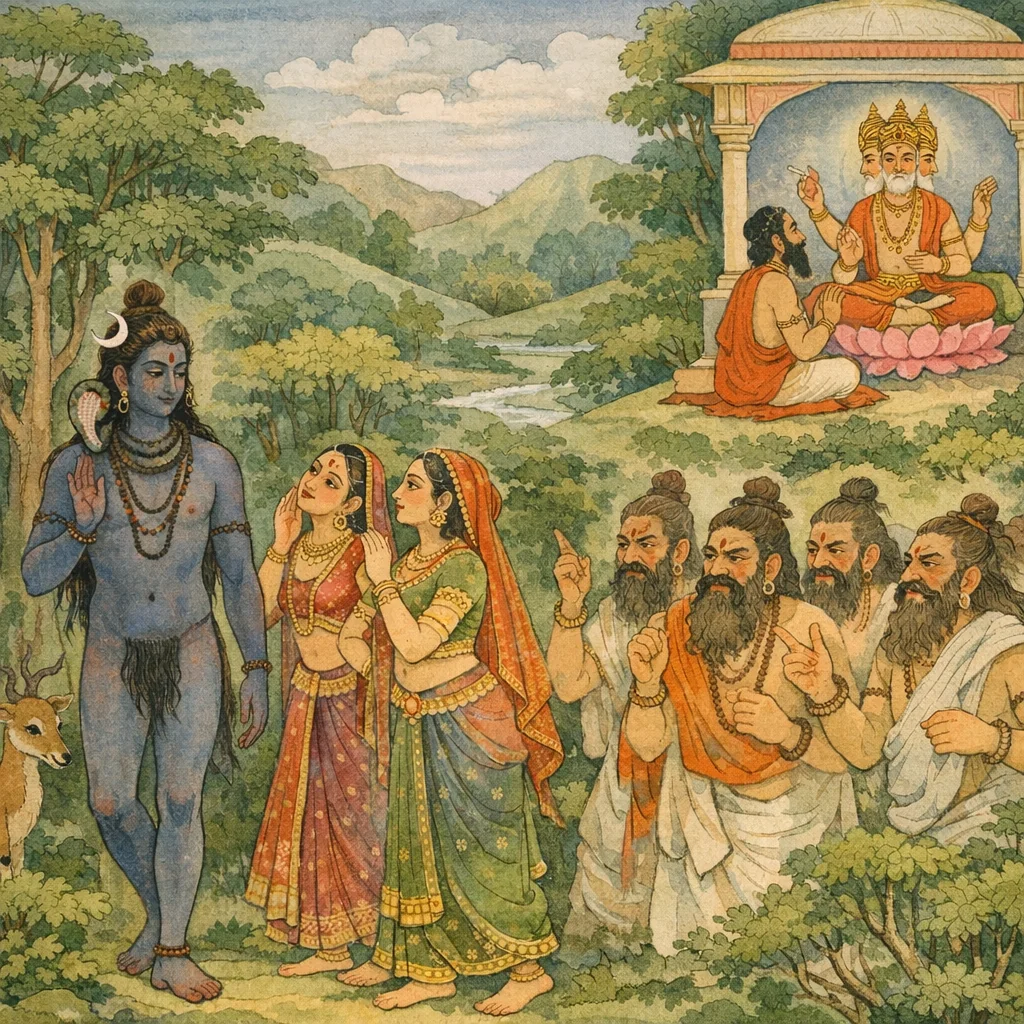
Sanatkumāra asks to hear what happened in Daruvana. In Sūta’s narration, Śailādi relates that the sages performed severe tapas for Rudra, but Śiva (Nīlalohita) entered the divine forest as a digambara, in a deliberately ‘strange’ form, to test their discernment of pravṛtti and nivṛtti. The women are captivated, while the sages answer with harsh words and fail to recognize Mahādeva; their tapas is checked, revealing the danger of pride and misjudgment. Reporting to Brahmā, they are rebuked, and Brahmā discloses that the one they condemned was Parameśvara himself, teaching that an atithi—whether pleasing or displeasing—must never be despised. Brahmā then tells the Sudarśana exemplum, where honoring the atithi conquers even Mṛtyu, establishing hospitality as worship of Śiva. Finally, Brahmā sets forth a graded saṃnyāsa-krama—Veda study, gṛhastha duties, yajña, forest discipline, ritual renunciation, and austerities—culminating in Śiva-sāyujya, and affirms that steadfast bhakti can grant immediate liberation. Thus the chapter joins līlā with practical dharma and mokṣa-oriented renunciation, preparing for deeper Śaiva teaching ahead.
Shlokas
Verse 1
इति श्रीलिङ्गमहापुराणे पूर्वभागे शिवार्चनतत्त्वसंख्यादिवर्णनं नामाष्टाविंशो ऽध्यायः सनत्कुमार उवाच इदानीं श्रोतुमिच्छामि पुरा दारुवने विभो प्रवृत्तं तद्वनस्थानां तपसा भावितात्मनाम्
Thus, in the revered Liṅga Mahāpurāṇa (Pūrvabhāga), in the chapter called “The description of the principles and enumeration of Śiva-worship,” Sanatkumāra said: “O Lord, now I wish to hear what happened long ago in the Dāru forest, among those forest-dwellers whose inner selves were refined by austerity.”
Verse 2
कथं दारुवनं प्राप्तो भगवान्नीललोहितः विकृतं रूपमास्थाय चोर्ध्वरेता दिगम्बरः
How did the Blessed Lord Nīlalohita come to the Dāruvana forest, assuming a strange, unconventional form—an ascetic of ūrdhva-retas, naked to the directions (digambara)—to reveal the truth of the Pati beyond worldly bonds?
Verse 3
किं प्रवृत्तं वने तस्मिन् रुद्रस्य परमात्मनः वक्तुमर्हसि तत्त्वेन देवदेवस्य चेष्टितम्
What truly took place in that forest concerning Rudra, the Supreme Self? Please recount, in truth and according to tattva, the divine activity of Deva-deva, the Lord of the gods.
Verse 4
सूत उवाच तस्य तद्वचनं श्रुत्वा श्रुतिसारविदां वरः शिलादसूनुर्भगवान् प्राह किंचिद्भवं हसन्
Sūta said: Hearing his words, the blessed son of Śilāda—foremost among those who know the essence of the Vedas—smiled gently and spoke a few words in an auspicious mood.
Verse 5
शैलादिरुवाच <दारुवन> मुनयो दारुगहने तपस्तेपुः सुदारुणम् तुष्ट्यर्थं देवदेवस्य सदारतनयाग्नयः
Śailādi said: In the Dāruvana forest, the sages in the deep Dārugahana—together with their wives, sons, and household fires—performed exceedingly severe austerities to please the God of gods, Lord Śiva, the Pati who grants liberation by loosening the pāśa that binds the pashu, the individual soul.
Verse 6
तुष्टो रुद्रो जगन्नाथश् चेकितानो वृषध्वजः धूर्जटिः परमेशानो भगवान्नीललोहितः
Rudra—pleased and gracious—is the Lord of the universe; the ever-vigilant One; He whose banner bears the Bull; the matted-haired Lord (Dhūrjaṭi); the Supreme Ruler (Parameśāna); the blessed Bhagavān Nīlalohita, of blue-and-red hue.
Verse 7
प्रवृत्तिलक्षणं ज्ञानं ज्ञातुं दारुवनौकसाम् परीक्षार्थं जगन्नाथः श्रद्धया क्रीडया च सः
To discern the knowledge of the forest-dwelling sages—knowledge marked by pravṛtti, outward ritual activity—the Lord of the worlds tested them, acting both with sincere intent and in sportive divine play (līlā).
Verse 8
निवृत्तिलक्षणज्ञानप्रतिष्ठार्थं च शङ्करः देवदारुवनस्थानां प्रवृत्तिज्ञानचेतसाम्
And Śaṅkara, to firmly establish the true knowledge marked by nivṛtti—the inward path of renunciation—approached those dwelling in the Devadāru forest, whose minds were set upon pravṛtti-knowledge, the outward ritual orientation.
Verse 9
विकृतं रूपमास्थाय दिग्वासा विषमेक्षणः मुग्धो द्विहस्तः कृष्णाङ्गो दिव्यं दारुवनं ययौ
Lord Shiva, assuming a strange and unsettling form—sky-clad, with an uncanny gaze—appearing simple and bewildered, two-armed and dark-limbed, went to the radiant forest of Daruvana to shatter the sages’ bondage to pride and outward ritual, and to reveal the supremacy of the Pati beyond mere external acts.
Verse 10
मन्दस्मितं च भगवान् स्त्रीणां मनसिजोद्भवम् भ्रूविलासं च गानं च चकारातीव सुंदरः
That Blessed Lord—exceedingly beautiful—wore a gentle smile; and for the women he displayed love-born charm arising within the mind. He also sported with expressive movements of the eyebrows and with song.
Verse 11
संप्रोक्ष्य नारीवृन्दं वै मुहुर्मुहुरनङ्गहा अनङ्गवृद्धिम् अकरोद् अतीव मधुराकृतिः
Having repeatedly sprinkled (or anointed) the assembly of women again and again, Anaṅga (Kāma)—in an exceedingly sweet and charming form—caused the power of desire to swell and intensify.
Verse 12
वने तं पुरुषं दृष्ट्वा विकृतं नीललोहितम् स्त्रियः पतिव्रताश्चापि तमेवान्वयुरादरात्
In the forest, on seeing that extraordinary Person—Nīlalohita, of awe-inspiring form—even the devoted, faithful wives followed him alone with reverent eagerness.
Verse 13
वनोटजद्वारगताश् च नार्यो विस्रस्तवस्त्राभरणा विचेष्टाः लब्ध्वा स्मितं तस्य मुखारविन्दाद् द्रुमालयस्थास् तम् अथान्वयुस्ताः
And the women standing at the doorways of the forest-huts—their garments and ornaments slipping, their composure overturned—having received but a smile from his lotus-like face, those who dwelt amid the trees then followed after him.
Verse 14
दृष्ट्वा काश्चिद्भवं नार्यो मदघूर्णितलोचनाः विलासबाह्यास्ताश्चापि भ्रूविलासं प्रचक्रिरे
Beholding Bhava (Śiva), some women—their eyes whirling as if intoxicated by mada—forgot all practiced coquettishness; yet, stirred from within, even they began to playfully arch and dance their eyebrows.
Verse 15
अथ दृष्ट्वापरा नार्यः किंचित् प्रहसिताननाः किंचिद् विस्रस्तवसनाः स्रस्तकाञ्चीगुणा जगुः
Then, seeing Him, the other women began to sing—some with faces softened by gentle laughter, some with garments slightly loosened and the cords of their girdles slackened—displaying an allure that stirs the mind.
Verse 16
काश्चित्तदा तं विपिने तु दृष्ट्वा विप्राङ्गनाः स्रस्तनवांशुकं वा स्वान्स्वान्विचित्रान् वलयान्प्रविध्य मदान्विता बन्धुजनांश् च जग्मुः
Then, seeing Him in the forest—His garment loosened, as though slipping—some Brahmin women, intoxicated by desire and delusion, cast away their many-colored bangles and went off to their kinsmen.
Verse 17
काचित्तदा तं न विवेद दृष्ट्वा विवासना स्रस्तमहांशुका च शाखाविचित्रान् विटपान्प्रसिद्धान् मदान्विता बन्धुजनांस्तथान्याः
Then one woman, on seeing Him, did not recognize Him at all—her garments displaced and her fine cloth slipping. Intoxicated and deluded, she (and the others) mistook well-known trees with branching, variegated boughs for their own kinsfolk.
Verse 18
काश्चिज्जगुस्तं ननृतुर् निपेतुश् च धरातले निषेदुर्गजवच्चान्या प्रोवाच द्विजपुङ्गवाः
Some sang in praise of Him; some danced; some fell down upon the earth. Others sat motionless like elephants in deep stillness, while certain foremost Brāhmaṇas began to proclaim His glory.
Verse 19
अन्योन्यं सस्मितं प्रेक्ष्य चालिलिङ्गुः समन्ततः निरुध्य मार्गं रुद्रस्य नैपुणानि प्रचक्रिरे
Smiling and glancing at one another, they moved about on every side; blocking Rudra’s path, they set in motion many clever stratagems—yet all of it lay within the Lord’s own līlā, for Pati (Śiva) alone is unbound, while the paśus act beneath the pāśa.
Verse 20
को भवानिति चाहुस्तं आस्यतामिति चापराः कुत्रेत्यथ प्रसीदेति जजल्पुः प्रीतमानसाः
With hearts softened by devotion, some said to Him, “Who are you?” Others said, “Be seated.” Still others asked, “From where have you come?” and then pleaded, “Be gracious—be pleased.”
Verse 21
विपरीता निपेतुर्वै विस्रस्तांशुकमूर्धजाः पतिव्रताः पतीनां तु संनिधौ भवमायया
By Bhava’s māyā—the veiling power of Śiva—those devoted wives (pativrata) collapsed in disarray, their garments loosened and their hair unbound, right in the presence of their husbands.
Verse 22
दृष्ट्वा श्रुत्वा भवस्तासां चेष्टावाक्यानि चाव्ययः शुभं वाप्यशुभं वापि नोक्तवान्परमेश्वरः
Having seen and heard their actions and words, Bhava—the imperishable Parameśvara—spoke neither “this is auspicious” nor “this is inauspicious.”
Verse 23
दृष्ट्वा नारीकुलं विप्रास् तथाभूतं च शङ्करम् अतीव परुषं वाक्यं जजल्पुस्ते मुनीश्वराः
Seeing the multitude of women in such a state, and seeing Śaṅkara in that very condition, the brahmin sages spoke exceedingly harsh words; those great seers uttered cutting speech.
Verse 24
तपांसि तेषां सर्वेषां प्रत्याहन्यन्त शङ्करे यथादित्यप्रकाशेन तारका नभसि स्थिताः
Before Śaṅkara, the austerities of them all were eclipsed—just as the stars abiding in the sky are outshone by the radiance of the sun. Thus the Pati (Lord) alone stands as the unsurpassed light, before whom all limited powers of the paśus fall silent.
Verse 25
श्रूयते ऋषिशापेन ब्रह्मणस्तु महात्मनः समृद्धश्रेयसां योनिर् यज्ञा वै नाशमाप्तवान्
It is heard that, due to a seer’s curse, even the great-souled Brahmā’s sacrifice—the very womb from which abundant auspiciousness is born—indeed fell into ruin.
Verse 26
भृगोर् अपि च शापेन विष्णुः परमवीर्यवान् प्रादुर्भावान्दश प्राप्तो दुःखितश् च सदा कृतः
By the curse of Bhṛgu, Viṣṇu—though possessed of supreme might—came to assume ten manifestations, and was made to abide in continual sorrow. Thus the Purāṇa indicates the workings of karma and divine ordinance under the sovereignty of Pati, Śiva.
Verse 27
इन्द्रस्यापि च धर्मज्ञ छिन्नं सवृषणं पुरा ऋषिणा गौतमेनोर्व्यां क्रुद्धेन विनिपातितम्
O knower of dharma, even Indra in ancient times—his virility cut off—was hurled down upon the earth by the enraged sage Gautama.
Verse 28
गर्भवासो वसूनां च शापेन विहितस् तथा ऋषीणां चैव शापेन नहुषः सर्पतां गतः
By the force of a curse, the Vasus were ordained to dwell in the womb (to take embodied birth); likewise, by the curse of the sages, King Nahuṣa fell into the state of a serpent. Thus does karmic law bind the paśu (individual soul) through pāśa (consequence), until the grace of Pati (Śiva) restores right order.
Verse 29
क्षीरोदश् च समुद्रो ऽसौ निवासः सर्वदा हरेः द्वितीयश्चामृताधारो ह्य् अपेयो ब्राह्मणैः कृतः
That Ocean of Milk is indeed forever the abode of Hari (Viṣṇu). It is also the second vessel that bears Amṛta, the nectar of immortality; and by the ordinance laid down by the Brāhmaṇas, its waters are not to be drunk.
Verse 30
अविमुक्तेश्वरं प्राप्य वाराणस्यां जनार्दनः क्षीरेण चाभिषिच्येशं देवदेवं त्रियंबकम्
Having reached Avimukteśvara in Vārāṇasī, Janārdana (Viṣṇu) bathed the Lord with milk in abhiṣeka, worshipping Īśa—the God of gods—Tryambaka, the Three‑eyed Pati who frees the bound soul (paśu) from its fetters (pāśa).
Verse 31
श्रद्धया परया युक्तो देहाश्लेषामृतेन वै निषिक्तेन स्वयं देवः क्षीरेण मधुसूदनः
Endowed with supreme faith, Madhusūdana (Viṣṇu) himself poured—using milk—Amṛta, the nectar that removes bodily affliction, performing the consecrating libation of abhiṣeka in worship of the Deva (Śiva).
Verse 32
सेचयित्वाथ भगवान् ब्रह्मणा मुनिभिः समम् क्षीरोदं पूर्ववच्चक्रे निवासं चात्मनः प्रभुः
Then the Blessed Lord—together with Brahmā and the sages—performed the consecrating sprinkling of abhiṣeka; and the Sovereign established the Ocean of Milk as before, making it His own abode.
Verse 33
धर्मश्चैव तथा शप्तो माण्डव्येन महात्मना वृष्णयश्चैव कृष्णेन दुर्वासाद्यैर्महात्मभिः
Thus Dharma himself was cursed by the great‑souled sage Māṇḍavya; and the Vṛṣṇis too were cursed—by Kṛṣṇa and by exalted sages such as Durvāsā. By such decrees of the mighty, the fruition of karma proceeds unfailingly under the higher governance of the Lord, the Pati.
Verse 34
राघवः सानुजश् चापि दुर्वासेन महात्मना श्रीवत्सश् च मुनेः पाद पतनात्तस्य धीमतः
Rāghava (Rāma), together with his younger brother, and also Śrīvatsa, attained auspiciousness through the great-souled sage Durvāsā—by falling at the feet of that wise muni. Thus humility before the realized one becomes a means for the bound soul (paśu) to loosen its bonds (pāśa) and turn toward the Lord (Pati), Śiva.
Verse 35
एते चान्ये च बहवो विप्राणां वशमागताः वर्जयित्वा विरूपाक्षं देवदेवमुमापतिम्
These and many other (deities and beings) came under the sway of the Brahmanas—except for Virūpākṣa, the God of gods, Umā’s Lord, who remains the independent Pati beyond all worldly constraints.
Verse 36
एवं हि मोहितास्तेन नावबुध्यन्त शङ्करम् अत्युग्रवचनं प्रोचुश् चोग्रो ऽप्यन्तरधीयत
Thus, deluded by him, they did not recognize Śaṅkara. They uttered exceedingly harsh words—and that fierce one, too, disappeared from their sight.
Verse 37
ते ऽपि दारुवनात्तस्मात् प्रातः संविग्नमानसाः पितामहं महात्मानम् आसीनं परमासने
Then they too—leaving that Daru forest at dawn with minds shaken and inwardly alarmed—approached Pitāmaha, the great-souled Brahmā, seated upon his supreme throne.
Verse 38
गत्वा विज्ञापयामासुः प्रवृत्तमखिलं विभोः शुभे दारुवने तस्मिन् मुनयः क्षीणचेतसः
Having gone there, the sages—their minds worn down—reported in full to the Lord all that had transpired in that auspicious Daru Forest.
Verse 39
सो ऽपि संचिन्त्य मनसा क्षणादेव पितामहः तेषां प्रवृत्तमखिलं पुण्ये दारुवने पुरा
Then Pitāmaha (Brahmā) too, reflecting within his mind, came to know in an instant the entire course of what had occurred earlier in the holy Daruvana—how those sages and their circle had proceeded in their actions.
Verse 40
उत्थाय प्राञ्जलिर्भूत्वा प्रणिपत्य भवाय च उवाच सत्वरं ब्रह्मा मुनीन्दारुवनालयान्
Rising up, Brahmā joined his palms in reverence and, bowing down to Bhava (Śiva), spoke quickly to the sages who dwelt in the Daru forest.
Verse 41
धिग् युष्मान् प्राप्तनिधनान् महानिधिम् अनुत्तमम् वृथाकृतं यतो विप्रा युष्माभिर् भाग्यवर्जितैः
Shame upon you—though you have reached the treasure, you have met only ruin. For you, O brāhmaṇas, bereft of good fortune, have rendered the unsurpassed great treasure worthless.
Verse 42
यस्तु दारुवने तस्मिंल् लिङ्गी दृष्टो ऽप्यलिङ्गिभिः युष्माभिर् विकृताकारः स एव परमेश्वरः
He who, in that Dāruvana, was seen as the bearer of the Liṅga even by those who deny the Liṅga—whom you perceived in a strange and unsettling form—He alone is Parameśvara, the Supreme Lord beyond all appearances.
Verse 43
गृहस्थैश् च न निन्द्यास्तु सदा ह्यतिथयो द्विजाः विरूपाश् च सुरूपाश् च मलिनाश्चाप्यपण्डिताः
Householders must never disparage visiting dvija guests. Whether they appear unattractive or attractive, whether unclean or even lacking learning, an atithi should always be treated as worthy of honor.
Verse 44
<स्तोर्य् ओफ़् सुदर्शन> सुदर्शनेन मुनिना कालमृत्युरपि स्वयम् पुरा भूमौ द्विजाग्र्येण जितो ह्यतिथिपूजया
Formerly on earth, even Kāla—Death itself—was conquered by the sage Sudarśana, foremost among the twice-born, through the reverent worship of the guest (atithi). Such honoring of the atithi becomes a Śaiva dharma that loosens the pāśas binding the paśu and draws the grace of Pati, Lord Śiva.
Verse 45
अन्यथा नास्ति संतर्तुं गृहस्थैश् च द्विजोत्तमैः त्यक्त्वा चातिथिपूजां ताम् आत्मनो भुवि शोधनम्
For householders—especially the foremost among the twice-born—there is no other way to safely cross over: abandoning that worship of the guest (atithi-pūjā) is, in this world, the defilement of one’s own self.
Verse 46
गृहस्थो ऽपि पुरा जेतुं सुदर्शन इति श्रुतः प्रतिज्ञामकरोज्जायां भार्यामाह पतिव्रताम्
In former times, though he was a householder, the one famed as Sudarśana resolved to conquer the trial before him. Having made a solemn vow, he spoke to his wife—devoted to her husband—declaring his intent.
Verse 47
सुव्रते सुभ्रु सुभगे शृणु सर्वं प्रयत्नतः त्वया वै नावमन्तव्या गृहे ह्यतिथयः सदा
O woman of noble vows, fair-browed and auspicious one—listen carefully to everything: you must never treat guests with contempt, for in a household guests are ever to be regarded with reverence. Such honoring of the atithi becomes a Śaiva dharma that purifies the paśu (bound soul) and loosens the pāśa (bonds), pleasing Pati, Lord Śiva.
Verse 48
सर्व एव स्वयं साक्षाद् अतिथिर्यत्पिनाकधृक् तस्मादतिथये दत्त्वा आत्मानमपि पूजय
Know that every guest is, in truth, the Pināka-bearing Lord Himself made manifest. Therefore, after offering to the guest, worship the Self also—recognizing Pati (Śiva) abiding within as the inner witness.
Verse 49
एवमुक्त्वाथ संतप्ता विवशा सा पतिव्रता पतिमाह रुदन्ती च किमुक्तं भवता प्रभो
Having spoken thus, that devoted wife—burning with grief and overwhelmed—addressed her husband through tears: “O Lord, what is it that you have said?”
Verse 50
तस्यास्तद्वचनं श्रुत्वा पुनः प्राह सुदर्शनः देयं सर्वं शिवायार्ये शिव एवातिथिः स्वयम्
Hearing her words, Sudarśana spoke again: “O noble lady, let everything be offered to Śiva; for Śiva Himself is truly the guest in person.”
Verse 51
तस्मात्सर्वे पूजनीयाः सर्वे ऽप्यतिथयः सदा एवमुक्ता तदा भर्त्रा भार्या तस्य पतिव्रता
Therefore, all guests are always worthy of reverent worship. Thus instructed by her husband, that devoted wife—steadfast in pativratā-dharma—accepted this rule of conduct, honoring the atithi as a sacred presence.
Verse 52
शेषामिवाज्ञामादाय मूर्ध्ना सा प्राचरत्तदा परीक्षितुं तथा श्रद्धां तयोः साक्षाद् द्विजोत्तमाः
Taking their command upon her head as though it were the sacred remnant of an offering, she acted accordingly at once; and the foremost brāhmaṇas, appearing directly, thus tested the faith (śraddhā) of the two.
Verse 53
धर्मो द्विजोत्तमो भूत्वा जगामाथ मुनेर्गृहम् तं दृष्ट्वा चार्चयामास सार्घ्याद्यैरनघा द्विजम्
Dharma, assuming the form of an excellent brāhmaṇa, then went to the sage’s house. On seeing that stainless twice-born, the blameless one honored him with offerings beginning with arghya (water of welcome) and other rites of reception.
Verse 54
सम्पूजितस्तया तां तु प्राह धर्मो द्विजः स्वयम् भद्रे कुतः पतिर्धीमांस् तव भर्ता सुदर्शनः
When she had duly honored him, Dharma himself—appearing as a brahmin—spoke to that noble lady: “O auspicious one, from where has your husband come—your wise and handsome lord, Sudarśana?”
Verse 55
अन्नाद्यैरलमद्यार्ये स्वं दातुमिह चार्हसि सा च लज्जावृता नारी स्मरन्ती कथितं पुरा
“Noble one, today it is enough to offer food and the like; you should not give yourself here.” Thus that woman—veiled in modesty—remembered what had been spoken earlier.
Verse 56
भर्त्रा न्यमीलयन्नेत्रे चचाल च पतिव्रता किंचेत्याह पुनस्तं वै धर्मे चक्रे च सा मतिम्
At her husband’s bidding, the devoted wife closed her eyes and began to move. Then she spoke again to him—“What is this?”—yet she fixed her resolve upon dharma and right conduct.
Verse 57
निवेदितुं किलात्मानं तस्मै पत्युरिहाज्ञया एतस्मिन्नन्तरे भर्ता तस्या नार्याः सुदर्शनः
Wishing to present herself to him, by the command of her husband, at that very moment her lord—the husband of that woman—Sudarśana, arrived.
Verse 58
गृहद्वारं गतो धीमांस् तामुवाच महामुनिः एह्येहि क्व गता भद्रे तमुवाचातिथिः स्वयम्
Reaching the doorway of the house, the wise great sage addressed her: “Come, come—where have you gone, auspicious one?” Then the Guest (Atithi), of his own accord, spoke to him.
Verse 59
भार्यया त्वनया सार्धं मैथुनस्थो ऽहमद्य वै सुदर्शन महाभाग किं कर्तव्यमिहोच्यताम्
“Today, together with this wife of mine, I am in the very act of union. O Sudarśana, great and fortunate one—tell me what should be done here.”
Verse 60
सुरतान्तस्तु विप्रेन्द्र संतुष्टो ऽहं द्विजोत्तम सुदर्शनस्ततः प्राह सुप्रहृष्टो द्विजोत्तमः
After the union was completed, Sudarśana—exceedingly delighted—said: “O best of Brahmins, O foremost of the twice-born, I am fully satisfied.”
Verse 61
भुङ्क्ष्व चैनां यथाकामं गमिष्ये ऽहं द्विजोत्तम हृष्टो ऽथ दर्शयामास स्वात्मानं धर्मराट् स्वयम्
“Enjoy her as you wish, O best of the twice-born; I shall depart.” Having spoken thus, Dharmarāja—delighted—then revealed his own true form by himself.
Verse 62
प्रददौ चेप्सितं सर्वं तमाह च महाद्युतिः एषा न भुक्ता विप्रेन्द्र मनसापि सुशोभना
Having granted him everything he desired, the radiant one then said: “O best of Brahmins, she is unenjoyed—untouched even in thought—pure and resplendent.”
Verse 63
मया चैषा न संदेहः श्रद्धां ज्ञातुमिहागतः जितो वै यस्त्वया मृत्युर् धर्मेणैकेन सुव्रत
For my part, there is no doubt: I have come here to understand this very śraddhā—steadfast faith. O you of excellent vows, since by a single-pointed dharma you have truly conquered Death, I seek to know the power and essence of that faith.
Verse 64
अहो ऽस्य तपसो वीर्यम् इत्युक्त्वा प्रययौ च सः तस्मात्तथा पूजनीयाः सर्वे ह्यतिथयः सदा
Saying, “Ah! how mighty is the power born of his tapas,” he departed. Therefore, all guests (atithis) are ever to be honored in that very manner; for in serving the atithi one serves the Lord (Pati), who through dharma tests and uplifts the bound soul (paśu).
Verse 65
बहुनात्र किमुक्तेन भाग्यहीना द्विजोत्तमाः तमेव शरणं तूर्णं गन्तुमर्हथ शङ्करम्
What is the use of many words here, O best of the twice-born? Bereft of good fortune, swiftly go to Śaṅkara alone and take refuge in Him—the Pati who alone severs the pāśas that bind the paśu, the soul.
Verse 66
तस्य तद्वचनं श्रुत्वा ब्रह्मणो ब्राह्मणर्षभाः ब्रह्माणमभिवन्द्यार्ताः प्रोचुराकुलितेक्षणाः
Hearing those words of Brahmā, the bull-like sages among the brahmins, distressed, bowed to Brahmā and spoke, their eyes unsteady with agitation.
Verse 67
ब्राह्मणा ऊचुः नापेक्षितं महाभाग जीवितं विकृताः स्त्रियः दृष्टो ऽस्माभिर् महादेवो निन्दितो यस्त्वनिन्दितः
The Brahmanas said: “O greatly blessed one, we no longer desire life. Our women have been ruined. We have witnessed the unthinkable—Mahādeva, who is truly beyond blame, has been reviled.”
Verse 68
शप्तश् च सर्वगः शूली पिनाकी नीललोहितः अज्ञानाच्छापजा शक्तिः कुण्ठितास्यनिरीक्षणात्
He is also called “the Sevenfold” and the All-pervading One; the Trident-bearer, the wielder of Pināka, the blue-and-ruddy Lord, Nīlalohita. From ignorance arises the curse-born power; yet by the Lord’s mere glance it is blunted and rendered ineffective.
Verse 69
वक्तुमर्हसि देवेश संन्यासं वै क्रमेण तु द्रष्टुं वै देवदेवेशम् उग्रं भीमं कपर्दिनम्
O Lord of the Devas, be pleased to expound, in proper sequence, the discipline of saṃnyāsa (renunciation), by which one may attain the vision of the God of gods—Rudra, the fierce and awe-inspiring Kapardin. He alone is Pati, the liberator who frees the paśu (bound souls) from the bonds of pāśa.
Verse 70
पितामह उवाच आदौ वेदानधीत्यैव श्रद्धया च गुरोः सदा विचार्यार्थं मुनेर्धर्मान् प्रतिज्ञाय द्विजोत्तमाः
Pitāmaha (Brahmā) said: “First, having duly studied the Vedas with faith (śraddhā) and with constant reverence toward the Guru, the best among the twice-born should vow to undertake the dharmas of the muni, for the sake of true inquiry.”
Verse 71
ग्रहणान्तं हि वा विद्वान् अथ द्वादशवार्षिकम् स्नात्वाहृत्य च दारान्वै पुत्रानुत्पाद्य सुव्रतान्
A learned man should observe that vow until the end of an eclipse, or else for a full twelve-year period. Having performed the purificatory bath, he should then take a wife and beget virtuous sons, thus establishing household life in accord with sacred discipline (vrata) under Pati.
Verse 72
वृत्तिभिश्चानुरूपाभिस् तान् विभज्य सुतान्मुनिः अग्निष्टोमादिभिश्चेष्ट्वा यज्ञैर्यज्ञेश्वरं विभुम्
Having assigned his sons to livelihoods suited to their natures, the sage performed Agniṣṭoma and other Vedic sacrifices, thereby worshipping Yajñeśvara—the all-pervading Lord Śiva, Master of sacrifice.
Verse 73
पूजयेत् परमात्मानं प्राप्यारण्यं विभावसौ मुनिर्द्वादशवर्षं वा वर्षमात्रम् अथापि वा
Having reached the forest, the sage should worship the Supreme Self (Paramātman)—Śiva, Pati beyond all—either for twelve years, or even for a single year.
Verse 74
पक्षद्वादशकं वापि दिनद्वादशकं तु वा क्षीरभुक् संयुतः शान्तः सर्वान् सम्पूजयेत्सुरान्
For twelve fortnights, or else for twelve days, let the devotee—living on milk, self-restrained and tranquil—worship and fully honor all the Devas, as an offering ultimately aligned to Pati, Lord Śiva.
Verse 75
इष्ट्वैवं जुहुयादग्नौ यज्ञपात्राणि मन्त्रतः अप्सु वै पार्थिवं न्यस्य गुरवे तैजसानि तु
Having thus completed the worship, one should, with the prescribed mantras, consign the sacrificial vessels into the sacred fire. The earthen implements are to be placed into water, while the fiery (metallic) ones are to be duly offered to the Guru—thus concluding the rite in purity and right order, honoring Pati through discipline and lineage.
Verse 76
स्वधनं सकलं चैव ब्राह्मणेभ्यो विशङ्कया प्रणिपत्य गुरुं भूमौ विरक्तः संन्यसेद्यतिः
Having given away all his own wealth to the Brāhmaṇas—without hesitation—then bowing to his guru with his body upon the earth, the renunciate, free from attachment, should enter saṃnyāsa as a yati. In this way the paśu (bound soul) loosens the pāśa (bond of possession) and turns toward Pati, Śiva, as the sole refuge.
Verse 77
निकृत्य केशान् सशिखान् उपवीतं विसृज्य च पञ्चभिर् जुहुयाद् अप्सु भूः स्वाहेति विचक्षणः
Having cut off the hair together with the topknot, and having cast away the sacred thread, the discerning practitioner should perform five oblations into water, uttering: “Bhūḥ—svāhā.”
Verse 78
ततश्चोर्ध्वं चरेदेवं यतिः शिवविमुक्तये व्रतेनानशनेनापि तोयवृत्त्यापि वा पुनः
Thereafter, the renunciant (yati) should live in this manner for liberation through Śiva—either by undertaking a vow, or even by fasting, or again by subsisting only on water.
Verse 79
पर्णवृत्त्या पयोवृत्त्या फलवृत्त्यापि वा यतिः एवं जीवन्मृतो नो चेत् षण्मासाद्वत्सरात्तु वा
A yati (renunciate) may sustain himself by living on leaves, or on milk, or even on fruits. If, by such restraint, he does not become “dead while living”—that is, inwardly detached from pāśa (bondage) while still embodied—then within six months, or at most within a year, he should bring that state to completion through intensified dispassion and Śiva-oriented discipline.
Verse 80
प्रस्थानादिकमायासं स्वदेहस्य चरेद्यतिः शिवसायुज्यमाप्नोति कर्मणाप्येवमाचरन्
A renunciant (yati) should practice bodily discipline—enduring the hardships of travel and the like; by living and acting in this way, through such disciplined conduct, he attains sāyujya, union with Lord Śiva.
Verse 81
सद्यो ऽपि लभते मुक्तिं भक्तियुक्तो दृढव्रताः
Even immediately, the paśu (bound soul) attains mukti (liberation) when endowed with steadfast bhakti and firm observance of sacred vows—by the grace of Pati, Lord Śiva, who severs the bonds of pāśa.
Verse 82
त्यागेन वा किं विधिनाप्य् अनेन भक्तस्य रुद्रस्य शुभैर्व्रतैश्च यज्ञैश् च दानैर्विविधैश् च होमैर् लब्धैश्चशास्त्रैर्विविधैश् च वेदैः
What use is mere renunciation, or this kind of rule-bound formal procedure, for one who is a true devotee of Rudra? For such a bhakta, auspicious vows, sacrifices, diverse gifts, oblations, and even the learning gained from many śāstras and Vedas are all secondary—devotion to Pati (Rudra) alone is the decisive means.
Verse 83
श्वेतेनैवं जितो मृत्युर् भवभक्त्या महात्मना वो ऽस्तु भक्तिर्महादेवे शङ्करे परमात्मनि
Thus, by the great-souled Śveta, Death was conquered through devotion to Bhava (Śiva). May you too possess unwavering bhakti to Mahādeva—Śaṅkara, the Paramātman—Pati, the Lord who frees the paśu (bound soul) from the bonds of pāśa.
Frequently Asked Questions
It demonstrates that Śiva transcends social appearances and that spiritual authority without humility leads to adharma; true Shaiva realization is recognizing Parameśvara beyond external form and integrating nivṛtti-oriented insight with dharma.
Hospitality offered with śraddhā is a direct form of śivārcana; the story frames atithi-sevā as spiritually potent enough to ‘conquer death,’ symbolizing the triumph of dharma-bhakti over भय and finitude.
Veda-study with guru-devotion, responsible गृहस्थ life (including yajña and progeny), transition to forest discipline with controlled diet and worship, ritual relinquishments (including symbolic offerings and renouncing possessions), then yati conduct with austerities—leading to Śiva-sāyujya; steadfast bhakti can yield sadyo-mukti.