Adhyaya 25
लिङ्गार्चनपूर्वकं स्नानाचमनविधिः (Snana–Achamana as Preparation for Linga-Archana)
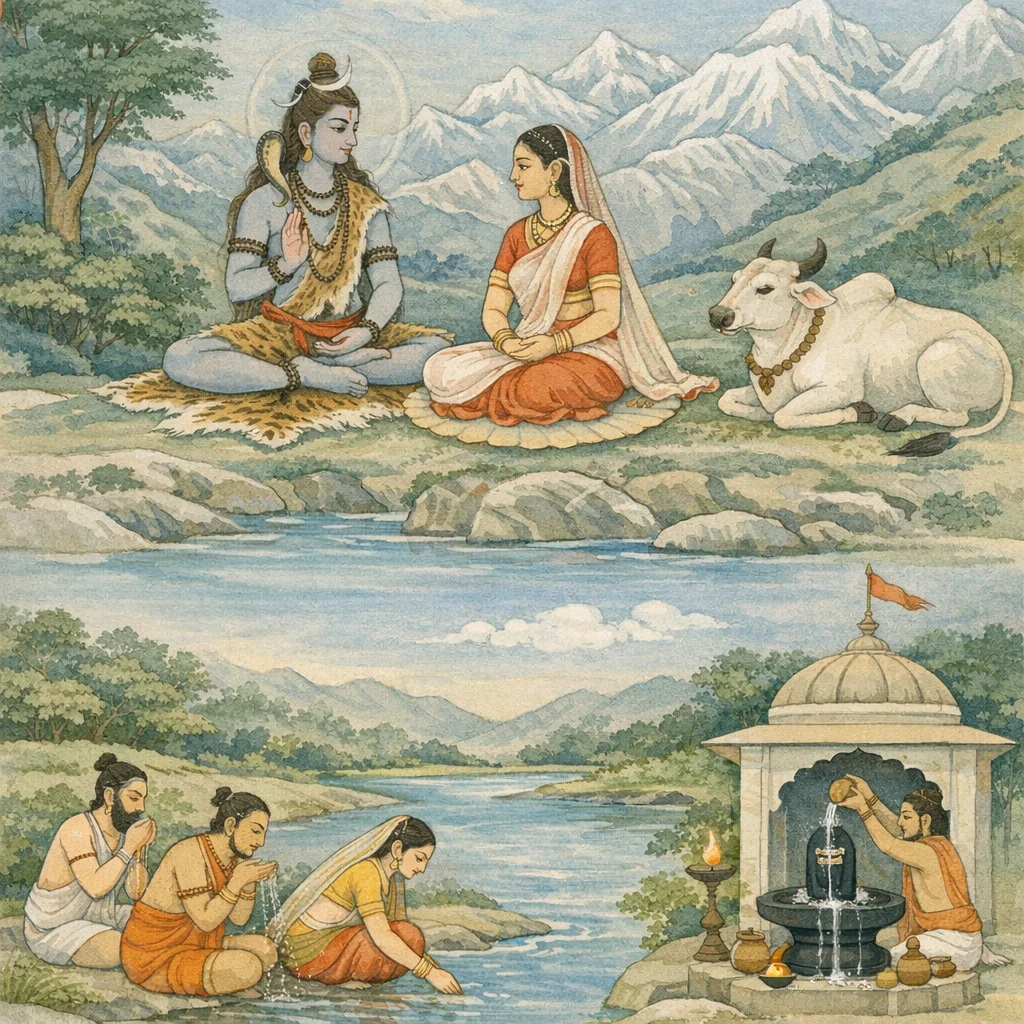
The rishis ask Suta Romaharshana how Mahadeva is to be worshipped as the Linga-murti. Suta establishes ritual authority by tracing the teaching lineage from Shiva’s instruction to Devi on Kailasa, through Nandi, to Sanatkumara and Vyasa. The chapter then prescribes snana as a sin-destroying prerequisite to Shiva-puja, describing three kinds—Varuna-snana, Agneya-snana, and Mantra-snana—followed by abhisheka with sanctified water and mantra recitations, including Rudra formulas and Panchabrahma/pavitraka elements. A key doctrinal point is stressed: inner purity (bhava) is decisive; without it, even sacred bathing bears no fruit. The sequence concludes with achamana, mantra-infused sipping for purification, and pradakshina to pacify himsa and papa, preparing the devotee to proceed into full Linga-archana.
Shlokas
Verse 1
ऋषय ऊचुः कथं पूज्यो महादेवो लिङ्गमूर्तिर्महेश्वरः वक्तुमर्हसि चास्माकं रोमहर्षण सांप्रतम्
The sages said: “O Romaharṣaṇa, tell us now how Mahādeva—Maheśvara whose very form is the Liṅga—should be worshipped.”
Verse 2
सूत उवाच देव्या पृष्टो महादेवः कैलासे तां नगात्मजाम् अङ्कस्थामाह देवेशो लिङ्गार्चनविधिं क्रमात्
Sūta said: When the Goddess questioned him on Kailāsa, Mahādeva—the Lord of the gods—spoke to Pārvatī, the mountain-born one seated upon his lap, and taught her in due order the rite of Liṅga worship.
Verse 3
तदा पार्श्वे स्थितो नन्दी शालङ्कायनकात्मजः श्रुत्वाखिलं पुरा प्राह ब्रह्मपुत्राय सुव्रताः
Then Nandī, the son of Śālaṅkāyana, standing at the side, heard it all and in former times related the whole of it to Brahmā’s son—O you of excellent vows.
Verse 4
सनत्कुमाराय शुभं लिङ्गार्चनविधिं परम् तस्माद्व्यासो महातेजाः श्रुतवाञ्छ्रुतिसंमितम्
To Sanatkumāra was taught the supreme and auspicious procedure of Liṅga worship; from him the mighty, radiant Vyāsa heard that instruction, in full accord with the spirit of the Vedas.
Verse 5
स्नानयोगोपचारं च यथा शैलादिनो मुखात् श्रुतवान् तत्प्रवक्ष्यामि स्नानाद्यं चार्चनाविधिम्
Having heard from Śailādi’s own lips the proper observances for the discipline of ritual bathing, I shall now set forth that very procedure—beginning with bathing—and the complete method of worship (arcana) for Śiva’s Liṅga, the Pati who loosens the bond (pāśa) of the paśu, the bound soul.
Verse 6
शैलादिरुवाच अथ स्नानविधिं वक्ष्ये ब्राह्मणानां हिताय च सर्वपापहरं साक्षाच् छिवेन कथितं पुरा
Śailādi said: “Now I shall declare the proper rite of sacred bathing, for the welfare of the brāhmaṇas—a practice that removes all sin, once taught directly by Śiva Himself.”
Verse 7
अनेन विधिना स्नात्वा सकृत्पूज्य च शङ्करम् ब्रह्मकूर्चं च पीत्वा तु सर्वपापैः प्रमुच्यते
Having bathed by this prescribed method, worshipped Śaṅkara even once, and then drunk the consecrated draught called brahma-kūrca, the bound soul (paśu) is freed from all sins—from those bonds (pāśa) that obstruct Śiva-realization.
Verse 8
त्रिविधं स्नानमाख्यातं देवदेवेन शंभुना हिताय ब्राह्मणाद्यानां चतुर्मुखसुतोत्तम
O best of the sons of the Four-faced Brahmā, Śambhu—the Lord of Lords—taught the threefold purificatory bath for the welfare of the brāhmaṇas and all other orders, so that embodied souls (paśu) may be cleansed of bonds (pāśa) and made fit for Śiva’s worship.
Verse 9
वारुणं पुरतः कृत्वा ततश्चाग्नेयमुत्तमम् मन्त्रस्नानं ततः कृत्वा पूजयेत्परमेश्वरम्
Having first performed the Varuṇa rite for purifying the water, and then the excellent Agni rite for purifying by fire, one should next undertake the mantra-bath; having done so, one should worship Parameśvara—Śiva, the Pati who frees the paśu from the bonds of pāśa.
Verse 10
भावदुष्टो ऽम्भसि स्नात्वा भस्मना च न शुध्यति भावशुद्धश्चरेच्छौचम् अन्यथा न समाचरेत्
One whose inner disposition (bhāva) is impure is not purified even by bathing in water or by applying sacred ash (bhasma). But one whose bhāva is pure should observe cleanliness (śauca); otherwise, it should not be done as mere outward display.
Verse 11
सरित्सरस्तडागेषु सर्वेष्व् आ प्रलयं नरः स्नात्वापि भावदुष्टश्चेन् न शुध्यति न संशयः
Even if a man bathes in every river, lake, and pond until the world’s dissolution, if his inner disposition is corrupted he is not purified—of this there is no doubt.
Verse 12
नृणां हि चित्तकमलं प्रबुद्धमभवद्यदा प्रसुप्तं तमसा ज्ञानभानोर्भासा तदा शुचिः
For men, when the lotus of the mind—long asleep in the darkness of tamas—awakens through the radiance of the Sun of Knowledge, then the inner being becomes purified.
Verse 13
मृच्छकृत्तिलपुष्पं च स्नानार्थं भसितं तथा आदाय तीरे निःक्षिप्य स्नानतीर्थे कुशानि च
Taking earth and clay, sesame and flowers, and likewise sacred ash (bhasma) meant for bathing, one should carry them to the bank and place them there; and at the bathing-ford (tīrtha) one should also set down kuśa grass. Thus the devotee prepares the means of purification before approaching Śiva—Pati, the Lord who loosens the pāśa-bonds of the paśu (soul).
Verse 14
प्रक्षाल्याचम्य पादौ च मलं देहाद्विशोध्य च द्रव्यैस्तु तीरदेशस्थैस् ततः स्नानं समाचरेत्
After washing the feet and performing ācamana, and after cleansing away bodily impurity, one should then properly undertake the sacred bath using the cleansing substances available at the riverbank—thus becoming fit for Śiva’s worship and for the Pati’s grace that loosens the pāśas binding the paśu.
Verse 15
उद्धृतासीतिमन्त्रेण पुनर्देहं विशोधयेत् मृदादाय ततश्चान्यद् वस्त्रं स्नात्वा ह्यनुल्बणम्
Using the mantra called “Uddhṛtāsīti,” one should again purify the body. Then, taking purifying earth (clay), and after bathing properly, one should put on another, clean and unsoiled garment.
Verse 16
गन्धद्वारां दुराधर्षाम् इति मन्त्रेण मन्त्रवित् कपिलागोमयेनैव खस्थेनैव तु लेपयेत्
Knowing the mantra, the adept should, while reciting the mantra that begins “gandhadvārāṁ durādharṣām,” smear the place of worship or the Linga-site with the dung of a tawny cow (kapilā), using only what is at hand.
Verse 17
पुनः स्नात्वा परित्यज्य तद्वस्त्रं मलिनं ततः शुक्लवस्त्रपरीधानो भूत्वा स्नानं समाचरेत्
Having bathed again, he should discard that soiled garment. Then, wearing clean white clothing, he should duly perform the purificatory bath, becoming fit to worship Pati (Lord Śiva), who loosens the bonds (pāśa) of the paśu (the embodied soul).
Verse 18
सर्वपापविशुद्ध्यर्थम् आवाह्य वरुणं तथा सम्पूज्य मनसा देवं ध्यानयज्ञेन वै भवम्
For purification from all sins, one should invoke Varuṇa; and having worshipped the Lord inwardly with the mind, one should adore Bhava (Śiva) through the sacrifice of meditation—the dhyāna-yajña.
Verse 19
आचम्य त्रिस्तदा तीर्थे ह्य् अवगाह्य भवं स्मरन् पुनराचम्य विधिवद् अभिमन्त्र्य महाजलम्
Having sipped sanctifying water (ācamana) three times, he should immerse himself in the sacred tīrtha, remembering Bhava (Śiva) while bathing. Then he should again perform ācamana and, according to rule, consecrate the abundant water with mantra.
Verse 20
अवगाह्य पुनस्तस्मिन् जपेद्वै चाघमर्षणम् तत्तोये भानुसोमाग्निमण्डलं च स्मरेद्वशी
After immersing again in that water, the disciplined practitioner should recite the Aghamarṣaṇa, the sin-dispelling mantra. And within that very water he should contemplate the circles of the Sun, the Moon, and Fire, bringing the senses under control; thus, by mantra and inner vision, the paśu is led from impurity toward Śiva’s purity.
Verse 21
आचम्य च पुनस्तस्माज् जलादुत्तीर्य मन्त्रवित् प्रविश्य तीर्थमध्ये तु पुनः पुण्यविवृद्धये
Having performed ācamana, the knower of mantras should again rise up from that water and re-enter the very midst of the sacred tīrtha once more, for the increase of merit—purifying the paśu (individual soul) through disciplined rite offered to Pati, Lord Śiva.
Verse 22
शृङ्गेण पर्णपुटकैः पालाशैः क्षालितैस् तथा सकुशेन सपुष्पेण जलेनैवाभिषेचयेत्
Using a horn as the pouring vessel, one should perform abhiṣeka of the Liṅga with water purified by washed Palāśa-leaf cups, accompanied by kuśa grass and flowers. Thus the devotee ritually bathes Pati in disciplined Śaiva worship, loosening the pāśa-bonds of the paśu.
Verse 23
रुद्रेण पवमानेन त्वरिताख्येन मन्त्रवित् तरत्समन्दीवर्गाद्यैस् तथा शान्तिद्वयेन च
The knower of mantras should promptly perform the pacificatory rite for Rudra using the Pavamāna and the Tvarita (swift-acting) formulas, along with the Taratsamandī group and related mantras, and also by employing the twofold Śānti—thus bringing appeasement and protection.
Verse 24
शान्तिधर्मेण चैकेन पञ्चब्रह्मपवित्रकैः तत्तन्मन्त्राधिदेवानां स्वरूपं च ऋषीन् स्मरन्
Practising the single discipline of pacification (śānti-dharma) and employing the purifying rites of the Five Brahmans (pañcabrahma), one should meditate upon the true forms of the presiding deities of each mantra and remember the seers (ṛṣis) connected with them—thus making the worship of the Liṅga faultless and fit to grant grace from Pati (Śiva) to the bound soul (paśu).
Verse 25
एवं हि चाभिषिच्याथ स्वमूर्ध्नि पयसा द्विजाः ध्यायेच्च त्र्यम्बकं देवं हृदि पञ्चास्यम् ईश्वरम्
Thus, after performing the ablution, O twice-born ones, you should also sprinkle milk upon your own head; then, meditating within the heart, contemplate the three-eyed God—Tryambaka, Īśvara, the Lord with five faces.
Verse 26
आचम्याचमनं कुर्यात् स्वसूत्रोक्तं समीक्ष्य च पवित्रहस्तः स्वासीनः शुचौ देशे यथाविधि
Having first sipped water for purification, one should perform ācamana exactly as enjoined in one’s own sūtra; with the hand made ritually pure, seated in a clean place, one should proceed according to the proper rule—thus becoming fit for the worship of Pati, Lord Śiva.
Verse 27
अभ्युक्ष्य सकुशं चापि दक्षिणेन करेण तु पिबेत्प्रक्षिप्य त्रिस्तोयं चक्री भूत्वा ह्यतन्द्रितः
Having first sprinkled the sanctifying water, and taking the kuśa-grass as well, he should drink with the right hand; then, after casting the water three times, he should become ‘cakrī’—moving in a ritual circuit—remaining ever vigilant and unheedful of distraction. Thus the rite proceeds toward the Lord (Pati), loosening the bonds (pāśa) of the embodied soul (paśu) through disciplined purity.
Verse 28
प्रदक्षिणं ततः कुर्याद् धिंसापापप्रशान्तये एवं संक्षेपतः प्रोक्तं स्नानाचमनमुत्तमम्
Thereafter, one should perform circumambulation to pacify the sin born of violence and injury. Thus, in brief, the supreme discipline of ritual bathing and ācamana has been taught.
Verse 29
सर्वेषां ब्राह्मणानां तु हितार्थे द्विजसत्तमाः
For the welfare of all the brāhmaṇas, the best among the twice-born acted with beneficent intent—upholding dharma that supports Śiva’s order in the world.
Frequently Asked Questions
The chapter enumerates Varuna-snana (invoking and honoring Varuna), Agneya-snana (fire-associated purification), and Mantra-snana (purification through consecrated water empowered by mantra), after which one proceeds to worship Parameshvara.
True shuddhi depends on awakened, clarified consciousness: if bhava is impure, bathing and even ash application do not purify; if bhava is pure, one should maintain proper shaucha and proceed according to vidhi.
The sequence includes repeated achamana, remembrance of Bhava (Shiva), mantra-empowerment of water, Aghamarshana-japa, mental visualization of Surya–Soma–Agni mandalas in the water, abhisheka with sanctified water (often with kusa and leaves), and concluding achamana with pradakshina.