Adhyaya 107
Upamanyu’s Tapas, Shiva’s Indra-Form Test, and the Bestowal of Kshiroda and Gaṇapatya
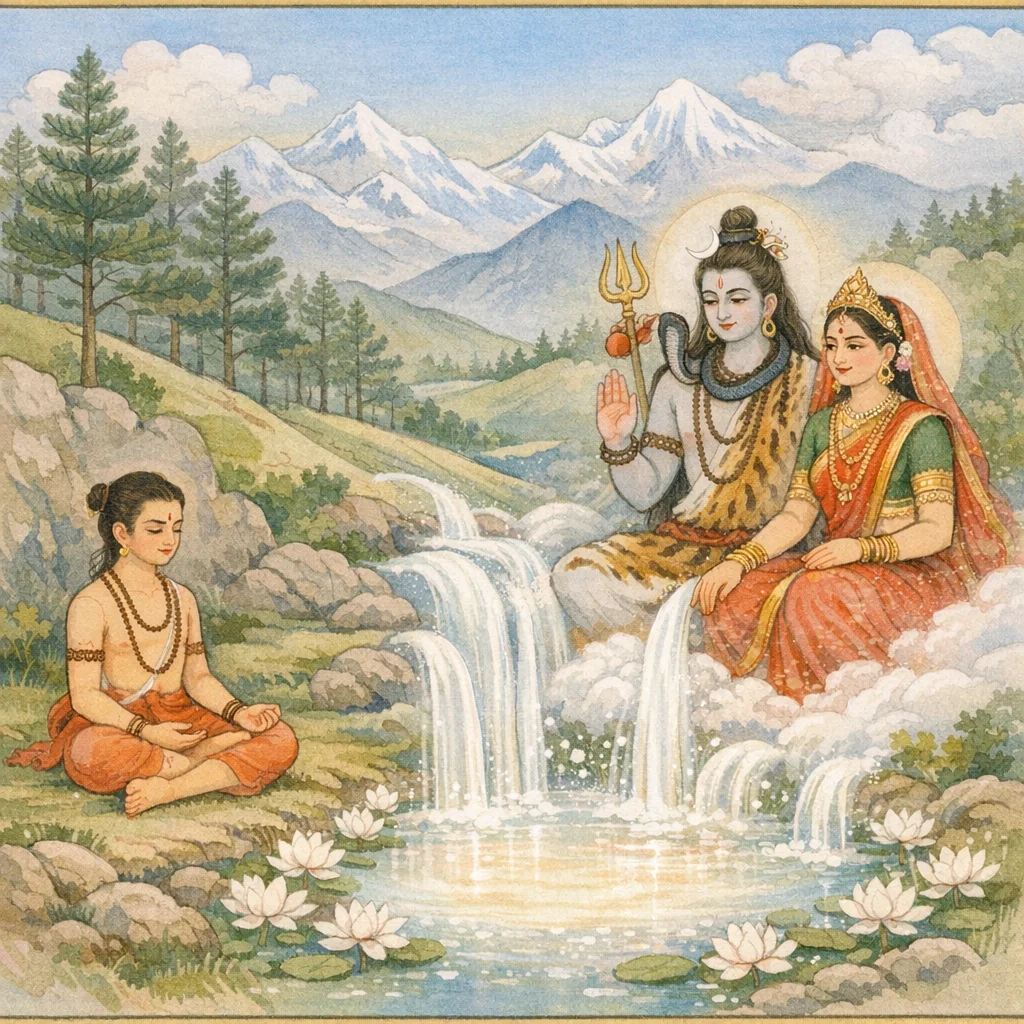
The rishis ask Suta how Upamanyu attained gaṇapatya and the boon of the milk-ocean. Suta tells how, as a child longing for milk, Upamanyu learned from his mother that prosperity comes from prior worship of Mahādeva and His present grace. Resolute, he performs fierce tapas in the Himalayas, shaking the worlds. Viṣṇu discovers the cause and approaches Śiva, who chooses to bless the boy but first tests him by appearing in Indra’s form. Offering boons while urging him to abandon Rudra, the Indra-form is exposed when Upamanyu chants the Pañcākṣarī, condemning Śiva-nindā as a grievous sin. As Upamanyu prepares to strike back with Atharva-astric power, Śiva restrains him, reveals His true form, and manifests vast oceans of milk and abundant foods. Śiva and Pārvatī adopt him with parental love, granting immortality, enduring gaṇapatya, yogaiśvarya, and brahma-vidyā. The chapter ends with Śiva disappearing after fulfilling the devotee’s unwavering request for steadfast faith and constant divine presence, showing how bhakti ripens into knowledge and liberation.
Shlokas
Verse 1
इति श्रीलिङ्गमहापुराणे पूर्वभागे शिवताण्डवकथनं नाम षडधिकशततमो ऽध्यायः ऋषय ऊचुः पुरोपमन्युना सूत गाणपत्यं महेश्वरात् क्षीरार्णवः कथं लब्धो वक्तुमर्हसि सांप्रतम्
Thus, in the Śrī Liṅga Mahāpurāṇa, in the Pūrva-bhāga, begins the one-hundred-and-seventh chapter called “The Account of Śiva’s Tāṇḍava.” The sages said: “O Sūta, how did Kṣīrārṇava (the Ocean of Milk) formerly obtain from Maheśvara the status of Gaṇapati-hood? Please explain this to us now.”
Verse 2
सूत उवाच एवं कालीम् उपालभ्य गते देवे त्रियंबके उपमन्युः समभ्यर्च्य तपसा लब्धवान्फलम्
Sūta said: Thus, having reproached Kāḷī, and when the Lord Tryambaka (Śiva) had departed, Upamanyu—having duly worshipped—attained the fruit through his austerity.
Verse 3
उपमन्युरिति ख्यातो मुनिश् च द्विजसत्तमाः कुमार इव तेजस्वी क्रीडमानो यदृच्छया
He was renowned as Upamanyu—an eminent sage among the best of the twice-born—radiant like a young boy, roaming and sporting of his own accord.
Verse 4
कदाचित् क्षीरम् अल्पं च पीतवान् मातुलाश्रमे ईर्ष्यया मातुलसुतो ह्य् अपिबत् क्षीरम् उत्तमम्
Once, while staying in his maternal uncle’s hermitage, he drank only a little milk; but the uncle’s son, driven by envy, drank up the finest milk instead. Thus the paśu-mind, bound by the pāśa of jealousy, turns away from sāttvika nourishment and falls into grasping.
Verse 5
पीत्वा स्थितं यथाकामं दृष्ट्वा प्रोवाच मातरम् मातर्मातर्महाभागे मम देहि तपस्विनि
After drinking and remaining as he wished, he looked at his mother and spoke: “Mother, mother—O greatly fortunate ascetic woman—grant it to me; give (me) what I ask.”
Verse 6
गव्यं क्षीरम् अतिस्वादु नाल्पमुष्णं नमाम्यहम् सूत उवाच उपलालितैवं पुत्रेण पुत्रम् आलिङ्ग्य सादरम्
“Cow’s milk—exceedingly sweet and not too hot—I reverently bow to it.” Sūta said: Thus fondled by his son, the father embraced his son with heartfelt regard.
Verse 7
दुःखिता विललापार्ता स्मृत्वा नैर्धन्यमात्मनः स्मृत्वा स्मृत्वा पुनः क्षीरम् उपमन्युरपि द्विजाः देहि देहीति तामाह रोदमानो महाद्युतिः
Afflicted with sorrow, she wailed in distress, remembering her own poverty. Again and again, remembering the milk, the radiant brahmin boy Upamanyu cried as he spoke to her: “Give it, give it!”
Verse 8
उञ्छवृत्त्यार्जितान् बीजान् स्वयं पिष्ट्वा च सा तदा बीजपिष्टं तदालोड्य तोयेन कलभाषिणी
Then she—sweet-voiced—took the grains gained by uñcha-vṛtti (gleaning), ground them with her own hands, and mixing that paste with water, prepared it as sustenance and as an offering, in disciplined austerity aligned with Pati (Śiva).
Verse 9
ऐह्येहि मम पुत्रेति सामपूर्वं ततः सुतम् आलिङ्ग्यादाय दुःखार्ता प्रददौ कृत्रिमं पयः
Crying, “Come, come—my son,” she first soothed him with gentle words; then, embracing and lifting her child, the grief-stricken mother gave him milk prepared as a substitute.
Verse 10
पीत्वा च कृत्रिमं क्षीरं मात्रा दत्तं द्विजोत्तमाः नैतत्क्षीरमिति प्राह मातरं चातिविह्वलः
O best of the twice-born, having drunk the artificial milk his mother gave, he grew greatly distressed and said to her, “This is not milk.”
Verse 11
दुःखिता सा तदा प्राह सम्प्रेक्ष्याघ्राय मूर्धनि संमार्ज्य नेत्रे पुत्रस्य कराभ्यां कमलायते
Then, stricken with sorrow, she spoke—gazing closely, smelling her son’s head, and with both hands wiping his eyes, making them open like lotuses.
Verse 12
तटिनी रत्नपूर्णास्ते स्वर्गपातालगोचराः भाग्यहीना न पश्यन्ति भक्तिहीनाश् च ये शिवे
Those rivers are filled with jewels and are accessible even to the realms of Svarga and Pātāla; yet the unfortunate do not behold them—those who are devoid of bhakti to Śiva.
Verse 13
राज्यं स्वर्गं च मोक्षं च भोजनं क्षीरसंभवम् न लभन्ते प्रियाण्येषां नो तुष्यति सदा भवः
They obtain neither kingdom, nor heaven, nor liberation—nor even nourishment born of milk. For such people nothing dear is gained, and Bhava (Śiva) is never pleased with them.
Verse 14
भवप्रसादजं सर्वं नान्यदेवप्रसादजम् अन्यदेवेषु निरता दुःखार्ता विभ्रमन्ति च
All attainments arise from the grace of Bhava (Śiva), not from the favor of other deities. Those devoted to other gods, afflicted by suffering, continue to wander in delusion.
Verse 15
क्षीरं तत्र कुतो ऽस्माकं महादेवो न पूजितः पूर्वजन्मनि यद्दत्तं शिवमुद्यम्य वै सुत
“Dear son, how could there be milk for us there, when in a former birth Mahādeva was not worshipped? Whatever was given then—only by taking up Śiva as the true refuge and striving with resolute effort, O son—does it bear auspicious fruit.”
Verse 16
तदेव लभ्यं नान्यत्तु विष्णुमुद्यम्य वा प्रभुम् निशम्य वचनं मातुर् उपमन्युर्महाद्युतिः
“That alone is to be attained—nothing else.” Having heard his mother’s words, Upamanyu of great splendor, resolved to seek the Lord Viṣṇu, set his effort toward the Supreme.
Verse 17
बालो ऽपि मातरं प्राह प्रणिपत्य तपस्विनीम् त्यज शोकं महाभागे महादेवो ऽस्ति चेत्क्वचित्
Even the boy, bowing down, spoke to his ascetic mother: “Cast off grief, O most fortunate one. If Mahādeva is anywhere at all, He is surely present (and able to protect).”
Verse 18
चिराद्वा ह्यचिराद्वापि क्षीरोदं साधयाम्यहम् सूत उवाच तां प्रणम्यैवमुक्त्वा स तपः कर्तुं प्रचक्रमे
“Whether after a long time or swiftly, I shall accomplish Kṣīroda, the Ocean of Milk.” Sūta said: Having bowed to her and spoken thus, he then set about performing tapas, sacred austerity.
Verse 19
तमाह माता सुशुभं कुर्विति सुतरां सुतम् अनुज्ञातस्तया तत्र तपस्तेपे सुदुस्तरम्
Then the mother said to her son, “Do what is most auspicious.” Granted her consent, he performed there an exceedingly arduous tapas—steadfast discipline aimed at the Highest Good; in Shaiva understanding, the paśu (bound soul) turns inward toward Pati (Śiva), loosening pāśa (bondage) through vow and purity.
Verse 20
हिमवत्पर्वतं प्राप्य वायुभक्षः समाहितः तपसा तस्य विप्रस्य विधूपितमभूज्जगत्
Having reached Mount Himavat, that Brahmin—living only on air and wholly collected in mind—performed such tapas that, by the force of his austerity, the entire world was shaken and stirred. In Shaiva Siddhānta terms, concentrated tapas can make the pāśa-bound cosmos tremble, while the true Pati alone remains unmoved.
Verse 21
प्रणम्याहुस्तु तत्सर्वे हरये देवसत्तमाः श्रुत्वा तेषां तदा वाक्यं भगवान्पुरुषोत्तमः
Having bowed down, all those best among the gods spoke to Hari. Then the Blessed Lord, the Supreme Person (Puruṣottama), having heard their words, prepared to reply.
Verse 22
किमिदं त्विति संचिन्त्य ज्ञात्वा तत्कारणं च सः जगाम मन्दरं तूर्णं महेश्वरदिदृक्षया
Reflecting, “What is this indeed?”, and having understood its cause, he swiftly went to Mount Mandara, longing to behold Mahēśvara—Śiva, the Pati (Lord) who alone dispels the pāśa (bondage) of the paśu (soul).
Verse 23
दृष्ट्वा देवं प्रणम्यैवं प्रोवाचेदं कृताञ्जलिः भगवन् ब्राह्मणः कश्चिद् उपमन्युरितिश्रुतः
Having beheld the Deva, he bowed down and, with hands joined in reverence, spoke: “O Bhagavān, there is a certain brāhmaṇa named Upamanyu, renowned by tradition.”
Verse 24
क्षीरार्थमदहत्सर्वं तपसा तं निवारय एतस्मिन्नन्तरे देवः पिनाकी परमेश्वरः शक्ररूपं समास्थाय गन्तुं चक्रे मतिं तदा
Seeking milk, he burned everything; restrain him by austerity. Meanwhile, the Lord—Pinākin, the Supreme Īśvara—assumed the form of Śakra (Indra) and then resolved to go forth.
Verse 25
अथ जगाम मुनेस्तु तपोवनं गजवरेण सितेन सदाशिवः सह सुरासुरसिद्धमहोरगैर् अमरराजतनुं स्वयमास्थितः
Then Sadāśiva went to the sage’s forest-hermitage of austerity, mounted upon a splendid white elephant, and accompanied by Devas, Asuras, Siddhas, and great serpents—Himself assuming the majestic form and splendor of the Lord of the immortals.
Verse 26
सहैव चारुह्य तदा द्विपं तं प्रगृह्य वालव्यजनं विवस्वान् /* वामेन शच्या सहितं सुरेन्द्रं करेण चान्येन सितातपत्रम्
Then Vivasvān (the Sun), mounting that splendid elephant, held aloft a yak-tail fan; with his left hand he attended Indra together with Śacī, and with his other hand he bore the white royal parasol—thus rendering divine honor in the celestial procession.
Verse 27
रराज भगवान् सोमः शक्ररूपी सदाशिवः सितातपत्रेण यथा चन्द्रबिंबेन मन्दरः
Bhagavān Soma shone resplendently, while Sadāśiva—assuming the form of Śakra (Indra)—appeared like Mount Mandara illumined by the moon’s orb, as though crowned by a white royal parasol.
Verse 28
आस्थायैवं हि शक्रस्य स्वरूपं परमेश्वरः जगामानुग्रहं कर्तुम् उपमन्योस् तदाश्रमम्
Thus, assuming the very form of Śakra (Indra), the Supreme Lord Parameśvara went to Upamanyu’s hermitage, intending to bestow grace.
Verse 29
तं दृष्ट्वा परमेशानं शक्ररूपधरं शिवम् प्रणम्य शिरसा प्राह मुनिर्मुनिवराः स्वयम्
Seeing the Supreme Lord—Śiva, the Parameśāna—who had assumed the form of Śakra (Indra), the sage, best among ascetics, bowed his head in reverence and then spoke of his own accord.
Verse 30
पावितश्चाश्रमश्चायं मम देवेश्वरः स्वयम् प्राप्तः शक्रो जगन्नाथो भगवान्भानुना प्रभुः
“This hermitage of mine has been sanctified; the Lord of the Devas has Himself arrived. Indra has come, and also the Lord of the worlds—Bhagavān Sūrya, the sovereign.”
Verse 31
एवमुक्त्वा स्थितं वीक्ष्य कृताञ्जलिपुटं द्विजम् प्राह गंभीरया वाचा शक्ररूपधरो हरः
Having spoken thus, Hara—bearing the form of Śakra (Indra)—looked upon the brāhmaṇa standing with palms joined in reverence, and then addressed him in a deep, solemn voice.
Verse 32
तुष्टो ऽस्मि ते वरं ब्रूहि तपसानेन सुव्रत ददामि चेप्सितान् सर्वान् धौम्याग्रज महामते
“I am pleased with you. Speak—choose a boon. By this austerity, O you of excellent vows; O wise elder brother of Dhaumya, I grant you all desired attainments.”
Verse 33
एवमुक्तस्तदा तेन शक्रेण मुनिसत्तमः वरयामि शिवे भक्तिम् इत्युवाच कृताञ्जलिः
Thus addressed by Śakra (Indra), the best of sages, with palms joined, replied: “I choose bhakti—devotion to Śiva.”
Verse 34
ततो निशम्य वचनं मुनेः कुपितवत्प्रभुः प्राह सव्यग्रमीशानः शक्ररूपधरः स्वयम्
Then, hearing the sage’s words, the Lord—Īśāna Himself, who had assumed the form of Śakra—spoke with an agitated mien, as though angered.
Verse 35
मां न जानासि देवर्षे देवराजानमीश्वरम् त्रैलोक्याधिपतिं शक्रं सर्वदेवनमस्कृतम्
“O divine seer, you do not recognize me—the king of the gods, the lordly ruler: Śakra (Indra), sovereign of the three worlds, to whom all the devas bow in reverence.”
Verse 36
मद्भक्तो भव विप्रर्षे मामेवार्चय सर्वदा ददामि सर्वं भद्रं ते त्यज रुद्रं च निर्गुणम्
“O best of Brahmins, become My devotee; worship Me alone at all times. I shall grant you every auspicious good. Renounce the notion of Rudra as merely nirguṇa (attribute-less) and adore Him as the supreme Pati—transcendent, yet graciously accessible to worship.”
Verse 37
ततः शक्रस्य वचनं श्रुत्वा श्रोत्रविदारणम् उपमन्युरिदं प्राह जपन् पञ्चाक्षरं शुभम्
Then, hearing Śakra’s ear-splitting words, Upamanyu replied while steadily repeating the auspicious five-syllabled mantra, anchoring his mind in Śiva, the Pati who cuts the bonds (pāśa) of the bound soul (paśu).
Verse 38
मन्ये शक्रस्य रूपेण नूनम् अत्रागतः स्वयम् कर्तुं दैत्याधमः कश्चिद् धर्मविघ्नं च नान्यथा
I think that some vile Daitya has surely come here in the very form of Śakra (Indra), of his own accord—only to create an obstruction to dharma, and for no other reason.
Verse 39
त्वयैव कथितं सर्वं भवनिन्दारतेन वै प्रसंगाद्देवदेवस्य निर्गुणत्वं महात्मनः
Indeed, you yourself have stated everything—being intent on censuring Bhava (Śiva). Yet, in the course of that very discussion, you have also revealed the nirguṇa nature of the Great Soul, the God of gods.
Verse 40
बहुनात्र किमुक्तेन मयाद्यानुमितं महत् भवान्तरकृतं पापं श्रुता निन्दा भवस्य तु
What is the use of saying much here? From the very outset I have clearly discerned a grave truth: the sin committed in another state of being has ripened—because the disparagement of Bhava (Lord Śiva) has been heard (and accepted).
Verse 41
श्रुत्वा निन्दां भवस्याथ तत्क्षणादेव संत्यजेत् स्वदेहं तं निहत्याशु शिवलोकं स गच्छति
Having heard the blasphemy of Bhava (Lord Śiva), he should abandon that body at that very instant; having swiftly slain his own body, he goes to Śiva’s world.
Verse 42
यो वाचोत्पाटयेज्जिह्वां शिवनिन्दारतस्य तु त्रिः सप्तकुलमुद्धृत्य शिवलोकं स गच्छति
Whoever, by a decisive act of restraint, tears out the tongue of one devoted to reviling Śiva—having delivered three times seven generations of his lineage—attains Śiva’s world.
Verse 43
आस्तां तावन्ममेच्छायाः क्षीरं प्रति सुराधमम् निहत्य त्वां शिवास्त्रेण त्यजाम्येतत्कलेवरम्
Let my own desire concerning the Milk-Ocean be set aside. O basest among the gods! After striking you down with the Śivāstra, Śiva’s divine weapon, I shall abandon this body.
Verse 44
पुरा मात्रा तु कथितं तथ्यमेव न संशयः पूर्वजन्मनि चास्माभिर् अपूजित इति प्रभुः
“What my mother told me long ago is indeed true—there is no doubt. In a former birth we did not worship the Lord (Pati); therefore this consequence has arisen,” said the master.
Verse 45
एवमुक्त्वा तु तं देवम् उपमन्युरभीतवत् शक्रं चक्रे मतिं हन्तुम् अथर्वास्त्रेण मन्त्रवित्
Having spoken thus to that god, Upamanyu—fearless and skilled in mantras—resolved to shatter Śakra’s intent by means of the Atharvāstra, the Atharvan weapon.
Verse 46
भस्माधारान्महातेजा भस्ममुष्टिं प्रगृह्य च अथर्वास्त्रं ततस्तस्मै ससर्ज च ननाद च
Then the greatly resplendent one, taking a fistful of bhasma—sacred ash—from the ash-receptacle, unleashed the Atharvāstra against him and roared aloud.
Verse 47
दग्धुं स्वदेहम् आग्नेयीं ध्यात्वा वै धारणां तदा अतिष्ठच्च महातेजाः शुष्केन्धनमिवाव्ययः
Then, meditating upon the Agneyī dhāraṇā—the fiery yogic fixation meant to burn away one’s bodily limitation—he stood forth in immense radiance, like dry fuel ablaze, yet inwardly unspent and undiminished.
Verse 48
एवं व्यवसिते विप्रे भगवान्भगनेत्रहा वारयामास सौम्येन धारणां तस्य योगिनः
O Brahmin, when he had thus resolved, the Blessed Lord—Bhaganetra-hā—gently restrained the yogin’s dhāraṇā (fixed inner concentration), tempering it with compassionate calm.
Verse 49
अथर्वास्त्रं तदा तस्य संहृतं चन्द्रकेण तु कालाग्निसदृशं चेदं नियोगान्नन्दिनस् तथा
Then his Atharva-weapon—though resembling the fire of time at dissolution—was restrained and withdrawn by Candraka, in accordance with Nandin’s command. Thus the terrible missile was pacified by Śaiva authority.
Verse 50
स्वरूपमेव भगवान् आस्थाय परमेश्वरः दर्शयामास विप्राय बालेन्दुकृतशेखरम्
Assuming His very own essential form, the Blessed Supreme Lord revealed Himself to the Brahmin—Mahādeva, whose crest is adorned with the newly risen crescent moon.
Verse 51
स्छ्लरफ़्फ़ेन्लन्द् क्षीरधारासहस्रं च क्षीरोदार्णवमेव च दध्यादेरर्णवं चैव घृतोदार्णवमेव च
There are thousands of streaming currents of milk, and indeed an ocean of milk as well—an ocean of curd (dadhi) and the like, and likewise an ocean of ghee (ghṛta). Thus the realm is portrayed as overflowing with auspicious sacrificial substances that sustain purity and worship of the Pati (Lord Shiva).
Verse 52
फलार्णवं च बालस्य भक्ष्यभोज्यार्णवं तथा अपूपगिरयश्चैव तथातिष्ठन् समन्ततः
For that divine Child, there appeared an ocean of fruits, an ocean of foods fit to be eaten and savoured, and mountains of sweet cakes (apūpa); thus they stood all around on every side as abundant offerings—signs of Śiva’s grace that loosens the Pāśas and nourishes the bound soul (Paśu) on the path to the Pati.
Verse 53
उपमन्युमुवाच सस्मितो भगवान्बन्धुजनैः समावृतम् गिरिजाम् अवलोक्य सस्मितां सघृणं प्रेक्ष्यतु तं तदा घृणी
Upamanyu said: Then the compassionate Lord, smiling, beheld Girijā (Pārvatī) surrounded by her kinsfolk; seeing her too smiling, He gazed upon her with tender mercy—He, the Merciful One.
Verse 54
भुङ्क्ष्व भोगान्यथाकामं बान्धवैः पश्य वत्स मे /* उपमन्यो महाभाग तवांबैषा हि पार्वती
“Enjoy the rightful pleasures as you wish, my child, and behold them together with your kinsmen. O Upamanyu, greatly fortunate—this indeed is your Mother: Pārvatī.”
Verse 55
मया पुत्रीकृतो ऽस्यद्य दत्तः क्षीरोदधिस् तथा मधुनश्चार्णवश्चैव दध्नश्चार्णव एव च
“Today I have accepted him as a son and bestowed upon him the Ocean of Milk; likewise the ocean of honey, and indeed the ocean of curd (dadhi) as well.”
Verse 56
आज्योदनार्णवश्चैव फललेह्यार्णवस् तथा अपूपगिरयश्चैव भक्ष्यभोज्यार्णवः पुनः
There are indeed oceans of rice mixed with ghee, oceans of fruits and sweet linctus (lehya), mountains of ritual cakes (apūpa), and again an ocean of all foods—edibles and cooked offerings—manifest as the fruit of meritorious giving and worship.
Verse 57
पिता तव महादेवः पिता वै जगतां मुने माता तव महाभागा जगन्माता न संशयः
O sage, Mahādeva is your father—indeed the Father of all the worlds. And your most fortunate Mother is the World-Mother herself; of this there is no doubt.
Verse 58
अमरत्वं मया दत्तं गाणपत्यं च शाश्वतम् वरान्वरय दास्यामि नात्र कार्या विचारणा
“I have granted you immortality and the everlasting station of being among My Gaṇas. Choose further boons; I shall bestow them—there is no need for hesitation or deliberation here.”
Verse 59
एवमुक्त्वा महादेवः कराभ्यामुपगृह्य तम् आघ्राय मूर्धनि विभुर् ददौ देव्यास्तदा भवः
Having spoken thus, Mahādeva—Bhava, the all-pervading Lord—took him in both hands, gently inhaled his scent at the crown of his head, and then placed him upon the Goddess’s crown, affirming Śiva’s sovereign grace within the Śiva–Śakti unity.
Verse 60
देवी तनयमालोक्य ददौ तस्मै गिरीन्द्रजा योगैश्वर्यं तदा तुष्टा ब्रह्मविद्यां द्विजोत्तमाः
O best of the twice-born, the Goddess—Girīndrajā (Pārvatī)—seeing her son, was pleased and bestowed upon him the lordly attainments of Yoga, along with Brahma-vidyā, the liberating knowledge that leads the bound soul (paśu) toward freedom under the grace of the Lord (Pati).
Verse 61
सो ऽपि लब्ध्वा वरं तस्याः कुमारत्वं च सर्वदा तुष्टाव च महादेवं हर्षगद्गदया गिरा
Having thus obtained her boon—that she would remain ever in youthful maidenhood—he too praised Mahādeva, his voice trembling with joy. In Śaiva understanding, the fruit of grace (anugraha) culminates in stuti and surrender to Pati, the Lord who loosens the pāśa of limitation.
Verse 62
वरयामास च तदा वरेण्यं विरजेक्षणम् कृताञ्जलिपुटो भूत्वा प्रणिपत्य पुनः पुनः
Then, with palms joined in reverence, he repeatedly bowed down and implored that most adorable One—Śiva, the stainless-eyed Lord—seeking a boon.
Verse 63
प्रसीद देवदेवेश त्वयि चाव्यभिचारिणी श्रद्धा चैव महादेव सान्निध्यं चैव सर्वदा
Be gracious, O Lord of the gods. May unwavering faith in You arise in me; and, O Mahādeva, may Your sacred nearness—Your abiding presence—be with me always.
Verse 64
एवमुक्तस्तदा तेन प्रहसन्निव शङ्करः दत्त्वेप्सितं हि विप्राय तत्रैवान्तरधीयत
Thus addressed by him, Śaṅkara, as though gently smiling, granted the brahmana the desired boon; and right there, the Lord disappeared from sight—revealing that Pati bestows grace by His mere will and is not bound by any form.
Frequently Asked Questions
It functions as the devotee’s inner refuge and discernment: Upamanyu chants the Panchākṣarī while rejecting inducements to abandon Rudra, demonstrating that mantra-based Shiva-bhakti protects the practitioner against deception and doctrinal deviation.
The text treats Shiva-nindā as a spiritually catastrophic act: hearing or participating in it is portrayed as leading to immediate downfall, while forcefully opposing it is praised as elevating one toward Shiva-loka—underscoring the ethic of guarding sacred speech (vāṇī) in Shaiva practice.