Adhyaya 102
मदनदाहः — पार्वतीतपः, स्वयंवरलीला, देवस्तम्भनं, दिव्यचक्षुर्दानम्
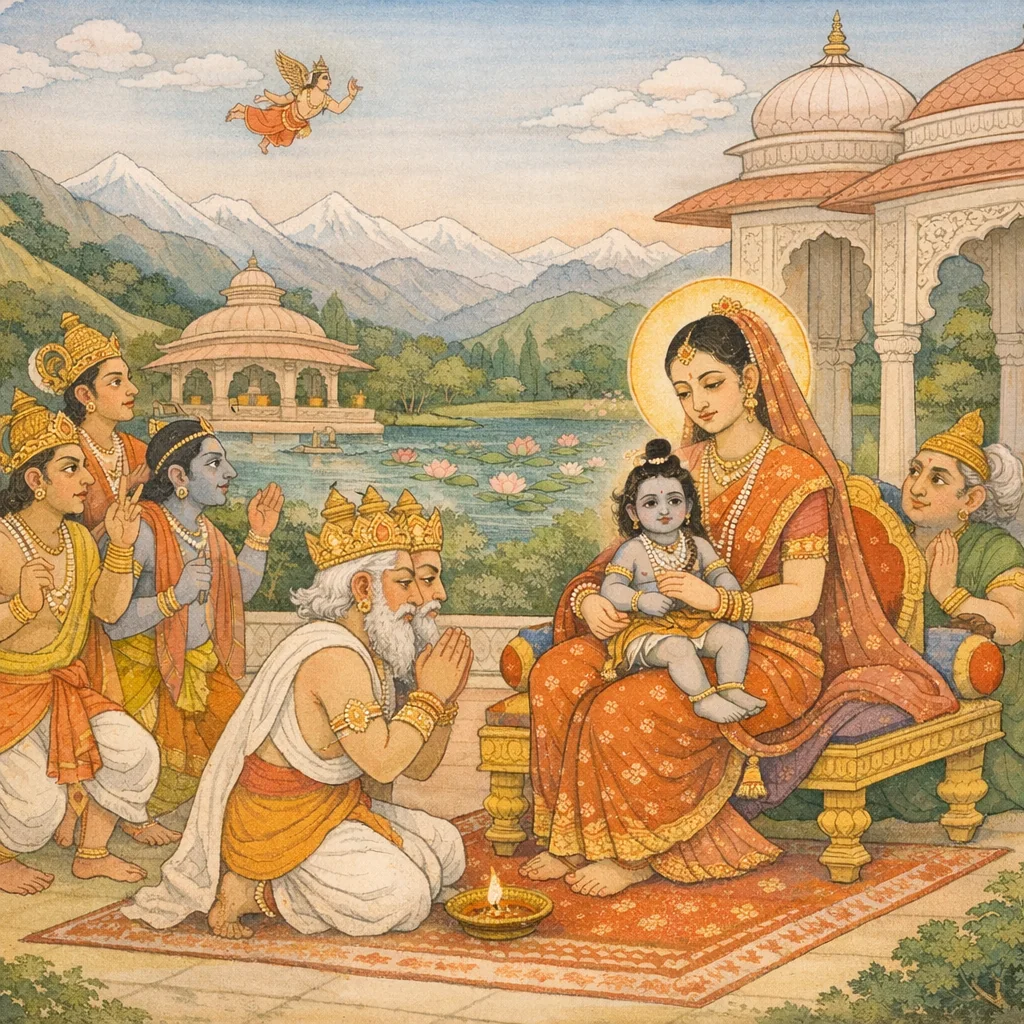
Sūta recounts that Pārvatī’s tapas delights Śiva. Brahmā comes to her hermitage, urging her to stop the world-heating austerities and affirming that Śiva himself will choose her. Śiva then arrives in disguise as a dvija, consoles Pārvatī, and promises to appear at her svayaṃvara in a gentle form. Himālaya proclaims the svayaṃvara; devas, ṛṣis, gandharvas, yakṣas, nāgas, and cosmic principles assemble. As Pārvatī sits adorned, Śiva becomes a child and lies in her lap, provoking the devas to doubt and attack. Indra, Agni, Yama, Varuṇa, Vāyu, Soma, Kubera, Īśāna, the Rudras, Ādityas, Vasus, and even Viṣṇu with his cakra are “stambhita” (frozen) by Śiva’s mere play; Pūṣan loses his teeth by Śiva’s glance. Brahmā realizes the truth, praises Śiva as the source of buddhi and ahaṅkāra and as the origin of Brahmā–Viṣṇu and Prakṛti/Devī, and begs mercy for the deluded gods. Śiva releases them, reveals a wondrous divine form, grants divya-cakṣus (spiritual vision) so they may behold him, and is worshipped with flowers, drums, hymns, and Pārvatī’s garland—carrying the narrative toward the sanctified union and reaffirming Śiva’s supremacy over all cosmic orders.
Shlokas
Verse 1
इति श्रीलिङ्गमहापुराणे पूर्वभागे मदनदाहो नामैकाधिकशततमो ऽध्यायः सूत उवाच तपसा च महादेव्याः पार्वत्या वृषभध्वज प्रीतिश् च भगवाञ्छर्वो वचनाद्ब्रह्मणस्तदा
Thus, in the revered Liṅga Mahāpurāṇa, in the Pūrvabhāga, begins the one-hundred-and-second chapter called “The Burning of Madana (Kāma).” Sūta said: “O Vṛṣabhadhvaja (Bannered by the Bull), by the austerity of Mahādevī Pārvatī, and then by Brahmā’s entreaty, the Blessed Lord Śarva (Śiva) became pleased.”
Verse 2
हिताय चाश्रमाणां च क्रीडार्थं भगवान्भवः तदा हैमवतीं देवीम् उपयेमे यथाविधि
For the welfare of the āśramas and also for divine play, the Blessed Bhava (Śiva) then, according to proper rite, accepted the Goddess Haimavatī (Pārvatī) in marriage.
Verse 3
जगाम स स्वयं ब्रह्मा मरीच्याद्यैर्महर्षिभिः तपोवनं महादेव्याः पार्वत्याः पद्मसंभवः
Then Brahmā himself—the Lotus-born—set out with the great seers beginning with Marīci, and went to the sacred forest of austerities belonging to Mahādevī Pārvatī.
Verse 4
प्रदक्षिणीकृत्य च तां देवीं स जगतो ऽरणीम् किम् अर्थं तपसा लोकान् संतापयसि शैलजे
Having circumambulated that Goddess—the araṇī, the churning-stick of the universe—he said: “O daughter of the mountain, for what purpose do you scorch the worlds by your austerity?”
Verse 5
त्वया सृष्टं जगत्सर्वं मातस्त्वं मा विनाशय त्वं हि संधारयेल्लोकान् इमान् सर्वान् स्वतेजसा
By you this entire universe has been brought forth, O Mother—do not destroy me. For you indeed sustain all these worlds by your own innate tejas, radiant power.
Verse 6
सर्वदेवेश्वरः श्रीमान् सर्वलोकपतिर्भवः यस्य वै देवदेवस्य वयं किङ्करवादिनः
Glorious Bhava—Lord over all the gods and sovereign of all the worlds—of that God of gods we are but servants, speaking only as his attendants.
Verse 7
स एवं परमेशानः स्वयं च वरयिष्यति वरदे येन सृष्टासि न विना यस्त्वयांबिके
That very Parameśāna—the Supreme Lord, self-sovereign—will Himself choose and grant the boon, O bestower of boons. For it is by Him that you were manifested; and without you, O Ambikā, He does not act.
Verse 8
वर्तते नात्र संदेहस् तव भर्त्ता भविष्यति इत्युक्त्वा तां नमस्कृत्य मुहुः सम्प्रेक्ष्य पार्वतीम्
“There is no doubt in this: your husband will surely come to be.” Saying so, he bowed to her, and again and again looked upon Pārvatī with reverent attention.
Verse 9
गते पितामहे देवो भगवान् परमेश्वरः जगामानुग्रहं कर्तुं द्विजरूपेण चाश्रमम्
When Pitāmaha (Brahmā) had departed, the Blessed Lord Parameśvara—the Supreme—went to the hermitage in the form of a brāhmaṇa, intending to bestow grace.
Verse 10
सा च दृष्ट्वा महादेवं द्विजरूपेण संस्थितम् प्रतिभाद्यैः प्रभुं ज्ञात्वा ननाम वृषभध्वजम्
And she, seeing Mahādeva abiding in the guise of a twice-born (brāhmaṇa), recognized the Lord through her inner intuitive signs, and bowed down to Vṛṣabhadhvaja—Śiva whose banner bears the bull.
Verse 11
सम्पूज्य वरदं देवं ब्राह्मणच्छद्मनागतम् तुष्टाव परमेशानं पार्वती परमेश्वरम्
Having duly worshipped the boon‑granting Deva who had arrived disguised as a brāhmaṇa, Pārvatī praised Parameśāna—Parameśvara, the Supreme Lord, who loosens the pāśa-bonds of the paśu (soul).
Verse 12
अनुगृह्य तदा देवीम् उवाच प्रहसन्निव कुलधर्माश्रयं रक्षन् भूधरस्य महात्मनः
Then, having shown grace to the Goddess, he spoke with a gentle, almost smiling demeanor—upholding the refuge of family-duty (kula-dharma) and safeguarding the great-souled Lord of the Mountain.
Verse 13
क्रीडार्थं च सतां मध्ये सर्वदेवपतिर्भवः स्वयंवरे महादेवी तव दिव्यसुशोभने
For the sake of divine sport, in the midst of the noble ones, Bhava—Lord of all the gods—appeared at your svayaṃvara, O Mahādevī, in radiant, celestial splendor.
Verse 14
आस्थाय रूपं यत्सौम्यं समेष्ये ऽहं सह त्वया इत्युक्त्वा तां समालोक्य देवो दिव्येन चक्षुषा
Assuming a gentle and auspicious form, the Deva said, “I shall unite with you.” Having spoken thus, he beheld her with his divine sight.
Verse 15
जगामेष्टं तदा दिव्यं स्वपुरं प्रययौ च सा दृष्ट्वा हृष्टस्तदा देवीं मेनया तुहिनाचलः
Then she went to her desired, divine abode—she returned to her own city. Seeing the Goddess, the lord of the Snowy Mountain (Himālaya), together with Menā, became joyful.
Verse 16
आलिङ्ग्याघ्राय सम्पूज्य पुत्रीं साक्षात्तपस्विनीम् दुहितुर्देवदेवेन न जानन्नभिमन्त्रितम्
Embracing her, smelling her head, and honoring her fully—his own daughter, a manifest ascetic—he did not realize she had been consecrated and blessed by the Lord of Lords, for Deva-deva had veiled it from him.
Verse 17
स्वयंवरं तदा देव्याः सर्वलोकेष्वघोषयत् अथ ब्रह्मा च भगवान् विष्णुः साक्षाज्जनार्दनः
Then the Goddess’s svayaṃvara was proclaimed throughout all the worlds. Thereupon Brahmā and Bhagavān Viṣṇu—Janārdana himself in person—also came.
Verse 18
शक्रश् च भगवान् वह्निर् भास्करो भग एव च त्वष्टार्यमा विवस्वांश् च यमो वरुण एव च
And Śakra (Indra), the venerable Vahni (Agni), Bhāskara (the Sun), and Bhaga; likewise Tvaṣṭṛ, Aryaman, Vivasvān, Yama, and Varuṇa—all abide within the Lord’s ordinance, working as His cosmic powers in the ordered governance of creation.
Verse 19
वायुः सोमस्तथेशानो रुद्राश् च मुनयस् तथा अश्विनौ द्वादशादित्या गन्धर्वा गरुडस् तथा
Vāyu, Soma, and Īśāna; the Rudras and the sages; the two Aśvins, the twelve Ādityas, the Gandharvas, and Garuḍa as well—these are all counted among the divine hosts established in the cosmic order under the Lord (Pati).
Verse 20
यक्षाः सिद्धास्तथा साध्या दैत्याः किंपुरुषोरगाः समुद्राश् च नदा वेदा मन्त्राः स्तोत्रादयः क्षणाः
Yakṣas, Siddhas and Sādhyas; Daityas, Kiṃpuruṣas and serpentine beings; the oceans and rivers; the Vedas; mantras and hymns—and even the fleeting moments of time—all are encompassed within and dependent upon the Supreme Lord, Pati, who transcends yet pervades the whole display of creation.
Verse 21
नागाश् च पर्वताः सर्वे यज्ञाः सूर्यादयो ग्रहाः त्रयस्त्रिंशच्च देवानां त्रयश् च त्रिशतं तथा
Nāgas, all mountains, the sacrificial rites (Yajñas), and the planets beginning with the Sun—along with the thrice‑eleven deities and likewise the three hundred and three divine hosts—are all included in this sacred enumeration. Thus the entire cosmic order is gathered as belonging to the domain governed by Pati, Lord Śiva, who alone transcends and upholds all such categories.
Verse 22
त्रयश् च त्रिसहस्रं च तथान्ये बहवः सुरा जग्मुर् गिरीन्द्रपुत्र्यास्तु स्वयंवरमनुत्तमम्
Three and three thousand, and many other devas as well, proceeded to the unsurpassed svayaṃvara of Girirāja’s daughter—an event that foreshadows the supreme union of Śiva and Śakti, the very axis of liberation where Pati draws the paśu beyond the pāśa.
Verse 23
अथ शैलसुता देवी हैममारुह्य शोभनम् विमानं सर्वतोभद्रं सर्वरत्नैर् अलंकृतम्
Then the Goddess, the Mountain-born (Śailasutā), mounted a splendid golden vimāna, auspicious on every side, adorned with every kind of jewel.
Verse 24
अप्सरोभिः प्रनृत्ताभिः सर्वाभरणभूषितैः गन्धर्वसिद्धैर्विविधैः किन्नरैश् च सुशोभनैः
Delighted Apsarases danced, radiant with every ornament; and with many kinds of Gandharvas and Siddhas, along with graceful Kinnaras, the divine assembly shone in celebration of the Lord (Pati).
Verse 25
बन्दिभिः स्तूयमाना च स्थिता शैलसुता तदा सितातपत्रं रत्नांशुमिश्रितं चावहत्तथा
Then Śailasutā (Pārvatī) stood there, praised by the bards, and was fanned and shaded by a white royal parasol, gleaming with the radiance of jewels.
Verse 26
मालिनी गिरिपुत्र्यास्तु संध्या पूर्णेन्दुमण्डलम् चामरासक्तहस्ताभिर् दिव्यस्त्रीभिश् च संवृता
For Giriputrī (Pārvatī), Mālinī stood like her sacred saṃdhyā, radiant as the circle of the full moon, while celestial women surrounded the Goddess, their hands engaged in fanning her with chamara-whisks.
Verse 27
मालां गृह्य जया तस्थौ सुरद्रुमसमुद्भवाम् विजया व्यजनं गृह्य स्थिता देव्याः समीपगा
Taking up a garland born of the celestial wish-fulfilling tree, Jaya stood ready; and Vijaya, taking a fan, remained nearby in attendance upon the Goddess—thus was shown the ordered service that honors Śiva-Śakti.
Verse 28
मालां प्रगृह्य देव्यां तु स्थितायां देवसंसदि शिशुर्भूत्वा महादेवः क्रीडार्थं वृषभध्वजः
In the assembly of the gods, while the Goddess stood present, Mahādeva—He whose banner bears the bull—took up a garland and, becoming like a child, engaged in divine play for sport.
Verse 29
उत्सङ्गतलसंसुप्तो बभूव भगवान्भवः अथ दृष्ट्वा शिशुं देवास् तस्या उत्संगवर्त्तिनम्
Lord Bhava (Śiva) lay fast asleep upon her lap. Then the Devas, beholding the child resting in her embrace, looked on in wonder—recognizing the hidden Pati who, by His own māyā, appears as an infant while remaining the supreme Lord who loosens the pāśas of the paśus.
Verse 30
को ऽयम् अत्रेति संमन्त्र्य चुक्षुभुश् च समागताः वज्रमाहारयत्तस्य बाहुम् उद्यम्य वृत्रहा
Consulting among themselves—“Who is this here?”—they gathered in agitation. Then Vṛtrahā (Indra), raising his arm, brought down the thunderbolt upon him.
Verse 31
स बाहुरुद्यमस्तस्य तथैव समुपस्थितः स्तम्भितः शिशुरूपेण देवदेवेन लीलया
As he raised his arm and advanced, he was instantly checked—stilled in that very posture—by the Lord of gods, who, in playful sport, appeared in the form of a child.
Verse 32
वज्रं क्षेप्तुं न शशाक बाहुं चालयितुं तथा वह्निः शक्तिं तथा क्षेप्तुं न शशाक तथा स्थितः
Indra could not hurl his thunderbolt, nor could he even stir his arm; likewise Agni, standing thus, could not cast his spear-like power. In the presence of the Supreme Lord (Pati), the instruments of the gods became ineffectual.
Verse 33
यमो ऽपि दण्डं खड्गं च निरृतिर्मुनिपुङ्गवाः वरुणो नागपाशं च ध्वजयष्टिं समीरणः
O best of sages, Yama bears the staff of punishment and the sword; Nirṛti too is assigned her weapon; Varuṇa holds the serpent-noose; and Samīraṇa (Vāyu) bears the banner-staff—thus are the divine insignia arranged within Śiva’s cosmic ordinance.
Verse 34
सोमो गदां धनेशश् च दण्डं दण्डभृतां वरः ईशानश् च तथा शूलं तीव्रमुद्यम्य संस्थितः
Soma stood grasping a mace; Dhanesha (Kubera), foremost among bearers of the rod of authority, held aloft his staff; and Īśāna, raising a fierce trident, took his stand—ready for the divine engagement. In Shaiva understanding, these weapons signify the Lord’s governance over pāśa (bondage) and the protection of the paśu (the bound soul) under the sovereignty of Pati, Śiva.
Verse 35
रुद्राश् च शूलमादित्या मुशलं वसवस् तथा मुद्गरं स्तम्भिताः सर्वे देवेनाशु दिवौकसः
The Rudras raised their tridents; the Ādityas took up clubs; and the Vasus likewise lifted mallets—yet all those dwellers of heaven were swiftly checked and immobilized by that Deva (the Supreme Lord), revealing Him as Pati who alone subdues every power.
Verse 36
स्तम्भिता देवदेवेन तथान्ये च दिवौकसः शिरः प्रकम्पयन् विष्णुश् चक्रम् उद्यम्य संस्थितः
Checked and immobilized by the God of gods, the other celestials too were held fast. Then Viṣṇu—shaking his head in astonishment—stood poised, raising up his discus.
Verse 37
तस्यापि शिरसो बालः स्थिरत्वं प्रचकार ह चक्रं क्षेप्तुं न शशाक बाहूंश्चालयितुं न च
Even the hair upon his head made him rigid and motionless. He was unable to hurl the discus, and he could not even move his arms.
Verse 38
पूषा दन्तान् दशन् दन्तैर् बालमैक्षत मोहितः तस्यापि दशनाः पेतुर् दृष्टमात्रस्य शंभुना
Pūṣan, bewildered, clenched his teeth and stared at the child; yet the moment Śambhu merely cast His glance, Pūṣan’s own teeth fell out. Thus is the Pati (Lord) unconquerable—bondage (pāśa) collapses by His will alone.
Verse 39
बलं तेजश् च योगं च तथैवास्तम्भयद् विभुः अथ तेषु स्थितेष्वेव मन्युमत्सु सुरेष्वपि
Then the all-pervading Lord (Pati), the Supreme Master, immobilized their strength, their radiance, and even their yogic power. And when those gods—though still present—stood thus checked, even while filled with wrath, they could do nothing.
Verse 40
ब्रह्मा परमसंविग्नो ध्यानमास्थाय शङ्करम् बुबुधे देवमीशानम् उमोत्संगे तमास्थितम्
Brahmā, utterly shaken, entered into meditation upon Śaṅkara. Through that contemplative absorption he came to know the Lord—Īśāna—abiding there, seated upon Umā’s lap.
Verse 41
स बुद्ध्वा देवमीशानं शीघ्रम् उत्थाय विस्मितः ववन्दे चरणौ शंभोर् अस्तुवच्च पितामहः
Recognizing that the Deity was Īśāna, he quickly rose, astonished, bowed at Śambhu’s feet, and then Pitāmaha (Brahmā) offered hymns of praise.
Verse 42
बुद्धिस्त्वं सर्वलोकानाम् अहङ्कारस् त्वम् ईश्वरः भूतानामिन्द्रियाणां च त्वमेवेश प्रवर्त्तकः
You are the buddhi (illuminating intelligence) of all worlds; You are the very ahaṅkāra, O Lord. And for all beings and their senses, O Īśa, You alone are the impelling initiator—the inner Pati who sets their functions in motion.
Verse 43
तवाहं दक्षिणाद्धस्तात् सृष्टः पूर्वं पुरातनः वामहस्तान् महाबाहो देवो नारायणः प्रभुः
From Your right hand I was first brought forth in the ancient beginning; and from Your left hand, O mighty-armed One, the Lord Nārāyaṇa—the ruling Deva—was manifested.
Verse 44
इयं च प्रकृतिर्देवी सदा ते सृष्टिकारण पत्नीरूपं समास्थाय जगत्कारणमागता
This very Goddess Prakṛti is ever Your inseparable cause of creation; assuming the form of Your consort, she has come forth as the causal basis of the universe.
Verse 45
नमस्तुभ्यं महादेव महादेव्यै नमोनमः प्रसादात्तव देवेश नियोगाच्च मया प्रजाः
Salutations to You, O Mahādeva; repeated salutations to the Great Goddess. O Lord of the Devas, it is by Your grace—and by Your divine command—that these beings, the progeny, have been brought forth by me.
Verse 46
देवाद्यास्तु इमाः सृष्टा मूढास्त्वद्योगमोहिताः कुरु प्रसादमेतेषां यथापूर्वं भवन्त्विमे
These beings—beginning with the Devas—have been created, yet they have become bewildered by the delusion born of Your Yoga-power. Bestow Your grace upon them, O Pati, so that they may return to their former state as before.
Verse 47
सूत उवाच विज्ञाप्यैवं तदा ब्रह्मा देवदेवं महेश्वरम् संस्तम्भितांस्तदा तेन भगवान् आह पद्मजः
Sūta said: Having thus submitted his petition to Mahēśvara, the God of gods, Brahmā—born of the lotus—then spoke, for they had been held motionless, restrained by Him.
Verse 48
मूढास्थ देवताः सर्वा नैव बुध्यत शङ्करम् देवदेवम् इहायान्तं सर्वदेवनमस्कृतम्
All the gods, standing in delusion, did not recognize Śaṅkara—Devadeva—who had come there, the One to whom all the deities bow.
Verse 49
गच्छध्वं शरणं शीघ्रं देवाः शक्रपुरोगमाः सनारायणकाः सर्वे मुनिभिः शङ्करं प्रभुम्
“Go quickly for refuge to Lord Śaṅkara, the Sovereign—O Devas led by Śakra. Go all together, with Nārāyaṇa among you, and along with the sages, to the auspicious Lord who is Pati, the ultimate protector beyond all bonds.”
Verse 50
सार्धं मयैव देवेशं परमात्मानमीश्वरम् अनया हैमवत्या च प्रकृत्या सह सत्तमम्
Together with me, along with this Haimavatī Prakṛti (the Mountain-born Śakti), worship the Lord of the gods—Īśvara, the Supreme Self—who is the highest of the exalted.
Verse 51
तत्र ते स्तम्भितास्तेन तथैव सुरसत्तमाः प्रणेमुर् मनसा सर्वे सनारायणकाः प्रभुम्
There, checked and held fast by that divine power, those foremost among the gods remained as they were; and all of them—together with Nārāyaṇa—bowed in their minds to the Supreme Lord (Pati).
Verse 52
अथ तेषां प्रसन्नो भूद् देवदेवस्त्रियंबकः यथापूर्वं चकाराशु वचनाद्ब्रह्मणः प्रभुः
Then Triyambaka, the God of gods, became gracious toward them; and that sovereign Lord—acting on Brahmā’s word—swiftly restored everything to its former state.
Verse 53
तत एवं प्रसन्ने तु सर्वदेवनिवारणम् वपुश्चकार देवेशो दिव्यं परममद्भुतम्
Then, when all was thus calmed, the Lord of the Devas assumed a supremely wondrous, divine form—one that restrained and checked all the gods—thereby revealing the Pati who governs even the celestial powers.
Verse 54
तेजसा तस्य देवास्ते सेन्द्रचन्द्रदिवाकराः सब्रह्मकाः ससाध्याश् च सनारायणकास् तथा
Overwhelmed by His radiance, those very gods—together with Indra, the Moon, and the Sun—along with Brahmā, the Sādhyas, and also Nārāyaṇa, were brought under the sway of that splendor.
Verse 55
सयमाश् च सरुद्राश् च चक्षुरप्रार्थयन् विभुम् तेभ्यश् च परमं चक्षुः सर्वदृष्टौ च शक्तिमत्
Then the Sāyamas and the Rudras implored the all-pervading Lord for vision; and to them He granted the supreme Eye—powerful in universal seeing—so that all could be beheld.
Verse 56
ददावंबापतिः शर्वो भवान्याश् च चलस्य च लब्ध्वा चक्षुस्तदा देवा इन्द्रविष्णुपुरोगमाः
Then Śarva—Śiva, the Lord of Umā—bestowed divine vision; and, having obtained sight at that time, the Devas, led by Indra and Viṣṇu, beheld Bhavānī and the Lord who stands steadfast amid the moving world.
Verse 57
सब्रह्मकः सशक्राश् च तमपश्यन्महेश्वरम् ब्रह्माद्या नेमिरे तूर्णं भवानी च गिरीश्वरः
Together with Brahmā and with Śakra (Indra), they beheld Maheśvara. Brahmā and the other gods at once bowed down; and Bhavānī and Girīśvara too offered swift reverence.
Verse 58
मुनयश् च महादेवं गणेशाः शिवसंमताः ससर्जुः पुष्पवृष्टिं च खेचराः सिद्धचारणाः
The sages, and the hosts of Śiva approved by Mahādeva, together with the sky-roaming Siddhas and Cāraṇas, caused a shower of flowers to fall in honor of the Great Lord.
Verse 59
देवदुन्दुभयो नेदुस् तुष्टुवुर्मुनयः प्रभुम् जगुर्गन्धर्वमुख्याश् च ननृतुश्चाप्सरोगणाः
The celestial kettledrums resounded; the sages praised the Lord. The foremost Gandharvas sang, and the hosts of Apsarases danced—celebrating the Pati, the Supreme Śiva, who loosens the bonds (pāśa) of the paśus.
Verse 60
मुमुहुर्गणपाः सर्वे मुमोदांबा च पार्वती तस्य देवी तदा हृष्टा समक्षं त्रिदिवौकसाम्
All the chiefs of Śiva’s gaṇas rejoiced, and Ambā Pārvatī too was filled with delight. The Goddess, radiant with joy, stood before the eyes of the celestial dwellers—revealing the auspicious harmony of Śiva and Śakti that, by the Pati’s grace, loosens the pāśa binding the paśu.
Verse 61
पादयोः स्थापयामास मालां दिव्यां सुगन्धिनीम् साधु साध्विति सम्प्रोच्य तया तत्रैव चार्चितम्
She placed a divine, fragrant garland at the Lord’s feet. Proclaiming, “Well done, well done!”, she worshipped Him then and there—honouring the Pati (Śiva) through reverent service at His feet, the gateway by which the paśu loosens pāśa.
Verse 62
सह देव्या नमश्चक्रुः शिरोभिर् भूतलाश्रितैः सर्वे सब्रह्मका देवाः सयक्षोरगराक्षसाः
Together with the Goddess, they all bowed in reverence, placing their heads upon the ground—every one of the Devas along with Brahmā, and also the Yakṣas, Nāgas, and Rākṣasas.
Frequently Asked Questions
The episode teaches that deva-power (aiśvarya) cannot override Śiva’s īśitva (supreme lordship). Their immobilization symbolizes ego-driven misrecognition; only when Brahmā realizes and praises Śiva does grace restore their powers.
Divya-cakṣu represents purified perception enabling true darśana of Parameśvara. It indicates that Śiva is not fully knowable by ordinary senses or status; right vision arises through grace (anugraha) and humility.
By foregrounding tapas, self-mastery, and Śiva’s transcendence over impulse and pride. The ‘burning’ motif extends beyond desire to the burning away of delusion (moha) in devas, preparing the ground for sacred union governed by dharma and Śiva-tattva.