Adhyaya 9
Iśvara on Māyā, the Unmanifest, and the Viśvarūpa of the One Supreme
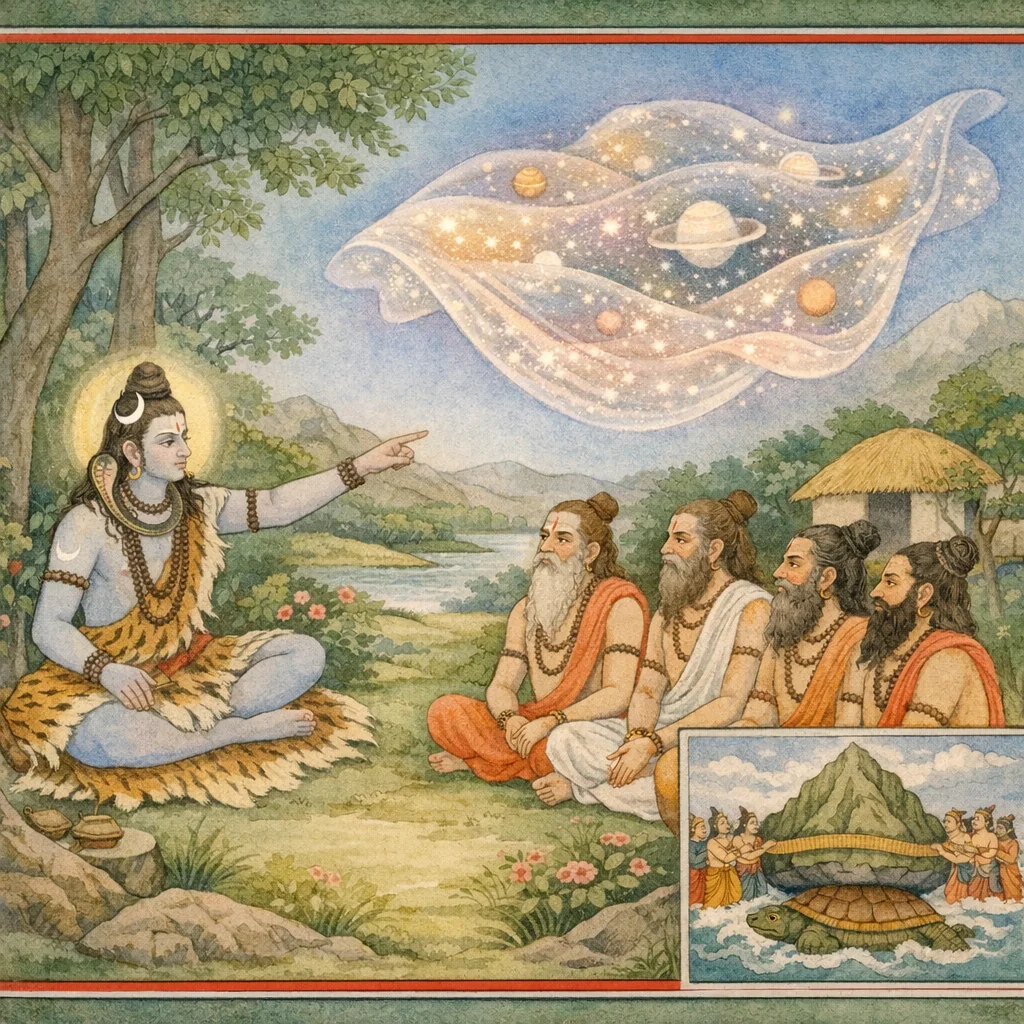
Continuing the Uttara-bhāga’s Īśvara-Gītā-like teaching, the sages ask how the Supreme—partless, stainless, eternal, and actionless—can yet be viśvarūpa, the universe-form. Īśvara replies that no reality stands apart from Him: the cosmos appears through Māyā, which rests on the Self and operates upon the Unmanifest (avyakta). A graded metaphysics is set forth: the Unmanifest is praised as imperishable Light and bliss, yet Īśvara declares Himself the Supreme Brahman beyond all duality. Thus unity and multiplicity are reconciled: the One is undivided in nature but seems divided through differing paths; only the true approach grants sāyujya (union). The discourse then turns Upaniṣadic—Brahman as the Light of lights, the woven fabric of the universe, beyond speech and mind—culminating in liberation through direct knowledge and repeated inner realization. The chapter ends by urging secrecy and careful protection of this rare wisdom, preparing for the yogic and doctrinal elaborations of the following adhyāyas.
Shlokas
Verse 1
इति श्रीकूर्मपाराणे षट्साहस्त्र्यां संहितायामुपरिविभागे (ईश्वरगीतासु) अष्टमो ऽध्यायः ऋषय ऊचुः निष्कलो निर्मलो नित्यो निष्क्रियः परमेश्वरः / तन्नो वद महादेव विश्वरूपः कथं भवान्
The sages said: “The Supreme Lord is partless, stainless, eternal, and actionless. Tell us, O Mahādeva—how is it that You are also the One whose form is the entire universe (Viśvarūpa)?”
Verse 2
ईश्वर उवाच नाहं विश्वो न विश्वं च मामृते विद्यते द्विजाः / मायानिमित्तमत्रास्ति सा चात्मानमपाश्रिता
Īśvara said: “I am not the universe, nor does the universe exist as something apart from Me. Apart from Me, O twice-born sages, nothing whatsoever exists. Here, the apparent cause is Māyā, and that Māyā rests upon the Self.”
Verse 3
अनादिनिधना शक्तिर्मायाव्यक्तसमाश्रया / तन्निमित्तः प्रपञ्चो ऽयमव्यक्तादभवत् खलु
Beginningless and endless is the Power—Māyā—resting upon the Unmanifest. From that very cause, this entire manifold cosmos has indeed arisen from the Unmanifest.
Verse 4
अव्यक्तं कारणं प्राहुरानन्दं ज्योतिरक्षरम् / अहमेव परं ब्रह्म मत्तो ह्यन्यन्न विद्यते
They declare the Unmanifest to be the causal source—bliss itself, the imperishable Light. I alone am that Supreme Brahman; apart from Me, nothing else exists.
Verse 5
तस्मान्मे विश्वरूपत्वं निश्चितं ब्रह्मवादिभिः / एकत्वे च पृथक्त्वे च प्रोक्तमेतन्निदर्शनम्
Therefore my universal form has been firmly ascertained by the knowers of Brahman. This very teaching is declared as the illustration of how I am both one and also distinct—as unity and as multiplicity.
Verse 6
अहं तत् परमं ब्रह्म परमात्मा सनातनः / अकारणं द्विजाः प्रोक्तो न दोषो ह्यात्मनस्तथा
I am that Supreme Brahman—the eternal Paramātman. O twice-born ones, I am declared to be without cause; thus, no fault or defect can ever pertain to the Self.
Verse 7
अनन्ता शक्तयो ऽव्यक्ते मायाद्याः संस्थिता ध्रुवाः / तस्मिन् दिवि स्थितं नित्यमव्यक्तं भाति केवलम्
In the Unmanifest (Avyakta) are established infinite powers—beginning with Māyā—steadfast and enduring. In that supreme, luminous realm, the Unmanifest alone shines eternally.
Verse 8
याभिस्तल्लक्ष्यते भिन्नमभिन्नं तु स्वभावतः / एकया मम सायुज्यमनादिनिधनं ध्रुवम्
By those ways, That is perceived as divided, though in its own nature it is truly undivided. Yet only by the one true way is attained sāyujya—union with Me—beginningless, endless, and unwavering.
Verse 9
पुंसो ऽभूदन्यया भूतिरन्यया तत्तिरोहितम् / अनादिमध्यं तिष्ठन्तं युज्यते ऽविद्यया किल
For the person (the Self), in one way there arises becoming, and in another way That is concealed; though It stands without beginning or middle, It is, as it were, yoked to avidyā—ignorance.
Verse 10
तदेतत् परमं व्यक्तं प्रभामण्डलमण्डितम् / तदक्षरं परं ज्योतिस्तद् विष्णोः परमं पदम्
This indeed is the Supreme, clearly manifest—adorned with a circle of radiance. That is the Imperishable (Akṣara), the highest Light; that is Vishnu’s supreme abode.
Verse 11
तत्र सर्वमिदं प्रोतमोतं चैवाखिलं जगत् / तदेव च जगत् कृत्स्नं तद् विज्ञाय विमुच्यते
In That this entire universe is woven and interwoven—indeed, the whole cosmos. That alone is the universe in its entirety; by truly knowing That, one is liberated.
Verse 12
यतो वाचो निवर्तन्ते अप्राप्य मनसा सह / आनन्दं ब्रह्मणो विद्वान् विभेति न कुतश्चन
That Reality from which speech returns—unable to reach it—together with the mind: the wise one, knowing the bliss of Brahman, fears nothing whatsoever from any quarter.
Verse 13
वेदाहमेतं पुरुषं महान्त- मादित्यवर्णं तमसः परस्तात् / तद् विज्ञाय परिमुच्येत विद्वान् नित्यानन्दी भवति ब्रह्मभूतः
“I know that Supreme, Great Person—radiant like the sun, transcending the darkness of ignorance. Having realized Him, the wise one becomes completely liberated; established as Brahman, he abides in eternal bliss.”
Verse 14
यस्मात् परं नापरमस्ति किञ्चित् यज्ज्योतिषां ज्योतिरेकं दिविस्थम् / तदेवात्मानं मन्यमानो ऽथ विद्वान् आत्मानन्दी भवति ब्रह्मभूतः
Beyond which there is nothing higher and nothing other—That one Light of all lights, abiding in the highest heaven: knowing That alone to be one’s very Self, the wise become blissful in the Self and attain the state of Brahman.
Verse 15
तदव्ययं कलिलं गूढदेहं ब्रह्मानन्दममृतं विश्वधाम / वदन्त्येवं ब्राह्मणा ब्रह्मनिष्ठा यत्र गत्वा न निवर्तेत भूयः
Brahman is indeed that imperishable Reality—subtle and hard to discern, hidden within embodied existence—pure bliss of Brahman, deathless, the universal abode. Thus do the Brahman-abiding sages declare it: having reached That, one does not return again.
Verse 16
हिरण्मये परमाकाशतत्त्वे यदर्चिषि प्रविभातीव तेजः / तद्विज्ञाने परिपश्यन्ति धीरा विभ्राजमानं विमलं व्योम धाम
In the golden radiance of the Supreme ether-principle, that splendor shines forth with flame-like brilliance; by truly knowing That, the wise behold the stainless, luminous abode in the inner sky.
Verse 17
ततः परं परिपश्यन्ति धीरा आत्मन्यात्मानमनुभूयानुभूय / स्वयंप्रभः परमेष्ठी महीयान् ब्रह्मानन्दी भगवानीश एषः
Thereafter, the steadfast wise behold the Supreme—again and again, directly realizing the Self within the Self. He is self-luminous, the highest Lord enthroned above all, the Most Great; He is the very bliss of Brahman—the Blessed Bhagavān, Īśvara Himself.
Verse 18
एको देवः सर्वभूतेषु गूढः सर्वव्यापी सर्वभूतान्तरात्मा / तमेवैकं ये ऽनुपश्यन्ति धीरास् तेषां शान्तिः शाश्वती नेतरेषाम्
The One Lord is hidden within all beings—all-pervading, the inner Self of every creature. Those steady-minded sages who directly perceive that One alone attain eternal peace; not so others.
Verse 19
सर्वाननशिरोग्रीवः सर्वभूतगुहाशयः / सर्वव्यापी च भगवान् न तस्मादन्यदिष्यते
The Blessed Lord has all faces, heads, and necks; He dwells in the hidden inner recess of every being. All-pervading is that Bhagavān—nothing else is acknowledged as distinct from Him.
Verse 20
इत्येतदैश्वरं ज्ञानमुक्तं वो मुनिपुङ्गवाः / गोपनीयं विशेषेण योगिनामपि दुर्लभम्
Thus, O foremost of sages, this divine knowledge of the Lord has been declared to you. It is to be guarded with special care, for it is rare to obtain—even for yogins.
Frequently Asked Questions
It asserts that nothing exists apart from Īśvara; the universe is not independent but appears through Māyā, which rests upon the Self. Thus Brahman remains partless and actionless in itself, while multiplicity is an appearance dependent on the Unmanifest and Māyā.
The chapter frames bondage as concealment by avidyā and liberation as direct knowledge of the one all-pervading inner Self. When the wise realize the Self within the self, they abide as Brahman (brahma-sthiti) and attain fearlessness and non-return.
Read Kurma Purana in the Vedapath app
Scan the QR code to open this directly in the app, with audio, word-by-word meanings, and more.