Adhyaya 8
Īśvara-gītā: The Supreme Lord as Brahman, the Source of Creation, and the Inner Self
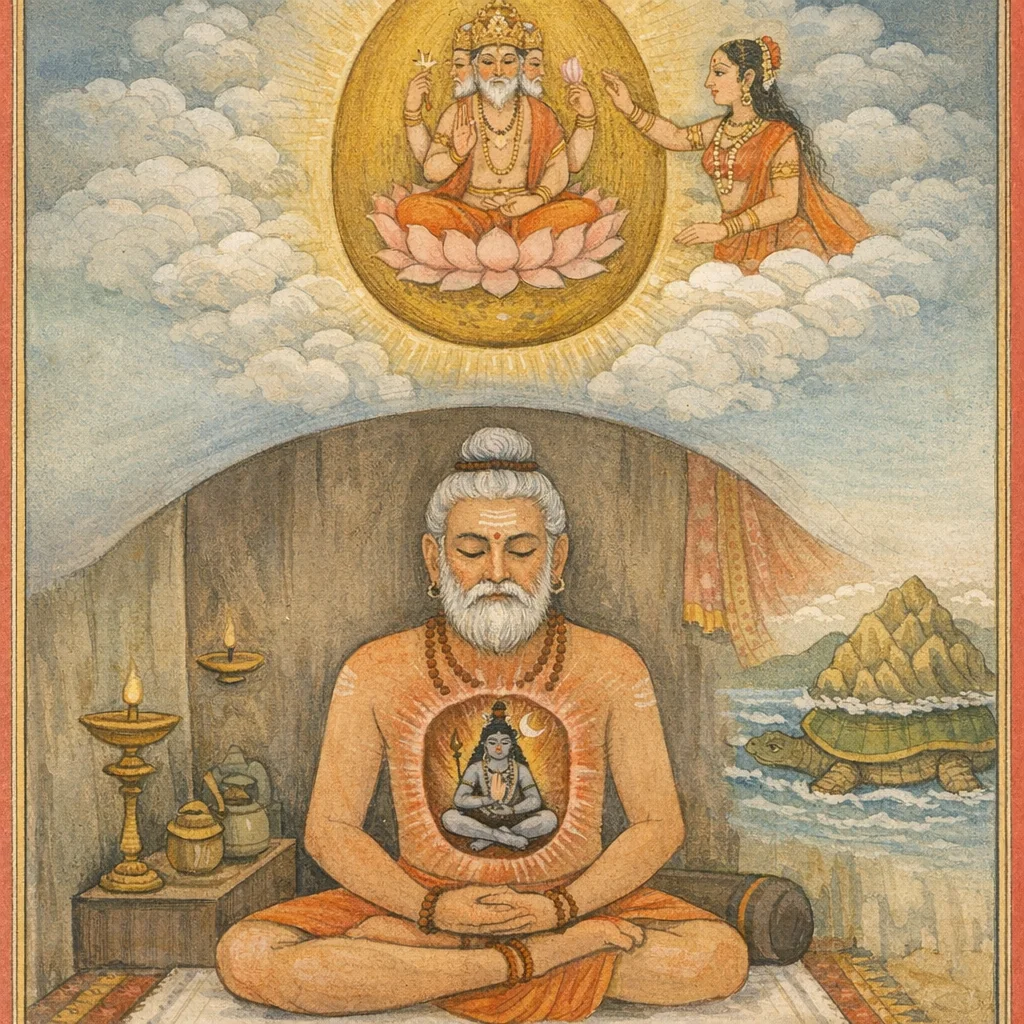
Concluding the seventh chapter, Īśvara proclaims a still more secret teaching for crossing saṃsāra. He declares Himself the non-dual Brahman—peaceful, eternal, stainless—and explains manifestation through Māyā: the seed is placed in the “womb” of vast Brahman, from which arise Pradhāna and Puruṣa, Mahat, bhūtādi, the tanmātras, mahābhūtas, and indriyas, culminating in the radiant cosmic Egg and the birth of Brahmā empowered by divine śakti. Though He pervades all beings, they fail to recognize their Father through delusion. The chapter then turns to salvific vision: the true seer beholds the imperishable Lord equally abiding in all beings, avoids self-harm, and attains transcendence. It introduces a technical soteriology—seven subtle principles (tanmātras, mind, self) and the “sixfold system” of Mahādeva—defining bondage as the misapplication (viniyoga) of Pradhāna. The teaching culminates in unitive theology: beyond prakṛti’s latent power stands the one Supreme Maheśvara, described with six essential attributes, spoken of as both one and many, and realized in the heart’s “secret cave” as the highest goal, leading onward to disciplined realization (yoga/jñāna) grounded in this non-dual, harmonizing vision of Īśvara.
Shlokas
Verse 1
इति श्रीकूर्मपुराणे षट्साहस्त्र्यां संहितायामुपरिविभागे (ईश्वरगीतासु) सप्तमो ऽध्यायः ईश्वर उवाच अन्यद् गुह्यतमं ज्ञानं वक्ष्ये ब्राह्मणपुङ्गवाः / येनासौ तरते जन्तुर्घोरं संसारसागरम्
Thus, in the Śrī Kūrma Purāṇa, in the six-thousand-verse compendium, in the latter division—within the Īśvara-gītā—the seventh chapter concludes. Īśvara said: “O foremost among brāhmaṇas, I shall now proclaim another teaching, most secret, by which the embodied being crosses the dreadful ocean of saṃsāra.”
Verse 2
अहं ब्रह्ममयः शान्तः शाश्वतो निर्मलो ऽव्ययः / एकाकी भगवानुक्तः केवलः परमेश्वरः
I am of the very nature of Brahman—peaceful, eternal, stainless, and imperishable. I am the One without a second, spoken of as Bhagavān: the sole Parameśvara, the absolute Supreme Ruler.
Verse 3
मम योनिर्महद् ब्रह्म तत्र गर्भं दधाम्यहम् / मूलं मायाभिधानं तु ततो जातमिदं जगत्
My womb is the vast Brahman (mahad-brahma); into that I place the seed. That very root is called Māyā; from it this entire universe is born.
Verse 4
प्रधानं पुरुषो ह्यत्मा महान् भूतादिरेव च / तन्मात्राणि महाभूतानीन्द्रियाणि च जज्ञिरे
Pradhāna (primordial Nature), Puruṣa (the conscious principle), the Self (Ātman), Mahān (Mahat, the Great principle), and bhūtādi (the origin of the elements) came forth; and from that arose the tanmātras (subtle elements), the mahābhūtas (great gross elements), and the indriyas (sense-faculties).
Verse 5
ततो ऽण्डमभवद्धैमं सूर्यकोटिसमप्रभम् / तस्मिन् जज्ञे महाब्रह्मा मच्छक्त्या चोपबृंहितः
Then arose a golden cosmic Egg, radiant like ten million suns. Within it was born the Great Brahmā, nourished, strengthened, and empowered by My own divine Śakti.
Verse 6
ये चान्ये बहवो जीवा मन्मयाः सर्व एव ते / न मां पश्यन्ति पितरं मायया मम मोहिताः
And the many other living beings too—indeed all of them—are pervaded by Me; yet, deluded by My Māyā, they do not behold Me, their Father, the primal source.
Verse 7
याश्च योनिषु सर्वासु संभवन्ति हि मूर्तयः / तासां माया परा योनिर्मामेव पितरं विदुः
Whatever embodied forms arise in all wombs and sources of birth—of them, My supreme Māyā is the higher matrix; and they know Me alone as the Father.
Verse 8
यो मामेवं विजानाति बीजिनं पितरं प्रभुम् / स धीरः सर्वलोकेषु न मोहमधिगच्छति
Whoever thus knows Me as the seed-bearing source, the Father and the sovereign Lord—such a steadfast wise one, in all worlds, does not fall into delusion.
Verse 9
ईशानः सर्वविद्यानां भूतानां परमेश्वरः / ओङ्कारमूर्तिर्भगवानहं ब्रह्मा प्रजापतिः
I am Īśāna, lord of all branches of knowledge, the Supreme Ruler of all beings. I am the Blessed Lord whose very form is Oṃ; I am Brahmā, the progenitor Prajāpati.
Verse 10
समं सर्वेषु भूतेषु तिष्ठन्तं परमेश्वरम् / विनश्यत्स्वविनश्यन्तं यः पश्यति स पश्यति
He truly sees who beholds the Supreme Lord, Parameśvara, abiding equally in all beings—imperishable amid the perishing.
Verse 11
समं पश्यन् हि सर्वत्र समवस्थितमीश्वरम् / न हिनस्त्यात्मनात्मानं ततो याति पराङ्गतिम्
For one who truly sees Īśvara abiding equally everywhere does not injure the Self by the self; from that right vision one attains the supreme transcendence.
Verse 12
विदित्वा सप्त सूक्ष्माणि षडङ्गं च महेश्वरम् / प्रधानविनियोगज्ञः परं ब्रह्माधिगच्छति
Having realized the seven subtle principles and known Mahādeva as the Lord endowed with the sixfold system, the knower of the proper application of Pradhāna attains the Supreme Brahman.
Verse 13
सर्वज्ञता तृप्तिरनादिबोधः स्वतन्त्रता नित्यमलुप्तशक्तिः / अनन्तशक्तिश्च विभोर्विदित्वा षडाहुरङ्गानि महेश्वरस्य
Having understood that Vibhu, the all-pervading Lord, possesses omniscience, perfect contentment, beginningless knowledge, absolute independence, ever-unfailing power, and infinite potency—these six are declared to be the essential attributes of Maheshvara.
Verse 14
तन्मात्राणि मन आत्मा च तानि सूक्ष्माण्याहुः सप्त तत्त्वात्मकानि / या सा हेतुः प्रकृतिः सा प्रधानं बन्धः प्रोक्तो विनियोगो ऽपि तेन
The tanmātras, the mind (manas), and the self (ātman)—these are declared subtle, constituting seven principles in essence. That causal Nature (prakṛti) is called Pradhāna; and bondage (bandha) is said to be the misapplication (viniyoga) brought about through it.
Verse 15
या सा शक्तिः प्रकृतौ लीनरूपा वेदेषूक्ता कारणं ब्रह्मयोनिः / तस्या एकः परमेष्ठी परस्ता- न्महेश्वरः पुरुषः सत्यरूपः
That Power which lies latent, merged within Prakṛti—proclaimed in the Vedas as the causal source, the womb of Brahmā—from that (Power) there is One Supreme Lord beyond all: Maheśvara, the transcendent Puruṣa whose very nature is Truth.
Verse 16
ब्रह्मा योगी परमात्मा महीयान् व्योमव्यापी वेदवेद्यः पुराणः / एको रुद्रो मृत्युरव्यक्तमेकं बीजं विश्वं देव एकः स एव
He is Brahmā, the supreme Yogi, the Paramātman—vast and all-pervading like space—knowable through the Vedas, the Ancient One. He alone is Rudra; he is Death; he is the one Unmanifest; he is the seed and the universe. That one God alone—he indeed is all this.
Verse 17
तमेवैकं प्राहुरन्ये ऽप्यनेकं त्वेकात्मानं केचिदन्यत्तथाहुः / अणोरणीयान् महतो ऽसौ महीयान् महादेवः प्रोच्यते वेदविद्भिः
Some declare Him alone to be the One; others, again, speak of Him as many. Some call Him the single Self of all, while others describe Him as distinct. Smaller than the smallest and greater than the greatest—He is proclaimed by the knowers of the Veda as Mahādeva.
Verse 18
एवं हि यो वेद गुहाशयं परं प्रभुं पुराणं पुरुषं विश्वरूपम् / हिरण्मयं बुद्धिमतां परां गतिं स बुद्धिमान् बुद्धिमतीत्य तिष्ठति
Thus, whoever truly knows the Supreme Lord abiding in the heart’s secret cave—the ancient Sovereign Puruṣa of universal form, radiant as gold and the highest goal of the wise—such a one becomes truly intelligent and, having attained perfect understanding, stands established in that realization.
Frequently Asked Questions
It presents manifestation through Māyā: from Pradhāna and Puruṣa arise Mahat and bhūtādi, then tanmātras, mahābhūtas, and indriyas, followed by the golden cosmic Egg within which Brahmā is born—an emanation schema used to orient the seeker toward liberation rather than mere cosmography.
The Lord is declared the imperishable Brahman equally abiding in all beings; delusion arises from Māyā, but the wise who recognize the Supreme as the indwelling Self and the seed-bearing Father do not fall into error and attain transcendence.
The chapter enumerates six essential qualities: omniscience, perfect contentment, beginningless knowledge, absolute independence, unfailing power, and infinite potency—presented as defining attributes for understanding Maheśvara as the Supreme.
Bondage is framed as a distorted engagement of primordial Nature (Pradhāna/Prakṛti), whereby consciousness becomes entangled with its evolutes (mind, senses, elements); correct knowledge and yogic discernment reverse this misapplication and lead to realization of the Supreme Brahman.