Adhyaya 3
Īśvara-gītā: Brahman as All-Pervading—Kāla, Prakṛti–Puruṣa, Tattva-Evolution, and Mokṣa
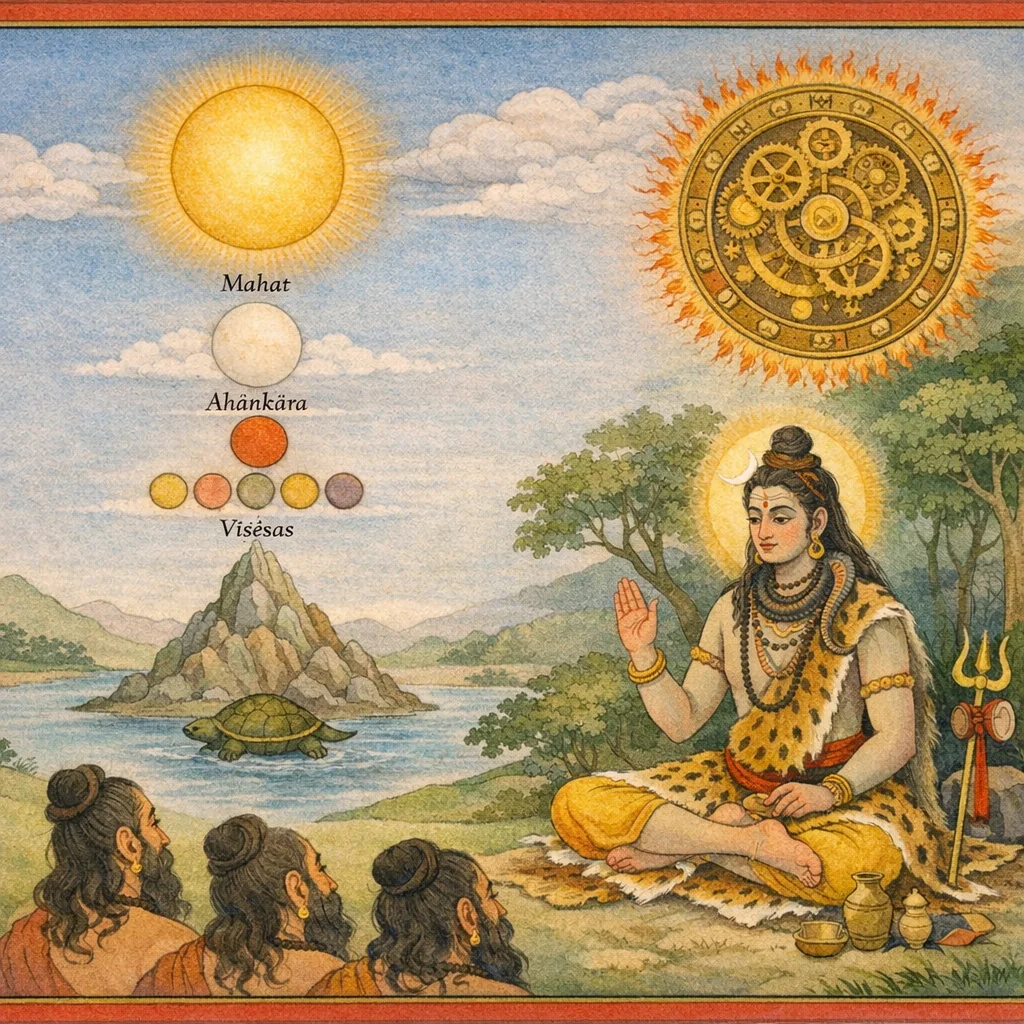
Continuing the Īśvara-gītā, the Lord deepens the teaching by declaring the Supreme to be the all-pervading Brahman—without senses yet shining through all senses, beyond comparison and all pramāṇas, present as the inner abode of every being. He then sets forth cosmology through a beginningless triad: Pradhāna/Prakṛti, Puruṣa, and Kāla, with Time as the transcendent coordinator that brings conjunction and cosmic activity. The chapter traces tattva-evolution from Mahat to the viśeṣas, explains ahaṅkāra as the “I”-sense (also termed jīva/antarātman in empirical life), and locates saṃsāra in aviveka arising from long association with Prakṛti under Kāla. Kāla is portrayed as sovereign, producing and withdrawing beings, while the Lord remains the inner governor, source of Prāṇa, and the supreme reality beyond prāṇa and subtle space. Thus the dialogue is prepared for the next step: soteriology and yogic discipline rest on a clear metaphysical hierarchy—discernment culminates in knowing the Lord as highest and leads to liberation, while creation and pralaya proceed by His ordinance through māyā and Kāla.
Shlokas
Verse 1
इति श्रीकूर्मपुराणे षट्साहस्त्र्यां संहितायामुपरिविभागे (ईश्वरगीतासु) द्वितीयो ऽध्यायः ईश्वर उवाच अव्यक्तादभवत् कालः प्रधानं पुरुषः परः / तेभ्यः सर्वमिदं जातं तस्माद् ब्रह्ममयं जगत्
Thus, in the Śrī Kūrma Purāṇa, in the Ṣaṭsāhasrī Saṃhitā, in the latter division (within the Īśvara-gītā), the second chapter. The Lord said: From the Unmanifest arose Time; and there are Pradhāna and the Supreme Puruṣa. From these, all this universe is born; therefore the world is pervaded by Brahman—made of Brahman.
Verse 2
सर्वतः पाणिपादं तत् सर्वतो ऽक्षिशिरोमुखम् / सर्वतः श्रुतिमल्लोके सर्वमावृत्य तिष्ठति
That Supreme Reality has hands and feet everywhere; everywhere are Its eyes, heads, and faces. Everywhere in the world It is endowed with hearing; enveloping all, It stands pervading everything.
Verse 3
सर्वेन्द्रियगुणाभासं सर्वेन्द्रियविवर्जितम् / सर्वाधारं सदानन्दमव्यक्तं द्वैतवर्जितम्
He appears as the qualities of all the senses, yet is devoid of all senses; the support of all, ever-blissful, unmanifest, and free from all duality.
Verse 4
सर्वोपमानरहितं प्रमाणातीतगोचरम् / निर्विकल्पं निराभासं सर्वावासं परामृतम्
That Supreme is beyond all comparison, beyond the reach of the means of knowledge; free from mental constructions and without any limiting appearance—dwelling in all as their inner abode, the highest nectar of immortality.
Verse 5
अभिन्नं भिन्नसंस्थानं शाश्वतं ध्रु वमव्ययम् / निर्गुणं परमं व्योम तज्ज्ञानं सूरयो विदुः
The wise know that true knowledge is That Supreme Space (Brahman): undivided yet appearing in diverse forms, eternal, steadfast, imperishable, and beyond all qualities (nirguṇa).
Verse 6
स आत्मा सर्वभूतानां स बाह्याभ्यन्तरः परः / सो ऽहं सर्वत्रगः शान्तो ज्ञानात्मा परमेश्वरः
He is the Self of all beings—transcendent, and present both outside and within. That all-pervading, tranquil Lord am I: the very Self that is pure knowledge, the Supreme God.
Verse 7
मया ततमिदं विश्वं जगदव्यक्तमूर्तिना / मत्स्थानि सर्वभूतानि यस्तं वेद स वेदवित्
By Me this entire universe has been pervaded—this world—through My unmanifest form. All beings abide in Me; whoever truly knows That reality is a knower of the Veda.
Verse 8
प्रधानं पुरुषं चैव तत्त्वद्वयमुदाहृतम् / तयोरनादिरुद्दिष्टः कालः संयोजकः परः
Pradhāna (primordial Nature) and Puruṣa (the conscious Self) are declared to be the two fundamental principles. Of these two, Time (Kāla) is taught as beginningless and supreme, the transcendent agent that brings them into conjunction.
Verse 9
त्रयमेतदनाद्यन्तमव्यक्ते समवस्थितम् / तदात्मकं तदन्यत् स्यात् तद्रूपं मामकं विदुः
This triad—without beginning or end—abides in the Unmanifest (Avyakta). It is of That very essence, and yet it is also spoken of as distinct from That. Know that its form is Mine.
Verse 10
महदाद्यं विशेषान्तं संप्रसूते ऽखिलं जगत् / या सा प्रकृतिरुद्दिष्टा मोहिनी सर्वदेहिनाम्
From Mahat (the Great Principle) up to the Viśeṣas (the particularized elements), she brings forth this entire universe. That Prakṛti, so described, is the bewitching power that deludes all embodied beings.
Verse 11
पुरुषः प्रकृतिस्थो हि भुङ्क्तेयः प्राकृतान् गुणान् / अहङ्कारविमुक्तत्वात् प्रोच्यते पञ्चविंशकः
The Puruṣa, though abiding in Prakṛti, experiences the qualities born of Prakṛti; yet, because he is free from egoity (ahaṅkāra), he is declared to be the twenty-fifth principle.
Verse 12
आद्यो विकारः प्रकृतेर्महानात्मेति कथ्यते / विज्ञानशक्तिर्विज्ञाता ह्यहङ्कारस्तदुत्थितः
The first transformation of Prakṛti is called Mahān (also known as Ātman). It is the power of discernment and the knowing principle; from it arises ahaṅkāra, the sense of ‘I’-making.
Verse 13
एक एव महानात्मा सो ऽहङ्कारो ऽभिधीयते / स जीवः सो ऽन्तरात्मेति गीयते तत्त्वचिन्तकैः
That one Great Self alone is called “ahaṅkāra,” the sense of “I.” The very same is named “jīva,” the individual living self, and is sung by contemplators of truth as the “antarātman,” the Inner Self.
Verse 14
तेन वेदयते सर्वं सुखं दुःखं च जन्मसु / स विज्ञानात्मकस्तस्य मनः स्यादुपकारकम्
Through that inner instrument one cognizes everything—pleasure and pain across births. Since it is of the nature of vijñāna, discerning knowledge, the mind can become a helpful instrument to that Self.
Verse 15
तेनाविवेकतस्तस्मात् संसारः पुरुषस्य तु / स चाविवेकः प्रकृतौ सङ्गात् कालेन सो ऽभवत्
Therefore, through aviveka—lack of discernment—saṃsāra, transmigration, arises for the puruṣa. And that very non-discrimination comes about in time from association with Prakṛti, material nature.
Verse 16
कालः सृजति भूतानि कालः संहरति प्रजाः / सर्वे कालस्य वशगा न कालः कस्यचिद् वशे
Time (Kāla) brings forth beings, and Time withdraws all creatures. All are subject to Time’s rule; but Time itself is subject to none.
Verse 17
सो ऽन्तरा सर्वमेवेदं नियच्छति सनातनः / प्रोच्यते भगवान् प्राणः सर्वज्ञः पुरुषोत्तमः
That Eternal One, abiding within, restrains and governs this entire universe. He is spoken of as Bhagavān—Prāṇa itself—omniscient, the Puruṣottama, the Supreme Person.
Verse 18
सर्वेन्द्रियेभ्यः परमं मन आहुर्मनीषिणः / मनसश्चाप्यहङ्कारमहङ्कारान्महान् परः
The wise declare the mind (manas) to be higher than all the senses. Higher than the mind is ego-sense (ahaṅkāra), and beyond ego-sense stands Mahān (Mahat, the Great Principle).
Verse 19
महतः परमव्यक्तमव्यक्तात् पुरुषः परः / पुरुषाद् भगवान् प्राणस्तस्य सर्वमिदं जगत्
Beyond Mahat (the cosmic intellect) is the Supreme Unmanifest (avyakta); beyond the Unmanifest is the transcendent Puruṣa. From that Puruṣa arises the blessed Prāṇa, the cosmic life-breath; of that Prāṇa this entire universe consists.
Verse 20
प्राणात् परतरं व्योम व्योमातीतो ऽग्निरीश्वरः / सो ऽहं सर्वत्रगः शान्तो ज्ञानात्मा परमेश्वरः / नास्ति मत्तः परं भूतं मां विज्ञाय विमुच्यते
Beyond prāṇa is vyoma, the subtle expanse; beyond even that expanse is the Lord—Agni, the sovereign. I am that Supreme Lord: all-pervading, tranquil, whose very nature is consciousness and knowledge. There is no reality higher than Me; by truly knowing Me, one is liberated.
Verse 21
नित्यं हि नास्ति जगति भूतं स्थावरजङ्गमम् / ऋते मामेकमव्यक्तं व्योमरूपं महेश्वरम्
Indeed, in this world there is nothing—whether unmoving or moving—that is eternal, except Me alone: the Unmanifest, whose form is like space, Maheśvara, the Great Lord.
Verse 22
सो ऽहं सृजामि सकलं संहरामि सदा जगत् / मायी मायामयो देवः कालेन सह सङ्गतः
I alone create the entire universe, and I forever withdraw it again. As the divine Lord—wielder of māyā and constituted of māyā—I operate in conjunction with Kāla, Time.
Verse 23
मत्सन्निधावेष कालः करोति सकलं जगत् / नियोजयत्यनन्तात्मा ह्येतद् वेदानुशासनम्
In My very presence, Time accomplishes the workings of the entire universe. The Infinite Self directs it—this is the ordinance taught by the Vedas.
Frequently Asked Questions
Prakṛti (Pradhāna) and Puruṣa are the two fundamental principles, while Kāla is beginningless and taught as supreme in function—serving as the transcendent agent that brings their conjunction and enables the universe’s operations, including creation and withdrawal.
Empirically, the ‘I’-sense (ahaṅkāra) is spoken of as jīva/antarātman for lived experience across births; ultimately, the Lord declares Himself as the all-pervading Self and pure knowledge, indicating that liberation lies in realizing the Supreme Brahman as the inner ruler beyond limiting constructions.
Saṃsāra arises from aviveka (non-discrimination) that develops over time through association with Prakṛti; it is ended by true knowledge—direct realization of the Supreme Lord/Brahman as the highest reality, beyond prāṇa and beyond all comparatives.