Adhyaya 25
Gṛhastha Livelihood, Āpad-dharma, and Sacrificial Stewardship of Wealth
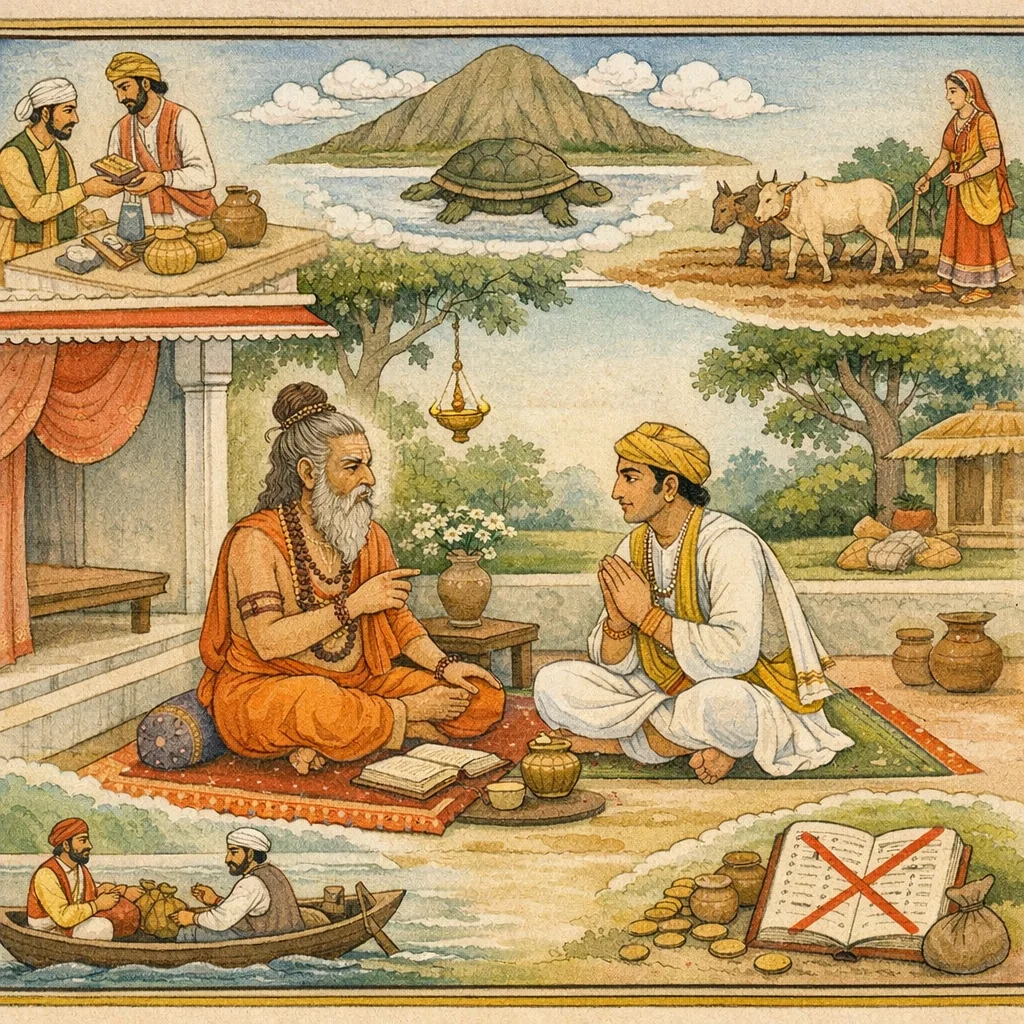
Continuing from the prior account of householders’ duties, Vyāsa announces a focused teaching on the “highest dharma” and proper conduct for the twice-born. The chapter distinguishes householders as disciplined practitioners (sādhaka) and non-practitioners (asādhaka), then ranks allowable livelihoods, especially for times of distress (āpad-dharma): teaching/priestly service and accepting gifts are normative; trade and agriculture are fallback means; lending at interest is portrayed as harsher and blameworthy. Even when livelihood turns pragmatic, brāhmaṇa integrity is required—straight, non-deceptive means—and prosperity is tied to ritual reciprocity: offerings to Devas and Pitṛs, honoring brāhmaṇas, and setting aside shares from agricultural produce. Hoarded wealth without due rites is warned to bring degraded rebirth. The chapter closes by placing economics within puruṣārtha: artha is valid only when sought for dharma, kāma must not violate dharma, and wealth should flow into dāna, homa, and worship—carrying the discussion toward a more Vedāntic-yogic valuation of life-goals and liberation (mokṣa).
Shlokas
Verse 1
इति श्रीकूर्मपुराणे षट्साहस्त्र्यां संहितायामुपरिविभागे चतुर्विशो ऽध्यायः इन् रेए निछ्त् ज़ुल्äस्सिगे ज़ेइछेन्: व्यास उवाच एष वो ऽभिहितः कृत्स्नो गृहस्थाश्रमवासिनः / द्विजातेः परमो धर्मो वर्तनानि निबोधत
Thus ends the twenty-fourth chapter in the Upari-bhāga of the Śrī Kūrma Purāṇa, in the Ṣaṭ-sāhasrī Saṃhitā. Vyāsa said: “The whole teaching for those who dwell in the householder-āśrama has been declared to you. Now understand the supreme dharma of the twice-born, and the rules of right conduct.”
Verse 2
द्विविधस्तु गृही ज्ञेयः साधकश्चाप्यसाधकः / अध्यापनं याजनं च पूर्वस्याहुः प्रतिग्रहम् / कुसीदकृषिवाणिज्यं प्रकुर्वोतास्वयङ्कृतम्
A householder is known to be of two kinds: the sādhaka, disciplined in practice, and the non-practitioner. For the former, the duties are said to be teaching, officiating at yajñas, and accepting gifts. But the latter pursues moneylending at interest, agriculture, and trade—livelihoods contrived for worldly gain.
Verse 3
कृषेरभावाद् वाणिज्यं तदभावात् कुसीदकम् / आपत्कल्पो ह्यं ज्ञेयः पूर्वोक्तो मुख्य इष्यते
When agriculture is not possible, one should take up trade; when even that is not possible, one may resort to lending at interest. This is to be understood as the rule for times of distress (āpad-dharma); the earlier-stated principal duty is regarded as primary.
Verse 4
स्वयं वा कर्षणं कुर्याद् वाणिज्यं वा कुसीदकम् / कष्टा पापीयसी वृत्तिः कुसीदं तद् विवर्जयेत्
One may personally take up farming, or engage in trade; but lending at interest is a harsh and more sinful livelihood—therefore one should avoid usury.
Verse 5
क्षात्रवृत्तिं परां प्रहुर्न स्वयं कर्षणं द्विजैः / तस्मात् क्षात्रेण वर्तेत वर्तनेनापदि द्विजः
They declare the kṣātra way of livelihood—the duty of protection and rule—to be the higher path, not self-ploughing for the twice-born. Therefore a twice-born should live by kṣātra duties; yet in times of distress he may subsist by whatever livelihood is at hand.
Verse 6
तेन चावाप्यजीवंस्तु वैश्यवृत्तिं कृषिं व्रजेत् / न कथञ्चन कुर्वोत ब्राह्मणः कर्म कर्षणम्
If even by that means one cannot secure a livelihood, then one may take up the Vaiśya way—agriculture. Yet a Brāhmaṇa should never, under any circumstance, perform the work of ploughing.
Verse 7
लब्धलाभः पितॄन् देवान् ब्राह्मणांश्चापि पूजयेत् / ते तृप्तास्तस्य तं दोषं शमयन्ति न संशयः
Having gained the desired fruit, one should worship the Pitṛs, the Devas, and also the Brāhmaṇas. When satisfied, they surely pacify that person’s fault—of this there is no doubt.
Verse 8
देवेभ्यश्च पितृभ्यश्च दद्याद् भागं तु विंशकम् / त्रिंशद्भागं ब्राह्मणानां कृषिं कुर्वन् न दुष्यति
One should set aside a twentieth share for the Devas and the Pitṛs, and a thirtieth share for the Brāhmaṇas. One who practices agriculture while making these offerings incurs no fault.
Verse 9
वणिक् प्रदद्याद् द्विगुणं कुसीदी त्रिगुणं पुनः / कृषीवलो न दोषेण युज्यते नात्र संशयः
A merchant may repay double, and a professional moneylender may again repay triple; but a cultivator is not held at fault for not doing so—of this there is no doubt.
Verse 10
शिलोञ्छं वाप्याददीत गृहस्थः साधकः पुनः / विद्याशिल्पादयस्त्वन्ये बहवो वृत्तिहेतवः
A disciplined householder may also adopt the śiloñcha way of living, gleaning what is left in the fields. Besides this, learning, crafts, and many other pursuits each serve as a means of livelihood.
Verse 11
असाधकस्तु यः प्रोक्तो गृहस्थाश्रमसंस्थितः / शिलोञ्छे तस्य कथिते द्वे वृत्ती परमर्षिभिः
But for the householder described as an asādhaka, dwelling in the gṛhastha-āśrama without practice, the great sages have taught two modes of livelihood in regard to śiloñcha and collecting.
Verse 12
अमृतेनाथवा जीवेन्मृतेनाप्यथवा यदि / अयाचितं स्यादमृतं मृतं भेक्षं तु याचितम्
Let him live by what is called ‘amṛta’—pure, blameless support—or, if that is not available, even by what is called ‘mṛta’, inferior support. What comes unasked is ‘amṛta’; alms gained by begging are said to be ‘mṛta’.
Verse 13
कुशूलधान्यको वा स्यात् कुम्भीधान्यक एव वा / त्र्यहैहिको वापि भवेदश्वस्तनिक एव च
He may be one who stores grain in a granary, or one who keeps it in jars; or he may live with provisions sufficient for three days, or even have only enough for the next day.
Verse 14
चतुर्णामपि चैतेषां द्विजानां गृहमेधिनाम् / श्रेयान् परः परो ज्ञेयो धर्मतो लोकजित्तमः
Among these four kinds of twice-born householders, each succeeding one should be understood as superior to the previous by the power of dharma, ever more able to ‘conquer the worlds’—that is, to attain higher spiritual and cosmic merit.
Verse 15
षट्कर्मैको भवत्येषां त्रिभिरन्यः प्रवर्तते / द्वाभ्यामेकश्चतुर्थस्तु ब्रह्मसत्रेण जीवति
Among these brāhmaṇas, one lives by all six prescribed duties; another sustains himself by three; one by two; while a fourth lives by conducting a Brahma-satra, a long Vedic sacrificial session.
Verse 16
वर्तयंस्तु शिलोञ्छाभ्यामग्निहोत्रपरायणः / इष्टीः पार्वायणान्तीयाः केवला निर्वपेत् सदा
Living by gleaning and by collecting fallen grains, devoted to the Agnihotra, he should always offer the simple iṣṭi-sacrifices prescribed for the concluding rites of the seasonal (pārvāyaṇa) observances.
Verse 17
न लोकवृतिं वर्तेत वृत्तिहेतोः कथञ्चन / अजिह्मामशठां शुद्धां जीवेद् ब्राह्मणजीविकाम्
For the sake of earning a livelihood, he should never adopt the ways of worldly people. Rather, he should live by a brāhmaṇa’s means of support—straightforward, free from deceit, and pure.
Verse 18
याचित्वा वापि सद्भ्यो ऽन्नं पितॄन्देवांस्तु तोषयेत् / याचयेद् वा शुचिं दान्तं न तृप्येत स्वयं ततः
Even if one must beg food from the righteous, one should use it to satisfy the Pitṛs and the Devas. Or, one may beg from a person who is pure and self-controlled—but one should not gratify oneself from that food.
Verse 19
यस्तु द्रव्यार्जनं कृत्वा गृहस्थस्तोषयेन्न तु / देवान् पितृंश्च विधिना शुनां योनिं व्रजत्यसौ
But that householder who, having amassed wealth, does not duly satisfy the Devas and the Pitṛs according to prescribed rites—he indeed goes to a canine womb, reborn among dogs.
Verse 20
धर्मश्चार्थश्च कामश्च श्रेयो मोक्षश्चतुष्टयम् / धर्माविरुद्धः कामः स्याद् ब्राह्मणानां तु नेतरः
Dharma, Artha, Kāma, and the highest good—Mokṣa—are taught as the four aims of human life. For Brāhmaṇas, desire (kāma) is to be pursued only when it does not conflict with dharma; otherwise, not.
Verse 21
योर्ऽथो धर्माय नात्मार्थः सोर्ऽथो ऽनर्थस्तथेतरः / तस्मादर्थं समासाद्य दद्याद् वै जुहुयाद् यजेत्
Wealth gained for Dharma—and not merely for one’s own ends—is truly ‘wealth’; but wealth sought only for oneself becomes misfortune. Therefore, having obtained resources, one should give in charity, offer oblations into the sacred fire, and perform sacrificial worship (yajña).
Frequently Asked Questions
It distinguishes the disciplined practitioner (sādhaka) from the non-practitioner (asādhaka) to show that livelihood choices and austerity-levels vary by spiritual commitment, yet both are accountable to dharma and ritual reciprocity.
Normatively, the twice-born live through teaching and officiating sacrifices (with permitted gift-receipt); if necessary they may adopt trade; if even that fails, lending at interest is permitted only as a last resort, and is still portrayed as more sinful than other means.
Śiloñcha is subsistence by gleaning what remains in fields (and collecting fallen grains). It is presented as a legitimate, often higher, mode of support for disciplined householders because it minimizes harm and dependence on profit-driven activity.
The chapter prescribes satisfying Devas and Pitṛs and honoring brāhmaṇas, including setting aside proportional shares from produce; prosperity is framed as stewardship that must circulate through yajña and dāna.
It teaches that artha is truly ‘wealth’ only when acquired for dharma; kāma is permissible only when non-conflicting with dharma; and the highest aim is mokṣa—therefore wealth should support charity, fire-offerings, and sacrificial worship rather than private indulgence.