Adhyaya 11
Īśvara-Gītā (continued): Twofold Yoga, Aṣṭāṅga Discipline, Pāśupata Meditation, and the Unity of Nārāyaṇa–Maheśvara
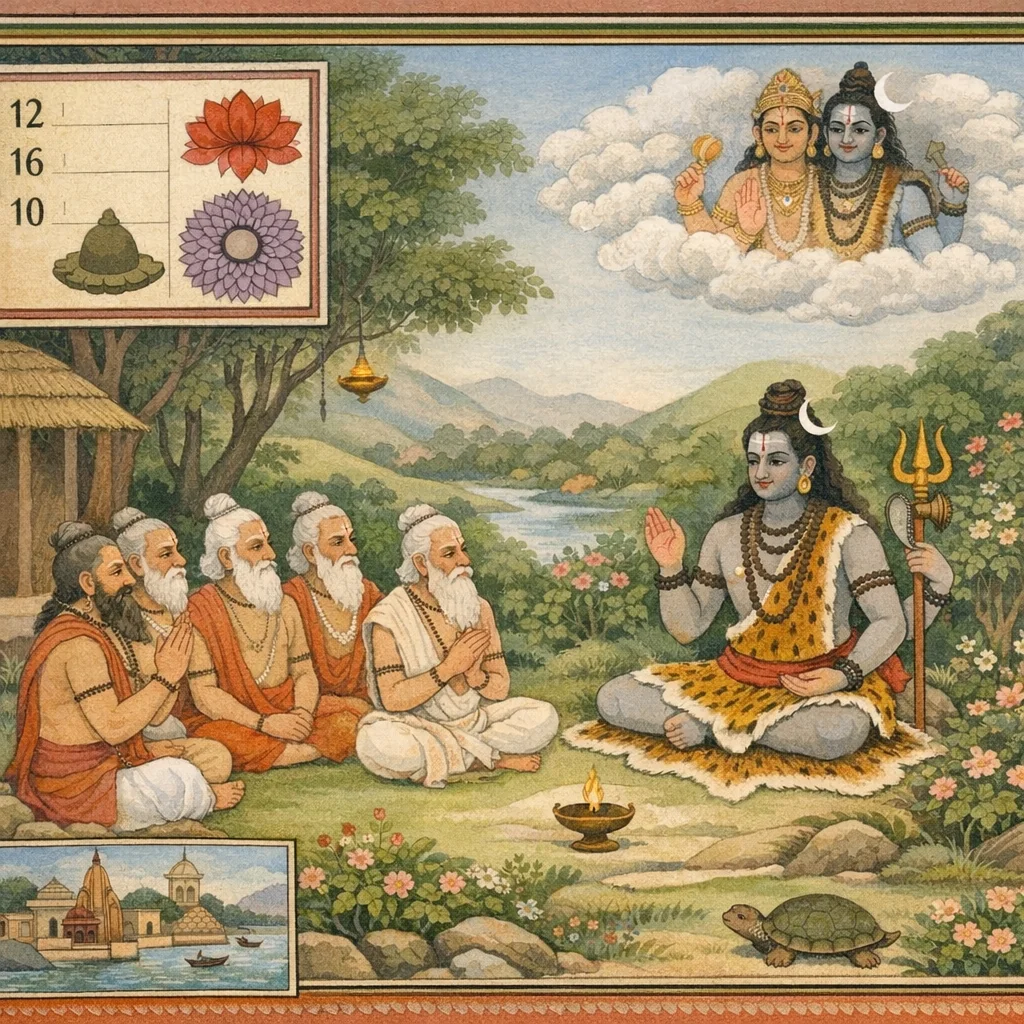
Continuing the Īśvara‑Gītā, Īśvara teaches a supremely rare Yoga that burns sin and grants direct vision of the Self and nirvāṇa. Yoga is set forth as twofold—Abhāva‑yoga (the cessation/emptiness of projections) and the higher Mahāyoga/Brahma‑yoga—culminating in beholding the all‑pervading Lord. The chapter systematizes aṣṭāṅga‑yoga: yama and niyama (with detailed meanings of ahiṃsā, satya, asteya, brahmacarya, aparigraha; tapas, svādhyāya, santoṣa, śauca, īśvara‑pūjā), then prāṇāyāma (mātrā measures; “with seed” and “seedless”; a Gāyatrī‑linked method), pratyāhāra, dhāraṇā, dhyāna, and samādhi (including duration ratios). It prescribes āsanas, proper places of practice, and two major contemplations (crown‑lotus and heart‑lotus) centered on Oṃ and the imperishable Light, leading into explicit Pāśupata praxis (Agnihotra ash, mantras, Īśāna as Supreme Light). The teaching expands into bhakti and karma‑yoga: renouncing fruits, surrendering to the Lord, worshiping the Liṅga everywhere, and japa of Oṃ/Śatarudrīya until death; Vārāṇasī is praised as a liberating seat. A strong doctrinal synthesis follows: Śiva declares Nārāyaṇa his supreme manifestation and insists that perceiving non‑difference ends rebirth, while sectarian difference leads to downfall. The chapter closes with the lineage of transmission (guru‑paramparā), injunctions on secrecy and eligibility, and a narrative turn as the sages request instruction on karma‑yoga, preparing the next chapter.
Shlokas
Verse 1
इती श्रीकूर्मपुराणे षट्साहस्त्र्यां संहितायामुपरिविभागे (ईश्वरगीतासु) दशमो ऽध्यायः ईश्वर उवाच अतः परं प्रवक्ष्यामि योगं परमदुर्लभम् / येनात्मानं प्रपश्यन्ति भानुमन्तमिवेश्वरम्
Īśvara said: “Now, thereafter, I shall teach the supremely rare Yoga—by which they directly behold the Self, radiant like the sun, as the Lord.”
Verse 2
योगाग्निर्दहति क्षिप्रमशेषं पापपञ्जरम् / प्रसन्नं जायते ज्ञानं साक्षान्निर्वाणसिद्धिदम्
The fire of Yoga quickly burns up the entire cage of sin. Then clear, tranquil knowledge arises—knowledge that directly bestows the attainment of nirvāṇa (liberating perfection).
Verse 3
योगात्संजायते ज्ञानं ज्ञानाद् योगः प्रवर्तते / योगज्ञानाभियुक्तस्य प्रसीदति महेश्वरः
From Yoga, true knowledge arises; from knowledge, Yoga is set in motion. For one who is steadily devoted to both Yoga and knowledge, Mahādeva (Maheśvara) becomes gracious.
Verse 4
एककालं द्विकालं वा त्रिकालं नित्यमेव वा / ये युञ्जन्तीह मद्योगं ते विज्ञेया महेश्वराः
Whether once a day, twice, three times, or continually—those who practice here My Yoga are to be known as ‘Maheshvaras’, devotees identified with the Great Lord.
Verse 5
योगस्तु द्विविधो ज्ञेयो ह्यभावः प्रथमो मतः / अपरस्तु महायोगः सर्वयोगोत्तमोत्तमः
Yoga is to be known as twofold. The first is held to be “abhāva”—the cessation, the absence of the mind’s fluctuations and worldly fixation. The other is Mahāyoga, the Great Yoga, highest of all yogas, supreme among the supreme.
Verse 6
शून्यं सर्वनिराभासं स्वरूपं यत्र चिन्त्यते / अभावयोगः स प्रोक्तो येनात्मानं प्रपश्यति
That discipline is called Abhāva-yoga, wherein one contemplates one’s own essential nature as “empty”—free from all appearances and objective projections—by which one directly beholds the Ātman, the Self.
Verse 7
यत्र पश्यति चात्मानं नित्यानन्दं निरञ्जनम् / मयैक्यं स महायोगो भाषितः परमेश्वरः
That state in which one beholds the Ātman—eternally blissful and stainless—and realizes unity with Me: that is declared to be Mahāyoga, the supreme Yoga, taught by the Supreme Lord (Parameśvara).
Verse 8
ये चान्ये योगिनां योगाः श्रूयन्ते ग्रन्थविस्तरे / सर्वे ते ब्रह्मयोगस्य कलां नार्हन्ति षोडशीम्
And whatever other yogas of yogins are heard of in the extensive scriptures—none of them is worthy of even a sixteenth part of Brahma-yoga.
Verse 9
यत्र साक्षात् प्रपश्यन्ति विमुक्ता विश्वमीश्वरम् / सर्वेषामेव योगानां स योगः परमो मतः
That state wherein the liberated directly behold the Lord (Īśvara)—the Sovereign who pervades the whole universe—this is regarded as the highest Yoga among all yogas.
Verse 10
सहस्रशो ऽथ शतशो ये चेश्वरबहिष्कृताः / न ते पश्यन्ति मामेकं योगिनो यतमानसाः
Though they be in the thousands or the hundreds, those who are shut out from Īśvara or who turn away from the Lord do not behold Me, the One. Only the yogins—whose minds are disciplined and striving—truly see (Me).
Verse 11
प्राणायामस्तथा ध्यानं प्रत्याहारो ऽथ धारणा / समाधिश्च मुनिश्रेष्ठा यमो नियम आसनम्
Breath-discipline (prāṇāyāma), meditation (dhyāna), withdrawal of the senses (pratyāhāra), and then concentration (dhāraṇā); and absorption (samādhi)—O best of sages—together with ethical restraint (yama), observance (niyama), and posture (āsana).
Verse 12
मय्येकचित्ततायोगो वृत्त्यन्तरनिरोधतः / तत्साधनान्यष्टधा तु युष्माकं कथितानि तु
The Yoga of one-pointedness in Me arises through the restraint of all other mental modifications. Its disciplines—eightfold in nature—have indeed been taught to you.
Verse 13
अहिंसा सत्यमस्तेयं ब्रह्मचर्यापरिग्रहौ / यमाः संक्षेपतः प्रोक्ताश्चित्तशुद्धिप्रदा नृणाम्
Non-violence, truthfulness, non-stealing, celibate discipline, and non-possessiveness—these are briefly declared to be the yamas, and they bestow purification of the mind upon human beings.
Verse 14
कर्मणा मनसा वाचा सर्वभूतेषु सर्वदा / अक्लेशजननं प्रोक्तं त्वहिंसा परमर्षिभिः
By deed, by mind, and by speech—towards all beings, at all times—non-violence is declared by the supreme seers to be that which causes no affliction (to any).
Verse 15
अहिंसायाः परो धर्मो नास्त्यहिंसा परं सुखम् / विधिना या भवेद्धिंसा त्वहिंसैव प्रकीर्तिता
There is no dharma higher than non-violence (ahiṃsā), and no happiness higher than non-violence. Even an act that appears as violence, when done according to scriptural rule and right procedure, is declared to be non-violence itself.
Verse 16
सत्येन सर्वमाप्नोति सत्ये सर्वं प्रतिष्ठितम् / यथार्थकथनाचारः सत्यं प्रोक्तं द्विजातिभिः
By truth (satya) one attains everything; in truth all things are established. The disciplined practice of speaking as it truly is—this the twice-born (dvija) have declared to be “truth”.
Verse 17
परद्रव्यापहरणं चौर्याद् वाथ बलेन वा / स्तेयं तस्यानाचरणादस्तेयं धर्मसाधनम्
Taking another’s property—whether by stealth or by force—is called stealing (steya). Refraining from that is non-stealing (asteya), a means for accomplishing dharma and a foundational discipline for spiritual life.
Verse 18
कर्मणा मनसा वाचा सर्वावस्थासु सर्वदा / सर्वत्र मैथुनत्यागं ब्रह्मचर्यं प्रचक्षते
They declare brahmacarya to be the renunciation of sexual union everywhere—at all times and in every condition—through deed, thought, and speech.
Verse 19
द्रव्याणामप्यनादानमापद्यपि यथेच्छया / अपरिग्रह इत्याहुस्तं प्रयत्नेन पालयेत्
Not accepting possessions—indeed, not taking even material goods—by one’s own free choice, even in times of hardship: this is declared to be aparigraha, non-possessiveness. One should uphold it with deliberate effort.
Verse 20
तपः स्वाध्यायसंतोषाः शौचमीश्वरपूजनम् / समासान्नियमाः प्रोक्ता योगसिद्धिप्रदायिनः
Austerity, sacred self-study (svādhyāya), contentment, purity, and worship of the Lord Īśvara—these, in brief, are declared to be the niyamas that bestow success in Yoga.
Verse 21
उपवासपराकादिकृच्छ्रचान्द्रायणादिभिः / शरीरशोषणं प्राहुस्तापसास्तप उत्तमम्
Through fasts, the Parāka observance, the Kṛcchra penance, the Cāndrāyaṇa vow, and the like, ascetics declare the mortification of the body—drying it up—to be the highest austerity.
Verse 22
वेदान्तशतरुद्रीयप्रणवादिजपं बुधाः / सत्त्वशुद्धिकरं पुंसां स्वाध्यायं परिचक्षते
The wise call svādhyāya the reverent recitation of Vedānta, the Śatarudrīya, and the japa of the Praṇava (Oṁ) and similar sacred formulas, for it purifies the sattva—the inner clarity—of human beings.
Verse 23
स्वाध्यायस्य त्रयो भेदा वाचिकोपांशुमानसाः / उत्तरोत्तरवैशिष्ट्यं प्राहुर्वेदार्थवेदिनः
Svādhyāya is said to be of three kinds: aloud, in a low/whispered tone (upāṁśu), and purely mental. Those who know the Veda’s meaning declare each succeeding mode superior to the former.
Verse 24
यः शब्दबोधजननः परेषां शृण्वतां स्फुटम् / स्वाध्यायो वाचिकः प्रोक्त उपांशोरथ लक्षणम्
That svādhyāya which, through sound, clearly awakens understanding in others who are listening is called the vocal mode (vācika). Thereafter, in contrast, the defining mark of the whispered mode (upāṁśu) is set forth.
Verse 25
ओष्ठयोः स्पन्दमात्रेण परस्याशब्दबोधकः / उपांशुरेष निर्दिष्टः साहस्रो वाचिकाज्जपः
When the mantra is conveyed without any audible sound, only by the slightest movement of the lips, it is taught as upāṃśu (the whispered, inaudible recitation). Such upāṃśu-japa is declared a thousand times more efficacious than spoken (vācika) japa.
Verse 26
यत्पदाक्षरसङ्गत्या परिस्पन्दनवर्जितम् / चिन्तनं सर्वशब्दानां मानसं तं जपं विदुः
That contemplation in which—through inward joining with the syllables of the mantra-words—there is no outward movement or vibration, and in which one mentally reflects upon the meaning of all the mantra-words: the wise know that to be mental japa (mānasa-japa).
Verse 27
यदृच्छालाभतो नित्यमलं पुंसो भवेदिति / या धीस्तामृषयः प्राहुः संतोषं सुखलक्षणम्
That steady understanding by which a person feels, “Whatever comes of its own accord is always enough for me,”—the sages have declared that very mindset to be contentment (santoṣa), the hallmark of true happiness.
Verse 28
बाह्यमाभ्यन्तरं शौचं द्विधा प्रोक्तं द्विजोत्तमाः / मृज्जलाभ्यां स्मृतं बाह्यं मनःशुद्धिरथान्तरम्
O best of the twice-born, purity (śauca) is declared to be of two kinds—external and internal. External purity is said to be achieved by cleansing with earth (clay) and water, while internal purity is the purification of the mind.
Verse 29
स्तुतिस्मरणपूजाभिर्वाङ्मनःकायकर्मभिः / सुनिश्चला शिवे भक्तिरेतदीश्वरपूजनम्
By acts of praise, remembrance, and worship—performed through speech, mind, and bodily conduct—when devotion to Śiva becomes unwavering, that itself is the true worship of Īśvara.
Verse 30
यमाः सनियमाः प्रोक्ताः प्राणायामं निबोधत / प्राणः स्वदेहजो वायुरायामस्तन्निरोधनम्
The yamas, together with the niyamas, have been taught; now understand prāṇāyāma. Prāṇa is the vital air born within one’s own body; “āyāma” is its restraint—therefore prāṇāyāma is the checking of that life-breath.
Verse 31
उत्तमाधममध्यत्वात् त्रिधायं प्रतिपादितः / स एव द्विविधः प्रोक्तः सगर्भो ऽगर्भ एव च
Because of the distinctions as superior, inferior, and middling, it has been taught as threefold. That same classification is also declared to be twofold: “with seed” (sagarbha) and “seedless” (agarbha).
Verse 32
मात्राद्वादशको मन्दश्चतुर्विंशतिमात्रिकः / मध्यमः प्राणसंरोधः षट्त्रिंशन्मात्रिकोत्तमः
Breath-restraint (prāṇa-saṃrodha) is of three grades: the mild is measured as twelve mātrās; the middling as twenty-four mātrās; and the excellent as thirty-six mātrās.
Verse 33
प्रस्वेदकम्पनोत्थानजनकत्वं यथाक्रमम् / मन्दमध्यममुख्यानामानन्दादुत्तमोत्तमः
In due sequence, bliss gives rise to perspiration, trembling, and rising up. Among the mild, the middling, and the foremost grades, the highest bliss is the most excellent of all.
Verse 34
सगर्भमाहुः सजपमगर्भं विजपं बुधाः / एतद् वै योगिनामुक्तं प्राणायामस्य लक्षणम्
The wise declare prāṇāyāma to be “with seed” (sagarbha) when it is accompanied by japa, the repetition of mantra, and “seedless” (agarbha) when it is without japa. This, indeed, is stated by yogins as the defining mark of prāṇāyāma.
Verse 35
सव्याहृतिं सप्रणवां गायत्रीं शिरसा सह / त्रिर्जपेदायतप्राणः प्राणायामः स उच्यते
With the vyāhṛtis and the praṇava (Oṁ), and including the “śiras” formula, one should recite the Gāyatrī three times while lengthening and regulating the breath; this is called prāṇāyāma.
Verse 36
रेचकः पूरकश्चैव प्राणायामो ऽथ कुम्भकः / प्रोच्यते सर्वशास्त्रेषु योगिभिर्यतमानसैः
Exhalation (recaka), inhalation (pūraka), and then breath-retention (kumbhaka)—this is what is called prāṇāyāma in all the scriptures, as taught by yogins of disciplined mind who strive in practice.
Verse 37
रेचको ऽजस्त्रनिश्वासात् पूरकस्तन्निरोधतः / साम्येन संस्थितिर्या सा कुम्भकः परिगीयते
Exhalation is known as recaka, arising from the continuous outgoing breath; inhalation is pūraka, through restraining that outward flow. The steady poise established in equilibrium is celebrated as kumbhaka.
Verse 38
इन्द्रियाणां विचरतां विषयेषु स्वभावतः / निग्रहः प्रोच्यते सद्भिः प्रत्याहारस्तु सत्तमाः
O best of the virtuous, the wise declare that pratyāhāra is the restraint of the senses which, by their very nature, roam among their objects.
Verse 39
हृत्पुण्डरीके नाभ्यां वा मूर्ध्नि पर्वतमस्तके / एवमादिषु देशेषु धारणा चित्तबन्धनम्
Fixing the mind in the lotus of the heart, or in the navel, or at the crown of the head, or on the summit of a mountain—concentration (dhāraṇā) is the binding and steadying of the mind in such chosen places.
Verse 40
देशावस्थितिमालम्ब्य बुद्धेर्या वृत्तिसंततिः / वृत्त्यन्तरैरसंसृष्टा तद्ध्यानं सूरयो विदुः
When the unbroken stream of the intellect’s modifications is anchored in one place and one state, and remains unmixed with other movements of mind—this, the wise know, is dhyāna, meditation.
Verse 41
एकाकारः समाधिः स्याद् देशालम्बनवर्जितः / प्रत्ययो ह्यर्थमात्रेण योगसाधनमुत्तमम्
Samādhi is said to be a one-formed absorption, free from dependence on place or external supports. Indeed, the supreme means of Yoga is that cognition which rests on the object alone—nothing but the intended meaning.
Verse 42
धारणा द्वादशायामा ध्यानं द्वादशधारणाः / ध्यानं द्वादशकं यावत् समाधिरभिधीयते
Dhāraṇā is said to last for twelve yāmas; twelve such dhāraṇās constitute dhyāna. And when dhyāna reaches a set of twelve, it is then called samādhi.
Verse 43
आसनं स्वस्तिकं प्रोक्तं पद्ममर्धासनं तथा / साधनानां च सर्वेषामेतत्साधनमुत्तमम्
The Svastika posture is declared to be an approved seat, and likewise the Lotus posture and the Half-lotus posture. For all spiritual disciplines, this is said to be the best means of practice.
Verse 44
ऊर्वोरुपरि विप्रेन्द्राः कृत्वा पादतले उभे / समासीतात्मनः पद्ममेतदासनमुत्तमम्
O best of brāhmaṇa sages, placing both soles upon the thighs and sitting steady with the self composed—this is padmāsana, the lotus posture, the supreme seat for dhyāna.
Verse 45
एकं पादमथैकस्मिन् विन्यस्योरुणि सत्तमाः / आसीतार्धासनमिदं योगसाधनमुत्तमम्
O best of the virtuous, placing one foot upon the opposite thigh and sitting thus—this is called Ardhāsana, the Half-Seat, an excellent aid for the discipline of Yoga.
Verse 46
उभे कृत्वा पादतले जानूर्वोरन्तरेण हि / समासीतात्मनः प्रोक्तमासनं स्वस्तिकं परम्
Placing both soles between the knees and thighs, one should sit composed and self-possessed. This posture is taught as the supreme Svastika-āsana.
Verse 47
अदेशकाले योगस्य दर्शनं हि न विद्यते / अग्न्यभ्यासे जले वापि शुष्कपर्णचये तथा
Indeed, when place and time are improper, there is no true attainment—or vision—of Yoga. It is like trying to kindle fire by practice in water, or (trying to do so) in a heap of dry leaves.
Verse 48
जन्तुव्याप्ते श्मशाने च जीर्णगोष्ठे चतुष्पथे / सशब्दे सभये वापि चैत्यवल्मीकसंचये
In places crowded with creatures, in a cremation-ground, in a dilapidated cowshed, at a crossroads, in a noisy or fear-provoking spot, and also amid heaps of shrines and ant-hills—there one should not undertake steady meditation.
Verse 49
अशुभे दुर्जनाक्रान्ते मशकादिसमन्विते / नाचरेद् देहबाधे वा दौर्मनस्यादिसंभवे
One should not undertake the prescribed rite or observance in an inauspicious place—overrun by wicked people, infested with mosquitoes and the like—nor when there is bodily affliction, or when depression and similar disturbances arise.
Verse 50
सुगुप्ते सुशुभे देशे गुहायां पर्वतस्य तु / नद्यास्तीरे पुण्यदेशे देवतायतने तथा
In a well-guarded, auspicious place—such as a mountain cave, a riverbank, a holy region, or likewise within the shrine or temple of the Deity—one should dwell and practice.
Verse 51
गृहे वा सुशुभे रम्ये विजने जन्तुवर्जिते / युञ्जीत योगी सततमात्मानं मत्परायणः
Whether in a well-kept home or in a beautiful, secluded place free from living disturbances, the yogin—taking refuge in Me as the supreme goal—should constantly practice Yoga, uniting the ātman.
Verse 52
नमस्कृत्य तु योगीन्द्रान् सशिष्यांश्च विनायकम् / गुरुं चैवाथ मां योगी युञ्जीत सुसमाहितः
Having first bowed to the foremost Yogins along with their disciples, to Vināyaka, and also to his Guru, the yogin—well-collected in mind—should then practice Yoga, fixing contemplation on Me, the Lord.
Verse 53
आसनं स्वस्तिकं बद्ध्वा पद्ममर्धमथापि वा / नासिकाग्रे समां दृष्टिमीषदुन्मीलितेक्षणः
Having assumed the Svastika posture—or alternatively the Half-lotus—keep an even, steady gaze at the tip of the nose, with the eyes slightly opened.
Verse 54
कृत्वाथ निर्भयः शान्तस्त्यक्त्वा मायामयं जगत् / स्वात्मन्यवस्थितं देवं चिन्तयेत् परमेश्वरम्
Then, becoming fearless and tranquil, and renouncing the world made of Māyā, one should meditate on Parameśvara, the Supreme Lord—the divine Reality established within one’s own ātman.
Verse 55
शिखाग्रे द्वादशाङ्गुल्ये कल्पयित्वाथ पङ्कजम् / धर्मकन्दसमुद्भूतं ज्ञाननालं सुशोभनम्
Then, at the crown of the head—twelve finger-breadths above—one should visualize a lotus, arising from the bulb of Dharma, with a radiant stalk of Knowledge, splendid to behold.
Verse 56
ऐश्वर्याष्टदलं श्वेतं परं वैराग्यकर्णिकम् / चिन्तयेत् परमं कोशं कर्णिकायां हिरण्मयम्
One should contemplate the supreme lotus: its eight petals are white with divine sovereignty, its central pericarp is the highest dispassion, and within that golden core one should meditate upon the supreme inner sheath—the inmost sanctum of consciousness.
Verse 57
सर्वशक्तिमयं साक्षाद् यं प्राहुर्दिव्यमव्ययम् / ओङ्कारवाच्यमव्यक्तं रश्मिजालसमाकुलम्
That Supreme Reality is directly the very fullness of all powers; the sages declare Him divine and imperishable—expressible through the syllable Oṃ, unmanifest, and pervaded by a net of rays of consciousness and radiance.
Verse 58
चिन्तयेत् तत्र विमलं परं ज्योतिर्यदक्षरम् / तस्मिन् ज्योतिषि विन्यस्यस्वात्मानं तदभेदतः
There one should contemplate the stainless, supreme Light that is imperishable; and, placing one’s own Self in that Light, one should abide in non-difference from It.
Verse 59
ध्यायीताकाशमध्यस्थमीशं परमकारणम् / तदात्मा सर्वगो भूत्वा न किञ्चिदपि चिन्तयेत्
Let one meditate upon Īśa, the Supreme Cause, as abiding in the midst of space. Becoming one in identity with That Self—pervading all—let one think of nothing whatsoever.
Verse 60
एतद् गुह्यतमं ध्यानं ध्यानान्तरमथोच्यते / चिन्तयित्वा तु पूर्वोक्तं हृदये पद्ममुत्तमम्
This is the most secret meditation; now another mode of meditation is taught. Having contemplated the supreme lotus in the heart as previously described,
Verse 61
आत्मानमथ कर्तारं तत्रानलसमत्विषम् / मध्ये वह्निशिखाकारं पुरुषं पञ्चविंशकम्
Then one should contemplate the Self as the inner doer, radiant like fire; and, in the very center, visualize the twenty-fifth Principle—the Purusha—shaped like a flame’s crest.
Verse 62
चिन्तयेत् परमात्मानं तन्मध्ये गगनं परम् / ओङ्करबोधितं तत्त्वं शाश्वतं शिवमच्युतम्
Let one contemplate the Supreme Self (Paramātman); within that, contemplate the supreme, sky-like expanse of pure consciousness. That Reality revealed by the syllable Oṃ is eternal—auspicious as Śiva and unfallen as Acyuta (Viṣṇu).
Verse 63
अव्यक्तं प्रकृतौ लीनं परं ज्योतिरनुत्तमम् / तदन्तः परमं तत्त्वमात्माधारं निरञ्जनम्
The Unmanifest (Avyakta), merged into Prakṛti, is the unsurpassed Supreme Light. Within that is the highest Principle—spotless, the very support of the Ātman.
Verse 64
ध्यायीत तन्मयो नित्यमेकरूपं महेश्वरम् / विशोध्य सर्वतत्त्वानि प्रणवेनाथवा पुनः
Becoming wholly absorbed in Him, one should constantly meditate on Maheśvara, the One of single, unchanging form; and, having purified all the tattvas, one should again steady and purify oneself also by the Pranava (Oṃ).
Verse 65
संस्थाप्य मयि चात्मानं निर्मले परमे पदे / प्लावयित्वात्मनो देहं तेनैव ज्ञानवारिणा
Having established the Self in Me—in the stainless, supreme state—one should flood and purify one’s embodied condition with that very water of knowledge.
Verse 66
मदात्मा मन्मयो भस्म गृहीत्वा ह्यग्निहोत्रजम् / तेनोद्धृत्य तु सर्वाङ्गमग्निरित्यादिमन्त्रतः / चिन्तयेत् स्वात्मनीशानं परं ज्योतिः स्वरूपिणम्
Knowing, “I am His Self; I am pervaded by Him,” one should take the ash produced from the Agnihotra, lift it up and smear it over the whole body while reciting the mantras beginning with “Agni…”. Then, within one’s own Self, one should contemplate Īśāna, the Lord, as the Supreme Light whose very nature is pure radiance.
Verse 67
एष पाशुपतो योगः पशुपाशविमुक्तये / सर्ववेदान्तसारो ऽयमत्याश्रममिति श्रुतिः
This is the Pāśupata Yoga, taught for the release of the bound soul (paśu) from the bonds (pāśa) of limitation. It is indeed the essence of all Vedānta; and the Śruti declares it to transcend all āśramas.
Verse 68
एतत् परतरं गुह्यं मत्सायुज्योपपादकम् / द्विजातीनां तु कथितं भक्तानां ब्रह्मचारिणाम्
This is the highest and most secret teaching, the means that leads to sāyujya—union with Me. It has been declared for the twice-born (dvija): the devoted who live in the discipline of brahmacarya.
Verse 69
ब्रह्मचर्यमहिंसा च क्षमा शौचं तपो दमः / संतोषः सत्यमास्तिक्यं व्रताङ्गानि विशेषतः
Brahmacarya (celibate self-restraint), ahiṃsā (non-violence), kṣamā (forgiveness), śauca (purity), tapas (austerity), and dama (self-control); together with santoṣa (contentment), satya (truthfulness), and āstikya (faithful reverence)—these, in particular, are declared to be the essential limbs of sacred vows.
Verse 70
एकेनाप्यथ हीनेन व्रतमस्य तु लुप्यते / तस्मादात्मगुणोपेतो मद्व्रतं वोढुमर्हति
If even a single observance is lacking, this vow is spoiled. Therefore, only one endowed with self-discipline and the virtues of the inner Self is fit to undertake and uphold My vow.
Verse 71
वीतरागभयक्रोधा मन्मया मामुपाश्रिताः / बहवो ऽनेन योगेन पूता मद्भावमागताः
Free from attachment, fear, and anger—absorbed in Me and taking refuge in Me—many have been purified by this very Yoga and have attained My state of being.
Verse 72
ये यथा मां प्रपद्यन्ते तांस्तथैव भजाम्यहम् / ज्ञानयोगेन मां तस्माद् यजेत परमेश्वरम्
As beings surrender to Me in whatever manner, in that very manner do I respond to them. Therefore, one should worship Me—the Supreme Lord—through the Yoga of knowledge.
Verse 73
अथवा भक्तियोगेन वैराग्येण परेण तु / चेतसा बोधयुक्तेन पूजयेन्मां सदा शुचिः
Or else, through the Yoga of devotion—supported by supreme dispassion—let the ever-pure one worship Me constantly with a mind endowed with awakened discernment.
Verse 74
सर्वकर्माणि संन्यस्य भिक्षाशी निष्परिग्रहः / प्राप्नोति मम सायुज्यं गुह्यमेतन्मयोदितम्
Renouncing all actions, living on alms, and free from possessiveness, one attains sāyujya—union with Me. This is the secret teaching declared by Me.
Verse 75
अद्वेष्टा सर्वभूतानां मैत्रः करुण एव च / निर्ममो निरहङ्कारो यो मद्भक्तः स मे प्रियः
He who bears no hatred toward any being, who is friendly and compassionate; who is free from possessiveness and free from ego—such a devotee of Mine is dear to Me.
Verse 76
संतुष्टः सततं योगी यतात्मा दृढनिश्चयः / मय्यर्पितमनो बुद्धिर्यो मद्भक्तः स मे प्रियः
Ever content, ever steadfast in yoga, self-restrained and firm in resolve—one whose mind and understanding are offered into Me: that devotee of Mine is dear to Me.
Verse 77
यस्मान्नोद्विजते लोको लोकान्नोद्विजते च यः / हर्षामर्षभयोद्वेगैर्मुक्तो यः स हि मे प्रियः
He from whom the world does not feel disturbed, and who is not disturbed by the world; and who is freed from exhilaration, resentment, fear, and agitation—he indeed is dear to Me.
Verse 78
अनपेक्षः शुचिर्दक्ष उदासीनो गतव्यथः / सर्वारम्भपरित्यागी भक्तिमान् यः स मे प्रियः
He who is free from expectation, pure, capable, impartial, and beyond distress; who has renounced all self-motivated undertakings and is endowed with devotion—such a person is dear to Me.
Verse 79
तुल्यनिन्दास्तुतिर्मौनी संतुष्टो येन केनचित् / अनिकेतः स्थिरमतिर्मद्भक्तो मामुपैष्यति
One who remains the same in blame and praise, who is restrained in speech, content with whatever comes of itself, without fixed abode, and steady in understanding—such a devotee of Mine attains Me.
Verse 80
सर्वकर्माण्यपि सदा कुर्वाणो मत्परायणः / मत्प्रसादादवाप्नोति शाश्वतं परमं पदम्
Even while always performing every action, one wholly devoted to Me attains—through My grace—the eternal, supreme state.
Verse 81
चेतसा सर्वकर्माणि मयि संन्यस्य मत्परः / निराशीर्निर्ममो भूत्वा मामेकं शरणं व्रजेत्
With the mind, renouncing all actions into Me and taking Me as the supreme goal, free from expectation and possessiveness, one should go for refuge to Me alone.
Verse 82
त्यक्त्वा कर्मफलासङ्गं नित्यतृप्तो निराश्रयः / कर्मण्यभिप्रवृत्तो ऽपि नैव तेन निबध्यते
Having abandoned attachment to the fruits of action, ever content and dependent on nothing, even though fully engaged in action, one is not bound by it.
Verse 83
निराशीर्यतचित्तात्मा त्यक्तसर्वपरिग्रहः / शारीरं केवलं कर्म कुर्वन्नाप्नोति तत्पदम्
Free from craving for results, with mind and self disciplined, and having renounced all possessions and claims, one who performs only the bodily (necessary) actions attains that Supreme State.
Verse 84
यदृच्छालाभतुष्टस्य द्वन्द्वातीतस्य चैव हि / कुर्वतो मत्प्रसादार्थं कर्म संसारनाशनम्
For one who is content with whatever comes of its own accord, who has transcended the pairs of opposites, and who performs action solely to obtain My grace—such action becomes the destroyer of saṃsāra (the cycle of worldly bondage).
Verse 85
मन्मना मन्नमस्कारो मद्याजी मत्परायणः / मामुपैष्यति योगीशं ज्ञात्वा मां परमेश्वरम्
With his mind fixed on Me, offering salutations to Me, worshipping Me in sacrifice, and taking refuge in Me alone, he will come to Me—the Lord of Yoga—having understood Me as the Supreme Lord, Parameśvara.
Verse 86
मद्बुद्धयो मां सततं बोधयन्तः परस्परम् / कथयन्तश्च मां नित्यं मम सायुज्यमाप्नुयुः
Those whose understanding is fixed on Me—constantly awakening one another to My truth and ever speaking of Me—attain sāyujya, union with Me, entering into My own state.
Verse 87
एवं नित्याभियुक्तानां मायेयं कर्मसान्वगम् / नाशयामि तमः कृत्स्नं ज्ञानदीपेन भास्वता
Thus, for those who are ever steadfastly devoted, I destroy all the darkness born of Māyā—together with its train of karma—by the radiant lamp of knowledge.
Verse 88
मद्बुद्धयो मां सततं पूजयन्तीह ये जनाः / तेषां नित्याभियुक्तानां योगक्षेमं वहाम्यहम्
Those people here whose understanding is fixed on Me and who worship Me constantly—of those ever-devoted ones, I Myself carry their yoga and kṣema: what they need to attain, and what they need to preserve.
Verse 89
ये ऽन्ये च कामभोगार्थं यजन्ते ह्यन्यदेवताः / तेषां तदन्तं विज्ञेयं देवतानुगतं फलम्
Those who, seeking pleasures and sensual enjoyments, worship other deities—know that their result is limited to that end alone; it is a fruit that follows the deity worshipped and terminates with it.
Verse 90
ये चान्यदेवताभक्ताः पूजयन्तीह देवताः / मद्भावनासमायुक्ता मुच्यन्ते ते ऽपि भावतः
Even those devoted to other deities, worshipping those gods here—if they are joined to the contemplation of Me, the Supreme Lord—are likewise liberated, according to the inward disposition of their devotion.
Verse 91
तस्मादनीश्वरानन्यांस्त्यक्त्वा देवानशेषतः / मामेव संश्रयेदीशं स याति परमं पदम्
Therefore, having wholly renounced the other gods who are not the Supreme Lord, one should take refuge in Me alone as Īśvara; such a one attains the highest state.
Verse 92
त्यक्त्वा पुत्रादिषु स्नेहं निः शोको निष्परिग्रहः / यजेच्चामरणाल्लिङ्गे विरक्तः परमेश्वरम्
Having abandoned attachment to sons and the rest, free from grief and without possessiveness, one should—dispassionate—worship Parameśvara in the deathless Liṅga, transcending mortality.
Verse 93
ये ऽर्चयन्ति सदा लिङ्गं त्यक्त्वा भोगानशेषतः / एकेन जन्मना तेषां ददामि परमैश्वरम्
To those who continually worship the Liṅga, having wholly renounced all worldly enjoyments—within a single lifetime—I grant the supreme lordship, the highest state of Īśvara.
Verse 94
परानन्दात्मकं लिङ्गं केवलं सन्निरञ्जनम् / ज्ञानात्मकं सर्वगतं योगिनां हृदि संस्थितम्
That Liṅga is of the very nature of supreme bliss—one alone, pure Being, stainless. It is of the nature of consciousness-knowledge, all-pervading, and established within the heart of yogins.
Verse 95
ये चान्ये नियता भक्ता भावयित्वा विधानतः / यत्र क्वचन तल्लिङ्गमर्चयन्ति महेश्वरम्
And other disciplined devotees as well—having duly prepared themselves according to the prescribed rite—worship Maheshvara by venerating that very liṅga wherever they may be.
Verse 96
जले वा वह्निमध्ये वाव्योम्नि सूर्ये ऽथवान्यतः / रत्नादौ भावयित्वेशमर्चयेल्लिङ्गमैश्वरम्
Whether in water, in the midst of fire, in the open sky, in the sun, or elsewhere—having contemplated Īśa as present there—one should worship the sovereign emblem, the liṅga of Īśvara.
Verse 97
सर्वं लिङ्गमयं ह्येतत् सर्वं लिङ्गे प्रतिष्ठितम् / तस्माल्लिङ्गे ऽर्चयेदीशं यत्र क्वचन शाश्वतम्
Indeed, all this is pervaded by the Liṅga; everything is established in the Liṅga. Therefore, one should worship the Eternal Lord in the Liṅga—anywhere, at any time—as the ever-abiding reality.
Verse 98
अग्नौ क्रियावतामप्सु व्योम्नि सूर्ये मनीषिणाम् / काष्ठादिष्वेव मूर्खाणां हृदि लिङ्गन्तुयोगिनाम्
For ritualists, (the Divine is sought) in fire; for others, in water; for the contemplative wise, in the sky and in the sun. The foolish look for it in mere wood and the like; but for yogins, the (true) liṅga is within the heart.
Verse 99
यद्यनुत्पन्नविज्ञानो विरक्तः प्रीतिसंयुतः / यावज्जीवं जपेद् युक्तः प्रणवं ब्रह्मणो वपुः
Even if true realization has not yet arisen, one who is detached yet filled with loving devotion should, with disciplined concentration, continue for as long as life lasts to repeat the Praṇava (Oṁ)—the very embodied form of Brahman.
Verse 100
अथवा शतरुद्रीयं जपेदामरणाद् द्विजः / एकाकी यतचित्तात्मा स याति परमं पदम्
Or else, let the twice-born recite the Śatarudrīya as japa until the time of death; dwelling alone, with mind and inner self restrained, he attains the supreme state.
Verse 101
वसेद् वामरणाद् विप्रो वाराणस्यां समाहितः / सो ऽपीश्वरप्रसादेन याति तत् परमं पदम्
A brahmin should dwell in Vārāṇasī, steadfast in gathered contemplation until death; by the grace of Īśvara, he too attains that supreme state.
Verse 102
तत्रोत्क्रमणकाले हि सर्वेषामेव देहिनाम् / ददाति तत् परं ज्ञानं येन मुच्येत बन्धनात्
At the very time of departing the body, He indeed bestows upon all embodied beings that supreme knowledge by which one is released from bondage.
Verse 103
वर्णाश्रमविधिं कृत्स्नं कुर्वाणो मत्परायणः / तेनैव जन्मना ज्ञानं लब्ध्वा याति शिवं पदम्
One who fully performs the entire discipline of varṇa and āśrama, devoted to Me as the supreme refuge, gains true knowledge in that very life; and having gained it, reaches the auspicious state of Śiva—liberation.
Verse 104
ये ऽपि तत्र वसन्तीह नीचा वा पापयोनयः / सर्वे तरन्ति संसारमीश्वरानुग्रहाद् द्विजाः
Even those who dwell there—though of low station or born in sinful wombs—cross over saṃsāra; by the grace of Īśvara, O twice-born ones, they all attain deliverance.
Verse 105
किन्तु विघ्ना भविष्यन्ति पापोपहतचेतसाम् / धर्मं समाश्रयेत् तस्मान्मुक्तये नियतं द्विजाः
Yet obstacles will surely arise for those whose minds are wounded by sin. Therefore, O twice-born ones, steadfastly take refuge in Dharma for the sake of liberation.
Verse 106
एतद् रहस्यं वेदानां न देयं यस्य कस्य चित् / धार्मिकायैव दातव्यं भक्ताय ब्रह्मचारिणे
This secret teaching of the Vedas should not be given to just anyone. It should be imparted only to a righteous person—one who is devoted and established in brahmacarya (disciplined continence and sacred study).
Verse 107
व्यास उवाच इत्येतदुक्त्वा भगवानात्मयोगमनुत्तमम् / व्याजहार समासीनं नारायणमनामयम्
Vyāsa said: Having thus spoken of the unsurpassed Yoga of the Self, the Blessed Lord then addressed Nārāyaṇa—seated there in composure, free from all affliction.
Verse 108
मयैतद् भाषितं ज्ञानं हितार्थं ब्रह्मवादिनाम् / दातव्यं शान्तचित्तेभ्यः शिष्येभ्यो भवता शिवम्
This knowledge has been spoken by me for the welfare of those devoted to Brahman. It should be bestowed by you, O auspicious one, upon disciples whose minds are tranquil.
Verse 109
उक्त्वैवमथ योगीन्द्रानब्रवीद् भगवानजः / हिताय सर्वभक्तानां द्विजातीनां द्विजोत्तमाः
Having thus spoken, the Unborn Lord then addressed the foremost of yogins, for the welfare of all devotees—especially for the good of the twice-born, O best among the twice-born.
Verse 110
भवन्तो ऽपि हि मज्ज्ञानं शिष्याणां विधिपूर्वकम् / उपदेक्ष्यन्ति भक्तानां सर्वेषां वचनान्मम
You too shall, in the duly prescribed manner, impart My knowledge to your disciples—indeed to all devotees—according to My command.
Verse 111
अयं नारायणो यो ऽहमीश्वरो नात्र संशयः / नान्तरं ये प्रपश्यन्ति तेषां देयमिदं परम्
This Supreme is Nārāyaṇa—indeed, I am that Īśvara; of this there is no doubt. For those who perceive no difference, this highest gift is to be bestowed.
Verse 112
ममैषा परमा मूर्तिर्नारायणसमाह्वया / सर्वभूतात्मभूतस्था शान्ता चाक्षरसंज्ञिता
“This is My supreme manifestation, known by the name ‘Nārāyaṇa’—abiding as the Self of all beings, present within all existences; tranquil, and designated as the Imperishable (Akṣara).”
Verse 113
ये त्वन्यथा प्रपश्यन्ति लोके भेददृशो जनाः / न ते मां संप्रपश्यन्ति जायन्ते च पुनः पुनः
But those people in the world who see otherwise—who are fixed in a vision of difference—do not truly perceive Me; and they are born again and again.
Verse 114
ये त्विमं विष्णुमव्यक्तं मां वा देवं महेश्वरम् / एकीभावेन पश्यन्ति न तेषां पुनरुद्भवः
But those who behold this unmanifest Vishnu—or Me, the Divine Maheshvara—with the vision of essential oneness, for them there is no rebirth again.
Verse 115
तस्मादनादिनिधनं विष्णुमात्मानमव्ययम् / मामेव संप्रपश्यध्वं पूजयध्वं तथैव हि
Therefore, behold Me alone—Vishnu, the imperishable, unchanging Self—without beginning and without end; and worship Me, indeed, in that very manner.
Verse 116
ये ऽन्यथा मां प्रपश्यन्ति मत्वेमं देवतान्तरम् / ते यान्ति नरकान् घोरान् नाहं तेषुव्यवस्थितः
Those who perceive Me otherwise—taking Me to be merely some other, separate deity—go to dreadful hells; I am not established in them.
Verse 117
मूर्खं वा पण्डितं वापि ब्राह्मणं वा मदाश्रयम् / मोचयामि श्वपाकं वा न नारायणनिन्दकम्
Whether one is foolish or learned, even a brāhmaṇa who has taken refuge in Me—I grant liberation; even a dog-cooker (an outcaste) I can free, but not one who reviles Nārāyaṇa.
Verse 118
तस्मादेष महायोगी मद्भक्तैः पुरुषोत्तमः / अर्चनीयो नमस्कार्यो मत्प्रीतिजननाय हि
Therefore, O Supreme Person, this Great Yogi is to be worshipped and saluted by My devotees—indeed, for the very purpose of generating My pleasure (divine grace).
Verse 119
एवमुक्त्वा समालिङ्ग्य वासुदेवं पिनाकधृक् / अन्तर्हितो ऽभवत् तेषां सर्वेषामेव पश्यताम्
Having spoken thus, the Bearer of the Pināka (Śiva) embraced Vāsudeva; and, while all of them were watching, he vanished from their sight.
Verse 120
नारायणो ऽपि भगवांस्तापसं वेषमुत्तमम् / जग्राह योगिनः सर्वांस्त्यक्त्वा वै परमं वपुः
Even Bhagavān Nārāyaṇa assumed the most excellent garb of an ascetic; setting aside His supreme form, He adopted that mode for the sake of all yogins.
Verse 121
ज्ञातं भवद्भिरमलं प्रसादात् परमेष्ठिनः / साक्षादेव महेशस्य ज्ञानं संसारनाशनम्
By the grace of Parameṣṭhin, the Supreme Lord, you have come to know the stainless truth—indeed, the direct knowledge of Maheśvara himself, which destroys the bondage of saṃsāra.
Verse 122
गच्छध्वं विज्वराः सर्वे विज्ञानं परमेष्ठिनः / प्रवर्तयध्वं शिष्येभ्यो धार्मिकेभ्यो मुनीश्वराः
“Go forth, all of you, free from affliction. Set in motion the supreme realized knowledge of Parameṣṭhin, the Highest Lord; and, O best of sages, transmit it to your righteous disciples.”
Verse 123
इदं भक्ताय शान्ताय धार्मिकायाहिताग्नये / विज्ञानमैश्वरं देयं ब्राह्मणाय विशेषतः
This sovereign, Īśvara-centered wisdom should be imparted to one who is devoted and tranquil, established in dharma and who maintains the sacred fires; and it should be given especially to a brāhmaṇa.
Verse 124
एवमुक्त्वा स विश्वात्मा योगिनां योगवित्तमः / नारायणो महायोगी जगामादर्शनं स्वयम्
Having spoken thus, that Universal Self—Nārāyaṇa, the Great Yogi, the foremost knower of Yoga among yogins—himself withdrew from sight and became unseen.
Verse 125
ते ऽपि देवादिदेवेशं नमस्कृत्य महेश्वरम् / नारायणं च भूतादिं स्वानि स्थानानि भेजिरे
They too, having bowed in reverence to Mahādeva, Mahēśvara—the Lord of the gods—and to Nārāyaṇa, the primordial source of all beings, returned to their own abodes.
Verse 126
सनत्कुमारो भगवान् संवर्ताय महामुनिः / दत्तवानैश्वरं ज्ञानं सो ऽपि सत्यव्रताय तु
The blessed sage Sanatkumāra bestowed upon the great seer Saṃvarta the aiśvara-jñāna, the Lord’s divine knowledge; and Saṃvarta, in turn, imparted it to Satyavrata.
Verse 127
सनन्दनो ऽपि योगीन्द्रः पुलहाय महर्षये / प्रददौ गौतमायाथ पुलहो ऽपि प्रजापतिः
Sanandana too, foremost among yogins, imparted that knowledge to the great sage Pulaha; thereafter Pulaha, the Prajāpati, bestowed it upon Gautama.
Verse 128
अङ्गिरा वेदविदुषे भरद्वाजाय दत्तवान् / जैगीषव्याय कपिलस्तथा पञ्चशिखाय च
Aṅgiras bestowed it upon Bharadvāja, the knower of the Veda; and Kapila likewise bestowed it upon Jaigīṣavya, and also upon Pañcaśikha.
Verse 129
पराशरो ऽपि सनकात् पिता मे सर्वतत्त्वदृक् / लेभेतत्परमं ज्ञानं तस्माद् वाल्मीकिराप्तवान्
My father Parāśara too, seer of all tattvas, received this supreme knowledge from Sanaka; and from him Vālmīki obtained it.
Verse 130
ममोवाच पुरा देवः सतीदेहभवाङ्गजः / वामदेवो महायोगी रुद्रः किल पिनाकधृक्
Long ago the Lord spoke to me—Rudra, Vāmadeva the great Yogin, famed as the bearer of the bow Pināka, born from the body of Satī.
Verse 131
नारायणो ऽपि भगवान् देवकीतनयो हरिः / अर्जुनाय स्वयं साक्षात् दत्तवानिदमुत्तमम्
Even Nārāyaṇa Himself—the Blessed Lord Hari, the son of Devakī—personally and directly bestowed this supreme teaching upon Arjuna.
Verse 132
यदहं लब्धवान् रुद्राद् वामदेवादनुत्तमम् / विशेषाद् गिरिशे भक्तिस्तस्मादारभ्य मे ऽभवत्
When I received from Rudra—Vāmadeva—the unsurpassed teaching, from that very time my devotion to Girīśa (Śiva, Lord of the Mountain) arose with special intensity.
Verse 133
शरण्यं शरणं रुद्रं प्रपन्नो ऽहं विशेषतः / भूतेशं गिरशं स्थाणुं देवदेवं त्रिशूलिनम्
I have taken refuge—most especially—in Rudra, the Refuge of all who seek shelter; in Bhūteśa, Lord of beings; in Girīśa, Lord of the mountains; in Sthāṇu, the Immovable One; in Devadeva, the God of gods; in the Trident-bearing Lord.
Verse 134
भवन्तो ऽपि हि तं देवं शंभुं गोवृषवाहनम् / प्रपद्यध्वं सपत्नीकाः सपुत्राः शरणं शिवम्
Therefore, you too should take refuge in that divine Lord Śambhu—Śiva, whose vehicle is the bull—approaching Him for protection together with your wives and your sons, surrendering to Śiva alone as your shelter.
Verse 135
वर्तध्वं तत्प्रसादेन कर्मयोगेन शङ्करम् / पूजयध्वं महादेवं गोपतिं भूतिभूषणम्
By His grace, live and act in the discipline of Karma-yoga; worship Śaṅkara—Mahādeva, the Lord and protector of beings, adorned with sacred ash.
Verse 136
एवमुक्ते ऽथ मुनयः शौनकाद्या महेश्वरम् / प्रणेमुः शाश्वतं स्थाणुं व्यासं सत्यवतीसुतम्
When this had been spoken, the sages led by Śaunaka bowed down in reverence—to Maheśvara, the eternal and steadfast Lord, and to Vyāsa, the son of Satyavatī.
Verse 137
अब्रुवन् हृष्टमनसः कृष्णद्वैपायनं प्रभुम् / साक्षादेव हृषीकेशं सर्वलोकमहेश्वरम्
Rejoicing at heart, they addressed the venerable Kṛṣṇa Dvaipāyana (Vyāsa), regarding him as the Lord himself—Hṛṣīkeśa manifest in person, the Great Sovereign of all the worlds.
Verse 138
भवत्प्रसादादचला शरण्ये गोवृषध्वजे / इदानीं जायते भक्तिर्या देवैरपि दुर्लभा
By Your grace, O refuge of all, O Lord whose banner bears the bull, there now arises in me an unwavering devotion—such devotion as is difficult to attain even for the gods.
Verse 139
कथयस्व मुनिश्रेष्ठ कर्मयोगमनुत्तमम् / येनासौ भगवानीशः समाराध्यो मुमुक्षुभिः
O best of sages, please teach the unsurpassed Yoga of action—by which that Blessed Lord, Īśa, is perfectly worshipped and propitiated by seekers of liberation.
Verse 140
त्वत्संनिधावेष सूतः शृणोतु भगवद्वचः / तद्वदाखिललोकानां रक्षणं धर्मसंग्रहम्
In your very presence, O Sūta, let him hear the Lord’s words; for in that same way all the worlds are protected—this is the compendium and safeguard of Dharma.
Verse 141
यदुक्तं देवदेवेन विष्णुना कूर्मरूपिणा / पृष्टेन मुनिभिः पूर्वं शक्रेणामृतमन्थने
This is what was formerly spoken by the God of gods—Vishnu in the form of the Tortoise—when, during the churning of the nectar, he was questioned by the sages and by Śakra (Indra).
Verse 142
श्रुत्वा सत्यवतीसूनुः कर्मयोगं सनातनम् / मुनीनां भाषितं कृष्णः प्रोवाच सुसमाहितः
Having heard from the sages the eternal discipline of Karma‑Yoga, Kṛṣṇa—the son of Satyavatī—spoke forth, with mind perfectly collected.
Verse 143
य इमं पठते नित्यं संवादं कृत्तिवाससः / सनत्कुमारप्रमुखैः सर्वपापैः प्रमुच्यते
Whoever regularly recites this dialogue of Kṛttivāsa (Śiva), spoken by foremost sages such as Sanatkumāra, is completely released from all sins.
Verse 144
श्रावयेद् वा द्विजान् शुद्धान् ब्रह्मचर्यपरायणान् / यो वा विचारयेदर्थं स याति परमां गतिम्
Or, if one causes pure twice-born men—devoted to brahmacarya—to hear this teaching; or if one reflects upon its meaning, that person attains the supreme state.
Verse 145
यश्चैतच्छृणुयान्नित्यं भक्तियुक्तो दृढव्रतः / सर्वपापविनिर्मुक्तो ब्रह्मलोके महीयते
Whoever hears this regularly—endowed with bhakti and steadfast in vow—is freed from all sins and is honored in the world of Brahmā (Brahmaloka).
Verse 146
तस्मात् सर्वप्रयत्नेन पठितव्यो मनीषिभिः / श्रोतव्यश्चाथ मन्तव्यो विशेषाद् ब्राह्मणैः सदा
Therefore, with every effort it should be read and studied by the wise; it should be listened to and then reflected upon—especially and always by Brahmanas.
Frequently Asked Questions
Abhāva-yoga is the discipline of contemplating one’s essential nature as “empty” of appearances and projections—cessation of mental modifications—leading to direct Ātman-vision. Mahāyoga/Brahma-yoga is the supreme state where the yogin beholds the Lord pervading the universe and realizes unity with Him.
It teaches yama, niyama, āsana, prāṇāyāma, pratyāhāra, dhāraṇā, dhyāna, and samādhi, but frames their culmination as one-pointed absorption in Īśvara—supported by Oṃ (Praṇava), devotion, and the vision of the Supreme as the inner Self.
Prāṇāyāma is called sagarbha (“with seed”) when accompanied by mantra-japa, and agarbha (“seedless”) when performed without japa; this distinction is presented as a defining mark recognized by yogins.
Śiva explicitly identifies Nārāyaṇa as his supreme manifestation and states “I am that Īśvara,” declaring that those who perceive essential oneness (no bheda) are freed from rebirth, while those fixed in difference fail to perceive the Supreme.
Continuous Praṇava (Oṃ) japa, Śatarudrīya recitation until death, and steadfast collected contemplation—especially in Vārāṇasī—are presented as powerful supports, with Īśvara granting liberating knowledge at the time of leaving the body.