Adhyaya 9
Brahmā’s Lotus-Birth, the Sealing of the Cosmic Womb, and the Epiphany of Parameśvara (Hari–Hara Samanvaya)
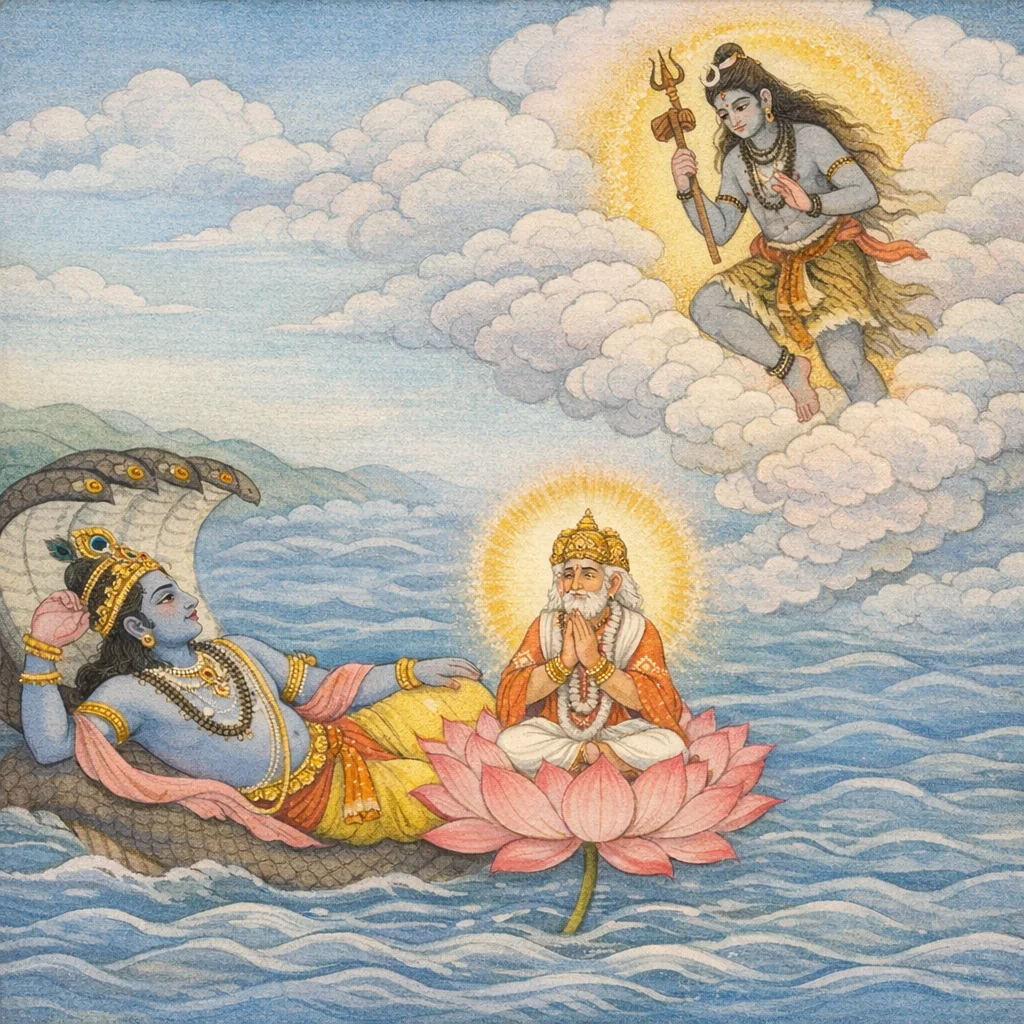
Continuing from the prior account of creation from Mahat and the ensuing principles, the sages ask Viṣṇu (as Kūrma) to resolve a doctrinal tension: how Śambhu can be called Brahmā’s son, and how Brahmā is lotus-born. Kūrma recounts pralaya, when the three worlds are drowned in darkness as a single ocean and Nārāyaṇa rests on Śeṣa in yoganidrā. From his navel rises a vast, fragrant lotus, and Brahmā appears; mutual claims of cosmic primacy follow, clarified through reciprocal “entering the body” visions that reveal Viṣṇu’s immeasurability. When Brahmā finds the navel-exit and emerges as Padmayoni, rivalry flares; Viṣṇu attributes Brahmā’s delusion to Parameśvarī as māyā. Śiva then manifests as Hara, trident-bearing and cosmically adorned; Viṣṇu recognizes him as Mahādeva, Lord of Pradhāna and Puruṣa, as Time that creates, sustains, and dissolves. Granted Śaiva vision, Brahmā takes refuge and hymns Śiva; boons confirm Brahmā’s creative office and proclaim non-separateness: Śiva and Viṣṇu pervade all, appearing as complementary principles (prakṛti/puruṣa, māyā/īśvara). The chapter prepares the next movement, where creation proceeds within this reconciled, non-dual framework of devotion and yogic knowledge.
Shlokas
Verse 1
इति श्रीकूर्मपुराणे षट्साहस्त्र्यां संहितायां पूर्वविभागे ऽष्टमो ऽध्यायः सूत उवाच एतच्छ्रुत्वा तु वचनं नारदाद्या महर्षयः / प्रणम्य वरदं विष्णुं पप्रच्छुः संशयान्विता
Thus, in the sacred Śrī Kūrma Purāṇa, in the six-thousand-verse Saṃhitā, in the Pūrva-bhāga, the Eighth Chapter comes to its close. Sūta said: Having heard these words, the great sages beginning with Nārada bowed in reverence to boon-bestowing Viṣṇu and questioned Him, their doubts not yet stilled.
Verse 2
ऋषय ऊचुः कथितो भवता सर्गो मुख्यादीनां जनार्दन / इदानीं संशयं चेममस्माकं छेत्तुमर्हसि
The sages said: “O Janārdana, you have spoken of creation beginning with Mahat, the chief principle, and all that follows. Now, be pleased to dispel this doubt of ours.”
Verse 3
कथं स भगवानीशः पूर्वजो ऽपि पिनाकधृक् / पुत्रत्वमगच्छंभुर्ब्रह्मणो ऽव्यक्तजन्मनः
“How is it that the Blessed Lord—Īśa Śambhu, wielder of the Pināka bow—though primordial and before all, is spoken of as the son of Brahmā, whose own birth is unmanifest?”
Verse 4
कथं च भगवाञ्जज्ञे ब्रह्मा लोकपितामहः / अण्डजो जगतामीशस्तन्नो वक्तुमिहार्हसि
“And how was the Blessed Brahmā born—Pitāmaha, grandsire and progenitor of the worlds—who arose from the cosmic egg and is lord of beings? Please tell us here.”
Verse 5
श्रीकूर्म उवाच शृणुध्वमृषयः सर्वे शङ्करस्यामितौजसः / पुत्रत्वं ब्रह्मणस्तस्य पद्मयोनित्वमेव च
Śrī Kūrma said: “Listen, all you sages, to the account of mighty Śaṅkara—how he is spoken of as ‘the son of Brahmā’, and how Brahmā, too, is called Padmayoni, ‘the lotus-born’.”
Verse 6
अतीतकल्पावसाने तमोभूतं जगत् त्रयम् / आसीदेकार्णवं सर्वं न देवाद्या न चर्षयः
At the close of a bygone kalpa, the three worlds were shrouded in darkness. All existence was but a single ocean—there were no gods, nor even the ṛṣis.
Verse 7
तत्र नारायणो देवो निर्जने निरुपप्लवे / आश्रित्य शेषशयनं सुष्वाप पुरुषोत्तमः
There, Nārāyaṇa—the divine Lord—abiding in a solitary, disturbance-free expanse, took refuge upon the couch of Śeṣa; and the Supreme Person entered yogic sleep.
Verse 8
सहस्त्रशीर्षा भूत्वा स सहस्त्राक्षः सहस्त्रपात् / सहस्त्रबाहुः सर्वज्ञश्चिन्त्यमानो मनीषिभिः
Assuming a form with a thousand heads, that Supreme One becomes thousand-eyed and thousand-footed; thousand-armed and all-knowing, He is contemplated by the wise.
Verse 9
पीतवासा विशालाक्षो नीलजिमूतसन्निभः / महाविभूतिर्योगात्मा योगिनां हृदयालयः
Clad in yellow garments, wide‑eyed, and dark like a rain‑cloud, He is of immense divine majesty; His very essence is Yoga, and He dwells in the hearts of yogins.
Verse 10
कदाचित् तस्य सुप्तस्य लीलार्थं दिव्यमद्भुतम् / त्रैलोक्यसारं विमलं नाभ्यां पङ्कजमुद्वभौ
Once, while He lay in yogic sleep, for the sake of wondrous divine play, there arose from His navel a spotless lotus—marvelous and celestial—the very essence of the three worlds.
Verse 11
शतयोजनविस्तीर्णं तरुणादित्यसन्निभम् / दिव्यगन्धमयं पुण्यं कर्णिकाकेसरान्वितम्
Spreading across a hundred yojanas, it shone like the newly risen sun—holy and auspicious, suffused with celestial fragrance, endowed with a central pericarp and surrounding filaments.
Verse 12
तस्यैवं सुचिरं कालं वर्तमानस्य शार्ङ्गिणः / हिरण्यगर्भो भगवांस्तं देशमुपचक्रमे
While Śārṅgin—Lord Viṣṇu, bearer of the Śārṅga bow—remained there in that manner for a very long time, the Blessed Hiraṇyagarbha (Brahmā) set forth and approached that very region.
Verse 13
स तं करेण विश्वात्मा समुत्थाप्य सनातनम् / प्रोवाच मधुरं वाक्यं मायया तस्य मोहितः
Then the Universal Self lifted up that eternal one with His hand and spoke sweet words, while that person was deluded by His Māyā.
Verse 14
अस्मिन्नेकार्णवे घोरे निर्जने तमसावृते / एकाकी को भवाञ्छेते ब्रूहि मे पुरुषर्षभ
In this dreadful single ocean—desolate and shrouded in darkness—who are you, lying here all alone? Tell me, O bull among men.
Verse 15
तस्य तद् वचनं श्रुत्वा विहस्य गरुडध्वजः / उवाच देवं ब्रह्माणं मेघगम्भीरनिः स्वनः
Hearing those words, the Garuḍa-bannered Lord (Nārāyaṇa) smiled and, in a voice deep as thunderclouds, spoke to the god Brahmā.
Verse 16
भो भो नारायणं देवं लोकानां प्रभवाप्ययम् / महायोगेश्वरं मां त्वं जानीहि पुरुषोत्तमम्
O! O! Know Me as Nārāyaṇa—the divine Lord who is the source and dissolution of the worlds; as the great Lord of Yoga; as the Supreme Person, Puruṣottama.
Verse 17
मयि पश्य जगत् कृत्स्नं त्वां च लोकपितामहम् / सपर्वतमहाद्वीपं समुद्रैः सप्तभिर्वृतम्
Behold in Me the entire universe—and behold also you, O Grandfather of the worlds. (See) the great continents with their mountains, encircled by the seven oceans.
Verse 18
एवमाभाष्य विश्चात्मा प्रोवाच पुरुषं हरिः / जानन्नपि महायोगी को भवानिति वेधसम्
Having spoken thus, Hari—the all-pervading Self of the universe—addressed that Supreme Person. Though he was the great Yogin who already knew, he asked Vedhas (the Creator), “Who are you?”
Verse 19
ततः प्रहस्य भगवान् ब्रह्मा वेदनिधिः प्रभुः / प्रत्युवाचाम्बुजाभाक्षं सस्मितं श्लक्ष्णया गिरा
Then the Blessed Lord Brahmā—sovereign and treasure-house of the Vedas—smiled and, with a gentle and gracious voice, replied to the lotus-eyed One.
Verse 20
अहं धाता विधाता च स्वयंभूः प्रपितामहः / मय्येव संस्थितं विश्वं ब्रह्माहं विश्वतोमुखः
“I am Dhātā and Vidhātā, the Sustainer and the Ordainer; the Self-born (Svayambhū), the Great Progenitor. In me alone this entire universe is established; I am Brahmā, the all-faced one (Viśvatomukha).”
Verse 21
श्रुत्वा वाचं स भगवान् विष्णुः सत्यपराक्रमः / अनुज्ञाप्याथ योगेन प्रविष्टो ब्रह्मणस्तनुम्
Having heard those words, the Blessed Lord Viṣṇu—whose valor is grounded in truth—granted his assent and, by yogic power, entered into the body of Brahmā.
Verse 22
त्रलोक्यमेतत् सकलं सदेवासुरमानुषम् / उदरे तस्य देवस्य दृष्ट्वा विस्मयमागतः
Seeing within the belly of that Deity the entire threefold world—together with gods, asuras, and human beings—he was struck with wonder.
Verse 23
तदास्य वक्त्रान्निष्क्रम्य पन्नगेन्द्रनिकेतनः / अजातशत्रुर्भगवान् पितामहमथाब्रवीत्
Then, emerging from his mouth, the Lord—dwelling in the abode of the king of serpents, the invincible One (Ajātaśatru)—addressed the Grandfather (Brahmā).
Verse 24
भवानप्येवमेवाद्य शाश्वतं हि ममोहरम् / प्रविश्य लोकान् पश्यैतान् विचित्रान् पुरुषर्षभ
O best of men, you too—just so, today—enter this eternally wondrous, truly enchanting vision of Mine, and behold these many worlds in all their astonishing variety.
Verse 25
ततः प्रह्लादनीं वाणी श्रुत्वा तस्याभिनन्द्य च / श्रीपतेरुदरं भूयः प्रविवेश कुशध्वजः
Then, hearing that joy-bestowing divine voice and offering his reverent assent, Kuśadhvaja once again entered the belly of Śrīpati (the Lord of Lakṣmī).
Verse 26
तानेव लोकान् गर्भस्थानपश्यत् सत्यविक्रमः / पर्यटित्वा तु देवस्य ददृशे ऽन्तं न वै हरेः
Satyavikrama beheld those very worlds abiding within the cosmic womb. Yet, though he wandered through the dominion of the God, he truly perceived no limit to Hari (Viṣṇu).
Verse 27
ततो द्वाराणि सर्वाणि पिहितानि महात्मना / जनार्दनेन ब्रह्मासौ नाभ्यां द्वारमविन्दत
Then all the gates were sealed by the great-souled Janārdana; and Brahmā, for his part, found an opening at the navel.
Verse 28
तत्र योगबलेनासौ प्रविश्य कनकाण्डजः / उज्जहारात्मनो रूपं पुष्कराच्चतुराननः
There, entering by the power of Yoga, the four-faced Brahmā—born from the golden cosmic egg—drew forth his own form from the lotus.
Verse 29
विरराजारविन्दस्थः पद्मगर्भसमद्युतिः / ब्रह्मा स्वयंभूर्भगवान् जगद्योनिः पितामहः
Seated upon the lotus, resplendent, with a radiance equal to the lotus-womb itself, Brahmā—the self-born, the Blessed Lord—appeared as the source-womb of the worlds, the Grandfather of creation.
Verse 30
समन्यमानो विश्वेशमात्मानं परमं पदम् / प्रोवाच पुरुषं विष्णुं मेघगम्भीरया गिरा
Reverently acknowledging Viṣṇu—the Lord of the universe—as the Supreme Self and the highest abode, he addressed that Puruṣa, Viṣṇu, in a voice deep as thunderclouds.
Verse 31
किं कृतं भवतेदानीमात्मनो जयकाङ्क्षया / एको ऽहं प्रबलो नान्यो मां वै को ऽबिभविष्यति
What have you now accomplished by craving victory for your own self? “I alone am mighty; there is none other—who indeed could ever overpower me?”
Verse 32
श्रुत्वा नारायणो वाक्यं ब्रह्मणो लोकतन्त्रिणः / सान्त्वपूर्वमिदं वाक्यं बभाषे मधुरं हरिः
Having heard the words of Brahmā—the steward of the world’s order—Nārāyaṇa, Hari, spoke this gentle and sweet reply, meant to console him.
Verse 33
भवान् धाता विधाता च स्वयंभूः प्रपितामहः / न मात्सर्याभियोगेन द्वाराणि पिहितानि मे
You are the Supporter and the Ordainer; you are the Self-born, the Primal Grandsire. It is not out of jealousy or malice that my gates have been shut.
Verse 34
किन्तु लीलार्थमेवैतन्न त्वां बाधितुमिच्छया / को हि बाधितुमन्विच्छेद् देवदेवं पितामहम्
But this is done only for the sake of divine play, not with any desire to obstruct you. For who, indeed, would seek to oppose the God of gods—the primordial Grandsire?
Verse 35
न ते ऽन्यथावगन्तव्यं मान्यो मे सर्वथा भवान् / सर्वमन्वय कल्याणं यन्मयापहृतं तव
You should not understand it otherwise: you are in every way worthy of my honor. Whatever prosperity of your lineage I have taken away—may all of it be restored to you in full.
Verse 36
अस्माच्च कारणाद् ब्रह्मन् पुत्रो भवतु मे भवान् / पद्मयोनिरिति ख्यातो मत्प्रियार्थं जगन्मय
For this very reason, O Brahman, become My son. Be renowned as “Padmayoni” (Lotus-born), and, pervading the universe, bring forth the world for My beloved purpose.
Verse 37
ततः स भगवान् देवो वरं दत्त्वा किरीटिने / प्रहर्षमतुलं गत्वा पुनर्विष्णुमभाषत
Then that blessed Lord, the divine one, having granted a boon to the crowned one, and having attained incomparable joy, spoke once again to Viṣṇu.
Verse 38
भवान् सर्वात्मको ऽनन्तः सर्वेषां परमेश्वरः / सर्वभूतान्तरात्मा वै परं बह्म सनातनम्
You are the all-pervading Self, the Infinite—Supreme Lord of all. Truly, you are the Inner Self within every being, the eternal, supreme Brahman.
Verse 39
अहं वै सर्वलोकानामात्मा लोकमहेश्वरः / मन्मयं सर्वमेवेदं ब्रह्माहं पुरुषः परः
I alone am the Self of all worlds, the Great Lord of the worlds. All this entire universe is pervaded by Me and made of Me; I am Brahman, the Supreme Person beyond all.
Verse 40
नावाभ्यां विद्यते ह्यन्यो लोकानां परमेश्वरः / एका मूर्तिर्द्विधा भिन्ना नारायणपितामहौ
There is no other Supreme Lord of the worlds apart from these two. One single divine reality appears divided into two forms—Nārāyaṇa and Pitāmaha (Brahmā).
Verse 41
तेनैवमुक्तो ब्रह्माणं वासुदेवो ऽब्रवीदिदम् / इयं प्रतिज्ञा भवतो विनाशाय भविष्यति
Thus addressed, Vāsudeva said to Brahmā: “This vow you have made will become the cause of your ruin.”
Verse 42
किं न पश्यसि योगेशं ब्रह्माधिपतिमव्ययम् / प्रधानपुरुषेशानं वेदाहं परमेश्वरम्
Why do you not behold the Lord of Yoga—the imperishable Master over Brahmā—the sovereign ruler of Pradhāna (primordial Nature) and Puruṣa (the conscious Self)? Know Him as Parameśvara, the Supreme Lord.
Verse 43
यं न पश्यन्ति योगीन्द्राः सांख्या अपि महेश्वरम् / अनादिनिधनं ब्रह्म तमेव शरणं व्रज
He whom even the foremost Yogins do not perceive—and whom even the Sāṅkhyas do not truly behold as the Great Lord—He is the beginningless and endless Brahman. Take refuge in Him alone.
Verse 44
ततः क्रुद्धो ऽम्बुजाभाक्षं ब्रह्मा प्रोवाच केशवम् / भवान् न नूनमात्मानं वेत्ति तत् परमक्षरम्
Then Brahmā, angered, addressed lotus‑eyed Keśava: “Surely you do not truly know your own Self—that Supreme, Imperishable Reality.”
Verse 45
ब्रह्माणं जगतामेकमात्मानं परमं पदम् / नावाभ्यां विद्यते ह्यन्यो लोकानां परमेश्वरः
He is Brahmā—the one Self of all worlds, the single inner Soul of the cosmos, and the supreme abode. Apart from Him, there exists no other Supreme Lord over the worlds.
Verse 46
संत्यज्य निद्रां विपुलां स्वमात्मानं विलोकय / तस्य तत् क्रोधजं वाक्यं श्रुत्वा विष्णुरभाषत
Casting off His vast deep sleep and turning awareness upon His own Self, Viṣṇu—having heard those anger-born words of that speaker—then spoke.
Verse 47
मा मैवं वद कल्याण परिवादं महात्मनः / न मे ऽस्त्यविदितं ब्रह्मन् नान्यथाहं वदामिते
O noble one, do not speak in this way—do not utter slander against a great-souled person. O Brahman, nothing is unknown to me; nor do I speak to you otherwise than the truth.
Verse 48
किन्तु मोहयति ब्रह्मन् भवन्तं पारमेश्वरी / मायाशेषविशेषाणां हेतुरात्मसमुद्भावा
But, O Brahman, the Supreme Lady (Parameśvarī) indeed deludes you. She—arising from the Self—becomes the cause of Māyā and of all its remaining particular manifestations.
Verse 49
एतावदुक्त्वा भगवान् विष्णुस्तूष्णीं बभूव ह / ज्ञात्वा तत् परमं तत्त्वं स्वमात्मानं महेश्वरम्
Having said only this much, the Blessed Lord Viṣṇu fell silent, for he had realized that Supreme Reality—his own Self—as Maheśvara, the Great Lord.
Verse 50
कुतो ऽप्यपरिमेयात्मा भूतानां परमेश्वरः / प्रसादं ब्रह्मणे कर्तुं प्रादुरासीत् ततो हरः
Then Hara—whose Self is immeasurable, the Supreme Lord of all beings—manifested from an unseen source, in order to bestow grace upon Brahmā.
Verse 51
ललाटनयनो ऽनन्तो जटामण्डलमण्डितः / त्रिशूलपाणिर्भगवांस्तेजसां परमो निधिः
He whose eye is upon the forehead, the Infinite One, adorned with a circle of matted locks; the Blessed Lord bearing the trident in his hand—he is the supreme treasury of all splendors (tejas).
Verse 52
दिव्यां विशालां ग्रथितां ग्रहैः सार्केन्दुतारकैः / मालामत्यद्भुताकारां धारयन् पादलम्बिनीम्
He wore a vast, divine garland—wondrous in form—strung with the planets, together with the Sun, the Moon, and the stars, hanging down to his feet.
Verse 53
तं दृष्ट्वा देवमीशानं ब्रह्मा लोकपितामहः / मोहितो माययात्यर्थं पीतवाससमब्वीत्
Seeing that Lord Īśāna, Brahmā—the grandsire of the worlds—became utterly deluded by the Lord’s māyā, and then addressed the One clad in yellow garments.
Verse 54
क एष पुरुषो ऽनन्तः शूलपाणिस्त्रिलोचनः / तेजोराशिरमेयात्मा समायाति जनार्दन
“Who is this infinite Person—bearing the trident, three-eyed—an immeasurable Self, a very mass of radiance—who is approaching, O Janārdana?”
Verse 55
तस्य तद् वचनं श्रुत्वा विष्णुर्दानवमर्दनः / अपश्यदीश्वरं देवं ज्वलन्तं विमले ऽम्भसि
Hearing those words, Viṣṇu—the crusher of the Dānavas—beheld the Lord Īśvara, the God, blazing with splendour in the spotless waters.
Verse 56
ज्ञात्वा तत्परमं भावमैश्वरं ब्रह्मभावनम् / प्रोवाचोत्थाय भगवान् देवदेवं पितामहम्
Having realized that supreme, sovereign state—contemplation of Brahman as the Lord—the Blessed One rose and spoke to the Grandfather, Brahmā, sire of the gods.
Verse 57
अयं देवो महादेवः स्वयञ्ज्योतिः सनातनः / अनादिनिधनो ऽचिन्त्यो लोकानामीश्वरो महान्
This God is Mahādeva—self-luminous and eternal; without beginning or end, beyond the mind’s grasp, the great Lord and ruler of all the worlds.
Verse 58
शङ्करः शंभुरीशानः सर्वात्मा परमेश्वरः / भूतानामधिपो योगी महेशो विमलः शिवः
He is Śaṅkara, Śambhu, and Īśāna—the Self of all beings, the Supreme Lord; the sovereign of creatures, the great Yogin, Mahādeva—spotless, auspicious Śiva.
Verse 59
एष धाता विधाता च प्रधानपुरुषेश्वरः / यं प्रपश्यन्ति यतयो ब्रह्मभावेन भाविताः
He is the Sustainer and the Ordainer—the Lord over Pradhāna (primordial Nature) and Puruṣa (conscious Spirit). Him the ascetics truly behold, their awareness suffused with the state of Brahman.
Verse 60
सृजत्येष जगत् कृत्स्नं पाति संहरते तथा / कालो भूत्वा महादेवः केवलो निष्कलः शिवः
He creates this entire universe, sustains it, and likewise withdraws it. Becoming Time itself, Mahādeva—Śiva—abides as the One alone: partless, attributeless, and pure.
Verse 61
ब्रह्माणं विदधे पूर्वं भवन्तं यः सनातनः / वेदांश्च प्रददौ तुभ्यं सो ऽयमायाति शङ्करः
That Eternal One who once appointed you as Brahmā and bestowed the Vedas upon you—He indeed is Śaṅkara, who now comes here.
Verse 62
अस्यैव चापरां मूर्ति विश्वयोनिं सनातनीम् / वासुदेवाभिधानां मामवेहि प्रपितामह
Know Me, O Great-Grandfather, as another eternal form of Him—the cosmic womb, the source of the universe—bearing the name Vāsudeva.
Verse 63
किं न पश्यसि योगेशं ब्रह्माधिपतिमव्ययम् / दिव्यं भवतु ते चक्षुर्येन द्रक्ष्यसि तत्परम्
Why do you not behold the Lord of Yoga, the imperishable Sovereign over Brahmā? May your eye become divine, by which you shall see that Supreme Reality.
Verse 64
लब्ध्वा शैवं तदा चक्षुर्विष्णोर्लोकपितामहः / बुबुधे परमेशानं पुरतः समवस्थितम्
Then the Grandfather of the worlds, having obtained the Śaiva vision—the divine ‘eye’ granted through Viṣṇu—recognized Parameśāna (Śiva) standing directly before him.
Verse 65
स लब्ध्वा परमं ज्ञानमैश्वरं प्रपितामहः / प्रपेदे शरणं देवं तमेव पितरं शिवम्
Having attained the supreme knowledge bestowed by Īśvara, the Great-Grandfather (Brahmā) took refuge in that very God—his Father—Śiva.
Verse 66
ओङ्कारं समनुस्मृत्य संस्तभ्यात्मानमात्मना / अथर्वशिरसा देवं तुष्टाव च कृताञ्जलिः
Having steadily recollected the sacred Oṃkāra, and restraining the self by the Self, he then praised the Lord with the Atharvaśiras hymn—standing with folded hands.
Verse 67
संस्तुतस्तेन भगवान् ब्रह्मणा परमेश्वरः / अवाप परमां प्रीतिं व्याजहार स्मयन्निव
Thus praised by Brahmā, the Blessed Supreme Lord (Parameśvara) was filled with the highest joy, and He spoke—seeming, as it were, to smile.
Verse 68
मत्समस्त्वं न संदेहो मद्भक्तश्च यतो भवान् / मयैवोत्पादितः पूर्वं लोकसृष्ट्यर्थमव्ययम्
You are equal to Me—of this there is no doubt—since you are My devotee. Indeed, you were brought forth by Me in the beginning for the purpose of creating the worlds, O imperishable one.
Verse 69
त्वमात्मा ह्यादिपुरुषो मम देहसमुद्भवः / वरं वरय विश्वात्मन् वरदो ऽहं तवानघ
“You are indeed the Self—the Primordial Person—born from my own body. Choose a boon, O Soul of the universe; I am the giver of boons to you, O sinless one.”
Verse 70
स देवदेववचनं निशम्य कमलोद्भवः / निरीक्ष्य विष्णुं पुरुषं प्रणम्याह वृषध्वजम्
Hearing the words of the God of gods, the Lotus-born (Brahmā) looked upon Viṣṇu, the Supreme Person; and, having bowed in reverence, he addressed Vṛṣadhvaja (Śiva, the Bannered with the Bull).
Verse 71
भगवन् भूतभव्येश महादेवाम्बिकापते / त्वामेव पुत्रमिच्छामि त्वया वा सदृशं सतम्
O Blessed Lord, Master of past and future, Mahādeva, consort of Ambikā—I desire you alone as my son; or else a virtuous son who is truly like you.
Verse 72
मोहितो ऽस्मि महादेव मायया सूक्ष्मया त्वया / न जाने परमं भावं याथातथ्येन ते शिव
O Mahādeva, I am bewildered by your subtle māyā. O Śiva, I do not truly know—exactly as it is—your supreme state (parama-bhāva).
Verse 73
त्वमेव देव भक्तानां भ्राता माता पिता सुहृत् / प्रसीद तव पादाब्जं नमामि शरणं गतः
You alone, O Deva, are the brother, mother, father, and true friend of your devotees. Be gracious; I bow to your lotus-feet, having come to you for refuge.
Verse 74
स तस्य वचनं श्रुत्वा जगन्नाथो वृषध्वजः / व्याजहार तदा पुत्रं समालोक्य जनार्दनम्
Hearing his words, the Lord of the universe—bearing the bull as his emblem—then addressed his son, looking upon Janārdana.
Verse 75
यदर्थितं भगवता तत् करिष्यामि पुत्रक / विज्ञानमैश्वरं दिव्यमुत्पत्स्यति तवानघ
“Whatever has been requested by the Blessed Lord, that I shall do, dear child. And in you, O sinless one, the divine, sovereign knowledge (aiśvara-vijñāna) will arise.”
Verse 76
त्वमेव सर्वभूतानामादिकर्ता नियोजितः / तथा कुरुष्व देवेश मया लोकपितामह
You alone are the primordial maker of all beings, appointed to this cosmic task. Therefore, O Lord of the gods, act as is fitting—at the urging of me, the Grandsire of the worlds, Brahmā.
Verse 77
एष नारायणो ऽनन्तो ममैव परमा तनुः / भविष्यति तवेशानो योगक्षेमवहो हरिः
This very Nārāyaṇa—Ananta—is indeed my own supreme form. He will become your Lord: Hari, who bears and secures your yoga and kṣema—your spiritual attainment and your welfare.
Verse 78
एवं व्याहृत्य हस्ताभ्यां प्रीतात्मा परमेश्वरः / संस्पृश्य देवं ब्रह्माणं हरिं वचनमब्रवीत्
Having thus spoken and gestured with both hands, the Supreme Lord—his heart pleased—touched the god Brahmā and then addressed Hari with these words.
Verse 79
तृष्टो ऽस्मि सर्वथाहन्ते भक्त्या तव जगन्मय / वरं वृणीष्वं नह्यावां विभिन्नौ परमार्थतः
I am wholly pleased with you through your devotion, O one who is pervaded by the universe. Choose a boon; for in the highest truth, the two of us are not separate.
Verse 80
श्रुत्वाथ देववचनं विष्णुर्विश्वजगन्मयः / प्राह प्रसन्नया वाचा समालोक्य चतुर्मुखम्
Having heard the god’s words, Vishnu—who pervades the entire universe and is immanent in all worlds—spoke in a gracious, serene voice, looking toward the Four-faced Brahmā.
Verse 81
एष एव वरः श्लोघ्यो यदहं परमेश्वरम् / पश्यामि परमात्मानं भक्तिर्भवतु मे त्वयि
This alone is the boon, truly worthy of praise: that I behold the Supreme Lord, the Supreme Self; may devotion arise in me toward You.
Verse 82
तथेत्युक्त्वा महादेवः पुनर्विष्णुमभाषत / भवान् सर्वस्य कार्यस्य कर्ताहऽमधिदैवतम्
Saying, “So be it,” Mahādeva again addressed Viṣṇu: “You are the doer of every undertaking; I am the presiding deity (adhidaivata) over it.”
Verse 83
मन्मयं त्वन्मयं चैव सर्वमेतन्न संशयः / भवान् सोमस्त्वहं सूर्यो भवान् रात्रिरहं दिनम्
All this is pervaded by me and by you—of that there is no doubt. You are the Moon, and I am the Sun; you are the Night, and I am the Day.
Verse 84
भवान् प्रकृतिरव्यक्तमहं पुरुष एव च / भवान् ज्ञानमहं ज्ञाता भवान् मायाहमीश्वरः
You are Prakṛti—the unmanifest ground; and I am Puruṣa alone. You are knowledge, and I am the knower; you are Māyā, and I am the Lord (Īśvara) who wields it.
Verse 85
भवान् विद्यात्मिका शक्तिः शक्तिमानहमीश्वरः / यो ऽहं सुनिष्कलो देवः सो ऽपि नारायणः परः
You are the Power whose very essence is divine knowledge; I am Īśvara, the possessor of that Power. And the God who is I—utterly partless and without division—He indeed is the Supreme Nārāyaṇa.
Verse 86
एकीभावेन पश्यन्ति योगिनो ब्रह्मवादिनः / त्वामनाश्रित्य विश्वात्मन् न योगी मामुपैष्यति / पालयैतज्जगत् कृत्स्नं सदेवासुरमानुषम्
The yogins, knowers of Brahman, behold You in oneness (non-dual vision). O Universal Self, without taking refuge in You, no yogin can attain Me. Therefore protect this entire universe—together with the gods, asuras, and human beings.
Verse 87
इतीदमुक्त्वा भगवाननादिः स्वमायया मोहितभूतभेदः / जगाम जन्मर्धिविनाशहीनं धामैकमव्यक्तमनन्तशक्तिः
Having thus spoken, the Blessed Lord—beginningless and of infinite power—whose own Māyā makes embodied beings perceive division and difference, departed to that single, unmanifest abode which is beyond birth, growth, and destruction.
Frequently Asked Questions
It narrates that during pralaya Nārāyaṇa rests in yoganidrā, from whose navel a celestial lotus arises; Brahmā emerges through that lotus and is therefore named Padmayoni, while also being commissioned to create for the Lord’s purpose.
The chapter frames the ‘son’ language as divine play and relational theology: Śiva is Parameśvara beyond origin, yet he can accept filial relation to Brahmā by boon and function, without compromising his beginningless supremacy.
It asserts non-separateness in the highest truth while allowing functional duality: Viṣṇu and Śiva mutually pervade all, are approached through devotion and yogic knowledge, and are described via complementary pairs (prakṛti/puruṣa, māyā/īśvara) as one Supreme Reality appearing in two forms.
This chapter is a theological prelude: it establishes Parameśvara as the Lord of Yoga and the supreme object of refuge, which the later Uttara-bhāga develops into explicit yogic and Vedāntic instruction often discussed under headings like Īśvara Gītā and Śaiva yoga streams such as Pāśupata-oriented devotion.