Adhyaya 7
Nine Creations (Sarga), Guṇa-Streams of Beings, and Brahmā’s Progeny in Cyclic Time
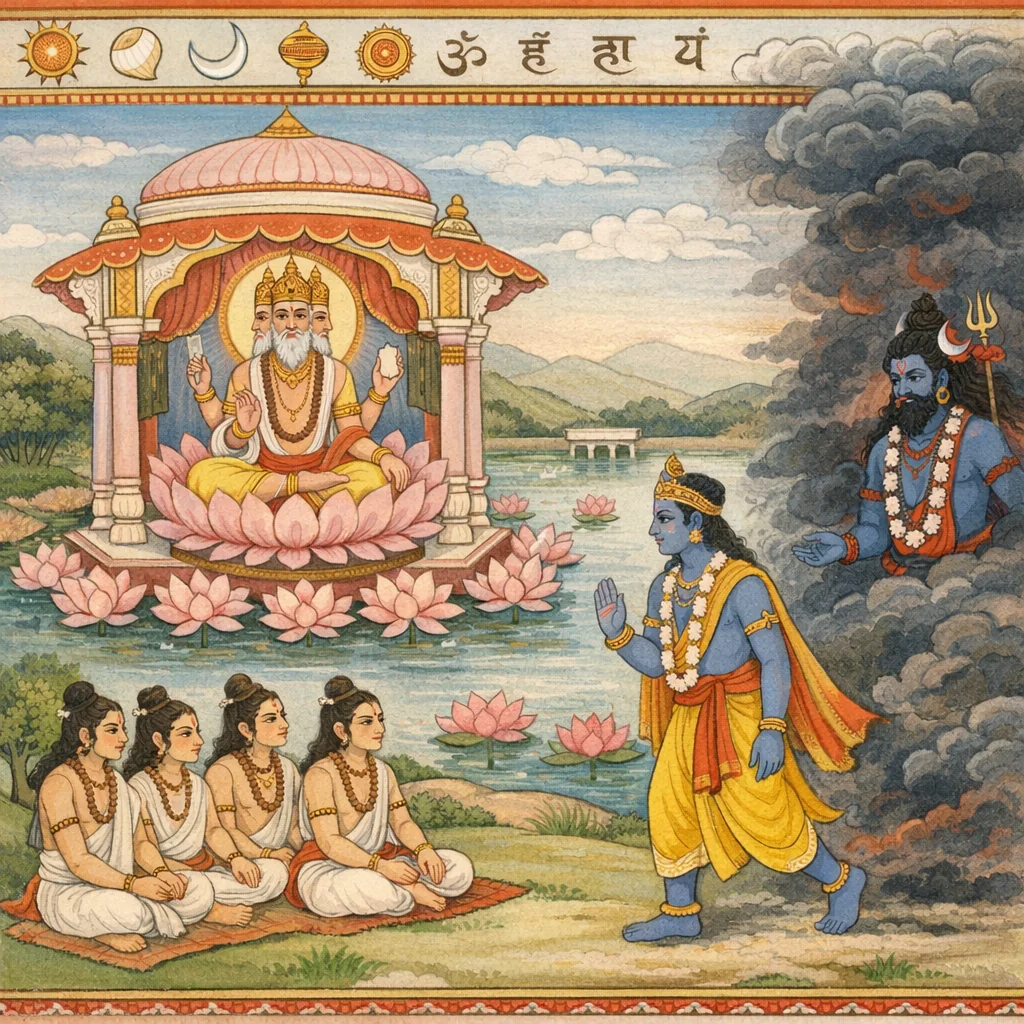
Closing the prior chapter’s threshold into cosmogony, Śrī Kūrma teaches that at the start of each kalpa creation first appears under tamas, as a veiled, seed-like state. Beings are then classified by “currents” (srotas): the primary immobile creation (mukhya-sarga), the crosswise-flowing animal realm (tiryak-srotas), the upward-flowing devas (ūrdhva-strotas), and the downward-flowing humans (arvāk-srotas), along with earlier prākṛta stages (mahat, tanmātras, and aindriya/vaikārika). The chapter turns to Brahmā’s mind-born sages whose dispassion stalls creation, bringing Brahmā into Māyā’s bewilderment until Nārāyaṇa intervenes. From Brahmā’s sorrow and anger manifests Nīlalohita Rudra; Śaṅkara refuses to create mortal progeny. Brahmā then emanates divisions of time, presiding powers, Prajāpatis, and the fourfold classes (devas, asuras, pitṛs, humans) through bodies dominated by tamas, sattva, and rajas. It culminates in an ethical-cosmological principle: beings repeat prior dispositions each cycle, while Dhātṛ and Maheśvara ordain differentiated functions, names, and rites—anchored in Vedic sound—preparing the next chapter’s ordered manifestation and dharma.
Shlokas
Verse 1
इति श्रीकूर्मपुराणे षटसाहस्त्र्यां संहितायां पूर्वविभागे षष्ठो ऽध्यायः श्रीकूर्म उवाच सृष्टिं चिन्तयतस्तस्य कल्पादिषु यथा पुरा / अबुद्धिपूर्वकः सर्गः प्रादुर्भूतस्तमोमयः
Thus, in the Śrī Kūrma Purāṇa, in the Ṣaṭsāhasrī Saṃhitā, in the Pūrva-bhāga, the sixth chapter concludes. Śrī Kūrma said: When He contemplated creation—just as of old at the beginnings of the kalpas—there first arose a creation not illumined by discernment, formed of tamas (darkness and obscuration).
Verse 2
तमो मोहो महामोहस्तामिस्त्रश्चान्धसंज्ञितः / अविद्या पञ्चपर्वैषा प्रादुर्भूता महात्मनः
Darkness (tamas), delusion (moha), great delusion (mahāmoha), the blinding gloom called Tāmisra, and the state known as Andhasa—this is Avidyā with five knots, arising in the embodied being, O great-souled one.
Verse 3
पञ्चधावस्थितः सर्गो ध्यायतः सो ऽभिमानिनः / संवृतस्तमसा चैव बीजकम्भुवनावृतः
Creation, poised in a fivefold condition, arose for that principle bound to self-identification (abhimānin) as it ‘contemplated’; yet it remained shrouded by tamas, enclosed like a seed, with the worlds still covered over.
Verse 4
वर्हिरन्तश्चाप्रकाशः स्तब्धो निः संज्ञ एव च / मुक्या नगा इति प्रोक्ता मुख्यसर्गस्तु स स्मृतः
They are described as having ‘grass-like’ growth turned inward, devoid of light, rigid and motionless, as though without consciousness. These are called the “mukhyā nagāḥ,” the primary immobile beings; and that is remembered as the “mukhya-sarga,” the primary creation.
Verse 5
तं दृष्ट्वासाधकं सर्गममन्यदपरं प्रभुः / तस्याभिध्यायतः सर्गस्तिर्यक्स्त्रोतो ऽभ्यवर्तत
Seeing that creation to be unfit for its intended purpose, the Lord conceived another. As He contemplated, there came forth the creation known as “tiryak-srotas”—beings whose current of life moves horizontally, the animal realm.
Verse 6
यस्मात् तिर्यक् प्रवृत्तः स तिर्यक्स्त्रोतस्ततः स्मृतः / पश्वादयस्ते विख्याता उत्पथग्राहिणो द्विजाः
Because their course moves obliquely, they are therefore remembered as the “tiryak-srotas”—beings whose current runs sideways. These are well known as animals and the like, O twice-born ones, for they follow a deviating path.
Verse 7
तमप्यसाधकं ज्ञात्वा सर्गमन्यं ससर्ज ह / ऊर्ध्वस्त्रोत इति प्रोक्तो देवसर्गस्तु सात्त्विकः
Knowing that this creation too was unfit for the intended purpose, he then brought forth another creation. This is called the “upward-flowing” (ūrdhva-strota) creation—indeed, the creation of the gods (deva-sarga), predominantly sāttvika.
Verse 8
ते सुखप्रतिबहुला बहिरन्तश्च नावृताः / प्रकाशा बहिरन्तश्च स्वभावाद् देवसंज्ञिताः
They abound in happiness; they are unobstructed both outwardly and inwardly. Luminous within and without by their very nature, they are therefore known as the Devas.
Verse 9
ततो ऽबिधायायतस्तस्य सत्याभिध्यायिनस्तदा / प्रादुरासीत् तदाव्यक्तादर्वाक्स्त्रोतस्तु साधकः
Then, as he proceeded—meditating upon Truth—there appeared at that time, from the Unmanifest, the sādhaka known as the ‘downward-flowing current’ (arvāk-srotas).
Verse 10
ते च प्रकाशबहुलास्तमोद्रिक्ता रजोधिकाः / दुः खोत्कटाः सत्त्वयुता मनुष्याः परिकीर्तिता
Such people are described as having an abundance of clarity and light, yet still touched by darkness; with rajas predominant, they are prone to intense suffering—though they remain endowed with a measure of sattva.
Verse 11
तं दृष्ट्वा चापरं सर्गममन्यद् भगवानजः / तस्याभिध्यायतः सर्गं सर्गो भूतादिको ऽभवत्
Seeing the earlier creation, the Unborn Lord (Aja) conceived another mode of emanation. As He contemplated that creation, there arose the ‘Bhūtādi’ creation—the emergence of the primordial elements and their subtle principles.
Verse 12
ते ऽपरिग्राहिणः सर्वे संविभागरताः पुनः / खादनाश्चाप्यशीलाश्च भूताद्याः परिकीर्तिताः / इत्येते पञ्च कथिताः सर्गा वै द्विजपुङ्गवाः
All of these were non-possessive, delighting again in mutual sharing; yet they were also given to devouring and were without disciplined conduct—thus are those beginning with the bhūtas described. Therefore, O best of the twice-born, these five creations (sargas) have been declared.
Verse 13
प्रथमो महतः सर्गो विज्ञेयो ब्रह्मणस्तु सः / तन्मात्राणां द्वितीयस्तु भूतसर्गो हि स स्मृतः
Know that the first creation is the emergence of Mahat (cosmic intellect), pertaining to Brahman (the cosmic principle). The second creation is that of the tanmātras (subtle elements), traditionally remembered as bhūta-sarga—the creation of beings/elements.
Verse 14
वैकारिकस्तृतीयस्तु सर्ग ऐन्द्रियकः स्मृतः / इत्येष प्राकृतः सर्गः संभूतो ऽबुद्धिपूर्वकः
The third emanation is called the vaikārika (transformative) creation—known as the aindriyaka, the genesis of the senses (indriyas). Thus this is the prākṛta creation, born of Prakṛti, arising not from deliberative intellect but spontaneously from primordial nature.
Verse 15
मुख्यसर्गश्चतुर्थस्तु मुख्या वै स्थावराः स्मृताः / तिर्यक्स्त्रोतस्तु यः प्रोक्तस्तिर्यग्योन्यः स पञ्चमः
The fourth is called the Primary Creation (mukhya-sarga); in it, the principal beings are the immobile forms of life (sthāvaras), such as plants. The fifth, declared as tiryak-srotas, the ‘crosswise current,’ is the creation of those born as animals (tiryag-yoni).
Verse 16
तथोर्ध्वस्त्रोतसां षष्ठो देवसर्गस्तु स स्मृतः / ततोर्ऽवाक्स्त्रोतसां सर्गः सप्तमः स तु मानुषः
Thus, among beings whose current flows upward, the sixth creation is remembered as the creation of the gods. Then, among those whose current flows downward, the seventh creation is that of human beings.
Verse 17
अष्टमो भौतिकः सर्गो भूतादीनां प्रकीर्तितः / नवमश्चैव कौमारः प्राकृता वैकृतास्त्विमे
The eighth is declared to be the ‘elemental’ creation—the manifestation of beings beginning with the gross elements. The ninth, indeed, is the ‘Kaumāra’ creation. These creations are spoken of as both Prākṛta (arising from primordial Nature) and Vaikṛta (arising through transformation).
Verse 18
प्राकृतास्तु त्रयः पूर्वे सर्गास्ते ऽबुद्धिपूर्वकाः / बुद्धिपूर्वं प्रवर्तन्ते मुख्याद्या मुनिपुङ्गवाः
O best of sages, the three earlier creations are Prākṛta and proceed without prior intelligence; but the creations beginning with the Principal Ones (mukhya) proceed with intelligence as their forerunner.
Verse 19
अग्रे ससर्ज वै ब्रह्मा मानसानात्मनः समान् / सनकं सनातनं चैव तथैव च सनन्दनम् / ऋभुं सनात्कुमारं च पूर्वमेव प्रजापतिः
In the beginning, Prajāpati Brahmā first brought forth, from his own mind—beings like himself—the mind-born sages: Sanaka, Sanātana, Sanandana, Ṛbhu, and Sanatkumāra.
Verse 20
पञ्चैते योगिनो विप्राः परं वैराग्यमास्थिताः / ईश्वरासक्तमनसो न सृष्टौ दधिरे मतिम्
These five Brahmin yogins, established in the highest dispassion, with minds wholly attached to Īśvara, did not set their thought upon creation (worldly becoming).
Verse 21
तेष्वेवं निरपेक्षेषु लोकसृष्टौ प्रजापतिः / मुमोह मायया सद्यो मायिनः परमेष्ठिनः
While those worlds were thus unfolding of themselves in creation, Prajāpati at once fell into delusion through Māyā—the illusive power belonging to the Supreme Lord, Parameṣṭhin, the great Magician.
Verse 22
तं बोधयामास सुतं जगन्मायो महामुनिः / नारायणो महायोगी योगिचित्तानुरञ्जनः
Then Nārāyaṇa—the great sage, the Mahāyogin, the wondrous power behind the universe’s Māyā—awakened and instructed his son, delighting the minds of yogins.
Verse 23
बोधितस्तेन विश्वात्मा तताप परमं तपः / स तप्यमानो भगवान् न किञ्चित् प्रतिपद्यत
Thus awakened by him, the Viśvātmā—the Lord indwelling all—undertook supreme austerity; yet even while the Blessed One performed that penance, no manifest fruit appeared.
Verse 24
ततो दीर्घेण कालेन दुखात् क्रोधो व्यजायत / क्रोधाविष्टस्य नेत्राभ्यां प्रापतन्नश्रु बिन्दवः
Then, after a long time, from sorrow anger was born; and for one seized by wrath, drops of tears fell from his eyes.
Verse 25
भ्रुकुटीकुटिलात् तस्य ललाटात् परमेश्वरः / समुत्पन्नो महादेवः शरण्यो नीललोहितः
From his forehead, furrowed by the knitting of his brows, there arose the Supreme Lord, Parameśvara—Mahādeva, giver of refuge, Nīlalohita, Rudra of blue-and-red hue.
Verse 26
स एव भगवानीशस्तेजोराशिः सनातनः / यं प्रपश्यन्ति विद्वांसः स्वात्मस्थं परमेश्वरम्
He alone is Bhagavān Īśa, the Eternal Sovereign—an everlasting mass of divine radiance—whom the wise directly behold as the Supreme Lord abiding within their own Self.
Verse 27
ओङ्कारं समनुस्मृत्य प्रणम्य च कृताञ्जलिः / ताम भगवान् ब्रह्मा सृजेमा विविधाः प्रजाः
Having duly recollected the sacred syllable Oṁ, and bowing with hands joined in reverence, the Blessed Lord Brahmā then set about creating the many and varied orders of living beings.
Verse 28
निशम्य भगवान् वाक्यं शङ्करो धर्मवाहनः / स्वात्मना सद्शान् रुद्रान् ससर्ज मनसा शिवः / कपर्दिनो निरातङ्कांस्त्रिनेत्रान् नीललोहितान्
Having heard those words, the Blessed Lord Śaṅkara—whose vehicle is Dharma—Śiva, by the power of his own Self, mentally brought forth Rudras like unto himself: matted-haired, fearless, three-eyed, and blue-red in hue.
Verse 29
तं प्राह भगवान् ब्रह्मा जन्ममृत्युयुताः प्रजाः / सृजेति सो ऽब्रवीदीशो नाहं मृत्युजरान्विताः / प्रजाः स्त्रक्ष्ये जगन्नाथ सृज त्वमशुभाः प्रजाः
To him Bhagavān Brahmā said, “Create beings who are bound to birth and death.” But that Lord replied, “O Jagannātha, I will not create progeny afflicted with death and old age. You yourself create those inauspicious (mortal) creatures.”
Verse 30
निवार्य च तदा रुद्रं ससर्ज कमलोद्भवः / स्थानाभिमानिनः सर्वान् गदतस्तान् निबोधत
Then, having restrained Rudra, the Lotus-born (Brahmā) brought forth all the presiding powers who identify with their respective stations; listen as he declares them.
Verse 31
अपो ऽग्निरन्तरिक्षं च द्यौर्वायुः पृथिवी तथा / नद्यः समुद्राः शैलाश्च वृक्षा वीरुध एव च
Water, fire, the mid-space (atmosphere), the heavens, wind, and likewise the earth; rivers and oceans, mountains, trees, and also creepers and herbs—all these are embraced within the manifested order of creation.
Verse 32
लवाः काष्ठाः कलाश्चैव मुहूर्ता दिवसाः क्षपाः / अर्धमासाश्च मासाश्च अयनाब्दयुगादयः
Lavas, kāṣṭhās, kalās, and muhūrtas; days and nights; half-months and months; and also ayanas (half-years), years, yugas, and the rest—these are the successive divisions of Time.
Verse 33
स्थानाबिमानिनः सृष्ट्वा साधकानसृजत् पुनः / मरीचिभृग्वङ्गिरसं पुलस्त्यं पुलहं क्रतुम् / दक्षमत्रिं वसिष्ठं च धर्मं संकल्पमेव च
Having first created the presiding beings who take pride in their respective stations, he then again brought forth the accomplished progenitors—Marīci, Bhṛgu, Aṅgiras, Pulastya, Pulaha, Kratu, Dakṣa, Atri, Vasiṣṭha, and also Dharma and Saṅkalpa.
Verse 34
प्राणाद् ब्रह्मासृजद् दक्षं चक्षुषश्च मरीचिनम् / शिरसो ऽङ्गिरसं देवो हृदयाद् भृगुमेव च
From his vital breath (prāṇa) Brahmā created Dakṣa; from his eye he brought forth Marīci. From his head the god produced Aṅgiras, and from his heart he generated Bhṛgu as well.
Verse 35
श्रोत्राभ्यामत्रिनामानं धर्मं च व्यवसायतः / संकल्पं चैव संकल्पात् सर्वलोकपितामहः
The Grandfather of all worlds (Brahmā) brought forth, from the two ears, the sage named Atri; from resolute determination he manifested Dharma; and from Saṅkalpa (creative intention) he produced Saṅkalpa itself.
Verse 36
पुलस्त्यं च तथोदानाद् व्यनाच्च पुलहं मुनिम् / अपानात् क्रतुमव्यग्रं समानाच्च वसिष्ठकम्
From Udāna arose Pulastya; from Vyāna, the sage Pulaha; from Apāna, Kratu—unwearied and undistracted; and from Samāna, Vasiṣṭha.
Verse 37
इत्येते ब्रह्मणा सृष्टाः साधका गृहमेधिनः / आस्थाय मानवं रूपं धर्मस्तैः संप्रवर्तितः
Thus were these householders—spiritual practitioners—created by Brahmā; and Dharma, assuming a human form, was set in motion and made to function through them.
Verse 38
ततो देवासुरपितृन् मनुष्यांश्च चतुष्टयम् / सिसृक्षुरम्भांस्येतानि स्वमात्मानमयूयुजत्
Then, desiring to bring forth the fourfold set—gods, asuras, ancestors, and human beings—he projected his own Self into these primordial waters as the basis of creation.
Verse 39
युक्तात्मनस्तमोमात्रा उद्रिक्ताभूत् प्रजापतेः / ततो ऽस्य जघनात् पूर्वमसुरा जज्ञिरे सुताः
For Prajāpati, though his mind was composed and integrated, the dark (tāmasic) element became predominant. Then from the front of his buttocks, the Asuras were born as his sons.
Verse 40
उत्ससर्जासुरान् सृष्ट्वा तां तनुं पुरुषोत्तमः / सा चोत्सृष्टा तनुस्तेन सद्यो रात्रिरजायत / सा तमोबहुला यस्मात् प्रजास्तस्यांस्वपन्त्यतः
Having projected the asuric beings, the Supreme Person cast off that body; and the moment it was cast away by Him, Night came into being. Since it is dense with darkness, therefore creatures fall asleep in it.
Verse 41
सत्त्वमात्रत्मिकां देवस्तनुमन्यामगृह्णत / ततो ऽस्य मुखतो देवा दीव्यतः संप्रजज्ञिरे
The Lord assumed yet another body made solely of sattva, pure luminosity. From His mouth, as He shone with divine radiance, the gods were brought forth into manifestation.
Verse 42
त्यक्ता सापि तनुस्तेन सत्त्वप्रायमभूद् दिनम् / तस्मादहो धर्मयुक्ता देवताः समुपासते
Even that body, once relinquished by Him, made the day predominantly sāttvika—pure and luminous. Therefore—marvel indeed—those deities aligned with Dharma worship that day/that state with reverent devotion.
Verse 43
सत्त्वमात्रात्मिकामेव ततो ऽन्यां जगृहे तनुम् / पितृवन्मन्यमानस्य पितरः संप्रजज्ञिरे
Then He assumed another body constituted solely of sattva, pure luminosity. And as He regarded Himself in the manner of a father, the Pitṛs—the ancestral Fathers—were duly brought forth.
Verse 44
उत्ससर्ज पितृन् सृष्ट्वा ततस्तामपि विश्वसृक् / सापविद्धा तनुस्तेन सद्यः सन्ध्या व्यजायत
Having created the Pitṛs, the all-creating Lord then set aside that body as well. From that discarded form, Sandhyā—the sacred Twilight junction—was immediately born.
Verse 45
तस्मादहर्देवतानां रात्रिः स्याद् देवविद्विषाम् / तयोर्मध्ये पितॄणां तु मूर्तिः सन्ध्या गरीयसी
Therefore, what is ‘day’ for the gods becomes ‘night’ for those hostile to the gods; and between the two, the most venerable form belonging to the Pitṛs is Sandhyā—the sacred twilight junction.
Verse 46
तस्माद् देवासुराः सर्वे मनवो मानवास्तथा / उपासते तदा युक्ता रात्र्यह्नोर्मध्यमां तनुम्
Therefore all the gods and asuras, the Manus and human beings as well—when rightly disciplined—worship at that time the “middle form” (madhyamā tanu) that abides between night and day.
Verse 47
रजोमात्रात्मिकां ब्रह्मा तनुमन्यामगृह्णत / ततो ऽस्य जज्ञिरे पुत्रा मनुष्या रजसावृताः
Brahmā then assumed another body constituted solely of rajas. From that form of his were born human beings—his progeny—veiled and driven by rajas.
Verse 48
तामप्याशु स तत्याज तनुं सद्यः प्रजापतिः / ज्योत्स्त्रा सा चाभवद्विप्राः प्राक्सन्ध्या याबिधीयते
Then Prajāpati immediately cast off that body as well; and she became Jyotsnā, radiance. O brāhmaṇas, she is what is called the morning twilight (prāk-sandhyā).
Verse 49
ततः स भगवान् ब्रह्मा संप्राप्य द्विजपुङ्गवाः / मूर्ति तमोरजः प्रायां पुनरेवाभ्ययूयुजत्
Then that Blessed Lord Brahmā, having approached you foremost of the twice-born, again yoked himself to a form predominated by tamas and rajas, so that the work of manifestation might proceed.
Verse 50
अन्धकारे क्षुधाविष्टा राक्षसास्तस्य जज्ञिरे / पुत्रास्तमोरजः प्राया बलिनस्ते निशाचराः
In darkness, rākṣasas—seized by hunger—were born from him. Those night-roaming beings, mostly sprung from the quality of tamas, became his powerful offspring.
Verse 51
सर्पा यक्षास्तथा बूता गन्धर्वाः संप्रजज्ञिरे / रजस्तमोभ्यामाविष्टांस्ततो ऽन्यानसृजत् प्रभुः
Then serpents, Yakṣas, Bhūtas, and Gandharvas were brought forth. Thereafter the Lord (Prabhu), impelling other beings possessed by rajas and tamas, created them as well.
Verse 52
वयांसि वयसः सृष्ट्वा अवयो वक्षसो ऽसृजत् / मुखतो ऽजान् ससर्जान्यान् उदराद्गाश्चनिर्ममे
Having created the birds from the passage of time (the years), he produced the sheep from his chest. From his mouth he brought forth the goats and other creatures, and from his belly he fashioned the cows as well.
Verse 53
पद्भ्याञ्चाश्वान् समातङ्गान् रासभान् गवयान् मृगान् / उष्ट्रानश्वतरांश्चैव न्यङ्कूनन्यांश्व जातयः / औपध्यः फलमूलिन्यो रोमभ्यस्तस्य जज्ञिरे
From his feet arose horses, elephants, donkeys, wild cattle (gavaya), and deer; also camels, mules, and the antelope called nyaṅku, along with other such species. And from his body-hair were born the plant-kingdom—those that bear fruits and roots.
Verse 54
गायत्रं च ऋचं चैव त्रिवृत्साम रथन्तरम् / अग्निष्टोमं च यज्ञानां निर्ममे प्रथमान्मुखात्
From the first mouth He fashioned the Gāyatrī metre and the Ṛk-verse, the Trivṛt Sāman and the Rathantara chant, and also the Agniṣṭoma—foremost among sacrifices.
Verse 55
यजूंषि त्रैष्टुभं छन्दः स्तोमं पञ्चदशं तथा / बृहत्साम तथोक्थं च दक्षिणादसृजन्मुखात्
From the southern mouth, He brought forth the Yajus formulas, the Triṣṭubh metre, the fifteenfold stoma, the Bṛhat Sāman chant, and the Uktha recitation.
Verse 56
सामानि जागतं छन्दस्तोमं सप्तदशं तथा / वैरूपमतिरात्रं च पश्चिमादसृजन्मुखात्
From the western mouth (of the Supreme Being) he brought forth the Sāman hymns, the Jagatī metre, the Chandastoma rite of seventeen stotras, and also the Vairūpa and Atirātra Soma-sacrifices.
Verse 57
एकविशमथर्वाणमाप्तोर्यामाणमेव च / अनुष्टुभं सवैराजमुत्तरादसृजन्मुखात्
From the northern mouth he brought forth the Atharva Veda as the twenty-first, along with the Āptoryāma rite; and he also manifested the Anuṣṭubh metre together with the Vairāja.
Verse 58
उच्चावचानि भूतानि गात्रेभ्यस्तस्य जज्ञिरे / ब्रह्मणो हि प्रजासर्गं सृजतस्तु प्रजापतेः
From the limbs of that Prajāpati Brahmā, as he set about creating the progeny, diverse beings—of higher and lower orders—came into existence.
Verse 59
सृष्ट्वा चतुष्टयं सर्गं देवर्षिपितृमानुषम् / ततो ऽसृजच्च भूतानि स्थावराणि चराणि च
Having brought forth the fourfold creation—of the gods, seers, ancestors, and humans—thereafter He also produced the living beings, both immobile and mobile.
Verse 60
यक्षान् पिशाचान् गन्धर्वांस्तथैवाप्सरसः शुभाः / नरकिन्नररक्षांसि वयः पुशुमृगोरगान् / अव्ययं च व्ययं चैव द्वयं स्थावरजङ्गमम्
Yakṣas, Piśācas, Gandharvas, and likewise the auspicious Apsarases; Naras, Kinnaras, and Rākṣasas; birds, cattle, wild beasts, and serpents—thus the world is set forth in two aspects: imperishable and perishable, as the immobile and the mobile creation.
Verse 61
तेषां ये यानि कर्माणि प्राक्सृष्टौ प्रतिपेदिरे / तान्येव ते प्रपद्यन्ते सृज्यमानाः पुनः पुनः
Whatever actions those beings adopted in the former creation—those very actions they take up again, as they are created anew, time after time.
Verse 62
हिंस्त्राहिंस्त्रे मृदुक्रूरे धर्माधर्मावृतानृते / तद्भाविताः प्रपद्यन्ते तस्मात् तत् तस्य रोचते
Whether in violence or non-violence, in gentleness or cruelty, in dharma or adharma, in truth or falsehood—beings move toward that which their inner disposition has cultivated; therefore, that very thing becomes pleasing to them.
Verse 63
महाभूतेषु नानात्वमिन्द्रियार्थेषु मूर्तिषु / विनियोगं च भूतानां धातैव विदधात् स्वयम्
The diversity found among the great elements, among the sense-objects, and among embodied forms—and even the specific allocation of functions among the beings—is fashioned by Dhātṛ (the cosmic Ordainer) alone, of his own accord.
Verse 64
नामरूपं च भूतानां कृत्यानां च प्रपञ्चनम् / वेदशब्देभ्य एवादौ निर्ममे स महेश्वरः
At the very beginning, Maheśvara fashioned the manifest expanse—both the names and forms of beings, and the differentiated field of actions and rites—indeed from the sounds of the Veda alone.
Verse 65
आर्षाणि चैव नामानि याश्च वेदेषु दृष्टयः / शर्वर्यन्ते प्रसूतानां तान्येवैभ्यो ददात्यजः
And the sage-sanctioned names—those that are also found in the Vedas—at the proper time after children are born, the Unborn Lord bestows those very names upon them.
Verse 66
यथर्तावृतुलिङ्गानि नानारूपाणि पर्यये / दृश्यन्ते तानि तान्येव तथा भावा युगादिषु
Just as the distinctive marks of the seasons appear in many forms as the cycle turns—yet remain those very same seasonal signs—so too the states of existence recur through the yugas and the other divisions of time.
Frequently Asked Questions
It enumerates prākṛta stages (mahat; tanmātras/bhūta-sarga; aindriya/vaikārika senses) and subsequent intelligent/ordered creations: mukhya (immobile), tiryak-srotas (animals), ūrdhva-strotas (devas), arvāk-srotas (humans), bhūtādi/elemental manifestations, and the Kaumāra creation of mind-born sages—together described as prākṛta and vaikṛta in a graded cosmology.
Humans are portrayed as rajas-predominant yet mixed with sattva and touched by tamas, making them capable of clarity but prone to intense suffering; the chapter ties this to karmic recurrence—beings re-assume former dispositions—so guṇic composition and prior saṃskāras shape experience and ethical orientation.
It states that Maheśvara fashioned the manifest expanse—nāma-rūpa and the differentiated field of actions/rites—from the sounds of the Veda, and that Veda-sanctioned names are bestowed at proper times, grounding cosmic order and social-ritual dharma in śruti-derived language.