Adhyaya 6
Cosmic Night, Nārāyaṇa as Brahmā, and the Varāha Raising of the Earth
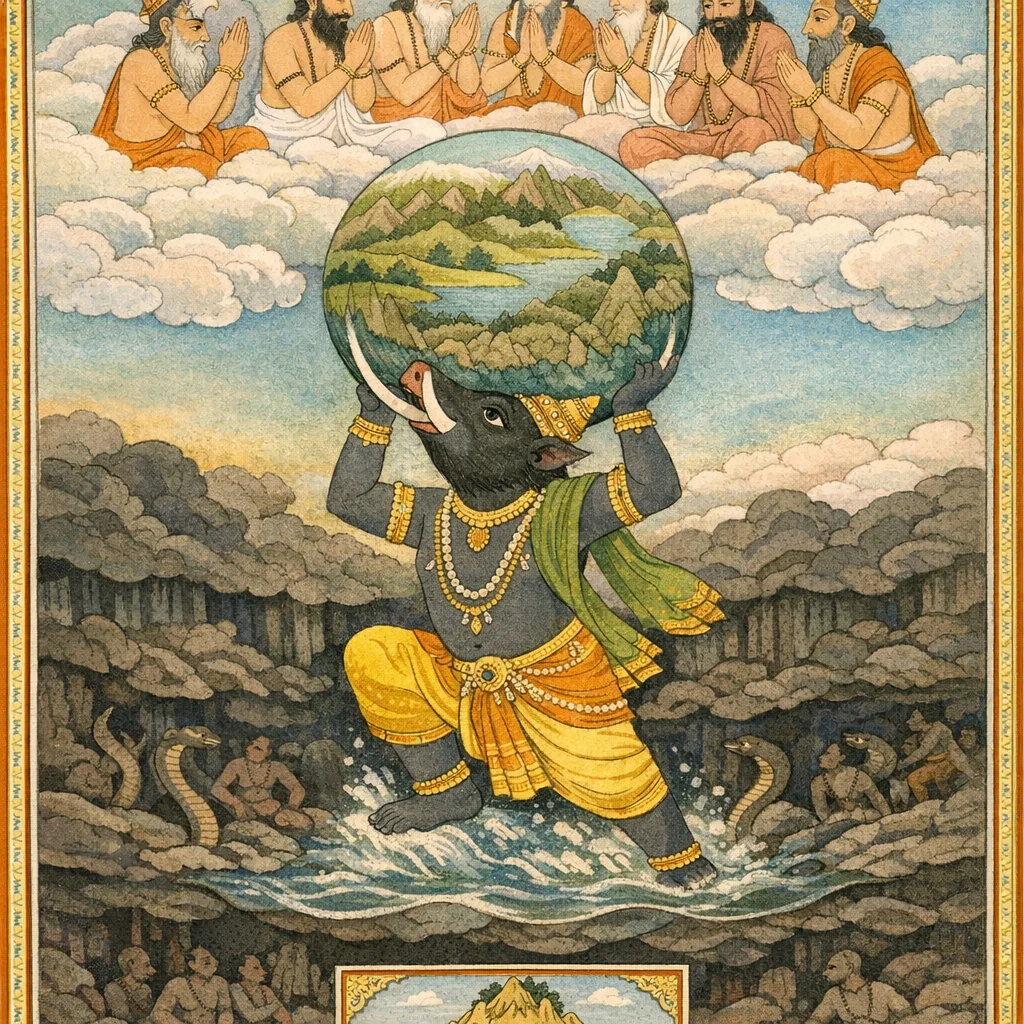
Closing the prior chapter’s colophon, the narrative turns to pralaya: a single ocean of darkness with no motion or distinction. From this state arises Brahmā, identified with the Supreme Person, Nārāyaṇa, who lies in yogic sleep upon the cosmic waters. The chapter explains “Nārāyaṇa” as “He whose resting-place is the waters” (nārā, waters; ayana, abode), and marks the end of the cosmic night (a thousand-yuga measure) when the Lord assumes the Brahmā-function as the instrumental cause of renewed creation. Finding Earth submerged, Prajāpati resolves to save her and manifests as Varāha, descending to Rasātala and lifting Earth upon His tusk. Siddhas and Brahmarṣis praise Hari in a litany uniting nirguṇa and saguṇa theology—Brahman, Paramātman, Māyā, Mūla-prakṛti, the guṇas, and avatāras—showing the Purāṇa’s samanvaya. With Earth stabilized, the Lord levels her, sets mountains in place, and turns to re-create the scorched worlds, leading into the next chapter’s cosmogony.
Shlokas
Verse 1
इति श्रीकूर्मपुराणे षट्साहस्त्र्यां संहितायां पूर्वविभागे पञ्चमो ऽध्यायः श्रीकूर्म उवाच आसीदेकार्णवं घोरमविभागं तमोमयम् / शान्तवातादिकं सर्वं न प्रज्ञायत किञ्चन
Thus, in the Śrī Kūrma Purāṇa, in the six‑thousand‑verse Saṃhitā, in the Pūrva‑bhāga (First Part)—(end of the previous chapter). Śrī Kūrma said: “There existed a single, dreadful ocean—undivided and made of darkness. All was stilled: wind and the rest; nothing whatsoever could be discerned.”
Verse 2
एकार्णवे तदा तस्मिन् नष्टे स्थावरजङ्गमे / तदा समभवद् ब्रह्मा सहस्त्राक्षः सहस्त्रपात्
When that single ocean alone remained, and all that is stationary and moving had perished, then Brahmā came into being—thousand‑eyed and thousand‑footed.
Verse 3
सहस्त्रशीर्षा पुरुषो रुक्मवर्णस्त्वतीन्द्रियः / ब्रह्मा नारायणाख्यस्तु सुष्वाप सलिले तदा
That Supreme Person—thousand-headed, golden-hued, and beyond the senses—(the very) Brahmā, known as Nārāyaṇa, then lay in yogic sleep upon the cosmic waters.
Verse 4
इमं चोदाहरन्त्यत्र श्लोकं नारायणं प्रति / ब्रह्मस्वरूपिणं देवं जगतः प्रभवाप्ययम्
Here, they also cite this verse addressed to Nārāyaṇa: “That Deva whose very form is Brahman—He is the origin and the dissolution of the universe.”
Verse 5
आपो नारा इति प्रोक्ता नाम्ना पूर्वमिति श्रुतिः / अयनं तस्य ता यस्मात् तेन नारायणः स्मृतः
The Vedic revelation declares that the waters (āpaḥ) were formerly known by the name “nārā.” Since those waters are His resting-place and abode (ayana), He is therefore remembered as Nārāyaṇa.
Verse 6
तुल्यं युगसहस्त्रस्य नैशं कालमुपास्य सः / शर्वर्यन्ते प्रकुरुते ब्रह्मत्वं सर्गकारणात्
Having passed the cosmic night equal to a thousand yugas, at its end he again assumes the state of Brahmā, becoming the instrumental cause of creation.
Verse 7
ततस्तु सलिले तस्मिन् विज्ञायान्तर्गतां महीम् / अनुमानात् तदुद्धारं कर्तुकामः प्रजापतिः
Then, realizing that the Earth had sunk within those waters, Prajāpati—by reflective inference—resolved to rescue her and raise her up.
Verse 8
जलक्रीडासु रुचिरं वाराहं रुपमास्थितः / अधृष्यं मनसाप्यन्यैर्वाङ्मयं ब्रह्मसंज्ञितम्
Sporting in the waters, he assumed the beautiful form of Varāha, the Boar; yet he remains unassailable even by another’s mind—he is Brahman, the Absolute embodied as the Word (Vāc).
Verse 9
पृथिव्युद्धरणार्थाय प्रविश्य च रसातलम् / दंष्ट्रयाभ्युज्जहारैनामात्माधारो धराधरः
To raise up the Earth, he entered Rasātala; and with his tusk he lifted her—he who is the Self-support of all, the bearer and uplifter of the world.
Verse 10
दृष्ट्वा दंष्ट्राग्रविन्यस्तां पृथिवीं प्रथितपौरुषम् / अस्तुवञ्जनलोकस्थाः सिद्धा ब्रह्मर्षयो हरिम्
Seeing the Earth set upon the tip of his tusk—he whose heroic might is renowned—the Siddhas and the Brahmarṣis dwelling in Jana-loka praised Hari.
Verse 11
ऋषय ऊचुः नमस्ते देवदेवाय ब्रह्मणे परमेष्ठिने / पुरुषाय पुराणाय शाश्वताय जयाय च
The sages said: “Salutations to You, God of gods—Brahman, the Supreme Lord; to the primordial Person, the Ancient One, the Eternal; and salutations to You as Victory itself.”
Verse 12
नमः स्वयंभुवे तुभ्यं स्त्रष्ट्रे सर्वार्थवेदिने / नमो हिरण्यगर्भाय वेधसे परमात्मने
Salutations to You, the Self-born (Svayambhu)—the Creator, the all-knowing knower of every aim and meaning. Salutations to Hiraṇyagarbha, to Vedhas the Ordainer, to the Paramātman, the Supreme Self.
Verse 13
नमस्ते वासुदेवाय विष्णवे विश्वयोनये / नारायणाय देवाय देवानां हितकारिणे
Salutations to Vāsudeva—Viṣṇu, the womb and source of the universe; to Nārāyaṇa, the radiant Lord, the benefactor and well-wisher of the gods.
Verse 14
नमो ऽस्तु ते चतुर्वक्त्रे शार्ङ्गचक्रासिधारिणे / सर्वभूतात्मभूताय कूटस्थाय नमो नमः
Homage to You, the four-faced One, bearer of the Śārṅga bow, the discus, and the sword. Again and again I bow to You—the inmost Self of all beings, the immutable Kūṭastha, the unchanging ground of all.
Verse 15
नमो वेदरहस्याय नमस्ते वेदयोनये / नमो बुद्धाय शुद्धाय नमस्ते ज्ञानरूपिणे
Salutations to You, the secret essence of the Vedas; salutations to You, the very womb and source of the Vedas. Salutations to You, the Awakened One, the Pure; salutations to You whose very form is Knowledge.
Verse 16
नमो ऽस्त्वानन्दरूपाय साक्षिणे जगतां नमः / अनन्तायाप्रमेयाय कार्याय करणाय च
Salutations to You whose very nature is Ananda, pure bliss; salutations to You, the Witness of all worlds. Salutations to the Infinite, the Immeasurable—You who are both effect and cause.
Verse 17
नमस्ते पञ्चबूताय पञ्चभूतात्मने नमः / नमो मूलप्रकृतये मायारूपाय ते नमः
Salutations to You who are the five great elements; salutations to You who are the inner Atman of the five elements. Salutations to You as Mūla-Prakṛti, the Root-Nature; salutations to You whose form is Māyā.
Verse 18
नमो ऽस्तु ते वराहाय नमस्ते मत्स्यरूपिणे / नमो योगाधिगम्याय नमः सकर्षणाय ते
Salutations to You as Varāha; salutations to You in the form of Matsya. Salutations to You who are attainable through Yoga; salutations to You, O Saṅkarṣaṇa.
Verse 19
नमस्त्रिमूर्तये तुभ्यं त्रिधाम्ने दिव्यतेजसे / नमः सिद्धाय पूज्याय गुणत्रयविभाविने
Salutations to You, the Trimūrti—Brahmā, Viṣṇu, and Śiva—the Lord of the three abodes, radiant with divine splendor. Salutations to You, the perfected Siddha, worthy of worship, who manifests through the three guṇas.
Verse 20
तमो ऽस्त्वादित्यवर्णाय नमस्ते पद्मयोनये / नमो ऽमूर्ताय मूर्ताय माधवाय नमो नमः
May darkness be dispelled before You, O Sun-hued One. Salutations to You, Padma-yoni, the Lotus-born Source. Obeisance to You who are both formless and embodied—homage, again and again, to Mādhava.
Verse 21
त्वयैव सृष्टमखिलं त्वय्येव लयमेष्यति / पालयैतज्जगत् सर्वं त्राता त्वं शरणं गति
By You alone has this entire universe been created, and into You alone it will finally dissolve. Protect this whole world; You are its Savior—its refuge and its highest goal.
Verse 22
इत्थं स भगवान् विष्णुः सनकाद्यैरभिष्टुतः / प्रसादमकरोत् तेषां वराहवपुरीश्वरः
Thus, the Blessed Lord Viṣṇu—praised by Sanaka and the other sages—bestowed His gracious favor upon them, He who is the Lord of Varāha-vapurī.
Verse 23
ततः संस्थानमानीय पृथिवीं पृथिवीपतिः / मुमोच रूपं मनसा धारयित्वा प्रिजापतिः
Then the Lord of the earth, Prajāpati, having brought the Earth into proper form and order, mentally sustaining that form, released her and set her down in her established state.
Verse 24
तस्योपरि जलौघस्य महती नौरिव स्थिता / विततत्वाच्च देहस्य न मही याति संप्लवम्
Above that rushing mass of waters, the great Earth stood firm like a vast ship; and because His body was spread out as a supporting expanse, the Earth did not sink into the cosmic inundation.
Verse 25
पृथिवीं तु समीकृत्य पृथिव्यां सो ऽचिनोद् गिरीन् / प्राक्सर्गदग्धानखिलांस्ततः सर्गे ऽदधन्मनः
Having levelled and set the earth in proper order, he then piled up the mountains upon the earth. After that, seeing all things scorched in the pre-creation conflagration, he fixed his mind upon bringing forth creation anew.
Frequently Asked Questions
It derives the name from the Vedic designation of the primordial waters as “nārā,” and states that because those waters are His resting-place (ayana), He is remembered as Nārāyaṇa—Lord who abides in and transcends the cosmic waters.
Creation and dissolution are attributed to the one Supreme Lord who is simultaneously Brahman (beyond senses and conceptual grasp) and the operative cause as Brahmā; the hymn’s language of Māyā, guṇas, and Paramātman implies that individual beings arise within conditioned manifestation while the Lord remains the immutable ground and inner Self of all.