Adhyaya 42
Cosmic Realms Above Dhruva, the Pātālas Below, and the Foundation of Pralaya (Ananta–Kāla)
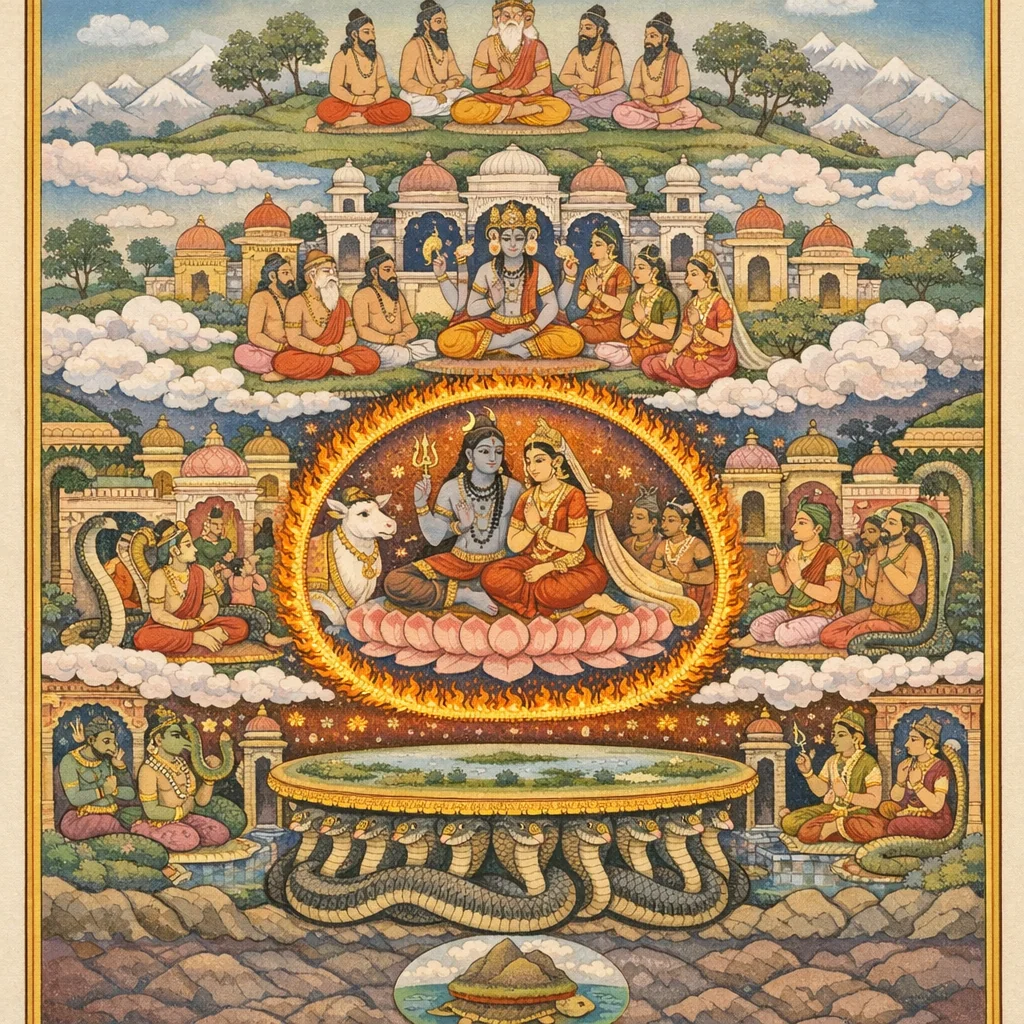
Following the prior chapter’s closing marker, Sūta continues the cosmographic teaching, ascending from Dhruva to Maharloka, Janaloka, Tapoloka, and Satyaloka (Brahmaloka), giving their measures and the sages and deities who dwell there. The account then turns from spatial mapping to liberation: perfected ascetics and yogins reach the “single gateway” to the supreme state, where a clear samanvaya is declared—Viṣṇu is also Śaṅkara. Above Brahmā’s city lies Rudraloka, radiant and ringed with fire, contemplated by the wise and attainable by desireless brahmacārins and proclaimers of Brahman devoted to Mahādeva. The narrative then descends to the pātālas (from Mahātala onward), describing their colors, inhabitants—nāgas, asuras, and kings—and their splendor, and notes the hells beneath. It culminates at the cosmic base: Ananta/Śeṣa as a Vaiṣṇava embodiment and Kālāgnirudra, the time-fire, from whom Time arises to withdraw the universe in pralaya, preparing the way for later teachings on dissolution, Time, and the ordering of karmic worlds.
Shlokas
Verse 1
इति श्रीकूर्मपुराणे षट्साहस्त्र्यां संहितायां पूर्वविभागे एकचत्वारिंशो ऽध्यायः सूत उवाच ध्रुवादूर्ध्वं महर्लोकः कोटियोजनविस्तृतः / कल्पाधिकारिणस्तत्र संस्थिता द्विजपुङ्गवाः
Thus, in the Śrī Kūrma Purāṇa, in the six-thousand-verse Saṃhitā, in the Pūrva-bhāga, the forty-first chapter concludes. Sūta said: Above Dhruva lies Maharloka, extending for a koṭi of yojanas. There dwell the foremost twice-born sages, entrusted with authority over the cycles of creation (kalpas).
Verse 2
जनलोको महर्लोकात् तथा कोटिद्वयातमकः / सनन्दनादयस्तत्र संस्थिता ब्रह्मणः सुताः
Above Maharloka lies Janaloka, extending to the measure of two koṭis; there dwell Sanandana and the other sages—sons of Brahmā—firmly established in that realm.
Verse 3
जलोकात् तपोलोकः कोटित्रयसमन्वितः / वैराजास्तत्र वै देवाः स्थिता दाहविवर्जिताः
Beyond that world lies Tapoloka, extending over three koṭis; there indeed dwell the Vairāja deities, established there, free from burning—untouched by heat, decay, and suffering.
Verse 4
प्राजापत्यात् सत्यलोकः कोटिषट्केन संयुतः / अपुनर्मारकास्तत्र ब्रह्मलोकस्तु स स्मृतः
Beyond Prajāpati’s realm lies Satyaloka, extending for six koṭis. There, beings are not subject to return and death; that region is remembered as Brahmaloka.
Verse 5
अत्र लोकगुरुर्ब्रह्मा विश्वात्मा विश्वतोमुखः / आस्ते स योगिभिर्नित्यं पीत्वा योगामृतं परम्
Here, Brahmā—the guru of the worlds, the Universal Self, the all-faced one—abides ever among the yogins, having drunk the supreme nectar of Yoga.
Verse 6
विशन्ति यतयः शान्ता नैष्ठिका ब्रह्मचारिणः / योगिनस्तापसाः सिद्धा जापकाः परमेष्ठिनम्
Peaceful ascetics—steadfast brahmacārins, yogins, accomplished tapasvins, siddhas, and devotees who recite japa—enter into the Supreme Lord (Parameṣṭhin).
Verse 7
द्वारं तद्योगिनामेकं गच्छतां परमं पदम् / तत्र गत्वा न शोचन्ति स विष्णुः स च शङ्करः
For the yogins who seek the supreme state, there is a single gateway. Having reached it, they grieve no more—He is Viṣṇu, and He is also Śaṅkara (Śiva).
Verse 8
सूर्यकोटिप्रतीकाशं पुरं तस्य दुरासदम् / न मे वर्णयितुं शक्यं ज्वालामालासमाकुलम्
That city shone with the brilliance of ten million suns and was unapproachable. I am unable to describe it—it was thronged all around with garlands and masses of flames.
Verse 9
तत्र नारायणस्यापि भवनं ब्रह्मणः पुरे / शेते तत्र हरिः श्रीमान् मायी मायामयः परः
There, within Brahmā’s celestial city, stands also the mansion of Nārāyaṇa. There the glorious Hari reposes—He who wields Māyā, who pervades all as Māyā, and who is nonetheless the Transcendent Supreme.
Verse 10
स विष्णुलोकः कथितः पुनरावृत्तिवर्जितः / यान्ति तत्र महात्मानो ये प्रपन्ना जनार्दनम्
Thus has the realm of Viṣṇu been described—free from return (rebirth). The great-souled go there: those who have taken refuge in Janārdana.
Verse 11
ऊर्ध्वं तद् ब्रह्मसदनात् पुरं ज्योतिर्मयं शुभम् / वह्निना च परिक्षिप्तं तत्रास्ते भगवान् भवः
Above the abode of Brahmā is a blessed city made of pure light. Encircled by sacred fire, there dwells the Lord Bhava (Śiva).
Verse 12
देव्या सह महादेवश्चिन्त्यमानो मनीषिभिः / योगिभिः शतसाहस्त्रैर्भूतै रुद्रैश्च संवृतः
Mahādeva, together with the Goddess, was contemplated by the wise; he was surrounded by hundreds of thousands of yogins, and by hosts of beings and Rudras.
Verse 13
तत्र ते यान्ति नियता द्विजा वै ब्रह्मचारिणः / मदादेवपराः शान्तास्तापसा ब्रह्मवादिनः
There, disciplined twice-born brahmacārins proceed—peaceful ascetics, devoted to me as Mahādeva, and proclaimers of Brahman.
Verse 14
निर्ममा निरहङ्काराः कामक्रोधविवर्जिताः / द्रक्ष्यन्ति ब्रह्मणा युक्ता रुद्रलोकः स वै स्मृतः
Those free from possessiveness and egoism, devoid of desire and anger—united with Brahman—shall behold that supreme state. That realm is remembered as Rudra’s world, Rudraloka.
Verse 15
एते सप्त महालोकाः पृथिव्याः परिकीर्तिताः / महातलादयश्चाधः पातालाः सन्ति वै द्विजाः
These seven great worlds associated with the earth have been described. And below—beginning with Mahātala—there exist the nether realms (Pātālas), O twice-born sages.
Verse 16
महातलं च पातालं सर्वरत्नोपशोभितम् / प्रासादैर्विविधैः शुभ्रैर्देवतायतनैर्युतम्
Mahātala and Pātāla are resplendent with every kind of jewel—adorned with many kinds of gleaming palaces and furnished with sanctuaries of the gods.
Verse 17
अनन्तेन च संयुक्तं मुचुकुन्देन धीमता / नृपेण बलिना चैव पातालस्वर्गवासिना
He was also allied with Ananta and with the wise Mucukunda; likewise with the powerful king Bali, who dwells in Pātāla yet partakes of the heavenly realm.
Verse 18
शैलं रसातलं विप्राः शार्करं हि तलातलम् / पीतं सुतलमित्युक्तं नितलं विद्रुमप्रभम् / सितं हि वितलं प्रोक्तं तलं चैव सितेतरम्
O brāhmaṇas, Rasātala is said to be rocky like a mountain; Talātala is indeed gravelly. Sutala is spoken of as yellow; Nitala shines with a coral-like radiance. Vitala is declared to be white, and Tala to be of a hue other than white.
Verse 19
सुपर्णेन मुनिश्रेष्ठास्तथा वासुकिना शुभम् / रसातलमिति ख्यातं तथान्यैश्च निषेवितम्
O best of sages, that auspicious realm—renowned as Rasātala—was frequented by Suparṇa (Garuḍa) and likewise by Vāsuki, and it was also resorted to by many others.
Verse 20
विरोचनहिरण्याक्षतक्षकाद्यैश्च सेवितम् / तलातलमिति ख्यातं सर्वशोभासमन्वितम्
Attended by Virocana, Hiraṇyākṣa, Takṣaka, and others, it is renowned as Talātala—adorned with every kind of splendour.
Verse 21
वैनतेयादिभिश्चैव कालनेमिपुरोगमैः / पूर्वदेवैः समाकीर्णं सुतलं च तथापरैः
Sutala is likewise filled with Vainateya (Garuḍa) and others, with Kālanemi at their head, and with the former gods—along with still other beings as well.
Verse 22
नितलं यवनाद्यैश्च तारकाग्निमुखैस्तथा / महान्तकाद्यैर्नागैश्च प्रह्मादेनासुरेण च
In the nether realm called Nītala dwell the Yavanas and others, and likewise beings such as Tāraka and Agnimukha. It is also inhabited by Nāgas beginning with Mahāntaka, and by the Asura named Brahmāde (Brahmāda).
Verse 23
वितलं चैव विख्यातं कम्बलाहीन्द्रसेवितम् / महाजम्भेन वीरेण हयग्रीवेण वै तथा
And (beneath that) lies the famed realm called Vitala, attended by the nāga-lords Kambala and Ahīndra, and likewise by the heroic Mahājambha and Hayagrīva.
Verse 24
शङ्कुकर्णेन संभिन्नं तथा नमुचिपूर्वकैः / तथान्यैर्विवधैर्नागैस्तलं चैव सुशोभनम्
That region of the netherworld was pierced through by Śaṅkukarṇa, and likewise by Namuci and others; and by many other diverse Nāgas as well—thus the subterranean world shone with great splendor.
Verse 25
तेषामधस्तान्नरका मायाद्याः परिकीर्तिताः / पापिनस्तेषु पच्यन्ते न ते वर्णयितुं क्षमाः
Below those realms are the hells—beginning with Māyā—as declared in the tradition. There sinners are “cooked” (tormented) by the fruits of their own misdeeds; they cannot be described in full.
Verse 26
पातालानामधश्चास्ते शेषाख्या वैष्णवी तनुः / कालाग्निरुद्रो योगात्मा नारसिंहो ऽपि माधवः
Below the netherworlds stands the Vaiṣṇava embodiment known as Śeṣa. He is also Kālāgnirudra—the Rudra who is the Fire of Time—whose very essence is Yoga; and he is Mādhava as well, appearing too as Nārasiṁha.
Verse 27
यो ऽनन्तः पठ्येते देवो नागरूपी जनार्दनः / तदाधारमिदं सर्वं स कालाग्निमपाश्रितः
That Deity who is recited as Ananta—Janārdana in the form of the cosmic serpent—upon Him this entire universe is supported; and He, abiding in (and transcending) the fire of Time, remains the ultimate ground of all.
Verse 28
तमाविश्य महायोगी कालस्तद्वदनोत्थितः / विषज्वालामयो ऽन्ते ऽसौ जगत् संहरति स्वयम्
Entering into Him, Time—the great Yogin, arising from His mouth—at the end becomes a mass of poisonous flames and, of itself, withdraws the universe into dissolution.
Verse 29
सहस्त्रमायो ऽप्रतिमः संहर्ता शङ्करोद्भवः / तामसी शांभवी मूर्तिः कालो लोकप्रकालनः
He of a thousand powers of māyā, incomparable, the dissolver—arising from Śaṅkara; his Śāmbhava form is tāmasic, linked to dissolution. He is Time itself, the regulator and ripener of the worlds.
Frequently Asked Questions
It states that the ‘single gateway’ for yogins is the supreme Lord who is Viṣṇu and also Śaṅkara, and it places Nārāyaṇa’s mansion within Brahmā’s city while also describing a luminous Rudraloka above—harmonizing both as supreme-access points.
Śeṣa (Ananta) is the cosmic support and a Vaiṣṇava embodiment identified with Kālāgnirudra; Time emerges from him, becomes a fiery, poisonous force at the end, and withdraws the universe into dissolution—linking ontology (support) with eschatology (pralaya).
Not as a formal manual; however, it foregrounds brahmacarya, tapas, yoga, and desirelessness as qualifications for reaching Rudraloka/Brahmaloka and for attaining the ‘single gateway,’ anticipating later doctrinal expansions often associated with Varnāśrama discipline and Śaiva yogic frames.