Adhyaya 41
Solar Rays, Planetary Nourishment, Dhruva-Bondage of the Grahas, and the Lunar Cycle
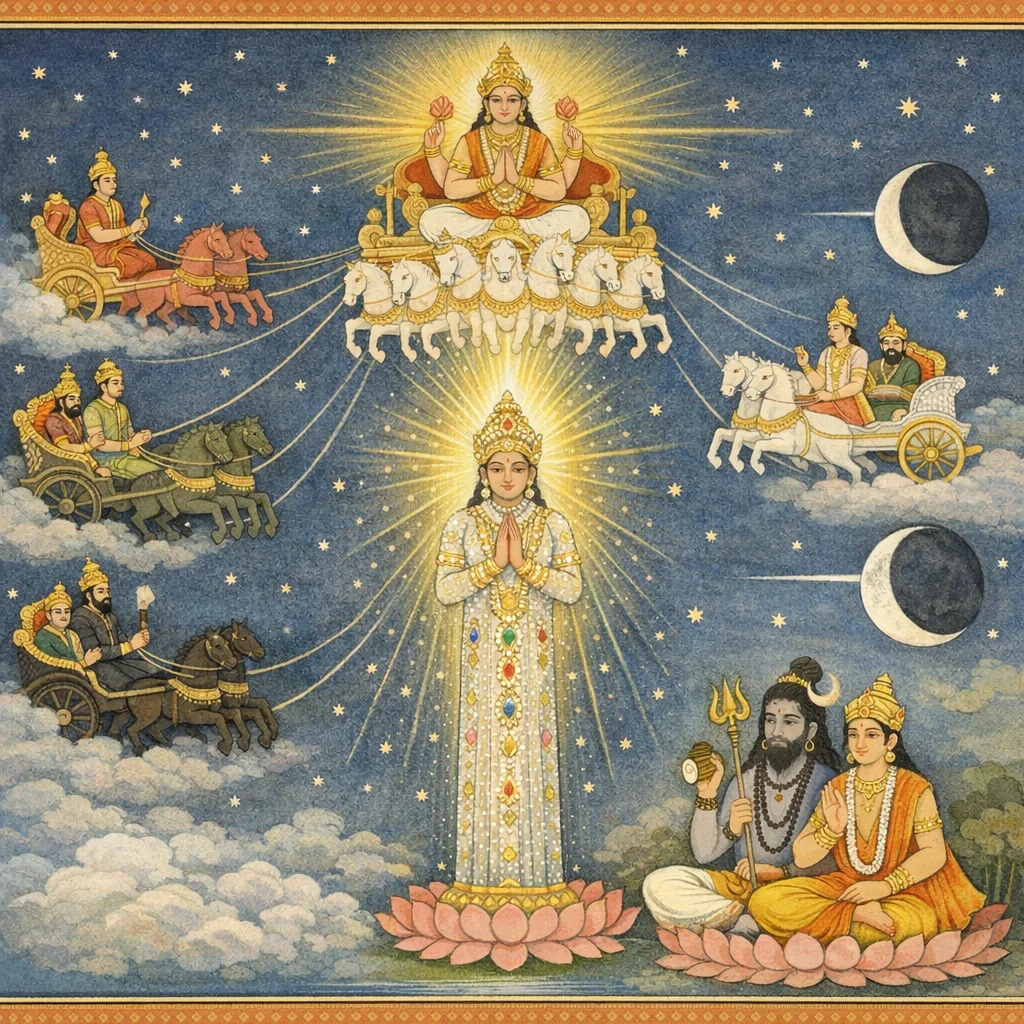
Continuing the prior chapter’s close that hails Mahādeva as the ordainer of kāla (Time) and cosmic order, this adhyāya presents a technical cosmology with Āditya (the Sun) as the heavens’ working axis. It lists the Sun’s chief rays and assigns them nourishing roles for the grahas (Mercury, Venus, Mars, Jupiter, Saturn) and for seasonal effects—heat, rain, and cold—thus linking astronomy with the sustaining of life and the ritual economy. It then sets out the monthly solar presiding deities (Varuṇa, Pūṣan, Aṁśa, Dhātṛ, Indra, Savitṛ, Vivasvān, Bhaga, Parjanya, Tvaṣṭṛ, Mitra, Viṣṇu), correlating them with ray-counts and the Sun’s seasonal hues. Next it explains the eight grahas under solar lordship, their being tethered to Dhruva by “wind-cords” (pravaha-vāyu), and the waxing and waning of the Moon as Soma is “drunk” by the gods and replenished by a solar ray. The chapter ends with descriptions of planetary chariots and a reaffirmation of Dhruva as the fixed hub of celestial revolution, preparing for further cosmographic or dharma-oriented teaching grounded in this ordered model.
Shlokas
Verse 1
इति श्रीकूर्मपुराणे षट्साहस्त्र्यां संहितायां पूर्वविभागे चत्वारिशो ऽध्यायः सूत उवाच एवमेष महादेवो देवदेवः पितामहः / करोति नियतं कालं कालात्मा ह्यैश्वरी तनुः
Thus, in the Śrī Kūrma Purāṇa, in the six-thousand-verse Saṃhitā, in the Pūrva-bhāga, the fortieth chapter concludes. Sūta said: “In this way Mahādeva—God of gods, the primordial Father—ordains Time in its fixed order; for Time is his very Self, indeed his sovereign (aiśvarī) form.”
Verse 2
तस्य ये रश्मयो विप्राः सर्वलोकप्रदीपकाः / तेषां श्रेष्ठाः पुनः सप्त रश्मयो ग्रहयोनयः
O brāhmaṇas, those rays of his—the Sun’s rays—are the illuminators of all the worlds. Among them, the seven most excellent rays are said to be the sources, the wombs from which the planets arise.
Verse 3
सुषुम्नो हरिकेशश्च विश्वकर्मा तथैव च / विश्वव्यचाः पुनश्चान्यः संयद्वसुरतः परः
“(They are named) Suṣumna, Harikeśa, and likewise Viśvakarman; another is called Viśvavyacāḥ; and beyond these is the one named Saṃyadvasurataḥ.”
Verse 4
अर्वावसुरिति ख्यातः स्वराडन्यः प्रकीर्तितः / सुपुम्नः सूर्यरश्मिस्तु पुष्णाति शिशिरद्युतिम्
One solar ray is renowned as Arvāvasu, and another is celebrated as Svarāṭ. The sun-ray named Supumna nourishes and sustains the cool-season radiance—the wintry brilliance.
Verse 5
तिर्यगूर्ध्वप्रचारो ऽसौ सुषुम्नः परिपठ्यते / हरिकेशस्तु यः प्रोक्तो रश्मिर्नक्षत्रपोषकः
That radiant channel which moves both horizontally and upward is recited as “Suṣumnā”; and the ray declared as “Harikeśa” is the one that nourishes the lunar mansions (nakṣatras).
Verse 6
विश्वकर्मा तथा रश्मिर्बुधं पुष्णाति सर्वदा / विश्वव्यचास्तु यो रश्मिः शुक्रं पुष्णाति नित्यदा
The sun-ray named Viśvakarmā ever nourishes Budha (Mercury); and the ray called Viśvavyacās continually nourishes Śukra (Venus).
Verse 7
संयद्वसुरिति ख्यातः स पुष्णाति च लोहितम् / वृहस्पतिं प्रपुष्णाति रश्मिरर्वावसुः प्रभोः / शनैश्चरं प्रपुष्णाति सप्तमस्तु सुराट् तथा
The Lord’s ray known as Saṃyadvasu nourishes Lohita (Mars). The ray called Arvāvasu especially nourishes Bṛhaspati (Jupiter). Likewise, the seventh ray—Surāṭ—nourishes Śanaiścara (Saturn) as well.
Verse 8
एवं सूर्यप्रभावेन सर्वा नक्षत्रतारकाः / वर्धन्ते वर्धिता नित्यं नित्यमाप्याययन्ति च
Thus, by the Sun’s potency, all the constellations and stars increase; and, being ever strengthened, they are continually nourished again and again.
Verse 9
दिव्यानां पार्थिवानां च नैशानां चैव सर्वशः / आदानान्नित्यमादित्यस्तेजसां तमसां प्रभुः
By continually drawing in, in every manner, the powers of the celestial, the earthly, and the nocturnal, Āditya (the Sun) abides forever as the sovereign Lord over both radiance and darkness.
Verse 10
आदत्ते स तु नाडीनां सहस्त्रेण समन्ततः / नादेयांश्चैव सामुद्रान् कूप्यांश्चैव सहस्त्रदृक् / स्थावराञ्जङ्गमांश्चैव यच्च कुल्यादिकं पयः
He indeed draws up the waters on every side—taking in thousands of rivulets and channels, the waters of rivers and even of the sea, and the waters of wells and reservoirs; and he also takes away the water meant for both the immobile and the moving beings—whatever water flows through canals and the like.
Verse 11
तस्य रश्मिसहस्त्रं तच्छीतवर्षोष्णनिस्त्रवम् / तासां चतुः शतं नाड्यो वर्षन्ते चित्रमूर्तयः
From him (the Sun) issue a thousand rays, streaming forth as cold, as rain, and as heat. Of those, four hundred are channels (nāḍīs) that pour down showers, assuming wondrous and varied forms.
Verse 12
वन्दनाश्चैव याज्याश्च केतना भूतनास्तथा / अमृता नाम ताः सर्वा रश्मयो वृष्टिसर्जनाः
And (the rays are called) Vandanā and Yājyā, Ketanā and Bhūtanā as well. All of these rays together are named “Amṛtā”; they are the radiances that bring forth rainfall.
Verse 13
हिमोद्वाहाश्च ता नाड्यो रश्मयस्त्रिशतं पुनः / रश्म्यो मेष्यश्च पौष्यश्च ह्लादिन्यो हिमसर्जनाः / चन्द्रास्ता नामतः सर्वाः पीताभाः स्युर्गभस्तयः
Those channels (nāḍīs) that bear cold are again spoken of as the Moon’s three hundred rays. Among them are Meṣyā and Pauṣyā—cooling in nature and bringing forth frost. All of these are known by the name “Candrāḥ” (lunar rays), and their beams are said to be of a pale-yellow hue.
Verse 14
शुक्राश्च ककुभश्चैव गावो विश्वभृतस्तथा / शुक्रास्ता नामतः सर्वास्त्रिविधा घर्मसर्जनाः
The classes called Śukrā and Kakubhā, and likewise the cows known as Viśvabhṛt—by name all these are called “Śukrā”; they are threefold, and they are emitters of heat (gharman).
Verse 15
समं बिभर्ति ताभिः स मनुष्यपितृदेवताः / मनुष्यानौषधेनेह स्वधया च पितॄनपि / अमृतेन सुरान् सर्वांस्त्रिभिस्त्ररिंस्तर्पयत्यसौ
By these three offerings he sustains alike humans, the Pitṛs (ancestors), and the Devas: here he nourishes mankind with food and healing herbs, the Pitṛs with the svadhā-offering, and all the gods with amṛta; thus, by this threefold act, he satisfies the three orders.
Verse 16
वसन्ते ग्रैष्मिके चैव शतैः स तपति त्रिभिः / शरद्यपि च वर्षासु चतुर्भैः संप्रवर्षति / हेमन्ते शिशिरे चैव हिममुत्सृजति त्रिभिः
In spring and in summer he (the Sun) burns with three hundred rays; in autumn and in the rainy season he pours forth rain with four hundred; and in winter and in the cool season he releases snow with three hundred.
Verse 17
वरुणो माघमासे तु सूर्यः पूषा तु फल्गुने / चैत्रे मासि भवेदंशो धाता वैशाखतापनः
In the month of Māgha, Varuṇa presides; in Phālguna, Sūrya as Pūṣan presides. In Caitra, Aṁśa becomes the presiding deity; and in Vaiśākha, Dhātṛ—known as Tāpana, the “giver of heat”—presides.
Verse 18
ज्येष्ठामूले भवेदिन्द्रः आषाढे सविता रविः / विवस्वान् श्रावणे मासि प्रौष्ठपद्यां भगः स्मृतः
In the month of Jyeṣṭha (at its root), Indra presides; in Āṣāḍha, Savitṛ—the Sun—presides. In Śrāvaṇa, Vivasvān presides; and in Proṣṭhapadā, Bhaga is remembered as the presiding deity.
Verse 19
पर्जन्यो ऽश्वयुजि त्वष्टाकार्तिके मासि भास्करः / मार्गशीर्ष भवेन्मित्रः पौषे विष्णुः सनातनः
In the month of Āśvayuja he is called Parjanya; in Kārtika, Tvaṣṭṛ; and in that very month he is also Bhāskara. In Mārgaśīrṣa he becomes Mitra; and in Pauṣa he is Viṣṇu, the Eternal.
Verse 20
पञ्चरश्मिसहस्त्राणि वरुणस्यार्ककर्मणि / षड्भिः सहस्त्रैः पूषा तु देवोंशः सप्तभिस्तथा
In the Sun’s sacred functioning, five thousand rays are assigned to Varuṇa; Pūṣan operates with six thousand; and the divine portion (Deva-aṁśa) likewise with seven thousand.
Verse 21
धाताष्टभिः सहस्त्रैस्तु नवभिस्तु शतक्रतुः / विवस्वान् दशभिः पाति पात्येकादशभिर्भगः
Dhātṛ protects with eight thousand (rays). Śatakratu (Indra) protects with nine thousand. Vivasvān (the Sun) protects with ten thousand, and Bhaga protects with eleven thousand.
Verse 22
सप्तभिस्तपते मित्रस्त्वष्टा चैवाष्टभिस्तपेत् / अर्यमा दशभैः पाति पर्जन्यो नवभिस्तपेत् / षड्भी रश्मिसहस्त्रैस्तु विष्णुस्तपति विश्वसृक्
Mitra shines forth with seven (sets of rays); Tvaṣṭṛ indeed shines with eight. Aryaman protects with ten; Parjanya shines with nine. But Viṣṇu—the creator of the world—heats and illumines with six thousand rays.
Verse 23
वसन्ते कपिलः सूर्यो ग्रीष्मे काञ्चनसप्रभः / श्वेतो वर्षासु वर्णेन पाण्डुरः शरदि प्रभुः / हेमन्ते ताम्रवर्णः स्याच्छिशिरे लोहितो रविः
In spring the Sun is tawny; in summer he shines with a golden radiance. In the rains he appears white in hue; in autumn the Lord is pale. In early winter he becomes copper-colored, and in late winter Ravi appears red.
Verse 24
ओषधीषु बलं धत्ते स्वधामपि पितृष्वथ / सूर्यो ऽमरत्वममृते त्रयं त्रिषु नियच्छति
He places strength within the medicinal herbs, and among the Pitṛs he establishes the oblation called svadhā. The Sun, through Amṛta, upholds immortality and thus governs the triad throughout the three realms.
Verse 25
अन्ये चाष्टौ ग्रहा ज्ञेयाः सूर्येणाधिष्ठिता द्विजाः / चन्द्रमाः सोमपुत्रश्च शुक्रश्चैव बृहस्पतिः / भौमो मन्दस्तथा राहुः केतुमानपि चाष्टमः
O twice-born ones, know also the eight grahas presided over by the Sun: the Moon; Budha, son of Soma; Śukra; Bṛhaspati; Bhauma (Mars); Manda (Saturn); Rāhu; and Ketu, the eighth.
Verse 26
सर्वे ध्रुवे निबद्धा वै ग्रहास्ते वातरश्मिभिः / भ्राम्यमाणा यथायोगं भ्रमन्त्यनुदिवाकरम्
All the planets are indeed fastened to Dhruva (the Pole Star) by cords of wind-like rays; set in motion according to their proper order, they revolve day by day, following the Sun’s course.
Verse 27
अलातचक्रवद् यान्ति वातचक्रेरिता द्विजाः / यस्माद् वहति तान् वायुः प्रवहस्तेन स स्मृतः
O twice-born ones, beings move like a whirling firebrand, driven by the wheel of wind. Because Vāyu bears them onward, he is remembered by the name Pravaha, “the one who carries forward”.
Verse 28
रथस्त्रिचक्रः सोमस्य कुन्दाभास्तस्य वाजिनः / वामदक्षिणतो युक्ता दश तेन निशाकरः
Soma’s chariot is three-wheeled, and his horses are white like jasmine. Ten steeds are yoked on the left and the right; by them the Night-maker, the Moon (Niśākara), proceeds upon his course.
Verse 29
वीथ्याश्रयाणि चरति नक्षत्राणि रविर्यथा / ह्रासवृद्धी च विप्रेन्द्रा ध्रुवाधाराणि सर्वदा
As the Sun moves along its celestial track, so the lunar mansions (nakṣatras) proceed upon their own paths. Their waning and waxing, O best of brāhmaṇas, are ever upheld by Dhruva (the Pole Star) as an unshifting foundation.
Verse 30
स सोमः शुक्लपक्षे तु भास्करे परतः स्थिते / आपूर्यते परस्यान्तः सततं दिवसक्रमात्
That Soma (the Moon), during the bright fortnight, when the Sun stands beyond it, is continually filled—day by day in due sequence—within its further portion.
Verse 31
क्षीणायितं सुरैः सोममाप्यायति नित्यदा / एकेन रश्मिना विप्राः सुषुम्नाख्येन भास्करः
O brāhmaṇas, when Soma (the Moon) is waned—having been ‘drunk’ by the gods—the Sun (Bhāskara) continually replenishes him by a single ray known as Suṣumnā.
Verse 32
एषा सूर्यस्य वीर्येण सोमस्याप्यायिता तनुः / पौर्णमास्यां स दृश्येत संपूर्णे दिवसक्रमात्
This body (disc) of Soma, nourished by the potency of Sūrya, is seen as full on the night of the Full Moon (Paurṇamāsī), when the ordered cycle of days is completed.
Verse 33
संपूर्णमर्धमासेन तं सोमममृतात्मकम् / पिबन्ति देवता विप्रा यतस्ते ऽमृतभोजनाः
Within a fortnight, O brāhmaṇas, the deities drink up that Soma whose very essence is amṛta, the nectar of immortality; therefore the gods and the brahmin sages are said to be nourished by immortality itself.
Verse 34
ततः पञ्चदशे भागे किञ्चिच्छिष्टे कलात्मके / अपराह्णे पितृगणा जघन्यं पर्युपासते
Then, when the fifteenth portion of the day—measured in kalās (time-units)—is almost spent, in the late afternoon the hosts of the Pitṛs attend the day’s lowest, its declining phase, awaiting the offerings.
Verse 35
पिबन्ति द्विकलं कालं शिष्टा तस्य कला तुया / सुधामृतमयीं पुण्यां तामन्दोरमृतात्मिकाम्
For the span of two kalās, the righteous drink that portion of him—bestowed by you—holy and nectar-like: the Moon’s immortal essence, wrought of amṛta.
Verse 36
निः सृतं तदमावास्यां गभस्तिभ्यः स्वधामृतम् / मासतृप्तिमपाप्यग्र्यां पितरः सन्ति निर्वृताः
On Amāvāsyā, the new-moon day, the nectar called Svadhā flows forth from the Sun’s rays; and having gained thereby the foremost monthly satisfaction, the Pitṛs abide in contentment, peace, and repose.
Verse 37
न सोमस्य विनाशः स्यात् सुधा देवैस्तु पीयते / एवं सूर्यनिमित्तस्य क्षयो वृद्धिश्च सत्तमाः
There is no destruction of Soma, the Moon; rather, the gods drink his ambrosial essence. Thus, O best among the virtuous, waxing and waning occur through the Sun’s agency as the determining cause.
Verse 38
सोमपुत्रस्य चाष्टाभिर्वाजिभिर्वायुवेगिभिः / वारिजैः स्यन्दनो युक्तस्तेनासौ याति सर्वतः
And the chariot of Soma’s son is yoked to eight horses, wind-swift and born of the waters; by that chariot he journeys everywhere.
Verse 39
शुक्रस्य भूमिजैरश्वैः स्यन्दनो दशभिर्वृतः / अष्टबिश्चाथ भौमस्य रथो हैमः सुशोभनः
Śukra (Venus) is borne upon a chariot drawn by ten earth-born horses; and Bhauma/Maṅgala (Mars) likewise has a splendid golden car drawn by eight.
Verse 40
बृहस्पतेरथाष्टाश्वः स्यन्दनो हेमनिर्मितः / रथस्तमोमयो ऽष्टाश्वो मन्दस्यायसनिर्मितः / स्वर्भानोर्भास्करारेश्च तथा षड्भिर्हयैर्वृतः
Bṛhaspati’s chariot is drawn by eight horses, and his car is fashioned of gold. Manda/Śani, the slow-moving one, has an eight-horsed chariot made of iron, of a dark and shadowy nature. Svarbhānu (Rāhu), the Sun’s foe, likewise is attended by six horses.
Verse 41
एते महाग्रहाणां वै समाख्याता रथा नव / सर्वे ध्रुवे महाभागा निबद्धा वातरश्मिभिः
Thus have the nine chariots of the great celestial bodies been described. All of them, O noble one, are fastened to Dhruva (the Pole Star) by cords made of currents of wind.
Verse 42
ग्रहर्क्षताराधिष्ण्यानि ध्रुवे बद्धान्येशेषतः / भ्रमन्ति भ्रामयन्त्येनं सर्वाण्यनिलरश्मिभिः
All the planets, lunar mansions (nakṣatras), stars, and their celestial stations are bound without exception to Dhruva. Moving in their courses, they also cause the cosmic wheel to revolve—driven by the currents and rays of the wind (anila).
Frequently Asked Questions
It presents the Sun’s rays as ‘wombs/sources’ that nourish and empower planetary forces; specific named rays sustain Budha, Śukra, Lohita (Maṅgala), Bṛhaspati, and Śanaiścara, making solar potency the underlying driver of planetary efficacy.
Dhruva functions as the fixed axis: planets, nakṣatras, and stars are said to be bound to it by cords of wind-like rays, and their revolutions proceed as the cosmic wheel is carried by pravaha-vāyu.
The chapter ties ancestral satisfaction to lunar timing: on amāvāsyā, svadhā is said to flow from the Sun’s rays, and the pitṛs attain monthly contentment, integrating ritual observance with solar-lunar mechanics.