Adhyaya 37
Yamunā–Gaṅgā Tīrtha-Māhātmya: Agni-tīrtha, Anaraka, Prayāga, and the Tapovana of Jāhnavī
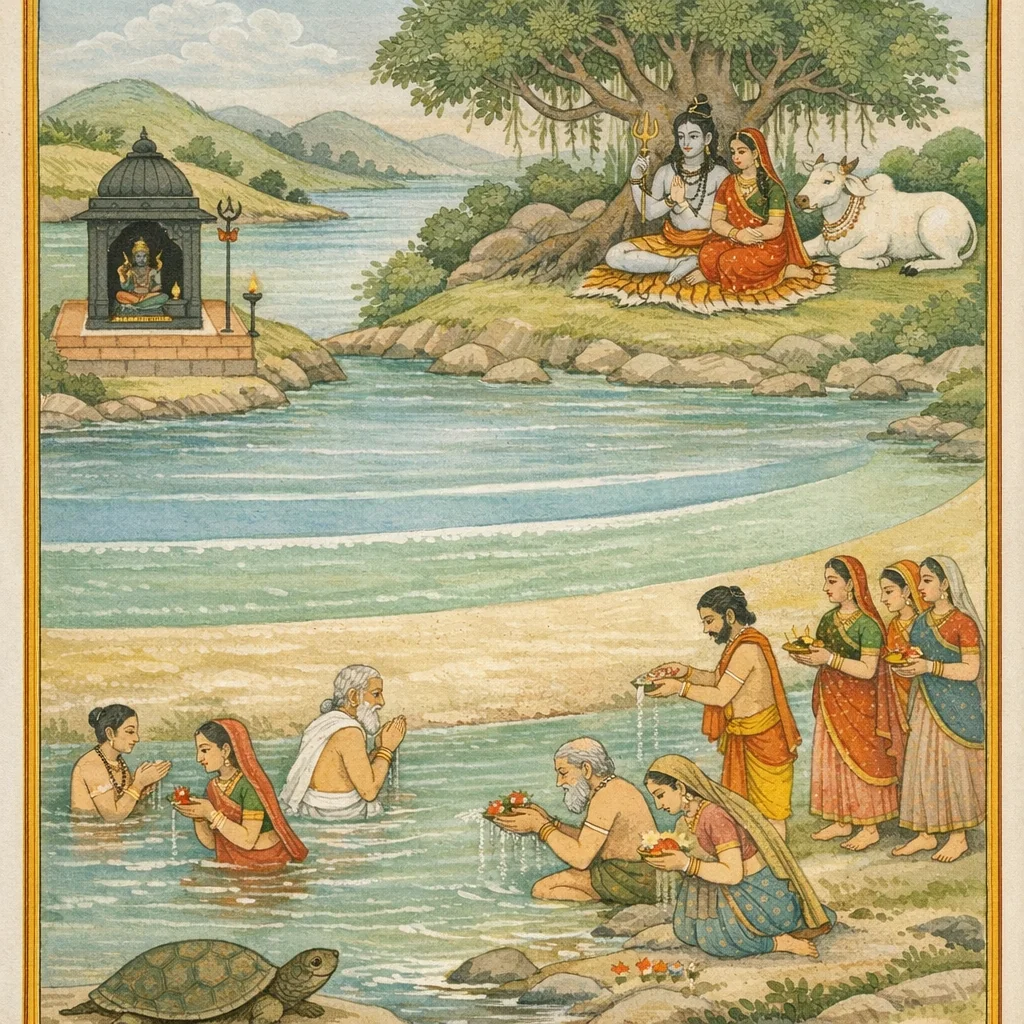
Continuing Mārkaṇḍeya’s tīrtha-instruction to Yudhiṣṭhira, this chapter deepens the sacred mapping of North India’s river-world. Yamunā—praised as the Sun’s daughter and linked in origin to Gaṅgā—is extolled as a purifier whose remembrance and praise destroy sin even from afar. It highlights southern-bank fords: Agni-tīrtha and, west of it, Dharmarāja’s Anaraka, where bathing and rites—especially tarpana to Dharmarāja on kṛṣṇa-pakṣa caturdaśī—free one from grave sins and lead to heaven. The narrative then widens to Prayāga’s vast tīrtha-network and re-centers Gaṅgā (Jāhnavī) as the all-encompassing matrix of tīrthas across realms: wherever she flows is tapovana and siddhi-kṣetra, and wherever Maheśvara abides with Devī as Vaṭeśvara is intrinsically a tīrtha. The chapter ends with an injunction to secrecy and proper eligibility for teaching, and with a phalaśruti that daily hearing/recitation grants purity, sinlessness, and Rudra-loka, preparing for further tīrtha enumerations and cosmographic teaching.
Shlokas
Verse 1
इति श्रीकूर्मपुराणे षट्साहस्त्र्यां संहितायां पूर्वविभागे षट्त्रिंशो ऽध्यायः मार्कण्डय उवाच तपनस्य सुता देवी त्रिषु लोकेषु विश्रुता / समागता महाभागा यमुना यत्र निम्नगा
Thus, in the holy Śrī Kūrma Purāṇa, in the six-thousand-verse Saṃhitā, in the Pūrvabhāga, the thirty-sixth chapter. Mārkaṇḍeya said: “The Goddess, daughter of Tapan (the Sun), renowned in the three worlds—the glorious Yamunā—has come to the place where the river flows.”
Verse 2
येनैव निः सृता गङ्गा तेनैव यमुना गता / योजनानां सहस्त्रेषु कीर्तनात् पापनाशनी
From that very source from which the Gaṅgā issued forth, the Yamunā too has flowed. Even from thousands of yojanas away, merely by being remembered and praised, she destroys sin.
Verse 3
तत्र स्नात्वा च पीत्वा च यमुनायां युधिष्ठिर / सर्वपापविनिर्मुक्तः पुनात्यासप्तमं कुलम् / प्राणांस्त्यजति यस्तत्र स याति परमां गतिम्
O Yudhiṣṭhira, having bathed and drunk the waters of the Yamunā there, one is freed from all sins and purifies one’s lineage up to the seventh generation. And whoever relinquishes life there attains the supreme destination.
Verse 4
अग्नितीर्थमिति ख्यातं यमुनादक्षिण तटे / पश्चिमे धर्मराजस्य तीर्थं त्वनरकं स्मृतम् / तत्र स्नात्वा दिवं यान्ति ये मृतास्ते ऽपुनर्भवाः
On the southern bank of the Yamunā there is a ford famed as Agni-tīrtha. To its west lies Dharmarāja’s sacred ford, remembered as Anaraka (“the place free from hell”). Those who bathe there, even if they later die, go to heaven; they do not return again to rebirth.
Verse 5
कृष्णपक्षे चतुर्दश्यां स्नात्वा संतर्पयेच्छुचिः / धर्मराजं महापापैर्मुच्यते नात्र संशयः
On the fourteenth lunar day (caturdaśī) of the dark fortnight, having bathed and become pure, one should offer tarpana (libations of water) to Dharmarāja; thereby one is freed from great sins—of this there is no doubt.
Verse 6
दश तीर्थसहस्त्राणि त्रिंशत्कोट्यस्तथापराः / प्रयागे संस्थितानि स्युरेवमाहुर्मनीषिणः
Ten thousand sacred tīrthas, and a further thirty crores besides, are said to be established at Prayāga—so declare the wise.
Verse 7
तिस्त्रः कोट्योर्ऽधकोटी च तीर्थानां वायुरब्रवीत् / दिवि भूम्यन्तरिक्षे च तत्सर्वं जाह्नवी स्मृता
Vāyu declared that there are three crores and a half-crore of sacred tīrthas; in heaven, on earth, and in the mid-region as well—yet all of that is remembered as Jāhnavī (the Gaṅgā) itself.
Verse 8
यत्र गङ्गा महाभागा स देशस्तत् तपोवनम् / सिद्धिक्षेत्रं तु तज्ज्ञेयं गङ्गातीरसमाश्रितम्
Wherever the greatly auspicious River Gaṅgā flows, that region is to be known as a tapovana, a grove of austerity. Know it as a siddhi-kṣetra, a field of spiritual accomplishment, for it rests upon the banks of the Gaṅgā.
Verse 9
यत्र देवो महादेवो देव्या सह महेश्वरः / आस्ते वटेश्वरो नित्यं तत् तीर्थं तत् तपोवनम्
Where Mahādeva—the great Lord Maheśvara—abides eternally together with the Goddess as Vaṭeśvara, that very place is a sacred tīrtha, and that itself is a tapovana.
Verse 10
इदं सत्यं द्विजातीनां साधूनामात्मजस्य च / सुहृदां च जपेत् कर्णे शिष्यस्यानुगतस्य तु
This teaching is truth: it may be spoken to the twice-born, to the virtuous, to one’s own son, and to trusted friends; but it should be murmured into the ear only of a disciple who is devoted and obedient.
Verse 11
इदं धन्यमिदं स्वर्ग्यमिदं मेध्यमिदं सुखम् / इदं पुण्यमिदं रम्यं पावनं धर्म्यमुत्तमम्
This is auspicious; this leads to heaven; this is purifying; this is happiness. This is meritorious; this is delightful; this is sanctifying—this is the supreme path aligned with dharma.
Verse 12
महर्षोणामिदं गुह्यं सर्वपापप्रमोचनम् / अत्राधीत्य द्विजो ऽध्यायं निर्मलत्वमवाप्नुयात्
This is the secret teaching of the great sages, a means that releases one from all sins. Having studied this chapter, a twice-born person attains inner purity.
Verse 13
यश्चेदं शृणुयान्नित्यं तीर्थं पुण्यं सदा शुचिः / जातिस्मरित्वं लभते नाकपृष्ठे च मोदते
Whoever—ever pure—listens daily to this sacred account of the holy tīrtha gains the power of remembering former births and rejoices on the heavenly plane.
Verse 14
प्राप्यन्ते तानितीर्थानि सद्भिः शिष्टानुदर्शिभिः / स्नाहि तीर्थेषु कौरव्य न च वक्रमतिर्भव
Those sacred tīrthas are attained by the good—by those who follow the conduct of the well-disciplined. O son of Kuru, bathe in the tīrthas, and do not become crooked-minded or devious in intent.
Verse 15
एवमुक्त्वा स भगवान् मार्कण्डेयो महामुनिः / तीर्तानि कथयामास पृथिव्यां यानि कानिचित्
Having spoken thus, the venerable great sage Markandeya then began to recount some of the sacred pilgrimage-fords (tīrthas) that exist upon the earth.
Verse 16
भूसमुद्रादिसंस्थानं प्रमाणं ज्योतिषां स्थितम् / पृष्टः प्रोवाच सकलमुक्त्वाथ प्रययो मुनिः
When questioned, the sage fully explained the arrangement of the earth and oceans, and the established measures and positions of the heavenly luminaries; having spoken all, the muni then departed.
Verse 17
य इदं कल्यमुत्थाय पठते ऽथ शृणोति वा / मुच्यते सर्वपापेभ्यो रुद्रलोकं स गच्छति
Whoever rises at dawn and recites this auspicious teaching, or even listens to it, is freed from all sins and attains the world of Rudra (Śiva).
Frequently Asked Questions
Bathing at Anaraka (Dharmarāja’s ford) and offering tarpana—especially on the dark-fortnight caturdaśī—are said to remove great sins; the tīrtha is framed as ‘free from hell,’ promising heavenly attainment and non-return in the chapter’s rhetoric of pilgrimage merit.
Any region touched by Gaṅgā’s flow is called tapovana and a field of accomplishment (siddhi-kṣetra); additionally, wherever Maheśvara abides with Devī as Vaṭeśvara is intrinsically a tīrtha, grounding sanctity in both river-presence and divine residence.